

Owner of Eureka’s Vista del Mar Angered By City’s Plans to Put Fuel Storage Tank Next to His Restaurant and Bar
Ryan Burns / Thursday, Sept. 18, 2025 @ 4:01 p.m. / Business , Local Government
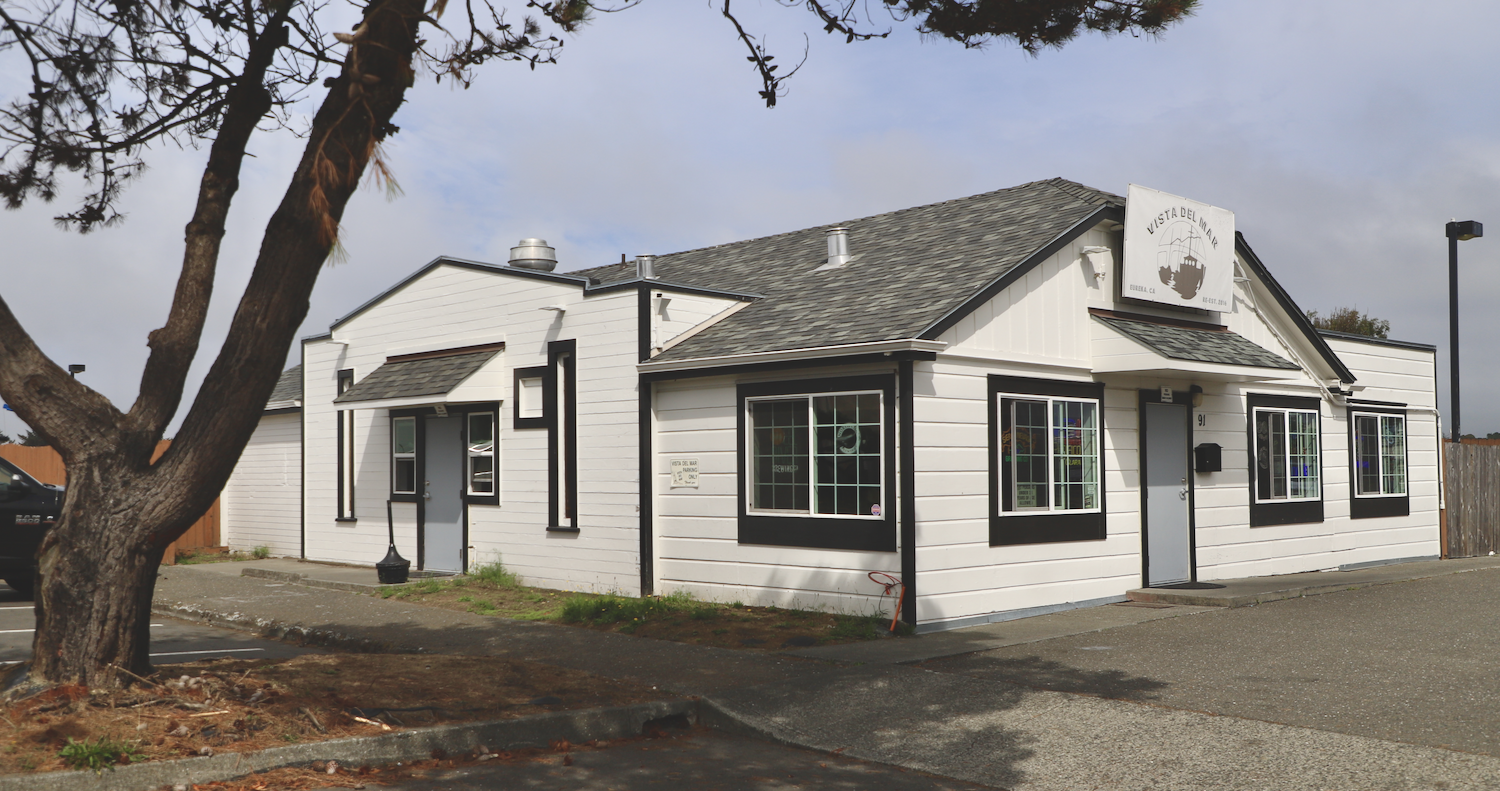
The humble building that’s currently home to the Vista del Mar has served as a haven for fishermen and other workers on the city’s industrial waterfront since the early 1900s. | Photos by Andrew Goff.
###
The owner of Eureka’s Vista del Mar, a dockside restaurant and bar at the intersection of Waterfront Drive and Commercial Street, is not very happy with the City of Eureka right now.
Kito Vorobik, who purchased the blue-collar watering hole in December of 2016, took to the internet yesterday to launch a change.org petition lambasting the city over plans to install an above-ground fuel storage tank along the western fence line behind his establishment.
“[M]y business is facing a significant threat that could not only affect my livelihood but also pose serious risks to the safety and well-being of our neighborhood,” his petition states.
Reached by phone, Vorobik said he was notified by city staff in June about plans to remove a big underground fuel tank near his property and replace it with an above-ground tank that will eliminate a handful of parking spots often used by his customers.
“I’m mainly concerned about my property value and what I could maybe do with the property in the future,” he said, though he also noted that his property line encompasses only the footprint of the restaurant, plus a four-foot setback.
His petition, which had gathered 51 signatures as of this writing, also cites environmental and public safety concerns and says the city should have given him more notice.

On Thursday, contractors had spray-painted dotted lines describing the construction boundary for a new fuel storage tank, which will be enclosed by a chain-link fence.
###
Eureka City Manager Miles Slattery told the Outpost that state law requires the city to remove any and all single-walled underground storage tanks before the end of the year and replace them with above-ground double containment systems. There’s a tank buried near the Vista that’s been there since the 1950s or ‘60s. It stores fuel for the local commercial and recreational fishing fleets.
“It’s the only fuel we have on Humboldt Bay … ,” Slattery said, adding, “[This location] has been an active commercial fishing dock since before ‘the V.D.’ [Vista del Mar] went in,” 120-odd years ago.
The city plans to install a new 25,000-gallon fuel storage tank (with 20,000 gallons of storage for diesel and 5,000 gallons of storage for regular) that will be enclosed under a covered structure that’s 12 to 13 feet tall, counting the foundation, with a catwalk around the top of the tank for maintenance purposes. The structure will also be surrounded by a fence of vinyl-coated chain link.
Slattery said the city gave Vorobik plenty of notice about these plans and has offered to work with him, even agreeing to build a fence or screen of some kind.
But the bottom line, he said, is that this location makes the most sense because, not only is it zoned properly, with all of the necessary permits, but it’s also directly adjacent to the underground plumbing that supplies fuel to the dispensing hardware at the dock. The city put the removal project out for bids and will soon put the new tank installation project out for bids.
Slattery noted that there will be no open-air fueling near the restaurant, and he argued that the new tank will actually eliminate environmental risks inherent with the existing underground setup. He added that all the other parking spots surrounding the Vista del Mar, including a large lot on the east side of the building, are on city-owned property, meaning parking for Vorobik’s business is effectively being subsidized by taxpayers.
More to the point, the infrastructure is necessary.
“We have to do this,” the city manager said. “The viability of our commercial fleet definitely takes precedence.”

A sign by the side door of the Vista del Mar says parking is for customers only.
###
Vorobik said he doesn’t expect his online petition to actually prevent the city from moving ahead with its plans. But he pointed out that the law requiring the city to install this above-ground tank was passed more than a decade ago, giving Eureka plenty of time for more public engagement and exploring other possible solutions. He’s annoyed that this is all happening at the last minute.
“This is just typical City of Eureka,” he said. “They just don’t give a shit about local businesses.”
In the Outpost’s phone conversation with Slattery, he said to pass along the message to Vorobik that the city is still willing to work with him, and he added, “Tell Kito I’ll still come and get his fish tacos, ‘cause they’re delicious.”
When we passed this along to Vorobik, he was nonplussed. He offered a concise reply: “Eureka, do better.”

BOOKED
Today: 8 felonies, 13 misdemeanors, 0 infractions
JUDGED
Humboldt County Superior Court Calendar: Today
CHP REPORTS
Briceland Thorn Rd / Twin Creeks Rd (HM office): Trfc Collision-Unkn Inj
ELSEWHERE
RHBB: Snow Safety and Recreation Info from HCSO
RHBB: Breaking News: Fourth Day of River Search Brings New Development in Case of Missing Covelo Couple
KINS’s Talk Shop: Talkshop February 20th, 2026 – Amy Nilsen
Governor’s Office: Governor Newsom launches new state investment and philanthropic collaboration to continue supporting families under federal assault
(UPDATE) Another Large Earthquake Shakes Russia; No Tsunami Threat to West Coast States
Isabella Vanderheiden / Thursday, Sept. 18, 2025 @ 12:53 p.m. / Earthquake
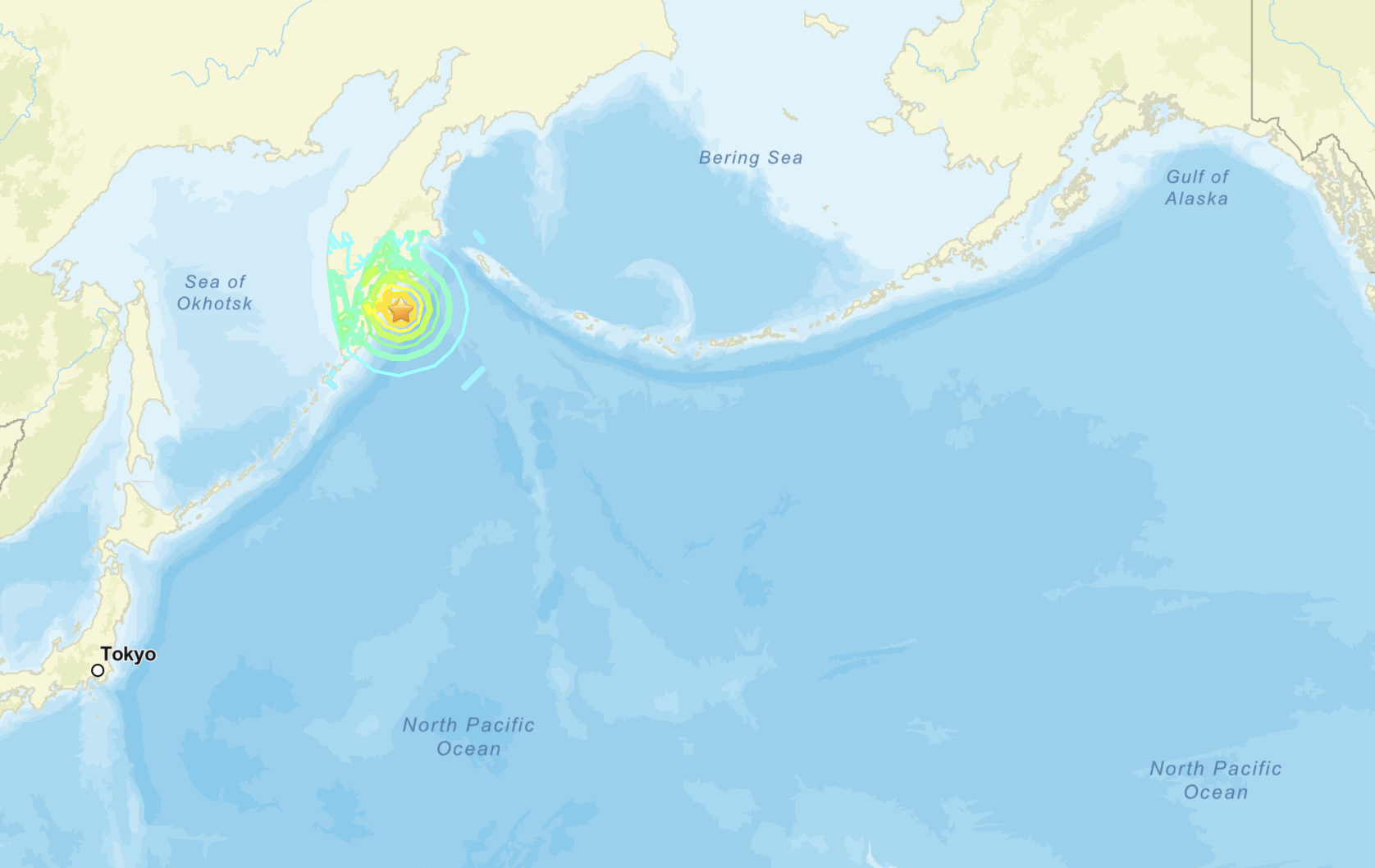
Map: United States Geological Survey (USGS)
###
UPDATE 1:15 PM: There is no tsunami threat to the West Coast, according to the U.S. Tsunami Warning Center.
Original post: A magnitude 7.8 earthquake struck off the coast of Russia’s Kamchatka Peninsula shortly after 12 p.m. PDT. As of this writing, “potential impacts to the West Coast of the United States are still being evaluated,” according to the Humboldt County Office of Emergency Services.
The U.S. Tsunami Warning Center reports a tsunami advisory for Amchitka Pass, Alaska, and a tsunami threat to Hawaii. There are no additional threats reported at this time.
We’ll update this post when we receive additional information.
###

Graphic: National Tsunami Warning Center
Armed Man Arrested at Arcata City Council Meeting Last Night
Dezmond Remington / Thursday, Sept. 18, 2025 @ 11:49 a.m. / Crime

Shaine Haugen standing in front of the council before he was arrested. Screenshot from the YouTube stream of the meeting, which cut out during the incident.
This article has been updated to include new information from the Arcata Police Department.
A man rushed the city councilmembers at last night’s meeting of the Arcata City Council before being tackled by city manager Merritt Perry and a police officer.
The man, Shaine Haugen from Fresno, was arrested on counts of assault and battery, possession of pepper spray and a butterfly knife, resisting arrest, public intoxication, and using violent means to “deter or prevent an executive officer from performing any duty imposed upon such officer by law.”
Haugen walked into the city council meeting around the time the first public comment period started at 6:30, cradling a package wrapped in a towel: a fake molotov cocktail made from a 40 ounce bottle of malt liquor with a piece of paper stuffed in it, according to several witnesses. He also had the butt of a foam-dart shooting NERF gun sticking out of vest over his left breast, painted black to look like an actual firearm.
A police officer in the audience intercepted him and took the fake molotov away from him, but didn’t stop him before he attempted to rush up the stairs towards the councilmembers on the left side of the dais. Perry stopped him and threw him on the ground before he made it all the way up, holding Haugen there for a second before the officer subdued and arrested him. Booking records show he had pepper spray and a switchblade.
The city council resumed the meeting as normal after about 10 minutes and worked their way through the rest of the agenda.
Haugen, 36, has an extensive rap sheet. He was sentenced to a five year prison term for unlawfully driving away an automobile in Michigan in 2015, and in 2011 was charged for possession of a controlled substance in California.
Haugen’s motives are unknown, but according to Perry was at the city council meeting in August where public commenters spent hours berating councilmembers for the city’s approach to the homeless and Gaza.
City council meetings in the future might have increased security measures, such as metal detector wands and an increased police presence.
Mayor Alex Stillman said in an email to the Outpost this morning that she was “concerned about civility everywhere.”
“It’s just really disappointing, the way the world is going,” Perry said in a phone interview with the Outpost this morning. “In the past, when you saw incidents happen, people would try to unite the country, but I think you see people trying to divide the country on both sides.”
Avelo Bails Early: Airline’s Last Flight to Burbank Will Be Next Month, Not December 2 as Previously Planned
LoCO Staff / Thursday, Sept. 18, 2025 @ 9:34 a.m. / Airport

Photo via Avelo.
PREVIOUSLY
- Soon You Will be Able to Fly to Burbank Any Day of the Week You Like, Provided That Day is Not Tuesday or Saturday, County Announces
- (UPDATE) Avelo Airlines to Launch ICE-Led Deportation Flights Out of Arizona (But Not California, the Company Says)
- Protest Against Avelo Airlines Set for Saturday in Arcata
- ‘Tell Avelo to Go to Hell’: Eureka Residents Applaud City Council Decision to Boycott Airline Over ICE Deportation Flights
- BREAKING: Avelo Airlines is Leaving Humboldt County, Closing Its Base in Burbank
###
Press release from the County of Humboldt:
Avelo Airlines has informed Humboldt County officials that they will discontinue service between the California Redwood Coast-Humboldt County Airport (ACV) and the Hollywood Burbank Airport (BUR) earlier than expected.
In July 2025, Avelo announced that service from ACV to BUR would be discontinued in December because they will be closing their base at the Hollywood Burbank Airport to focus on their east coast operations.
Avelo has now informed the county that its last flights between ACV and BUR will now end Monday, Oct. 20. Travelers will be notified about the changes to their flight reservations and refund options. Avelo customers should visit aveloair.com or call 346-616-9500 if they are in need of customer support.
United Airlines will continue to offer flights out of ACV to Los Angeles, San Francisco and Denver.
Beginning March 12, 2026, Breeze Airways will offer new nonstop air service between ACV to BUR and connecting service to Provo Airport (PVU). Flights are scheduled to run Tuesdays, Thursdays and Sundays. Travelers can book their flights on Breeze Airways now at FlyBreeze.com.
The County of Humboldt continues to prioritize recruiting new air service providers to meet the region’s growing travel needs. The Department of Aviation, in partnership with the County Administrative Office’s Economic Development Division, is actively working with carriers to expand flight options, including northbound routes.
“Humboldt County is a unique destination with so much to offer travelers,” said Second District Supervisor and Board Chair Michelle Bushnell. “Our commitment to meeting the needs of our community and visitors by exploring new destinations and expanding flight options at ACV is ongoing.”
For more information on the California Redwood Coast-Humboldt County Airport and the Humboldt County Department of Aviation, please visit FlyACV.com.
Striking Northcoast Environmental Center Staff Issue Statement
LoCO Staff / Thursday, Sept. 18, 2025 @ 8:16 a.m. / Activism
PREVIOUSLY:
###
The following is a statement issued by the striking Northcoast Environmental Center staff:
It is unsurprising yet still deeply disappointing that we have been compelled to respond to further disparagement at the hands of people who have rejected our every attempt to engage in good faith.
On Record:
As reflected in the meeting minutes of Northcoast Environmental Center’s Board Meeting on October 17, 2024:
Larry Glass motioned to give staff the green light to move forward with the Co-Directorship model with a year-long trial with quarterly reviews. Scott Sway seconded the motion.
The vote passed with no “nays”.
In a recent article in the Lost Coast Outpost, an NEC Board member misremembered (and thus, misrepresented) the vote that created the Co-Directorship.
In another part of the article, Larry Glass claims 20 people have cancelled their subscriptions in response to a City Council meeting late July. As of the decision to strike on Monday, September 15, 2025, only one individual contacted NEC subscription services to unsubscribe from EcoNews in response to that meeting — an individual who was not a member at the time of her email to EcoNews.
EcoNews subscription services is able to confirm, however, that as of the decision to strike, at least 3 new members have subscribed since the July and August City Council meetings.
Why Strike?: Working Conditions and Long-term Concern
Issues around fact and memory — who said what when, what procedures around the office are, what the bylaws are, who has authority, what agreements are made… All these are factors in our decision to unionize and to strike.
Leading up to the staff decision to strike, we had made many attempts toward good faith conversation. These attempts were ignored or framed as refusals to engage. Any gesture that asserted the weight of our collective workplace condition and solidarity was regarded as hostile.
Much of our collective work conditions and strain centers around precisely how we are treated, spoken to, how Board meetings operate, and the role of memory and knowledge. It is not simply that we feel unappreciated, rather, we feel unappreciated because Board meetings are repeated corrections of inaccurate statements regarding funding sources, the percentage of funding deriving from grants, whether memberships are increasing or decreasing, and many other efforts to micromanage the staff without having a working or accurate knowledge of the operational flow of the organization. Further, miscommunication amongst Board members often resulted in Board members screaming at each other or at staff, frequent interruptions, disrespectful remarks, and all manner of unprofessional behavior.
Staff are accustomed to receiving panicked phone calls and unreasonable demands at all hours of the night. We are then accused of not making ourselves (part-time employees) much more available. At times we call Board members to address panicked accusations of organizational failure, and Board members don’t recall that they reached out in the first place.
The Staff pushed for the Co-Directorship to reduce the weight of such encounters landing on a single director’s isolated shoulders. We endeavored to guarantee that no single staff member would have to face the chaos, disrespect, and unprofessionalism of the Board alone.
The two employees targeted for discipline recently stood in shock as Larry Glass stated that he had recruited the previous Executive Director to the position so that “she could take the blame from the Board, but I [Larry] would still run the org.”
Several years ago, the NEC hired a consultant to evaluate the Board and its development.
In the final report, Board members said much of the same about the staff then, as we hear in more recent Board meetings today — reflections of a Board so unaware of the actual labors involved, they ask for tasks that the staff already regularly worked on. Staff from that time have their own reflections also recorded in the document — their fury at being mistreated and unappreciated, as well as frustration that the Board seemed to not hear any staff or consultant feedback at all.
Apparently, the Board did not need to be developed.
One staff member commented, “Whoever said we’re not doing real work, f*ck you.”
Current staff face the same accusation of our work not being legitimate, but it is now framed as “fake” environmentalism. Environmental justice is now the scapegoat for a systemic crisis within the organization that predates all current staff members.
Disciplinary Whiplash: Inconsistency a breaking point for staff
In a recent conversation with one of the targeted employees, Larry explicitly stated that the org had been sued previously for failing to conduct fair workplace disciplinary procedures.
This did not surprise the staff to learn, as multiple staff members had already had the supposedly “private” disciplinary proceedings of the targeted individuals discussed (unprompted by staff) during multiple conversations at various times — sometimes during unsolicited phone calls occurring as late as ten at night.
While staff were told via one channel that we shall be punished “privately” with no witnesses to the ever-shifting disciplinary process, Board members are apparently at liberty to discuss their personal emotions, demands, and hopes for disciplinary outcomes to staff members at random.
One targeted staff member was contacted after-hours to be told that the Mayor had complained about a rowdy City Council meeting and identified staff by name. The staff member was reassured that their activity was protected, private political activity, but the staff member was also immediately pressured to remain silent about the Mayor’s effort to punish them.
It is of note that neither targeted staff members identified themselves at the Council Meeting by name, nor their employer, nor was there anything occurring to indicate that they were present as environmentalists (they were present as humanitarian activists). The staff member was initially told that it was very clear that no one was under the impression that individuals were there to represent the NEC.
Later, these assurances would be walked back by Board members to conveniently justify punishment. Staff would be told that we were no longer allowed to appear in public in any manner that people might find somehow offensive. Staff were warned away from public political participation.
The efforts to guarantee disciplinary proceedings are witnessed are in response to contradictory instructions from multiple Board members. At first, the President provided one pathway of conversation. This offering was later discounted by the Board Secretary as surprising stating, “I don’t know where she even got that plan from!”
Later it would seem Board members were conversing or making organizational decisions without alerting the Staff — who retain a bylaws enumerated seat on the Board. Staff would later be informed that Larry Glass was the new Editor-in-Chief of EcoNews and that all content would be reviewed and approved by him alone.
At times, the Executive Committee would send out communications claiming to represent the Board, yet only listing the names of Personnel or Executive Committee members, adding to further confusion about communication origins.
Once again, we state emphatically, that our efforts toward collectivity have been to consolidate lines of communication, increase procedural transparency, and to protect our fellow workers from unfair and retributive actions.
Solidarity Forever!
While the Board and Executive Committee waffled on disciplinary procedures, the Staff has remained consistent in our assertion that all our rights to public engagement are under threat.
Further, we continue to assert that the independence and variety of voice is key to a free press, and we feel strongly that politicians should not be able to exert downward pressure on the employment of political activists. We are firm and united on these points.
To be clear, NEC Staff loves working on and printing EcoNews. We have opposed removal of Member Groups who disagree with our analysis or the analysis of Executive Committee members.
The Staff has emphasized the value of a complex and various publication. We love printing a full spectrum of ecologically oriented voices. As voices who are not often listened to in the environmentalist world, we are honored to steward a rich ecology of environmental critique.
Judi Bari herself was a labor organizer, a feminist, and a staunch anti-capitalist who was attacked for her disruptive, passionate politic. Sid Dominitz frequently wrote about incarcerated people of color in EcoNews articles, and Tim McKay wrote strong truths about freedom from social inequalities being bound up with the freedom of the forests.
We see ourselves on the path set out by the Northcoast Environmental Center’s mission, “to promote understanding of the relations between people and the biosphere.”
There are many environmental voices and memories we are honored to steward, and we align ourselves with that rich history that recognizes human suffering as fundamentally bound up with the destruction of the Earth. We do not believe, as some who seek to silence us claim, that this is an “extreme” or “radical” view.
We see this connection merely as tradition, and a deeply old one at that.
We remain in good faith and hope that others value this old way still.
In good faith and solidarity with workers everywhere,
The Staff of the Northcoast Environmental Center
instagram: @necstrike
California Releases Its Own Vaccine Recommendations as RFK Shifts Federal Policy
Ana B. Ibarra and Kristen Hwang / Thursday, Sept. 18, 2025 @ 7:51 a.m. / Sacramento

Amaya Palestino, 6, receives a COVID-19 vaccine at one of St. John’s Well Child and Family Center mobile health clinics in Los Angeles on March 16, 2022. Photo by Alisha Jucevic for CalMatters
###
This story was originally published by CalMatters. Sign up for their newsletters.
###
In anticipation of restrictive federal immunization rules, state health officials issued their own vaccination guidelines on Wednesday, recommending that all Californians 6 months and older who want protection from the COVID-19 virus get this season’s updated vaccine.
Gov. Gavin Newsom and state health officials released the recommendations as part of the state’s newly formed health alliance with Oregon, Washington and Hawaii. Leading medical organizations, including the American Academy of Pediatrics and the American College of Obstetricians and Gynecologists, informed the recommendations, according to the state’s announcement. Simultaneously, Newsom signed Assembly Bill 144, which among several things, requires insurance plans to cover the vaccines the state endorses.
“We are here to protect our communities,” Dr. Erica Pan, director of the California Department of Public Health, told CalMatters. “Many of us have dedicated our lives to doing that. We feel really strongly and want to show our unity” as medical, scientific and public health experts.
Pharmacies across the country started dispensing the vaccine in recent weeks, but anecdotes and news reports reveal a patchwork of access, with some people having no difficulty getting the shot, while others still unable to get it.
Last month, the U.S. Food and Drug Administration approved the use of an updated COVID-19 vaccine but only for seniors and for people ages 5 to 64 who have an underlying condition that puts them at high risk for complications from a COVID-19 infection. This is more restrictive than in previous years, when the federal drug agency approved the vaccine for nearly everyone. Leading medical groups and some states immediately pushed back on the agency’s decision.
California’s guidance comes just two days ahead of a key meeting where a federal vaccine panel will review the updated COVID-19 vaccine. Public health experts anticipate this panel will restrict access to the vaccine.
That’s because U.S. Health and Human Services Secretary Robert F. Kennedy, Jr. who is, known for anti-vaccine activism, in June dismissed all 17 members of this panel known as the Advisory Committee on Immunization Practices at the U.S. Centers for Disease Control. He replaced them with 12 new members, some of whom are documented vaccine skeptics.
Typically, after the FDA approves a vaccine for use, this federal committee makes recommendations on who should be immunized. In the past, insurers have based their vaccine coverage on the guidelines issued by this group.
Pan said California’s actions are necessary because the committee’s credibility has been “compromised”. Now with the state’s separate guidance, the CDC group’s recommendations will carry no weight for Californians.
“Whatever comes out of [this committee], our new law is independent of that,” Pan said.
Easier access under state rules
The new law accompanying the state’s independent guidance ensures that most Californians will be able to get a COVID-19 vaccine, including young children, pregnant people and those without underlying medical conditions, said Dorit Reiss, a professor at UC Law San Francisco and an expert on vaccine law. That’s in part because it allows pharmacists to independently prescribe and administer the shot so long as the state health department recommends it.
Many people rely on pharmacies for seasonal vaccines like the flu shot and COVID-19 booster, Reiss said. Now if somebody who does not meet the more narrow federal guidelines goes to a CVS or Walgreens they won’t need a separate doctor’s prescription.
The law also grants the state health department broad authority over other vaccine policies. Many of the state’s immunization laws, including school vaccine schedules, insurance requirements and prescriber authorization, had also been tied to recommendations made by the CDC advisory committee. The state health department’s recommendations now take precedence.
Under these new policies, the department will be able to respond to future threats to vaccine availability and access, Pan said.
“We do anticipate there may be other issues that we would like to be unified on again,” she added.
It also comes amid reports that Kennedy intends to change the childhood vaccine schedule.
Pan said California and the other states in the alliance will base immunization recommendations on the work done by “trusted medical groups” that have independently assessed vaccine safety for years.
Insurers to cover state-endorsed vaccines
Most Californians have insurance through state-regulated health plans, which now must cover the updated COVID-19 shot without copays. The new law also requires Medi-Cal, the state run insurance program for low-income residents and people with disabilities, to cover the COVID-19 shot and other vaccines recommended by the state health department.
Mary Ellen Grant, a spokesperson for the California Association of Health Plans, said the state’s policy changes “will greatly reduce the amount of confusion” among patients and ensure they have access to vaccinations.
About 5.4 million Californians have insurance that is subject to federal regulations rather than state ones. Generally, these are people who work for large, multi-state or multinational companies. Nationally, insurers have been hesitant to make statements about vaccine coverage ahead of the CDC’s vaccine advisory committee, leaving coverage for people with federally regulated plans uncertain.
Still, Reiss said, she expects insurers to continue covering vaccines regardless of future changes made by the CDC’s advisory committee. It’s much cheaper for insurers to pay for vaccines than it is for them to pay for treatment of the diseases they prevent.
The state’s partnership with Hawaii, Oregon and Washington also creates market pressure on insurers to continue vaccine coverage, Reiss said.
“They might just say, ‘This is a big chunk of the population. We might as well have the same policy for all the country,’” she added.
Vaccines continue to be key protection
The rollout of this year’s vaccine is coinciding with a moderate surge in COVID-19 infections. Data from the California Department of Public Health show that cases have been ticking up since July. As of Sept. 6, 11.72% of samples sent in for testing were positive, slightly higher than this time last year.
Public health officials say the best way to stay healthy this fall and winter is to get vaccinated.
In addition to the COVID-19 vaccine, California’s immunization guidance also recommends that everyone 6 months and oldAmaya Palestino, 6, receives a COVID-19 vaccine at one of St. John’s Well Child and Family Center mobile health clinics in Los Angeles on March 16, 2022. Photo by Alisha Jucevic for CalMatters er get a flu shot. The vaccine to protect against Respiratory Syncytial Virus, or RSV, is recommended for all babies younger than 8 months and for babies between 8 months and 19 months if they carry risk factors. The RSV vaccine is also recommended for pregnant women at 32 weeks to 36 weeks of gestation and for all seniors 75 and older, as well as for those ages 50 to 74 with comorbidities.
“If we want to make America healthy, rather than treating disease, we want to prevent disease, and well, vaccination is one of the best creations to prevent disease,” said. Dr. Jeffrey Silvers, an infectious disease specialist at Sutter Health. “It’s right up there with clean water in terms of preventing disease.”
###
Supported by the California Health Care Foundation (CHCF), which works to ensure that people have access to the care they need, when they need it, at a price they can afford. Visit www.chcf.org to learn more.
These Rural Californians Want to Secede. Newsom’s Maps Would Pair Them With Bay Area Liberals
Jeanne Kuang / Thursday, Sept. 18, 2025 @ 7:48 a.m. / Sacramento

A barn in rural Modoc County on Sept. 4, 2025. Photo by Miguel Gutierrez Jr., CalMatters
###
This story was originally published by CalMatters. Sign up for their newsletters.
###
Over several rivers and through even more woods, flags advocating secession from California flutter above hills dotted with cattle, which outnumber people at least sixfold.
This ranching region with a libertarian streak might have more in common with Texas than the San Francisco Bay Area.
But it’s not Texas. Five hours northeast of Sacramento on an easy day, Modoc County and its roughly 8,500 residents are still — begrudgingly — in California.
And California is dominated by Democrats, who are embroiled in a tit-for-tat redistricting war with the Lone Star State that will likely force conservative Modoc County residents to share a representative in Congress with parts of the Bay Area.
Democratic Gov. Gavin Newsom is proposing to split up the solidly Republican 1st Congressional District covering 10 rural, inland counties in the North State as part of his plan to create five more Democratic seats to offset a GOP-led effort to gain five red seats in Texas.
That would mean Republican Doug LaMalfa, the Richvale rice farmer who represents the district, would likely lose his seat.
Modoc County and two neighboring red counties would be shifted into a redrawn district that stretches 200 miles west to the Pacific Coast and then south, through redwoods and weed farms, to include some of the state’s wealthiest communities, current Democratic Rep. Jared Huffman’s home in San Rafael and the northern end of the Golden Gate Bridge, all in uber-liberal Marin County.
“It’s like a smack in the face,” said local rancher Amie Martinez. “How could you put Marin County with Modoc County? It’s just a different perspective.”

Amie Martinez at the Brass Rail Bar & Grill in Alturas on Sept. 3, 2025. Photo by Miguel Gutierrez Jr., CalMatters
The proposal would even likely force Modoc residents to share a district with the governor, who moved back to Marin County last year and splits his time between there and Sacramento. Modoc County voted 78% in favor of recalling him, and voters asked about redistricting there view it as a publicity stunt for Newsom’s presidential ambitions.
The ballot measure known as Proposition 50, on voters’ ballots Nov. 4, has sparked outrage in the North State. Yet for a region known for its rebellious spirit, residents are also resigned: they know they’re collateral damage in a partisan numbers game.
The map would dilute conservative voting power in one of the state’s traditional Republican strongholds. It would cut short the career growth of politicians from the state’s minority party and make room for the growing cadre of Democrats rising up from state and county seats, jockeying for bigger platforms.
But locals say they’re most concerned it’s a death-knell for rural representation. They worry their agricultural interests and their views on water, wildlife and forest management would be overshadowed in a district that includes Bay Area communities that have long championed environmental protection.
“They’ve taken every rural district and made it an urban district,” said Nadine Bailey, a former staffer for a Republican state senator who now advocates for agricultural water users and the rural North State. “It just feels like an assault on rural California.”
Though Modoc County supervisors have declared their opposition to Prop. 50, there’s little else locals can do. Registered Republicans are outnumbered by Democrats statewide nearly two-to-one. Rural residents represent an even smaller share of the state’s electorate.
“It’ll be very hard to fight back,” said Tim Babcock, owner of a general store in Lassen County, a similar and neighboring community that’s proposed to be drawn into a different liberal-leaning congressional district. “Unless we split the state. And that’s never going to happen.”
An isolated county
Far-flung but tight-knit, the high desert of Modoc County has been an agricultural community for generations.
In the west, cattle graze through a series of meadows and valleys into the hills of the Warner Mountains. Hundreds of them are sold weekly at an auction yard Martinez’s family runs on the outskirts of Alturas. The 3,000-person county seat consists of a cluster of government buildings, a high school and empty storefronts. In the east, migratory birds soar over vegetable farms on the drained Tule Lake bed that the U.S. granted to World War II veteran homesteaders by picking names out of a pickle jar. Not far away sit the remains of an internment camp where the government imprisoned nearly 19,000 Japanese Americans.
The sheer remoteness and harsh natural beauty are a point of pride and a source of difficulty. Residents live with the regular threat of wildfires. A fifth of the county’s residents live below the poverty line. There’s no WalMart and no maternity ward, and there are few jobs outside of agriculture. Like other forested counties, local schools are facing a fiscal cliff after Congress failed to renew a source of federal funding reserved for areas with declining timber revenues.

Cattle graze on farmland in Modoc County on Sept. 4, 2025. Photo by Miguel Gutierrez Jr., CalMatters


First: Businesses in downtown Alturas, on Sept. 4, 2025. Alturas, in Modoc County, is one of the communities that would be affected by the current redistricting efforts led by state Democrats. Last: Historical structures at the Tule Lake Relocation Center in Newell on Sept. 4, 2025. The Tule Lake Relocation Center was a concentration camp established during World War II by the U.S. government for the incarceration of Japanese Americans. Photos by Miguel Gutierrez Jr., CalMatters
It’s so sparsely populated that local Republican Assemblymember Heather Hadwick, who lives in Modoc County, represents 10 neighboring counties besides her own. She puts in hundreds of miles on the road holding town halls between Sacramento and home, and struggles to imagine a congressmember reaching her county, with winding roads and the Klamath Mountains between Modoc and the coast.
“It’s just not good governance,” she said.
Modoc County went for Trump by over 70% last fall. Its sheriff, Tex Dowdy, proudly refuses to fly the California flag over his station out of grievance with the state’s liberal governance. In 2013, Modoc made headlines for declaring its intent to secede from California and form the “State of Jefferson” with neighboring counties in the North State and southwest Oregon.
County Supervisor Geri Byrne said she knew it was a longshot — but thought, “when’s the last time The New York Times called someone in Modoc County?”
Byrne, who is also chair of the Rural County Representatives of California and of the upcoming National Sheepdog Finals, said the secession resolution was about sending a message.
“It wasn’t conservative-liberal,” she said. “It was the urban-rural divide, and that’s what this whole Prop. 50 is about.”
Even a Democratic resident running a produce pickup center in Alturas observed that her neighbors are “not that Trumpy.” Instead, there’s a pervasive general distrust of politics on any side of the aisle.
In particular, residents who live by swaths of national forests bemoan how successive federal administrations of both parties have flip-flopped on how to manage public lands, which they say have worsened the risk of wildfire and prioritized conservation over their livelihoods.
Flourishing wolves are a problem
At the moment, all anyone can talk about is the wolves.
The apex predator returned to California more than a decade ago, a celebrated conservation success story after they were hunted to near-extinction in the western U.S. Now they’re flourishing in the North State — and feeding on cattle, throwing ranching communities on edge. Federally, they’re still listed as an endangered species under the landmark conservation law signed by President Richard Nixon.
Under California rules, ranchers can only use nonlethal methods to deter the wolves, like electrifying fencing or hiring ranch hands to guard their herds at night.


First: Signs related to wolves hang on a trailer in Lassen County, near Nubieber, on Sept. 3, 2025. The gray wolf population has grown in Northern California, causing tension between local residents and animal protection advocates. Last: Teri Brown, owner of Modoc Farm Supply, at her store in Alturas, on Sept. 4, 2025. Alturas, in Modoc County, is one of the communities that would be affected by the current redistricting efforts led by Democrats. Photos by Miguel Gutierrez Jr., CalMatters
“That whole issue is softened by the organizations that mean well for the animals, but this is our absolute existence here,” said Teri Brown, owner of a local feed store, who said she’s had cows go missing that she suspects were killed by wolves.
It’s one of the rural issues Brown, a registered Republican, said voters closer to the Bay Area wouldn’t understand. She said she doesn’t support gerrymandering anywhere — in Texas or California.
In town to visit his bookkeeper, rancher Ray Anklin scrolled through his phone to show videos of wolves trotting through his property and grisly photos of calf kills. He said last year, wildlife killed 19 of his cattle — a loss of over $3,000 per head. He’s set up a booth at a nearby fair, hoping to get public support for delisting wolves as an endangered species, and wants any representative in Congress to take the issue seriously.
As California’s battlegrounds increasingly take shape in exurban and suburban districts, rural North State conservatives at times feel almost as out of touch with their fellow Republicans as they do with Democrats.
Few Republicans in the state and nation understand “public lands districts,” said Modoc County Supervisor Shane Starr, a Republican who used to work in LaMalfa’s office. “Doug’s the closest thing we’ve got.”

Modoc County Supervisor Shane Starr at the Hotel Niles in Alturas on Sept. 4, 2025. Photo by Miguel Gutierrez Jr., CalMatters
“This whole thing with DEI and ‘woke culture’ and stuff,” he said, referring to the diversity and inclusion efforts under attack from the right, “it’s like, yeah, we had a kid who goes to the high school who dyed his hair a certain color. Cool, we don’t care. All of these things going on at the national stage are not based in our reality whatsoever.”
At a cattlemen’s dinner in Alturas one recent evening, Martinez said she once ran into LaMalfa at a local barbecue fundraiser for firefighters and approached him about a proposal to designate parts of northwestern Nevada as protected federal wilderness. Her 700-person town of Cedarville in east Modoc County is 10 minutes from the state line.
Martinez worried about rules that prohibit driving motorized vehicles in wilderness, which she said would discourage the hunters who pass through during deer season and book lodging in town. Even though the proposal was in Nevada, LaMalfa sent staff, including Starr, to meetings to raise objections on behalf of the small town, she said.
“I know we won’t get that kind of representation from Marin County,” she said.
Reached by phone, Huffman defended his qualifications to represent the region.
Adding Siskiyou, Shasta and Modoc counties would mean many more hours of travel to meet constituents, but Huffman pointed out his district is already huge, covering 350 miles of the North Coast. And it includes many conservative-leaning, forested areas in Trinity and Del Norte counties. A former attorney for the environmental group Natural Resources Defense Council, he’s the top Democrat on the House Natural Resources Committee, where LaMalfa also sits.

Emma Harris holds a belt buckle she was awarded as a prize for winning a branding competition, at the Brass Rail Bar & Grill on Sept. 3, 2025. Photo by Miguel Gutierrez Jr., CalMatters


First: A mural depicts a cowboy riding Red Rock the famous bucking bull in Alturas, on Sept. 4, 2025. Last: Ranchers chat during a cattlemen’s meeting at the Brass Rail Bar & Grill in Alturas on Sept. 3, 2025. Photos by Miguel Gutierrez Jr., CalMatters
Huffman said he would run for re-election in the district if voters approve its redrawing, and “would work my tail off to give them great representation.”
As for the wolves, he doesn’t support delisting their endangered status and said he only supports nonlethal methods of managing the population.
“There are plenty of win-win solutions,” he said of conflict between ranchers and environmentalists. “I’m not an absolutist. I’m a problem solver.”
For Democrats, ‘I don’t think there’s any option’
On the other side of the aisle, North State Democrats are gearing up to support Prop. 50, even as parts of it make them uneasy.
Nancy Richardson, an office manager at the free weekly paper in Modoc County (coverage of high school sports remains steady, along with a police blotter announcing a woman’s booking for eavesdropping), said she doesn’t like that it will cost the state as much as $280 million to run the statewide election on redistricting.
But she thinks it has to be done.
“I don’t like that Texas is causing this problem,” she said.
In Siskiyou County’s liberal enclave of Mt. Shasta, Greg Dinger said he supports the redistricting plan because he wants to fight back against the Trump administration’s targeting of immigrants, erosion of democratic norms and a federal budget that is estimated to cut $28 billion from health care in California over the next 10 years.
The effects are expected to be particularly acute in struggling rural hospitals, which disproportionately rely on Medicare and Medicaid funding. LaMalfa voted for the budget bill.
Dinger, who owns a web development company, said normally he would only support bipartisan redistricting. But he was swayed by the fact that Trump had called for Republicans to draw more GOP seats in Texas.
“Under the circumstances, I don’t think there’s any option,” he said. “There’s the phrase that came from Michelle Obama, ‘When they go low, we go high.’ Well, that doesn’t work anymore.”
In an interview, LaMalfa said the impacts to rural hospitals were exaggerated. He blamed impending Medicaid cuts instead on California’s health care system being billions of dollars over budget this year, in part because of rising pharmaceutical costs and higher-than-expected enrollment of undocumented immigrants who recently became eligible. (California doesn’t use federal dollars to pay for undocumented immigrants’ coverage.)
“Basically what it boils down to is they want illegal immigrants to be getting these benefits,” he said in response to criticism of the spending bill. “Are the other 49 states supposed to pay for that?”
LaMalfa has criticized Prop. 50 and said no state should engage in partisan redistricting in the middle of the decade. But he stopped short of endorsing his Republican colleague Rep. Kevin Kiley’s bill in Congress to ban it nationwide, saying states should still retain their rights to run their own elections systems.
The proposed new maps would make Kiley’s Republican-leaning district blue. They would turn LaMalfa’s 1st District into a dramatically more liberal one that stretches into Santa Rosa.
But LaMalfa said he’s leaning toward running for re-election even if the maps pass, though he’s focused for now on campaigning against the proposition.
“I intend to give it my all no matter what the district is,” he said.
He would likely face Audrey Denney, a Chico State professor and two-time prior Democratic challenger who has already said she’d run again if the maps pass. Outgoing state Senate President Pro Tem Mike McGuire, a Healdsburg Democrat who was instrumental in coming up with the proposed new maps, is also reportedly interested in the seat; McGuire’s office did not respond to a request for comment.
In her renovated Queen Anne cottage in downtown Chico, Denney buzzed with excitement describing how the proposition has galvanized rural Democrats.
She emphasized her own family’s roots as ranchers in the Central Coast region, and said she has bipartisan relationships across the North State.

Audrey Denney at her home in Chico on Sept. 3, 2025. Denney is considering running as a Democratic candidate for U.S. Congress in Calfornia’s 1st District if voters approve the new congressional maps. Photo by Miguel Gutierrez Jr., CalMatters
“I have credibility in those spaces, growing up in rural America and spending my career advocating for rural America and real, actual, practical solutions for people,” she said.
Denney’s former campaign staffer Rylee Pedotti, a Democrat in Modoc County, shares her optimism — to an extent. A communications professional whose family also owns a ranch, she said she’s not worried Huffman couldn’t represent Modoc.
“More often than not we actually do experience some of the same issues,” Pedotti said: water and irrigation concerns, the loss of home insurance, the rising costs of health care.
Yet she’s deeply conflicted about the proposal: on the one hand cheering Democrats for being “finally ready to play hardball as the Republicans have done so well for decades in consolidating power;” on the other fearful of the escalating partisan rancor and the disenfranchisement of her neighbors. She’s considering sitting out the election.
“We’ll still be heard,” she said, if the new maps pass. “But I understand the concerns of folks who are on the other side of the aisle. It feels like their voice is being taken away.”


