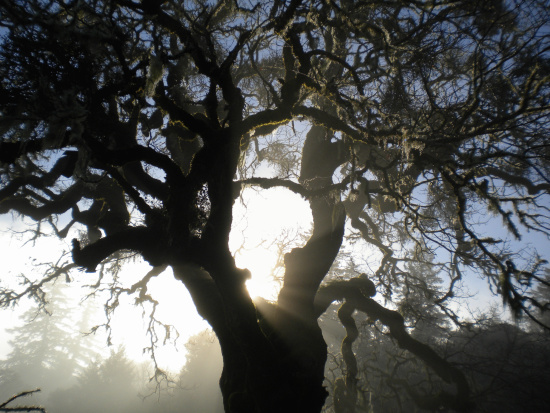
Photos in this article provided by Kyle Keegan
The following piece is a guest article by Kyle Keegan. It was first printed in Permaculture Magazine and was adapted to fit a broader audience here.
Oaks, of the genus “Quercus” are widely distributed over many of the temperate parts of Europe, Asia, North Africa and North America. Their edible nuts (acorns) were a reliable staple food for many cultures before the beginnings of agriculture. Even today, acorns are sold in the markets of Korea, China, North Africa, and in some major cities of the U.S.
Growing staple crops on marginal land has been an age old struggle. Carbohydrates, the source of metabolic energy, drive many of life’s processes, and are a basis for survival. However, most agricultural practices that rely on annual plants (grains, legumes vegetables), contribute to the destruction of fertile soils. Over-tillage, as practiced by modern farmers, results in the loss of soil carbon and soil biodiversity. In contrast, long-lived oak trees provide not only sustenance, but also stabilize soils and climate, while offering shade, shelter, fuel and medicine.
Thus, a perennial-based agriculture should be the aim for any civilization seeking solutions to the problems of excess tillage and fertilizer inputs—problems long associated with annual crops. Interestingly, some evidence suggests that annual-based agriculture may be directly related to the past mismanagement and destruction of oak woodland ecosystems worldwide.1 Remaining oak woodlands may provide the most elegant design model for a perennial polyculture in temperate North America.
Unlike corn, barley, wheat, or rice; acorn requires no tilling of the soil, and neither fertilizer inputs nor irrigation. Acorns are relatively simple to collect, store and process and provide a nutrient rich source of food for humans. The trees sequester carbon, moderate climate, build soil, stabilize hillsides and provide essential habitat for hundreds of species of animals.2 Oaks can be grown on steep or unstable land where annual crops would lead to erosion. Most species of oak can be grown on arid or semi-arid landscapes, where annual grain crops would be problematic.
The yields of acorn compare well with those of many grains; established oak woodlands have been recorded to yield up to 6,000 lbs of acorn per acre.3 Sadly, the current health of most oak woodland ecosystems is compromised due to the loss or lack of indigenous management practices (including prescribed burning). As a consequence, acorn production has declined, and crop yields have become more inconsistent.4,5,6
Acorn Nutrition
Acorn was a staple crop for most of California’s indigenous cultures. It is a rich source of carbohydrate as well as protein, essential amino acids, trace minerals and vitamins (especially A and C).
California Quercus spp. range from 3-5% protein, 4-9% fat, and 38-69% carbohydrate.7
Producing acorn flour takes time and energy but the processing time is probably less than that of a cereal crop, while the nutritional value of acorn compares favorably with wheat or barley. The quality and flavor of acorn oil is reportedly similar to olive oil,7 and the residual nut meal can be used as animal fodder after the acorns have been pressed.
What Were We Thinking?
Thirteen years after moving to our rural land, my family began to focus attention on the staple food crop that had sustained native Californians for over 10,000 years. It now seems silly that for over a decade we walked a narrow winding path through a thriving perennial polyculture (oak woodland) stepping on or over an exceptional food source (acorns) to get to our cultivated crops!
This past fall, thousands of Tan Oak (Notholithocarpus densiflorus) acorns fell on our driveway, right outside of our home. Out of respect, and with a willingness to receive the trees’ offering, we reached out to the local community for knowledge on how to process, store, and prepare acorn. At first, most of the responses we got from neighbors and old-timers regarding the use of acorn ended in comments like, “It’s too darn labor intensive!” or “They’re just too bitter!” Luckily, a close neighbor provided the inspiration and support we needed to get started.
Collecting and Cracking
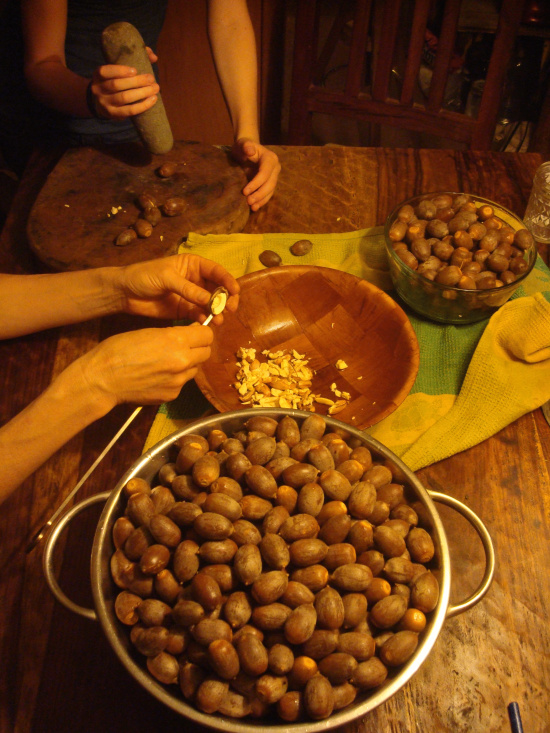
With two pairs of hands, we were able to collect 50-60 lbs. of acorns in an hour by picking them up from beneath the trees. We then dumped the acorns into a large container filled with water, (good ones sink, bad ones float). Next, we poured off the water and placed the acorns onto a large wooden board. Using a rock pestle we had found here many years ago, we cracked as many as we were able to use. Removing the hard shell, we set aside less desirable pieces for our chickens. (One might want to cover the acorns with an old towel or cloth while cracking them to keep the pieces from scattering.) Another possibility is to put handfuls of acorn on a solid piece of wood on the ground, cover them with a cloth, and then crack the nuts open with a square-bottomed soil tamper. We’ll try this technique to speed up the process next fall. A hand-cranked nutcracker reportedly works quite well for acorns.8
Leaching
After shelling the acorns, they must be leached to remove bitter tannins. To do this, we grind the acorns roughly in a blender, then put the chopped nutmeats into 1/2 gal. jars fitted with screened (sprouting) lids. We cover the nuts with cool water and keep them in a refrigerator or outside, during cold weather. We then change the water and rinse a couple of times a day for 5-7 days. As part of this process, we skim off any floating acorn skins. When the acorn meal is no longer bitter to taste (5-7 days), we dry it for storage. Any remaining acorn skins can be winnowed when the acorn has been dried.
Bitterness can be removed more quickly by pouring boiling water over the acorn meal a few times, but this tends to change the color of the meal and may decrease its nutritional value. We prefer the cold-water methods. Others have leached acorn meal by placing crushed acorn in a mesh or burlap bag and submerging the bag in a clean stream of moving water for some days to remove the tannins.
One of our batches was finely ground in a hand mill after chopping and drying, and then placed in a fine mesh bag used for making nut-milk and set outside in a basin of water; it froze and thawed a few times in the cold weather. When we rinsed the meal, it was the least bitter we had processed, for the least amount of effort. Grinding the acorn more finely increased the surface area for leaching; the freeze-thaw process further broke down the cell walls. We’ll experiment more with this technique in the future.
Storage and Use
After the tannins have been removed, acorn meal can be dried and stored in the refrigerator, freezer. Un-cracked acorns can be stored up to a year ( some native tribes stored them for two years or more). Be sure to do the float/sink test and cull any rotten or wormy ones first. Then dry the unshelled acorns and store in a rodent-proof bin in a cool, dark place. They can be processed as needed. Acorns can also be sprouted before processing. As with other nuts and seeds, their nutritional value increases with germination.
Acorn meal just feels right to eat. Last fall, I found myself snacking on tablespoons of raw acorn meal as I went about my fall chores. When we are ready to use our acorn, we put the roughly ground chunks through a hand-cranked grain mill, turning it into a meal or fine powder which can be incorporated into soups, breads, pie crusts, and breakfast cereals. Recipes abound for the use of acorn.9 It can also substitute partly or wholly for corn flour in recipes that call for that.
Fodder
Our chickens eat the nut meats after the shells have been cracked. We keep a covered container of acorns near our flock. When needed, we place a handful into a bucket and then use the blunt end of a cut fir pole to crush them before throwing the pieces out to the fowl. Their willingness to consume the acorn increases after the tannins have been removed, but we save the majority of processed acorn for ourselves.
Acorns can be fed to pigs and other livestock as a supplementary grain. They are a favorite food of deer, black bear, squirrels, some birds, and rodents. We pick up only what we are able to use and leave the rest for the non-human residents of the land.
A Long Lasting Perennial Polyculture
In permaculture, we create guilds of plants that are mutually beneficial in order to increase the sum of all yields, and to minimize labor and external inputs. We understand that in our designed systems, resiliency is dependent upon diversity, and that the synergy between interdependent parts forms strong bonds that can survive and adapt to changing conditions. A mature oak woodland embodies the essence of our most demanding design criteria— a resilient and long lasting foundation of complexity, reinforced by the species it supports—and is supported by.
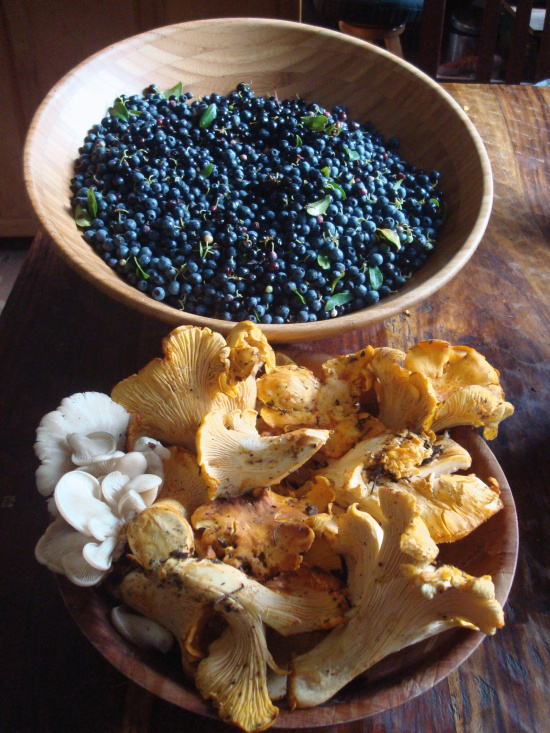
Foraging under the filtered canopy of oak woodland species such as Black Oak (Q. kellogii) and Oregon White Oak (Q. garryana), a diverse polyculture unfolds, revealing foods such as: Miner’s Lettuce(Claytonia perfoliata), Chanterelles (Cantharellus cibarius), Black Trumpets (Craterellus cornucopioides), Service Berry (Amelanchier sp.),Wild Strawberry (Fragaria vesca), numerous edible species of geophytes (perennial tubers, corms, and bulbs),and Licorice Fern (Polypodium glycyrrhiza) an edible epiphyte that grows on the mossy trunks of shady oaks. Along the woodland edges and in sunny openings we have collected: Wild Rose hips (Rosa californica), Gooseberries (Ribes sp.), Black Cap Raspberries (Rubis leucodermis), and of course if one choses, there are California Quail, Mule Deer, and Wild Turkey for the carnivorous crowd.
In our north coast region, a Tan Oak (Notholithocarpus densiflorus) polyculture can
yield: Huckleberry (Vaccinium ovatum), Thimbleberry (Rubus parviflorus), Chanterelles, Boletes (Boletus sp.), Oyster Mushrooms (Pleurotus ostreatus), Oregon Grape (Mahonia sp.), Redwood Sorrel (Oxalis sp.) and Hazelnut (Corylus cornuta). During days of wild food gathering our family is often serenaded with the songs of neotropical and resident songbirds foraging overhead on the abundance of insect biomass offered—their fertile guanos falling to the forest floor in return.
A Reintegration Revival
Ecologists use the term “trophic cascade” to explain the negative consequences of changes that stem from misunderstood linkages formed among various species within a food web. In a “top-down” induced trophic cascade, the removal of a key predator from an upper trophic level (Wolf, Grizzly Bear, Cougar) may set off a cascade of events that later unveils interdependent bonds intrinsic to the ecosystem. Species in lower feeding levels that once appeared to be disconnected to the larger predators are shown to be dependent. One such example is the extermination of the wolf in Yellowstone National Park, that later was followed by the strange disappearance of songbirds and beavers in the park’s valleys. Biologists were stumped by the troubling phenomenon until the wolves were later reintroduced; after which the birds and beavers returned. An over-simplified explanation is as follows: No wolves = lazy elk = overgrazing of riparian habitat in valleys = no willows = no birds and beavers = overall decline in ecosystem health and vibrancy.
Here on the North Coast of California and across the entire North American continent, we are experiencing symptoms of a multitude of trophic cascades that have reduced the carrying capacity of entire landscapes. Perhaps as important as the loss of key predators, is the loss of the the human connection to the landscape.
The forced removal of the indigenous peoples from their native lands has disrupted and displaced thousands of years of embedded knowledge and connection to place. This loss, coupled with modern society’s belief that “Nature is best left alone,” has caused the separation-induced stagnancy of many of our ecosystems; complicated and diverse natural communities that have co-evolved with the careful tending, harvest and propagation practiced by deeply connected human hands.
The oak woodlands, savannah and chaparral have grown lonely and we will have to face our “separation consciousness” with a reintegration revival! We should not only seek to grow food in gardens and at local farms, but also dare to venture out into what we have come to mistakenly call “wilderness” to find our place as an integral part of these systems. In order to accomplish this, we can seek out the traditional ecological knowledge of the indigenous people who once tended (and continue to tend) the land.
Our success will take the commitment of staying in the place that we chose to sink our roots into. The transient nature of our culture continues to sever the land-human connection that depends on the prolonged observation and knowledge that is passed on by the people of that particular place. In poet, Gary Snyder’s words, “Find your place on the planet, dig in, and take responsibility from there.”
Restoring and Protecting Oak Woodlands
An acorn falling from the boughs of an ancient mother oak today, comes to rest on a very different landscape than it would have centuries ago. The perennial bunch grasses that once carpeted the earth beneath the oak’s canopies have now mostly been replaced by annual grasses introduced from other lands. The “park-like” feeling described by early explorers who walked into oak woodlands kept clear for thousands of years by indigenous burning practices, are now being invaded by the succession of Douglas Fir (Pseudotsuga menziesii ). The loss and displacement of keystone predators such as Grizzly Bears and Mountain Lions may have altered the ability of woodland ecosystems to regenerate due to the unchecked proliferation of browsing deer. In California, large areas of oak woodland have been converted to monocultures for the fast growing wine industry. The introduced pathogen (Phytopthora ramorum), other wise known as Sudden Oak Death, has severely impacted species such as Tanoak, Black Oak and Coast Live Oak, altering forest composition on tens of thousands of acres of once plentiful oak dominated polycultures.10
The health and resiliency of oak woodland ecosystems are closely connected with the co-evolutionary presence of low-intensity fires. Of all of the negative impacts associated with the conversion of oak woodland habitat, the on-going suppression of fire may pose the most serious threat to their long-term survival.
The health of human cultures and oak woodland ecosystems will require a reciprocal act of reconnecting. Perhaps we can view “wildlands” more as “cultural landscapes”, a place where we can learn to recreate a new story of now that begins with re-entering our food-webs responsibly. As we strive to design more productive and accountable food production models within our communities, those of us who are fortunate enough to live in acorn territory must not forget the potential of the life giving oak.
Notes
-
Bainbridge, David A. 1986 Use of Acorns for Food: Past, Present, Future. Presented at the Symposium on Multiple-use Management of California’s Hardwoods, November 12-14, 1986, San Luis Obispo, California. Available online at www.ecocomposite.org/native/UseOfAcornsForFoodInCalifornia.doc 2. Pavlik, Bruce M., P. Muick, and S. Johnson. 1993. Oaks of California, Press, Los Olivos, CA. 3. Bainbridge, loc. Cit. 4. Anderson, M. Kat 2005. Tending the Wild: Native American Knowledge and the Management of California’s Natural Resources, University of California Press, Berkeley, CA. 5. Biswell, Harold. 1989. Prescribed Burning in California Wildlands Vegetation Management. University of California Press, Berkeley, CA. 6. Bakker, Elna. 1984. An Island Called California: An Ecological Introduction to Its Natural Communities. University of California Press, Berkeley. CA. 7. Bainbridge, loc. cit. 8. Davebilt Co., Lakeport, CA, www.davebilt.com, 707-263-5270 9. Ocean Suellen, 1993. Acorns and Eat ‘Em: A How-to Vegetarian Cookbook, Complete Directions for Harvesting, Preparing, Cooking Acorns. www.californiaoaks.org/ExtAssets/acorns_and_eatem.pdf 10. www.suddenoakdeath.org/
-
Special credit to Brock Dolman and Dennis Martinez for many fire-side conversations on this topic.
* Kyle Keegan, a life-long student and teacher of ecology and nature awareness, received his certificate in permaculture design at Occidental Arts and Ecology Center in 2008. Kyle is a market gardener, seed saver, nature historian, and stream and upland restorationist. Kyle can be contacted at: owlsperch@asis.com.
CLICK TO MANAGE