Lawmakers in blue states like California may prefer to tax the rich, but there’s always a risk: What if the rich just move elsewhere?
Last week Assemblymember Alex Lee said he was introducing a new tax on “extreme wealth.” It wasn’t the first time the Milpitas Democrat pushed the idea. But this year, he had back up.
Lawmakers from seven other states, including Connecticut, Hawaii, New York, Illinois and Washington were introducing new taxes for the rich on the same day.
“The counter argument is that the rich will just leave,” said Lee. “Well, this is kind of the strategy of ‘You can run but you can’t hide.’”
Lee’s proposal would apply to individuals with a net worth of $50 million or more, taxing their wealth at 1% annually. Wealth beyond $1 billion would be taxed at 1.5%. The tax would apply to about 23,000 households, or the wealthiest 0.1% in the state, and would raise about $21.6 billion in revenue per year, according to calculations from UC Berkeley economist Emmanuel Saez, who helped design Massachusetts Sen. Elizabeth Warren’s national wealth tax proposal and had a hand in some of the state-level proposals.
Unlike income tax, a tax on overall wealth is unprecedented in the U.S. The proposal would apply to assets including shares of privately owned companies, art and collectables, “financial assets held offshore” and more.
Even in the overwhelmingly Democratic state Legislature, the proposal is a longshot. When Lee introduced similar legislation last year, it didn’t get a first hearing, much less a vote.
That deficit, Lee said, is almost exactly the same amount that the tax is projected to raise annually.
“The top 5 percent of income earners pay 70 percent of the personal income tax. And the personal income tax is California’s biggest source of revenue,” said Robert Gutierrez, CEO of the California Taxpayers Association, which opposes the idea. “So, if even a few of those taxpayers rethink California as a place to live, that does have an impact on the (state) budget.”
But do wealthy people actually relocate when their tax bill goes up? And if they do, how large is the exodus?
Research on the subject is growing rapidly, but a clear consensus has yet to emerge, wrote Cristobal Young, a sociologist at Cornell, and Ithai Lurie, an economist at the U.S. Treasury in a recent paper.
In 2018, Charles Varner and Cristobal Young, then both at Stanford’s Center on Poverty and Inequality, worked with Allen Prohofsky at California’s Franchise Tax board, looking at decades of California tax data to figure out the impacts of several tax changes. Before and after tax increases in 2004 and 2012, they compared top earners affected by the tax increases to those just below them on the income ladder — people who still make plenty of money, but weren’t affected by the raises.
First they looked at the number of $1-million-plus- per-year earners leaving the state each year versus moving to it. Before 2004, there was a net out-migration. In the years after the 2004 tax increase, that outflow decreased, and by 2007 it flipped: More million-dollar earners were coming to California than were leaving. That persisted after another tax increase in 2012 (the data goes through 2014).
That leads to another important point: The number of million-dollar-plus earners in California each year fluctuates considerably, but people moving to the state or pulling up stakes only account for a teensy portion of the change, they found. The average number of people earning more than $1 million per year varies by about 10,000 people each year; net migration accounts for only about 50 to 120 people. The number of super-high earners California has each year, in other words, is almost entirely driven by other stuff; mostly “California residents growing into the [million-dollar-earner] bracket, or falling out of it again,” they wrote.
Next they analyzed the 2004 tax increase — comparing top earners affected by the tax to the almost-top earners who aren’t — and found that the rate of top earners leaving the state actually declined slightly after the 2004 tax increase, while the almost-top earners continued to leave at the same rate. In other words, the 2004 tax increase didn’t drive the people paying a larger bill out of the state.
Then, they looked at the 2012 California tax increase, brought on by the passage of Proposition 30, which boosted the tax rate by 1% for individuals earning $250,000 to $300,000, 2% for individuals earning $300,000 to $500,000, and 3% for individuals earning over half a million dollars annually. “This was one of the largest effective tax rate increases in recent US history,” said Varner.
The researchers did find “a very slight” difference: For every 1 percentage point increase in the tax rate they found that the state lost about .04% of its million-dollar earners to net migration — about 40 people, Varner wrote in an email.
There’s a broader context too, to this research teasing out the specific effects that taxes have on rich people moving, Varner said: California has grown its population of million-dollar earners overall. In 2009, that rarified group was about 75,000 strong (adjusted for inflation), and by 2019 it was over 158,000 Varner said, drawing on data he received from the state’s tax board.
In 2019, a different group of researchers from Stanford also used tax data, again to examine the effect of the 2012 tax increase. They found a much larger effect: The tax increase drove an extra 0.8% of top earners to leave the state the year after it went into effect.
That 0.8% translates — with some fancy math putting more weight on the tippy top of the top earners to account for their disproportionate impact — to 535 additional people making $500,00 per year or more hightailing it as a result of thet tax. The impact on California’s budget, of course, is in the revenue lost from that exit rather than the headcount of people leaving.
Not every study of this issue has the same finding, said Saez, the Berkeley economist. But “if I were to summarize the work,” he said, “you will find that some people move to avoid paying higher taxes, but it is quantitatively small, meaning that the fraction of your tax base that you lose … (is) typically quite small.” He thinks Lee’s proposal would cause some wealthy people to leave, but the number of people would be small relative to the number of wealthy people in the state.
The possibility that ultra-wealthy people — and the taxes they pay, and the dollars they spend — will leave the state is not the only critique opponents of the tax make. They also argue it will immediately face a legal challenge, especially because the tax applies to wealthy people for a few years after they leave California. And they contend that it will be extremely difficult to evaluate the totality of the ultra-rich’s assets.
But, Lee points out, we already tax people on one form of wealth – houses – and “we have developed a whole system of assessment for millions and millions of units of homes” he said. “So we can do the same thing for mega yachts.”
###
CalMatters.org is a nonprofit, nonpartisan media venture explaining California policies and politics.
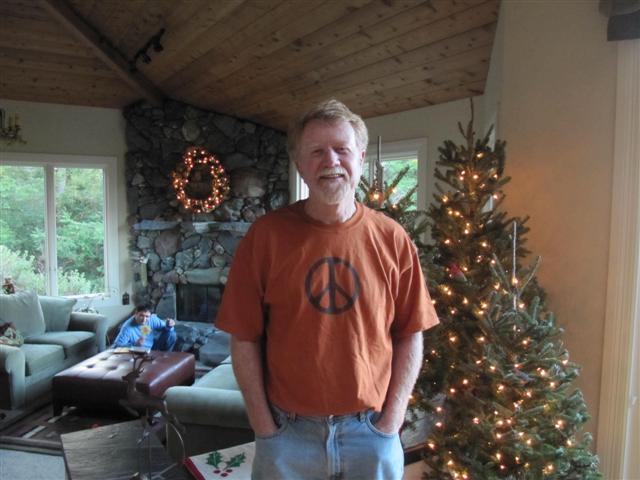
Robert Eugene Neely died December 31, 2022 at his home in
McKinleyville at the age of 75, with loved ones at his side. Bob
was a truly kind, honest man with many friends. He loved playing the
monthly poker game with the same friends for over 30 years. He looked
forward to golfing with friends weekly at Baywood and going on yearly
golf trips with the rowdy bunch. Mostly he loved being with his family
and enjoying the peaceful Mad River.
Bob was born in Los Angeles, where he lived until 1964 when his
family moved to West Covina, where he attended West Covina High
School and Cal Poly Pomona. He was an avid beachgoer, boogie-boarder and
fun teen, always with a cool car. He also loved nature and camping and
had a sense of giving as well as service. He was an Eagle Scout, a fact
he was very proud of. A veteran of the Vietnam War, he served in the Army
stationed in Thailand.
During the summer of 1971 Bob met his future
wife, Maria at work. They both said it was love at first sight. They
married in 1973 and Bob became a permanent father to Maria’s son
Jeffrey. Together they moved to Arcata from SoCal to enable Jeffrey to
attend Glenn Paul Center in Eureka. Soon the family grew, with two more
boys added to the mix, Nathan and Reed. Bob started an auto repair
business in 1976. He was in business 41 years with many loyal customers.
He is remembered as a knowledgeable mechanic, an honest businessman and
an understanding employer to his crew.
Bob is survived by his wife of 49 years, Maria; his sons Jeffrey
Dominguez, Nathan Neely and Reed Neely; daughter-in-law Lindsay
Neely-Mangos; grandchildren Lena Neely, Kieran Neely and Jackson Neely;
sister and brother-in-law Bonnie West (Neely) and Ron West; niece and
nephew Laura Garner and Bob Garner; brothers Bill Neely and Bruce Neely.
Bob was a wonderful person — quick to laugh, kind hearted, loyal and
smart. He will be missed, thought of and remembered fondly .Special
thanks to his caregivers, Georgia Reed and especially Renee Rawski, who
became such a very good friend of Bob’s and Maria’s as well. Also thank
you to Erin Grey of the V.A. and Brian and Mike from Life on Wheels for
all of your unwavering support during the last 12 years. That you to Vicki
Cushing N.P.A., and finally Hospice of Humboldt.
###
The obituary above was submitted on behalf of Bob Neely’s loved ones. The Lost Coast Outpost runs obituaries of Humboldt County residents at no charge. See guidelines here. Email news@lostcoastoutpost.com.
Jill Levinson Lapple September
8, 1950 to January 17, 2023
Jill Levinson Lapple passed away on
January 17, 2023 at 1:50 in the morning. She was born 72 years
earlier in Johannesburg, South Africa; on September the 8th,
1950. Jill was a fraternal twin; her sister’s name was Daphne.
After her schooling she became a film editor and eventually became
the censorship editor for the country. Her job was to make the cuts
that a panel of censors required in a film or to go to court and
argue why a cut didn’t need to be made. She was very successful at
reducing the number of cuts. In fact a newspaper article was written
about just that, under the headline, “No Butcher She.” An
interesting by product of her job was that she was one of the only
people, in South Africa, who got to see uncut movies. Jill hated the
Apartheid system that she had grown up in and due to her seeing uncut
films she knew where she wanted to live; that bastion of free and
equal government, that shiny city on the hill, the United States of
America.
She moved to the US when she was 30
years old, on a visitor’s visa. She was dismayed to discover that
the America she had seen on film did not live up to that promise, in
real life. While she was staying at Dobie Gray’s road manager’s
house she met a young television commercial director named Edward
Lapple. Two years later they were married. Ed recounts, “When we
went out, a second time, I told her that she was, “Foxy,” and
when I called her for a third date, she was a little stand offish.
She said, “Well the last time that we went out you said that I
smelled gamy.” They were able to work their semantics problems out
and romance blossomed. She worked at Lajon Films, for a couple of
years editing movie trailers and doing production management jobs.
Then Ed and his brother decided to open their own production company
and Jill went with them. Their family owned the Town of Bridgeville,
in Humboldt County and Jill became intimately familiar with the
paperwork required in tenant management. In 1982 South Africa paid
her to go to the Cannes Film Festival to pick movies for the country.
She also worked with Norman Seeff shooting album covers. Meanwhile
during 5 years working at Video General she worked her way up from
being the Graphics designer to General Manager.
When Jill got pregnant, with their
son Joshua, she retired from the company to be a full time mother. A
few years later the little family moved to Fillmore, California and
Jill returned to the workplace becoming the feature writer for the
Fillmore Gazette, she also joined the Baháʼí faith where she was
attracted by its strong stand for universal justice and equality.
Being the enthusiastic overachiever that she always was, she soon
wound up as an instructor, teaching the faith. The family eventually
moved to Humboldt County and from there Joshua deployed to
Afghanistan. During his tour he was injured in an IED explosion. He
suffered a broken back, neck and jaw; he was moved to Ft. Sam Houston
medical center and spent two years recovering, Jill moved to San
Antonio and spent two years living in the barracks with him. When he
returned to Humboldt County the Baháʼí’s asked Jill if she would
start a ministry in Crescent City. She said yes and moved up there,
where she recruited members and got involved in community programs to
help the local homeless population. Then the Covid-19 restrictions
slammed a brake on most of this activity and Jill developed physical
problems that ended when she passed on January 17th.
Her
parents Micky and Leon Levinson passed before she did. She was
visited by her three sisters a week before and her husband and son
were with her at the end. Jill is survived by Edward and Joshua
Lapple, plus her three sisters, Cynthia Modugno, Daphne Gaddie and
Debbie Buckley as well as a multitude of nieces and nephews.
Graveside services will be held at the Table Bluff Cemetery at 2 p.m.
on Friday, January 28.
###
The obituary above was submitted on behalf of Jill Lapple’s loved ones. The Lost Coast Outpost runs obituaries of Humboldt County residents at no charge. See guidelines here. Email news@lostcoastoutpost.com.
HUMBOLDT TODAY: The bay trail between Eureka and Arcata has an estimated completion date, California’s congressional leaders aim to keep our coast pristine with new legislation, local do-gooders honored for acts of heroism, and more in today’s newscast with John Kennedy O’Connor!
Also! Would you like the audio version of JKO to pop up in your podcast app? You can subscribe to that here.
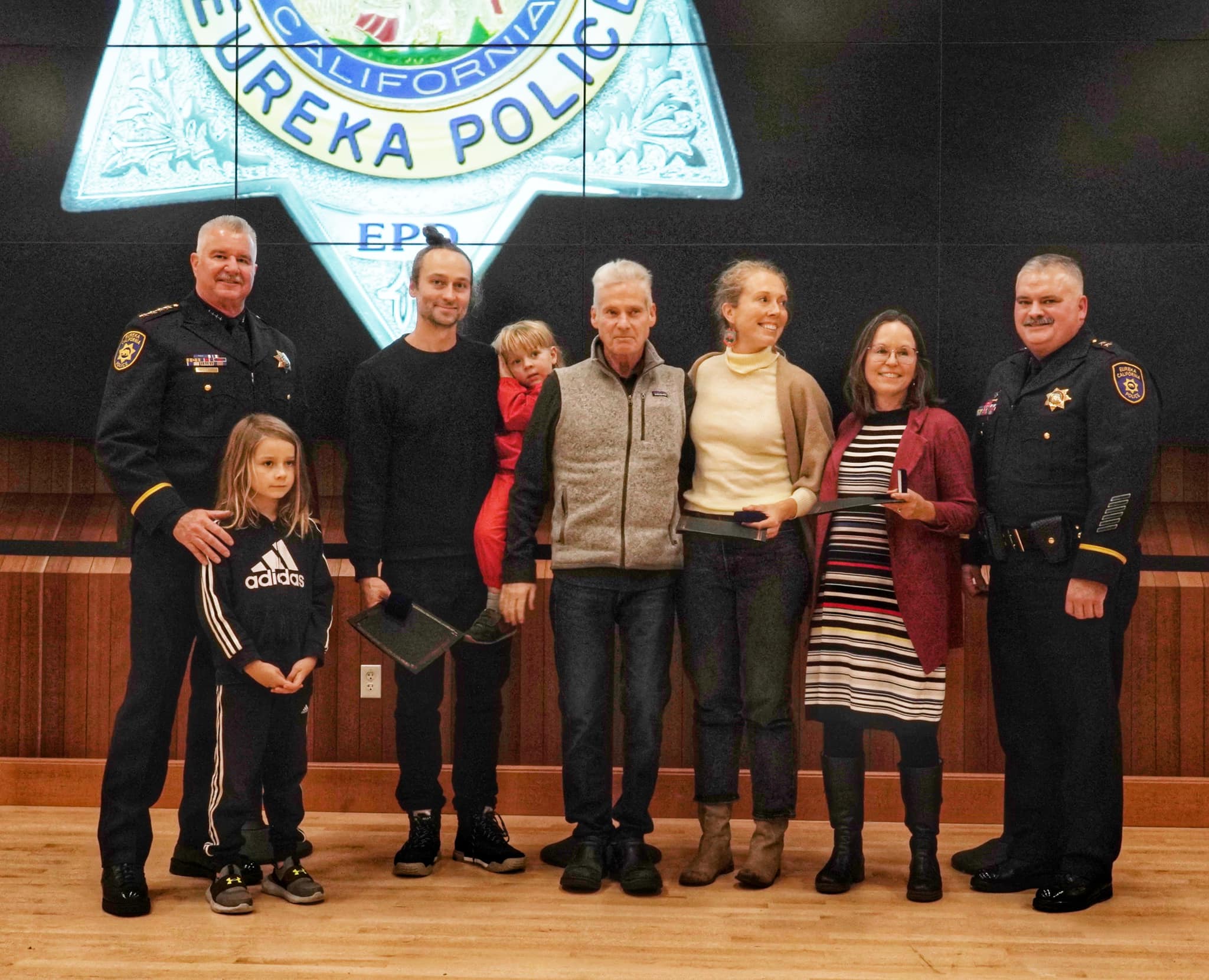
At a recent promotion ceremony, we had the great honor of presenting our Challenge Coins to a few deserving citizens who gave of themselves in an exceptional manner. The Challenge Coin acknowledges valued citizens and groups who commit acts of extraordinary kindness or valor,
unselfishly give of themselves to help others, or perform other good deeds that go above and beyond the normal courtesies society expects.
Allison Backman, Alex Backman, and Dr. Emily Dalton were presented the Challenge Coin for their heroic action which saved the life of a man who had collapsed at a gym on December 1, 2022. They quickly and without hesitation performed life saving measures, giving chest compressions and utilizing an AED. Their actions saved this man’s life and he was present at the ceremony as well!
Justyn Sequoia and Jose Rios were presented the Challenge Coin for their assistance in locating an at risk missing adult on September 18, 2022. As Asset Protection leaders of Target, they went above and beyond in reviewing security footage that ultimately led officers to the correct direction of travel of the missing male.
Mr. Roy Gomes, Mr. Zackariah Dickson and Mr. Logan McNeill we’re presented the Challenge Coin for coming to an officers aid and assisting with a violently resisting suspect on May 30, 2021.
Thank you for demonstrating the great qualities of Valor, Service, and Community.
Notice is hereby given that applications will be accepted for appointments to the following city boards and commissions until filled
Board, Committee or Commission:
Art and Culture Commission (2 Vacancies)
Board of Appeals (1 Vacancy)
Citizen’s Oversight Board on Police Practices (2 Vacancies)
Economic Development Commission (3 Vacancies)
Eureka Energy Committee (1 Vacancy)
Historic Preservation Commission (1 Vacancy)
Open Space Parks & Recreation Commission (2 Vacancies)
Personnel Commission (1 Vacancy)
Transportation Safety Commission (2 Vacancies)
Applications may be obtained by phone or in person from the Mayor’s Office, City of Eureka, 531 “K” Street, Eureka, CA 95501, (707) 441-4175, or may be downloaded from the City Clerk’s
website, listed below.
In order to be eligible for appointment to any board or commission, a person must be a qualified registered elector of the City of Eureka, the Humboldt Community Services District or Humboldt County Service Area No. 3, or an owner of a business located within the city limits of the City of Eureka. The mayor shall make the appointments with the approval of a majority of the Council.
Appointments of qualified non-city residents will require a four-fifths (4/5) vote of the Council for confirmation.
Members on Boards and Commissions shall be willing to serve as a civic responsibility and without compensation. No member of any board or commission shall hold any paid office or employment in the city government.
For more information, call the City Clerk at (707) 441-4175, or go to:
Illustration by DALL-E, an artificial intelligence.
Press release from the office of Rep. Jared Huffman:
Congressman
Jared Huffman (D-San Rafael) and Senator Dianne Feinstein (D-CA)
today introduced the West
Coast Ocean Protection Act
to
permanently ban oil and gas drilling in federal waters off the coast
of California, Oregon and Washington.
“Offshore
drilling poses unacceptable risks, and the science and public opinion
are clear: we should not put our oceans and fisheries, coastal
communities, economies, and planet at risk just to enrich the fossil
fuel industry,” said
Representative Huffman.
“The world is transitioning to a green, clean energy future – and
it is past time that we ban new offshore drilling and shift our
investments to safe, renewable energy sources. Californians have
experienced first-hand the environmental disasters caused by oil
spills, and we are ready to put an end to that risk once and for all
by permanently protecting our coasts.”
“The
era of offshore oil and gas production in the Pacific is coming to a
close,” said
Senator Feinstein.
“We’re in the midst of a historic transition to cleaner energy
sources, including offshore wind. Offshore drilling and the risks it
poses to the environment and our robust ocean and coastal economies
are not part of that clean-energy future. It’s time to permanently
ban new drilling leases in federal waters off the West Coast.”
California
began efforts to block offshore drilling in 1969 when an oil rig off
the coast of Santa Barbara leaked 3 million gallons of crude oil into
the ocean, blanketing beaches with a thick layer of oil and killing
thousands of marine mammals and birds. It was the largest oil spill
in U.S. history until the Exxon Valdez spill 20 years later. After
the 1969 Santa Barbara spill, California blocked all new offshore oil
drilling in state waters, protecting our coastal waters up to three
miles from the shore. The state reinforced that ban in 1994 by
passing the California Coastal Sanctuary Act, which prohibited new
leasing in state waters.
In
October 2021, a ruptured pipeline from an existing oil well spilled
more than 25,000 gallons of crude oil into the ocean and onto the
beaches of Orange County. Despite numerous alarms, operators allowed
oil to flow from the leak for over 14 hours. The spill covered more
than 8,000 acres of the ocean’s surface and required more than a
week of cleanup while local businesses and fisheries suffered.
No
new offshore drilling has been allowed in federal waters along the
Pacific Coast since 1984. However, the Trump administration released
a five-year offshore leasing plan in 2018 that proposed opening up
the entire West Coast to new drilling despite widespread opposition
in Pacific coast states. That proposal was blocked by the courts but
the threat of drilling will remain until a permanent ban is enacted.
The
West Coast Ocean Protection Act would permanently protect
these waters that are essential to coastal economies and healthy
marine ecosystems. Nearly 70 percent of Californians opposed offshore
drilling according to recent polling by the Public Policy Institute
of California.
The
bill is supported by the Natural Resources Defense Council (NRDC),
Oceana, Sierra Club, Environment America, Environment Washington,
Environment Oregon, Environment California, Surfrider Foundation,
League of Conservation Voters, Surf Industry Members Association,
WILDCOAST, Business Alliance for Protecting the Pacific Coast, Paddle
For Peace, and the National Aududon Society.
“Surfrider
Foundation applauds the introduction of the West Coast Protection
Act. We urge Congress to pass this and other legislation to protect
U.S. waters from new offshore drilling. Stopping new offshore
drilling will protect our nation’s environment, communities and
businesses. The bill is also a key action to address climate change,”
said
Pete Stauffer, ocean protection manager, Surfrider Foundation.
“We
can’t continue business as usual. With a climate and biodiversity
crisis to address, and a clean energy economy taking off, this is no
time to pursue a backward-looking energy strategy. The public has
made it clear – communities oppose new offshore drilling and
seismic blasting and don’t want to hand over our coastal waters to
polluters. This bill would make significant strides in protecting the
West Coast, coastal communities, and fragile ecosystems,” said
Valerie Cleland, senior ocean advocate, NRDC.
“From
soaring cliffs to sunny beaches, the Pacific coast is truly a
national treasure. Sadly, this treasure has been threatened far too
often, for far too long, with spills and pollution from offshore
drilling. We’re glad to see the West Coast Ocean Protection Act
reintroduced. We need to make ocean drilling a thing of the past,”
said
Kelsey Lamp, Protect our Oceans campaign director, Environment
America.
“Dirty
and dangerous offshore drilling worsens climate change, threatens
marine life, and results in environmentally and economically
devastating oil spills. Oceana applauds Senator Feinstein and
Congressman Huffman for reintroducing the West Coast Ocean Protection
Act which makes important progress toward permanently protecting all
our coasts from new offshore drilling. Ending new offshore drilling
is a crucial step toward addressing the climate crisis. Our oceans
can be part of the solution as we expedite our transition away from
dirty and dangerous fossil fuels and toward clean, renewable energy
like responsibly-sited offshore wind,” said
Diane Hoskins, Climate and Energy campaign director, Oceana.
“Communities
on the West Coast have been fighting for a long time to be free of
the fossil fuel industry’s grip. LCV thanks Congressman Huffman and
Senator Feinstein for reintroducing the West Coast Ocean Protection
Act, which would prohibit new oil and gas leasing off the West Coast
and prevent a massive 19 billion tons of greenhouse gases from
fueling the climate crisis. Offshore drilling continues to pollute
coastal waters, with devastating consequences for the economy and
public health of coastal communities already bearing the brunt of Big
Oil’s greed. This bill is a step towards a just, clean, renewable
energy future,” said
America Fitzpatrick, conservation program director, League of
Conservation Voters.
“We
thank Senator Feinstein and Congressman Huffman for championing this
effort to protect our coasts from the environmental disruption of
offshore oil and gas extraction. Offshore drilling puts wildlife in
danger, threatens the health of coastal communities, and prolongs our
reliance on climate-damaging fossil fuels. Congress needs to listen
to the local communities and millions of Americans who have spoken
out against offshore drilling and pass the West Coast Protection
Act,” said
Athan Manuel, director of Sierra Club’s Lands Protection Program.
“Put
simply, there is no room for more offshore drilling in a clean energy
future. Rather we need to prioritize transformative and responsible
actions that will move us away from fossil fuel production to
renewable energy. Ocean Conservancy is excited to see the
re-introduction of this critical legislation that would permanently
ban risky offshore drilling on the West Coast, protecting our ocean
health, and fostering the transition to cleaner energy sources. We
look forward to working with Congress to advance this legislation,”
said
Jeff Watters, Vice President of External Affairs at Ocean
Conservancy.
In
the House, the legislation is cosponsored by Representatives Nanette
Diaz Barragán (CA-44), Suzanne Bonamici (OR-01), Julia Brownley
(CA-26), Ed Case (HI-01), Judy Chu (CA-28), Suzan K. DelBene (WA-01),
Mark DeSaulnier (CA-10), Anna Eshoo (CA-16), Jimmy Gomez (CA-34),
Raúl Grijalva (AZ-03), Val Hoyle (OR-04), Sara Jacobs (CA-51),
Pramila Jayapal (WA-07), William Keating (MA-09), Derek Kilmer
(WA-06), Rick Larsen (WA-02), Barbara Lee (CA-12), Mike Levin
(CA-49), Ted. W. Lieu (CA-36), Doris Matsui (CA-07), Jimmy Panetta
(CA-19), Scott Peters (CA-50), Katie Porter (CA-47), Deborah Ross
(NC-02), Adam Schiff (CA-30), Eric Swalwell (CA-15), Mark Takano
(CA-39), Mike Thompson (CA-04), Jill Tokuda (HI-02) and Juan Vargas
(CA-52.).
In
the Senate, the legislation is cosponsored by Senators Alex Padilla
(D-Calif.), Ron Wyden (D-Ore.), Jeff Merkley (D-Ore.), Patty Murray
(D-Wash.), Maria Cantwell (D-Wash.), Bob Menendez (D-N.J.), Cory
Booker (D-N.J.), Edward J. Markey (D-Mass.) and Bernie Sanders
(I-Vt.).