

California Cities Lack Unified Response on Homeless Encampments
Marisa Kendall / Thursday, Aug. 21, 2025 @ 6:48 a.m. / Sacramento

Roger Mead of Monterrey, right, who has been homeless for several years and suffers from a form of skin cancer, plays the guitar in Santa Cruz on Aug. 7, 2024. Photo by Manuel Orbegozo for CalMatters. Story from CalMatters.org.
###
This story was originally published by CalMatters. Sign up for their newsletters.
###
Clearing an encampment is one of the most complicated and fraught tasks any California city can take on when responding to homelessness.
How they handle that challenge varies widely.
CalMatters asked nearly three-dozen cities and counties throughout California for copies of their encampment management policies. Responses spanned a wide range, highlighting the lack of a unified strategy to address street homelessness across the state, even as Gov. Gavin Newsom is pushing for more cohesive rules.
San Diego, for example, has a 10-page policy that spells out everything from when removals can take place (during daylight hours and not if there is a 50% chance of rain) to how much advance warning the city must give camp residents (at least 24 hours) and how to handle personal belongings confiscated during the removal (items must be photographed, logged and stored for 90 days).
But some smaller cities and counties have no rules, or only bare-bones guidelines. Mendocino County has no encampment management policy. The sheriff’s office’s 861-page manual includes a little more than two pages on how deputies should interact with homeless individuals. Deputies are “encouraged” to consider referring them to shelter and counseling instead of arresting them for minor crimes. Mendocino County also does not track encampment removals.
Dismantling an encampment can be devastating for the people who call the camp home, many of whom already have experienced significant trauma while living on the streets. At the same time, cities say they have an obligation to remove camps that are dangerous, unsanitary, pose fire risks or are blocking traffic.
Having a policy in place, so that people living in an encampment know what to expect, can make the process easier on everyone, said Alex Visotzky, senior California policy fellow for the National Alliance to End Homelessness.
“Folks need to know when that trash truck is coming,” he said. “Folks need to know how long they have to be able to move. And when there’s nothing in place at all and folks are just flying by the seat of their pants, that leads to more harm. That leads to more chaos.”
How cities and counties remove camps has become especially important recently, as many places are increasing enforcement after the U.S. Supreme Court last year gave them more leeway to do so. Cities across the state have passed new laws banning encampments, which may or may not include provisions that require the city to give advance warning before clearing a camp, or store people’s possessions.
Some counties, including Santa Cruz and Monterey, are just now writing encampment policies for the first time, spurred by a recent push from Newsom’s administration. In May, he called on cities to make it illegal to camp for more than three days in one place, while also encouraging them to give people a 48-hour notice before clearing a camp and to store belongings confiscated during a clearing so that their owners can claim them.
The latest application for state homelessness funding requires cities and counties to submit a link to their encampment policy. If they have no such policy, they are supposed to commit to following the state’s guidance on addressing camps.
Both the governor’s office and the Legislature have signalled that the next round of funding — which won’t come until the 2026-27 budget year — will require cities and counties to adopt encampment policies in order to qualify.
“The Governor cannot mandate cities and local jurisdictions to adopt a specific plan or ordinance,” Tara Gallegos, a spokesperson for the governor’s office, said in an email. “That said, the Governor has shared a model ordinance and called on every local government to adopt and implement local policies without delay, backed by billions in state funding and authority affirmed by the U.S. Supreme Court last year.”
Santa Cruz County recently drafted a policy to govern encampment removals in unincorporated parts of the county (nearly 600 square miles), which is set to go before the board of supervisors next month. Monterey County passed a new policy earlier this year.
The current process for clearing an encampment in unincorporated Santa Cruz County can be “chaotic,” said Robert Ratner, director of Santa Cruz County Housing for Health. It’s not always clear which agencies should be making the difficult decisions about which camps to clear, when and how.
Typically the sheriff’s office makes those calls, Ratner said, but there are many relevant factors that the agency might not know — such as how many shelter beds are available, or whether the camp is polluting a nearby waterway. The new policy puts the county’s executive office in charge of those tough decisions, and gives guidance on how long to store confiscated property (for at least 90 days) and how to conduct outreach (make a list of all camp residents and record details about their situation that will help connect them with housing and other services).
“Unfortunately, it’s not easy,” Ratner said. “And I think this is where the guide is helpful. Because we’re bringing it to the board and they’re agreeing to the principles and then giving that direction to all the staff, so staff aren’t left guessing.”
But cities and counties, including Santa Cruz, tend to be reluctant to write strict rules they may have trouble following later; It’s hard to promise a shelter bed when you don’t know if one will be available, for example. As a result, many policies offer vague guidelines rather than enforceable decrees. The U.S. Supreme Court last year ruled local governments can ban encampments even if no shelter is available. While some local encampment policies state that cities and counties should try to offer a shelter bed before destroying a camp, few go so far as to require it.
There is one thing that tends to make encampment policies more binding: when they’re written in court. That often happens after a group of homeless residents sues a city, as happened in San Diego and San Bernardino. When the two sides settle, they may agree on new rules to govern encampment removals in that city, and the city is legally bound to follow them.
But that can also lead to drawn-out courtroom battles. Chico has been fighting for the past year to get out from under a settlement reached after eight homeless residents sued the city in 2021, claiming its enforcement of anti-camping laws was unconstitutional.
The settlement set out strict new rules Chico now has to follow before it can clear a homeless encampment. The city must make sure it has enough shelter beds available for everyone who will be displaced from the camp, provide written notice to the plaintiffs’ lawyers more than two weeks ahead of the clearing, provide a seven-day warning to the camp residents, and then give another 72-hour warning.
“Folks need to know when that trash truck is coming.”
— Alex Visotzky, senior California policy fellow, National Alliance to End Homelessness
Advocates for unhoused communities say those rules, which are stricter than in many other California cities, provide crucial protections for people on the street who are just trying to survive. The city, on the other hand, says following that “multi-week, burdensome” process before enforcing its camping ordinances is getting in the way of its duty to clear camps in areas prone to wildfires.
“The City of Chico is prevented from exercising reasonable actions to protect public health and safety (including the transient encampments themselves) from fire danger,” City Manager Mark Sorensen said in an email. “The city is held hostage by the seven remaining plaintiffs and (their lawyers, Legal Services of Northern California).”
The city tried last year to get out of the settlement, after the U.S. Supreme Court ruled that cities can make camping illegal even if they don’t have shelter beds available, and was shot down. Now, the city is trying again. The parties are expected back in court later this fall.
Legal battles can also influence how cities handle personal belongings taken from a homeless encampment. San Bernardino, which last year settled a lawsuit related to the destruction of unhoused people’s property, must provide camp residents with different-colored bags to differentiate between their property and trash, and give people with disabilities extra time to pack up their belongings.
Stockton, which cleared more than 200 encampments last year, instead abides by a police department policy that vaguely states officers should “use reasonable care” with a homeless resident’s property, and avoid destroying it. If the property owner can’t pack it up, “measures should be taken” to secure the items.
Most jurisdictions lack the resources to respond to all the encampments on their streets, so some have drafted policies that help them prioritize which camps to clear first. Fresno has a detailed metric that ranks encampments based on various risk factors. A camp gets two points if the fire department has had to come out, four points if it’s been the location of a violent crime, and one point if a policy maker has asked the city to clear the camp.
Having such a patchwork of policies across the state makes it harder to solve the problem of homelessness, Ratner said. And while Newsom’s efforts to get cities on the same page seem to be having some effect, tying those rules to state funding is far from a perfect solution, he said. Smaller cities that don’t receive homelessness funds directly from the state have no incentive to adopt rules, he said.
“It creates significant inconsistencies,” Ratner said, “and more drama between the jurisdictions.”
BOOKED
Today: 8 felonies, 8 misdemeanors, 0 infractions
JUDGED
Humboldt County Superior Court Calendar: Today
CHP REPORTS
No current incidents
ELSEWHERE
KINS’s Talk Shop: Talkshop February 23rd, 2026 – Rob Arkley
RHBB: ‘What the hell is going on?’: Democratic leaders clash over congressional endorsement
RHBB: Planning Commission Backs Briceland Cannabis Nursery With Zoning Change
RHBB: Humboldt CalFresh Enrollment Surges 55% in a Decade, Outpacing Statewide Trends
What About Texas? California Republicans Pressed for Answers in Redistricting Fight
Jeanne Kuang and Maya C. Miller / Thursday, Aug. 21, 2025 @ 6:44 a.m. / Sacramento

Republican Assemblymember Carl DeMaio addresses the media during a press conference at the State Capitol in Sacramento on the current national redistricting battle between Democrats and Republicans on Aug. 18, 2025. Photo by Miguel Gutierrez Jr., CalMatters.
###
This story was originally published by CalMatters. Sign up for their newsletters.
###
California Republicans have a simple rebuttal when Democrats blame Texas for starting the congressional gerrymandering arms race: two wrongs don’t make a right.
That means they have to acknowledge both wrongs — a move that puts them at odds with their party leader, President Donald Trump, who wants the GOP to redraw congressional districts in red states to bolster its chances of retaining a majority in Congress next fall.
In Texas, Trump has said he’s “entitled” to five additional GOP House seats. Those maneuvers sparked California’s retaliatory effort, which Democratic lawmakers today are expected to place on the ballot for a special election in November.
The California maps, backed by Gov. Gavin Newsom, would offset the Texas map by tilting five Republican-held congressional districts toward Democrats.
“I haven’t heard a single Republican in the state of California, who’s in office in the state Legislature, defend Texas,” said Assemblyman Carl DeMaio, Republican of San Diego and an unabashed Trump supporter. “Gerrymandering is wrong no matter who’s doing it, whether it’s done by a red state or a blue state. Politicians manipulating the lines of their districts, it’s wrong.”
DeMaio, along with Assembly Minority Leader James Gallagher, on Monday introduced a resolution calling on Congress to propose a constitutional amendment requiring all states to use a nonpartisan commission for redistricting, as California’s constitution has required since voters passed a ballot measure creating that process in 2010. All GOP Assemblymembers have signed on.
“When does it stop?” said Sen. Tony Strickland, a Huntington Beach Republican, who warned that a gerrymandering race to the bottom would result in a “destructive country” and “chaos” by encouraging redistricting every two years. Instead, he said all states should adopt California’s model, where maps are drawn every 10 years by an independent citizens redistricting commission.
“What we have currently right now should be the model and the gold standard for the rest of the country to follow,” he said.
He was among several California Republicans who this week sued the state over Newsom’s rush to put his ballot measure before voters. The California Supreme Court late Wednesday rejected their complaint.
The independently drawn districts, which resulted in Democrats winning 43 of the state’s 52 seats, have also drawn criticism from Trump and Vice President JD Vance, who have said the maps are unfairly tilted against Republicans.
Researchers have found the maps give Democrats a slight advantage by some measures but are competitive on other ones.
What Republicans in Congress say
Several California Republicans in Congress have also called for an end to the redistricting wars. Their motivations include preserving voter representation, as well as keeping their seats.
Rep. Kevin Kiley, a Rocklin Republican, introduced a bill in Congress that would ban mid-decade redistricting nationwide — effectively a detente among the states. Kiley’s sprawling 3rd congressional district, which stretches nearly 500 miles through the conservative-leaning eastern Sierra region, would become a much smaller one that includes more liberal suburbs of Sacramento under the Democrats’ plan.
On Tuesday, when House Speaker Mike Johnson, a Louisiana Republican, criticized Newsom’s map efforts, Kiley wrote on social media demanding his bill be brought to the floor – a long shot at best. It would mean undoing Trump’s plans for Texas and weakening the Republicans’ chance of holding on to power in Congress.
“Mr. Speaker, these are nice words but we need action,” Kiley said.

Republican Rep. Kevin Kiley would be at a disadvantage if California voters approve Gov. Gavin Newsom’s proposal to redraw the state’s congressional districts. Here, he speaks at a press conference in Sacramento on Aug. 24, 2021. Photo by Anne Wernikoff, CalMatters
Republican Reps. Doug LaMalfa of Oroville and Rep. Jay Obernolte of Big Bear Lake have also spoken against mid-decade redistricting in California and other states, saying the practice creates voter distrust.
Matt Rexroad, a GOP consultant and redistricting specialist, said California Republicans are right to push for independent redistricting nationwide and to oppose gerrymandering in both blue and red states. He called the redistricting wars “a horrible idea for everyone,” for both principled reasons and raw numerical ones.
Newsom’s map would not only draw out five Republican seats but also eliminate three competitive districts held by Democrats in Southern California. Rexroad isn’t convinced Republicans can win the seats in Texas under their new maps.
“In addition to the reasons (for independent redistricting), I think it’s a bad trade,” he said.
Other Republicans in California have been more cautious to openly criticize the Trump-backed efforts in Texas. A spokesperson for Rep. Young Kim said the Orange County congresswoman viewed Newsom’s plan as an “unconstitutional power grab” and believed he should “focus on addressing crises facing Californians instead of disenfranchising voters and positioning himself for a presidential run.”
Spokespeople for Republican Reps. Tom McClintock, David Valadao, Darrell Issa, Ken Calvert and Vince Fong did not respond to questions from CalMatters in time for publication.
Newsom vs. Trump
Some GOP state lawmakers have demurred when asked if they would call on Trump directly to back down from redistricting in Texas — a move that California Democrats have said would prompt them to abandon their gerrymandering effort — or deflected blame in Texas to civil rights groups that sued over the current map, which gives Republicans 25 safe seats and two competitive ones, and Democrats 11 safe seats.
As that case wound its way through the federal courts, Assistant U.S. Attorney General Harmeet Dhillon wrote Texas in July saying it needed to redraw its congressional maps — giving Gov. Greg Abbott justification to convene a special legislative session for that purpose.
“I haven’t been a part of those conversations,” state Senate Minority Leader Brian Jones, a San Diego Republican, said when asked if Trump should also back down from new maps in Texas. “I’m not an expert on Texas law or the Texas constitution or their legislature. I’m concentrating on California.”
In the Senate elections committee on Tuesday, Democrat Tom Umberg needled Republican Steven Choi for saying California was wrongly following the “same condemnable actions” of other states.
“If you’re condemning what they’re doing in Texas, I assume that you condemn the president of the United States,” Umberg, of Santa Ana, said. “It’s a bold move for a Republican … so I congratulate you for your courage.”
Choi, of Irvine, said he was only using the word “condemn” because Democrats had.
“What I meant was, let’s don’t become the bad ones or part of the bad actors, if you are condemning them,” he said. “I didn’t criticize or evaluate (Texans’) actions.”
Whether bipartisan criticism on California Republicans’ part will help or hurt them may well be moot. The campaign over the GOP seats, Rexroad said, will ultimately come down to a more basic question.
“I don’t know what sort of strategy they can come up with, because the governor’s strategy is clear,” he said. “‘Choose me, or choose Trump.’”
48-Year-Old Santa Rosa Man Identified as Deceased Pilot in Last Weekend’s Shelter Cove Plane Crash
LoCO Staff / Wednesday, Aug. 20, 2025 @ 2:18 p.m. / Emergencies
PREVIOUSLY:
###
From the Humboldt County Sheriff’s Office:

The Humboldt County Sheriff Coroner’s Office has identified the individual who was found deceased after the plane crash that occurred on Aug. 17 in Shelter Cove. The next of kin have been notified, and the decedent has been identified as 48-year-old, Brian Kenneth Mariette, of Santa Rosa, California. The autopsy has been completed, and the cause of death was determined to be drowning.
The Humboldt County Sheriff’s Office extends our deepest condolences to the family and friends of Brian Mariette during this difficult time.
Eureka City Council Narrowly Approves New Rules for Stolen Shopping Carts, Despite Concerns for Businesses Impacted by Theft
Isabella Vanderheiden / Wednesday, Aug. 20, 2025 @ 1:57 p.m. / Local Government

Screenshot of Tuesday’s Eureka Council meeting.
###
Following yet another enduring discussion over abandoned and stolen shopping carts, the Eureka City Council on Tuesday voted 3-2, with councilmembers Renee Contreras-DeLoach and G. Mario Fernandez dissenting, to approve an ordinance that holds retailers accountable for carts scattered around town.
The ordinance — linked here — amends the city’s municipal code to allow staff to return abandoned shopping carts to the grocery stores and retailers that own the carts, rather than sending them to the landfill or salvage yard. Under the city’s current policy, retailers are subject to an $80.34 per-cart fine to cover the cost of retrieval and disposal, but it hasn’t been enforced in the last year. The city will roll out a new tagging, tracking and billing system to streamline the process. Retailers with tagged carts will be billed at the end of each month. Repeat offenders may face additional fines.

One of the many shopping carts sent to the dump by city staff. | Photo: City of Eureka
During the council’s last cart-related discussion, Councilmember Fernandez asked if the city could base the fines on gross earnings or the locality of the business to target big box stores rather than small businesses. At last night’s meeting, City Attorney Robert Black said he looked into it, but felt it was out of the city’s jurisdiction.
“You’re not really in a position to single out one level of business … [based] on the size of the business,” Black said, adding that the city cannot use a fee to generate revenue that exceeds the cost of staff time. “[T]he cost to recover and return the carts is gonna be the same for a small business or a large business, and therefore, this cannot be charged as a fee. The only other option would be to make it a tax, but then that has other implications and requires a vote of the people.”
The council also discussed the possibility of giving retailers a “freebie” and not issuing fines for the first five carts recovered. The idea was entertained, but it didn’t go anywhere.
Councilmember Kati Moulton asked how often staff pick up shopping carts, and whether cart pick-up was focused in certain areas or across the city.
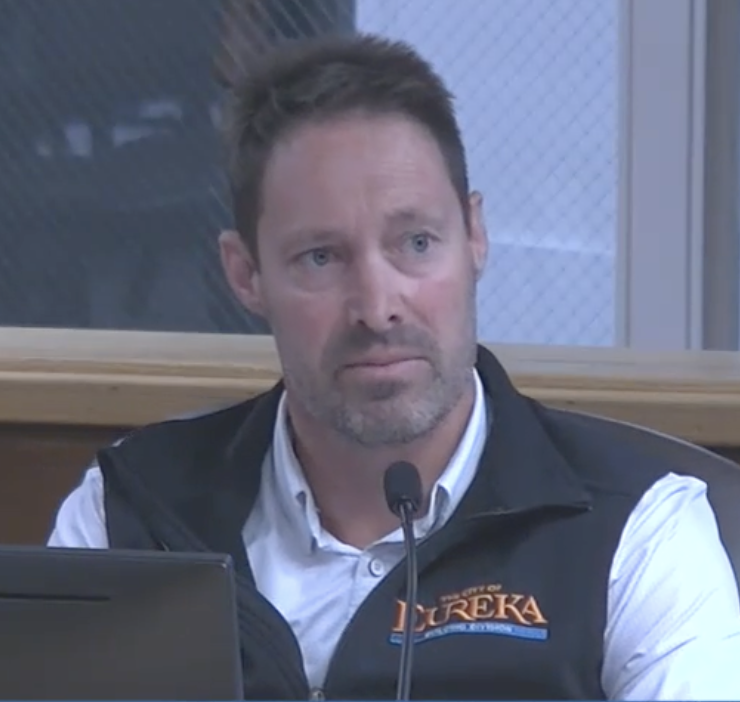
Riley | Screenshot
“We are constantly trying to keep them cleaned up,” said Chief Building Official Brendan Reilly. “It’s an everyday thing.”
Councilmember Contreras-DeLoach expressed many of the same concerns she had during the council’s previous discussion, namely, that the ordinance would unfairly target businesses experiencing rampant theft. “It seems like we’re penalizing businesses for something that they — assuming that they’ve [implemented] precautions — have nothing to do with,” she said.
“We have a situation where somebody who’s just doing business is being victimized,” she continued. “They’re being victimized by shoplifters, they’re being victimized by people who are stealing their carts, and then we’re like, ‘We’re gonna charge you a fee for that.’ I think the impression from some of the people I’ve talked to is that it’s another move in a series of moves by the city that is not friendly to business and does not understand the pressures that they’re under or … that they’re being victimized by crime pretty continually and that that’s significantly affecting their bottom line.”
Mayor Kim Bergel asked Councilmember Contreras-DeLoach who should pay for the cost of cart recovery/return if not the businesses. “Do you feel … that the general population should be paying for that out of the General Fund, that our taxpayers should be paying for that?”
“I think we already do in a lot of indirect ways, with the expansion of law enforcement … because of the amount of issues that we’re dealing with,” Councilmember Contreras-DeLoach responded. “So yeah, I guess in a lot of ways I see this as kind of … a roll-in.”
Councilmember Fernandez aligned himself with her position, adding, “I find that disingenuous [and] inequitable to the smaller businesses that are already trying to do right by this, and I can’t fathom why I would want to move forward with it.”
Councilmember Leslie Castellano reminded her peers that the question before the council was not about the fines, but whether staff should be allowed to return stolen carts to retailers.
“Just to say, if we do not pass this, there is an existing ordinance on the books that will still charge a fee to business owners, it just won’t return the carts,” she said. “This is not changing the fee; this is actually allowing us to return the carts to business owners.”

Contreras-DeLoach | Screenshot
Councilmember Contreras-DeLoach asked if staff had any approximation of how much time staff spent on cart collection every week. City Manager Miles Slattery said staff had factored in staff wages and the cost of bringing carts to the dump when the fee was implemented, but he couldn’t say how much staff time had been spent on cart collection.
Riley noted that staff haven’t been focused on cart pick-up in recent months, but estimated that he could “easily get 20 a day.” He added that the majority of carts are coming from “just a few” businesses.
“I can’t even speak to all of what other departments pick up because right now we don’t have a centralized way to track stuff — that’s part of what we’re trying to do,” Riley said. “Last Friday, I picked up three. … And we haven’t been [picking up as many as we could] because we’re waiting to implement this [ordinance] so we can keep better track and try to forge things going forward.”
Riley added that he would be happy to come back to the council with an update in the coming months.
After a bit of additional discussion, Councilmember Castellano asked to “call the question,” a parliamentary procedure used to end a debate on an ongoing issue and bring the matter to an immediate vote. She requested that staff come back with a progress report in six months.
The ordinance passed in a 3-2 vote, with councilmembers Contreras-DeLoach and Fernandez dissenting.
5 QUESTIONS for BRETT MCFARLAND, In Advance of His Big Show at the Humboldt County Fairgrounds This Weekend
Andrew Goff / Wednesday, Aug. 20, 2025 @ 12:30 p.m. / Music
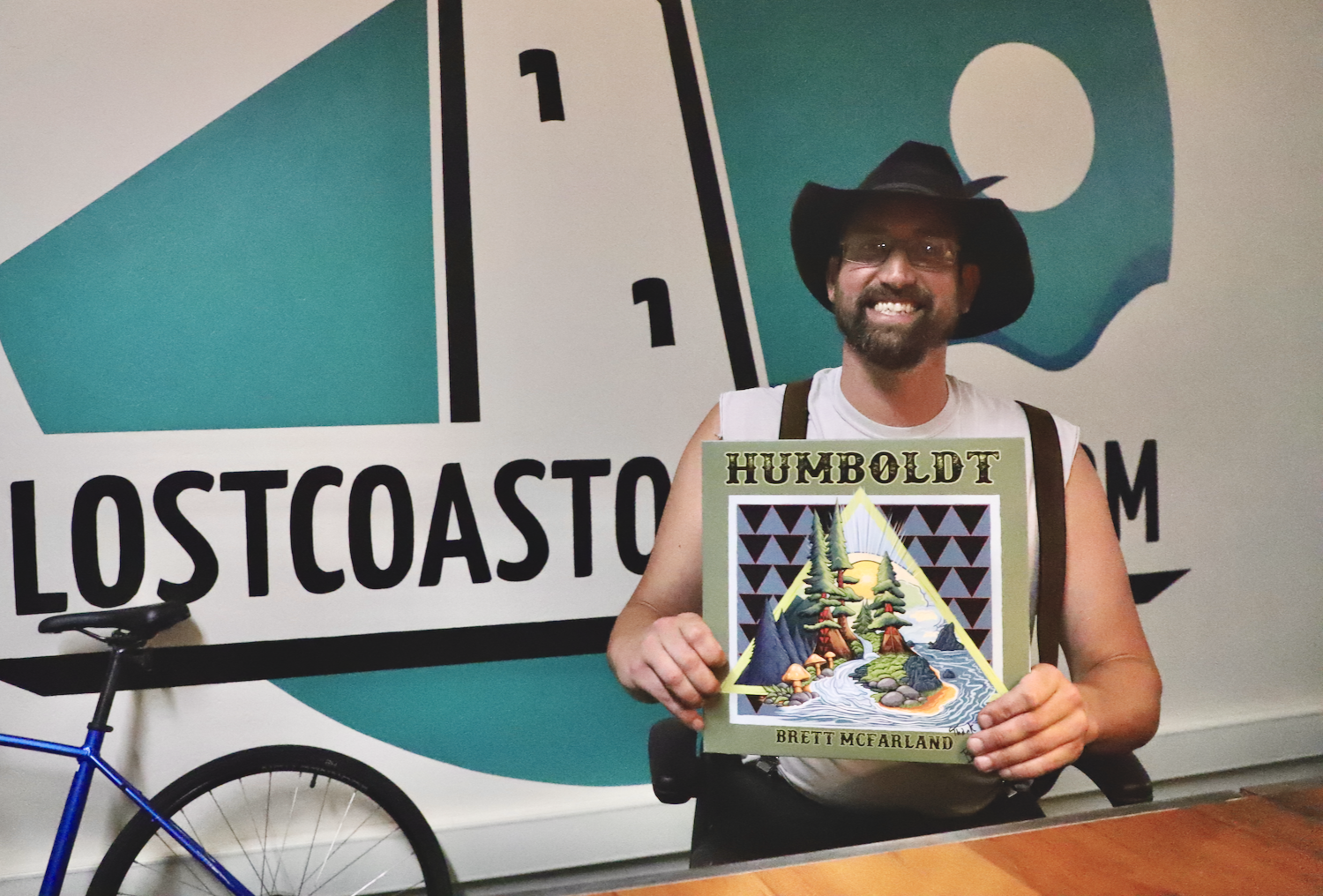
HOT OFF THE PRESS! Brett McFarland shows off the vinyl edition of his album Humboldt
This coming Saturday, Aug. 23, local farmer/songwriter Brett McFarland is again swinging for the fences, this time in the form of a concert before the Humboldt County Fairgrounds grandstands, also featuring Huckleberry Flint and Luke Powell. As part of his local promotional tour, a barefoot McFarland was kind enough to wander into LoCOHQ for a li’l interview to discuss this weekend, his music, his crazy year, and, of course, Humboldt.
# # #
LoCO: So, I think it’s fair to say you’re going for a big show feel with this with this Humboldt County Fair performance. What was the first big concert you saw as a kid and what do you remember about it?
McFARLAND: The first big concert I saw as a kid: I got to see Radiohead at Red Rocks in Colorado when I was 18. I remember watching the guys coming out of the rigging — like the people that were working on lighting stuff — and it was so trippy and psychedelic watching that band with all these lights and these people descending from ropes. And the music was was amazing.
There was all kinds of magic that happened at that concert for me. I felt like I was the youngest person at this concert — I went with my older cousins — but somebody that knew me came and tapped me was like, “Hey, come over here.” And he had tickets like three rows back. So, thank you, Jason Weiss! Because, you know, he snuck me up front in that concert and that brought the magic in. I just remember being blown away by the music and how it brought everyone together. They played so many of the classics off Kid A and, you know, the whole thing was just like a psychedelic blur.
LoCO: I was looking at your press release you sent out to promote your upcoming show and you mention your desire to use the occasion to celebrate Humboldt’s heritage and working class roots. And one of the ways you’re going to do that is you plan to surround the stage with the vintage tractors and logging trucks, etc. Why does going to all that effort feel like an important gesture to make at this point in time?
McFARLAND: Well, there’s more that’s going to be on that stage that’s not in that press release, so let me just tell you that! We’ve hinted at it with the “surprise appearances” and “top secret shenanigans.”
But yeah, I feel like Humboldt County right now is going through some changes. The perception is a lot of these industries have come and gone or have changed a lot. Like, there was timber and then timber kind of busted. There was fishing and fishing kind of busted. There was weed and weed kind of busted. All these things are still present. We still have fishermen, we still have loggers, there’s still people in the hills that are cultivating. But it’s all changed in a lot of ways. And to me, heritage is about remembering, “Where did you come from?”
Picture a logger in your mind. Now, picture a hippie pot grower. Do they look like the same person to you? In Humboldt County, they might very well be the same person, but that’s not normal in a lot of the country. We’re told there’s these more stark divides now more than ever. To me, celebrating those working class roots is really about celebrating what unites us and what unifies us here in Humboldt.
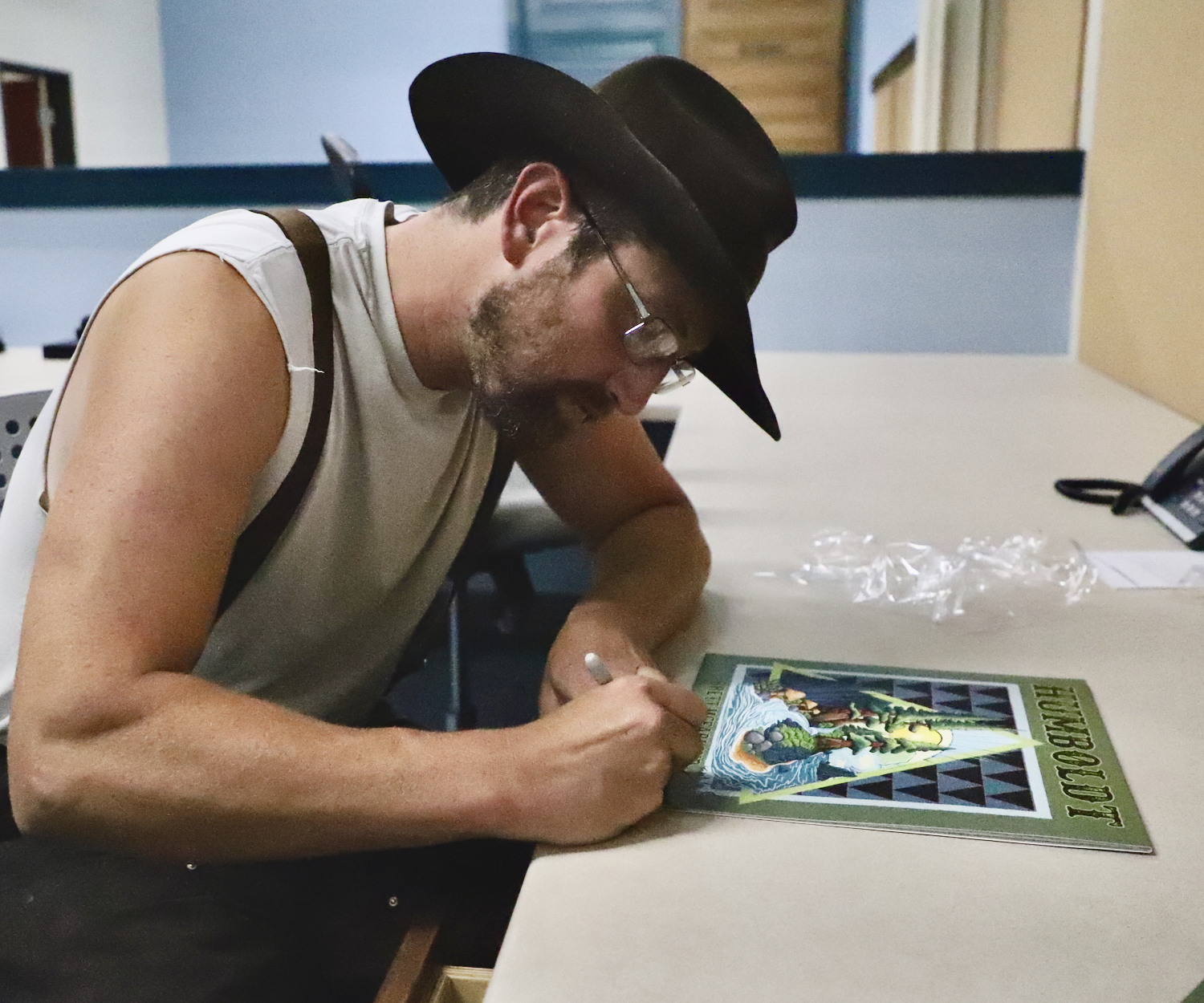
McFarland signs a copy of Humboldt for LoCO. (Aww.)
LoCO: It’s been almost a year since the release of the “Humboldt” music video, which seemed to lift you into a whole other level of public awareness here locally. When you were writing that song, were you consciously thinking about how you might connect with the widest Humboldt audience possible?
McFARLAND: When I wrote that song, I wrote the first line from a place of personal gratitude. The first line in the song says, “I built my home with my own two hands…” I worked my tail off doing a lot of the things that I’ve done, so I was feeling this sense of personal accomplishment. But then, I’m like, well, I can’t really say much more without looking around at all the help that I received, all the support I received, so the next lines in the song talk about “help from my friends and trees from the land.” After the first line — which I had kicking around for maybe a couple months — when I actually sat down and wrote it, it happened in less than 24 hours. It just happened so fast, so I wasn’t even thinking. I just thought, “What do I think about Humboldt,” you know? I wasn’t thinking, “How do I connect with Humboldt?” I’m writing a song about my appreciation of Humboldt. It wasn’t labored over. It just really came through and in that way, to me, I can’t take full credit for that song. When I think about the song “Humboldt,” I think of that song as a co-write between me and the community and all the conversations with people that I’ve had over two decades living here.
LoCO: Kind of in the same vein of talking about this kind of whirlwind year that you’ve had: Some months ago, it seemed like you kind of lucked into being this sort of de facto spokesman for Humboldt when you were featured in that Peter Santenello YouTube clip. That video has nearly 5 million views now. How did that encounter come to be and what kind of reaction have you received from it?
McFARLAND: Yeah, so I had never heard of Peter Santanello before he reached out to me. And Peter, I think he saw the “Humboldt” video! He had some local contact here, and I’m very grateful for that person because they bridged the gap.
I’ve had a lot of people reach out to me from all these videos — I have to be careful about who I say yes to, you know? But I looked at Peter’s videos and I saw that he was somebody who went around and just met with different people. I saw this video he did of this farmer in Europe, and I was like, oh, [Humboldt] is going to be right up his alley. So, I kind of knew to say yes. But what surprised me was how much fun we had together! Like he’s a genuine, kind person. We remain in contact. I mean, he’s like messaging me before the gigs and stuff which has been really sweet and it’s been cool to see his journey.
But the impact of that video was not insignificant. I had a sense when he was coming that it would be meaningful, that I was meeting with somebody who was worthy of my time. And I know I was worthy of his.
What’s remarkable to me about that video is not just the fact that it has almost 5 million views, but that it’s over an hour long. You know, you can get 5 million views on nine-second TikTok and like, okay, good job, but people have tuned in and that documentary shows so much of the heart of Humboldt.
But the impact has been tremendous. I mean, right when that video came out, our farm cidery got slammed with so many cider orders. We sold out of cider temporarily. I mean, we had product, we just didn’t have enough labeled and stuff. And we had to get it in the mail and it was new to us. So that was tremendous to have all these people from over the country send so many messages and emails. A lot of people were touched by the music. Because what Peter did, I don’t know if you watched to the end, but the end of that video, he actually put the entire “Humboldt” music video in there. He really showcased the music. All of a sudden it was like, whoa, we’re getting all these new listeners and there’s been all different people reaching out about opportunities to play at different festivals and stuff. So it’s kind of mind blowing how quickly things can change, how something like spending a day with this YouTuber who shows up at your front door can change your life.
LoCO: Going back to the Humboldt County Fair show you’re promoting here: Which song from your live shows do you feel connects with audiences in a way that surprises you?
McFARLAND: Well, first of all, the fact that the music connects with audiences to me is just a stinking miracle. It’s so beautiful. It’s the thing that draws me to it. Even like the song “Humboldt,” how it could connect with so many different people with different backgrounds. It would be easy to think they’d be in conflict with each other and yet they’re not, in so many cases. “Humboldt” is the song that, locally, when we play it, you feel this connection with the audience that’s unparalleled, because people feel so stoked. It’s not just the hit, it’s their hit. That’s what I think is so cool about it. When they’re there celebrating with us, it’s like, oh wow, this is this is all of our hit. We all get to share in this hit. So, that’s kind of the obvious one.
But I guess the song that was probably the first one that came to mind, is there’s a song on this album called “Sing Son Sing.” It’s a song about about all the great cowboys I’ve known in my life. You know, one of which being my dad. And my neighbor Ken Jarvela, he’s a painter, he appeared in there. “Cowboy” is a loose term to me, because Ken, he don’t raise cows. But you look at Ken, he’s a mountain man. There’s a line in that song, it says “I knew an old cowboy. He used to paint the moon. You can find him by the river from June to June.” There’s lines about my neighbor, Freddy, about the people I’ve lost. I think about the wisdom and advice they gave me. That’s the spirit of that song. It’s very personal in that way, so to hear other people going deep with it… you ask about surprising? I think that one has been pretty surprising, the way that’s touching people has been cool to hear.
# # #
Tickets ($11) and more info about this weekend’s Brett McFarland and the Freedom Riders show can be found here. McFarland is hosting a meet-and-greet event the night before on Friday, Aug. 23 at 5:30 p.m., with the first 250 people in line set to receive a free t-shirt.
HSCO Arrests Man Who Tried to Stab His Mother
LoCO Staff / Wednesday, Aug. 20, 2025 @ 12:28 p.m. / Crime
Press release from the Humboldt County Sheriff’s Office:
On Aug.19, 2025 at about 9:27 p.m. Humboldt County Sheriff’s deputies were dispatched to the 1900 block of Strawberry Ct. in McKinleyville for the report of an attempted homicide.
The Humboldt County Emergency Communications Center received a series of text messages to 9-1-1 stating a male subject inside the residence was physically assaulting and attempting to stab his mother and had started a fire.
When deputies arrived on scene, a young male adult was observed exiting the residence with his hands raised above his head and he was immediately detained. Based on the witness and victim statements, 18-year-old, Hunter Taula-Sanson, of Waianae, Hawaii was arrested. He was transported the Humboldt County Correctional Facility (HCCF) and booked on the following charges: P.C. 664/187(A)-Attempted Homicide, P.C. 245(A)(4)-Assault with a Deadly Weapon, P.C. 422(A)-Criminal Threats, P.C. 594(A)(2)-Felony Vandalism and P.C.417(A)(1) Brandishing a Deadly Weapon.
This case is still under investigation.
Anyone with information about this case or related criminal activity is encouraged to call the Humboldt County Sheriff’s Office at (707) 445-7251 or the Sheriff’s Office Crime Tip line at (707) 268-2539.
SAVE THE DATE! Eureka is Hosting a Pop-Up DUI Checkpoint on Friday, and if You Wrongly Feel That You Have to Drive Drunk Then You Are Invited to Attend
LoCO Staff / Wednesday, Aug. 20, 2025 @ 8:53 a.m. / Safety
Press release from the Eureka Police Department:
The Eureka Police Department (EPD) will conduct a driving under the influence (DUI) and Driver’s License checkpoint on Friday, August 22, from 6:00 p.m. to 12:00 a.m. at a location within the city limits of Eureka.
The exact location is not being disclosed in advance.
The primary purpose of checkpoint is to promote public safety by deterring impaired driving, raising awareness, and removing suspected impaired drivers from the road. Officers will look for drivers who are impaired by alcohol, cannabis, illicit drugs, or prescription medications that can affect driving ability.
“Our goal is simple: prevent crashes and save lives,” said Sergeant Omey. “If you’re planning to drink or use any substance that can impair your driving, plan ahead for a sober ride.”
What Drivers Can Expect
- Vehicles may be stopped in a neutral, pre-determined sequence.
- Drivers will be briefly contacted by officers trained in DUI detection.
- Sobriety tests may be administered as appropriate.
- Delays to motorists will be minimal.
Safety Reminders
- Plan ahead: designate a sober driver, use public transit, rideshare, or taxi.
- If you see an impaired driver on the road, call 9-1-1.
- Medications (including some over-the-counter and prescription drugs) can impair—read labels and consult your doctor.
Driving impaired is not worth the risk. A DUI arrest can lead to jail time, license suspension, and significant fines and fees.
This operation is funded by a grant from the California Office of Traffic Safety (OTS), through the National Highway Traffic Safety Administration (NHTSA).


