

A Major Cascadia Zone Earthquake Could Cause Much of Coastal Humboldt to Rapidly Drop Into the Sea, New Study Finds
Ryan Burns / Monday, April 28, 2025 @ 4:29 p.m. / Environment , Science

Humboldt and Arcata Bay during a 2021 king tide. | File photo by Tim Hanan.
###
Those of us who live in earthquake country tend to have two primary anxieties about the unsettling events: the shaking itself (collapsed roofs, crumbling buildings, etc.) and a tsunami (giant wall of water, ‘nuf said). However, a newly published study invites us to adopt an altogether new earthquake-related fear: rapidly sinking land.
The study, published Monday in the Proceedings of the National Academy of Sciences (PNAS), found that a major earthquake along the Cascadia subduction zone will likely cause between 1.6 and 6.5 feet of sudden subsidence long the Washington, Oregon and northern California coasts.
This abrupt land sinkage would dramatically raise the relative sea level of coastal communities in a matter of seconds. In the worst-case scenario, the subsidence would more than double the flooding exposure of coastal residents, structures and roads. And those risks would remain long after the shaking settles.
“This lesser talked about hazard is going to persist for decades or centuries after the earthquake,” the study’s lead author, Dr. Tina Dura, told NBC News. “The tsunami will come in and wash away and it’s going to have big impacts, don’t get me wrong, but the lasting change of the frequency of flooding … that’s going to have to be dealt with.”
Such damaging events have already happened elsewhere on the globe. Earthquake-driven coastal subsidence followed recent earthquakes in Chile, Alaska, Southeast Asia and Japan, resulting in such severe consequences as permanent land loss, widespread infrastructure damage and forced relocation.
These risks are exacerbated by climate-driven 21st century sea-level rise. In some communities along the coastal Washington, Oregon and northern California, the effects of sea-level rise are somewhat moderated by gradual coastal uplift. In fact, coastal uplift rates exceed the current rate of sea-level rise in such places as Astoria, Ore., Port Orford, Ore., and our neighbor to the north, Crescent City.
Humboldt Bay residents aren’t so lucky. Here, the study’s authors note, “complex regional tectonics are causing gradual subsidence, resulting in the highest recorded Pacific-coast RSLR [relative sea-level rise] rate of 4.7 [millimeters per year].” In other words, the ground beneath our feet is slowly dropping as the water rises.
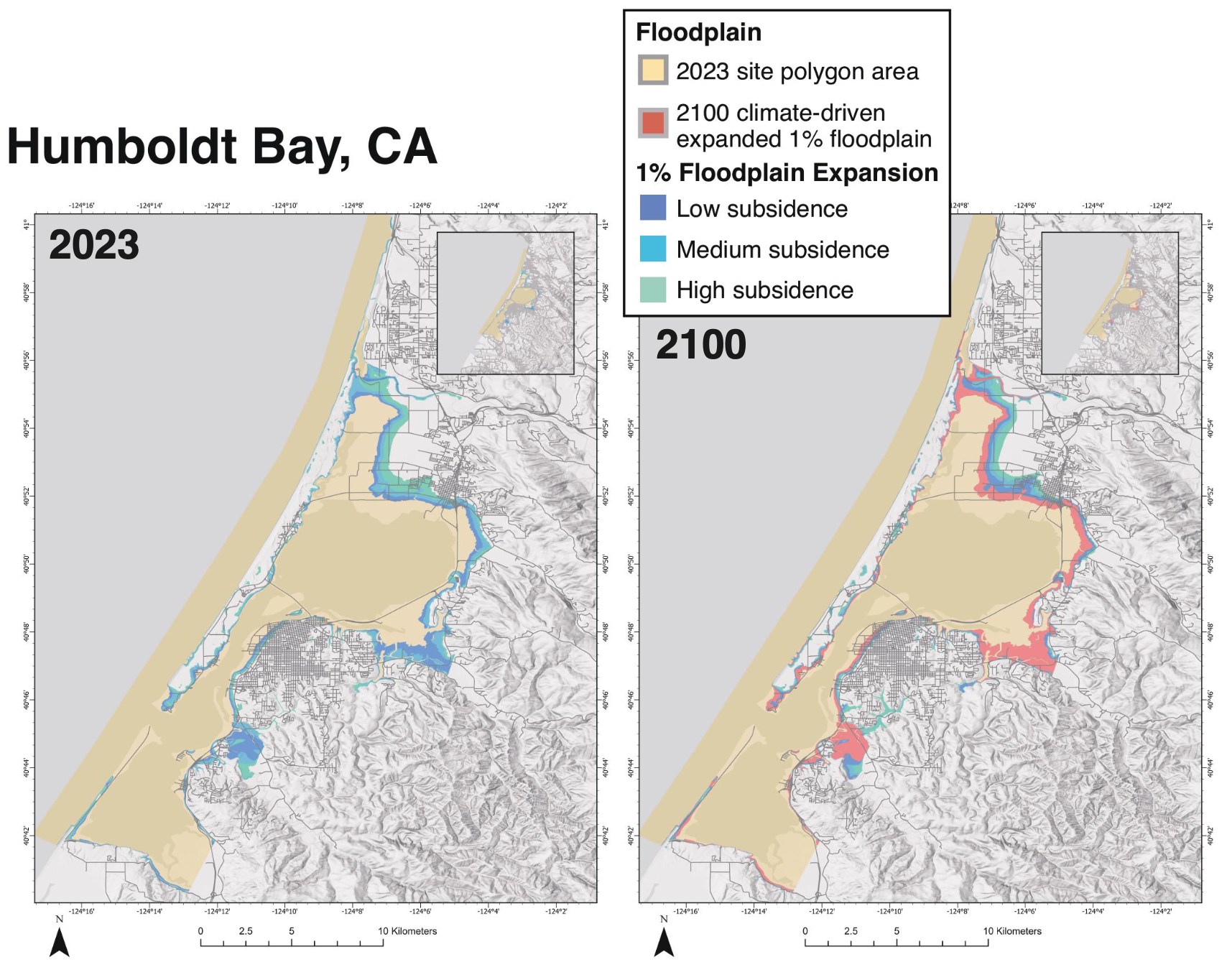

Floodplain map and bar graph depicting the expansion of the 1% floodplain (an area with a 1-in-100 chance of flooding each year) after earthquake-driven subsidence today (2023) and in 2100 when the earthquake-driven subsidence is amplified by climate-driven sea-level rise for Humboldt Bay. The bar graph shows the amount of land area, number of residents, structures, roads, and different land-use types in the 1% floodplain following earthquake-driven subsidence today (2023) and in 2100, when the effects of earthquake-driven subsidence are amplified by climate-driven sea-level rise. | Creative Commons license CC-BY-NC-ND 4.0.
###
The study defines a “major earthquake” as a magnitude 7.7 to 9.2, and while that may sound unlikely (knock wood), scientists were able to discover how often they occur by radiocarbon-dating plant fragments preserved within pre-earthquake peat or overlying mud. The results? There have been 11 such “great earthquakes” along Cascadia’s coasts over the past 6,000-7,000 years. They hit roughly every 200 to 800 years.
The most recent “great earthquake” along the Cascadia subduction zone struck in 1700 — more than 300 years ago. The CSZ is a major offshore fault line running from Northern California to British Columbia.
The authors of the new study warns that coastal flood hazard analysis often overlooks the risk of sudden earthquake-triggered land subsidence.
“This study underscores the need to consider combined earthquake and climate impacts in planning for coastal resilience at the Cascadia subduction zone and globally,” it says.
The combined effects of earthquake subsidence and climate-driven sea-level rise could more than triple the flood exposure of residents, structures and roads in the next 75 years, the study found. The coastal areas at risk are home to airports, major highways, wastewater treatment facilities, businesses and homes.
County leaders recently completed a Sea-Level Rise Adaptation Plan for Humboldt Bay/Eureka Slough Area. It advocates “an incremental approach” to planning, using various “shorter-term actions” to reduce immediate risk and buy time for more ambitious “longer-term actions” to address future conditions. It does not appear to contemplate the possibility of long-term projections becoming a reality all at once.
Tsunamis along the Cascadia Subduction Zone can be triggered in a mega earthquake when the Juan de Fuca plate is rapidly pushed underneath the North American plate, displacing massive amounts of water. That same movement can cause coastal land to suddenly drop, according to Dura, an assistant professor in geosciences at Virginia Tech.
If that happens, she recently told the San Francisco Chronicle, “All the sea-level rise you expected by 2300 is going to happen in minutes.”
You can download the study and read it for yourself via the link below. The study was funded by the Cascadia Region Earthquake Science Center, part of the National Science Foundation.
###
###
NOTE: This post was updated on April 29 to add the maps and bar graphs.
BOOKED
Today: 4 felonies, 15 misdemeanors, 0 infractions
JUDGED
Humboldt County Superior Court Calendar: Today
CHP REPORTS
1284 Mm299 W Tri 12.80 (RD office): Trfc Collision-No Inj
ELSEWHERE
Humboldt Last Week: 378: Foster toddler murder case, new child sex charges, the mall’s auction, eviction drama, many positives, and more
County of Humboldt Meetings: Behavioral Health Board - SUD/Dual Recovery Committee - April 9, 2026
County of Humboldt Meetings: Behavioral Health Board - SUD/Dual Recovery Committee - March 12, 2026
Does Your Dog Need Her Rabies Shot? You Can Get it For Her on the Cheap at One of These Upcoming Clinics
LoCO Staff / Monday, April 28, 2025 @ 3:19 p.m. / Animals

Photos via Pexels.
Press release from the Humboldt-Del Norte Veterinary Medical Association
The Humboldt-Del Norte Veterinary Medical Association is sponsoring a county-wide low-cost canine rabies vaccination clinic. The Humboldt-Del Norte Veterinary Medical Association offers these low-cost canine rabies clinics as a public service.
It is important that all dogs and cats be vaccinated, as we have had several cases of rabies in wildlife and pets in Humboldt County as recently as the last few months. Foxes, skunks, and bats are a few examples of rabies carriers. We will be vaccinating dogs at the cost of $10.00 per rabies vaccination.
Other canine and feline vaccinations will be available. The costs of these vaccines will vary with the clinic.
If you have any questions, please contact the animal hospital you would be interested in taking your pet(s) to.
Clinic Schedule:
- Thursday, May 1, 8 a.m.-5 p.m.: Sunny Brae Animal Clinic Saturday
- Saturday, June 7, 8 a.m.-1 p.m.: Myrtle Ave Veterinary Clinic
- Thursday, July 17, 8 a.m.-noon: Arcata Animal Hospital
Additional clinics are available in Trinity County. Please call for dates and times.
Sincerely,
Julie Lisignoli, RVT
The Celebrity Guests for This Year’s Forest Moon Festival Have Been Announced, And You’ll Never Guess Who’s Coming to Town!
LoCO Staff / Monday, April 28, 2025 @ 12:39 p.m. / Our Culture

You know these guys. From left: a Rebel Force Radio host, the other Rebel Force Radio host and Kyle Newman. Photo courtesy the Humboldt Del-Norte Film Commission.
Press release from the Humboldt-Del Norte Film Commission:
The 3rd Annual Forest Moon Festival returns this May 30th–June 1st, 2025, hosted by the Humboldt-Del Norte Film Commission. Taking place across the iconic redwoods of Northern California — the very filming location for the Forest Moon of Endor — this immersive, multi-day celebration will span both Humboldt and Del Norte counties with events for fans of all ages.
This year, the Forest is especially strong with the guest lineup, including Kyle Newman, director of Fanboys and a beloved voice in the Star Wars community, and the team behind Rebel Force Radio, one of the largest and internationally popular Star Wars podcasts, Jason Swank and Jimmy “Mac” McInerney. Their presence promises a weekend filled with galactic insights, unforgettable conversations, and deep dives into the franchise and fandom. Attendees can catch them at exclusive appearances throughout both Humboldt and Del Norte Counties, making this a truly unforgettable Forest Moon Festival.
From costumed appearances by Lucasfilm-approved fan groups, to rebel training courses, a scavenger hunt with epic prizes, and late-night afterparties, the weekend will be packed with interactive and family-friendly experiences. Free movie screenings will also take place in Fortuna, Eureka, and Crescent City.
The full schedule goes live this week, with new events being added in the weeks leading up to the festival. Be sure to check back often! Fans are encouraged to attend in costume and show off their galactic best — just visit the website for guidance on costume policy and safety tips.
Starting May 3rd, the Forest Moon Exhibit at the Redwood Coast Museum of Cinema in Eureka (235 F Street) will be showcasing the region’s part in Star Wars history. The exhibit also features original memorabilia and insights into becoming a certified Lucasfilm costumer.
For all details, maps, and up-to-the-minute updates, visit www.forestmoonfestival.org and download the Redwood Coast Film Experience App on iOS or Android as well as follow on social media at @forestmoonfestival.
The Forest Moon Festival is made possible through support from the Humboldt Lodging Alliance, Measure J, County of Humboldt, and County of Del Norte, with special thanks to the cities of Fortuna, Eureka, and Crescent City for co-hosting events.

This guy seems to show up for every Forest Moon Festival. Last year proved that he’s not such a bad dude by posing for selfies at the Arcata Farmer’s Market. Awww! Photo: Mark McKenna.
In Gargantuan-Number-to-One Odds, This Husband and Wife Both Served on the Same Eureka Jury This Month
Dezmond Remington / Monday, April 28, 2025 @ 7:21 a.m. / Community

David and Tori Wilmington.
There are about 136,000 people living in Humboldt County, according to the 2020 census, and about 106,000 of those people are adults. A few hundred of them will get a little white and red card in the mail during any given year telling them it’s time to sacrifice a little time out of their lives and serve on a jury, and many will have some kind of excuse and get out of it. Quite a few others will simply ignore the summons. Many of those that do show up will be excused.
When the process is concluded, 12 people (about 0.00009% of Humboldt’s population) will be chosen for jury duty, statistically a tiny slice out of a county that’s larger than Rhode Island and Delaware combined — so it’s incredible that this month, a husband and a wife from Eureka served together on the same jury.
“The judge asked me ‘Do you know anyone else here in the courtroom?’” said Tori Wilmington, 47. “And I was like, ‘Well, yes,’ and he said, ‘OK, who do you know?’ and I said, ‘My husband, the juror in the back!’ And he was like ‘That’s never happened to me before,’ and the lawyers are looking at him too. ‘It’s never happened to us either!’”
It’s a pretty extraordinary coincidence that she, and her husband of 15 years David Wilmington, 53, both served on a drunk-driving trial. Both David and Tori wanted to make it on the jury, but for Tori it was especially exciting because she had always wanted to serve on a jury. She had been impressed on the importance of community service since a young age by her grandmother, and it left a mark on her.
She was thrilled to be summoned when she was 28, but she had recently given birth and missed the selection. This time around, she was happy to be there and the experience lived up to her expectations.
“I know [most people want to avoid jury duty],” Tori said. “But I look at it like this: if I were ever to need to have a jury of my peers, I would want to know that not everybody sitting there hated every second of theirs; that they were actually going to pay attention, and that they were going to be interested in what was going on and be able to give me a fair shot.”
David, who had served on a few juries before this, wasn’t as psyched, but he enjoyed the experience of working together with his wife.
“Being with her means I don’t always snap so quickly to stand my ground, per se,” David said. “You’re gonna have disagreements. We always do, because we view things through different lights, and you have to learn to, frankly, shut up for a few minutes to absorb what information you’ve just got, rather than just let the emotional response happen.”
Both he and Tori would love to get a chance to repeat the experience, even if the chances of that happening are millions to one.
“You know, out of all the things that we’ve gotten to share over the years, this was just a really cool thing to be able to do together,” Tori said. “We’ve done other community service things together, so in a way, it didn’t totally shock me. We’ve always given blood together. We were Cub Scout leaders together. Serving our community together is not something new for us. This was just a different way for us to serve our community together. It was just a little surprising.”
How the State Sent Californians’ Personal Health Data to LinkedIn
Tomas Apodaca and Colin Lecher / Monday, April 28, 2025 @ 7 a.m. / Sacramento

Illustration by Gabriel Hongsdusit, CalMatters
###
This story was originally published by CalMatters. Sign up for their newsletters.
###
The website that lets Californians shop for health insurance under the Affordable Care Act, coveredca.com, has been sending sensitive data to LinkedIn, forensic testing by CalMatters has revealed.
As visitors filled out forms on the website, trackers on the same pages told LinkedIn their answers to questions about whether they were blind, pregnant, or used a high number of prescription medications. The trackers also monitored whether the visitors said they were transgender or possible victims of domestic abuse. (See the data on our Github repo.)
Covered California, the organization that operates the website, removed the trackers as CalMatters and The Markup reported this article. The organization said they were removed “due to a marketing agency transition” in early April.
In a statement, Kelly Donohue, a spokesperson for the agency, confirmed that data was sent to LinkedIn as part of an advertising campaign. Since being informed of the tracking, “all active advertising-related tags across our website have been turned off out of an abundance of caution, she added.”
“Covered California has initiated a review of our websites and information security and privacy protocols to ensure that no analytics tools are impermissibly sharing sensitive consumer information,” Donohue said, adding that they would “share additional findings as they become available, taking any necessary steps to safeguard the security and privacy of consumer data.”

When an individual indicated they were pregnant, the information was sent to LinkedIn via the Insight Tag.
Visitors who filled out health information on the site may have had their data tracked for more than a year, according to Donohue, who said the LinkedIn campaign began in February 2024.
CalMatters observed the trackers directly in February and March of this year. It confirmed most ad trackers, including the Meta “pixel” tracker, as well as all third-party cookies, have been removed from the site as of April 21.
Since 2014, more than 50 million Americans have signed up for health insurance through state exchanges like Covered California. They were set up under the Affordable Care Act, signed into law by President Barack Obama 15 years ago. States can either operate their exchange websites in partnership with the federal government or independently, as California does.
Covered California operates as an independent entity within the state government. Its board is appointed by the governor and Legislature.
In March, Covered California announced that, after four years of increasing enrollment, a record of nearly 2 million people were covered by health insurance through the program. In all, the organization said, about one in six Californians were at one point enrolled through Covered California. Between 2014 and 2023, the uninsured rate fell from 17.2% to 6.4%, according to the organization, the largest drop of any state during that time period. This coincided with a series of eligibility expansions to Medi-Cal, the state’s health insurance program for lower-income households.
Experts expressed alarm at the idea that those millions of people could have had sensitive health data sent to a private company without their knowledge or consent. Sara Geoghegan, senior counsel at the Electronic Privacy Information Center, said it was “concerning and invasive” for a health insurance website to be sending data that was “wholly irrelevant” to the uses of a for-profit company like LinkedIn.
“It’s unfortunate,” she said, “because people don’t expect that their health information will be collected and used in this way.”
The LinkedIn Insight Tag
CalMatters and The Markup in recent months scanned for trackers on hundreds of California state and county government websites that offer services for undocumented immigrants using Blacklight, an automated tool developed by The Markup for auditing website trackers.
“People don’t expect that their health information will be collected and used in this way.”
— Sara Geoghegan, senior counsel at the Electronic Privacy Information Center
CalMatters found that Covered California had more than 60 trackers on its site. Out of more than 200 of the government sites, the average number of trackers on the sites was three. Covered California had dozens more than any other website we examined.
On coveredca.com, trackers from well-known social media firms like Meta collected information on visitor page views, while lesser-known analytics and media campaign companies like email marketing company LiveIntent also followed users across the site.
But by far the most sensitive information was transmitted to LinkedIn.
While some of the data sent to LinkedIn was relatively innocuous, such as what pages were visited, Covered California also sent the company detailed information when visitors selected doctors to see if they were covered by a plan, including their specialization. The site also told LinkedIn if someone searched for a specific hospital.

When an individual selected a medical provider, the information was sent to LinkedIn via the Insight Tag.
In addition to demographic information including gender, the site also shared details with LinkedIn when visitors selected their ethnicity and marital status, and when they told coveredca.com how often they saw doctors for surgery or outpatient treatment.
 >When an individual selected their ethnicity, the information was sent to LinkedIn via the Insight Tag.
LinkedIn, like other large social media firms, offers a way for websites to easily transmit data on their visitors through a tracking tool that the sites can place on their pages. In LinkedIn’s case, this tool is called the Insight Tag. By using the tag, businesses and other organizations can later target advertisements on LinkedIn to consumers that have already shown interest in their products or services. For an e-commerce site, a tracker on a page might be able to note when someone added a product to their cart, and the business can then send ads for that product to the same person on their social media feeds.
A health care marketplace like Covered California might use the trackers to reach a group of people who might be interested in a reminder of a deadline for open health insurance enrollment, for example.
In its statement, Covered California noted the usefulness of these tools, saying the organization “leverages LinkedIn’s advertising platform tools to understand consumer behavior and deliver tailored messages to help them make informed decisions about their health care options.”

When an individual indicated they were a victim of domestic abuse or spousal abandonment, the information was sent to LinkedIn via the Insight Tag.
Trackers can also be valuable to the social media companies that offer them. In addition to driving ad sales, they provide an opportunity to gather information on visitors to websites other than their own.
On its informational page about the Insight Tag, LinkedIn places the burden on websites that employ the tag not to use it in risky situations. The tag “should not be installed on web pages that collect or contain Sensitive Data,” the page advises, including “pages offering specific health-related or financial services or products to consumers.”
LinkedIn spokesperson Brionna Ruff said in an emailed statement, “Our Ads Agreement and documentation expressly prohibit customers from installing the Insight Tag on web pages that collect or contain sensitive data, including pages offering health-related services.. We don’t allow advertisers to target ads based on sensitive data or categories.”
Legal recourse
Collection of sensitive information by social media trackers has in previous instances led to removal of the trackers, lawsuits, and scrutiny by state and federal lawmakers.
For example, after The Markup in 2022 revealed the Department of Education sent personal information to Facebook when students applied for college financial aid online, the department turned off the sharing, faced questions from two members of Congress, and was sued by two advocacy groups who sought more information about the sharing. Other stories in the same series about trackers, known as the Pixel Hunt, also led to changes and blowback, including a crackdown by the Federal Trade Commission on telehealth companies transmitting personal information to companies including Meta and Google without user consent and proposed class action lawsuits over information shared through trackers with drug stores, health providers, and tax prep companies.
LinkedIn is already facing multiple proposed class-action lawsuits related to the collection of medical information. In October, three new lawsuits in California courts alleged that LinkedIn violated users’ privacy by collecting information on medical appointment sites, including for a fertility clinic.
Social media companies’ tracking practices have underpinned the tremendous growth of the tech industry, but few web users are aware of how far the tracking goes. “This absolutely contradicts the expectation of the average consumer,” Geoghegan said.
In California, a law called the California Confidentiality of Medical Information Act governs the privacy of medical information in the state. Under the act, consumers must give permission to some organizations before their medical information is disclosed to third parties. Companies have faced litigation under the law for using web tracking technologies, although those suits have not always been successful.
Geoghegan said current protections like these don’t go far enough in helping consumers protect their sensitive data.
“This is an exact example of why we need better protections,” she said of LinkedIn receiving the data. “This is sensitive health information that consumers expect to be protected and a lack of regulations is failing us.”
Fifteen People Arrested This Morning as Sheriff’s Office Serves Warrant at House on McK’s Murray Road
LoCO Staff / Saturday, April 26, 2025 @ 2:24 p.m. / Crime
PREVIOUSLY:
###
Press release from the Humboldt County Sheriff’s Office:
On April 26, 2025, patrol deputies with the Humboldt County Sheriff’s Office served a search warrant at a residence located in the 1500 block of Murray Road, McKinleyville. This is the second search for the same house since the new year and has been the source of numerous community complaints in recent years. This search warrant was the direct result of the complaints received. During the search, 15 people were located and arrested.
The homeowner, Aaron Stott (age 46), was charged with the following crimes, H&S 11351: Possession of Fentanyl for sales, H&S 11366(a): Maintaining a drug house, PC 135: Destruction of evidence and PC 12022.1: Committing a Felony while out on bail. Stott was arrested for similar charges in January during the last search of the home. The other 14 occupants of the home were arrested for violations of H&S 11365: Being present where drugs are used/sold. This case will be forwarded to the Humboldt District Attorney’s Office for prosecution and to Humboldt County Code Enforcement for other issues located on the property.
Anyone with information about this case or related criminal activity is encouraged to call the Humboldt County Sheriff’s Office at (707) 445-7251 or the Sheriff’s Office Crime Tip line at (707) 268-2539.
THE ECONEWS REPORT: Reviewing Trump’s First 100-ish Days
The EcoNews Report / Saturday, April 26, 2025 @ 10 a.m. / Environment

Image: Stable Diffusion.
Presidents often set a “first 100 days” agenda, when, fresh from their inauguration, they have the most political power and influence in their term. The first 100 days is not only a benchmark to measure success but a preview for how they hope to govern for the rest of their four years.
We are at day 95, close enough to measure Trump’s impact on the environment. Instead of a long list of all the rollbacks and deregulation, guests Scott Greacen of Friends of the Eel River and Matt Simmons of EPIC discuss what the first 100 days reveal about the President’s agenda and what it foretells moving forward.
Want more?


