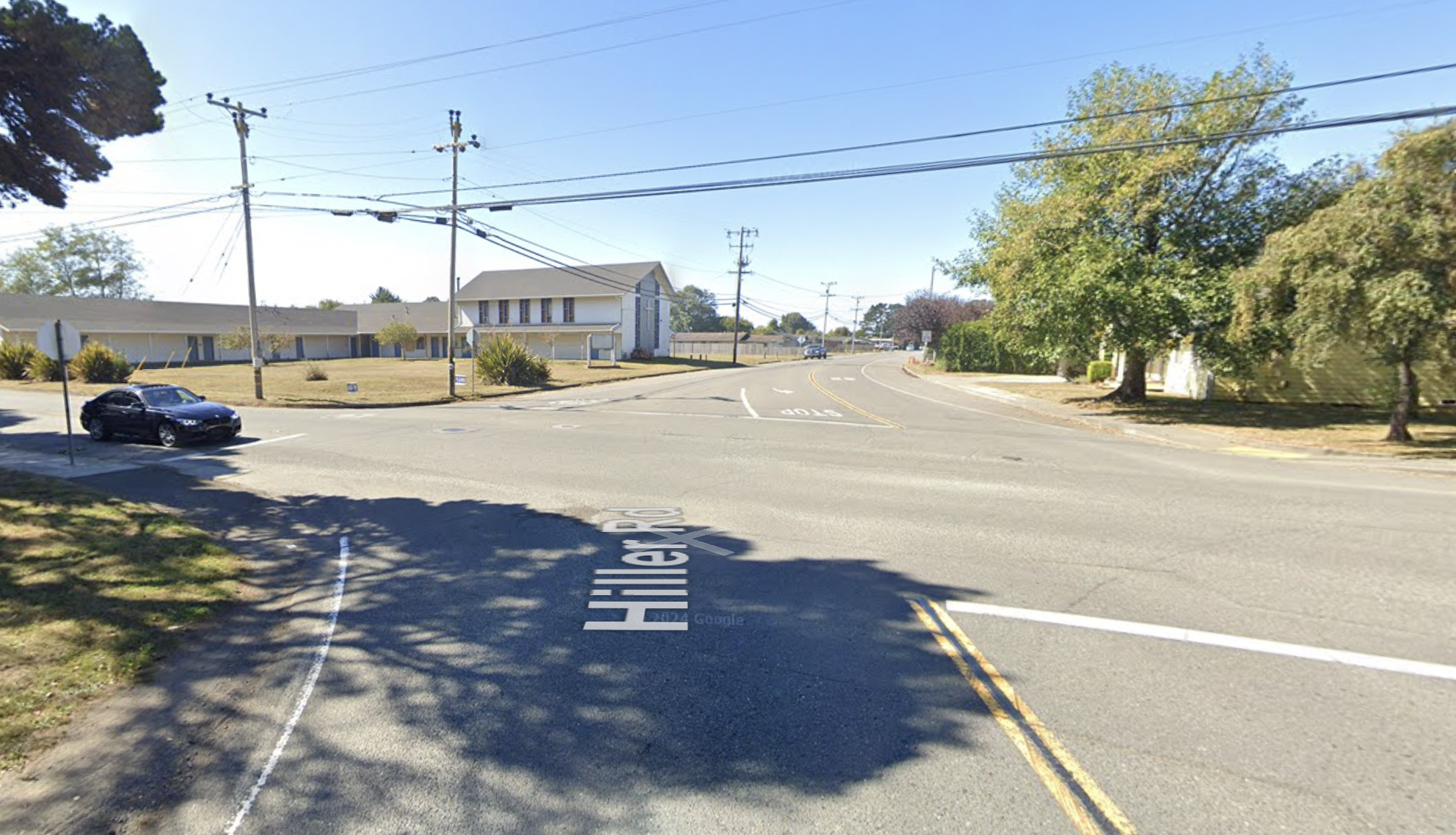
The future site of the pop-up roundabout at Hiller Rd. and McKinleyville Ave. | Image via Google Street View.
###
If you’ve driven through McKinleyville in the past week or so, you may have noticed Public Works staff doing some prep work for a big road improvement project on Hiller Road. That’s the Hiller Road Quick-Build Project, which aims to test out traffic-calming measures on Hiller Road — between McKinleyville and Central avenues — before moving forward with permanent construction.
The project includes a temporary roundabout at the intersection of Hiller Road and McKinleyville Avenue, as well as buffered bicycle lanes, new signage and public art murals.
More information can be found in the following press release from the Humboldt County Department of Public Works.
###
The Humboldt County Department of Public Works is thrilled to announce that work to install the Hiller Road Quick-Build Project, aimed at improving safety on Hiller Road between the intersections at McKinleyville Avenue and Central Avenue, is ongoing in McKinleyville.
Preparation work to install this temporary project began on Sept. 25 and the project installation is expected to continue through the end of this month and in November, weather permitting. As part of this project, local artists will be painting murals on Hiller Avenue.
A quick-build project is a fast, temporary way to make streets safer for everyone as they help clam traffic and protect pedestrians. Quick-builds are not meant to be permanent but are often used to test design ideas for future, long-term safety improvements to roads. The quick-build pop up in McKinleyville includes installing temporary bike lanes, rubber posts to protect the bike lanes, a temporary roundabout with speed humps, signage and crosswalks and public art murals.
Background
The Hiller Road Quick-Build Project is a partnership between the Humboldt County Public Works Department and McKinleyville Municipal Advisory Committee (MMAC) to test out road safety design features, gather community feedback and add some color and creativity to Hiller Road, between Central and McKinleyville avenues, in McKinleyville. It is the first quick-build project of its kind by Humboldt County’s Public Works Department, thanks to road improvement funding provided by Measure O tax dollars.
Additionally, Public Works and the MMAC have partnered with Sea Goat Farmstead and Folk School to bring colorful murals to the quick-build. Funding for the project’s murals will be provided by generous community donations.
“This project really came about after the community raised concerns about safety along this stretch of road in McKinleyville,” said Fifth District Supervisor Steve Madrone. “I’m excited to see this project move forward. It will allow us test road safety improvements, gather community feedback on the design and showcase the work of our talented local artists. I’m thankful for every community member who has helped make this project a reality.”
This project is not a part of the McKinleyville Town Center Project. The Hiller Road Quick-Build Project was developed after years of studies focused on improving travel safety in McKinleyville for drivers, pedestrians, cyclists and individuals who use mobility devices. Since 2019, Public Works and the MMAC have discussed safety issues on Hiller Avenue, first identified in the McKinleyville Middle School Walkability Assessment and later reaffirmed in the 2023 McKinleyville Multimodal Connections Project.
The Hiller Road Quick-Build Project tests several of the recommendations made in these assessments in addition to featuring murals painted by local artists Ben Goulart, Gina Tuzzi, Toad and Soren Richards. The murals will be arranged to help calm traffic, improving safety for all road users while adding beauty to Hiller Avenue.
“We’re thrilled to see the Hiller Road Quick-Build Project come to life after years of community engagement on safer routes for walking and rolling,” said MMAC Chair Mary Burke. “I would like to thank Public Works for bringing this opportunity to MMAC and our partners at Sea Goat Farmstead and Folk School who helped us incorporate public art into the project. By testing these road safety measures and adding artwork to Hiller Road, we’re making McKinleyville safer and more vibrant for everyone.”
What to Expect
Work for this project is currently taking place along Hiller Road between Central to McKinleyville avenues. Humboldt County Public Works has finished removing paint on Hiller Road to prepare it for the quick-build pop up installation. Next steps include installing temporary bike lanes, rubber posts to protect the bike lanes, a temporary roundabout with speed humps, signage and crosswalks and the murals.
Road work is anticipated to continue this week through Thursday, Oct. 16 from 7 a.m. to 4 p.m. The murals are currently scheduled to painted on Friday, Oct. 17 through Sunday, Oct. 19 from 10 a.m. to 3 p.m. Community members are invited to stop by, walk along the route and see the artists in action while Hiller Road is transformed into an outdoor art gallery. Finally, the temporary roundabout installation is expected to take place at least two weeks after the murals dry, sometime in November.
All work for this project will be conducted as weather conditions allow. Work may be delayed or rescheduled due to rainy weather conditions. Residents are encouraged to drive slowly and follow all directions and traffic control devices within the project area. On the days of scheduled work, travelers should expect delays as one-way controlled traffic will be in place for safety purposes.
Once installed, the quick-build is expected to last for three months and up to one year.
Share Your Input
Once fully installed, community members will be invited to share input on the Hiller Road Quick-Build Project via an online survey. Additionally, Humboldt County Public Works will install a sign near the intersection of Hiller Road and Central Avenue, allowing community members to scan a QR code and share input on the quick-build project and how they feel about it.
Public input received will be reviewed and feedback from the community will help inform future road designs. More information regarding the public survey will be provided once the project is installed.
For more information about the Hiller Road Quick-Build Project, please call 707-445-7421.
Stay Informed
Humboldt County residents are encouraged to sign up to receive text and email alerts regarding county road conditions, including upcoming projects, road closures and chain requirements. Residents can sign up at humboldtgov.org/RoadsUpdates. By planning ahead and staying informed, you can minimize stress and make your travel experience more enjoyable.
Press release from the Humboldt County Sheriff’s Office:
The
Humboldt County Sheriff’s Office (HCSO) Major Crimes Division (MCD)
is seeking the public’s assistance as part of an ongoing
investigation involving a missing person last known to be in the
Southern Humboldt area in August 2023.
With
the 2-year anniversary of John’s disappearance upon us,
investigators are asking anyone who may have seen or had contact with
John Starr Vang, age 36, around mid-August 2023 to come forward. John
is described as a Hmong male adult approximately 5’2”, 165 pounds
with black hair and brown eyes. John was reported missing by his
family and loved ones in March of 2024 and was believed to be working
on a marijuana grow at a rural property in the Panther Gap area near
Honeydew in the Southern Humboldt area during the time of his
disappearance.
As
part of this effort, the Sheriff’s Office is also attempting to
identify three adult Hmong females (shown below) who were seen in the
company of John at the Walmart in Eureka on August 14, 2023. The HCSO
is also attempting to locate a Hispanic male known only as Mateo who
used to work with John on the same farm. These individuals may have
important information that could assist in the investigation.
Anyone
who may have interacted with John during the summer of 2023 or who
may have knowledge of individuals residing or working in the Panther
Gap area of Southern Humboldt during that time is urged to contact
Investigator Buihner with the HCSO Major Crimes Division at (707)
445-7251 and reference case number 202401065.
This story was originally published by CalMatters. Sign up for their newsletters.
###
A new California law aims to keep more short children in booster seats for longer, imposing fines if they can’t properly wear their seat belt.
Last week, Gov. Gavin Newsom signed a watered-down version of Assembly Bill 435 that originally proposed to ban smaller teenagers from sitting in the front seat and to require short-statured youth to use booster seats into their middle school years.
But enough of the Democrats who control the Legislature balked at ending the time-honored tradition of teens calling “shotgun” to ride in the front seat.
Instead, they settled on changing the standards police officers use to determine if a child is tall enough to safely wear a seatbelt while riding in a vehicle. Currently, California law requires children to use booster seats until they turn 8 or reach a height of 4 foot 9 inches.
That won’t change under the law Newsom signed. But beginning in 2027, children from 8 to 16 years old will have to pass a five-step test to be considered properly restrained by a seat belt under California law.
If the driver of a vehicle can’t answer “yes” to all of these five questions about their seat-belted child passenger, the driver could get a ticket and fines of $490.
1. Does the child sit all the way back against the seat?
2. Do the child’s knees bend comfortably at the edge of the seat?
3. Does the belt cross the shoulder between the neck and arm, resting on the collarbone?
4. Is the lap belt as low as possible, touching the thighs?
5. Can the child stay seated like this for the whole trip?
The bill’s proponents said the point is to encourage children and their parents to stay in booster seats until they’ve grown tall enough for a seat belt to fit them properly. The new rules are in line with recommendations public health officials and the California Highway Patrol have for years encouraged parents to follow.
Advocates cite numerous studies showing that small children in car wrecks are more likely to be severely injured or killed because seat belts aren’t designed for their small frames. It’s also especially dangerous for small-framed children to sit up front.
“The longer the child can be using a booster if they do not meet the test, the better, because it is so important to have the belt in the right place,” said Stephanie Tombrello, the former executive director SafetyBeltSafe U.S.A. and a longtime proponent of seat belt laws.
Original bill was a tough sell
The original version of the bill would have banned teens up to 16 years old from sitting in the front seat if they couldn’t pass the five-step test.
The bill also would have required all children younger than 10 to use booster seats and bar all those under 13 from sitting in the front seat. The measure also would have required children as old as 13 to use a booster seat unless they passed the five-step test.
But even with child and automotive safety and health care groups supporting the bill, it proved to be too tough a sell in its original form for its author, Democratic Assemblymember Lori Wilson of Suisun City.
Her bill sailed through its first two committees. Then, in May, the bill died when Wilson brought it to the Assembly floor. It needed 41 votes to pass. It got 35, with 25 Democrats not voting, which counts the same as voting “no.”
As CalMatters reported, Democrats almost never vote “no” on their colleagues’ bills. Instead, they typically don’t vote at all. In the Capitol, it’s seen as a more polite way of saying “no” and less likely to lead to retaliation. Not voting also allows politicians to dodge accountability for controversial votes since it’s difficult for a member of the public to determine if a particular lawmaker was actually there to vote that day.
Wilson told CalMatters that part of the resistance from her Democratic colleagues was fallout over controversial legislation that sought to increase penalties for teen sex solicitation. That legislation raised difficult questions in the Democratic caucus about how hard to crack down on those accused of soliciting sex from minors, based on whether the victims were younger or older teenagers.
Then along came Wilson’s bill soon after. Wilson said conservative media outlets made comparisons between the bills, since hers sought to have the state treat some teens like small children. That was seen as hypocritical given the resistance from progressive Democrats to increasing penalties for those soliciting sex from older teenagers.
“It then started getting eyes on it,” she said. “And people started talking about, ‘Well, actually, I have a 10-year-old, and they don’t want to sit in a booster seat. I don’t want them to sit in a booster seat.’”
None of the Democrats who didn’t vote on the bill in May spoke during the bill’s brief Assembly floor hearing.
Of the Assembly Democrats who didn’t vote that day, CalMatters requested interviews this week with five of them, all of whom have children.
The following month, Wilson brought the bill back to the Assembly. Noting that many of her colleagues were leery of the bill, she promised to fix it in the Senate.
With her assurances, the bill squeaked by with 42 votes. Then, after the most controversial provisions were removed, it passed the Senate unanimously.
Wilson said she’s satisfied with the version of the bill that Newsom signed and has no plans to resurrect the more controversial measures in future legislation.
“I think just changing the culture, and now it being required by law to properly restrain your child,” she said, “I think that’s enough to push parents to make the right choice for their kids.”
This story was originally published by CalMatters. Sign up for their newsletters.
###
On Monday, Gov. Gavin Newsom signed a set of bills meant to recognize incarcerated firefighters, including a historic measure to raise their pay to meet the federal minimum wage during active fires.
The wage increase, funded through the state budget, follows years of advocacy to improve pay and working conditions for incarcerated labor. That effort took on a new urgency after hundreds of incarcerated firefighters were deployed to battle deadly wildfires that hit Los Angeles in January.
State lawmakers this year introduced a seven-bill “Firefighting to Freedom” package to protect incarcerated firefighters and support job opportunities upon their reentry. Five of those bills were signed into law today, marking the most comprehensive changes to incarcerated firefighting in the state’s history.
Incarcerated firefighters previously earned between $5.80 and $10.24 per day, according to the California Department of Corrections and Rehabilitation. During active emergencies, Cal Fire pays them an additional $1 per hour. Now, they will earn $7.25 per hour when they’re on a fire.
Assemblymember Isaac Bryan, a Democrat from Culver City who authored the bill, said Californians should feel proud about the sense of moral clarity that crossed party lines.
“This is a historic and momentous day,” said Bryan. “The governor signing the bill is an incredibly powerful reminder that all labor is dignified and anybody who is willing to put their lives on the line deserves our gratitude.”
Bryan initially set out to raise wages for incarcerated firefighters to $19 per hour, but settled on the federal minimum wage after budget negotiations. The bill was opposed by the California State Sheriffs’ Association over concerns of its potential fiscal impact on counties, which administer jails and could also face pressure to increase pay for incarcerated labor.
It received bipartisan support from nearly two dozen lawmakers.
“A number of years ago, when I worked for Cal Fire, you have never seen men work harder than with these crews,” said Assemblymember Heath Flora at a legislative hearing in September, a Republican from Ripon who co-authored the bill. “There is not a system — there is not a program — better than the fire camps with Cal Fire and the state of California.”
Bryan introduced the bill after voters last year rejected a ballot measure that would have ended forced labor in prisons and jails. It would have amended the state’s constitution to repeal language that allows involuntary servitude as a form of criminal punishment, making work assignments voluntary.
California’s incarcerated firefighters have long provided critical support to state, local and federal government agencies in responding to various emergencies, including wildfires and floods. They’re voluntary assignments.
Over 1,800 incarcerated firefighters live year-round in minimum-security conservation camps, also known as “fire camps,” located across 25 counties in California, according to the corrections department. Those numbers have dwindled in recent years due to a declining prison population.
Two of the proposals did not pass, including one that would have required Cal Fire to create more opportunities for incarcerated firefighters to secure firefighting jobs upon their release. The proposal, Assembly Bill 1380, did not reach Newsom.
That was disappointing to Royal Ramey, a formerly incarcerated firefighter who co-founded the nonprofit organization Forestry and Fire Recruitment Program, which sponsored the measure. But he said the other five bills signed by Newsom are “huge progress.”
“For me, transitioning from fire camp into a career was one of the hardest challenges of my life, and I know too many people who never got that chance,” said Ramey. “With these laws, we can change that story.”
The package of bills Newsom signed included:
Assembly Bill 247: Requires incarcerated firefighters be paid $7.25 per hour while actively fighting a fire.
Assembly Bill 799: Requires the California Department of Corrections and Rehabilitation pay a death benefit of $50,000 for the death of an incarcerated firefighter.
Assembly Bill 812: Requires the corrections department to create regulations around referring incarcerated firefighters for resentencing.
Assembly Bill 952: Requires the corrections department to establish and expand the Youth Offender Program Camp Pilot Program as a permanent program.
Senate Bill 245: Streamlines and expedites the expungement process for formerly incarcerated firefighters.
“It’s incredibly heartening to see that the Legislature has taken the issue of protecting incarcerated firefighters seriously,” said Taina Angeli Vargas, executive director of the nonprofit organization Initiate Justice Action, which co-sponsored most of the bills. “It’s about time that the state of California began to treat them with more respect and dignity.”
Assemblymember Sade Elhawary, a Democrat from Los Angeles who authored the law to establish and expand the youth pilot program, said it’s an opportunity for the 13 other states that have incarcerated firefighters to “follow in the footsteps of California.”
“I hope this is the beginning of what will be a national movement to elevate the rights and opportunities for incarcerated firefighters,” she said. “All of these folks deserve more love and support.”
It’s been almost a month since staffers for the Northcoast Environmental Center (NEC) went on strike, and no progress has been made towards a resolution.
Larry Glass, the NEC’s public lands director and secretary for their board of directors, said the staffers haven’t responded to any of the NEC’s letters, phone calls, or emails.
Glass said the NEC was not planning to punish them for forming a union, but the rest of their demands (which include editorial control of the NEC’s publication EcoNews, ceasing contact after work hours, and the right to “self-direct [their] own labor”) were “impractical or impossible to meet.”
“They wanted us to turn the organization’s assets over to them and stop telling them what to do,” Glass told the Outpost in an interview. “That’s the best way I could describe it…There’s no way we could function as a 501(c)(3) if we agree to those demands.”
The strikers have not responded to requests for comment sent to their email or to their Instagram account.
The union did start a crowdfunding effort on GoFundMe Oct. 1 to replace their lost incomes. It’s raised $309 out of a goal of $4,000 as of publication.
The union’s silence has halted negotiations to a stalemate, though they also claim on social media that the NEC also hasn’t responded to any of their attempts at outreach. An Instagram account claiming to represent the strikers posted an update on Sept. 25 claiming that the board hadn’t told the strikers its views on the strike, nor the five staffers’ unionization last month.
In the meantime, Glass said the NEC was soldiering along. Their annual Coastal Cleanup Month was left unfinished, and October’s EcoNews wasn’t published. Many members who had set up automatic donations ended them, drastically lowering the NEC’s income — but with all of their staff on strike and no paper to print, their overhead is also low.
It’s been a struggle to get things going again. According to Glass, a dissection of the EcoNews office after the strike started revealed a trove of uncompleted work and uncashed checks. Office computers had been password protected and were difficult to access.
He’s not overly optimistic about the possibility of a simple end to the ordeal.
“They’re going to have to really rethink their demands before there could be any forward movement,” Glass said.
Press release from the Humboldt County Sheriff’s Office:
On
Oct. 11, 2025, at approximately 5:04p.m., Humboldt
County Sheriff’s deputies responded to a welfare check in the 800
block of Mad River Road following reports of an intoxicated adult
female walking in the road with two small children.
Deputies arrived
at the scene and located the woman, later identified as 38-year-old
Mary Elizabeth Miller, along with three children.
During their
investigation, deputies learned that Miller and her children gone to
a local pumpkin patch where witnesses reported she was drinking
alcoholic beverages while at the event. Upon leaving the event on
foot she was observed falling down several times while holding one of
the children. One of the children had visible injuries that did
not require immediate medical attention.
Child Welfare
Services (CWS) was notified. Following their contact with the
children’s father, the children were safely released into his
custody.
Based on their
investigation and witnesses’ statements, deputies arrested Miller
and transported to her to the Humboldt County Correctional Facility.
She was booked on the following charges:
P.C.
273d(a)– Child Abuse (Infliction of corporal punishment or injury)
P.C.
273a(a)– Child Endangerment
P.C. 647(f)
– Public Intoxication
Anyone with
information about this case or related criminal activity is
encouraged to call the Humboldt County Sheriff’s Office at (707)
445-7251 or the Sheriff’s Office Crime Tip line at (707) 268-2539.
Squeeze that ball! Photo by Rahul Sapra via Pexels.
Press release from the Northern California Community Blood Bank:
The
Northern California Community Blood Bank is sounding the alarm as
supplies of O+ blood have reached critically low levels. This urgent
shortage is attributed to increased local use, highlighting the
pressing need for donations from individuals with this vital blood
type.
O+
blood is essential for numerous medical treatments and emergencies,
as it is one of the most commonly needed blood types. Its versatility
allows it to be used for patients with multiple blood types, making
it a crucial component of our healthcare system.
In
light of this urgent situation, the Northern California Community
Blood Bank calls upon all individuals with O+ blood to step forward
and donate. Your contribution can directly impact the lives of
patients in need, ensuring they receive the critical care and
transfusions that can save lives.
Donating
blood is a simple yet powerful way to give back to the community. We
invite you to make a difference by donating today!
Please
visit the Northern California Community Blood Bank’s website
at nccbb.org,
or call 707-443-8004 for more information.
Thank
you for your immediate attention to this urgent matter and for your
generosity in helping to replenish our O+ blood supplies. Together,
we can ensure that patients receive the care they deserve.