

Sheriff’s Office Asks Public for Any Information They May Have About the Disappearance of Emmilee Risling Four Years Ago
LoCO Staff / Wednesday, Oct. 15, 2025 @ 9:56 a.m. / Crime
Press release from the Humboldt County Sheriff’s Office:
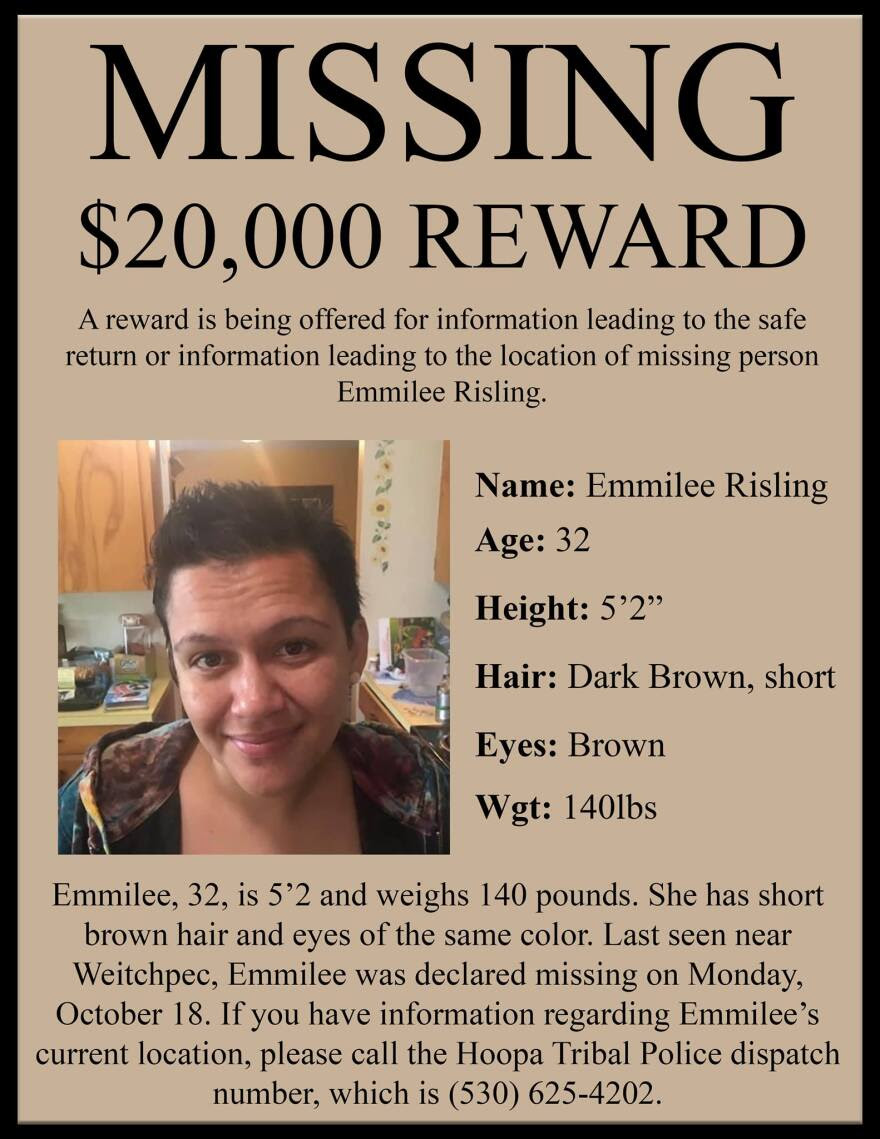
Poster. Click to enlarge.
This October will be the 4-year anniversary of the disappearance of Emmilee Renea Risling. The Humboldt County Sheriff’s Office is once again asking for the public’s help locating Risling. She was last seen October 14th, 2021, on the Pecwan Bridge near Johnson (Wautec).
A $20,000 reward is being offered for information leading to the safe return or information leading to the location of missing person Emmilee Risling. Risling is described as a Native American female 32 years old (at the time of her disappearance), 5’- 2”, 140 pounds, brown eyes, and short dark brown hair.
Anyone with information is asked to call Cold Case Detective Mike Fridley at 707-441-3024.
###
PREVIOUSLY:
- MISSING: Family Seeks 32-Year-Old Native American Woman Missing For Over a Week
- Search for Missing Hupa Mother Continues as Intertribal, Interagency Team Expands Efforts
- Yurok Tribe Declares Emergency Following a Series of Human Trafficking Attempts
- (VIDEO) Focusing on Yurok Tribe, Associated Press Explores the Crisis of Missing and Murdered Indigenous Women
- New York Times Publishes Heartbreaking Story on the Search for Emmilee Risling
BOOKED
Today: 3 felonies, 10 misdemeanors, 0 infractions
JUDGED
Humboldt County Superior Court Calendar: Friday, Oct. 9
CHP REPORTS
1510 Mm169 E Hum 15.10 (HM office): Traffic Hazard
0 Us101 (HM office): Closure of a Road
ELSEWHERE
RHBB: Marshall Fire Breaks Out Near Hoopa as Crews Battle Two Other Fires in Northeastern Humboldt
RHBB: Eastern Humboldt Surgeon Fire Draws Full Response: Airtankers Requested
RHBB: Humboldt Builders Exchange Works to Fill Construction Jobs as Aging Workforce Nears Retirement
RHBB: Prescribed Burns: Today in Ocean Ranch Near Loleta and Tomorrow near Ettersburg
Newsom Vetoes Car Dealers’ Bill to Hike Fees on Buyers
Ryan Sabalow / Wednesday, Oct. 15, 2025 @ 7:36 a.m. / Sacramento

A line of electric vehicles at a Hyundai dealership in Fresno on Sept. 7, 2023. Photo by Larry Valenzuela, CalMatters/CatchLight Local
###
This story was originally published by CalMatters. Sign up for their newsletters.
###
Gov. Gavin Newsom vetoed a bill that would have allowed California’s car dealers to tack on another $175 in fees to the cost of buying a vehicle.
On Monday, Newsom announced he wasn’t going to sign Senate Bill 791, which would have raised the fees dealers can charge to process Department of Motor Vehicles and other paperwork from $85 to up to 1% of the purchase price, capped at $260.
In his veto message, Newsom said the fee increase made little sense since a car buyer would be paying a dealership “for only minutes of data entry.”
“At a time when Californians are already struggling with the high cost of living,” Newsom wrote, “this bill would raise the document processing fee to three times the current $85 cap – far beyond what an inflation adjustment would justify.”
Brian Maas, president of the California New Car Dealers Association, said in an emailed statement that the state’s car sellers “were extremely disappointed” by the veto.
Maas said the current $85 cap on the document-processing fee is “by far the lowest in the country.” The now-dead fee increase, he said, would still have been at “the bottom quartile of such charges across the nation.”
Car dealers argue that the Legislature continually passes new laws that add to their costs. They say other kinds of businesses are allowed to recoup those costs through service charges, but dealers can’t because the $85 cap is set in state law.
The dealers were especially frustrated with Newsom’s veto because he also signed a measure this month that adds a number of requirements on car dealers that are intended to prevent buyers from getting suckered as they haggle over the price of a vehicle.
Notably, that measure, Senate Bill 766, creates a first-in-the-nation policy that allows a used car buyer to return a vehicle for a full refund within three days if the purchase price was less than $50,000. Dealers can charge a restocking fee.
The new law requires dealers to disclose the full costs up front, and it prohibits dealers from charging for add-ons that have no benefits to the buyer, such as free oil changes for electric vehicles — which don’t need oil changes.
The law takes effect Oct. 1, 2026.
Maas said “the Legislature continues to place more burdens on dealers. SB 766 only added significantly to those responsibilities, which makes the veto of SB 791 all the more disappointing.”
The California New Car Dealers Association has donated at least $3 million to legislators since 2015, according to the CalMatters Digital Democracy database.
How did the fee increase easily pass?
It was perhaps surprising that the bill to hike fees made it to the governor’s desk at all, given that legislative leaders from both parties had promised to lower costs this year.
Yet the Senate overwhelmingly passed an earlier version of the bill that was even more expensive. It proposed upping the fee to $500.
Only one of the Legislature’s 40 senators, Calabasas-area Democratic Sen. Henry Stern, voted “no.”
After CalMatters reported on the controversial measure passing the Senate, its author, San Jose Democratic Sen. Dave Cortese lowered the proposed fee in the Assembly first to $350 and then eventually to $260.
Cortese said in an interview the amount the Legislature settled on would have provided the minimum dealers need to recoup their costs to pay employees who might “spend an hour and a half filling out documents” state regulations require for a single sale.
“There’s 113 different documents now that we’ve created,” he said. “Every single one of them is legislative created. … We were trying to get fair remuneration for fair work.”
In the Assembly, the bill passed with only three Democrats – Alex Lee of San Jose, Jacqui Irwin of Thousand Oaks and Tasha Boerner of Solana Beach – voting “no.” Seventeen other Assembly members didn’t vote at all, which counts the same as voting “no.”
As CalMatters reported, Democrats almost never vote “no” on their colleagues’ bills. Instead, they typically don’t vote at all. In the Capitol, it’s seen as a more polite way of saying “no” and less likely to lead to retaliation from other lawmakers and lobbyists.
With so much talk of lowering costs this year, Cortese said he could understand why the governor wasn’t as receptive to his arguments about fairness to car dealers as his colleagues in the Legislature were.
“The perception was stalking us the whole way through, no question about it,” Cortese said. “And I can understand why the governor would be sensitive to that.”
Rosemary Shahan of Consumers for Auto Reliability and Safety said she was “thrilled to bits” that Newsom vetoed the would-be “junk fee” increase and signed the law protecting car buyers from “the kind of bait-and-switch that goes on” when buying a vehicle.
She said the new three-day cooling-off period to return a vehicle will be especially helpful, allowing buyers to review their paperwork without pressure. They can also have their vehicles inspected by an independent mechanic to make sure they didn’t drive a lemon off the lot.
She called Newsom’s actions this year “huge wins for California car buyers.”
OBITUARY: Stanley Daniel Stevens II, 1985-2025
LoCO Staff / Wednesday, Oct. 15, 2025 @ 6:56 a.m. / Obits

In Loving Memory of Stanley Daniel Stevens II
March 25, 1985 – Oct. 9, 2025
It is with heavy hearts that we announce the passing of Stanley Stevens, a devoted husband, loving father, cherished son, brother, and uncle. He left this world on Oct. 9, 2025.
Stanley was a man of deep loyalty, strength, and heart. He proudly served his country with honor and dedication through his six years/ SRG E5 /Army, embodying the true spirit of service and sacrifice. His commitment to the military and his fellow servicemen and women was matched only by the love he had for his family.
When he wasn’t serving his country, Stanley found peace and joy in the outdoors. Hunting wasn’t just a pastime — it was his way to connect with nature, reflect, and share meaningful time with those he loved. Whether in the woods at sunrise or telling stories around a campfire, he brought warmth and laughter wherever he went.
Preceded in death by Grandma Amy, Grandpa Etcyl, Grandma Lloyce, Grandpa Duane, Grandpa Shermon, Grandma Dorothy, Grandpa Clide, Grandma Penny, Uncle Shannon, Uncle Chuck,Aunt Lenore, Uncle Bryan.
He is survived by his loving wife, Emily Stevens; his 5 children, Elizabeth, Lolah, Weston, Duane, Derick; his dad Stanley Stevens, mom Sharold Stevens, mother Paula Fulcher; and his siblings, Dorothy Stevens, Tisha Hanson, Lenore Weber, Spencer Stevens, Sidney Stevens. He will also be deeply missed by many nieces, nephews, and friends who were blessed to know him.
Stanley’s legacy of love, courage, and devotion will live on through all who were fortunate enough to be part of his life. Though our hearts ache, we find comfort in knowing he is at peace and his spirit will forever guide us.
A service to honor his life will be held on Oct. 26, 2025 at 1 p.m. at Bull Creek cemetery. Take South Fork Honeydew off ramp. Turn right and follow out to cemetery. A celebration of life and potluck will be held at the Veterans Hall in Fortuna immediately following. In lieu of flowers, the family asks that donations be made to veteran’s organization.
###
The obituary above was submitted on behalf of Stanley Stevens’s loved ones. The Lost Coast Outpost runs obituaries of Humboldt County residents at no charge. See guidelines here.
OBITUARY: Yvonne Marie (LaFlame) Jones, 1941-2025
LoCO Staff / Wednesday, Oct. 15, 2025 @ 6:56 a.m. / Obits
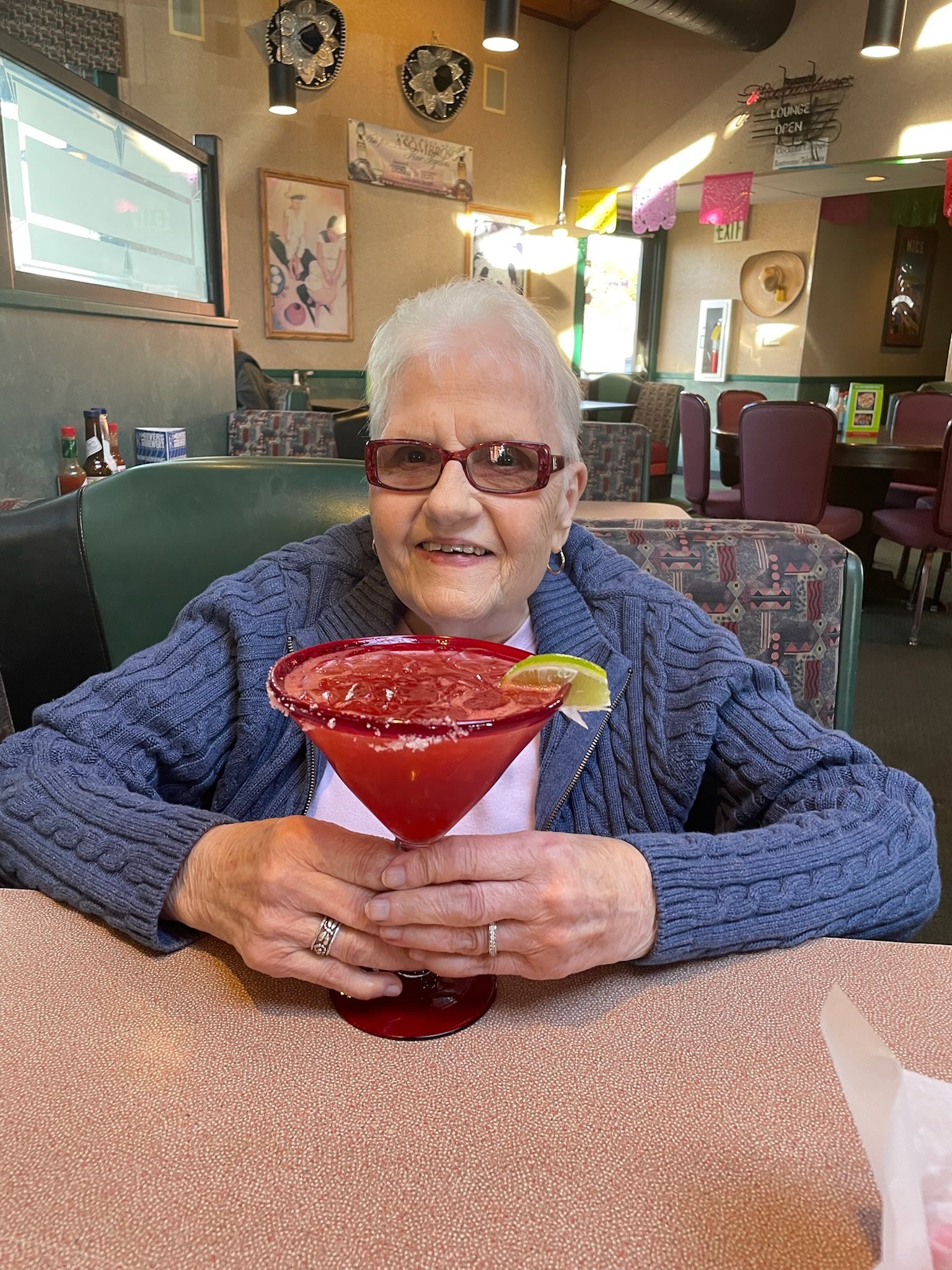
Born January 25, 1941 in Milwaukee, Wisc. to parents Alonzo Joseph and Jeanette Marie (Guilbault) LaFlame, and departed on October 8, 2025. She was the youngest of three siblings. Her sister Mary Janice (LaFlame) Boyd Proctor, brother Alonzo Joseph LaFlame Jr., brother in-law James ‘Jim’ DeMoss, and ex-husband Richard ‘Dick’ Ross Jones are since deceased.
She is survived by her son Robert ‘Bob’ Ross Jones, daughter in-law Beth (Turner) Jones, and grandson Owen Ashby Jones; sister in-law Patricia LaFlame and sister in-law Sone (Jones) Piper; nieces Lisa LaFlame, Cindy (LaFlame) Justice, and Karin (Piper) Harmon; nephews Mark Piper and Bill “Billy” Boyd.
Her family moved to Southern California when she was still in high school. She graduated from Hollywood High in 1959 with the likes of Linda Evans and Stephanie Powers. She met her first and only husband on a blind date and they were married shortly thereafter in 1961. She and Dick loved to take road trips to places like Las Vegas and Virginia City.
They adopted their only child at six weeks old in 1966, while living in a small apartment in Glendale, Calif. They relocated to Bakersfield, Calif. shortly after in pursuit of Dick’s career as an embalmer and funeral director. She had a variety of odd jobs, including working the switchboard at Three-Way Chevrolet and doing hair at the funeral home. Unfortunately after her initial debilitating injury in the early seventies, she endured a countless series of surgeries throughout the rest of her life, most of which revolved around multiple fusions of her spine. In spite of these setbacks she was a model of vitality.
She was a devoted wife and mother and helped to raise Great Danes. Their travels became largely consumed with showing dogs until they divorced in 1980. Afterwards, she and her bestie Shirley Hall, also recently divorced, hit the town like they had a new lease on life. They spent many a night whooping it up and two-stepping at Trouts or one of their favorite spots in Morro Bay or playing bingo. She eventually settled in with a new bunch of friends like Breck and Carl, with whom she happened to share a birthday, who she’d hang out with at the piano bar in the old Padre in downtown Bakersfield.
She relocated to Arcata shortly after her grandson ‘Owie’ arrived in 2006, and lived out the rest of her years there.
“Nana,” as she came to be known by many of those closest to her, was loved for her open heart and adventurous spirit. She even inspired a rousing chant of “Bob’s mom rocks!” that can still be heard every year around the campfire at Mike & Bob’s Easter Xtravaganza. She had an uncanny way of making friends with the most unlikely people, like Patty and Melissa in Bakersfield, or Beverly and Kay in Arcata, all of them notably younger than her — with the exception of Carl — and maintaining those ties until the end. She also had the curious ability to get the better of a slot machine, after which she’d always share her winnings with whoever she was with. She maintained a winning attitude in spite of her various afflictions and was a wealth of moral support to those she loved. Our worlds will never be the same without her.
As she was a great lover and defender of animals. Please give to your local animal shelter in lieu of flowers. A special thanks to her caregivers at St. Joseph Hospital in Eureka, Hospice of Humboldt, and Timber Ridge in McKinleyville. There will not be a memorial service but a local celebration of life will be announced.
###
The obituary above was submitted on behalf of Yvonne Jones’s loved ones. The Lost Coast Outpost runs obituaries of Humboldt County residents at no charge. See guidelines here.
OBITUARY: Michael Shaun Dolan, 1965-2025
LoCO Staff / Wednesday, Oct. 15, 2025 @ 6:56 a.m. / Obits

Michael Shaun Dolan, affectionately known to most as “Shaun,” was loved just as much as “Milt” or “S.D.” left us much too soon on Monday, July 28, 2025. He was born on April 14, 1965, in Washington, D.C., and grew up in Columbia, Maryland. Shaun had passions for sports, music, and spreading smiles. He loved the Grateful Dead, The Meters, The Baltimore Orioles and the Washington Redskins.
Shaun attended Atholton High School before graduating from St. Vincent Pallotti High School. He excelled as both a baseball and football player. He continued his athletic journey at Salem University on a partial baseball scholarship. After college, Shaun’s adventurous path took him to Ocean City, Maryland. He made his way to Eureka via Allentown, Pennsylvania, Lake Tahoe and San Francisco. Shaun’s web of love and friendships spread far and wide.
Shaun found his true calling in the music industry. His talent for booking and promoting musical acts was invaluable to many bands who appreciated his hard work. From George Porter of the Meters, Melvin Seals of the Jerry Garcia Band, and many others. Perhaps one of his best-known accomplishments was the “Las Tortugas” festival, hosted at the Evergreen Lodge near Yosemite National Park.
Shaun is survived first and foremost by his daughter, Avery, who was the light of his life and the pride of his heart. He is also survived by his sister Erin Leishear and stepbrothers, Bob Newman and Scott Hildreth, and countless friends.
Shaun will be remembered as a beloved father, friend, teammate, mentor, coach, umpire, and presence at many community and musical gatherings. Whether on the sports field, enlivening the Medieval Fair, or dancing with you at a live show, Shaun’s presence brought people together and filled every gathering with warmth and laughter. His wide circle of friends is a testament to his generous spirit and irrepressible humor.
Shaun’s family and friends invite all who knew him to remember his vibrant spirit — with music, laughter and stories shared in his honor.
A celebration of life/memorial will be held on October 18, 2025, at the Septentrio Winery Barrel Room, beginning at 12 p.m., for close friends and family. There will be a fundraising celebration, including music for all, starting at 6 p.m.
###
The obituary above was submitted on behalf of Shaun Dolan’s loved ones. The Lost Coast Outpost runs obituaries of Humboldt County residents at no charge. See guidelines here.
READY to PICKLEBALL? Then You Must Check Out This Comprehensive Video on the Humboldt County Pickleball Scene, Which a Very Chill Guy Has Put Together
Hank Sims / Tuesday, Oct. 14, 2025 @ 1:30 p.m. / LoCO Sports!
Pickleball has been sweeping the nation for the last few years, growing bigger and bigger and bigger as more people get out there and find their places on the ever-growing number of courts.
But where to pickleball in Humboldt? What’s the scene like at those spots?
Until now, we lacked a comprehensive all-in-one guide to answer these questions. But no longer! Now steps forward YouTuber @Junnyinthesun — a very friendly, welcoming narrator — to show you what’s happening at each of Humboldt County’s pickleball spots. Did you know they’re even pickling it up down in Shelter Cove?
Junny makes use of beautiful video, some of which was shot by Friend o’ the LoCO Rowdy Kelley, and all of which shows a surprisingly huge number of people getting down on courts around the county.
You no longer have any excuse to not pickleball.
And join the Humboldt County Pickleball Facebook group, which includes awesome fun memes, scene reports from traveling Humboldt County pickleballers, video of someone playing glow-in-the-dark pickleball at nighttime at a local court and — true to pickleball’s reputation as the most community-minded of all pastimes — local ballers offering big ups to one another for their successes off the court, or GoFundMe links for pickleballers who have suffered setbacks.
###
[CORRECTION! This story originally implied that Kelley shot most or all of the footage in the above video, when in fact he only shot a bit of it and Junny shot the bulk of it. Sorry, Junny!]
U.S. Supreme Court Declines to Review Case Challenging Humboldt County’s Cannabis Code Enforcement Process
Ryan Burns / Tuesday, Oct. 14, 2025 @ 11:57 a.m. / Courts
UPDATE, 2:22 p.m.:
A county spokesperson emailed the following statement:
This is an important issue for the county; however, it is an ongoing legal matter, and we are committed to preserving the integrity of that process. For that reason, the county is unable to provide further comment on this subject to the press at this time.
###
Original post:

West façade of the Supreme Court Building. | Photo via the U.S. Supreme Court.
###
PREVIOUSLY
- Federal Judge Tosses Class Action Suit Challenging Humboldt County’s Cannabis Code Enforcement Process
- Appeals Court Reverses Dismissal of Class Action Suit Challenging Humboldt County’s Cannabis Abatement Penalties, Sending the Case Back to District Court
- Humboldt County Asks U.S. Supreme Court to Deny Review of Cannabis Fine Case
###
The U.S. Supreme Court today declined to hear a case arguing that Humboldt County landowners have a right to a jury trial when facing civil penalties for alleged violations of the county’s cannabis code.
In a statement that accompanies the petition’s denial, Justice Neil Gorsuch says that the case presented a poor vehicle to consider the fundamental constitutional question at issue: namely, whether the Seventh Amendment right to a jury trial should extend to state-level proceedings, including county code enforcement matters.
The case in question is Corrine Morgan Thomas, et al. v. Humboldt County, California, et al., a federal class action suit originally filed three years ago. The plaintiffs are a group of Southern Humboldt property owners, represented by the libertarian Institute for Justice , who allege that Humboldt County’s cannabis code enforcement practices are illegal. Specifically, their claim argues that the county levied exorbitant fines for alleged weed violations — in some cases by the prior owners of their properties — without giving them due process.
A federal judge dismissed the case in May 2023, noting, in part, that none of the plaintiffs had actually paid any of the proposed fines and that, furthermore, the county’s code enforcement regulatory framework “expressly provides for full-fledged judicial review after the conclusion of the administrative phase of the proceedings.”
However, a three-judge panel in the Ninth Circuit Court of Appeals overturned the dismissal late last year, finding that Humboldt County’s system of administrative penalties and fees may conceivably violate the Eighth Amendment’s prohibition on excessive fines.
While none of the plaintiffs have paid such fines, the appeals court found that the threatened penalties caused plaintiffs emotional and psychological distress, and that they had to spend money to abate and/or challenge the alleged violations. But the appeals court upheld the lower court’s dismissal of plaintiffs’ Seventh Amendment claim that they were deprived of a jury trial, citing as precedent the 1916 case of Minneapolis & St. Louis Railroad Company v. Bombolis, which holds that the Seventh Amendment’s right to a civil jury trial does not apply to state courts.
That precedent is exactly what the Institute for Justice was hoping to get overturned by the highest court in the land, and their petition garnered support from some heavy hitters on the political right, including the Cato Institute and the Buckeye Institute, both of which filed amicus briefs urging the Supreme Court to overturn Bombolis — as did Steven Calabresi, co-chairman of the Federalist Society, which has spent decades helping to pack the federal judiciary (including the Supreme Court itself) with right-wing appointees.
In a press release issued this morning, the Institute for Justice said its case will continue at the lower court level.
“The question of a civil jury trial was just one of the multiple ways that Humboldt’s code enforcement system violates the constitution,” the firm said.
Lead attorney Jared McClain added, “The Supreme Court’s decision not to take this case doesn’t change the fact that Humboldt’s scheme of crushing ordinary people under massive penalties for minor code issues is still unconstitutional—whether the fines are brought before a jury or not. We’ll continue fighting to stop it.”
Meanwhile, the Supreme Court may well be willing to overturn the Bombolis precedent if a better-suited challenge comes along. In his statement regarding the Humboldt case, Gorsuch describes that case as “something of a relic” and says its lingering presence on the books “not only leaves our law misshapen, it subjects ordinary Americans to a two-tiered system of justice.”
The Outpost reached out the the county this morning to request a response to the Supreme Court’s decision but has not yet heard back.
You can read Gorsuch’s statement on pages 18-21 of this document.


