A fireplace remains standing from a home that was burned down by the Eaton Fire in the Altadena and Pasadena area on Jan. 8, 2025. Photo by Jules Hotz for CalMatters
###
This story was originally published by CalMatters. Sign up for their newsletters.
###
Many Californians have seen rising costs, less availability and are running into other issues with insurance — including delays and denials of their claims — in the past several years.
As climate change increases the risk of wildfires and other disasters, it’s important to know how insurance plays a role. The health of the insurance market affects the ability of individuals and communities to replace, rebuild and recover after a catastrophe.
Disasters aside, property insurance affects where people live, how neighborhoods are formed, whether people can drive to work, and more.
As the state’s residents prepare to vote for a new insurance commissioner in November, here’s a look at a few common myths about insurance in California.
MYTH: Only homeowners and wealthy people should care about the state’s insurance issues.
FACT: Almost everyone needs insurance, including landlords, renters and small business owners. Anyone who drives needs auto insurance.
About 44% of the state’s residents do not own their homes, according to the U.S. Census Bureau. But their landlords have been dealing with increased insurance costs in the past several years, with some of them telling CalMatters that they have passed some of those costs along to renters.
The state does not require renters to buy their own insurance, although some landlords require tenants to get renters insurance. Consumer advocates recommend that renters have insurance in case they have to find an alternate place to live after a fire or other disaster.
Other providers of rental housing are also running into insurance-availability issues, which could affect housing supply.
A high-cost state like California needs all the affordable housing it can get. Affordable housing owners and operators say some insurance companies have moved away from offering insurance to commercial properties, including affordable housing units. Some of them have had to turn to “non-admitted” insurance companies, which are not licensed and regulated by the state — and not backed by the state if they go bankrupt. Some operators have had to tap their reserves to cover the increasing costs of insurance. They typically do not pass those costs along to renters because affordable-housing rules limit how much rent they can charge. Besides, they know their renters have limited incomes.
“If organizations have to come out of pocket to cover premiums, it’s just not sustainable,” said Erich Nakano, director of special projects for Little Tokyo Service Center, a Los Angeles community development group that owns more than 1,000 affordable housing units across different properties in the area.
Meanwhile, auto insurance premiums in California are among the highest in the nation. The insurance industry has said that’s due in part to growing disaster risks, as well as higher costs for replacing parts or repairing vehicles. Unlike housing or rentals — where people who don’t have a mortgage need not have insurance, and not all renters must buy coverage — everyone who wants to drive is legally required to have insurance.
MYTH: California’s insurance issues are all state lawmakers and regulators’ fault.
FACT: Many other states are dealing with higher insurance costs and availability problems. Climate change has sparked and worsened different kinds of natural disasters, such as hurricanes in Florida and tornadoes in Texas.
California’s voter-approved insurance law, Proposition 103 from 1988, is often a scapegoat for people frustrated by the state’s insurance market problems. Insurance is overregulated and the state should just let the free markets reign, the law’s critics say.
But low-regulation states like Florida continue to have issues with insurance affordability; its average home insurance premiums are the most expensive in the United States, according to the Insurance Information Institute, an industry group. Meanwhile, because of Prop. 103 and its provision that the Insurance Department must approve rate increases, California’s home insurance premiums rank somewhere in the middle.
As for other problems, like glacial insurance-claim processing or claim denials, the state’s elected insurance commissioner gets a lot of pressure to make those disappear. Some — such as survivors of the deadly Los Angeles County fires last year — have placed the blame squarely on Ricardo Lara, whose term is set to end this year. They called on him to resign.
A couple of insurance experts who are also consumer advocates said there is no “magic wand” that can make the insurance industry be as responsive as their customers want them to be, and no easy fixes for the other issues plaguing insurance markets everywhere.
“(Fire survivors) have the right to be angry about the impact of industry trends on them,” said Amy Bach, executive director of consumer advocacy group United Policyholders. But the insurance department’s authority over industry trends and practices — such as the number of adjusters that might be assigned to a claim — is limited, she said.
Lara’s department eventually found that State Farm, the biggest insurer in California, violated laws in its handling of claims from the L.A.-area fires. A yet-to-be-scheduled hearing before an administrative law judge will determine whether to impose the penalties suggested by the department.
MYTH: Insurance companies are struggling financially.
FACT: Insurers have seen record profit, and their executives’ pay isn’t too bad, either.
As insurance companies began to cancel policies in California a few years ago, the industry said the state failed to approve their requested rate increases quickly enough. They said their premiums were not matching the increased risk they were facing, especially after several major fires in the state.
Lara adopted new regulations to speed up rate reviews and allow insurance companies to base their rate requests on two additional factors: catastrophe modeling and reinsurance costs. That has led to rising premiums in California, just as they are in other states.
Insurers had record U.S. profits last year as they collected $68.7 billion in premiums, up from the $25.3 billion in premiums they collected in 2024, data from the National Association of Insurance Commissioners, a group of state insurance regulators, shows. Additionally, insurance companies’ financial cushion rose to an all-time high of $1.27 trillion last year, according to an analysis of the data by Public Citizen, a left-leaning consumer advocacy group in Washington, D.C., founded by activist Ralph Nader.
Those numbers were made possible by lower insured losses from U.S. extreme weather disasters last year than the previous year, the analysis said. The L.A.-area fires were the exception: They resulted in about $37.5 billion in losses. The regulators’ group called the fires some of “the costliest fires in world history.”
In 2024, chief executives at the 10 largest insurers in the country were paid a combined $134 million, according to the analysis. And another look at insurance executive pay, by Consumer Federation of America, shows that as insurers raised auto and homeowners insurance premiums in 2024, their CEO compensation also rose.
MYTH: The FAIR Plan is run by the state.
FACT: The plan is run by an alliance of insurance companies that do business in the state.
The FAIR Plan is mandated by law to sell fire insurance to property owners who can’t obtain insurance from anywhere else. All admitted carriers that sell insurance in the state are required to be in the plan, whose board is made up of industry insiders and whose operations are largely opaque. The state’s insurance department has taken legal action against the FAIR Plan, most recently accusing it of denying smoke-damage claims from the L.A. fires.
As of March, the FAIR Plan had more than 684,000 policies — nearly 663,000 for residential properties and more than 21,000 for commercial properties — up more than 152% since 2023.
Although the rate of growth of policies in the plan has slowed since late last year, the sheer number of policies still reflects a not-quite healthy insurance market. Customers of the FAIR Plan pay more for less coverage: They get fire insurance from the plan and must also obtain separate coverage for everything else.
Britney Alyssa Willison passed away tragically on June
16, 2026. She was born on January 16, 1991, in
Garberville, to Stefan Willison and Bonita
Corder.
Britney was raised by her dad, Stefan, and Tammy in the
Alderpoint and Redway communities. Some of her
happiest childhood memories were made on her
grandparents’ ranch in Alderpoint, where she spent
countless days with her dad, Nanny Judi and Papa
Kenny. She loved talking about those years — riding
around logging camp, helping on the ranch, and
spending time with her Nanny. Those memories stayed
with her throughout her life and always brought a smile
to her face.
She attended Casterlin Elementary before moving to
Redway around the age of eight. She continued her
education at Redway Elementary and Leggett Valley
School before graduating from South Fork High School
in 2010. During those years, Britney formed lifelong
friendships that remained some of the most important
relationships in her life.
As a young girl, Britney was a proud Bulldogs
cheerleader and later played volleyball at South Fork
High School. She loved being outdoors and treasured
family adventures at Ruth Lake, where camping,
swimming, laughter and time together created
memories she carried with her forever.
Britney met Kevin and they started their life together.
They welcomed their two greatest joys, their sons, Jaxon
and Liam.
She loved every adventure with her boys, whether they
were searching for marbles, being at the beach, hiking
beneath the redwoods or exploring somewhere new
together. One of her proudest moments was when
Jaxon killed his first buck with Papa Dave in the fall of
2025. She wanted every detail, every picture, and a
complete play-by-play because she couldn’t have been
more excited for him.
Britney had a gift for making people feel loved. She
cherished her family and her friends and never missed
an opportunity to spend time with the people who
meant the most to her. Whether it was going out for
dinner, wine tasting or simply sitting around “shooting
the shit,” as she would say, she found joy in the simple
moments. She was thoughtful, fiercely loyal and the
kind of person who would drop everything to help
someone she loved.
The ocean was one of Britney’s favorite places, with
Shelter Cove holding a special place in her heart.
Sometimes she would make the drive just to sit quietly,
listen to the waves, and watch the surf roll in. It was
where she found peace.
Britney worked at the Bootleg in Garberville, where she
became much more than an employee. She genuinely
loved retail. It gave her the chance to connect with
people. Customers became friends, and coworkers
became family. Her warm smile, kind heart, and
hardworking spirit left a lasting impression on everyone
she met. She is deeply missed by her Bootleg family. Her
Aunt and Uncle have dedicated a memorial bench in
front of the store in her honor.
Britney is survived by her beloved sons, Jaxon and Liam
Harrison; their father, Kevin Harrison; her dad Stefan and
Tammy Willison; her grandmother, Chris Schaafsma; her
in-laws, David and Michelle Bushnell; her aunt and
uncle, Bobby and Shelly Puga; along with many loving
aunts, uncles, cousins, extended family members and
countless friends.
She leaves behind cherished friends who became family,
JoJo, Brooke, Jerrell, Katie and Matt.
Britney was preceded in death by her beloved Nanny
Judi and Papa Kenny Willison; her grandparents, Mary
and Kenny Willison; her grandparents, Ron and Bobby
McFarland; her cousins, Amber Hardy, Mariah Coogan;
her Aunt Jo Moroni, and Papa John Schaafsma.
Britney will be remembered for her beautiful smile, her
quick wit, her loyalty, and the enormous love she had
for her family and friends. She loved deeply, laughed
often and embraced life’s simple pleasures — from a day
at the lake to the sound of the ocean waves or an
afternoon spent with the people she loved most. Her
memory will live on through her boys, the stories she
leaves behind and the countless lives she touched with
her kindness, compassion and generous heart. “Never
regret anything that made you smile.”
Family and friends are invited to join us in honoring
Britney’s memory at one of her favorite places, Beginnings, 5 Cemetery Road, Briceland, on
Sunday, July 26, 2026 at 1 p.m.
Come as you are, bring your own booze and share
stories, laughter, tears and memories as we remember
Britney and the love, friendship and joy she brought to
so many lives.
###
The obituary above was submitted on behalf of Britney Willison’s loved ones. The Lost Coast Outpost runs obituaries of Humboldt County residents at no charge. See guidelines here. Email news@lostcoastoutpost.com.
Paula was born to Dick and Marge Flannery at the old Trinity Hospital in Arcata in December of 1954, and left this life in early June 2026.
During her lifetime Paula traveled our rural roads and lanes on foot and in her truck as she shod horses, gathered materials for spinning, kept track of her growing sons. Checked in on her world.
Paula was strong and determined, a worker and a teacher. She fought hard, not always successfully, to overcome early trauma, and always sought solace in both work and pleasures and in walking.
She kept all manner of animals at her home place in Bayside, handled constant chores, kept busy. She rode in gymkhanas as a youngster, was crowned Orick Rodeo Queen as a teenager and won the prize of a horse. There was always a horse or two in her life. She got her first pony when she was just seven. She was the first woman to become a farrier in Humboldt County at the young age of just 21. She learned hot horseshoeing, and continued this work in her own business — Bare Foot Shoeing, offering trimming and local hauling in her three-horse trailer. “Sheep and goats welcome.” She also made sheep’s milk soap, which she sold under the name Miss Wooly.
Paula practiced fiber arts associated with animals. She learned to spin a broad variety of materials, and used her yarn to knit and crochet clothing and blankets — beautifully. She was usually an expert at whatever new skill she tried, could make new again the worn or torn.
And she shared her knowledge — training horses, and offering lessons in training and riding to children and adults. She taught knitting and crochet through College of the Redwoods, and entered these categories along with pies at the county fair. She also judged spinning and wool at the fair and demonstrated spinning techniques at Blue Ox in Eureka.
Paula was unique, spirited. Later in life she discovered a love of dancing, and could often be found a-whirl at local venues, enjoying the music, the movement and the fellowship live music encourages. It must have been liberating after years of bending heavy objects to her will and coaxing willful animals to cooperate with her ministrations. Maybe, like Atlas, she was trying to lift up the world, and she knew she would need to be strong of leg and well grounded in the earth.
Paula was preceded by her folks and her son, Silas. She is survived by her husband, Steve Pope, and their sons, Kalin and Luther and their families; by her sisters Katie and Val and their families.
A private family service is planned. If you wish to make a gift in memory of Paula, please consider the Lost Souls Horse Rescue in Freshwater. And some early morning when you are out-of-doors and hear a horse whinny in the distance, know that perhaps her old mare, Kelly, is missing seeing Paula at the fence.
###
The obituary above was submitted on behalf of Paula Flannery’s family. The Lost Coast Outpost runs obituaries of Humboldt County residents at no charge. See guidelines here. Email news@lostcoastoutpost.com.
Press release from the Humboldt County Sheriff’s Office:
On
July 19, 2026, at approximately 11:50 a.m., Humboldt County Sheriff’s
deputies were dispatched to the area of Reasor Road in McKinleyville
for the report of a shooting.
While
deputies were en route, they received updated information indicating
the shooting had occurred behind McKinleyville High School and that a
victim had sustained a gunshot wound to the leg. Deputies located the
24-year-old victim and immediately began rendering medical aid by
applying a tourniquet until emergency medical personnel arrived. The
victim was transported to a local hospital with non-life-threatening
injuries.
The
investigation revealed that, following a verbal altercation,
18-year-old Dameon Bradfield brandished a firearm and fired
approximately four to five rounds at the victim, striking the victim
once in the leg before fleeing the scene in a vehicle.
Deputies
conducted an extensive investigation that included collecting
numerous witness statements and reviewing video surveillance,
including footage from Flock Safety cameras. Through the course of
the investigation, Bradfield was identified as the suspect.
At
the time of the incident, Bradfield was on formal juvenile probation
and was monitored with a court-ordered GPS ankle monitor. Deputies
contacted a Humboldt County Juvenile Probation Officer who advised
that the GPS monitor was actively pinging at a residence located in
the 1700 block of Stromberg Avenue in Arcata.
Based
on the investigation, deputies obtained a search warrant and arrest
warrant for Bradfield for the following charges:
PC
664/187(a)-Attempted murder
PC
245(a)(2)-Assault with a firearm
PC
25800(a)-Carry a loaded firearm w/ intent to commit a felony
PC
25850(a)-Carry a loaded firearm in public under specific
circumstances
PC
29800(a)(1)-Felon/addict possess firearm
With
the assistance of the Arcata Police Department and Cal Poly Humboldt
University Police Department, deputies responded to the Stromberg Ave
residence and a surround-and-call-out was conducted, and Bradfield
exited the residence, where he was taken into custody without
incident.
Bradfield
was transported to the Humboldt County Correctional Facility and
booked on the above listed charges.
The
Humboldt County Sheriff’s Office would like to thank the California
Highway Patrol, Arcata Police Department, Cal Poly Humboldt
University Police Department and the Humboldt County Juvenile
Probation Department for their assistance in this case.
Anyone
with information related to this incident is encouraged to contact
the Humboldt County Sheriff’s Office at (707) 445-7251 or the
Sheriff’s Office Crime Tip Line at (707) 268-2539.
Providence’s emergency room at St. Joseph Hospital. Photo by Ryan Burns.
An abrupt policy change made last week by health care provider Providence briefly sent a local urgent care spiraling, though a Providence executive says that the change is mostly administrative.
Redwood Urgent Care received a notice from Providence last Wednesday, July 15, informing them that Providence employees on its company health insurance plan, and patients who receive primary care via an HMO that has a Providence Medical Group clinic in its network, have to get permission from that HMO or Providence’s health insurance carrier before being treated at Redwood Urgent Care to have their visits covered by insurance.
[Correction, 7/22: a previous version of this article said that Providence employees on the company health insurance plan are also affected. They are not. The Outpost regrets the error.]
Redwood Urgent Care isn’t contracted with Providence. Affected patients that use another urgent care clinic that does have a Providence contract don’t need the prior authorization before being treated there, but Redwood Urgent Care is the only one of its kind in Humboldt County. (OpenDoor has a “same-day appointment clinic,” which a spokesman clarified isn’t the same thing.)
The change affects around 1,800 people in Humboldt County who are treated through the HMO Western Health Advantage, said Providence Medical Group & Clinical Network Regional Chief Executive Bob Just through a spokesperson.
Providence is “financially responsible” to keep prices down for members of that HMO, Just said, and keeping as many urgent care visits in-network as possible keeps the prices lower for both Providence and their patients. It’s unlikely that the policy adjustment will harm anyone, Just claimed. Providence’s patients have same-day access to a primary care physician on weekdays, he said, plus telehealth care from 8 a.m. to 8 p.m. every day of the week.
“If a patient needs to utilize an urgent care facility when primary care or telemedicine services are not available, then services would typically be approved if an authorization is submitted,” Just wrote in a statement to the Outpost.
If not, patients have to pay out-of-pocket, or use Providence’s emergency room at St. Joseph Hospital. The cost of treatment at an emergency room is typically more expensive than at an urgent care.
Press release from the Humboldt County Sheriff’s Office:
The
Humboldt County Sheriff’s Office is releasing information regarding
two separate drowning incidents that occurred in the Trinity River
within a couple of days of each other and is reminding residents and
visitors to use caution while recreating in and around local
waterways.
Trinity
River Drowning – Hoopa
On
July 16, 2026, at approximately 11:43 a.m., Humboldt County Sheriff’s
deputies were dispatched to the Campbell Creek area of the Trinity
River in Hoopa following a report of a drowning.
Due
to the responding deputies’ geographic location at the time of the
call and the potential for a delayed response, deputies requested
assistance from the Hoopa Tribal Police Department, whose personnel
were located closer to the incident.
Upon
arrival, Hoopa Tribal Police officers located and recovered the
victim from the river using their patrol boat, with assistance from
Hoopa Ambulance personnel and Hoopa Volunteer Fire Department
paramedics. Rescue personnel immediately initiated lifesaving
efforts, including CPR; however, the victim was pronounced deceased
at the scene.
According
to witnesses, the victim entered the river and walked into chest-deep
water before being overcome by the current and swept underwater.
Trinity
River Drowning – Willow Creek
On
July 18, 2026, at approximately 1:32 p.m., Humboldt County Sheriff’s
deputies were dispatched to the Trinity River just north of Burwood
Lane in Willow Creek following reports that a female tubing on the
river had gone underwater after her tube overturned in a strong
current.
The
female was wearing a life vest; however, the vest became entangled on
a tree branch, trapping her underwater and preventing her from
resurfacing. Nearby friends were eventually able to free her from the
branch.
The
female was located unconscious, and bystanders immediately began
performing CPR until deputies arrived and assumed lifesaving efforts.
Medical personnel responded and continued extensive lifesaving
measures, including CPR and advanced medical treatment. Despite these
efforts, the female was pronounced deceased.
The
Humboldt County Sheriff’s Office would like to thank the Hoopa
Tribal Police Department, Hoopa Ambulance Services personnel, Hoopa
Volunteer Fire Department, Salyer Volunteer Fire Department, and the
United States Coast Guard for their assistance during these two
tragic incidents.
Autopsies
have been scheduled for this week, and toxicology results are
pending. The identities of the deceased are being withheld pending
the completion of next-of-kin notifications.
These
investigations are still ongoing. Additional information will be
provided as it becomes available.
The
Humboldt County Sheriff’s Office extends its condolences to the
families and loved ones impacted by these tragic losses.
Water
Safety Reminder
The
Trinity River is a beautiful and popular recreation area; however, it
can also present serious and unpredictable hazards, including strong
currents, cold water temperatures, submerged obstacles, and rapidly
changing conditions.
The
Humboldt County Sheriff’s Office urges everyone recreating on or
near the river to take the following precautions:
Wear
a properly fitted life jacket or personal flotation device (PFD),
especially while swimming, boating, or tubing.
Never
underestimate the power of moving water, even in areas that appear
calm or shallow.
Avoid
entering the river alone and always inform someone of your plans.
Closely
supervise children around all bodies of water.
Avoid
alcohol or impairing substances while participating in water
activities.
Know
your limits and exit the water if conditions become unsafe.
A
moment of preparation can help prevent a tragedy. The Humboldt County
Sheriff’s Office encourages everyone to enjoy the river responsibly
and prioritize safety while recreating outdoors.
Anyone with information about these cases is
encouraged to call the Humboldt County Sheriff’s Office at (707)
445-7251.
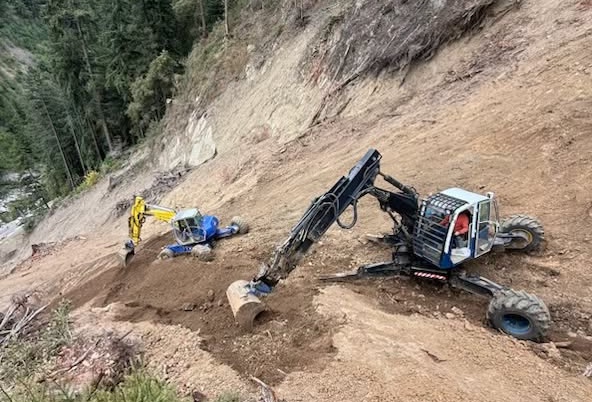
Spider excavators are still working to stabilize the slide area. | Photos: Caltrans District 1
###
Facebook post from Caltrans District 1:
(ROUTE 36/GRIZZLY SLIDE UPDATE) SATURDAY WORK 7/25: Travelers along Route 36 west of Grizzly Creek Redwoods State Park in Humboldt County should continue to expect weekday traffic holds between 9 a.m. and 5 p.m., plus work this coming Saturday, July 25, while slide stabilization efforts continue.
During active work windows weekdays, holds may last up to one hour, with traffic released at the top of each hour.
This Saturday, a helicopter will be placing additional wire mesh near the top of the slide. Travelers should expect delays of up to 45 minutes during helicopter operations.
Spider excavators continue moving material down the slope, with excavation now about two-thirds complete. Helicopter crews are installing additional wire mesh to further stabilize the hillside as work progresses.
Travelers should also plan ahead this Friday and Saturday, as increased traffic is expected due to the Fortuna Auto Expo.
As always, schedules can shift based on field conditions, equipment needs and weather. For updates, follow us here or check quickmap.dot.ca.gov or the QuickMap app.