

OBITUARY: Roger Hardaway, 1939-2025
LoCO Staff / Tuesday, Oct. 7, 2025 @ 6:56 a.m. / Obits

Roger Hardaway passed away peacefully early morning on October 2, 2025. Dad recently lost, Ila, his wife of 66 years, in July this year. He was lost without her and longed to be with mom once again.
Dad was born in Galena, Missouri on January 23, 1939 to Joann Guilliams and Randall Hardaway. He was raised in Galena until age four, when the family left for California. Grandma Joann got a job at the shipyard in Long Beach working on the ships during WWII. Dad grew up in Long Beach with his cousin Richard, riding their bicycles everywhere. Dad lived above a barber shop and that’s where he and Richard learned to play poker at a ripe age of 8.
My grandma met the love of her life and they relocated in Fortuna when dad was 13 years old. He was a graduate of Fortuna High School and started working in the mill at age 17. He met Ila when he was 19 years old mowing the lawn of his grandmother. Ila’s family lived next door to his grandma. It was love at first site. They married a year later. Dad was 20 and mom was 17.
After marriage, they moved to Eureka and dad bought their house on K street. They both raised five kids — Vicki (Steve) Gibney of Eureka, Jeffrey Hardaway who passed in December 2006, Lisa Hider of Weaverville, Kevin Hardaway of Eureka and Jenny Davis of Arcata. He is survived by 13 grandchildren, Amber, Justin, Trevor, Joshua Gibney, Jessica, Joshua, Matt and Thomas (Montel, Hider), Darren Hardaway, Ashlynn Owens, Danielle and Jacob Davis and Hailee Davis-Hardaway. Jeff’s only child Autumn passed away in 1987. Roger has 21 great-grandchildren all of whom loved to play poker with dad and go fishing when he was able. He is survived by his two first cousins, Carlann Norman and Johanna of Alabama.
Dad worked for Georgia Pacific and Louisiana Pulp Mill until the Park Expansion Program in 1976 ended most of the mill work in our entire area. Dad’s favorite hobby was taking old toys, painting them and fixing them for the kids. He went to work at Pierson’s Building Center in the Paint Department in 1977. Dad was chosen to play Santa at Pierson’s for several years and he loved every minute of it. He loved people and sharing stories. Pierson’s had an advertisement on TV with dad dancing in it, everyone loved it. He had a contagious laugh and smile. He was a jokester always stirring things to keep it lively while working at Pierson’s.
When he retired all he wanted to do was fish either at the rivers or the ocean with his son-in-law Steve. Dad was always bragging about his big fish he caught. We do have pictures to prove he did catch very large salmon and steelhead. He use to tease the grandkids he could talk to the fish. Little did they know he made his own stinky roe that lured them to his pole. He was a collector of old piggy banks and coins. He made proof sets for each child, grandchild and great grandchild. Before his death, he even did one for his latest great-grandchild, Noah, born October 6.
Dad’s final days were at home with the assistance of Hospice of Humboldt and immediate family. He passed away from complications of pancreatic cancer.
A celebration of life will occur for both dad and mom (Roger and Ila Hardaway) on Saturday October 25, 2025 at the lower level Wharfinger Building from 1-3 p.m. Many of their kids, grandkids and great-grandkids will be present. Please come and share your favorite memories of Roger or Ila, enjoy our slideshow of their life together and have a bite to eat. There will be a Mexican luncheon provided since this was their favorite food.
###
The obituary above was submitted on behalf of Roger Hardaway’s loved ones. The Lost Coast Outpost runs obituaries of Humboldt County residents at no charge. See guidelines here.
BOOKED
Yesterday: 3 felonies, 10 misdemeanors, 0 infractions
JUDGED
Humboldt County Superior Court Calendar: Today
CHP REPORTS
No current incidents
ELSEWHERE
RHBB: Honsal Talks Sanctuary Law, ICE Enforcement and What Humboldt Can Expect
RHBB: Southern Humboldt Faces Foreclosures as Countywide Market Finds Its Footing
RHBB: Two Humboldt County Food Spots Temporarily Closed Following Health Inspections
OBITUARY: Timothy (Tim) Brent Mendoza, 1957-2025
LoCO Staff / Tuesday, Oct. 7, 2025 @ 6:56 a.m. / Obits

Timothy (Tim) Brent Mendoza passed away on September 10, 2025 after a brave struggle with cancer.
He was born in Portland, Oregon in 1957 to Donald Charles Mendoza and Lora Clair Mendoza. He is the youngest of four children. He spent his formative years in Portland with his older brothers and sister. The family would often go on road trips and camping trips to explore the great outdoors.
When he was a senior in High School the family moved to San Pedro, California. There, he attended San Pedro High School and graduated in the class of 1976. During that time, he was active in Boy Scouts earning the rank of Eagle Scout. After completing high school, he went on to attend Long Beach State University, where he received a degree in Electrical Engineering. He began his first career as an engineer with Texas Instruments.
After having children, he would occasionally volunteer in their classes. This experience sparked his love of teaching. He then went back to school receiving a teaching degree from Chapman University in Orange, California in 2005. This started his second career. He worked as a math teacher at Badger Springs Middle School in Moreno Valley, and then at Pacific View Charter School in Eureka until he retired in 2023.
Tim was a member of the Elks Lodge and he enjoyed taking family and friends to Friday night for dinner. He also enjoyed volunteering at the Redwood Coast Music Festival.
Tim loved to travel, having recently traveled to Mexico and Ireland with his wife Michele. Our sweet Tim has traveled on to his school house in the sky. He will be missed.
Tim is predeceased by his beloved wife Debbie, as well as his parents. He is survived by his sister Candace and his brothers, Tony and Joe. He is survived by his children, Michael and Thomas, Chris, Paul and Jina. And by his nephews Moises, Anthony and Isaia and his niece Viviana and his cat Mr. Grey. Finally, but not least, he is survived by his loving wife, Michele.
A memorial will be held on October 18 at Sacred Heart Church in Eureka at 12 noon. A reception to celebrate his life is to follow.
###
The obituary above was submitted on behalf of Tim Mendoza loved ones. The Lost Coast Outpost runs obituaries of Humboldt County residents at no charge. See guidelines here.
OBITUARY: Avery Gallacci, 1956-2025
LoCO Staff / Tuesday, Oct. 7, 2025 @ 6:56 a.m. / Obits

The one.
Avery Gallacci of Arcata passed away suddenly on the 27th of September at the age of 69. He attended St. Mary’s Elementary school and was a graduate of Arcata High school.
While going to high school he worked with his dad at Twin Parks Lumber Mill. Upon graduation, he went to work for Simpson Timber Company for 30 years until his retirement.
He is survived by his mom, Wilda Gallacci, his two sons, Patrick and Christopher Gallacci, his sister and her husband, Cathey and Joe Kneer, his brother, John Gallacci, and his two daughters, Isabella and Sophia Gallacci. In addition, he leaves behind many friends and family members, and his wonder dog Jimmy.
He was an intelligent individual and had a kind and generous nature. He danced to a different drummer & had an artistic flair that spurred many interesting projects. His off-beat humor could be infections and often times hilarious. He will be missed.
Catholic Mass will be held on Friday, October 10, at 10 a.m., St. Mary’s Church, 1690 Janes Road, Arcata.
Reception to follow at the Veterans Hall, 1425 J Street, Arcata.
###
The obituary above was submitted on behalf of Avery Gallacci’s loved ones. The Lost Coast Outpost runs obituaries of Humboldt County residents at no charge. See guidelines here.
OBITUARY: Beverly Ann Dame, 1940-2025
LoCO Staff / Tuesday, Oct. 7, 2025 @ 6:56 a.m. / Obits

Beverly was born in Klamath Falls, Oregon on January 18, 1940 to her mother, Ruth Kirkman, and her father Horace Hazen, who served in the Navy. After a long fight with dementia, she passed on September 29, 2025. She was married for 67 years to her husband, Charles Dame.
Beverly was a teacher’s aide at McKinleyville Middle School for 28 years. She leaves behind her son, Charles Dame Junior, her daughter, Annette Dame, and granddaughter, Stacey Wilkinson, and great-grandson Daxton Pierce.
Thank you for always supporting me and loving me, Grandma. I miss you so much. Please tell Grandpa I miss him and I love him and I hope you guys find peace together. Rest in peace, Grandma.
###
The obituary above was submitted on behalf of Beverly Dame’s loved ones. The Lost Coast Outpost runs obituaries of Humboldt County residents at no charge. See guidelines here.
Humboldt’s Crabbing Fleet Faces New Regulations, Decreased Funding and the Rise of Whale-Safe Pop-Up Gear
Ryan Burns / Monday, Oct. 6, 2025 @ 4:05 p.m. / News

Crabbers load pots onto their vessel in Trinidad Harbor on opening day of the season this past January. | File photo by Matt Filar.
###
Crab fishing in California has never been so complicated. Recent seasons have been delayed, truncated and subject to mandatory gear reductions for a variety of reasons, including a spike in whale entanglements, unhealthy levels of the neurotoxin domoic acid, low meat quality (a measurement of meat yield percentage) and ever-increasing layers of bureaucracy.
These complications were recently dubbed “the four horsemen of the crab apocalypse” by Dr. Craig Shuman, marine region manager for the California Department of Fish and Wildlife (CDFW). When he made the remark at a statewide fisheries forum led by Senate Leader Mike McGuire last week, he was likely half joking. After all, following a few years of lower prices the state’s crab fleet last year reached a record price for Dungeness of seven dollars per pound.
“We also had the highest number of active permits since the 2019-2020 season,” Shuman said during the forum.
Opening day was delayed in the northern zones of the state until January 15 due to meat quality issues and delayed in the rest of the state due to the presence of whales offshore. And when the fisheries did open it was under trap reductions in both zones. Still, by the time the season came to a close, California’s fleet had landed about eight and a half million pounds of crab worth close to $55 million, which is about average for the past 10 years.

California’s Dungeness crab fishery is divided into six management zones. | CDFW.
###
Nonetheless, crabbers both locally and statewide have never felt so hemmed in by restrictions.
“It’s very hard to express and get out to the public the complexity of the hurdles and the regulatory constraints that we’re now bound by,” Harrison Ibach, president of the Humboldt Fisherman’s Marketing Association, told the Outpost in a phone interview last week.
Many of those regulations are contained in RAMP, CDFW’s Risk Assessment and Mitigation Program, which took effect five years ago. Designed to reduce the frequency of whale entanglements, the program was developed in the wake of a large, multi-year marine heatwave that would become known as “The Blob.”
The phenomenon, which was likely tied to human-caused climate change, had serious impacts on the marine ecosystem, causing toxic algae to multiply while altering whale migration patterns, among other effects. In 2016 there was a record number of whale entanglements in fishing gear off the West Coast, and while the rate declined for a few years, the frequency remains elevated, as shown in the chart below.
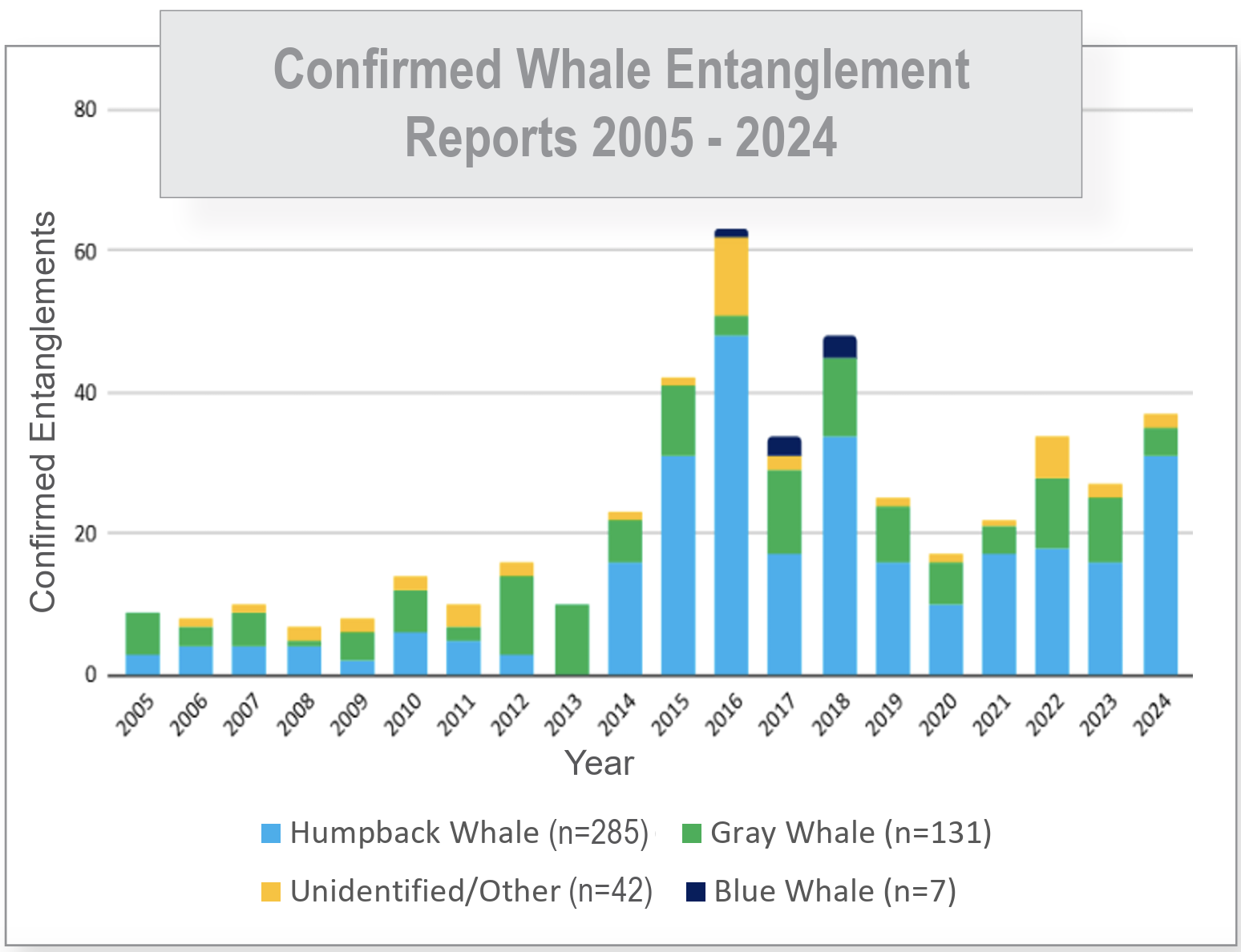
Whale entanglements off the West Coast. | NOAA.
###
A new blob arrived this year as sea surface temperatures across the North Pacific hit a record high.
In partnership with California Ocean Protection Council and National Marine Fisheries Service, CDFW also established a Dungeness crab fishing gear working group, comprised of commercial and recreational fishermen, environmental organization representatives, and state and federal agencies.
The working group was formed in 2015. Two years later, the nonprofit Center for Biological Diversity sued CDFW, arguing that the agency was moving too slowly to protect whales and thus in danger of violating the Endangered Species Act.
Ryan Bartling, senior environmental scientist supervisor at CDFW, said the development of RAMP complied with the terms of a settlement agreement for that lawsuit, though he said the agency had already been working toward such a program with the goal of reducing whale entanglements.
The program works, Bartling said, by giving the agency’s director “a suite of management options to choose from to try to draw down the number of entanglements that occur in any one year.”
Ibach sounded weary even talking about these regulatory mechanisms.
“For every entanglement that takes place in our fishery, it’s a point,” he said, “and now we’re graded on a point system. If we have too many points in a calendar year, we can’t go fishing.”
Even if whales don’t get caught up in crab gear, the season can be canceled or delayed based on whale sightings. CDFW conducts regular surveys while fishermen also report sightings.
Ibach voiced frustration at the array of regulations and restrictions that have resulted from whale entanglement while relatively less has been done to reduce vessel strikes, which are another source of whale mortality.
Lisa Damrosch, executive director of the Pacific Coast Federation of Fishermen, likewise expressed annoyance at last week’s fisheries forum.
“The problem is we’re being held to an expectation of zero [entanglements],” she said. “That’s like saying you’re being held to an expectation of driving on the freeway and there’s never an accident — and if there is an accident, we’re going to stop driving. … And unfortunately for us, when there’s an accident, the commercial Dungeness crab fishery stops, but all the other ocean uses don’t. Ships don’t.”

A breaching humpback whale entangled with line through the mouth, around the right pectoral flipper and trailing along its body. The whale was documented off Laguna Beach. | Photo: Delaney Trowbridge Photography, via NOAA.
###
McGuire noted another factor negatively impacting the industry: namely, drastic cuts to fisheries funding to the National Oceanic and Atmospheric Association (NOAA) under the Trump administration. Partially driven by the Elon Musk-led Department Of Government Efficiency (DOGE), the cuts, which could total more than $1 billion, target specific programs including the Pacific Coastal Salmon Recovery Fund.
“If I could be so candid, we would be in real trouble if we did not see Proposition 4 funding in the state of California,” McGuire said at the forum, referring to the $10 billion climate bond measure approved by voters last year. Governor Gavin Newsom has appropriated roughly $267 million in Prop 4 revenues for coastal resilience and another $256 million to protect and enhance fish and wildlife resources.
But Wade Crowfoot, California’s Natural Resources secretary, said such spending is insufficient.
“As remarkable as the state investment has been … it’s not enough,” Crowfoot said during last week’s forum. “You know, the federal government simply can’t divest in our fisheries in order for our fisheries to recover — just can’t happen. … We haven’t seen [any] signs of support from this administration, really, in any respect.”
McGuire concurred, noting that state revenues intended to fuel expansion may instead have to be used to backfill the loss of federal dollars.
While fishermen may grumble about RAMP, Kate Kauer, fisheries strategy lead for The Nature Conservancy, defended the program as a science-based effort to reduce whale entanglement risk, though she noted that its success depends on accurate data about whale presence and abundance along the coast.
Speaking at last week’s forum, she said her organization advocated for putting $17 million in Prop 4 revenues toward vessel-based whale surveys, lost gear recovery efforts and investment in new types of gear. Newsom wound up allocating $11 million to CDFW for climate-ready fisheries.
The Promise of Pop-Up Gear
Environmental advocates and a growing group of fishermen believe that a relatively new type of crab fishing gear can serve as an important tool for reducing whale entanglement.
Geoff Shester, California campaign director for the nonprofit group Oceana, told the Outpost in a recent phone interview that whale-safe “pop-up” crab traps — also known as “ropeless” or “on-demand” gear — have already proven successful through experimental CDFW fishing permits up and down the coastline, though mostly in the San Francisco Bay Area.
Based on technology developed by the Department of Defense (recently renamed the Department of War) to hide mines, nuclear warheads and other expensive equipment on the ocean floor, pop-up crab traps are equipped with inflatable buoys that can be triggered to inflate remotely. Each of these traps can be lowered to the ocean floor and left there until a fisherman returns and sends an acoustic signal that triggers a release mechanism, inflating the flotation device and sending the crab pot back to the ocean surface.
“So there are no buoys at the surface or vertical lines anymore while the gear is fishing,” Shester said. “That that eliminates the risk of entangling the whales and sea turtles, which has been one of the major causes of fishery closures over the last last six or seven years.”

Graphic via NOAA.
###
These pop-up traps can also be tethered to a “ground line” with up to 50 traditional crab pots. Putting one pop-up on either end of such a line allows for all the pots to be retrieved at once.
“The goal is to restore the fishing opportunity that has been lost over the last few years, particularly in the springtime when the whales are returning — usually sometime around March or April,” Shester said.
This gear’s not cheap. One pop-up unit can cost $1,000-$1,500, according to Shester.
“It’s running about twenty to thirty thousand dollars [per vessel] to get the full setup out there,” he said. “What we’ve seen, though, is that that opportunity has has been well worth it.”
Most fishermen who tried this gear last season were able to make their initial investment back after just a couple of trips, Shester said.
“It does have some additional cost, but the the benefit in terms of the restored opportunity is more than compensating for that.”
When we talked to Ibach about pop-up gear, he was skeptical, referring to it as “a purple unicorn idea.” He said the technology is too expensive and unreliable to be implemented across the industry. He and other local fishermen worry that nonprofits will push to replace all traditional gear with pop-ups.
Bartling, the CDFW scientist, said that’s not the case.
“We think there’s always going to be a core season with traditional gear,” he told the Outpost.
Shester agreed, saying pop-up gear will simply offer crabbers a new tool.
“We’re hoping to eventually have multiple options out there so that fishermen can choose what works best for them and let the market decide what technology they want to use,” he said.
Under current state regulations, pop-up gear can only be approved after the traditional season has been closed. Any day now, though, the state is expected to release a new set of regulations under RAMP 2.0.
At last week’s fisheries forum, Shuman, CDFW’s marine region manager, said the new rules include updated thresholds for entanglement and whale sightings.
“For example, if we have three humpback whales entangled in one calendar year, that will automatically delay the start of that season the next year until January 1,” he said. There have already been three confirmed humpback entanglements in crab fishing gear this year, so if RAMP 2.0 had already been implemented, the season would automatically be delayed.
Shuman said he expects CDFW will likely take a conservative approach, meaning this year’s opening could easily be delayed again.
“I think the one silver lining of that, if we were under those rules, is [that] the fleet would have the certainty that they’ve been looking for,” Shuman said.
Ibach agreed. In recent years, the local fleet stood by week after week, waiting on new information to roll in regarding domoic acid and meat quality, unsure whether CDFW would open the season in a matter of days, weeks or months.
“And so we were constantly on the edge of our seat all fall and early winter, waiting to hear,” Ibach said. With this year’s high entanglement score, there should be more certainty.
“We would like CDFW to just state whether or not we’re delayed so everyone has a chance to better understand when we’re actually going to get started so we can plan life, execute other fisheries, make holiday plans, whatever.”
Shester, meanwhile, is optimistic about the future.
“It’s really exciting that through collaboration and getting these new technologies, fishermen are really leading the way towards innovation,” he said. “Without them, we wouldn’t have these new systems that are out there that have now moved past the testing phase [and] that are now ready for prime time.”
It may be a while yet before the local fleet agrees to adopt pop-up traps. Ibach said he doesn’t think they’ll work as well on our ocean floor given the amount of silt deposits we get from the Eel, Klamath and other waterways. Plus, local fishermen have always used traditional gear.
Even when told that neither CDFW nor nonprofits are pushing to have pop-up gear be the new standard, Ibach said the local fleet hopes to maintain the traditional fishery for the foreseeable future.
Ballots for the Prop. 50 Special Election Mailed Out Today; Polls Show the Gerrymander Initiative in the Lead
Hank Sims / Monday, Oct. 6, 2025 @ 1:28 p.m. / Elections
PREVIOUSLY:
###
You could say California’s Nov. 4 special election is just around the corner, or you could say it’s already here. Ballots are being mailed out to every voter in the state today, as we do since the pandemic, so some people will start casting their ballots this week.
To recap, quickly: A few years ago, the U.S. Supreme Court ruled that it’s not unconstitutional for states to gerrymander their congressional districts for political purpose. That led, this year, to the state of Texas — under apparent pressure from the Trump Administration — to redraw its lines in the middle of the usual 10-year cycle, so as to deliver more Republicans to Congress than it otherwise would have done.
This, in turn, led to Gov. Gavin Newsom proposing that California should do the same in reverse — to gerrymander the state for maximum Democratic gains, to offset Texas’s move. Thus, Proposition 50 and the current special election were born. The California gerrymander would undo, temporarily, the lines drawn at the beginning of this decade by the independent Citizens’ Redistricting Commission. If it passes, five Republicans in California’s Congressional caucus are projected to lose their seats, including Rep. Doug La Malfa to our east.
Proposition 50 proponents have raised nearly double the amount of money that its opponents have, and from far more sources. Calmatters currently estimates that nearly 1/3 of the $151 million dollars in the pro- camp’s war chest was raised from small donations, while opponents raised only $8,400 of its $77 million from such sources.
The most recent polling shows that the “Yes” side has a significant lead.
A couple of things to note:
1. Big change this year: If you’re going to mail in your ballot, you would be wise to do that before Election Day — not on the day of. New postal service practices mean that your ballot won’t be postmarked on Election Day, in such cases, but rather the day after, and therefore won’t count. If you white-knuckle it up to the deadline, you’ll want to instead drop your ballot off in one of the county’s drop box locations. (See press release from Attorney General Rob Bonta here.)
2. If you’re looking for more resources about this election, our friends at Calmatters have an ever-updating voting guide here.
If you’re curious about what Prop. 50 does to our Congressional district in particular — California’s Second District — check the map below. The areas that would be removed from our district are in red, and the areas that would be added to it are in blue. Feel free to zoom and pan around, if you like, and you can turn layers off and on with the buttons in the upper right.
It’s still considered a safe Democratic seat.
New Research Suggests That Trespass Grows Scar the Land for Longer Than You Might Have Thought
LoCO Staff / Monday, Oct. 6, 2025 @ 10:17 a.m. / Environment

Photo: IERC.
Press release from the Integral Ecology Research Center:
A new peer-reviewed study published in Science of the Total Environment sheds light on the persistent chemical contaminants left behind at illegal cannabis cultivation sites, also known as “trespass grows,” on California’s federally managed lands. The research, conducted by scientists from the U.S. Geological Survey (USGS) in partnership with the Integral Ecology Research Center (IERC) and with support from the U.S. Forest Service Law Enforcement and Investigations, provides the most comprehensive look to date at how pesticides, pharmaceuticals, and other organic pollutants linger long after grow sites have been abandoned. (Link here.)
Key Findings
Researchers investigated former illegal cannabis cultivation sites in Six Rivers National Forest, Shasta-Trinity National Forest, and San Bernardino National Forest. Even months to years after law enforcement shut down these operations, the study found:
Pesticides such as imidacloprid, malathion, and myclobutanil in topsoil, with concentrations reaching significant levels.
Cannabis-related compounds including THC and cannabidiol persisting in soils and water and bed sediments, suggesting contamination of surrounding ecosystems.
Plasticizers, pharmaceuticals, and personal care products associated with the extensive irrigation and living infrastructure used and remaining at these sites.
The findings highlight that these sites leave a lasting chemical footprint, raising concerns about impacts on wildlife, water quality, and forest ecosystems from the thousands of sites that remain on California’s National Forest Lands.
A Collaborative Effort
This study underscores the power of partnership. USGS scientists and IERC, a Humboldt County-based non-profit conservation organization, worked hand-in-hand with the U.S. Forest Service Law Enforcement and Investigations Branch, whose on-the-ground efforts made sampling possible.
“By documenting these contaminants, we are taking the first step in understanding the long-term ecological risks posed by illegal cannabis cultivation,” said lead author Gabrielle Black of USGS.
Illegal cultivation sites not only degrade critical habitats but also threaten drinking water supplies, fisheries, and wildlife, including threatened and endangered species. Findings from this study will support future remediation efforts and policy decisions aimed at protecting California’s natural heritage.
“This research highlights the urgent need to address the legacy of trespass grows,” said Mourad Gabriel, Co-Director of IERC. “Together, we can better safeguard our public lands and the communities and species that depend on them.”


