

California to End the COVID State of Emergency
Kristen Hwang / Monday, Oct. 17, 2022 @ 4:32 p.m. / Sacramento

Newsom announcing the first statewide stay-at-home order in March 2020. YouTube thumbnail.
California’s COVID-19 state of emergency will end Feb. 28, 2023, nearly three years from its initiation, officials from Gov. Gavin Newsom’s office announced today.
The announcement came as new variants spur concerns that there will be another deadly winter surge across the country and as test positivity rates plateau in California following a nearly three-month decline. More than 95,000 Californians have died as a result of COVID-19, according to state data.
The state of emergency gave Newsom broad, often controversial, powers to issue masking mandates and temporary stay-at-home orders in an effort to slow the spread of the virus. It also enabled the governor to enter into billions of dollars of no-bid emergency response contracts with testing facilities, personal protective equipment suppliers and temporary workforce agencies. Some of those contracts were with untested vendors who failed to deliver services.
Today, 27 provisions from the 74 executive orders issued under the state of emergency remain in effect, officials said. More than 500 provisions have already ended. The Newsom administration would not allow the press to name the senior officials who participated in an embargoed media briefing about ending the state of emergency.
“The State of Emergency was an effective and necessary tool that we utilized to protect our state, and we wouldn’t have gotten to this point without it,” Newsom said in a statement. “With the operational preparedness that we’ve built up and the measures that we’ll continue to employ moving forward, California is ready to phase out this tool.”
The duration of the state of emergency has been controversial among state Republican leaders who attempted to overturn the governor’s power during a Senate emergency meeting in March. The resolution to terminate the state of emergency was voted down 8-4, with senators voting along party lines.
At the time, representatives for frontline health workers, including the California Hospital Association, stated flexibilities allowed under the executive orders were critical to expanding capacity. It allowed health care officials to hire thousands of out-of-state workers who typically need to be licensed in California to practice, among other emergency measures.
“The State of Emergency was an effective and necessary tool that we utilized to protect our state, and we wouldn’t have gotten to this point without it.”
— Gov. Gavin Newsom
In February, the administration unveiled the SMARTER plan, its $3.2 billion long-term strategy for combating COVID-19. The strategy outlined preparedness measures such as stockpiling 75 million masks, increasing testing capacity to half a million tests per day and investing in the health care workforce and local community health organizations. The SMARTER plan’s rollout has been a key component in eliminating the need for emergency provisions, officials said.
“The administration has determined that rolling back the remaining 27 executive order provisions will have largely minimal operational impact,” an unnamed official said.
The administration plans on pursuing permanent legislative changes for two temporary provisions allowed under the executive order: allowing nurses to order and administer COVID-19 antiviral treatments like PAXLOVID and allowing laboratory assistants to process COVID-19 tests.
###
CalMatters.org is a nonprofit, nonpartisan media venture explaining California policies and politics.
BOOKED
Yesterday: 10 felonies, 12 misdemeanors, 0 infractions
JUDGED
Humboldt County Superior Court Calendar: Today
CHP REPORTS
852 MM199 S DN 8.50 (HM office): Trfc Collision-1141 Enrt
Poppy Dr / Sherwood Rd (HM office): Closure of a Road
ELSEWHERE
Mad River Union: Arcata’s petite data center only the first
Mad River Union: Whistleblower calls for Miranda’s Rescue end
Mad River Union: EV infrastucture needs in rural areas reviewed
Mad River Union: $600K grant for Jolly Giant, Butcher’s Slough resilience
Man Arrested for Attempted Murder in Deep SoHum
LoCO Staff / Monday, Oct. 17, 2022 @ 4:19 p.m. / Crime
Press release from the Humboldt County Sheriff’s Office:
On Oct. 17, 2022, the Humboldt County Sheriff’s Office SWAT team conducted an operation at a property in the area of Cemetery Road in Blocksburg to locate a suspect known to be armed and dangerous.
While on scene deputies located and arrested Kip Branson, 50, without incident. The arrest and search warrant were related to a shooting reported last week in the 1200 block of Fox Creek Road in Carlotta.
Branson was booked into the Humboldt County Correctional Facility on charges of robbery (PC 211), carjacking (PC 215(a)), possession of firearm silencer (PC 33410), person prohibited in possession of ammunition (PC 30305(a)), possession of a controlled substance armed (HS 11370.1(a)), convicted felon in possession of a firearm (PC 29800(a)), criminal threats (PC 422(a)), assault throwing acid (PC 244), attempted murder: premeditated (PC 664/187(a)) and assault with a semiautomatic firearm (PC 245(b)).
Anyone with information about this case or related criminal activity is encouraged to call the
Humboldt County Sheriff’s Office at (707) 445-7251 or the Sheriff’s Office Crime Tip line at (707) 268-2539.
Receive HCSO news straight to your phone or email. Subscribe to news alerts at: humboldtsheriff.org/subscribe.

SoHUM ULTRASOUND! Now You Can Get Those Weird UFO Pictures of Your Body Parts or Your Baby Right There at Jerold Phelps
LoCO Staff / Monday, Oct. 17, 2022 @ 3:38 p.m. / Health
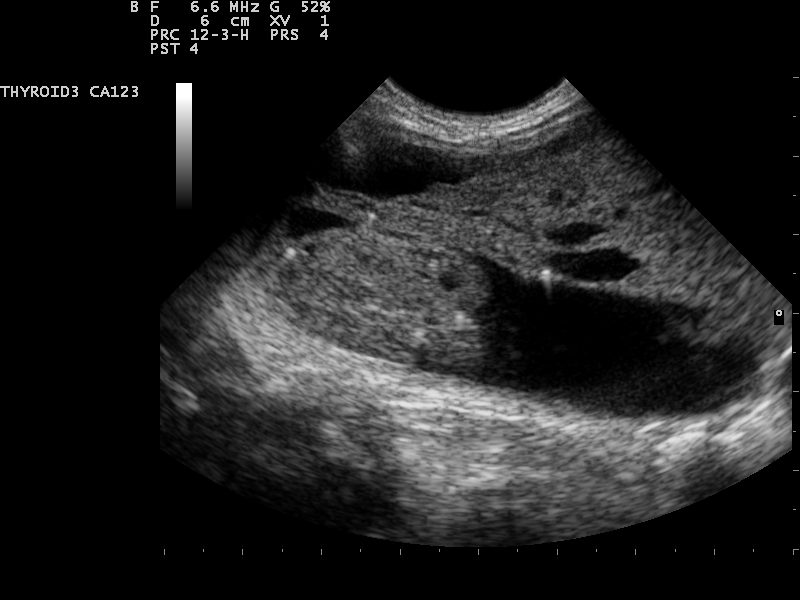
Ultrasound can take pictures of things other than your fetus! Such as a thyroid, for example. Nevit Dilmen, CC BY-SA 3.0, via Wikimedia Commons
###
Press release from SoHum Community Health
SoHum Health is proud to announce a new avenue for ultrasound services in Humboldt County. Jerold Phelps Community Hospital in Garberville now has a brand new GE Logiq E10 Ultrasound machine, the most advanced ultrasound system available to date. Offering a wide scope of ultrasound exams including abdomen, aorta, renal, thyroid, carotid, scrotum, deep vein thrombosis, pelvic, infertility studies (follicle counts), and obstetric dating and anatomy. Doctor’s orders for ultrasound services at Jerold Phelps Community Hospital can be faxed to (707) 923-2578. Same Day Results and STAT Reads are available at the medical provider’s request. Once an order is received, SoHum Health staff will call the patient to schedule an appointment. We look forward to serving you!
For more information about Ultrasound services at SoHum Health, visit sohumhealth.org or call (707) 923-3921. SoHum Health is a California Special Healthcare District that operates Jerold Phelps Community Hospital, Southern Humboldt Community Clinic, Southern Humboldt Family Resource Center and Garberville Pharmacy.
Rabid Fox Found Dead Under a Truck After Biting a Person and Attacking a Moving Vehicle
LoCO Staff / Monday, Oct. 17, 2022 @ 1:35 p.m. / Health

Gray fox. | Photo via California Department of Water Resources.
###
Press release from the Humboldt County Department of Health & Human Services (DHHS) Division of Environmental Health:
The Humboldt County Department of Health & Human Services (DHHS) Public Health Laboratory, in partnership with the California Department of Public Health Viral and Rickettsial Disease Laboratory, confirmed that a fox found at the Lanphere Dunes in the Arcata area tested positive for rabies. The animal was brought into the lab for testing after being found dead under a U.S. Fish and Wildlife (USFWS) work truck on Lanphere Road.
Last week DHHS’s Division of Environmental Health (DEH) received a report that a fox bit someone and then attacked a moving vehicle the following day on Lanphere Road. The person who was bit is currently undergoing treatment for rabies exposure. Two days after these encounters, DEH received the report of the dead fox.
Benjamin Dolf, DEH Supervising Environmental Health Specialist, said staff notified stakeholder agencies, including USFWS, which manages the dunes, Friends of the Dunes, which manages public access privileges and the Bureau of Land Management, which manages the neighboring Ma-le’l Dunes. “Based on the fox’s aggressive behavior,” USFWS staff had already posted warning signage and temporarily closed public access to the Lanphere Dunes wildlife refuge.
Although rabies is always present in the wildlife population throughout Humboldt County, especially foxes, skunks and bats, Dolf said, “It’s very likely that the fox found dead was the same fox from the other two incidents.”
However, he said people in the area between Manila and Mad River Beach who see a wild animal acting strangely should contact DEH which is monitoring reports in that area. He said as a general rule, it is important to use caution around wild animals, and if you encounter an animal that is sick, injured or docile, “Do not try to approach it, help it or try to nurse it back to health,” Dolf said. People who come across sick or injured animals can contact the Humboldt Wildlife Care Center which has staff who are trained to respond.
Preventive measures against the spread of rabies in Humboldt County include avoiding contact with wild and stray animals, bringing pet food indoors at night, reporting animal bites to your county or municipal animal control officer, and if you are bitten, washing the bite immediately with soap and water and seeking medical attention.
Public Health officials stress the importance of fully vaccinating domestic animals against rabies, including dogs, cats and select livestock.
For questions about rabies or to report a rabid or suspected rabid animal, call DEH at 707-445-6215 or toll free at 1-800-963-9241.
To report a sick or injured animal, contact the Humboldt Wildlife Care Center at 707-822-8839.
Sheriff’s Office Investigating Possible Sexual Assault of Juvenile Near McKinleyville High Late Friday Night
LoCO Staff / Monday, Oct. 17, 2022 @ 9:51 a.m. / Crime
Press release from the Humboldt County Sheriff’s Office:
On October 14th, 2022, at about 10:00 PM, the Sheriff’s Office received a report of a possible juvenile sexual assault in a wooded area near McKinleyville High School. Deputies responded to investigate and learned the incident had occurred several hours prior to the report. The Sheriff’s Office Major Crimes Division was called to assist in the investigation.
The alleged suspect was described as a Hispanic or Native American male who appeared to be in his thirties. He was approximately 5’9” – 5’10” in height and had a physically fit build. He had dark wavy shoulder length hair and a full beard, and was wearing a camouflage jacket, black sweatpants, and white shoes. He was also wearing a purple bracelet and carrying a blue hiking style backpack.
Deputies have been and are continuing to conduct patrol checks of the area but have been unable to locate the suspect. The Sheriff’s Office has been in contact with officials from the McKinleyville High School and notified them of the investigation.
The investigation is ongoing and as further information is developed it will be released to the public.
Anyone with information about this case or related criminal activity is encouraged to call the Humboldt County Sheriff’s Office at (707) 445-7251 or the Sheriff’s Office Crime Tip line at (707) 268-2539.
(PHOTOS) Sara Bareilles at Home
Andrew Goff / Monday, Oct. 17, 2022 @ 8:45 a.m. / Our Culture

Sara at home. | Photos: Andrew Goff
On Sunday, musical megastar and Eureka native Sara Bareilles returned to her old stomping grounds and showed her hometown it can do big things. Anyone who dares to estimate the size of the crowd will be guessing, so LoCO will go ahead and play too: There were a gazillion people at Halvorsen Park, which we now know is criminally underutilized. Eureka looked dreamy.
The Outpost bopped around and snapped a few photos to commemorate the day which locals who attended are sure to wear as a badge of honor for years to come. We share those little snaps now.
(Click photos to enlarge)

Eureka had a ball.

Sara is interviewed before taking the stage.

Huckleberry Flint warms up the crowd









Sara’s mom, Bonnie Halvorsen, chats with the show’s other opener, Mario Matteoli

Eureka City Council assembled

Mayor Susan Seaman holds a key to the city made for Sara by local craftsman Eric Hollenbeck

Mayor Seaman read a proclamation declaring it Sara Bareilles day

Hooray!

Sara receives her gifts: “This is unbelievable! This is beyond my wildest expectations!”

Hugs!

Onto the music







\m/

Boats line up to enjoy the tunes from Humboldt Bay

Locals gather on a balcony overlooking Halvorsen Park



The view from Samoa Bridge


Thanks, Sara
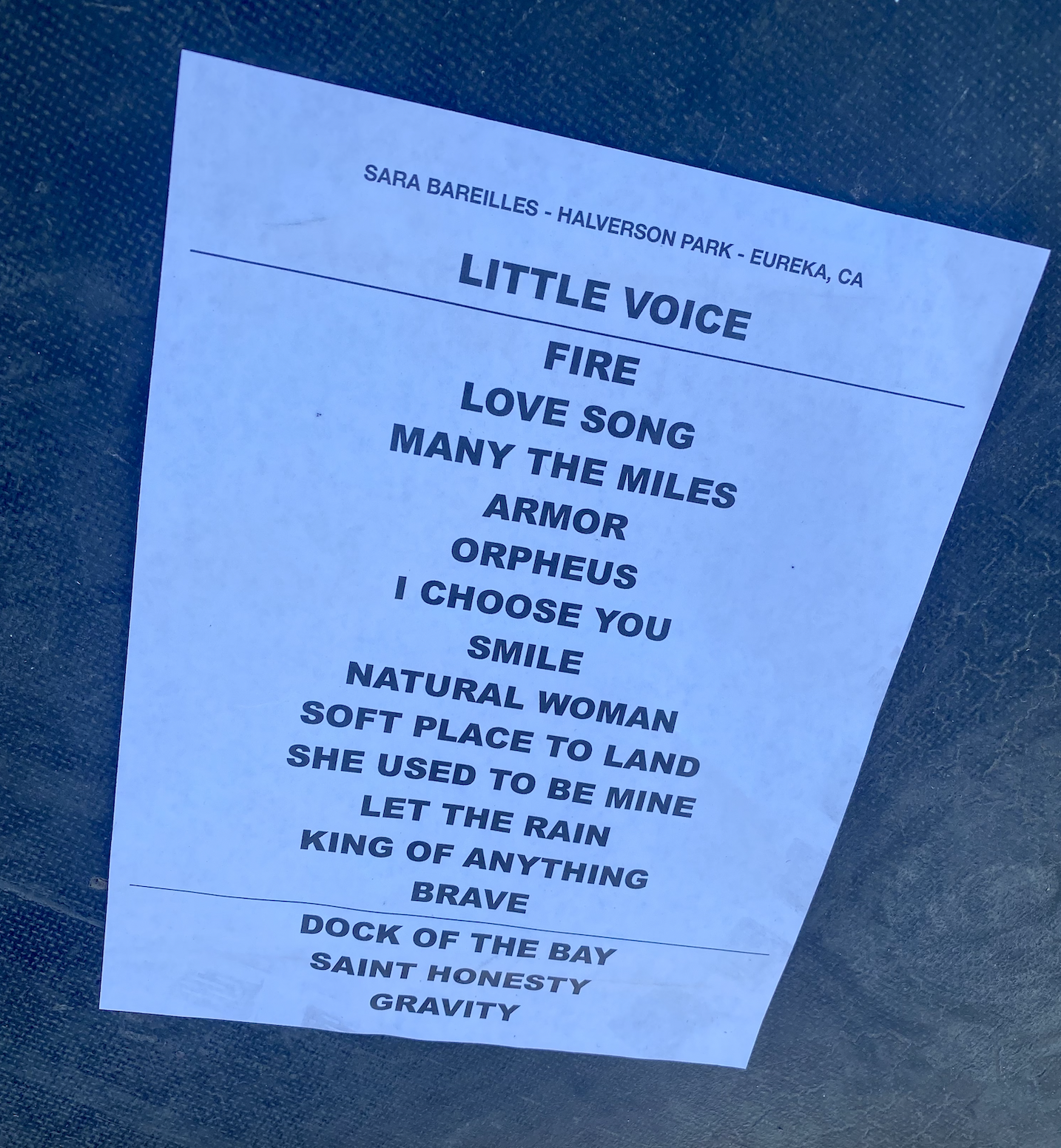
The day’s setlist

Aerial shot courtesy Jeff Abercrombie
Agency Battling Wage Theft in California Is Too Short-Staffed to Do Its Job
CalMatters staff / Monday, Oct. 17, 2022 @ 7:36 a.m. / Sacramento

Illustration by Miguel Gutierrez Jr., CalMatters
###
Story by Alejandro Lazo, Jenna Kuang and Julie Watts.
###
For decades California’s lawmakers and regulators have taken aim at employers who rob their workers of pay, overtime premiums, tips and other forms of compensation.
Just last year, legislators made certain instances of wage theft a felony. They also fixed their sights on wage theft in the garment industry, eliminating some longstanding pay practices that often resulted in workers being paid below the minimum wage.
Earlier this month, California Labor Commissioner Lilia García-Brower recovered $282,000 in stolen wages and penalties for 22 workers of a Long Beach car wash using a law enacted in January that empowers her office to place liens on the property of problematic worksites.
California’s laws targeting wage theft — which is the failure by bosses to pay workers what they are owed — make it a leader among states, national labor experts say. But in practice, enforcing those laws has not been easy.
State officials and lawmakers say the Labor Commissioner’s office, the California agency overseeing wage and hour violations, has been too short-staffed to do its job, a problem that worsened during the pandemic and subsequent labor shortage.
Last year alone California workers filed nearly 19,000 individual claims totaling more than $338 million in stolen wages. Many claims take three times longer than the legal minimum of 135 days to resolve, data provided by the Labor Commissioner’s office show.
‘Three strikes’
Assemblymember Ash Kalra, a San Jose Democrat who chairs the Assembly’s labor committee, said the Labor Commissioner does not have enough agents or other workers to process all of the wage claims made by California workers effectively.
Nearly a third of the Labor Commissioner’s positions were vacant in May, officials told a state Senate budget committee. In August, a spokeswoman for the Labor Commissioner’s office told CalMatters the office had hired 288 people since January 2021, but not how many people had left the office during that period.
The Labor Commissioner’s budget this year is $166 million, enough funding for nearly 840 positions.
“We need to put more urgency into it,” Kalra said, ”and that could include having hiring bonuses, whatever it takes to increase the staffing, because it’s unacceptable — the current state of affairs. If we really care about these workers, we need to show it.”
Experts and legislators say California’s bureaucratic hiring processes and below-market salaries are complicating its hiring efforts.
When it comes to recruiting workers “it’s three strikes against them right now, just the government in general,” said Patrick Murphy, director of resource equity and public finance at The Opportunity Institute, a nonprofit that studies poverty and racial inequality in California. “It’s the nature of government, the tight labor market, and then the specialization that goes with these jobs.”
The state’s hiring and retention issues at agencies enforcing labor laws have existed for years. The Little Hoover Commission, California’s bipartisan oversight agency, studied wage theft in 2015 as part of an investigation of California’s underground economy.
Hiring frustrations
The study found that state investigators across agencies are paid less than those in police forces and often require more training and education. The state’s hiring process for such jobs can take up to a year, the report found, making hiring frustrating for all parties.
“We’re just not a competitive employer,” said Krystal Beckham, a project manager with the commission who led the study. “You can see that when it comes to enforcement in the underground economy.”
California stands out among states for its efforts and policies to tackle wage theft given its union density, number of worker centers and public dollars committed to combating the problem, said David Cooper, a researcher who has studied wage theft at the left-leaning Economic Policy Institute, which is based in Washington, D.C.
Union members accounted for 15.9% of wage and salary workers in California, compared to 10.3% nationally. That higher than average membership helps workers identify wage theft, Cooper said.
“We need to put more urgency into it, and that could include having hiring bonuses, whatever it takes to increase the staffing, because it’s unacceptable.”
— Assemblyman Ash Kalra, Democrat from San Jose
The state also has 47 worker centers, more than any other, according to a recent report by the Worker Empowerment Research Network, a national collection of labor experts. Worker centers are community-based organizations providing training and support for low-income workers. California’s labor offices have partnered with a coalition of 17 centers to bring wage theft investigations in certain industries.
Also workers can file lawsuits against employers through California’s Private Attorneys General Act (PAGA), which gives workers the same powers as the state to sue employers and recover penalties on behalf of coworkers. Last year the Department of Industrial Relations received 6,501 notices of new PAGA suits, according to data provided to CalMatters in response to a records request.
Abusive practices
The size of California’s economy, its diversity and demographics, also give cover to abusive practices by employers, experts said. The state has a vast service economy, a robust agricultural sector and one of the nation’s largest immigrant populations, including about 1.7 million undocumented workers, according to the Migration Policy Institute.
Wage theft typically impacts society’s most vulnerable workers: those with the least education and financial means and the fewest legal protections — often those workers are immigrants.
“California has far more immigrants than a lot of other places, and we know that immigrants, and people of color generally, tend to more likely be victims of wage theft,” said Cooper, who is director of the institute’s Economic Analysis and Research Network, which coordinates nearly 60 state and local research and advocacy efforts nationally.
“Immigrants who are either undocumented, or may have family who are undocumented, are not going to speak up as vocally if their rights are being violated.”
Cooper said the thousands of wage theft claims filed in California each year are likely an undercount of stolen pay cases.
‘Good faith dispute’
On the other hand, the California Chamber of Commerce said those claims represent only a fragment of a percent of California’s $1 trillion-a-year payroll, and the vast majority of claims are misunderstandings of California law.
CalChamber CEO Jennifer Barrera, who represented employers as an attorney before joining the business group, said wage theft claims at large employers often come down to a “good faith dispute” about whether a worker was properly classified. With small employers, there often was a lack of education about labor laws, she said.
“When you got into the smaller employers, it was just a lack of understanding of what actually the law required but thinking that they were doing things right,” she said.
California’s policymakers over the years have focused on accountability in cases of wage theft. The state, for instance, requires businesses in certain industries, such as car washes and garment manufacturers, to register with the state and post bonds with the state, so there are funds available to recoup stolen wages for workers.
The Legislature also has taken on the growing prevalence of contracting and subcontracting in various industries by passing laws that make the “parent” employer or company responsible for a contractor’s labor violations.
California’s former Labor Commissioner, Julie Su, instituted a statewide, multilingual “Wage Theft Is A Crime” public awareness campaign in 2014. Two years later she launched a strategy of partnering with various workers’ rights organizations throughout the state to bring targeted, high-profile enforcement actions against some large employers.
Advocates, not umpires
Experts credit much of California’s wage theft enforcement philosophy to Su’s advocacy.
“Su lifted up an entirely different way of thinking about the role of government and was not afraid to say, ‘We are not neutral. That is not our role. We are not umpires,’” said Janice Fine, professor of labor studies and employment relations at Rutgers University. “We are advocates for worker rights.”
Su, now deputy secretary of labor in President Biden’s administration, through a spokesman declined to comment.
Some experts have argued that gig economy companies such as Uber Technologies Inc. and Lyft Inc. have committed wholesale wage theft by classifying their workers as contractors rather than employees.
California, the birthplace of the gig economy, has been at the forefront of those battles.
“Su lifted up a different way of thinking about the role of government and was not afraid to say, ‘We are not neutral. That is not our role. We are not umpires.’”
— Janice Fine, professor of labor studies and employment relations at Rutgers University
In 2019, California Gov. Gavin Newsom signed legislation intended to classify some independent contractors as employees. In response, Uber, Lyft and other gig giants spent more than $200 million on a successful ballot measure, Proposition 22, that exempted them from that law. The ballot measure was ruled unconstitutional last year but remains in place while the case is being appealed.
In 2020, García-Brower’s office sued the ride-sharing companies, accusing them of “systemic wage theft” for misclassifying workers and failing to meet their obligations under California law, including paying minimum wage, overtime, providing rest breaks and other allegations. That suit also remains outstanding, but the debate over worker classification is now a national one. On Oct. 11, the Biden administration released a proposal that would make it easier for contract workers to be classified as employees, giving them federal labor protections.
505 days
In California, García-Brower, who was appointed by Newsom, has continued the pro-worker philosophy of her agency. She was a former executive director of the Maintenance Cooperation Trust Fund, a Los Angeles- based organization that investigates wage theft and other abuses in the janitorial industry.
“My number one goal is to improve our ability to enforce the law, to make workers’ protections real in a very practical way for the poorest workers, for those vulnerable communities,” García-Brower said in an interview with CalMatters last month.
Most pressing for García-Brower is addressing backlogs for those workers waiting to have their wage claims heard. For workers who don’t drop or settle their cases, the state averages 505 days to decide an individual worker’s wage claim, data from 2017 to 2021 show. That is much longer than the 135-day maximum set by state law.
Kalra, the assemblyman, said California needs to quickly address those wait times by staffing the commissioner’s office.
“We’re having these massive budget surpluses; if we can’t give them the resources now, then it may just show that it’s not a priority,” he said. “I really hope that’s not the case.”
###
Staff reporters Lil Kalish and Grace Gedye contributed to this report. Julie Watts is an investigative journalist at CBS13 in Sacramento.
This article is part of the California Divide project examining income inequality and economic survival in California.
CalMatters.org is a nonprofit, nonpartisan media venture explaining California policies and politics.


