A lawyer representing the owners of the Royal Crest Mobile Home park said in a lengthy letter sent to the Fortuna City Council that the upcoming moratorium on mobile home lot rent increases was unnecessary and could lead to “costly and unwanted” litigation.
The attorney, Anthony Rodriguez, said that a rent increase planned for January 1, 2026 was already tied to the Consumer Price Index at 2.49%. Both advocates for the Rent Stabilization Ordinance (RSO) and the owners have agreed that any future raises in rent will be tied to the CPI, though the Save Our Seniors prefer that lot rents only go up 75% of the CPI.
The moratorium would stop the owners from implementing that January increase unless the RSO is adopted before then.
Rodriguez also said that the owners have “promised” not to raise the rent again until January 2027, and threatened to ditch a rent credit program for their residents if the moratorium is passed on Monday.
But one of the main issues facing the park, says Rodriguez, is that the park’s operating costs have increased about 89% since 2013, while the CPI has only increased 37%. He also claims that the owners have invested almost $900,000 into the park’s infrastructure and cited a court case (Sierra Lake Reserve v. City of Rockland) that says that park owners are entitled to make a fair return on their investments.
“I can assure the Council that these are issues that can result in litigation lasting many years, resulting in unwanted stress and expense for all concerned,” Rodriguez said. “…If the parties are willing to agree to a long-term plan regarding rent increases at Royal Crest, my clients are willing to waive their right to pursue litigation in each of these issues.”
The new display case at the NCIDC’s Eureka office will display “living” artifacts from North Coast tribes. | Photos: Isabella Vanderheiden
###
Local tribal leaders kicked off California Native American Day a little early this year with a Wiyot Brush Dance and ribbon-cutting ceremony on Thursday, celebrating the unveiling of a new cultural archive collection and display case at the Northern California Indian Development Council (NCIDC) office in Old Town Eureka.
The wooden display cabinet, designed by local architect Kash Boodjeh, showcases handmade basketry, jewelry, ceremonial hats and regalia, quivers made of animal pelts, abalone shells and other cultural items from tribes across the North Coast.
NCIDC Chief Executive Officer Madison Flynn described the new exhibit as “a tribute to the strength and resilience of our communities,” as well as a “reminder that [Native] traditions, languages and stories will continue to thrive in the future.” However, she warned that “celebrating culture is not enough.”
“We are faced with a federal administration that, within the six months since the inauguration, has proposed unprecedented and devastating budget cuts,” Flynn said. “The President’s budget for Fiscal Year 2026 proposes nearly $1 billion in cuts to Indian Country, including more than $700 million in cuts to the Bureau of Indian Affairs and $239 million to tribal housing programs. … At a time when funding for native programs continues to be cut, it is more important than ever to showcase and preserve our traditions.”
She closed with a quote from Wilma Mankiller, a prominent Native activist and the first woman elected to serve as Principal Chief of the Cherokee Nation: “The secret of our success is that we never, never give up.”
It’s official! From left to right: Lonyx Landry, Madison Flynn and Jace Baldosser.
NCIDC Chair Trina Mathewson took a moment to honor the legacy of Terry Coltra, who helped shape the NCIDC and advocate for local tribal communities during his 30-plus years as executive director of the organization.
“This cultural display case was one of his long-time goals,” Mathewson said. “This collection showcases the cultural and historical significance of native basketry and regalia from the North Coast region. It is a reminder of the strength, resilience and beauty of our local tribes. … We dedicate this display to the memory of Terry Coltra and to the leadership of Greg Gehr and Madison Flynn, whose efforts helped bring this vision to life.”
Lonyx Landry, an advisor and coordinator for the Indian Natural Resources, Science & Engineering Program (INRSEP) at Cal Poly Humboldt, added that many of the “living items” in the display case are still used in ceremonies.
“Just recently, we had some of our staff returning from world renewal ceremonies where some of the baskets that you will see got to go dance and live the life that they’re supposed to live,” Landry said. “Now, we have this wonderful home for those items to exist — not locked up in some dark closet for 100 years — and have the life that [they’re] supposed to have, and do the things it’s supposed to do, like dance and ceremony.”
Eureka Mayor Kim Bergel shared a few words as well, expressing her gratitude to the tribal community and underscoring the city’s commitment to “celebrating and honoring Native culture — past, present and future — through restoration of language and ceremony, reparations and through the land back movement.”
After the speakers, a group of Wiyot dancers in ceremonial regalia performed a Brush Dance on the sidewalk in front of the NCIDC. More pictures of Thursday’s ceremony can be found below.
Paul Thomas Anderson and Leonardo DiCaprio on set at the Cutten Murphy’s Market. | File photo.
###
It’s finally opening day for director Paul Thomas Anderson’s latest masterpiece*, One Battle After Another, which was partly filmed right here in Humboldt County, and in an interview over on the movie website Letterboxd, Anderson and star Leonardo DiCaprio say our region had a distinct impact on the film.
DiCaprio plays a paranoid, washed up former revolutionary named Bob, whose 16-year-old daughter Willa (Chase Infiniti) is a student at a high school, played in the movie by Eureka High. (Many local students are extras.)
Here’s Anderson expressing his appreciation for our humble community:
We knew that we were going to be up in Northern California for Bob’s cabin in the woods with Willa. That took us to scouting Eureka and all points around there. We ended up obviously loving it, finding locations and finding a community and investing in the high school, Eureka High School, and visiting just for their high school dance to see how they decorated it, what kind of music did they play, what were the kids wearing, what was the energy level, to taking videos, hanging out with them. Really just trying to be there but not assert our presence—to try to kind of almost oddly act like a documentary crew. I mean, as much as you could by coming in with 50 people. But try to keep a low profile and not come in as the big Hollywood machine attacking a town, but just to try to embrace what they had.
DiCaprio, for his part, said his character “clicked” into place when he arrived here and experienced our “hip-neck” vibe (half hippie, half redneck).
“Yeah, it’s a little mix of ‘don’t tread on me,’ ‘get off of my property,’ but mixed with radical sort of woke ideas simultaneously,” the actor says. “It’s a culture that—I understood Bob when we got into Eureka.”
Local actress Tisha Sloan, who we recently interviewed, also gets a shoutout in the interview, with Anderson calling her “so wonderful.”
Read the full interview at this link and, if you haven’t yet, watch the trailer below.
###
*Yes, it’s a stone cold masterpiece. And it includes plenty of recognizable Humboldt locales. This Outpost reporter highly recommends that you get to your nearest movie theater and experience the film alongside some fellow locals at your earliest convenience.
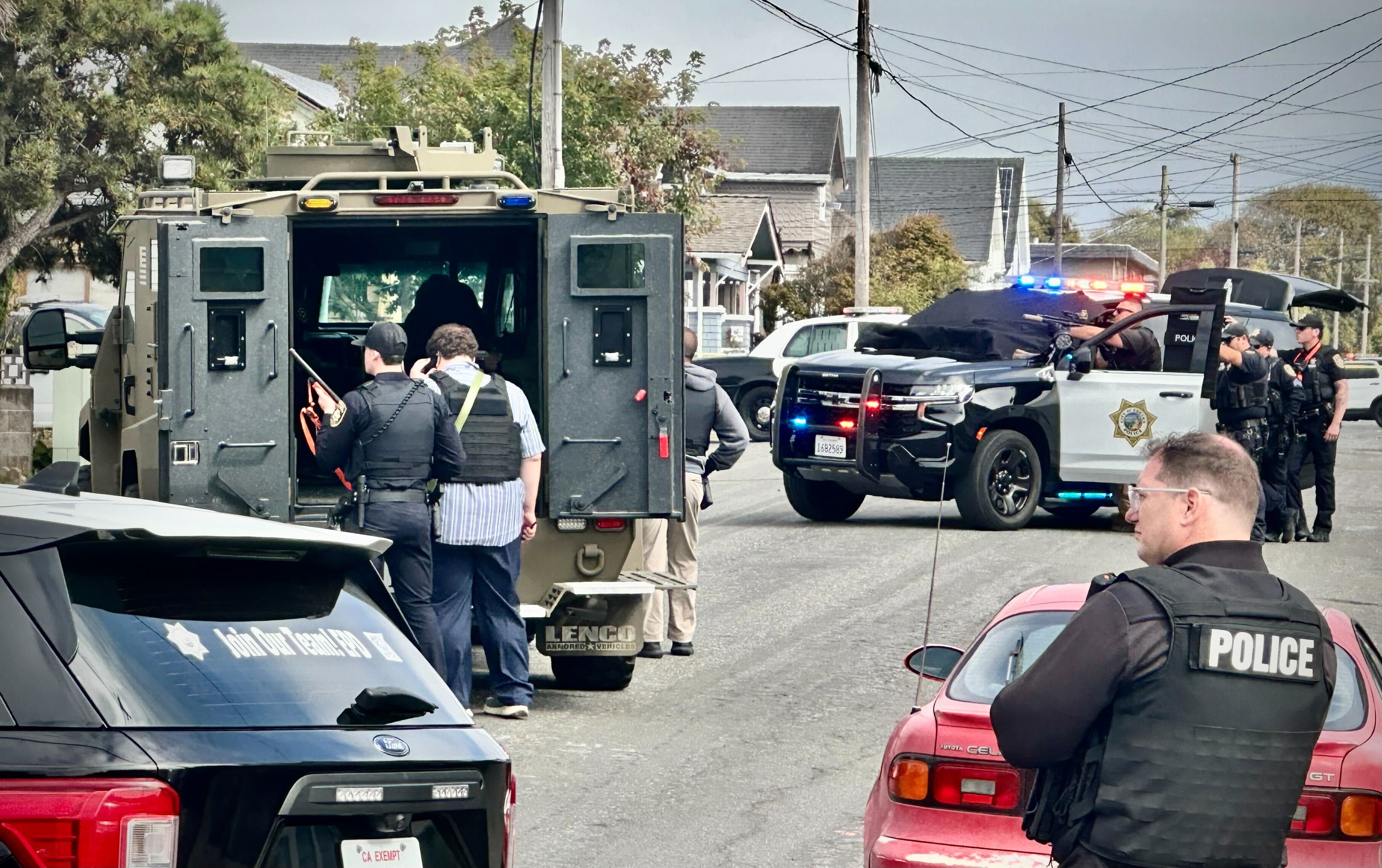
On September 25, 2025, at approximately 9:32 a.m., Eureka Police Department (EPD) patrol
officers responded to a residence on the 300 block of W. Hawthorne Street for a report of an
unknown problem. The reporting party advised that 31-year-old Silverio Parro Snider Sanchez
had unlawfully entered their home, threatened them, and was in possession of a firearm. After
the initial confrontation, Sanchez reportedly fell asleep in an upstairs bedroom. While the
victim was able to safely exit the residence, an elderly male remained inside.
Upon further investigation, officers discovered Sanchez had an outstanding felony warrant.
Based on information provided by the victim, Sanchez was also determined to have committed
additional felony offenses during the incident.
Given the dynamic situation of Sanchez reportedly being armed with a firearm and the elderly
male still inside the residence, EPD’s patrol division and the following EPD and Humboldt
County Sheriff’s Office personnel responded to the scene:
EPD Community Safety Engagement Team (CSET) Officers - to assist with operational
support and negotiations.
EPD Criminal Investigations Unit (CIU) Officers - to assist with the investigation and to write
additional warrants.
City of Eureka -Crisis Alternative Response of Eureka (CARE) - mental health professionals to
assist with negotiations.
HCSO Drone Operators - to assist with operational and aerial support.
HCSO County-wide Crisis Negotiations Team (CNT) - to assist with negotiations.
Due to Sanchez reportedly being armed, The Humboldt County Sheriff’s Office also provided a
tactical armored vehicle.
Over the course of more than four hours, negotiators made contact with Sanchez and
attempted to gain his compliance for a peaceful surrender. However, he refused. In the
meantime, EPD officers were able to safely evacuate the elderly male and a dog from the home.
A second dog was later evacuated.
As negotiations continued without success, HCSO SWAT was deployed to the scene. In an effort
to gain compliance, SWAT deployed distraction devices and chemical agents into the residence—
however, these methods were also unsuccessful in gaining a peaceful surrender.
Ultimately, more than fourteen hours after the initial patrol response, SWAT entered the
residence and conducted a search using a HCSO K-9. The K-9 located and apprehended Sanchez,
who was taken into custody without further incident. He was medically cleared and transported
to the Humboldt County Correctional Facility. Sanchez was booked on his felony warrant along
with fresh charges for Burglary, Terrorist Threats, False Imprisonment, and Resisting Arrest.
The Eureka Police Department would like to thank the Humboldt County Sheriff’s Office and
Crisis Alternative Response of Eureka for their professional coordination and support in safely
resolving this dangerous situation. We would also like to thank Humboldt Bay Fire and City
Ambulance for their assistance. We understand that these types of incidents impact our
community and the neighborhoods were they occur and our operations impact your lives and
daily activities. The safety of our community is our priority and we truly appreciate your patience
and understanding as we resolve these types of dangerous and potentially volatile situations.
This incident demonstrates the value of interagency collaboration and the critical importance of
law enforcement, special operations teams and equipment, and mental health professionals in
responding to high-risk situations involving armed and barricaded individuals.
Press release from the Humboldt County Sheriff’s Office:
In a demonstration of its ongoing commitment to proactive enforcement against illicit narcotics, the Humboldt County Sheriff’s Office (HCSO) arrested John Joseph Hanley, 46, following a routine patrol operation.
On September 25, 2025, at approximately 1:50 a.m., an HCSO deputy was conducting proactive patrols near the Bear River Casino in Loleta. During this operation, the deputy identified a vehicle parked at the Pump and Play gas station registered to Hanley. Upon further investigation, the deputy confirmed that Hanley was on local probation for prior narcotics-related offenses. In accordance with the conditions of his probation, which authorize law enforcement to conduct search and seizure, the deputy located Hanley inside the Bear River Casino and performed a lawful search of his person.
The search revealed nearly 26 grams of suspected methamphetamine in Hanley’s possession. Hanley was subsequently arrested and transported to the Humboldt County Correctional Facility, where he was booked on the following charges:
Health and Safety Code (H&S) 11395(b)(1): Possession of methamphetamine with prior convictions
H&S 11377(a): Possession of methamphetamine
Penal Code (PC) 1203.2(a): Probation violation
The Humboldt County Sheriff’s Office remains vigilant and proactive in its mission to intercept and disrupt the distribution of dangerous illicit substances within our communities. Through routine and strategic patrols, deputies are empowered to fight crime and hold individuals accountable, thereby enhancing public safety.
Under California’s lenient criminal justice policies, methamphetamine possession is often classified as a “non-violent” offense, reflecting the state’s soft stance on crime. This approach frequently results in Superior Court Judges releasing repeat offenders pending future court appearances, undermining public safety. The Humboldt County Sheriff’s Office strongly encourages residents to stay informed about the severe dangers of methamphetamine use and to advocate for stronger, more effective public safety policies that prioritize accountability and community protection.
Anyone with information about this case or related criminal activity is encouraged to call the Humboldt County Sheriff’s Office at (707) 445-7251 or the Sheriff’s Office Crime Tip line at (707) 268-2539.
The Fortuna City Council will likely establish a moratorium on rent increases on mobile home residences at a special meeting this Monday, September 29, to give them time to develop a Rent Stabilization Ordinance for the city.
Though it’s not a set-in-stone RSO, the Fortuna-based group Save Our Seniors (SOS) is calling it a win after months of advocacy.
Announced after a closed session of the Fortuna City Council on Monday, the moratorium pauses all rent increases on mobile home lots within city limits until April 30, 2026, or until it’s repealed. It’ll likely be replaced by an RSO, which will establish some limits on how much owners of mobile home parks can raise the lot rent on their residents.
Increases are usually tied to increases in the Consumer Price Index; SOS spokesperson Hilary Mosher said they’d like them to be around 75% of the CPI. They’re also asking that rents won’t be bumped up more than 5% when the houses are sold.
Mosher said that they were thrilled when they heard the news.
“There was a shocked silence as we all looked at each other and thought, ‘Wait, did you just hear what we just heard?’” Mosher said in a phone call with the Outpost.
If the council hadn’t decided to enact a moratorium, the SOS was planning on switching tactics to trying to pass a citizen’s initiative, which requires a lot more effort, especially for a group mostly made up of the elderly.
“We were despondent,” Mosher said. “We really thought, ‘Oh man, we gotta go around these folks and do the right thing.’ And then when they came out and announced that they had done the right thing, we just felt such a wave of relief and support.”
Mosher, who has helped to pass several RSOs over the last decade in Humboldt County, said that during previous campaigns owners had increased rents on residents while government officials were working to create them — the moratorium prohibits that possibility, a reason also mentioned in the document.
The owners of the Royal Crest Mobile Home Park, the park at the center of the movement, have hinted through their lawyer that they’d be willing to sue if an RSO is enacted. They’d prefer a Memorandum of Understanding (MOU) with the city, but the SOS don’t want the city to enter an agreement that’s mostly dictated by one side and isn’t written into law. According to Mosher, there are also over 100 cities in California with an RSO and only four with an MOU.
City Manager Amy Nilsen said in a voicemail that the moratorium was the result of “significant public comment” from the SOS.
Fortuna Mayor Mike Johnson declined to speak at length about the ordinance.
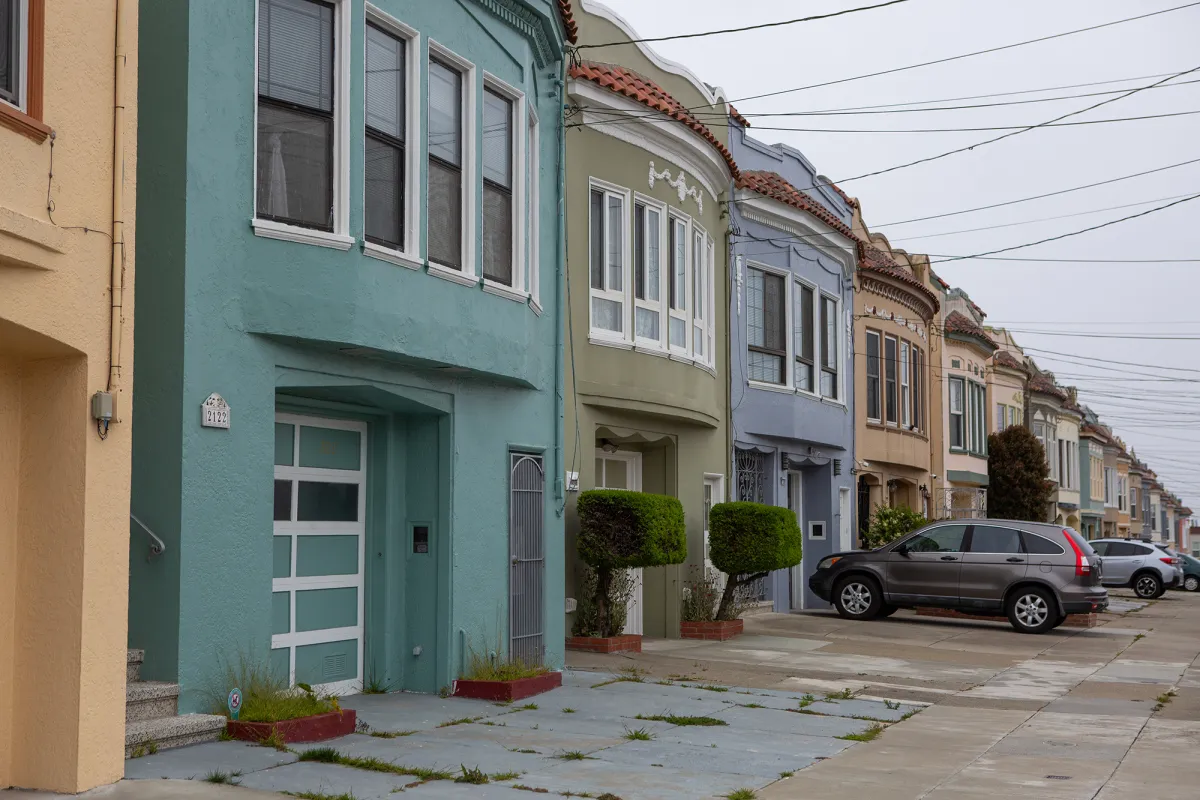
Houses in San Francisco’s Sunset District on July 12, 2023. Photo by Semantha Norris, CalMatters
###
This story was originally published by CalMatters. Sign up for their newsletters.
###
Imagine you’ve finally taken your car to the mechanic to investigate that mysterious warning light that’s been flashing on your dashboard for the past week and a half.
The mechanic informs you that your car’s brake fluid is too low. Dangerously low. Your brake fluid supply, he says, has reached “crisis” levels, which sounds both scary and very expensive.
Naturally, you would prefer that your car have a non-critical amount of brake fluid. “How much more do I need?” you ask.
“A quart,” the mechanic responds. “No, actually, three quarts. Or maybe seven gallons — but only routed to your rear brakes. Actually, let’s settle on half an ounce.”
Such is the situation with California’s housing shortage.
For nearly a decade now, the Legislature has been churning out bills, Attorney General Rob Bonta has been filing lawsuits and Gov. Gavin Newsom has been revamping agencies, dashing off executive orders and quoting Ezra Klein with the explicit goal of easing the state’s chronic undersupply of places to live.
California simply doesn’t have enough housing and this shortage is the leading cause of our housing affordability concerns — virtually everyone in and around the state government, along with the vast majority of academics who have studied the issue, seems now to agree on this point.
This consensus was on display this year when lawmakers passed two sweeping changes to state housing law, one that shields apartment developments from environmental litigation and the other that would permit denser development near major public transit stops in big cities. Both were legislative non-starters just a few years ago. These days even the opponents of these bills have accepted the premise that the state faces a “housing shortage,” a term evoked at least 30 times in committee hearings and floor speeches this year.
Now, if only anyone could agree on how big the housing shortage actually is.
Plenty of people have tried to put a number on the problem.
In 2015, the Legislative Analyst’s Office, which serves as a policy analysis shop and think tank for the Legislature, took an early crack at quantifying the state’s shortage by calculating how many additional units major metro areas would have had to build over the prior three decades to keep housing cost inflation on par with that of the rest of the country.
It came up with 2.7 million missing units.
A year later, consulting giant McKinsey one-upped the LAO, putting the state’s “housing shortfall” at 3.5 million houses, apartments and condos, a number Newsom campaigned on.
Not all estimates hit seven digits. In 2024, the housing policy nonprofit Up For Growth published the more modest estimated shortfall of 840,000 units, which comes pretty close to the 820,000 Freddie Mac put forward a few years earlier.
California Housing Partnership, a nonprofit that advocates for affordable housing, has counted the deficit at 1.3 million units — but not just any units. That’s how many homes the state needs to add that are affordable to people making under a certain income.
Then, this summer, a group of housing analysts including an economist at Moody’s Analytics, came up with the strikingly low figure of just 56,000 — though the authors acknowledged that it’s probably an underestimate.
Estimates of the nation’s overall housing supply are similarly all over the place: From as high as 8.2 million to 1.5 million (and, in one controversial paper, zero).
What even is a housing shortage?
The concept of a “housing shortage” is, in theory, pretty simple, said Anjali Kolachalam, an analyst at Up For Growth.
“It’s basically just the gap between the housing you have and the housing you need,” she said.
In practice, defining and then setting out to quantify the “housing you need” is an exercise fraught with messy data, guestimation and an inconvenient need for judgement calls.
Most estimates begin with a target vacancy rate. In any reasonably well-functioning housing market, the logic goes, some houses and apartments sit empty, either because they’re between renters, they’ve just been built or sold, they’re being fixed or renovated or they’re someone’s second home. A modest vacancy rate is what allows you to pull up Zillow or Craigslist and not get a “No Results Found” error. A very low one suggests there aren’t enough homes to go around.
But choosing a “healthy” vacancy rate — one that reflects a functional housing market — and then backing out the number of additional homes needed to hit it, is more art than science. Most estimates turn to historical data to find some level when supply and demand weren’t completely out of whack. Whether that halcyon period of relative affordability is 2015 or 2006 or 2000 or 1980 varies by researcher and, likely, by the region being considered.
“This notion of ‘pent up demand’ is necessarily in an economist’s judgment call.” — Elena Patel, fellow, Brookings Institution
Beyond that, many researchers have tried to put a value on what is sometimes called “pent up” demand or “missing households.” Those are all the people who would have gone off and gotten their own apartment or bought their own place, but, because of the unavailability of affordable places to live, have opted to keep living with housemates, with parents or, in more extreme cases, without shelter of any kind.
Absent a survey of every living person, there’s no way to precisely measure how many people fall into this camp.
“This notion of ‘pent up demand’ is necessarily in an economist’s judgment call,” said Elena Patel, a fellow at the Brookings Institution who helped put together a nationwide shortage estimate last year (4.9 million).
These variations in methods help explain some of the differences in the shortage estimates. Other differences pop-up thanks to the vagaries of data.
The Moody’s Analytics-led report, for example, calculated a national shortage of roughly 2 million units by adding together both the number of new units needed to raise the overall vacancy rate and the homes needed to backfill their measure of “pent up” demand. But for its California-specific estimate, the data wasn’t available to do the latter, potentially leaving out a big chunk of the statewide shortage.
Then some estimates differ because the analysts are defining the shortage in a completely different way.
The California Housing Partnership looks at the difference between the number of households deemed by federal housing guidelines to have “very” or “extremely” low incomes and the number of units that those households could conceivably rent with less than 30% of their incomes.
That gap of 1.3 million gets at a problem totally distinct from an overall shortage of homes.
Finally, there’s the question of scale. Housing markets are, on the whole, local. A national shortage is going to add together San Francisco and Detroit, masking the extremes of both. A shortage estimate for a state as large and diverse as California may have the same problem.
“It is like looking for a weather forecast for a trip to the beach and being told that the average temperature nationwide is likely to be 67 degrees,” the authors of the Moody’s-led analysis wrote.
Why estimate a shortage?
What might be more valuable than fixating on any one shortage estimate, said Daniel McCue, a researcher at the Harvard Joint Center for Housing Studies, is to look at all the estimates together and appreciate that, by and large, they’re all huge.
“Whether it’s one-and-a-half million or five-and-a-half million, these are big numbers,” he said. That leads to an inescapable takeaway, he said. “There’s so much to do. There’s so far to go.”
Patel, from Brookings, said trying to put a precise tally on what is ultimately the somewhat nebulous concept of a “housing shortage” is still a worthwhile exercise because it gives lawmakers and planners a benchmark against which to measure progress.
How much additional taxpayer money should a state throw at affordable housing development? How aggressive should a locality be in pursuing changes to local zoning? “The more concrete you can be in policy making land, the better,” she said.
The State of California does in fact have its own set of concrete numbers.
Every eight years, the Department of Housing and Community Development issues planning goals to regions across the state — a number of additional homes, broken down by affordability level, that every municipality should plan for. These are, effectively, California government’s official estimates of the state shortage.
To cobble together these numbers, state regulators look at projections of population growth to accommodate the need for future homes and then tack on adjustments to account for all the homes that weren’t built in prior periods, but perhaps ought to have been. If a region has an excess number of households deemed overcrowded, it gets more units. If vacancy rates are below a predetermined level, it gets more units. If there is a bevy of people spending more than 30% of their incomes on rent, more (affordable) units.
It’s a process that the state regulators have come to take somewhat more seriously in recent years, engendering an ongoing political backlash from density-averse local governments and neighborhood activists.
In the state’s last estimate, the topline total was 2.5 million units.
This coming cycle, which has already begun in the rural north and will slowly roll out across the state in the coming years, will produce yet another number. That will be one more estimate for state lawmakers of how much brake fluid the car needs.