And just like that the new Jacoby Creek Bridge has been moved to its permanent home! Crews worked overnight last weekend on U.S. 101 between Arcata and Eureka to prepare and complete the big move using the jack-and-slide technique, lifting the bridge up and sliding it into place inch-by-inch. You can see the whole thing in just over a minute in this timelapse video.
Many thanks to Caltrans and Golden State Bridge, Inc. crews for their hard work and to the traveling public for your patience as we replaced the old 1920s bridge.
You all know about the Gateway Area Plan, right? That’s the big
City of Arcata initiative to add lots and lots of housing in a
somewhat underutilized area of the city or the next several years and
decades, in order to accommodate the town’s natural growth along
with the big influx of people expected due to the Cal Poly Humboldt
transformation.
If you haven’t been following the plan’s every move, this is a good time to plug in. This week two separate city bodies — the Planning Commission and the Historical Landmarks Committee — will be taking a look at the area’s future and past, respectively. These meetings, the latest in a long series, are leading up to the the big joint Planning Commission/City Council special joint study session on the project currently scheduled for Aug. 23. That’s when the rubber is gonna really hit the road on this thing.
First: If you’re catching up, here’s a map of the Gateway Area:
The Gateway Area is in red.
It’s a big chunk of town within walking distance of downtown and Cal Poly Humboldt, and it’s currently dominated by post-industrial buildings, along with some apartments and single-family homes. The idea of the Gateway Area Plan is to rezone and redesignate the whole area to make it suitable for dense, urban-style development.
What will that development look like? Well, that’s the point of Tuesday evening’s meeting of the city’s Planning Commission, which begins at 6 p.m. in City Hall. (Zoom accommodations are available — click here for the agenda and for instructions.)
The commission will be looking, particularly, at the chapter of the Gateway Area Plan that deals with design. What sorts of building sizes and architectural features will be permitted? How far back will the buildings be set back from the street? How tall will they be? How are we going to deal with cars?
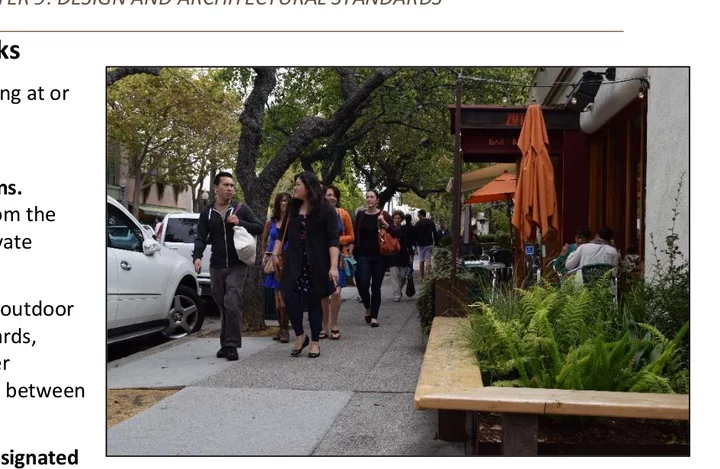
The whole goal of the design chapter can be summed up in this mission statement, which is sort of the prologue to the proposed policies:
Ensure site design offers a mix of vibrant, mixed-use neighborhood structures with active and inviting public
spaces. Provide for visual interest in walkable neighborhoods with street-level activity and public gathering places that
support a car-free lifestyle.
You can read the whole design chapter, as well as the staff report that will frame the commission’s discussion of it, in PDF form at this link. It’s on pages 8 through 14.
This is the goal. Screenshot excerpted from the Gateway Plan’s Design chapter.
The Gateway Area Plan will be a subsection of the city’s General Plan, the rest of which is also being revised simultaneously. City officials are looking to get the whole package done early next year. Right after the discussion on the Gateway Area Plan’s design principles, the Planning Commission will take a look at proposed updates to the larger plan’s Resource Conservation Element, which, according to the staff report, will require only “minor” changes.
###
The next afternoon — Wednesday, July 27 — the city’s Historic Landmarks Committee will take up a different aspect of the Gateway Area Plan at a special meeting starting at 4 p.m., also at City Hall. (Find the agenda here.)
[UPDATE: City senior planner Delo Freitas, who is referenced below, lets us know that the public may only attend the Committee’s meeting virtually — no in-person spectators. Instructions at the agenda link, above.]
And where the Planning Commission will be looking at the future of the Gateway Area, this committee will be looking at its past — specifically, which buildings have enough historical value to merit additional protection.
The committee will winnow down a list of a little more than two dozen structures and features (including the abandoned railroad tracks that run through the area) to figure out which of them may be old enough, significant enough, in good enough shape, and/or associated with particular people or events to forward on to the Planning Commission and City Council for a final decision on their historical value.
The sites on the current long list include many single-family homes in the area, and also a few other well-known structures, including Portuguese Hall and the Cooper Building, which currently houses Richard’s Goat. (The Creamery Building is already a designated landmark.)
Once the City Council finalizes a list of historical buildings in the area, does that mean that those buildings will be protected forever? Not necessarily, according to senior city planner Delo Freitas, who explained the process to the Outpost earlier today. But it will mean that anyone who wants to build something else on those sites will have to either:
Make the case why the building doesn’t merit historic preservation, or
Complete a full Environmental Impact Report on their proposed project.
A list of properties that the Historic Landmarks Commission will consider at the Wednesday meeting can be found, in PDF form, at this link.
###
Both these meetings will be open to public comment, of course, so if you have something to say — say it there! But as the Gateway Area Plan, and the city’s General Plan Update, nears completion, it’s going to be more and more important for citizens to weigh in with their thoughts sooner rather than later.
You can find a whole lot of background material on the Gateway Area Plan and related matters on the city’s web page on its “Strategic Infill Redevelopment Program,” which encompasses the Gateway and related topics. You can find the aforementioned and future opportunities for public comment on “Ongoing Community Outreach” page pertaining to the SIRP.
Finally: Note, under the calendar tab on that last-linked page, what’s happening Aug. 23. That’s going to be the big City Council/Planning Commission study session where a lot of big decisions are going to be made regarding the Gateway project. If you have any thoughts at all about the project, you’re going to want to put them on the record well in advance of that date.
One way to do that: Email the planning commission members with your thoughts, ideas, praise, criticism or concern, and be sure to copy Community Development Director David Loya to make sure that your email goes on the record. You can find all those email addresses at this link.
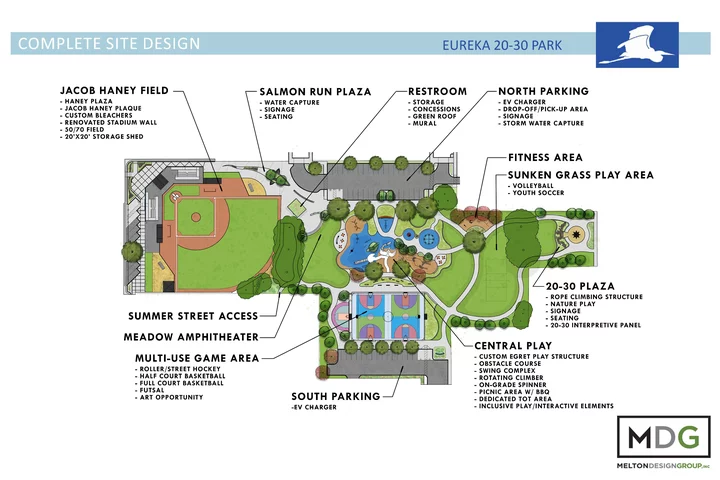
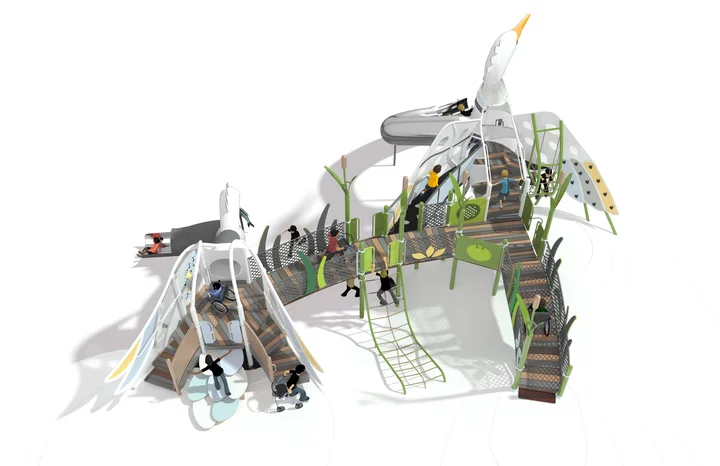
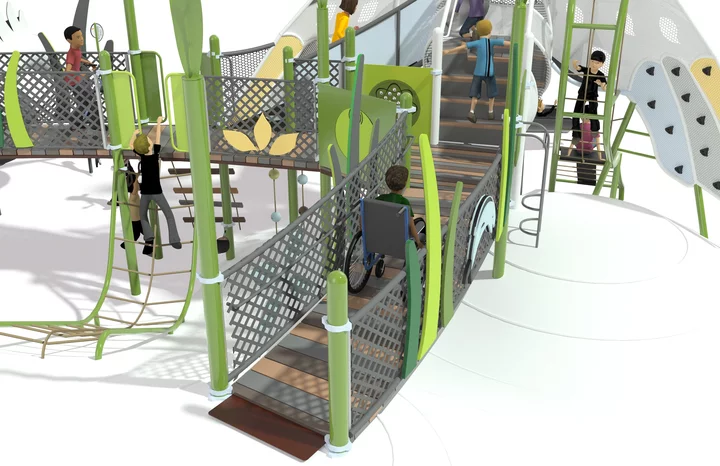
20/30 Park conceptual design by Melton Design Group. Images via the City of Eureka.
###
Eureka’s 20/30 Park – on Pine Street in the West Side neighborhood – is slated for a major makeover in the coming months and the City would like to hear your thoughts on the park’s new identity. Should the park be renamed? Should it stay the same? The City needs your input!
If you recall, the City received a $6.3 million grant from California State Parks back in 2019 to transform the park. In the time since, City staff have worked with local engineering firm LACO Associates and Chico-based design firm Melton Design Group (MDG) to design an all-inclusive egret- and watershed-themed playground, multi-use sports courts, restrooms, fitness equipment, access pathways, an amphitheater and upgrades to Jacob Haney Field. The City has also partnered with the Wiyot Tribe to include interpretive, cultural and educational elements into the project.
“[This] will be the most significant and largest investment in a park renovation in the history of Humboldt County,” City Manager Miles Slattery told the Outpost. “Community Services staff did an outstanding job of demonstrating the need through their successful grant application and assembled a world-class design team to develop plans for what will be one of the most impressive recreation facilities in all of California.”
Construction is slated to begin in early 2023 but before that happens, City staff need some name ideas to go with the park’s new theme. Before you take the City’s survey, be sure to scroll through MDG’s conceptual designs below for inspiration. You can find the survey here.
Press release from the Humboldt County Sheriff’s Office:
On July 23, 2022, at about 9:30 p.m., a Humboldt County Sheriff’s deputy on patrol in the Hoopa area attempted a traffic stop for a vehicle code violation on Tish Tang Road. The vehicle failed to yield and fled at a high rate of speed.
The deputy pursued the vehicle for approximately two miles, the suspect vehicle eventually coming to a stop in the area of Airport Road. Upon stopping the vehicle, four occupants, including one young juvenile, fled on foot. Deputies were unable to locate the individuals.
During a search of the vehicle, deputies located a loaded, unregistered firearm.
This case is still under investigation. Anyone with information about this case or related criminal activity is encouraged to call the Humboldt County Sheriff’s Office at (707) 445-7251 or the Sheriff’s Office Crime Tip line at (707) 268-2539, reference case number 202203820.
Press release from the Humboldt County Sheriff’s Office:
On July 23, 2022, at about 10:42 p.m., Humboldt County Sheriff’s deputies were dispatched to the area of Highway 101 and Palmer Creek Road for the report of a man with a firearm walking alongside the road.
The reporting party told emergency communications dispatchers that they were driving in the area and observed a man brandishing what appeared to be a firearm at the reporting party’s vehicle. Deputies arrived in the area and located a 27-year-old Eureka man in possession of an air rifle. The man was detained during deputies’ investigation and was found to have multiple stab wounds. The man was transported to a local hospital and is expected to recover.
The circumstances surrounding how the man was injured are still under investigation at this time and no additional information is available for public release.
Anyone with information about this case is encouraged to call the Humboldt County Sheriff’s Office at (707) 445-7251 or the Sheriff’s Office Crime Tip line at (707) 268-2539, reference case number 202203821.
If you’re a fan of local TV news, there’s a good chance you’ve seen a segment about so-called “rage rooms.” These are businesses – often in strip mall storefronts or office parks – where people pay to don a pair of safety glasses, grab a baseball bat and smash the heck out of things like old dishes, cabinets and fax machines.
While the businesses have been growing in popularity, some California environmental officials say they are worried that operators often don’t know about safety regulations and could be releasing hazardous waste into the environment. One high-ranking state environmental regulator says her department is too thinly staffed to do anything about it.
“It’s like that nightmare that’s just out of my reach. Like, I know it’s a huge problem,” said Rita Hypnarowski, a senior environmental scientist and e-waste team leader in the state’s Department of Toxic Substances Control. “Fundamentally, there’s nothing wrong with smashing some plates in a room for stress release. But the problem comes in when they’re breaking things like e-waste, which can seriously harm people’s health.”
Hypnarowski’s department cited a Sacramento rage room in 2019 for mishandling e-waste. The Los Angeles County Fire Department recently cited a rage room for similar issues.
Electronic waste includes things like old televisions, flat screen monitors and laptops. Some of that waste has leaded glass while others are lined with rows of mercury tubes, Hypnarowski said. Those items are supposed to be recycled at facilities that use special equipment to separate the hazardous elements. When people smash e-waste, the rooms can fill with a fine dust of toxic metals, Hypnarowski said.
“You’re getting exposed to flying airborne particles and you don’t even know you’re being exposed,” she added.
Hypnarowski said her department became aware of the issue around 2018. In 2019, they inspected a business in the Capital region, Smash Sacramento, state inspection records show.
“There’s nothing wrong with smashing some plates in a room for stress release. The problem comes in when they’re breaking things like e-waste which can seriously harm people’s health.” — Rita Hypnarowski, Department of Toxic Substances Control
Inspectors found old computers and other electronics, according to inspection records. The owner told the state he got the material from e-waste companies but refused to say which ones, the records show.
Inspectors scanned debris on site in April 2019 and found elevated levels of lead, zinc and cobalt, according to a statement of facts in the case. The department cited the company at that time for two alleged violations of the state’s hazardous waste control laws, which are supposed to protect the environment from improper waste disposal.
The agency didn’t conduct air sampling, so it’s unclear the degree to which the release of the heavy metals was a health risk to customers or employees. The inspector did indicate, however, that it was a concern, documents show.
“I informed him that I was seriously concerned about the health and well-being of not only Smash’s customers but of (the owner) as well,” the investigator wrote in a statement of facts regarding the case.
That case is still open and the owner did not respond to interview requests.
California has at least 14 rage rooms operating in the state, according to a list provided by Hypnarowski.
The danger to the environment and to customers from such businesses is likely minimal – especially compared to larger issues the Department of Toxic Substances Control regulates, said Antonio F. Machado, professor of environmental and occupational health at California State University, Northridge. The amount of toxic material rage rooms generate is probably small, and good ventilation could alleviate much of the concern for patrons, he said.
“To me the largest health concern potentially would be workers in the facility who are exposed daily,” Machado said.
The names of the 14 rage rooms aren’t listed in a database of sites the California Division of Occupational Safety and Health (Cal/OSHA) has inspected.
Some of the businesses explicitly state on their websites that they don’t allow patrons to smash certain toxic items.
One rage room in Southern California says that outside items “must be reviewed by our staff prior to entering the rage room for safety. Items such as fluorescent lightbulbs, batteries, power tools and CRT TVs…are not allowed due to hazardous materials found inside of them.”
Hypnarowski acknowledged not all electronics pose a health risk. For example, computer towers pose a minimal danger as compared to monitors. But that’s why inspections are so important, she said.
“To me the largest health concern potentially would be workers in the facility who are exposed daily.” — Antonio F. Machado, California State University, Northridge
The 2019 Sacramento inspection was both the first and last inspection the Department of Toxic Substances Control conducted of a rage room, Hypnarowski said.
The department has struggled to hire and retain scientists, making it difficult to keep up with inspections, said David Rist, a senior environmental scientist who’s been with the department for more than 30 years.
“We have lost inspectors in a variety of programs,” Rist said. “They come for the mission but leave because there are other opportunities and (they) don’t like being undervalued.”
Scientists like Hypnarowski and Rist are talking about shortcomings in their departments’ oversight as their union – the California Association of Professional Scientists – is currently in labor negotiations with the state. The starting salary for an environmental scientist is around $50,000 to $62,000 a year. A union spokesman said higher pay would help the state keep talented young scientists in departments like Toxic Substances Control and allow for better regulatory oversight.
“The state needs to pay equitably so we can pay to fill these positions to protect the people of California,” said Bianca Gutierrez Petzold, staff director at the California Association of Professional Scientists.
So-called “rage rooms” like this one in Sacramento allow patrons to don safety glasses and smash things like plates and old furniture. But environmental regulators are worried some might be mishandling e-waste, a potential threat to people and the environment. Photo by Miguel Gutierrez, Calmatters.
Without the state, oversight of rage rooms could fall to local regulators, as has happened in Los Angeles.
“Los Angeles County Fire has been looking into these sites and is concerned about potential hazardous waste issues,” according to a statement the Los Angeles County Fire Department provided to CalMatters. The department issued a citation in June to one local rage room for violating environmental regulations.
The department declined to provide a copy of that citation or provide details because the case is open, and the business can still attempt to defend itself against the alleged violations.
“It’s a concern to ensure that hazardous waste is not being illegally disposed of and also that the individuals in these so-called rage rooms are not being exposed to hazardous constituents,” according to the department’s statement.
“Los Angeles County Fire has been looking into these sites and is concerned about potential hazardous waste issues.” — Los Angeles County Fire Department statement
A Riverside County environmental official said his office is aware of rage rooms but didn’t know there were any in that county until CalMatters reached out.
The county will contact the businesses to see if they’re allowing people to smash e-waste on site and, if so, to educate owners on the various regulations, said Nicholas Crain, program chief in the county environmental health department’s hazardous materials management branch.
An education campaign is often enough to make sure businesses know of and follow health and safety regulations, he said. But it’s a lot of work.
“There’s always another business popping up that’s generating hazardous waste,” Crain added.
###
CalMatters.org is a nonprofit, nonpartisan media venture explaining California policies and politics.
Malcom “Mac”
Hanks passed away on June 11, 2022, with his loving children at his
side. Mac was born on April 19, 1926, in Doty, Washington. He was
primarily raised by his mother as his father was killed in a logging
accident when Mac was two years old. He went to school in Pe Ell,
Washington ,where he met and married his high school sweetheart, Lois
Guay. They were happily married for 64 years until Lois passed in
2008.
Mac was drafted
into the US Army in September of 1945 as a Private E1. Upon his
return from duty, he worked in the woods learning various logging
skills. In 1954 he and his brother moved to Northern California
forming Hanks and Hanks logging. Many long hours and manual labor
were constant with this occupation, but they loved and took pride in
their work. Mac had a love for sports and played local recreational
ball in his younger years. He loved watching his son, grandsons,
great grandsons, and great granddaughters play ball. There was always
a game of some sport on his television at any given time of day. He
would often watch games from years past and say, “Hell I can’t
remember, they’re all new to me!”
In recent years
he enjoyed going to the McKinleyville Senior Center to play Pinochle.
He had many good friends in his Pinochle family. Mac was known for
not having a filter on what he would say to his partner or players in
general, but he was loved for his gruff but gentle personality. He
also loved treating his family and friends to meals. It did not
matter the meal; he was ready to go with whoever he could talk into
going. Also known for last minute dinner invites, Mac would call his
kids at 5:30 asking, “you want to go out for dinner?” And he
would never pass up an opportunity to have a margarita; he loved his
daily margarita!
Mac is
predeceased by and reuniting with the love of his life Lois, his
parents, and his seven siblings: Fritz, Floyd, Flossy, Mildred, Alma,
Cora, and Ruby. He is survived by his three children, Karen Giacomini
(Ron), Pamela Dobbas (Kevin Heinisch), and Fred Hanks (Sandy); seven
grandchildren, Kelly Miller (Ross), Becky Schutte (Tom), Matt
Giacomini (Cindy) Jennifer Crowson (Jason), Nicole England (Jesse),
Freddie Hanks (Audrey), and Alicia Smith (Lawrence
Dwight); 19 great grandchildren, Gavin
Miller (Kaitlyn), Lucas Miller, Jennelle Crnich, Brian Schuette
(Bella), Brad Schuette, Jesse Slade (Peyton), Jacob Rojeski ,
Courtney Barbee (Eric), Tim Phillips (Kristen), Grace Kilday, Zachery
Crowson, Brendon Crowson, Olivia England, Tucker England, Cody Hanks,
Tyler Hanks, Justin Smith, Brady Smith, and Maci Smith; and eight
great-great grandchildren, Sadie, Ryleigh, Jaxson, Gracelynn, Holden,
Scarlet, Cora and Jag.
He was a gentle
giant and will be missed by many; we are blessed to have him in our
lives. Thank you to Hospice of Humboldt for the love and support
during this process; we are forever grateful. For those who wish to
remember Mac in a special way may make gifts in his memory to:
Hospice of Humboldt, 3327 Timberfall Court, Eureka, Calif., 95503.
###
The obituary above was submitted by Malcom Hanks’ loved ones. The Lost Coast Outpost runs obituaries of Humboldt County residents at no charge. See guidelines here. Email news@lostcoastoutpost.com.