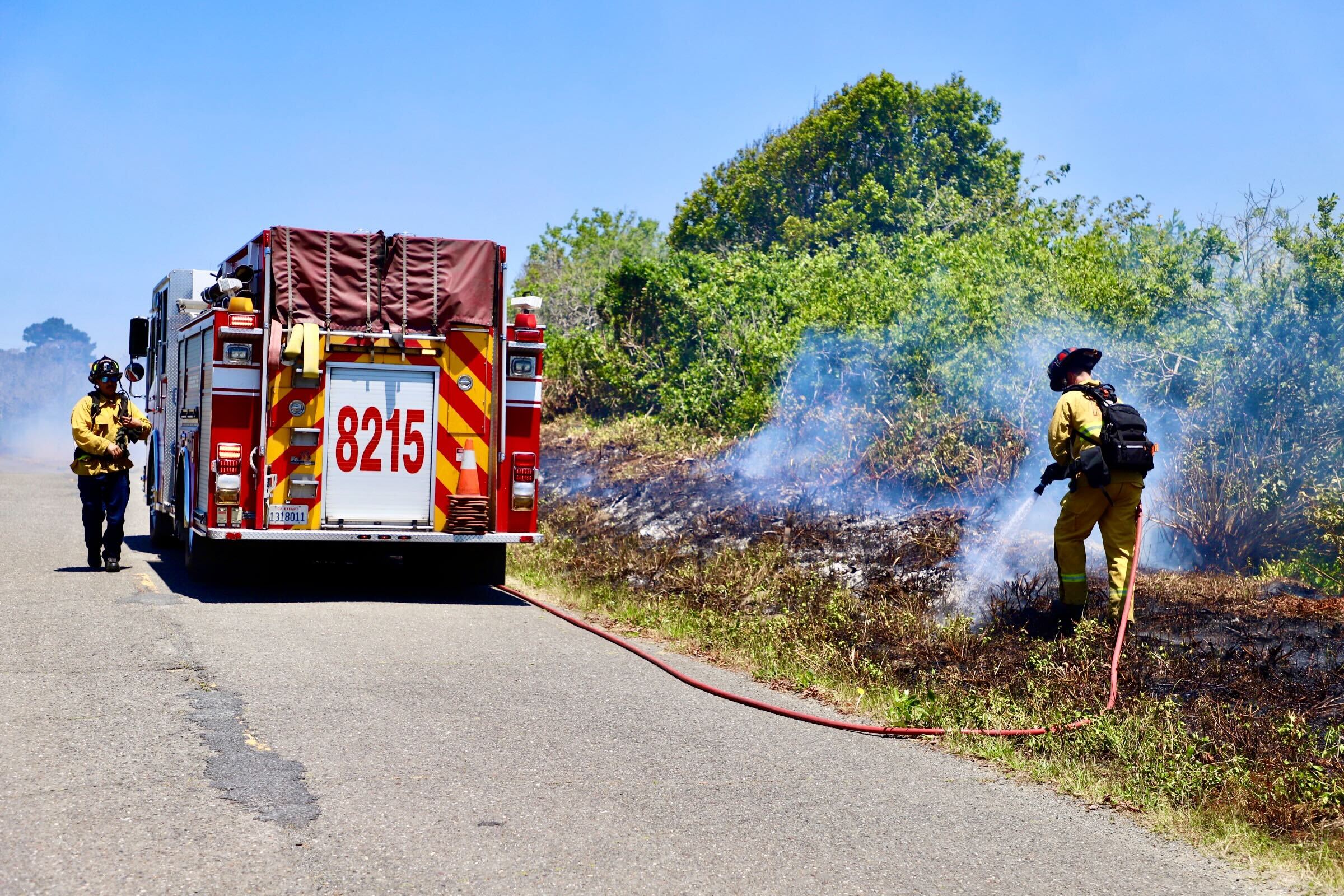
Firefighters from several local agencies are currently working to stamp out a series of fires that broke out along Vance Avenue in Samoa, on either side of the bridge, early this afternoon.
The Sheriff’s Office has been dispatched to the scene as well, according to scanner traffic, as it appears that the fires were intentionally set by a person.
As of a few moments ago, firefighters were trying to determine exactly how many roadside fires there were. The answer appears to be four, at minimum, with several others possible.
The Outpost’s Andrew Goff, at the scene, says that emergency personnel seem to have knocked down most of the fires.
Press release from the Humboldt County Sheriff’s Office:
On June 10, 2022, at about 3:38 a.m., Humboldt County Sheriff’s deputies were dispatched to a residence on the 5000 block of Dows Prairie Road in McKinleyville for the report of a gunshot victim.
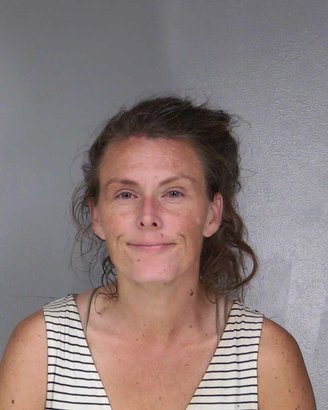
Deputies arrived at the residence and located the suspect, 40-year-old Tanaua Marie Bryan, outside of the home. Bryan was taken into custody without incident.
Deputies then contacted a 53-year-old female victim who had sustained gunshot-related injuries. The victim was transported to a local hospital for treatment and is expected to recover from her injuries.
During their investigation, deputies learned that the suspect and victim are family members. The suspect reportedly confronted the victim outside the residence and shot her. Deputies found evidence of a round entering the victim’s residence, which was occupied by an adult and a child at the time of the incident.
Bryan was booked into the Humboldt County Correctional Facility on charges of attempted murder (PC 664/187(a)), assault with a firearm on a person (PC 245(a)(2)), child endangerment (PC 273a(a)) and shooting at an inhabited dwelling (PC 246). She is being held without bail.
This case is still under investigation. Anyone with information about this case or related criminal activity is encouraged to call the Humboldt County Sheriff’s Office at (707) 445-7251 or the Sheriff’s Office Crime Tip line at (707) 268-2539.
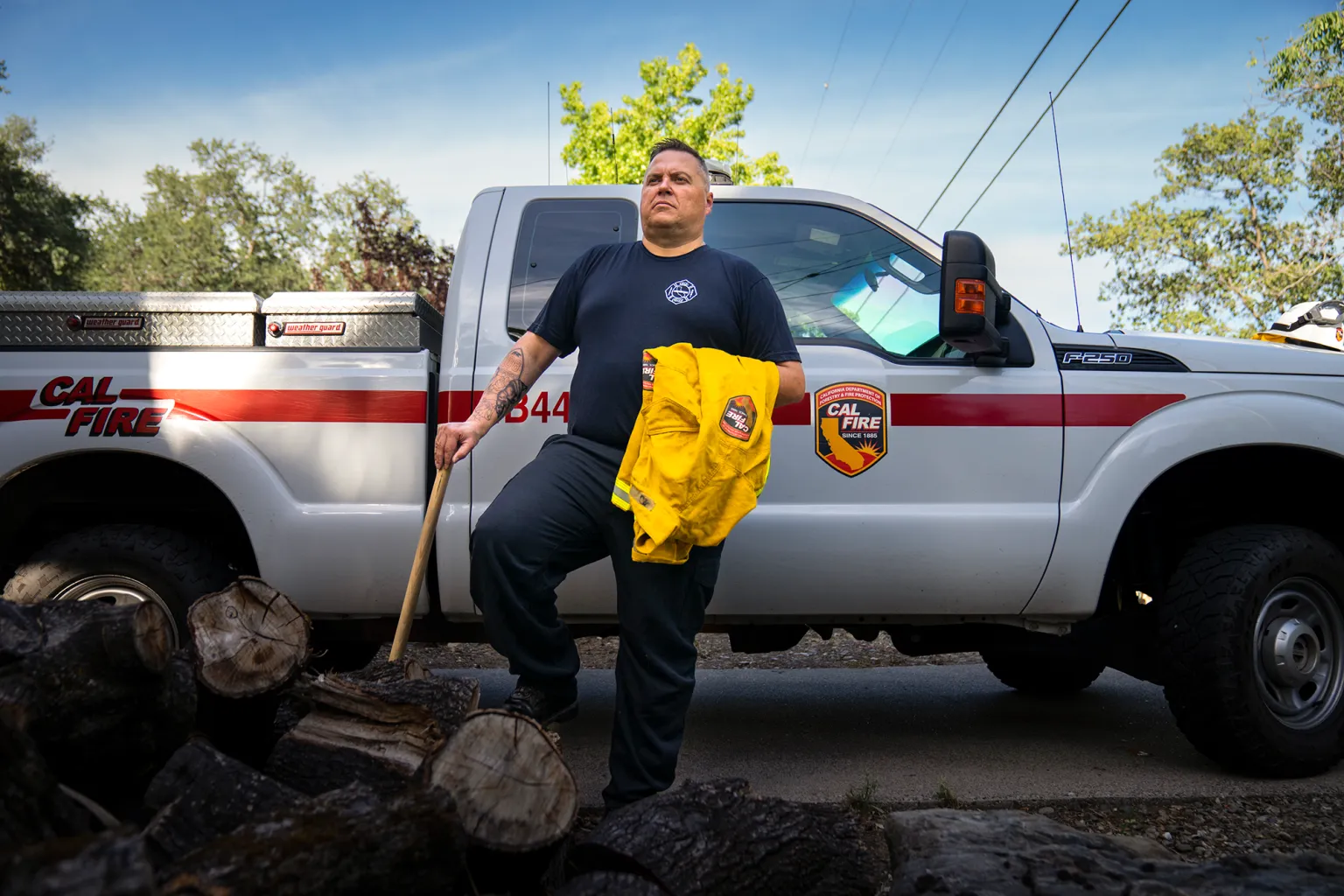
Cal Fire Battalion Chief Brad Niven from Sonora battled to get workers’ comp after he suffered PTSD and considered suicide. Photo by Julie Hotz for CalMatters
California’s firefighting agency has been slow to react to a mounting mental health crisis within its ranks as firefighters around the state say Cal Fire has failed to get them what they need — including a sustainable workload, easier access to workers’ comp benefits and more counselors.
While climate change is driving enduring drought and ferocious fires ravaging California, nature can’t be blamed for all of Cal Fire’s problems:The state’s fire service, which prides itself in quickly putting out wildfires, has failed to extinguish a smoldering mental health problem among its ranks.
Many firefighters told CalMatters they are fatigued and overwhelmed, describing an epidemic of post-traumatic stress in their fire stations. Veterans say they are contemplating leaving the service, which would deplete the agency of their decades of experience. Some opened up about their suicidal thoughts, while others — an unknown number since Cal Fire doesn’t track it — already have taken their own lives.
Interviews with Cal Fire firefighters, including many high-ranking battalion chiefs and captains, and mental health experts paint a picture of the state agency’s sluggish response to an urgent and growing crisis:
Cal Fire has an unyielding policy of 21-day shifts and forced overtime. Staffing is insufficient as firefighters battle thousands of fires year-round, sometimes for 40 days in a row, year after year. The nonstop work and increasing overtime are contributing to on-the-job injuries and post-traumatic stress disorder.
The workers’ comp system is difficult to navigate for firefighters suffering from post-traumatic stress, even suicidal thoughts, beginning with skepticism among managers about the legitimacy of their unseen wounds. Some say to get help or be reimbursed for mental health care, they have to hire lawyers, who told CalMatters that claims are routinely denied.
In California’s rural areas, where many Cal Fire employees are based, there are inadequate numbers of qualified mental health care providers. And many won’t accept workers’ compensation cases because of the extensive paperwork and low compensation. As a result, firefighters say they can’t find help when they desperately need it.
Work conditions and stress are driving an exodus from the department, which loses invaluable institutional knowledge and field experience. Last year 10% of Cal Fire’s permanent, non-seasonal workforce quit.
Firefighters say suicidal thoughts and PTSD are rampant. But Cal Fire collects no incidence data on suicides or PTSD. Experts say the agency can’t develop an effective program to combat them if they don’t understand and monitor their scope.
Cal Fire’s behavioral health unit ramped up slowly despite the growing problem. Although created in 1999, it had no permanent budget and no permanent employees for 20 years. It began with one staffer — and six years later there were two. Now it has 27 peer-support employees, who assist a permanent and seasonal workforce of more than 9,000.
Cal Fire’s growing budget reflects the priority California places on fighting wildfires as they intensify and spread. The agency’s base budget for wildfires has grown by nearly two‑thirds over the past five years alone, from $1.3 billion in 2017‑18 to $2.1 billion in 2021‑22. The total budget, which includes resource management and fire prevention, has also increased about 45% in the same period, to $3.7 billion.
The California Legislature has maintained a laser focus on combating wildfires, in part because of the breathtaking cost to suppress them: In the last 10 years, Cal Fire has pulled $7.5 billion from the state emergency fund to fight fires, including about $1.2 billion in the past year.
Despite the large investment, the funds have not kept pace with staffing needs: Days with extreme fire risk have more than doubled in California over the last 40 years. Every year, Cal Fire responds to nearly half a million local emergency calls in addition to thousands of wildfires. Last year alone, almost 9,000 wildfires scorched the state; the millions of acres burned in recent years have set new records.
“I recognize that the cumulative toll is taking an effect on our people. To be honest, it’s taken a toll on me as well.” — Joe Tyler, Cal Fire chief
When asked about the problems facing his crews, Cal Fire Chief Joe Tyler, who was appointed in March, acknowledged in an interview with CalMatters that “the fatigue and working long hours on large, destructive fires” is taking a toll on their health and wellness across the state.
Tyler vowed in the interview to make the mental wellbeing of his employees “my number one” priority. “I recognize that the cumulative toll is taking an effect on our people. To be honest, it’s taken a toll on me as well,” he told Calmatters, adding that he once worked a fire for 56 straight days.
Asked why the agency he oversees is failing to protect its firefighters from PTSD, California Resources Secretary Wade Crowfoot said “there’s no absolute, silver-bullet solution.”
“We’ve taken a big step forward,” he said, with a proposal in Gov. Gavin Newsom’s 2022-23 budget to add $400 million for relief staffing and permanent Cal Fire personnel.
“They need to be able to come off the front lines during fire season, and have periods of rest, reconnect with families. It’s an incredible strain. In some cases firefighters haven’t been home for months,” Crowfoot said.
“This is a complex challenge that requires resources and support in a lot of ways. I would not suggest that if we are able to get funding for staffing, it will solve the problem.”
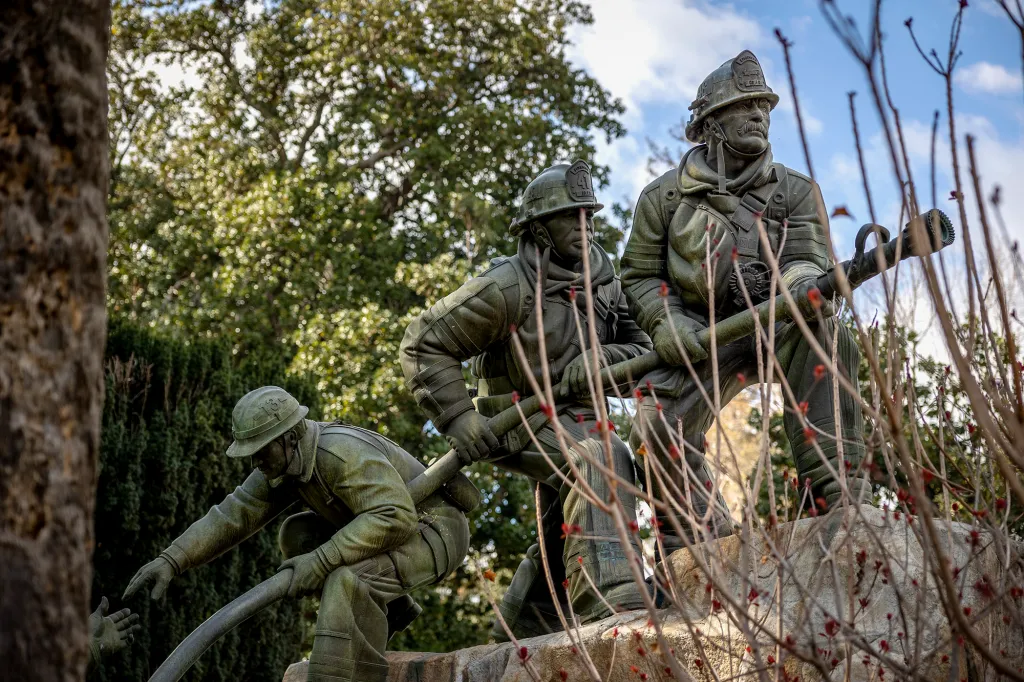
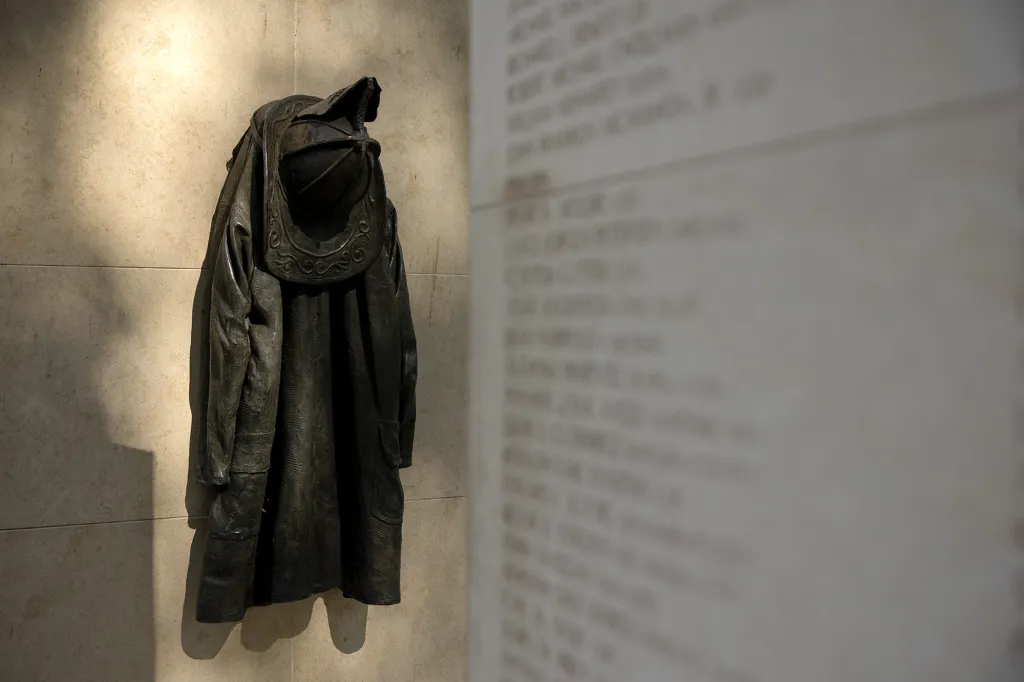
he dangerous work of California’s firefighters is honored at the California Firefighters Memorial on the state Capitol grounds in Sacramento. Miguel Gutierrez Jr., CalMatters
Former Cal Fire Chief Thom Porter, who retired last year after three years as the agency’s commander, said “more needs to be done” to address the agency’s staffing problems, long hours and PTSD among firefighters.
“Part of what needs to be done is recognition that we don’t have enough firefighters in service at any level — state or local,” Porter said. “We need our elected officials at all levels to increase those numbers. People can’t recover from these kinds of stressors without rest away from the job.”
Overworked, under stress
An administrative claim notice from Cal Fire’s firefighters’ union had a Dickensian tone, like a logbook from a 19th century sweatshop: Forced overtime, punishing working conditions, little sleep, workplace injuries, an inhuman system of indenture.
“Employees have been known to work 30 days or more without any time off due to forced overtime, and the most egregious cases include employees on duty for 49 days or more straight without a day off. Overworked beyond the point of exhaustion,” says the claim, which union attorneys sent in February to the state’s Division of Occupational Safety and Health (Cal OSHA) and the Labor Workforce Development Agency.
“CAL FIRE employees have sustained physical injuries and routinely experience fatigue, sleep deprivation, stress, and mental distress,” the union wrote, describing the emotional toll, including divorce, alcoholism and substance abuse, of what it called “excessive hours.”
“Other CAL FIRE employees are quitting their job to find relief from the pressure,” the union attorneys wrote. “Even worse, some employees’ emotional distress is so severe that they have committed suicide or experienced suicidal ideation.”
The document requested that the state’s workplace regulatory agencies investigate unsafe work conditions at the fire stations, which are staffed by Cal Fire under contracts with cities and counties.
The staffing problems stem from Cal Fire’s contractual obligationwith local stations in 36 counties to handle all emergency calls, including structure fires, rescues and medical aid, while also being dispatched to battle wildfires statewide.
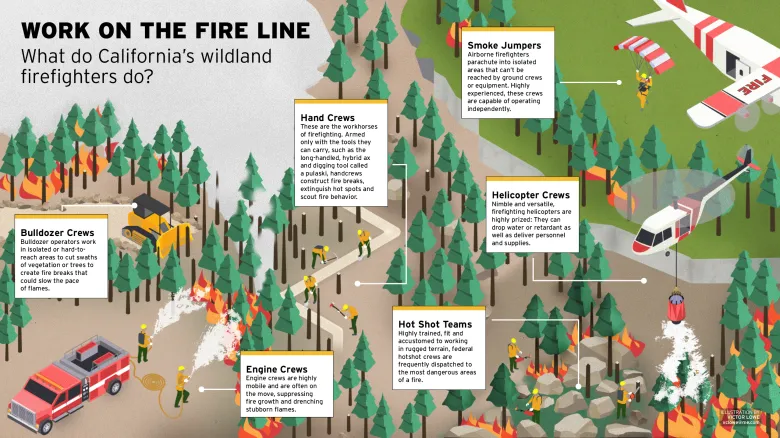
Illustration by Victor Lowe. Click to enlarge.
Gary Messing, a labor lawyer for Cal Fire’s union, Local 2881, said California is out of step with the work rotations of other first responders. Cal Fire has shifts of 21 days, while federal firefighters work 14-day shifts. The union is negotiating with Cal Fire over the issue as part of its collective bargaining process.
“The solution is easy to articulate and hard to accomplish: Reduce the number of hours,” Messing said. “Our people work 72 hours a week. The first thing that could be done is to put Cal firefighters on a 56-hour week. That’s a start.”
The Legislative Analyst’s Office noted in a recent analysis that despite bumps in firefighting staffing and budgets, California’s relentless fires “can still strain response capacity.” In 2020 alone, Cal Fire was unable to dispatch personnel and equipment to thousands of fires: “Roughly 7,900 requests for fire engines, 900 requests for dozers, and 600 requests for helicopters could not be filled.”
The proposed Fixing the Firefighter Shortage Act of 2022, which has been approved by the Senate but has not yet cleared the Assembly, could address some of Cal Fire’s staffing problems. The bill would add about 1,300 firefighters to the state’s ranks at an estimated cost of almost $300 million per year; it would also increase the number of firefighters per engine and attempt to stop forced overtime.
“We are at critical mass, guaranteed, right now,” said Mike Orton, a Cal Fire captain and former Marine who has undergone counseling for PTSD. “These people in fire stations are not going to get relief for years because the state system takes so long to work. The people who are working here are jumping ship like no other. People like me are pulling the ejection handle.”
“The people who are working here are jumping ship like no other. People like me are pulling the ejection handle.” — Cal Fire Capt. Mike Orton
Unlike most workers, when firefighters make a mistake because of stress or fatigue, their actions can endanger the public.
“At the end of the day, all of the well-intentions in the world, and the mental health awareness, the opportunity to go to trauma retreats, doesn’t help when the bell goes off,” Orton said.
“How do we face the public and say, ‘We decided to close your station today because these guys are tired.’ That’s not a decision our managers are going to make.”
One of the core problems is the simple, intractable math: As fires are more frequent, burning longer and more difficult to fight, California does not have enough firefighters to perform all the tasks the state asks of them.
“If you can’t fill all the positions in your battalion, the way the system Is designed, nobody goes home until the positions are filled,” said Battalion Chief Jeff Burrow, referring to daily work shifts. “If I can’t fill those positions, I’ve got to reach out to the battalion next to me, and nobody in that battalion gets to go home. It just spreads. We run out of people all the time.”
‘Denial, denial, denial’
California’s workplace insurance system instructs stressed workers to follow a prescribed path to get relief: Report the problem to your superior, talk to a peer counselor to get referred to a mental health professional, keep your receipts and apply for workers’ comp.
Medical help is the endgame. Workers’ compensation benefits, paid by the state, cover the costs, which average $60,000 for first responders’ cases, according to a Rand Corp. estimate. But the barriers to firefighters’ claims are myriad.
Randy Thrash, who manages Cal Fire’s Occupational Health Program, said finding clinically competent mental health providers outside of large cities is a “huge challenge. They are difficult to find in the rural areas where a lot of our staff lives.”
Even when mental health clinicians can be located, it’s another struggle to identify those willing to take workers’ comp insurance patients, Thrash said. “They don’t want to deal with the billing and reporting requirements of workers’ comp. They prefer to deal with private insurance.”
That creates another layer of bureaucracy for a firefighter seeking help: If someone receives a PTSD diagnosis from a private insurer, those medical records — which are confidential by law — must be made available to the state. If that doesn’t happen, the diagnosis must be verified by a state-qualified medical examiner. The process can take months for a firefighter to be reimbursed for medical care.
A current bill, introduced by three Democratic senators, would cut the time period to investigate PTSD workers’ comp claims from 90 to 60 days, and states that if the claim is not rejected within that timeframe it would be presumed to be eligible for compensation.The proposal has cleared the Senate and is in the Assembly.
The long wait for workers’ comp insurance “is hugely frustrating,” said Gena Mabary, Cal Fire’s injury and accommodation manager. “When you are dealing with psychiatric stress, you are already stressed out. It adds another layer of stress. It means that sometimes people won’t go through the process.”
Cal Fire workers’ comp claims for mental health problems “are more frequent. I am expecting them to increase still more,” Mabary said. No data, however, was available.
“Comprehensive national data on first responder mental health do not exist,” said a 2020 Congressional Research Service report on federal efforts to address the mental health of first responders. The authors reported that barriers to accessing mental health services are particularly problematic among firefighters, where a “culture of not seeking help” exists.
Mynda Ohs, a San Bernardino-based counselor specializing in treating first responders, said Cal Fire “has no idea how to proceed with a mental health injury versus a physical injury.”
One of her Cal Fire patients suffering from PTSD had to hire an attorney to pursue a claim, and even then the case took two years to resolve. “They put him through the ringer, ” Ohs said. “It’s more trauma on top of trauma.”
“When you are dealing with psychiatric stress, you are already stressed out. (The long wait for workers’ comp) adds another layer of stress.” — Gena Mabary, Cal Fire injury and accommodation manager
In 2020, a state law recognized that all first responders engage in stressful and dangerous occupations, and made PTSD “presumptive” for workers’ comp benefits — codifying that a mental injury is a legitimate medical claim, although it must still be proven. That law sunsets at the end of 2024.
Before the law was enacted two years ago, California firefighters’ PTSD cases were denied workers’ comp benefits 24% of the time — almost three times more often than their claims for other medical conditions, according to a RAND Corp. report. They were also denied more often than PTSD cases filed by people in other occupations.
Yet the current system is still stacked against those filing claims, according to an attorney representing firefighters who dispute workers’ comp rejections. He said many are denied.
Cal Fire ‘has no idea how to proceed with a mental health injury versus a physical injury.” — Mynda Ohs, counselor specialized in treating first responders
“Denial, denial, denial,” said San Diego attorney Scott O’Mara. “It’s very, very common. Adjusters’ training is to contain and control costs. They need to pull back and allow these people to get the care. They delay and deny treatment. It’s horrendous.”
Workers’ comp claims begin with an adjuster at the state’s nonprofit insurance provider, the State Fund. If the claim is denied, challenges can move their way, slowly, to the state’s Division of Workers’ Compensation, which is the final arbiter.
Battalion Chief Brad Niven successfully navigated the workers’ comp insurance system for his mental health claim after he began considering suicide, but not without difficulty. He said he has at least 18 friends and peers who have faced the same problems he did.
“I’ve heard horror stories from people whose boss has not supported them, who say, ‘You are making this stuff up, you are not sick. You are trying to get out of coming to work’. You have to sit down with a psychiatrist and you have to relive those experiences. People who have issues, myself included, don’t want to relive them,” Niven said.
“They are looking at it from a financial standpoint, not wanting to approve the claim, not wanting to pay it out. You are guilty until proven innocent. You have to go above and beyond to prove your case.”
Turnover: ‘People are leaving in droves’
Far from being walking recruitment posters for Cal Fire, many fire service veterans bluntly said they are ready to leave the organization they love — and they give that unvarnished advice to their colleagues. The agency is losing experienced employees who either accept quieter, better-paid first responder jobs or opt to retire and collect a pension.
Burrow said his Riverside staff is operating at about 50% capacity. “You’d be hard-pressed to talk to someone in the department right now that isn’t looking for other avenues in their life,” he said.
He added, “people are leaving in droves.”
“My entire battalion — we have people leaving all the time or retiring earlier, which is where I’m at,” said Burrow, 49. “For the people that work for me, I advise them to move on. I can’t in good conscience tell them to stay. We have people quitting the academy now. That was unheard of 20 years ago. That speaks volumes.”
Cal Fire officials initially disputed that people are leaving in large numbers, saying their staffing levels have been fairly consistent.
But data released at CalMatters’ request shows that about 10% of its workforce quit last year. The number of firefighters and other personnel who left in 2021 was 691, nearly twice the average for the previous four years, according to numbers provided by Cal Fire spokesman Chris Amestoy.
‘For so long it was in the dark.’ And often, it still is
There have been few attempts at legislation to address the mental health of the state’s wildland firefighters.
A 2017 bill would have created a peer-support program for a broad range of first responders that included a strict confidentiality component. It made it through the Legislature and to then-Gov. Jerry Brown in 2018 for his signature.
In the month that the bill sat on the governor’s desk, two Cal Fire employees committed suicide, according to Assemblymember Tim Grayson, the bill’s author. Brown ultimately vetoed it, objecting to the scope of the confidentiality, which he said could jeopardize workplace safety.
Grayson, a Democrat from Concord, revived the measure the next legislative session, with a more-narrow focus on creating a pilot program of peer support for local or regional firefighters. That legislation was signed by Gov. Gavin Newsom, although it has a sunset provision in two years.
Grayson said it took three years to convince colleagues that mental health problems were increasing at Cal Fire, in part because the agency collects little data.
“There’s been a shift — people are talking about this. For so long it was in the dark,” he said. “We’re talking about lives here. Not just lives of the firefighters, but their family and children, everybody is impacted by the wellbeing of our first responders. It would behoove us to invest in the mental health and wellbeing of our first responders. They do lay their lives on the lines for us.”
Porter, Cal Fire’s recently retired chief, said firefighters are starting to open up more about their PTSD and share their heart-wrenching stories.
“It’s been an incredibly moving experience to have people opening their personal lives and talking about things that never would have been talked about before. In my career, up until the last three years, I have never heard some of this. It’s alarming,” he said.
But getting help is problematic in a service where tough-guy traditions persist. Mike Ming, who oversees Cal Fire’s employee support program, saw firsthand the “walk-it-off” mentality as a young firefighter. When he told a supervisor that a traumatic work experience was bothering him, “He said, ‘Suck it up, buttercup,’ and told me to pull up my skirt.”
While that attitude is fading, Ming said, there remain “some holdovers, some 30-year grumpy captains. We do also have in management some folks who say, ‘I sucked it up, why don’t they suck it up?’ I don’t know if we are ever going to get away from having some aspect of that.”
Dennis King, 76, who retired as a battalion chief after 22 years with Cal Fire, may be one of those holdovers. He wonders “if the pendulum has swung so far.”
“The state has always had a very liberal policy. The phone rings in the morning at the station and I go, “Who’s calling in sick today?’ Everyone says, ‘I think I have the flu.’ We have people who are serial hypochondriacs. There’s always people who are going to take advantage of this system.”
Cal Fire leaders “will always tell you there’s no punitive action against anybody who admits to PTSD. But it does affect their career.” — Mike Feyh, former captain, Sacramento City Fire Department
Today, when mental health issues are raised among wildland firefighters, it’s still in hushed tones. There’s a stubborn stigma attached to discussing PTSD or trauma.
“They will always tell you there’s no punitive action against anybody who admits to PTSD,” said Mike Feyh, a former captain with the Sacramento City Fire Department. “But it does affect their career. There were very few times that I saw someone who has struggled with a mental health issue rise to the top of an organization or take a leadership position. They kept it to themselves.”
Ernie Marugg, a former Cal Fire battalion chief who is in the process of seeking a medical retirement for PTSD, said the agency culture is, “If you need help you are weak and if you are weak I don’t want you around me. It’s like you are contagious,” he said.
A slow reckoning at Cal Fire
Until recently, Cal Fire’s behavioral health program was bare-bones. The program had only one staffer when it began in 1999 and six years later, there were two. Now Cal Fire has 27 employees in its peer-led program — all of them with their own stories of addiction, suicide attempts and trauma — to help a statewide workforce of 6,500. These peers do not offer formal counseling, they mostly listen, and then, if warranted, send employees to therapists for help.
But Cal Fire still doesn’t collect much data on mental health, and what information it does gather is often squirreled away in departments that don’t talk to each other. Some Cal Fire staffers bemoan the agency’s antiquated and cumbersome data management.
For example, its behavioral health program collects numbers of “contacts” — calls to a helpline and visits in person from a peer advisor. But, rather than focusing solely on issues such as PTSD, the numbers include those seeking advice about an array of other topics, such as parenting, financial problems and legal issues.
When CalMatters asked Tyler, the Cal Fire head, why his agency doesn’t have data on incidence of PTSD and suicides, he said he will soon meet with the behavioral health team to discuss “strengths and weaknesses and threats to the program.” He said the data related to mental health needs to be improved.
The 2012 Strategic Plan, Cal Fire’s guiding document updated every seven years, devoted two pages to the value of physical fitness and calisthenics. There was no discussion of PTSD or mental health.
Cal Fire now preaches the importance of mental health awareness and the no-strings approach to asking for help. The latest plan, from 2019, for the first time acknowledges suicide as a problem.Now each station house has pamphlets and fliers tacked onto bulletin boards with information about PTSD and suicide prevention. Classes about PTSD and suicide awareness have recently been added to the Cal Fire academy’s curriculum.
The names of fallen firefighters are inscribed at the California Firefighters Memorial on the Capitol grounds. By Miguel Gutierrez Jr., CalMatters
Behavioral health experts point to the U.S. Armed Forces as a model for integrating mental health programs alongside physical well being.
The Defense Department has studied and reported on the health of American troops for 30 years. In 2021 the military asked the Rand Corporation to perform a similar analysis, considered a critical tool to understanding the impacts of the long deployments and inherent dangers. “Exposure to traumatic events, combat in particular, is a well-known hazard of military service. PTSD can contribute to military attrition, absenteeism, and misconduct,” the report said.
The U.S. Forest Service, which manages the nation’s largest wildland firefighting force, says it is focusing on PTSD like never before.
“Over the past several years, understanding the mental health impacts on firefighters has become a high priority,” said E. Wade Muehlof, a deputy national press officer with the Forest Service in Washington, D.C., citing the length and intensity of the fire season as factors.
The federal agency has an expanded employee assistance program and a new provider with on-call “trauma-trained clinicians.” In addition, it tasked a new behavioral health steering committee with developing programs.
But even as the need has come into sharper focus, a gap in services for first responders remains.
The nonprofit National Fire Protection Association identified an acute shortage of programs to treat PTSD and trauma among firefighters. Its 2021 national assessment found that nearly three-quarters of fire departments do not have behavioral health programs for their employees. Of those that do, 90% offer help for post-traumatic stress but few other mental health services.
“We are really good at preventing fires, why don’t we work on preventing this?,” said Patrick Walker, a Cal Fire battalion chief. “There’s a tendency to kick people when they are down, instead of pulling them up. That’s got to change.”
A life saved
Intervention, if it comes in time, can save lives. Niven can attest to that.
In late 2019 the battalion chief, who is based in Sonora, was struggling with depression and suicidal thoughts. They became overwhelming after he drove through an intersection where, five years earlier, he was unable to save the life of a young woman hit by a logging truck.
He couldn’t shake the memories. “I thought to myself, ‘Is this it? Am I going to commit suicide?’,” Niven, 47, said in an interview.But he didn’t reach out for help, “I thought I could fix it.”
During a flight to Sacramento, he made a plan: He would kill himself by jumping off the top floor of the airport parking garage.
A flight attendant who saw him crying sat next to him and asked how she could help. She arranged for Niven to text a friend, who put him in touch with a counselor from Cal Fire’s employee support program, who then stayed with Niven on the phone for two hours after the plane landed.
After that, Niven received counseling and the support of a supervisor, who told him what every employee in pain wants to hear: I got your back.
###
If you are having suicidal thoughts, you can get help from the National Suicide Prevention Lifeline at 1-800-273-8255 or https://suicidepreventionlifeline.org/
CalMatters.org is a nonprofit, nonpartisan media venture explaining California policies and politics.
Voters fill out their ballots at a voting site at the Hamilton School gymnasium in central Fresno on June 7, 2022. Photo by Larry Valenzuela, CalMatters/CatchLight Local
If you need an example of just how befuddling California’s top-two primary system can be, consider the case of the $50,000 mailer sent to voters across 13 California counties in early June.
The mailer’s message: In the crowded race for a state Senate district that sprawls from Modesto to Truckee to the Owens Valley, the only “Democratic choice” — the one with a “progressive agenda” — was local labor leader Tim Robertson, not school administrator Marie Alvarado-Gil.
“We Trust Only Tim Robertson,” the mailer blared in large type.
There’s nothing unusual about campaign material touting one Democratic candidate over another. Except that this one was funded by a Republican. And not just any Republican, but GOP state Senate leader Sen. Scott Wilk.
There were six Republican candidates running in that central Sierra district, but none were the beneficiaries of Wilk’s outside political spending. Nor were any championed by another independent expenditure committee that poured $17,000 behind Democratic Party-endorsed Robertson after receiving nearly $50,000 from Wilk’s account.
Though ballots are still being tallied at registrar’s offices across the district, now it’s clear what Wilk was trying to do.
In the Republican-leaning 4th state Senate district, 59% of voters in the most recent count checked their ballots for one of the half-dozen GOP candidates. But they diced up the vote into smaller slivers. The two Democrats, Robertson and Alvarado-Gil, only got 22% and 19% of the vote, respectively. But that was enough to put them in first and second place as of Sunday.
The top Republican, former U.S. Rep. George Radanovich, is barely ahead of two others at 17% and insists the race is far from over. “We fully expect to be in the runoff,” said campaign manager Joe Yocca. “There are plenty of votes still left.” (In the nine counties completely in the district, about 163,000 ballots have been counted, with an estimated 62,000 to go.)
Under California’s unusual top-two primary system, all candidates are listed on the same ballot and only the first- and second-place winners move on to the November general election, regardless of party affiliation.
By backing Robertson and knocking Alvarado-Gil as insufficiently progressive, Wilk was trying to concentrate the district’s Democratic voters on one candidate, thus pushing the second Democrat’s support beneath that of at least one Republican.
If the current results hold, he failed.
Wilk said he decided to fund the mailer after seeing “scary” polling numbers a couple weeks before the June 7 primary suggesting that the Republican candidates were at risk of cannibalizing the GOP vote. Earlier in the year, he tried to persuade some of those Republicans to drop out to avert exactly this scenario, he said.
But by early June, it was too late. One strategy would be to pick a favorite Republican and spend money to persuade right-of-center voters to get behind them. But that went against a promise Wilk said he made not to put his “thumb on the scale” for any one of the Republicans.
So, as a last resort, he tried putting his thumb on the scale for a Democrat.
Comparing the results to those early polling numbers, Wilk said Robertson’s vote share ticked up slightly. “So it worked a little bit, but obviously it didn’t work enough,” he said.
Oddly enough, the California Democratic Party also landed on the same strategy in the final weeks of the campaign. It spent roughly $50,000 boosting Robertson, believing that Alvarado-Gil was already safely in the top two. That Wilk seized on the same approach hoping to achieve the opposite outcome either speaks to a strategic miscalculation or terrifically bad luck.
“When you’re in the minority, you gotta think outside the box a little bit,” Wilk told CalMatters.
Wilk may have messed up, and too many Republicans may have entered the race. But in a broader sense, the upside-down results are the product of California’s decade-long experiment with a nonpartisan primary system — the top two.
Approved by voters in 2010 and rolled out for the first time statewide two years later, the system has changed state politics in many of the ways that its proponents promised at the time — and a few ways that they didn’t.
As supporters of the system claim, it’s offered an avenue for moderate members of both parties to amass more political power in the Legislature, while also giving “no party preference” voters — Californians who don’t belong to any party at all — a chance to participate in every major stage of the electoral process.
The ascendancy of the “Mod Caucus” — “a whole cohort of centrist Democrats” in the state Legislature — is thanks in part to the top two, said Dan Schnur, who worked as spokesperson for Republican Gov. Pete Wilson and the late Sen. John McCain of Arizona, before leaving the GOP and becoming an independent.
Political polarization remains, and sometimes the system produces odd results, but “I think it might be unfair to ask one political reform to solve all problems,” he said.Supporters also assured voters that the top two would increase voter participation overall by engaging a broader range of voters, not just partisans. The truth is a bit of a mixed bag: Political independents can now freely participate in the primary, but many partisan voters are turned off if top-of-the-ticket races don’t include a member of their party. And there’s no evidence that non-voters are drawn to the polls by the state’s primary system, even while a series of other changes have made it much easier to register to vote. The percentage of eligible Californians who are registered to vote, at 85%, is the highest in 68 years. And since 2020, ballots have been mailed to every registered voter.
Still, like any electoral system, it’s not without its drawbacks. Critics say it too regularly produces head-scratching outcomes, like the apparent result in Senate District 4; limits voter choice; makes primary races more expensive and thus dependent on big spending by special interest groups; and is uniquely ripe for well-funded “shenanigans.”
Theory versus practice
In an old-fashioned partisan primary, Democrats and Republicans vote in separate elections, and the winners secure a spot on the general election ballot. The critique of that arrangement, made forcefully by supporters of top two, is that any candidate hoping to make it past the primary has to appeal to the party’s base. Those voters disproportionately occupy the ideological extremes, the argument goes, so partisan primaries lead to more extreme candidates and officeholders, which leads to gridlock.
“We have hyperpartisan on one side, hyperpartisan on the other, and we can never come together to do the people’s business in California,” then-Lt. Gov. Abel Maldonado, the man responsible for putting top two on the ballot, told voters in 2010.
By putting all candidates on the same ballot where they have to compete for votes across the ideological spectrum, top two encourages politicians to move toward the political center, the argument goes.
Since most legislative and congressional districts in California are overwhelmingly Democratic, the top two candidates in many districts are likely to be two Democrats — often a progressive and a moderate. And that gives voters in those districts a more meaningful choice that better reflects that district’s political preferences.
Or as FiveThirtyEight founder Nate Silver explained as California was considering the change, if every state helds its primaries this way, “we’d have a Senate full of Susan Collinses — and Joe Liebermans,” referring to two New England moderates.
That’s the theory. A decade into California’s electoral experiment, not everyone thinks it’s worked so well in practice.
In last week’s primary, the fantastically expensive five-way competition to be state controller resulted in a victory for Republican Lanhee Chen and, it appears, progressive Democrat Malia Cohen. Steve Glazer, among the most conservative Democrats in the state Senate who could serve as poster boy for the top two, didn’t make the cut. The polarized outcome more or less reflects what one might expect from a partisan primary.
Likewise, in the races for governor and attorney general, voters in November will not see the liberal Democratic incumbents square off against moderate Democrats or independents, but against long-shot Republicans.
After legislative primaries in Democratic strongholds in Sacramento, Hayward, Inglewood and San Diego, voters will see two Democrats square off in November. But from San Mateo to Milpitas to San Luis Opisbo; from Palmdale to Moreno Valley; from Norwalk to Anaheim, many of the state’s solidly blue legislative districts eschewed picking Democrats in the top two, instead opting for traditional partisan standoffs pitting a Democrat versus a sacrificial Republican.
“This system is not delivering on all the promises of providing opportunity for middle-ground candidates,” said Rob Stutzman, a GOP consultant who has run campaigns for moderate Republicans and political independents.
But Alvarado-Gil, one of the apparent top two Democratic finishers in the Senate District 4, considers herself a “middle-ground candidate.” A charter school administrator who described herself as a “proponent of less government,” she seems as surprised as anyone in the California political establishment at her success.
“I’m on quite the ride right now,” she said in a phone interview. “I don’t know if there’s a word to describe this other than, ‘Wow!’”
Alvarado-Gil said it wasn’t until two weeks before the primary that she heard from a politically-connected friend that she was polling surprisingly well for a candidate with less than $10,000 in her campaign account and no — literally zero — endorsements. When the Wilk-funded mailer attacking her landed in her mailbox, she knew her success in the polls was no mere rumor.
“I was just thrilled because they had a great picture of me,” she said.
Now that the results are in, she acknowledged the “paradox” of the apparent double-Democratic win in a district where Republicans outnumber Democratic voters by more than three percentage points and where Donald Trump narrowly defeated Joe Biden in 2020.
“I have many Republican friends, and I am willing to earn the vote of Republicans who believe that a moderate representing their district is a solid choice,” she said.
Robertson, the Democrat in first place so far, declined to comment in detail on the results or on Wilk’s involvement, saying that he is focused on his own campaign.
Shutout dread
The fate that apparently befell Republicans in Senate District 4 isn’t especially novel in California. Almost every year, the prospect of one party getting shut out from the November ballot, because an overabundance of candidates splits the primary vote, sends activists and political strategists into flights of panic.
In 2018, the terror was on the Democratic side. With hordes of fresh-faced candidates motivated to run in competitive congressional seats by a shared distaste for then-President Trump, party leaders warned of an “overpopulation problem.” In the end, the fear was overblown. Democratic candidates made it to the top two in all seven of the California congressional seats targeted that year — and went on to flip them all.
In fact, it was the GOP that suffered a surprise shutout that June when Democrats claimed first and second in a toss-up Assembly district in San Diego — thanks to an overly crowded Republican field and some last minute Dem-friendly misinformation about the top GOP candidate.
In 2020, it was Democrats’ turn to crowd themselves out of a possible legislative victory. Five little-known liberals entered the field against two Republicans in an Assembly district in Southern California. The two Republicans came first and second, despite securing less than half the total vote.
Election workers sort through ballots at the Sacramento County Registrar of Voters on June 7, 2022. Photo by Miguel Gutierrez Jr., CalMatters
No wonder that back in 2010, both major political parties, preferring to have more influence over the candidates who run under their banners, found common ground in opposing the top-two measure. California’s smaller parties also opposed the idea, as did some political independents, who argued — correctly it turns out that — that in the vast majority of cases the top two slots will be monopolized by Democrats and Republicans.
With 10 years of California election data to work with — plus the experiences of Washington and Nebraska, also top-two states — the top-two system does seem to result in the election of more moderate candidates, but only by a bit.
“It’s not that it doesn’t have that effect, it’s just pretty small,” said Eric McGhee, a political scientist and researcher at the Public Policy Institute of California. “It’s not going to get us back to the 1970s or something,” an era with much more ideological overlap between Republican and Democratic lawmakers.
One complication that McGhee found is that voters often have a difficult time distinguishing between different ideological factions within the same party, so centrist candidates don’t always prevail even in districts where they would be expected to win.
“It’s asking a lot of the typical voter,” said McGhee.
Voters seem to like the system anyway. A statewide PPIC poll conducted in May found that 62% of likely voters say top two has been “mostly a good thing” for California.
The new lawn sign
But as voters have grown accustomed to the top-two primary, so have California’s political consultants and strategists, who have fine-tuned the art of gaming the system.
The consummate example might be in 2018, when Democrat Gavin Newsom’s gubernatorial campaign went out of its way to “attack” Republican John Cox, elevating his name recognition and conservative cred with GOP voters. That came at the expense of former Los Angeles Mayor Antonio Villaraigosa, a moderate Democrat who likely would have been a more formidable opponent to Newsom in a general election. Arguably, the two would have represented a more representative choice for California’s overwhelmingly Democratic electorate. But Newsom’s plan seemed to work, and he easily defeated Cox in November.
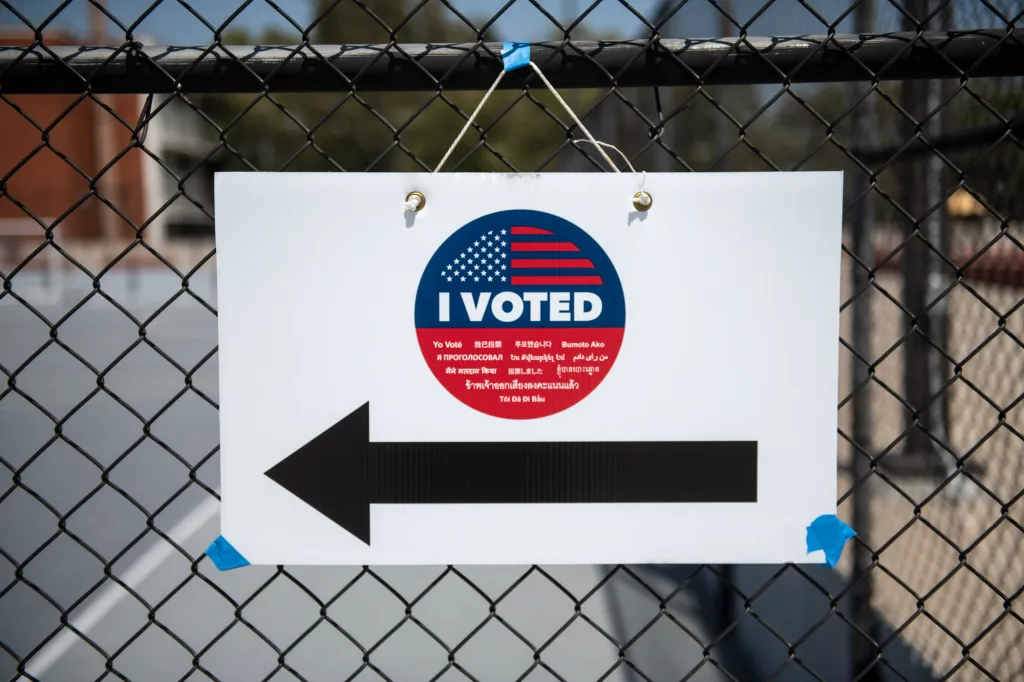
A voting sign at Cal State Los Angeles in Los Angeles on June 7, 2022. Photo by Pablo Unzueta for CalMatters
This year, a similar strategy played out when supporters of Democratic Attorney General Rob Bonta began touting the conservative bona fides of his Republican opponents, while doing their best not to mention the name of his no party preference opponent, Sacramento County District Attorney Anne Marie Schubert. As of Saturday, Republicans Nathan Hochman and Eric Early were battling for the second spot on the November ballot, both far ahead of Schubert.In an Orange County congressional race, the Democratic campaign of Asif Mahmood name-checked a right-wing Republican, hoping to elevate him over incumbent Young Kim, though it doesn’t appear to have worked. And in a number of strongly Democratic legislative districts, candidates and special interests alike have toiled to prop up easier-to-beat Republican opponents — including, in one case, a QAnon conspiracy theorist who got some minor support from the California Chamber of Commerce.
What was once a high-concept bit of electoral engineering has gone mainstream, said Paul Mitchell with Political Data Inc., a consulting and analysis firm that works with Democratic campaigns.
“Now you have someone in every little f — ing Assembly race trying to prop up the Republican,” he said. “It’s become a part of the process as much as lawn signs. It’s part of the California campaign war chest.”
Yet, while that tool may “look good on paper,” it’s not clear how often it actually works exactly as planned, said political consultant Andrew Acosta. For instance, Bonta appears likely face the more moderate Hochman rather than the arch-conservative Early targeted by Bonta’s ads.
And back in Senate District 4, Wilk’s effort to elevate one Democrat and pull down the other apparently didn’t work out, either.
Former state GOP Chairperson Ron Nehring blames the “idiotic” top-two system, but Wilk doesn’t. One of the Senate’s more moderate Republicans, Wilk represents a Southern California district that is more Democratic-leaning than any of his fellow GOP caucus members.
“I blame the Republicans candidates because none of them closed the deal,” he said. “I personally like the top two.”
###
CalMatters.org is a nonprofit, nonpartisan media venture explaining California policies and politics.
“I,
the often-mentioned Sebastos Gregory…the very sinful (until now)
longed to build a very beautiful church and round it a dwelling for
monks and in it a burial place for the repose of my sinful bones…it
was not completed with any other money belonging to someone else nor
as a result of any wrongdoing nor even with forced labor…”
— Gregory,
founder of Bachkovo monastery, AD 1083
###
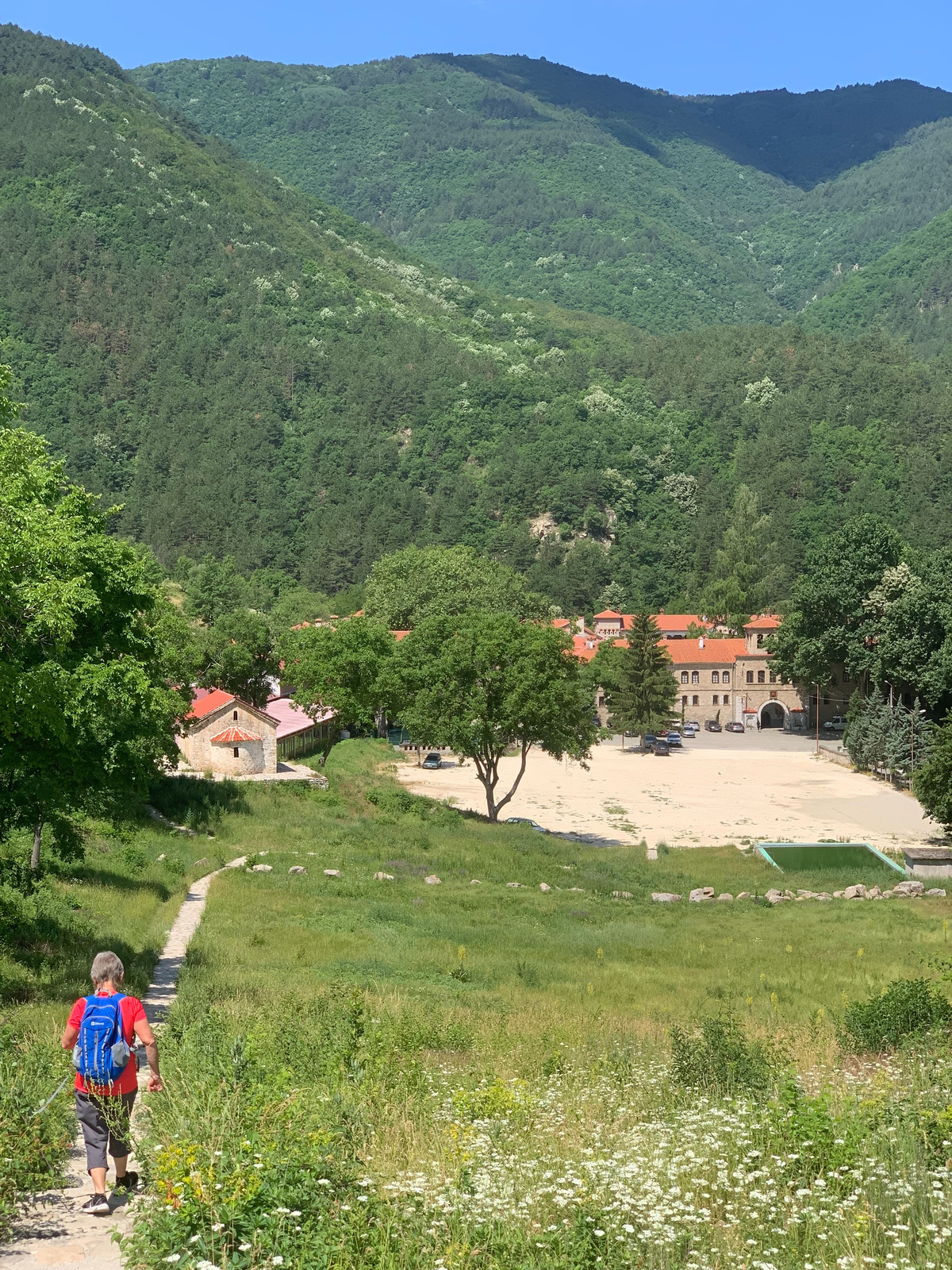
Bachkova orthodox monastery, in the hills south of Plovdiv, Bulgaria (Barry Evans)
Main church, Bachkova monastery (Barry Evans)
Doing
serious penance for one’s sins isn’t exactly in vogue these days,
but in medieval Europe, making amends for sins was part and parcel of
Life. (You’re not a sinner, you say? Sorry laddie/lass, check out
Original Sin: you were born one!) Not everyone can aspire to same
heights of penance as Sebastos Gregory, but some really try. Five
hundred years previously, a monk from the Monastery of St. Catherine,
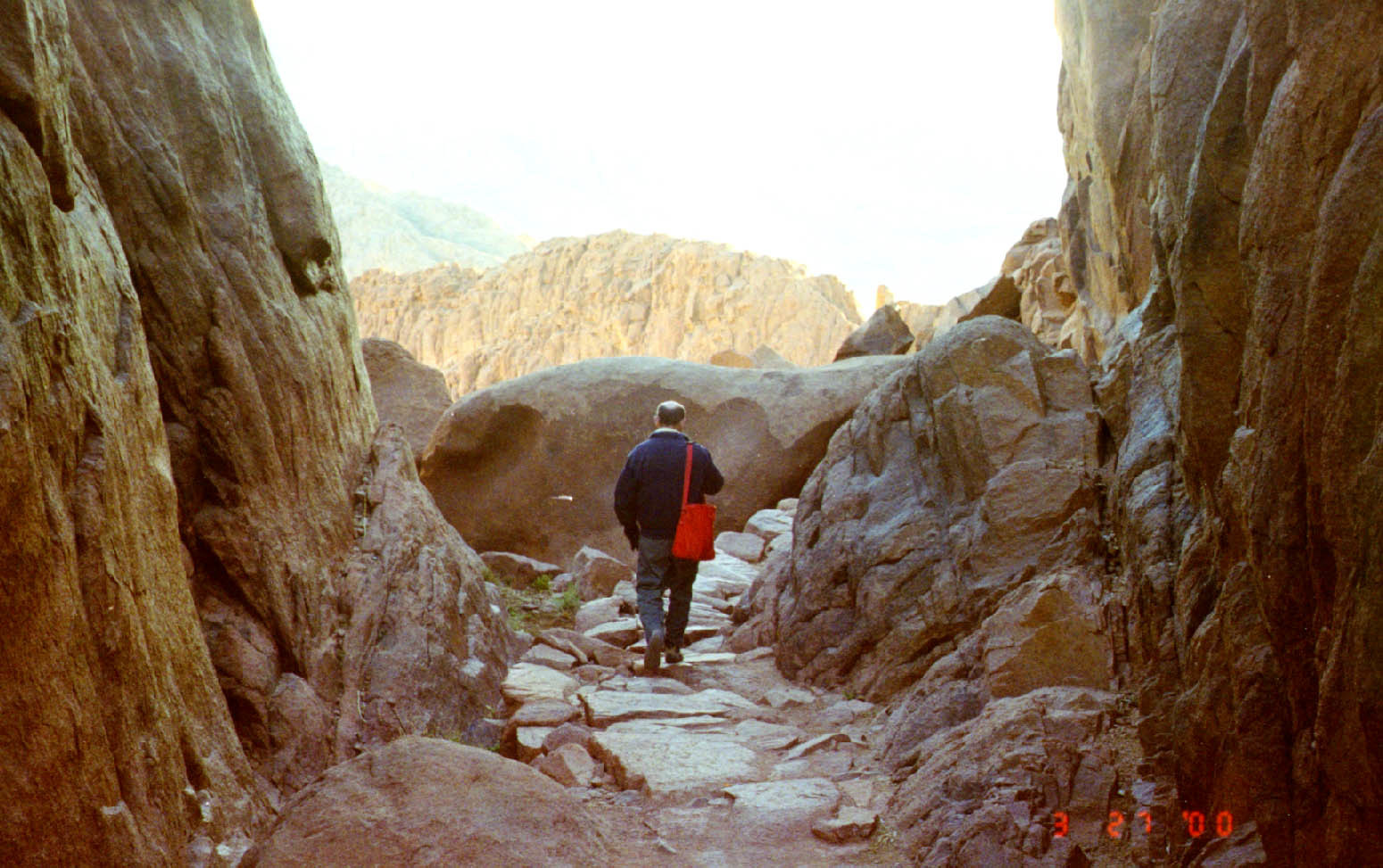
in the heart of Egypt’s Sinai Desert, made the “Steps of
Repentance” his life’s work. The steps are a staircase from the
monastery to the top of adjacent Mount Sinai, a total of 3,750 stone
steps. It took him 50 years, and was “in repentance of a sin he
committed.” We neither know the monk’s name, nor (more
pruriently) what his sin was.
Heading down the 3,750 Steps of Repentance (Barry Evans)
If
monastery-building or staircase-construction wasn’t your thing, you
could always turn to a professional to handle your amends. Six
hundred years ago, William Chaucer parodied such a worthy, in the
Tale
of the Pardoner,
one of his many rollicking and bawdy Canterbury
Tales.
The Pardoner charges folks to absolve them from their sins, making a
good living in the process — he boasts of fleecing the rubes to the
tune of a hundred pounds a year. His schtick is admirably simple: he
has a Holy Mitten, and if you put it on your hand, your sins will be
forgiven and your crops will be abundant:
He
that his hand wol putte in this mitayn, He
shal have multipliyng of his greyn…
Unless,
that is, the one asking for absolution “hath doon synne horrible,”
in which case they need more than a mitten to obtain redemption.
Chaucer’s
magnum
opus is
set in the Tabard Inn in Southwark, London, where a hodgepodge group
of pilgrims overnights en route to the shrine of Thomas à Beckett in
Canterbury Cathedral, Kent. And the whole point of a pilgrimage is to
do penance in order to resolve your guilt, jealousy, spite or malice,
preferably suffering en
route.
That
was the original idea, anyway. When Louisa and I walked the Camino de
Santiago — 540 miles, 30 days, a million steps — across northern
Spain some years ago, I don’t think we had any particular
sins
in mind to atone for. Some of our fellow perigrinos
did
though, they told us, while others were doing the peregrination to
honor of the death of a loved one, or they needed to take a complete
break from their day-to-day lives after a divorce or other traumatic
event: to reboot their brains, as it were.
A reminder, on the Camino de Santiago, of the millions of pilgrims who traveled the same path for over a thousand years. (Barry Evans)
All
of us, whatever our virtue-vice quotient, suffered from blisters. And
all of us heard the same refrain, repeated as a mantra on the trail:
Tus
ampollas son tus pecados. Your
blisters are your sins.
The transmission lines running into Humboldt County are fairly small. This has big implications for local efforts to decarbonize our local electricity supply. The lines are too small to supply enough of Humboldt’s current power demands, necessitating the Humboldt Bay Generating Station, run off methane gas (Gang Green refuses to call it “natural gas”). It also limits our ability to fully realize our offshore wind resource as, again, the damn lines are too small, thereby limiting our capacity constraints.
Arne Jacobson from the Schatz Energy Research Lab joins the show to talk through the lab’s new report on grid constraints.
The
concept of loss leadership, a pricing strategy where a product is
sold below market cost to stimulate the sale of more profitable goods
and services, is receiving considerable attention in the cannabis
space currently.
Here
in California, amid aggressively falling cannabis prices at the
wholesale level, smaller farms are cursing corporate operators for
intentionally dropping prices to force them out of business.
Is
there a widely adopted, sinister corporate play to snuff out family
farms in the Golden State, or is a highly competitive market in a
capitalistic nation simply playing out as one could expect?
Terminology
Matters
To
begin with, it seems that labeling the current state of affairs as
“loss leadership” is misguided. While it’s been documented
that retail cannabis establishments use loss leadership as a pricing
strategy, i.e. selling a line of pre-rolls on the cheap to attract
buyers and steer them into products with higher margins like
cartridges, packaged flower, or dabs, I haven’t found literature
supporting this at the wholesale level.
More
correctly, I’d argue that larger corporations have more
efficiencies of scale, and can “afford” to move products cheaper
than others. In this context, I’d argue that they are deploying
market penetration pricing, whereby they accept smaller short-term
margins on sales, in exchange for greater market share, and
ultimately higher profits once they have won over a larger customer
base.
Capitalism,
Costs, and Price Pressure
What
seems to be the case in California cannabis, specifically, is that
price compression is more of a structural reality versus a more
devious outcome of a corporate design.
Firstly,
California produces a lot of weed – more all the time, in fact. As
I’ve written about in the past, with vast amounts of production and
relatively few retail outlets, supply far outpaces demand and prices
fall. This happens with all commodities and agricultural products
and cannabis is no different.
Additionally,
cannabis is a discretionary purchase for most consumers. While some
segment of the population uses based on medicinal need, most
consumers, especially with respect to adult-use markets, use
casually. Given that inflation is rampant right now – people are
spending far more on everything else. Gas, food, clothing, pet
supplies, home care products, durable goods, and many services are
rapidly increasing in price.
With
more money going to living expenses, most average consumers simply
have less to spend on weed. Government stimulus has slowed and
retail cannabis companies are noting how much average purchases have
fallen. One dispensary owner I spoke to recently said people used to
spend a couple of hundred dollars in the shop, now they spend $40.
As
demand slacks off, prices fall – it’s basic economics.
Up
and down the supply chain businesses, like consumers, are facing
rising input prices. Packaging materials and other supplies used in
value-added segments like manufacturing are up considerably and
hurting profits. With this in mind, companies need to control costs
in other areas, like what they pay for cannabis flower, biomass, or
bulk extracts.
So
while it is easy (and popular) to curse loss leadership for
California’s cannabis woes, like many things in life, the truth
seems more complicated.
Forced
Loss Leadership
More
than anything, it seems that cannabis operators have been forced into
a downward pricing strategy, not so much by design, but by
circumstance. Ever-increasing competition, growing supply, softening
demand, and the need for lower input prices has shredded the price
for pounds and more is likely to come.
Desperation
Aside
from the market forces discussed above, desperation, not ill intent
forces some producers further into a downward pricing spiral.
Low-quality product, the need to fund operating expenses, or service
debt can create a real need for cash in the cannabis space –
especially given that lending and access to the banking system are
still limited in the sector.
As
capital needs mount, desperation ensues and operators of all sizes
can be forced to move product quickly. Buyers, happy to capitalize
on cheaper stuff, will gobble it up and convert distressed pricing
into the new normal. Just as black-market buyers in Nor Cal cite The
Pines as a source on the cheap, legal distributors cite Salinas,
Santa Barbara, and desert grows in an effort to grind down sellers a
few bucks a unit.
As
long as there are ample numbers of growers in the game, someone is
always forced and willing to sell at a lower number. Pricing
contagion is real and a downward cascade ensues.
In
my view, California has reached a point where the market no longer
clears. Weed used to get harder to find in early spring and summer
and prices would melt-up, padding the pockets of those who held over
flower or had early deps. That is not really happening anymore.
Year-round
production is now significant in Cali, and more is coming on line all
the time. This fact only exacerbates desperation and forces
cash-strapped farmers to sell on the cheap.
After
a very brief window in which prices firmed, things seem to be
dropping off precipitously again. We are hearing $600-800 for bulk
deps, pre-packaged pounds a bit better. Last year, which ended very
poorly for prices, pounds were much higher at this time.
As
the season matures and supply burgeons further against the backdrop
of inflation and looming recession, I anticipate many producers
experiencing a cash crunch. With looming financial obligations,
folks will be forced to sell – cheaper and cheaper I would assume.
The
legal cannabis industry has proven to be a real challenge. Some of
the largest multi-state operators and global giants like Aurora are
posting huge losses – hundreds of millions to billions a year.
Investment flooded the industry but inflow is slowing, or at least
becoming more scrupulous.
Interest
rates and the cost of capital are rising and investors are getting
grumpy, demanding a return on capital. I anticipate failures,
takeovers, and forced liquidations over the coming months. Caught in
the middle of this all will be millions of pounds searching for a
home. My guess is that prices will continue to grind downward –
not based on a corporate loss leadership strategy, but because of
industry and economic dynamics.
Things
can change, but for the moment, it seems like challenging times are
brewing. I received two calls this week that troubled me further and
illustrated the case I’m making here, ample product with limited
distribution equals falling prices.
The
first was from an acquaintance who had “tons of deps and ins” at
$400 to $800 a unit. The second was from someone looking to move
many, many pounds of pre-packaged one-gram jars of sauce. Both were
in relation to the traditional market.
If
the illicit market, which accounts for an estimated 75-80 percent of
the total cannabis market, is similarly struggling to move product
and is slashing prices in May, how might we expect this year to play
out on the West Coast?
Perhaps
eliminating the cultivation tax, as proposed for July 1, will shake
things loose a bit and get a bit more capital moving around, but
barring that, I expect prices to far surpass last year’s lows,
until the point when so many operators fail that the supply/demand
balance comes back to a closer equilibrium point.
Like
in every recession or challenging period within an industry,
opportunity still exists. Several well-established brands look to
source truly exceptional flower and the full terpene extract market
continues to garner attention. It’s time to saddle up, control
costs, boost yields, perform at your very best, and brace for what
looks to be a wild ride.