

California Contradiction: Ban Gas Cars Later, but Cushion Gas Prices Now?
Grace Gedye / Monday, March 28, 2022 @ 7:33 a.m. / Sacramento
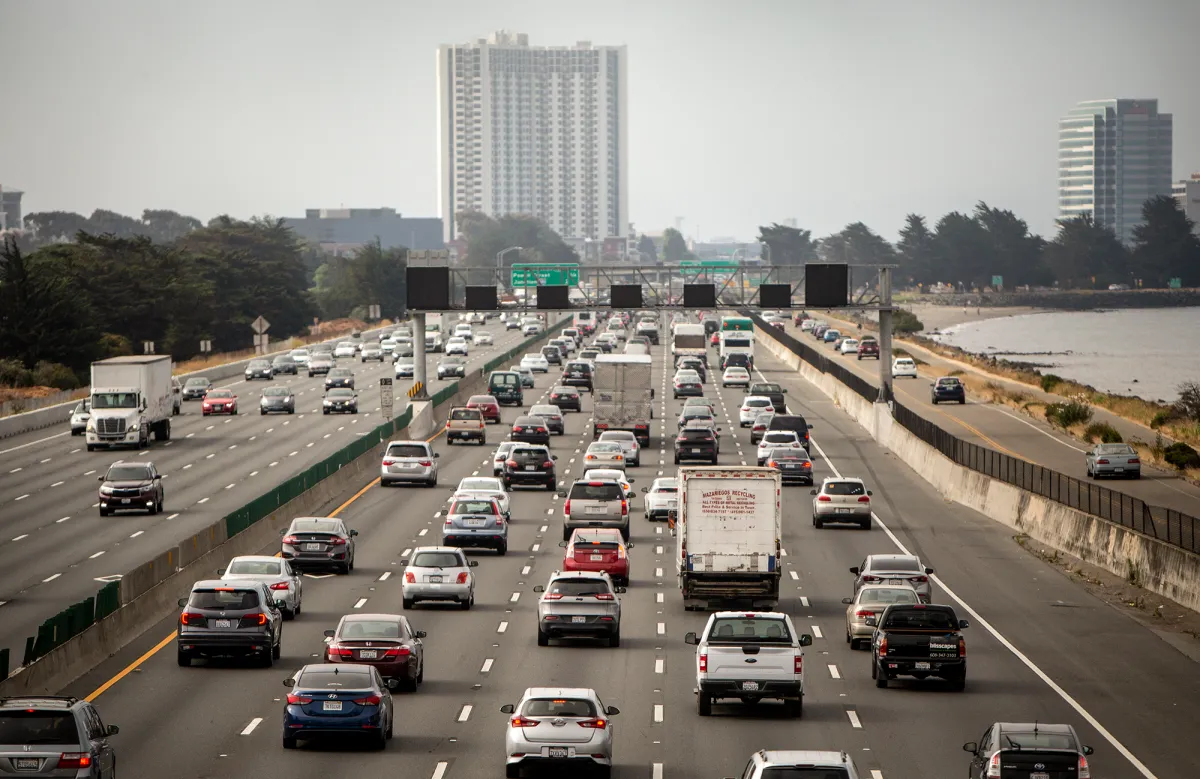
As California gas prices approach $6 per gallon, will proposals to have the state pay car owners blunt a move away from gas-powered driving? Vehicles head westbound on route 580 toward Oakland on July 22, 2019. Photo by Anne Wernikoff, CalMatters
###
As California gas prices soar — reaching a per-gallon average of $5.90 on Friday — lawmakers are trying to rush to the rescue with pricey proposals to assist drivers. Gov. Gavin Newsom wants to give car owners $400 per car for up to two vehicles, at a cost of $9 billion.
Yet at the same time, California is investing billions to pry people out of their gas-thirsty cars and trucks. Positioning itself as a global leader combating climate change, the state offers rebates to knock thousands off the price of a Chevy Bolt or Nissan Leaf. The governor pledged $10 billion to accelerate the transition to electric vehicles, and has even made a commitment to end the sale of all new gas powered cars in California by 2035.
Sending money to car owners would work at cross purposes with the state’s climate goals in response to a political moment, said Danny Cullenward, policy director for CarbonPlan, a nonprofit climate-research organization. “It is not a policy that rises to the moment in addressing income inequality or climate,” he said.
So is the state engaged in a multi-billion dollar contradiction here? Would a payout for car owners essentially undercut the state’s climate efforts?
“I actually think it doesn’t, because of the way this is structured,” said Severin Borenstein, an economist and director of the Haas Energy Institute at UC Berkeley. Californians who get a check or debit card could use it for anything, said Borenstein. So long as gas prices are high, drivers still have an incentive to try to buy less gas and spend the state payment buying other goods.
What’s important, he said, is that this proposal doesn’t try to substantially drive down the price of gasoline — as suspending the gas tax entirely, which Republicans are calling for, would. Cheaper gas would encourage people to use more gas, and “that definitely undermines our environmental goals,” he said. He would have rather seen the payment targeted at lower income people though, “instead of people who own cars, many of whom are not struggling financially.”
The advantage of doing flat checks or debit cards, rather than cutting the gas tax to reduce the price, is that the checks don’t get bigger if you drive more, or smaller if you drive less, said Jesse Rothstein, a professor of public policy and economics at UC Berkeley, and faculty director of the California Policy Lab. In other words, they don’t change the incentives around how much gas people use.
Already, increasing gas prices have driven more people to search online for electric vehicles, but drivers looking to make the switch might have a hard time finding one, thanks to supply chain delays and pent up demand.
Under Newsom’s proposal, owners of electric vehicles would also receive the $400 debit cards, and the payments are part of a broader package, including:
- $750 million in grants to incentivize public transit agencies to make rides free for three months
- $500 million for walking and biking lanes and other infrastructure
- Funds to reduce or pause certain gas and diesel taxes
- The acceleration of $1.75 billion in funding for a larger zero-emissions vehicles package.
Still, some environmental advocates wanted to see lawmakers do much more to speed the shift away from gas-powered cars.
RL Miller, a member of the Democratic National Committee and founder of Climate Hawks Vote, said she recognized that gas prices were hurting people and appreciated that the governor’s package included funding for transit and biking and walking projects. But she wanted a larger share of the total package spent on non-car transit.
Out of Newsom’s $11 billion proposal, about 80% would pay for sending debit cards to car owners, while about 7% would go to public transit agencies and 4.5% would go toward walking and biking infrastructure.
“We know the long-term goal is to get people off oil. But in the short term, we need to do something to bring people relief who are feeling a lot of pain at the pump.
— Erin Mellon, spokesperson for Gov. Newsom
Miller would have preferred California address rising gas prices by offering a generous reward to people willing to ditch their gas-guzzlers — a ‘cash for clunkers’ program — as well as a commitment to hasten the date by which California will ban the sale of gas-powered cars.
“If you couple these long-term investments with the short-term gas card rebate silliness that they’re talking about,” Miller said, “then I would consider that acceptable.”
A spokesperson for the Newsom administration said the proposal isn’t a “this or” approach, it’s “this and.” “We know the long-term goal is to get people off oil,” said Erin Mellon, a spokesperson for the governor. “But in the short term, we need to do something to bring people relief who are feeling a lot of pain at the pump because of Putin’s war,” she said.
“Sending people $400 checks and saying ‘sorry gas prices are so high, I hope this helps,” isn’t the ideal message, said David Weiskopf, a senior policy advisor on climate and environmental issues at NextGen Policy, which advocates for progressive legislation. But he thinks relief payments, especially when the government has a large budget surplus, is appropriate.
There’s kind of a knee jerk reaction that says: ‘why are we rewarding vehicle ownership?’ he said. But he sees the policy as an attempt to reach lots of people who are in the DMV’s records, but who might not be reached by a program that distributes money based on whether they filed taxes, which is how income-based refunds often work. That includes some of the poorest Californians, who may not have to file state taxes. But, he said, he’d like to see the money also go to people with state IDs, to reach households that don’t own a car.
“It’s impressive how governments can react quickly to certain things — COVID, or high gasoline prices,” said Ellie Cohen, CEO of the Climate Center. She was complimentary of elements of Newsom’s proposal, but would have liked to see the funds targeted at lower-income people. “We’re just not going fast enough on climate change.”
###
CALmatters.org is a nonprofit, nonpartisan media venture explaining California policies and politics.
BOOKED
Yesterday: 7 felonies, 17 misdemeanors, 0 infractions
JUDGED
Humboldt County Superior Court Calendar: Friday, Sept. 4
CHP REPORTS
2470 Mm199 N Dn 24.70 (HM office): Traffic Hazard
Lesina Rd / Titus Rd (HM office): Trfc Collision-Unkn Inj
0 Sr299 (RD office): Trfc Collision-No Inj
ELSEWHERE
RHBB: Redway Transfer Station to Close an Extra Day for Construction
RHBB: Dows Prairie Road to Close for Two Months for Culvert Repair
RHBB: Humboldt County Health Officials Urge Caution After Three Children Exposed to Rabies from Bats
California Lawmakers Struck a Deal on Eviction Protections. What Does It Mean for Tenants?
Manuela Tobias / Monday, March 28, 2022 @ 7:23 a.m. / Sacramento
When California legislators voted last June to again extend eviction protections, they promised the third time would be the charm.
But the state’s rent relief program, which has struggled to reach the neediest tenants and landlords from the start, continues to lag. As of last week, the state has paid $2.4 billion to about 214,000 households — fewer than half of all who have applied for aid.
Those delays — which one study found left the average tenant waiting about three months to get paid — forced legislators’ hands: Last Thursday, the state’s top legislative leaders struck another last-minute deal designed to stave off eviction for another three months for hundreds of thousands of renters who have applied for relief but are still waiting to hear back.
The first hearing on Assembly Bill 2179 is scheduled for today. The current law, set to expire Thursday, says a judge must pause an eviction proceeding if a rent relief application is pending. The new legislation, expected to go into effect by Thursday, would shield tenants through June 30 as the state continues to process their paperwork.
“It is on us to take care of the thousands of Californians — landlords and tenants alike — who reached out to COVID-19 emergency rental assistance programs for help and still have their applications pending,” said Assemblymember Tim Grayson, a Concord Democrat who is the bill’s co-author.
“It would be cruel, wasteful and unfair to subject these Californians to eviction or the loss of rental income now, when they have done everything asked of them, and distribution of their emergency rental assistance is imminent,” he said in a statement.
But renters who do not apply to the program by the Thursday deadline will not receive any protections. Landlords will still be able to take those tenants to court over missed rent starting Friday.
California has about $5.4 billion in federal funds to help qualified applicants with 100% of unpaid rent dating back to April 2020, some of which is being distributed by local rent relief programs. Lawmakers last month authorized more state spending if the federal dollars don’t cover the costs.
Senate President Pro Tem Toni Atkins, a San Diego Democrat, and Assembly Speaker Anthony Rendon, a Lakewood Democrat, endorsed the new bill in a joint statement Thursday, promising it would move quickly through both houses.
Gov. Gavin Newsom appears likely to sign the bill. A spokesperson told CalMatters in an email: “The governor strongly supports an extension that continues to protect tenants well into the summer and ensures that every eligible applicant is protected under this nation-leading rent relief program as it winds down.”
Local protections at risk
On Friday, the California Rental Housing Association, which says it represents more than 20,000 landlords with 575,000 units across the state, issued a statement opposing the bill. The group said that statewide eviction protections are no longer necessary, and it urged the timely payment of rent relief. (Some major provisions of the statewide moratorium expired Sept. 30.)
“Enough is enough,” said Christine Kevane La Marca, CalRHA president. “By halting applications for those in need, and extending the eviction moratorium, rental housing providers are being forced to carry the financial weight of the pandemic and some of them will lose their properties as a result.”
Legislative leaders drove negotiations for the last-minute deal, according to Debra Carlton, executive vice president of the California Apartment Association, which also represents landlords at the state Capitol. As in the most recent extension negotiations last fall, Carlton said neither her group nor tenant advocates were at the table, but their recommendations were taken into account.
The association’s main request was granted: Local jurisdictions won’t be allowed to enact new tenant protections until July 1, and any protections put in place by local governments after Aug. 19, 2020, will also be delayed.
That’s exactly what worries tenant advocates. The bill would postpone hard-fought protections that were set to go into effect on April 1, notably in Los Angeles County, San Francisco and Fresno. A few protections put in place before the cutoff — including in the city of Los Angeles and Alameda County — will remain in place.
“I see it as honestly cruel,” said Alexander Harnden, a staff attorney at Inner City Law Center, which serves tenants across L.A. County. “Repealing protections the day before they’re set to kick in means a lot of people are not going to get that information. It’s really setting people up to get evicted.”
Informing renters of the patchwork of protections in L.A. County has been no easy feat, Harnden said, as some tenants continue to have the false belief there’s an outright eviction ban statewide. In fact, sheriff’s departments across California have carried out at least 10,000 lockouts — the last step in an eviction process — since the start of the pandemic, according to a CalMatters investigation last summer.
Using data obtained through a Public Records Act request, Kyle Nelson, a Ph.D. candidate in sociology at the University of California, Los Angeles, found the L.A. County Sheriff’s Department performed lockouts at more than 8,600 households between April 2020 and September 2021.
“I see it as honestly cruel…. It’s really setting people up to get evicted.”
— Alexander Harnden, a staff attorney at Inner City Law Center in Los Angeles, on local protections being postponed
Tenant advocates worry that after the application deadline for rent relief passes on Thursday, thousands of renters will still need help. In the most recent survey conducted by the U.S. Census Bureau, more than 977,000 California households at all income levels reported no confidence in their ability to pay April’s rent.
According to another poll released last week, 34% of renters said they are “very concerned” about not having enough money to pay their housing costs.
“It feels like a mixed bag,” said Tina Rosales, legislative advocate at the Western Center on Law and Poverty. “With our budget surplus, we thought that there would be an extension of the deadline to apply for (rent relief), and there wasn’t.”
According to another recent survey of 58 tenant organizations across the state by Tenants Together, an advocacy group, 90% of organizations helping renters apply for aid said their tenants reported difficulties applying. Half of survey respondents complained of inadequate language access and lack of community outreach.
“They’re basically saying, ‘Tough luck,’” said Shanti Singh, legislative and communications director for the group. “If we didn’t do our job telling you this program exists, that’s your problem now.”
Last June, a coalition of tenant advocacy groups filed a discrimination complaint against the state over language barriers for non-English speakers. The case is now under investigation by the U.S. Department of Housing and Urban Development, according to Tiffany Hickey, a staff attorney at the Asian Law Caucus.
“Throughout this complaint process we’ve really been pushing to have this investigated and addressed as quickly as possible because people are being left out of relief because they can’t access the program,” Hickey said.
###
CALmatters.org is a nonprofit, nonpartisan media venture explaining California policies and politics.
Cass Bell Drops Out of Upcoming Fight Due to ‘Injuries and Family Issues’; Eureka’s Tyson Miller Still a Go
John Ross Ferrara / Sunday, March 27, 2022 @ 10:30 a.m. / LoCO Sports!

Cass Bell (left) and Tyson Miller (right). | Photos provided by Bell
Cass Bell fans will have to wait a while longer for the green-haired fighter’s return to the ring.
Arcata’s MMA pro planned to enter the ring next month for the first time since his loss to Jornel Lugo at Bellator 256 a year ago. Bell and his Institute of Combat teammate Tyson Siphavong-Miller were initially both signed to fight in separate preliminary bouts at Bellator 277 on April 15. But on Friday, Bell announced that he officially dropped out of the upcoming contest.
“Bad news, guys,” Bell shared on social media. “Due to injuries and family issues, I was forced to pull out of my next fight. I’m super disappointed. I’ve never pulled out of a fight in my career — professional or amateur.”
While Bell won’t be fighting at Bellator 277, he said he’ll sill be in attendance to support Miller ringside.
“Thank you all for the support, there’s nothing I hate more than letting you all down,” Bell said. “That being said, I will be at the fight, and my awesome teammate will still be fighting.
The 2-0 fighter from Eureka is scheduled to face Shane Keefe (2-0) from San Jose.
“I’m looking forward to showing some Humboldt love to another bad-ass, locally raised and trained fighter,” Bell said.
The Bellator 277 preliminary fights are scheduled to start at 4 p.m. and will be available on YouTube and PlutoTV.
Humboldt’s Louis Cosce will also step into the ring next month for UFC Fight Night on April 23. After suffering his first pro loss in 2020, Cosce will look to get his first official UFC win against the 9-3 Preston Parsons.
GROWING OLD UNGRACEFULLY: Reality Check
Barry Evans / Sunday, March 27, 2022 @ 7 a.m. / Growing Old Ungracefully
Mixing science and religion usually doesn’t work out well, as Galileo discovered when his empirical verification of Copernican theory — Earth goes round the sun, not vice versa — brought him up against the prevailing Catholic belief about the supremacy of man, and therefore the centrality of our planet in the cosmos. (To the credit of the church, the Vatican finally acknowledged its error in 1992 — 359 years after persecuting the dude.)
Another more current example comes from today’s headlines, in which we find die-hard Christian conservatives still opposing Darwinian evolution despite overwhelming evidence that, as Theodosius Dobzhansky succinctly put it in a 1973 essay, “Nothing in biology makes sense except in the light of evolution.”
Lately, in our post-Matrix (i.e. since 1999) world, the notion that we may be simulated entities living in a simulation has been popularized by the media, with books by “serious” scientists, in podcasts, YouTube videos, The Simpsons, Black Mirror and the like. The time has come, it seems, for us to seriously consider the possibility that the lives we’re living aren’t the Real Thing. Isn’t this, though, another case of mixing science and religion?
The simulation hypothesis maintains that the world as we know it was created by an intelligent being, and that we’re part of that world, believing ourselves to be free agents living real lives, when we’re actually artificial, digital entities, able to be manipulated by an unseen creator. Which sounds like monotheism, doesn’t it? An omniscient creator who can control us and the world around us: think of Moses parting the Red Sea, or Jesus raising the dead. (Is our simulator herself a simulation? Was God created by Uber-God? –ad infinitum.)
The Matrix aside, the simulation hypothesis was given its current boost into scientific circles in 2003 by Swedish philosopher Nick Bostrom. He put forward the argument: If there are many civilizations, and some of them run simulations of self-conscious beings (very advanced versions of SimCity entities), there will be many more simulated conscious beings than real ones. So the odds are that you and I are simulations.

Plato’s Cave. Illustration, 4edges, via Wikimedia. Creative Commons license.
None of this is new, of course. Plato anticipated Bostrom 2,500 years ago, with his “prisoners in the cave” allegory: The prisoners are chained so they only see shadows on the wall of the cave, taking the shadows to be the real world. Or the monk who wrote, “Once I, Chuang Chou, dreamt I was a butterfly. Soon I awaked, and there I was, veritably myself again. Now I do not know whether I was then a man dreaming I was a butterfly, or whether I am now a butterfly, dreaming I am a man.” Or Descartes and his evil demon.
I’ve written about the simulation hypothesis before (here, here and here), but I can’t get enough of it. A recent interview by professional skeptic Michael Shermer with philosopher David Chalmers (who popularized the easy vs. hard problem of consciousness) reignited my interest. (For Chalmers, digital entities are as real as flesh-and-blood entities, deserving of the same rights. As is Mr. Data.)
At one level, the notion that I’m a simulation is as absurd as the idea that an omniscient God hears and responds to prayers, all the while allowing untold suffering in the world. Of course I’m not a sim, I’m a free agent, choosing these words, watching my fingers magically translate them to the screen of my iPad here in Old Town Coffee on a Thursday morning. On the other hand (as if it’s a dichotomy!), I’ve been pre-programmed: input sufficient data into a super-supercomputer, run the “sim.barry” program, and consciousness just happens as an “emergent property.”
I love how New Yorker contributor Adam Gopnik summed it all up after seeing The Matrix: “…everybody could grasp the basic set-up instantly…We’re not strangers to the feeling that, for much of our lives, we might just as well be brains-in-vats…”
Nah, ridiculous. Here, I’ll show you. See this spinning top?
LETTER FROM ISTANBUL: Eye on the Bosphorus
James Tressler / Sunday, March 27, 2022 @ 7 a.m. / Letter From Istanbul

Photo: Tressler.
###
Every morning when I get the ferry, I cross the Bosphorus. It’s one of the busiest waterways in the world. This thin strait not only connects Europe with Asia, but also the Black Sea with the Mediterranean via the Dardenelles to the southwest. You can see vessels, from the huge container ships to hotel-sized luxury liners to sleek metal-grey warships at any time, bound for ports from Russia to North Africa, and beyond.
These days, I find myself casting a pensive, or at least more watchful, eye to the north as the ferry takes us over to the European side. The grey waters of the Bosphorus pass beneath the bridges, past the hillsides of the city and on up to the Black Sea, which has kept the war in Ukraine at a relatively comfortable distance. Or more precisely: 528 miles, the distance from Sile, an Istanbul district on the Black Sea coast, to the shores of Odesa. That’s roughly the same distance from Eureka to Seattle, just for perspective.
Standing on the ferry deck and peering north, all appears normal. One sees the ferries making their routine journeys back and forth beneath overcast skies, a cargo ship faint in the distance already beyond the Martyrs’ Bridge steaming north. The waters themselves are smooth, green-grey, the current rippling south toward great mosques jutting up from the shores of the Golden Horn.
Yes, all quiet on the Turkish front, you could say. Still, you can’t help but imagine the prospect of waking up one morning to the sight of battleships on the horizon, or even worse, to the sound of their big guns booming. Fortunately, such imaginings remain remote, but when you reflect on the strategic importance of this waterway, and its proximity to the current conflict, it doesn’t seem so far-fetched.
Could the Bosphorus have a role to play yet in this war? Yes, and no. Thanks to the 1936 Montreux Convention, an international agreement regarding usage of the Bosphorus and Dardenelles passageways. Under the agreement, ships are guaranteed free access during peacetime, but in the event of war, Turkey has the right to deny access to the Bosphorus to those deemed to be active participants. There is a caveat. Passage cannot be denied if the ship is bound for its home port. Officially, Turkey could deny Russian naval vessels access to the Bosphorus, but in the current context this old agreement could be moot, since the Russians already reportedly amassed a large fleet in the Black Sea, well before the war began in late February. However, some experts have said the Montreux agreement could come into play should the conflict drag on and on, and Russians need to deploy reinforcements or retreat. And of course, there is the concern that Russian President Putin may choose to disregard such agreements, along with everything else, as he continues to raise the stakes.
I know – I’m no diplomat or general, so all of this is general hearsay, gleamed from the news. Also, one wonders, given the importance of Russia as a trading partner, whether the Turkish government would not any case feel pressured to make exceptions to these old rules down the road. Turkey has officially denounced the war, and is playing a neutral role in trying to bring peace. Still, the country relies heavily on Russian tourism (you wonder, with all the economic sanctions, how badly this will affect Russian tourism this summer), just as Russia depends on Turkey for fruits and vegetables, and these ties would definitely factor into any decisions regarding the Bosphorus. The bigger fear is that such a scenario could very well put Turkey’s neutrality to the test.
###
All of this is speculation, “big picture” stuff, over which we here in Istanbul have little or no control, just as we have no idea how long the war will last, or how many refugees will continue to arrive in the country. Just as we have no control over the inflation that has spiked in recent months and seen our hard-earned liras go all to shit. Like the old song goes, We’re just a pawn in the game.
Some 60,000 Ukrainians, as well as 14,000 Russians, have already come to Turkey (as of mid-Wednesday, the time of writing this), according to local news reports. They have taken the journey by bus to the border town of Edirne before making their way to Istanbul or elsewhere. I say this only to indicate that, unlike the Syrian war, which saw untold numbers of refugees depart for Europe in boats, we have yet to see any refugees floating in boats here in the Bosphorus. That may sound trite, and highly unlikely given the heavy presence of Russian ships in the Black Sea, but these days you never know what could happen next.
Maybe that’s why I have been keeping this watchful eye on the Bosphorus each morning, an anxious eye to the north. My wife and I and our son live in a small apartment on a hill that overlooks the Bosphorus. We can walk to the end of our street and look right out at the ships passing. It is one of the reasons why we bought the place four years ago. The view is a post card, the location central, a five-minute walk from the ferry station. In those normal times of a few years ago, we figured it was a sound long-term investment. Even now, the apartment is likely worth twice what we paid.
But what would happen if one morning the relative tranquility of those waters were shattered, if we awoke one morning (or night) to the strange sounds of heavy artillery? Our post card view suddenly, nightmarishly transformed into a balcony seat of a naval battle? It would be hard to take our son to the nearby park with the prospect of nearby shelling.
Again, fortunately these imaginings remain just that, imaginings. Since the conflict began, several people have messaged from America asking if we are “OK.” I always say, yes, we are. And I remind them and myself that, between Syria, Georgia, Crimea, Afghanistan, Iraq and now Ukraine, we in Turkey have had war in one form or another at our borders for as long as I have been here, and well before. We have been surrounded by war. It’s no accident that Turkey houses more refugees than any other country, is it?
“Peace in Turkey, peace in the World,” said the great Turkish general and president Mustafa Kemal Ataturk. I find myself wondering what Ataturk would have made of the present conflict. Before his untimely death at age 58 in 1938, Ataturk shored up Turkey’s borders by establishing peaceful relations with all of Turkey’s neighbors, a far-seeking course that kept his young republic out of the Second World War. It should be noted too that the aforementioned Montreux agreement was signed while Ataturk was still at the helm, a far-reaching agreement that underscored Ataturk’s determination to forge an independent course for his nation. His distant successor, current President Erdoğan, seems bent on staying this course, having played an active role as a mediator in the current war.
Looking out at the Bosphorus, on a grey overcast day, I think of these and other things – my wife and son at home – and can only hope the war to the north will end soon (wouldn’t it be great if the war were over by Sunday, the day you, reader, are reading this and hence it’s irrelevant?). If little else, one can only hope that the war stays over there, beyond the bridge, beyond the Bosphorus and horizon, and out of our lives here. That may sound selfish, but after years of war to the south and west, followed by the pandemic, two years of living in lockdown and isolation, we would very much like to get on with our own lives here. And I suspect we are not alone.
###
James Tressler, a former Lost Coast resident, is a writer and teacher living in Istanbul.
THE ECONEWS REPORT: Build Bike Back Better! Getting Back on Two Wheels as an Adult
The EcoNews Report / Saturday, March 26, 2022 @ 10 a.m. / Environment

Photo via the Moon Cycles Instagram. Used with permission.
With gas prices spiking and a climate crisis making you feel guilty every time you get into your car, you might be thinking about dragging your bike out of the garage for a ride. But what about the rusty chain, the flat tire and old brakes? And what about your own anxiety: Will I look dumb? Where is it safe to bike?
Your friends at Moon Cycles are here to help! Sage and Sprout, the owners of Moon Cycles, Arcata’s queer-owned bicycle shop, join Gang Green to talk about getting back on your bike and how they are working to make bicycling more inclusive.
AUDIO:
“The Econews Report,” March 26, 2022.
REQUIRED READING:
(UPDATES) Overturned Big Rig Hauling ‘Corrosive Chemicals’ Shuts Down Traffic on Highway 101 in Northern Mendocino
LoCO Staff / Saturday, March 26, 2022 @ 9:48 a.m. / Traffic
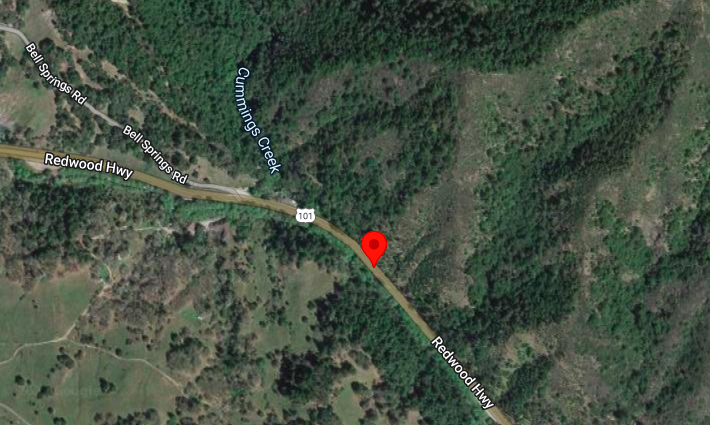
The traffic collision occurred just south of Bell Springs Road | Google Maps
###
Update, 2:50 p.m.:
Highway 101 remains closed in both directions north of Laytonville in Mendocino County. The CHP expects one-way controlled traffic to resume later tonight.
“Fuel tanks have been pumped out by HAZMAT…should be done tonight around 2100 HRS,” according to an update on the CHP Incident Information Page. “Once the truck and [trailer] are removed we can have one-way traffic control in place.”
An earlier update indicated the spill was close to but had not reached a nearby waterway.
Update, 10:40 a.m.:
Bell Springs Road is closed a half-mile north of Highway 101, according to the CHP Incident Information Page. Highway 101 remains closed.
A spokesperson with the Laytonville Volunteer Fire Department told the Outpost traffic is being directed to Branscomb Road and State Route 20.
Previously:
An overturned big rig carrying hazardous chemicals has completely shut down traffic on U.S. Highway 101 just south of Bell Springs Road in northern Mendocino County. There is no estimated time of the highway reopening at this time.
The California Highway Patrol reported a traffic collision shortly after 5:15 a.m. involving a semi hauling corrosive chemicals including “organic peroxide, phosphoric acid and sodium hydroxide,” according to the CHP Incident Information Page. No injuries have been reported.
At 5:54 a.m. the CHP reported “leakage of two to five gallons” on the roadway and requested a clean-up crew. Residents in the surrounding area are being advised to shelter in place due to the chemical spill.
We will update this post when we know more.


