

California Fish and Game Commission Revokes Fortuna Man’s Commercial Fishing License for Crab Trap Violations
LoCO Staff / Wednesday, Aug. 27, 2025 @ 12:50 p.m. / Government

Photo via CDFW.
###
Press release from the California Department of Fish and Wildlife:
The California Fish and Game Commission has revoked the commercial fishing licenses and permits of two fishermen after extensive histories of violations in the lobster and Dungeness crab fisheries.
At its June 11-12, 2025, meeting, the Commission – acting on California Department of Fish and Wildlife (CDFW) recommendations – revoked the commercial fishing license and lobster operator permit of Christopher James Miller, 68, of Santa Barbara, and the commercial fishing license and Dungeness crab permit of Ronald Ghera, 45, of Fortuna.
Miller’s violations, spanning a decade, included abandoning 156 lobster traps around Santa Barbara and the Northern Channel Islands, leaving traps in the water after the season closure, failing to retrieve baited traps and filing inaccurate catch records.
Ghera’s record included abandoning 94 crab traps after the 2023 season and 74 after the 2024 season, failing to service traps within the required 96 hours, failing to submit mandatory reports, and fishing with untagged traps and improperly marked buoys.
“The majority of people who fish commercially are law-abiding and care about our fisheries,” said Nathaniel Arnold, Chief of the CDFW Law Enforcement Division. “There are a few individuals, however, who choose to partake in commercial poaching. These individuals will eventually be caught and will likely lose the privilege to commercially fish in this state through either criminal or administrative actions.”
CDFW emphasizes that compliance with commercial fishing regulations – particularly removing traps at the end of each season—is essential. Those who abandon traps not only endanger marine mammals and other wildlife that can become trapped or entangled in derelict gear, but they can also cause shortened fishing seasons for law-abiding fishers who depend on those opportunities for their livelihood.
Whether it’s hunting, recreational fishing, or commercial fishing, the privilege to harvest California’s fish and wildlife requires a high degree of mutual trust between the public and law enforcement. CDFW’s wildlife officers are entrusted with protecting the state’s marine fish and wildlife species by patrolling and enforcing the law along California’s 840-mile coastline, and together with the California Fish and Game Commission, will continue to review violations of commercial fishing cases and take decisive administrative action to prevent bad actors from further harming California’s ocean environment.
See something serious? Report it and help protect California’s fish and wildlife. You can:
- Call CalTIP at (888) 334-2258 – available 24/7
- Text “CALTIP” + your message to 847411 (tip411).
- Download the CalTIP app from Apple’s App Store or Google Play to send tips anonymously.
BOOKED
Friday, Feb. 20: 8 felonies, 13 misdemeanors, 0 infractions
JUDGED
Humboldt County Superior Court Calendar: Friday, Feb. 20
CHP REPORTS
2555 Harris St (HM office): Trfc Collision-Unkn Inj
ELSEWHERE
RHBB: Students Dispute Cal Poly Humboldt’s Investment Claims After Siemens Hall Protest
RHBB: Mendocino DA Welcomes New Chief DA Investigator
RHBB: Trinity County Reports Rise in Animal Control Calls, Shelter Euthanasia in 2025
RHBB: Day Five on the Eel River: Sheriff Calls Recovery a ‘Little Win’ in a ‘Terrible Situation’
Eureka City Council Approves Letter Urging CalPERS to Divest From Companies Invested in the ‘Genocide of Palestinian People’
Isabella Vanderheiden / Wednesday, Aug. 27, 2025 @ 12:01 p.m. / Local Government

Screenshot of Tuesday’s Eureka Council meeting.
###
At last night’s special meeting, the Eureka City Council unanimously voted to send a letter asking CalPERS, the state’s public pension fund, to pull investments that support the “ongoing military occupation and genocide of the Palestinian people.”
The letter — linked here — urges the California Public Employees’ Retirement System (CalPERS) Board of Directors to “divest from all companies and bonds that enable, facilitate, and profit from weapons manufacturing and human rights violations, in particular, violations of international law, military occupation, apartheid, and genocide.”
“CalPERS has the opportunity to stand on the right side of history and set a powerful example for other institutions,” the letter states. “We can and must use our financial power to exert pressure that could help end the suffering of the Palestinian people and others around the world who are subjected to violence. We urge you to act swiftly and decisively.”
The letter received unanimous support from the two dozen people who spoke during the public comment portion of the meeting, many of whom wore a Palestinian keffiyeh, a black-and-white checkered scarf that’s become an international symbol of the pro-Palestine cause.

Alice Finen | Screenshot
“We — as a socially responsible community committed to justice and human rights and dismantling the ongoing legacies of settler colonialism — have got to do everything that we can, everything in our power, to stand up against these violations that Israel is committing,” said local educator Alice Finen. “I know that people are commenting that you need to focus on problems that are right here in the community, and I have got to say that Israel is our problem. We send them billions of dollars every year.”
Several other speakers identified themselves as “anti-Zionist Jews” against genocide.
“The Jewish people were refugees for hundreds of years after the Roman wars and the destruction of the temple in the first century,” said one speaker, who only identified themselves as Lev. “Now, the State of Israel has caused millions of Palestinians to become refugees, and much, much worse. To make refugees of another people is one of the most evil and most un-Jewish things that a country can do. City council, please act in favor of CalPERS divestment.”
Councilmember G. Mario Fernandez made a motion to approve the letter shortly after public comment. Councilmember Leslie Castellano seconded the action.
During the council’s discussion, Councilmember Renee Contreras-DeLoach asked to change a sentence in the letter that calls for CalPERS to “divest from all its assets and companies supporting Israeli apartheid and genocide.”
“It says ‘supporting Israeli apartheid and genocide,’ and I want to be careful with that, because ‘Israeli’ is referring to people, and there are people in Israel [who] do not support what’s happening right now,” she said. “I don’t want this being made about individual people.”
Councilmember Castellano agreed and expressed support for the letter, but acknowledged that it is a “symbolic act.”
“I don’t want to move forward with this idea that we’re that this will have much of an effect on CalPERS in terms of their investment strategy or portfolio, though I do hope that people listen and they’re aware of this,” she said. “CalPERS has pretty strong stances around divestment, and policies that will make it unlikely that they will divest.”
Councilmember Fernandez also acknowledged the letter as a symbolic gesture, but said requesting divestment is “the bare minimum.”
“The action to divest does carry fiscal implications, and the state itself should be investing in businesses that ethically benefit our state and its residents,” he said. “There’s, from my perspective, a difference in building for a common defense compared to building for profiteering, which is exactly what these funds are going to. For me, the moral imperative is to withdraw that financial support from the corporations that enable and benefit from the atrocities taking place.”
Councilmember Kati Moulton echoed her peers, adding that she has Jewish friends in Humboldt County who’ve been subjected to anti-Semitic threats “despite their opposition to the actions of the Israeli government.”
“We all deserve safety,” she said. “I just wanted to express support for the Jewish members of our community, whether they are vocal on this issue or not.”
After a bit of additional discussion, the council asked staff to add another line to the letter expressing the city’s opposition to war profiteering at large. Staff agreed, and the motion passed in a 4-0 vote, with Councilmember Scott Bauer absent.
###
Who Dumped a Bunch of Trash From a Roofing Project in Jed Smith Park?
LoCO Staff / Wednesday, Aug. 27, 2025 @ 10:48 a.m. / Crime

Photo: Redwood National and State Parks.
Press release from Redwood National and State Parks:
On Saturday, the 16th of August, an illegal garbage dump was discovered at Walker Road in the Jedediah Smith portion of Redwood National and State Parks. The refuse was found to contain materials removed from an apparent roofing project on a building of light green or seafoam color. The trash contained shingles, tar paper, old OSB board, siding and metal mesh and gutter trim. The dumpsite was located uphill near the Smith River. All of these materials contain chemicals dangerous to wildlife and flora within the local ecosystem.
Redwood National and State Parks requests public assistance with this issue by providing any information on possible suspects or links to possible sites where the materials originated from. If anyone has knowledge about possible suspects or where the materials may have come from, they are encouraged to call Ranger McKisson at 707-465-7455 or leave a tip anonymously at 707-465-7353.
Sheriff’s Office Arrests Two in Connection With Early Morning Burglary on Harrison Avenue
LoCO Staff / Wednesday, Aug. 27, 2025 @ 10:20 a.m. / Crime
Press release from the Humboldt County Sheriff’s Office:
On Aug 26 at about 4:56 a.m. Humboldt County Sheriff’s deputies were dispatched to the area of Harrison Ave. and Munson St., in Eureka for the report of a male and female loitering in the area and the sound of breaking glass.
While responding to the location deputies observed a male and female who matched the witness’s description rapidly walking on Myrtle Ave. at Dean St. Deputies contacted the two subjects, and they were identified as Christopher Michael Bessant, 34 years old of Eureka and Summer Regina Kenyon, 34 years old of Eureka.
After further investigation, which included witness statements and video surveillance footage both Bessant and Kenyon were placed under arrest.
Bessant was arrested on the following charges:
- P.C. 460(B) Second degree burglary
- P.C. 182(A)(1) Conspiracy to commit a crime
- P.C. 466 Possession of burglary tools
- H.S. 11377(A) Possession of a controlled substance
- H.S. 11364 (A) Possession of drug paraphernalia
Kenyon was arrested on the following charges:
- P.C. 460(B) Second degree burglary
- P.C. 182(A) Conspiracy to commit a crime
- H.S. 11364(A) Possession of drug paraphernalia
Both were transported to the Humboldt County Correctional Facility and booked on the above charges.
Anyone with information about this case or related criminal activity is encouraged to call the Humboldt County Sheriff’s Office at (707) 445-7251 or the Sheriff’s Office Crime Tip line at (707) 268-2539.

Arcata is Making More Sales Tax Money than Ever Before
Dezmond Remington / Wednesday, Aug. 27, 2025 @ 9:58 a.m. / Government

A chart showing Arcata’s sales tax revenues for the last six years.
Fiduciary fanatics can celebrate: Arcata’s sales tax numbers from last year are IN — and higher than ever before. What fun factoids are buried in the documents shared at last night’s Transactions and Use Tax Oversight Committee meeting?
The big one: Arcata made almost $3 million in sales tax fees during the fiscal year 2024-2025 which ended June 30 ($2,979,490 if you’d like to quibble), about 13% of all General Fund revenue. It’s an increase of over $100,000 more than the year before that, boosted at least a tad by the 0.75% increase to the tax that voters approved last year that went into effect on April 1, and a massive $700,000 more than the 2018-19 fiscal year.
The years following a pandemic bump in spending were more profitable to the city than the ones before, though the earnings from this last fiscal year have soared above even the pandemic-era high.
Over $500,000 of that revenue was construction-related, at least partially related to the work done on Cal Poly Humboldt’s dorm and engineering buildings which have to ship in large amounts of material and pay a tax on it. During the last fiscal year, Arcata only made $466,000 on building and construction sales taxes.

Arcata’s sales tax revenue, broken down by category.
A memorandum composed by the committee estimates that Arcata will make about $2.7 million on the sales tax the next fiscal year, and the next few years will see “minimal to moderate growth” of between 0.3-3.1%.
OK, but where’s it all getting spent? For 25-26, Arcata is budgeting $1.75 million for road improvement and $972,000 for the police out of the 2008 Measure G’s 0.75% tax, split 64-36. Last year’s ratio was closer to 71% of Measure G funding for street maintenance and 29% for the police. Some past police funding went to $50,000 bonuses for new officers, a program which allowed the police department to reach full staffing levels.
EPD Releases More Info About the Man Who Allegedly Torched His Own Car on the Courthouse Lawn
LoCO Staff / Wednesday, Aug. 27, 2025 @ 9:49 a.m. / Crime

Still of video by Shannon Cortez.
PREVIOUSLY
###
Press release from the Eureka Police Department:
On August 23, 2025, at approximately 7:51 pm, Eureka Police Department (EPD) officers and Humboldt Bay Fire personnel responded to the 800 block of 5th Street for a report of a vehicle fire on the front lawn of the Humboldt County Courthouse.
Upon arrival, the first officer observed a white sedan fully engulfed in flames on the courthouse lawn. The officer recognized the vehicle from prior contacts and quickly located the registered owner, identified as Stephen Paiment, 69, of McKinleyville, standing in the intersection of 5th and I Streets acting erratically. Based on witness information that a male subject had intentionally set the fire, the officer detained Paiment without incident.
The investigation determined that Paiment drove his vehicle onto the courthouse lawn, exited, and then reached back through the window to deliberately ignite the vehicle. Several witnesses positively identified Paiment as the individual responsible.
Paiment was arrested and booked into the Humboldt County Correctional Facility for felony arson and littering.
Paiment is known to local law enforcement and has been engaged in protests regarding an alleged useof-force incident. His vehicle and scattered papers at the scene contained writings related to those allegations, as well as statements opposing nuclear power. Investigators also believe Paiment is responsible for chalk messages recently written on the courthouse sidewalk.
No injuries were reported. Damage was limited to Paiment’s vehicle and the courthouse lawn.
This remains an active investigation. Anyone with additional information is asked to contact the EPD Criminal Investigations Unit at 707-441-4300.
A Mini Cascadia Quake? What the 6.5-Magnitude Earthquake of 1954 Reveals About the ‘Big One’
Isabella Vanderheiden / Wednesday, Aug. 27, 2025 @ 7:36 a.m. / Earthquake , Science
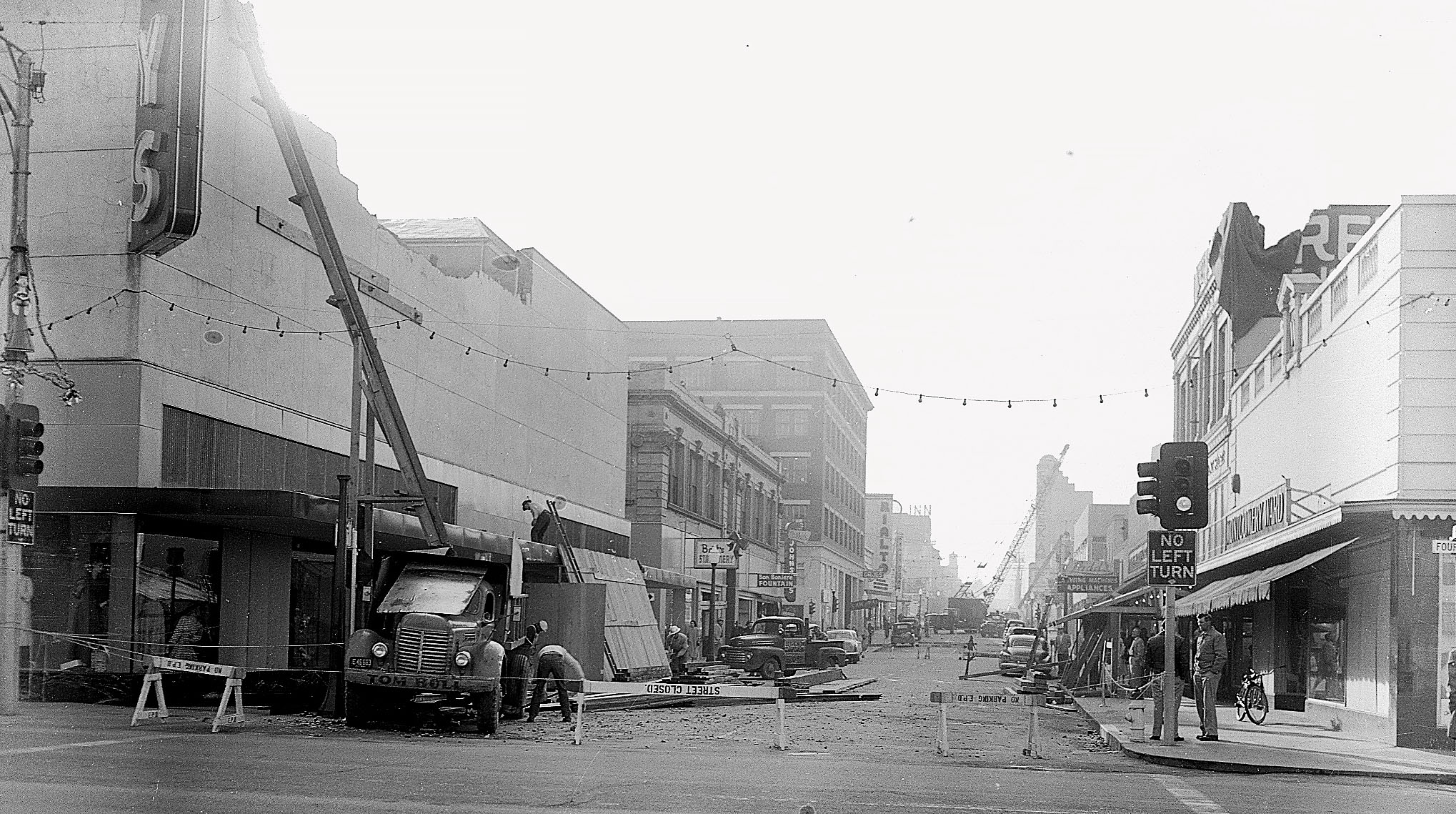
The aftermath of the Dec. 21, 1954, earthquake, as seen from Fourth and F streets in downtown Eureka. | Photo contributed by Lori Dengler via the Humboldt Times.
###
Just before noon on Dec. 21, 1954, a 6.5-magnitude earthquake rocked northern Humboldt County, toppling chimneys, shattering storefront windows, buckling old buildings and causing irreparable damage to Eureka’s old courthouse. The initial jolt triggered the collapse of a log deck in Korbel, killing an employee at the mill. Fifty others were injured, and countywide damages were estimated at $2 million.
While destructive, the earthquake itself wasn’t unprecedented — the North Coast region has experienced four dozen earthquakes of a magnitude 6.0 or greater since 1900, according to data from the U.S. Geological Survey (USGS). What set this one apart was its unusual inland location and the intensity of its shaking.
This so-called “enigma” earthquake was long thought to have been the only quake in our historic catalog centered on one of our region’s many surface faults, until now.
A newly published study in the Bulletin of the Seismological Society of America revealed that the earthquake “most likely” took place approximately seven miles beneath Fickle Hill on the infamous Cascadia Subduction Zone interface, a major offshore fault line that runs from Northern California to British Columbia.
“One of the things that’s so unusual about the Cascadia Subduction Zone is how quiet it is,” said Lori Dengler, emeritus professor of geology at Cal Poly Humboldt and co-author of the study. “We don’t see small or moderate earthquakes on it. There have been a few very small magnitude twos and threes that appear to be close to the interface … but we’re talking about really, really small earthquakes. It never occurred to me that [the 1954] earthquake was actually an interface event, and now it looks like it was.”
The finding prompts new questions about seismic activity along the Cascadia Subduction Zone, which is capable of producing “great earthquakes,” defined as a magnitude 8.0 or greater. The last time the Cascadia Subduction Zone produced a “great earthquake” was in January 1700, when a 9.0-magnitude quake ruptured from the Cape of Mendocino north to Vancouver Island, causing coastlines to drop by several feet and an “orphan tsunami” to crash into Japan.
Before this research, seismologists didn’t know that the Cascadia Subduction Zone was capable of producing “moderate” earthquakes, ranging in magnitude from 5.0 to 6.9.
“What we now know is that this Cascadia Subduction fault can have moderate-size earthquakes,” said Peggy Hellweg, a retired seismologist at UC Berkeley’s Seismological Laboratory and lead author of the study. “It may be a relatively rare occurrence, but it can happen.”
Uncovering 70 Years of Seismic Data
Most “moderate” or “strong” earthquakes we feel here in Humboldt County originate way out in the ocean near the Mendocino Triple Junction, a tectonic boundary where the Juan de Fuca/Gorda, North American and Pacific plates meet.
Since 1950, the USGS has recorded 28 earthquakes in our region that exceeded a magnitude of 6.0. “Eight were centered in the triple junction region within 25 miles of Cape Mendocino,” Dengler wrote in a July 2024 column published in the Times-Standard. “Thirteen were in the Gorda plate offshore of Humboldt and Del Norte Counties. Six were Mendocino fault quakes, on the plate boundary that marks the southern edge of the Gorda plate. There is one enigma.”
The enigma is, of course, the Fickle Hill earthquake of 1954.
When the shaking began that December morning, it triggered nearby seismic stations in Arcata, Eureka and Ferndale. Preliminary data indicated the earthquake’s epicenter was onshore, somewhere within a huge “cloud of probability” between Arcata, Blue Lake and Dinsmore.
“Even with the seismic networks of that time, it was clear it was constrained to being onshore,” Dengler said. “The genesis of this project was: Can we figure out exactly where it was? Can we figure out if it was deep? However, our ability to constrain depth in 1954 was not very good. Now, obviously, we can’t go back and rerecord the earthquake, but what we could do is find all the records that did record it and use modern techniques to get a much better sense of the geology.”
Dengler had discussed the enigma earthquake with Hellweg many times over the years. When Hellweg retired a few years back, she decided it was time to take on the project. She dug through decades of paper records looking for any information relating to the December 1954 earthquake. Once she had what she needed, she passed it on to another researcher to be digitized and analyzed.

Scans of paper three-component accelerograms from Eureka and Ferndale seismic stations. | Image contributed by Peggy Hellweg.
While Hellweg scoured 70-year-old documents, Dengler conducted in-person interviews with people who had lived through the earthquake. “It was amazing how vivid their recollections were,” she said.
“There was the four-year-old boy who was sitting at his kitchen table and watching a cup and a saucer vibrate along the countertop and then stop and not fall off. It’s one of his earliest memories, and we can actually tell [a lot] from that story,” Dengler said. “First of all, it was high-frequency motion. If it had been low, slow motion, it wouldn’t have vibrated; it would have just sat on the counter. We can also tell that it wasn’t super strong at his location because it didn’t go flying off the counter.”
Dengler also recounted the story of an 11-year-old girl who was riding her bicycle around Eureka with a friend when they were “suddenly stopped in their tracks” because the shaking was so strong.
“They could see the ground rolling like the ocean and see chimneys toppling,” Dengler said. “One thing she said that really stuck in her mind was the woman in her bathrobe and her curlers racing out of her house onto the street, which, in 1954, was definitely not something you did. … It was fascinating, not only to get a sense of the pattern of shaking, but that the pattern of shaking supported this moderately deep — not super deep and not super shallow — earthquake.”

The aftermath of the 1954 earthquake at the old Arcata Market. | Photo contributed by Lori Dengler via the Arcata Union.
When Dengler first began her research, she theorized that the 1954 earthquake occurred within the subducting Juan de Fuca/Gorda Plate, where we tend to have strike-slip earthquakes.
“That would have been my guess … because that’s where we see the most earthquakes,” she said. “I would have bet that this was a moderately deep strike-slip earthquake, but it wasn’t. … It was definitely what we call a ‘thrust’ earthquake, where one side is shoved up over the other.”
There are only two places on the North Coast where thrust earthquakes can occur. “One is in the faults really near the surface,” Dengler said, referring to a series of exposed fault lines that trend northwest, parallel to mountain ridges. The Little Salmon Fault, for example, runs through the College of the Redwoods campus and has several parallel fault strands running through the Mad River Fault Zone.
The other place where thrust earthquakes can occur is, of course, the Cascadia Subduction Zone.

Cross-section of the Cascadia Subduction Zone. | Graphic: USGS
‘It’s Certainly Opened Our Eyes’
What does this new research mean for our understanding of the Cascadia Subduction Zone, you ask?
“The results [of this study] have contributed new insights into its source, which is quite possibly the Cascadia subduction interface, making the 1954 earthquake the first large event to be documented in the instrumental era centered on the locked boundary,” the study states. “[O]ur study of the 1954 Fickle Hill earthquake provides a template for the reexamination of other significant earthquakes of the pre-digital age.”
In simpler terms, seismologists now know that the fault line is capable of producing moderate earthquakes, not just catastrophic events.
“The Cascadia Subduction Zone is about 650 miles in length. … [The 1954] earthquake caused slip on a patch [of the fault line] that was about 10 miles, maybe even less than that,” Dengler said. “One side slipped up and over the other, only on the order of a foot or so. For a magnitude 9.0, we would expect a rupture of 650 miles long. One side would be shoved over the other on the order of 30 to 60 feet.”
“It’s certainly opened our eyes,” she continued. “It’s causing a lot of discussion in the scientific community, which is exactly what we wanted to do.”
The work isn’t quite finished. Dengler is still looking for eyewitness accounts of the 1954 earthquake. Hellweg will continue collecting records and seismic signals to better understand the complexities of the Cascadia Subduction Zone, and whether the next “great earthquake” could be preceded by a foreshock (a small to moderate earthquake that occurs before the big one).
At several points during our conversation, Dengler emphasized that this study “does not in any way change our perception of the hazards” posed by a rupture on the Cascadia Subduction Zone.
“One magnitude 6.5 earthquake 71 years ago is not going to relieve stress on the interface, especially since it only slipped a 10-mile zone,” she said. “It’s completely negligible in terms of the general picture of Cascadia.”
If you’ve read Kathryn Schulz’s article “The Earthquake That Will Devastate the Pacific Northwest,” published in The New Yorker in 2015, you are almost certainly already terrified of the impending catastrophe that awaits within the Cascadia Subduction Zone. Among other frightening things, the article claims that Cascadia is “long overdue” for a rupture, an assertion Dengler passionately disputes, given that geological evidence indicates the Cascadia Subduction Zone ruptures every 200 to 800 years.
Rather than taking a fatalistic approach to the inevitable rupture of Cascadia, Dengler encouraged residents and local governments to start preparing for a massive seismic event sooner rather than later.
“Thinking ‘Oh my god, we’re all going to die!’ means ‘I’m just not going to think about it because there’s nothing I can do to prepare. That’s exactly the opposite of what you want to do,” Dengler said. “What you do and what your community does beforehand will make a huge difference in terms of how comfortable you are in the hours, weeks and months afterwards, and how quickly your community can recover and kind of get back to a new normal.”
Dengler is still looking for eyewitness accounts from the 1954 earthquake. If you or someone you know lived through the earthquake — or if you happen to have old newspapers, church records, diaries, or anything from that time period — give Dengler a call at the Humboldt Earthquake Education Center at 707-826-6019 or send an email to kamome@humboldt.edu.
###
###
Want to prepare you and your family for an earthquake or tsunami? Check out the links below for local emergency preparedness tips.


