Press release from the Humboldt County Sheriff’s Office:
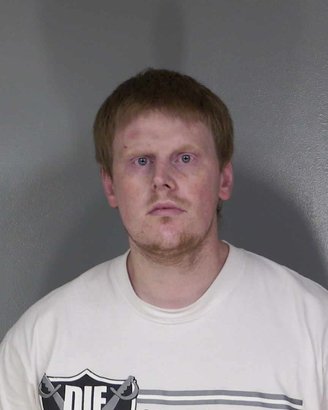
On Sept. 24, 2021, at about 11:13 p.m., Humboldt County Sheriff’s deputies on patrol in the area of Harris and M Streets, in Eureka, observed a vehicle abruptly veer into the oncoming lane of traffic. Deputies conducted a traffic stop on the vehicle for the violation.
Upon contacting the driver, 30-year-old Jordan Ray Steele, deputies observed drug paraphernalia inside the vehicle in plain view. Steele was detained and searched incident to arrest. During a search of Steele, deputies located over 8 grams of heroin. During a search of Steele’s vehicle, deputies located items consistent with the sale of controlled substances.
Steele was arrested and booked into the Humboldt County Correctional Facility on charges of possession of a controlled substance for sales (HS 11351) and possession of a controlled substance paraphernalia (HS 11364(a)).
Anyone with information about this case or related criminal activity is encouraged to call the Humboldt County Sheriff’s Office at (707) 445-7251 or the Sheriff’s Office Crime Tip line at (707) 268-2539.
Press release from the Humboldt County Sheriff’s Office:
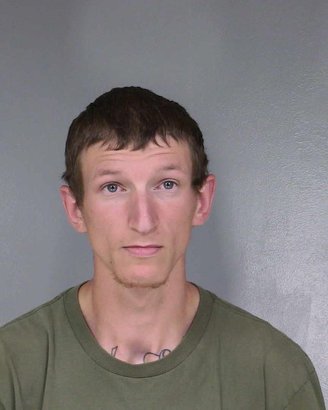
Maxwell Elliot | HCSO
On Sept. 26, 2021, at about 7:28 a.m., Humboldt County Sheriff’s deputies were dispatched to the 3500 block of State Highway 36 near Hydesville for the report of a male passed out in the driver seat of an idling vehicle on the roadside.
Deputies arrived in the area and contacted the male, who was identified as 26-year-old Maxwell Thomas Elliot. Elliot was found to be on active parole with a search clause. During a search of Elliot, deputies located drug paraphernalia and methamphetamine packaged for sales.
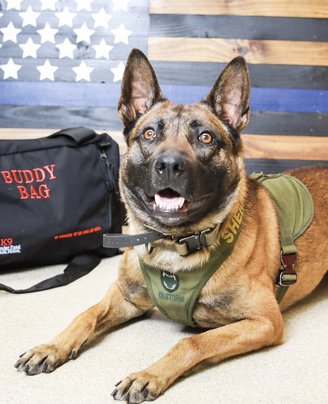
K9 Yahtzee | HCSO
Deputies deployed HCSO K9 Yahtzee to conduct a free-air sniff around the vehicle, during which K9 Yahtzee indicated the presence of additional controlled substances within the vehicle. During a search of the vehicle, deputies located additional drug paraphernalia and over one pound of cannabis bud.
Elliot was arrested and booked into the Humboldt County Correctional Facility on charges of possession of a controlled substance for sales (HS 11378), possession of a controlled substance paraphernalia (HS 11364) and possession of marijuana for sales (HS 11359(a)).
Anyone with information about this case or related criminal activity is encouraged to call the Humboldt County Sheriff’s Office at (707) 445-7251 or the Sheriff’s Office Crime Tip line at (707) 268-2539.
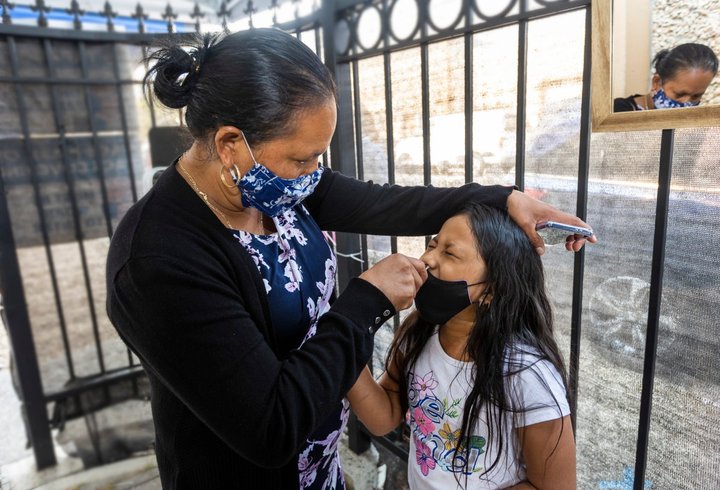
Maria Jimenez swabs her daughter, Glendy Perez, 7, for a COVID-19 test at Canal Alliance in San Rafael on Sept. 25, 2021. Photo by Penni Gladstone for CalMatters
###
Sarah Voit likes to keep 10 to 15 rapid test kits on hand in case any of the residents of the Family Emergency Shelter Coalition in Hayward need to be tested for COVID-19. They’ve had some infection scares, and the antigen tests — which return results in minutes — have been crucial to curbing the virus in the family shelter.
But in recent weeks, the staff has struggled to purchase enough rapid test kits. The local Walgreens and Costco have started limiting sales to one per customer. “We ran into the same issue at the beginning of the pandemic when we were trying to buy Clorox wipes and hand sanitizer,” said Voit, the shelter’s program director.
Three weeks ago, a child living at the shelter was sent home from school after a classmate contracted COVID-19. Voit’s team used the rapid tests on the whole family. They all came back positive.
“Because we had those kits on hand, we were able to send them immediately to the isolation and quarantine hotel the county runs,” she said. “Otherwise it could have taken three to five days to get those results and many more families could have gotten sick.”
A nearby clinic offers COVID-19 tests, but only PCR tests, which usually take several days for results. Even a single day’s wait could fuel an outbreak among the shelter’s 23 adults and children.
“If a resident really needs a test, we can send them there,” Voit said, “but the three to five days is tough to wait.”
Voit managed to find an online supplier and ordered 70 kits for the shelter, but they aren’t coming anytime soon: The delivery date is a month out.
Online and in stores, major retailers are sold out of the popular at-home tests, and medical supply vendors can’t find enough rapid test kits for schools, shelters, nursing homes, employers and other groups. Across the state, people in low-income communities are being turned away as community groups and clinics are forced to ration their tests. Workers in need of regular screening for employment struggle to find them. Some parents are spending hundreds of dollars out-of-pocket to test their school kids. And nursing homes are told they may have to wait weeks for testing kits.
“The U.S. gets a D- when it comes to testing,” said Dr. John Swartzberg, an infectious disease expert and professor emeritus at UC Berkeley. “We’re not doing enough of it and it’s too difficult for people to get tests. Those with the least resources have the greatest difficulty in finding a free test site or purchasing at-home testing.”
“Those with the least resources have the greatest difficulty in finding a free test site or purchasing at-home testing.” — Dr. John Swartzberg, UC Berkeley
Experts say quick and easy testing is vital to contain the spread of COVID-19. Without widespread access to tests, people don’t know they are infected and need to quarantine, causing outbreaks that could have been prevented.
“There should be little stations where you can get rapid tests anywhere, anytime,” said Joe DeRisi, professor of biochemistry and biophysics at UC San Francisco.
Rapid test kit shortages abound
It’s a mismatch of supply and demand. Although the state is reporting record-high testing numbers, Californians seeking same-day results and over-the-counter test kits for sniffling kids, employer verification, or merely peace of mind say they are unavailable. The problem: Nearly all state-run testing facilities offer only laboratory-based PCR tests, and people want rapid ones instead.
When the Delta variant reared its head, the shortage of rapid tests created the “perfect storm,” experts say. The surge coincided with schools reopening and employers requiring quick, routine testing. At the same time, local health departments scaled back their testing efforts, focusing on vaccinations instead. Manufacturers, seeing decreased summer demand, reportedly shuttered production lines and tossed unsold product.
Fewer than 10% of testing locations across the state now offer rapid-result antigen tests, according to a database from Coders Against COVID and URISA GISCorps.
The test shortage is so severe that the federal government has stepped in to increase production. On Sept. 9, the Biden Administration announced a national COVID-19 action plan that includes the purchase of 280 million rapid point-of-care and over-the-counter tests by the federal government and a three-month deal with Walmart, Amazon and Kroger to sell the tests at cost.
The U.S. Department of Health and Human Services did not respond to requests inquiring how many rapid tests would be allocated to California.
Industry experts say manufacturers, including Abbott Laboratories, are picking up production, but adequate supplies have yet to hit the shelves for consumers — and it could be weeks off.
“We have been told by this particular manufacturer that they’ve caught up, but clearly at the customer level we still see shortages, and of course customers are shifting to other brands which cascade the shortage elsewhere,” said Nam Tran, professor of clinical pathology at UC Davis and a member of the state’s COVID-19 Testing Task Force.
Despite the slightly lower sensitivity of rapid tests compared to laboratory-based PCR ones, the ease of the at-home options make them ideal for community surveillance, DeRisi said. PCR tests can detect lower levels of virus and potentially catch an infection sooner, but the reality is the inconvenience of scheduling an appointment means people aren’t getting tested enough.
“I could get a PCR, but that’s just a snapshot in time,” Tran said. “If you want people to test every day, (PCR) is not feasible.”
About 90% of all PCR test results are returned in two days, according to state data, although that time has steadily crept upward recently. The 15 minutes of wait for a home rapid test compared to 48 hours could mean the difference between an infectious person starting quarantine immediately versus spreading the virus for several days.
And it’s clear that rapid testing works.
Fewer than 10% of testing locations across the state now offer rapid-result antigen tests.
The Mariposa skilled nursing facility that Katrina Anderson manages hasn’t had a single case of COVID-19 among its frail residents since the beginning of the pandemic.
In addition to other strict infection control policies, every person that enters the building is given a rapid test.
“If you come to work in our facility you’re tested. If you come to fix something that’s broken in the facility, you’re tested,” Anderson said. “Nobody enters without getting a rapid test.”
Anderson received word from the state that tests were in short supply. She was able to secure enough kits for the next few weeks. But other organizations, like schools and community groups, attempting to set up rapid testing through the California Department of Public Healthmay not be so lucky. The Testing Task Force website warns that it will take six to eight weeks to receive the state’s rapid test kits.
Schools desperate for test supplies
In March, the state offered 5 million BinaxNOW tests to schools as an optional incentive to reopen in the spring.
Rapid testing is a major strategy for schools eager to avoid kids’ time spent out of the classroom sick or in quarantine. But the state program has been swamped with orders, and some schools say PCR testing is their only reliable option right now.
State public health officials told Kern High School District in Bakersfield “that there is a nationwide shortage of antigen/rapid tests,” said Erin Briscoe-Clarke, a district spokesperson. So the school is using PCR tests instead despite the longer wait time for results.
DeRisi from UCSF said he heard that “hundreds of schools” signed up in September for the state tests, “right when the shortage occurred and right when the Delta bump hit.”
The state Department of Public Health did not return requests for comment about its ability to fill schools’ orders.
Officials at the Clovis Unified School District northeast of Fresno said they have struggled to secure enough rapid tests for their 43,000 students. In addition to required masking and daily health screenings, the schools there routinely test students involved in extracurricular activities and are gearing up to begin testing faculty weekly. The schools also shorten the 10-day quarantine period by three days if a student can prove they are COVID-negative.
But the Clovis district was notified earlier this month that the state may not be able to fill its test kit order, spokesperson Kelly Avants said. “We got our order in and heard within a day or two that the state was no longer accepting additional orders because they were out,” Avants said.
Early this month, the Clovis district contacted more than 40 vendors in search of rapid test kits. Nobody had any in stock and wouldn’t until at least October, maybe even December. Eventually, the state was able to fulfill the district’s order.
“Like so many other supply chains right now, it is unpredictable,” Avants said.
“We got our order in and heard within a day or two that the state was no longer accepting additional (test kit) orders because they were out.” — Kelly Avants, Clovis Unified School District
The district has about a two-week supply of tests, and expects a delivery of 12,800 more from a private vendor soon.
Without rapid testing readily available publicly, some parents are spending hundreds of dollars to monitor their kids’ health.
Nayamin Martinez, a parent in Clovis Unified, received an email several weeks ago that a child in her daughter’s classroom tested positive for COVID-19.
It was a Friday afternoon, and the family’s local Kaiser testing clinic was closed. Even with insurance, Martinez couldn’t find a rapid test kit or same-day appointment anywhere. She also knew that results from a PCR test wouldn’t come until the following Monday or Tuesday and didn’t want to keep her daughter out of school needlessly.
Martinez wound up taking her to urgent care and paying $270 for the rapid test — and her peace of mind.
Hundreds of testing sites shut down
The California Department of Public Health says there’s a glut of PCR testing capacity. Thousands of same-day appointments for the tests are available through the state testing website, and more tests are processed daily now than during the winter surge. OptumServe, which manages the state’s testing efforts, works with the state to monitor demand and offer drive-thru, mobile and fixed site options, health officials told CalMatters.
Yet many Californians complain that they can’t find an appointment or a rapid test. The issue: As government-run mass testing sites have closed, it’s not always clear to people where new locations have sprung up.
“You end up with barriers to access that have less to do with capacity and more to do with lack of information,” said Dr. Jorge Caballeros, a physician and founder of Coders Against COVID, a volunteer group that crowdsources a directory of test sites nationally.
“More of the testing has shifted from a government-based or public health service and become privatized. A lot has shifted to primary care physicians, health systems and to companies that are running these tests,” he said.
According to the Coders Against COVID database, 900 testing sites have closed in California since April 2020, and that’s likely an undercount.
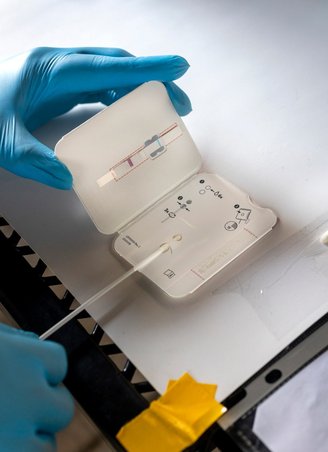
A rapid antigen COVID-19 test is used on patients at Canal Alliance’s test site in San Rafael. Photo by Penni Gladstone for CalMatters
Working-class and immigrant communities that often face technological or language barriers are struggling with the shifting test locations and longer turnaround times. Community organizations have been left to fill the gaps with what little supplies they have left.
“We’re still the only organization in Marin County that’s doing rapid testing for free, and I don’t understand why,” said Yolanda Oviedo, COVID-19 response manager at Canal Alliance. “It’s been really hard for us to maintain.”
Canal Alliance, which provides an array of services for the Latino community in Marin, offers rapid testing two days a week.
The pandemic hit the county’s Latino population hard. Latinos accounted for 80% of the county’s COVID-19 cases last year despite making up less than 16% of the population. Most are essential workers with high risks of exposure.
Oviedo said the group received 5,000 test kits from the state in May and have used more than 3,000. Demand has grown since August, and they have resorted to limiting testing to 100 people per day in order to make supplies last as long as possible.
People seeking tests at the site are frequently turned away. It’s a tough decision, especially when they know community members are desperate, said Marina Palma, San Rafael City Schools board member and volunteer at Canal Alliance.
“We have people coming to test with us from Richmond, Petaluma, Novato, San Francisco,” Palma said.
“When I heard we were capping (tests), I asked ‘Why don’t you order more?’ They said ‘There’s no more to order. They’re on backlog.’” — Nayamin Martinez, Central California Environmental Justice Network
Increasingly employers, like Amtrak and Goldman Sachs, are requiring proof of vaccination or negative test results, and many workers can’t afford to miss a day of work.
“When you go to other places, it takes two days for the results. Two days means a lot for those families who work labor,” Palma said. “If they don’t have that verification, they can’t support their families.”
It’s a similar story in the Central Valley, where Martinez, the Clovis parent, is the executive director of the Central California Environmental Justice Network. Her organization, which partnered with UC Davis, is the only place in Yolo, Stanislaus, Madera and Fresno counties offering rapid tests.
Several weeks ago they, too, started capping the tests at 100 per day.
“When I heard we were capping (tests), I asked ‘Why don’t you order more?’ They said ‘There’s no more to order. They’re on backlog,’” Martinez said.
Many of the people they test have Medi-Cal or are uninsured, and are unable to get appointments at local health clinics. Routine testing for employers isn’t necessarily covered by insurance.
Everyday around 5 a.m., people start calling Martinez, desperately searching for a free test. “It’s bureaucracies after bureaucracies. It’s exhausting,” she said.
###
CALmatters.org is a nonprofit, nonpartisan media venture explaining California policies and politics.
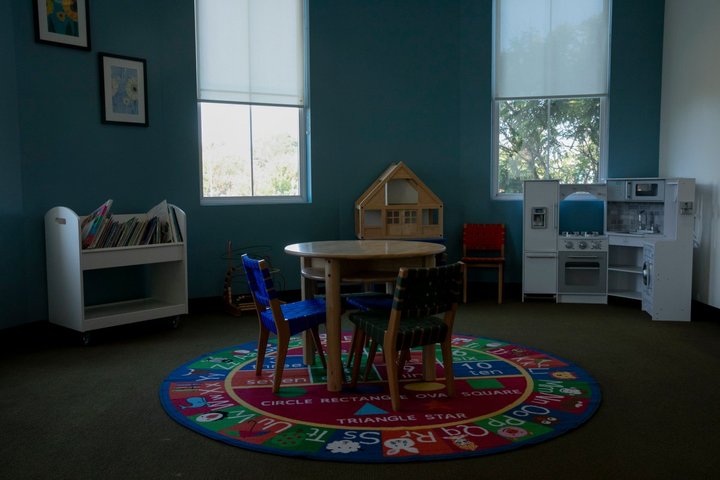
A play area at WestCoast Children’s Clinic in Oakland on Sept. 22, 2021. The clinic serves nearly 1,500 children annually, many of whom are in foster care or on Medi-Cal. Photo by Anne Wernikoff, CalMatters
###
The children keep coming.
Some are rushed to the emergency room of Rady Children’s Hospital in San Diego harboring thoughts of suicide, others because they’ve tried — again and again — to hurt themselves.
Dr. Ben Maxwell, Rady’s interim child psychiatry director, worries that a long-brewing crisis is now morphing into a full-blown emergency. When Maxwell started at the hospital 10 years ago, he’d see an average of 40 children and adolescents arriving each month in a mental health crisis. The average these days is 400 or 450.
Many of these young patients wait for days in the emergency room. With a statewide shortage of pediatric mental health hospital beds, Maxwell has nowhere else to send them.
Around the state and country, other hospitals report the same: Children and teens are coming into emergency rooms in psychiatric crises, and then they’re getting stuck. The pandemic has only made it worse.
As the crisis unfolds in the state’s emergency rooms, a controversial bill that aims to help these children is awaiting the governor’s signature. AB 226, by Democratic Assemblymember James Ramos of San Bernardino County, would allow for creation of “crisis psychiatric residential treatment facilities” for children with Medi-Cal. These non-hospital settings would allow young people in mental health crises to spend a few weeks stabilizing before returning home.
Similar facilities exist in California to serve privately insured children. But they are not available for most children insured by Medi-Cal, proponents say, because there’s no way to adequately fund them.
“We need to do a better job making sure we’re equipped here in the state of California to respond when our youth are crying out.” — Assemblymember James Ramos, D-San Bernardino
The bill before the governor would change that, allowing nonprofit organizations that specialize in children’s mental health a way to collect federal funds to operate crisis beds and treat the state’s low-income children.
Among the bill’s supporters are children’s mental health advocates, county behavioral health systems and providers like Maxwell. They say this new designation could potentially create a few hundred non-hospital residential beds around California for children and teens who are experiencing psychiatric emergencies, specifically the 40% of the state’s children currently insured by Medi-Cal.
“We need to do a better job making sure we’re equipped here in the state of California to respond when our youth are crying out,” Ramos said.
Expanding access to non-hospital residential beds could relieve pressure on hospitals and emergency rooms while offering children a more homelike residential placement nearer to their families, proponents say.
The facilities would also provide a less restrictive alternative to pediatric psychiatric hospital beds, which themselves are in short supply, proponents say. Of the state’s 58 counties, only 16 have inpatient mental health hospital beds for children and adolescents.
Critics question restrictive care, costs
But the bill has critics among advocates for disability and foster children’s rights. They worry it will simply expand the most restrictive kinds of mental health treatment while failing to address the shortage of intensive outpatient mental health services and crisis services for children.
“It’s like getting a filter for smoke and not putting the fire out,” said Kim Lewis, a managing attorney at the National Health Law Program. “At some point, you’re missing the point. More beds and more beds and more beds and let them keep coming because there’s nothing downstream to stop them from coming.”
Some state departments have also pushed back. In a letter of opposition to the bill in July, the Department of Finance said that, given the bill’s general fund impacts — about $1 million a year — it should go through the budgetary process.
Concerns about children’s mental health in the state have been mounting for more than a decade. In 2017, then Gov. Jerry Brown signed a related bill into law. But because it did not come with a way to draw down federal funding for children with Medi-Cal, no such facilities were created, said Adrienne Shilton, senior policy advocate for the California Alliance of Child and Family Services, the bill’s sponsor.
Pandemic fuels crisis for kids
Then, during the pandemic, the situation got markedly worse.
“We are now in a crisis that you poured a bunch of gasoline on and lit on fire,” said Alex Briscoe, head of California Children’s Trust and former director of Alameda County Health Care Services Agency, who supports the bill.
Skyrocketing psychiatric emergency room visits among children reflect not pathology, he said, but the influence of racism, classism, housing insecurity and “what it’s like to be a kid in this culture.”
He rattles off a reference list of bleak statistics:
California ranked 48th in the nation for children’s access to mental health care, according to a 2020 scorecard released by the Commonwealth Fund.
As need continued to accelerate during the pandemic, low-income children experienced a 34% decline in access to mental health support, according to the Centers for Medicare & Medicaid Services.
“The process is just failing them over and over.” — Jodie Langs, Westcoast Children’s Clinic in Oakland
State officials, mental health advocates and health care providers have been scrambling to find solutions. The Newsom administration this year promised to prioritize children’s mental health, budgeting an unprecedented $4.4 billion for a range of efforts, including a public awareness campaign and school-based interventions.
Heather Huszti, chief psychologist at Children’s Hospital Orange County, said she has seen a doubling of the number of children admitted to the hospital’s inpatient medical unit for suicide attempts during the past year.
“Since May of 2020, it all exploded,” she said. “And it’s just been nonstop ever since.”
Children’s Hospital Colorado recently declared a “state of emergency” with respect to children’s mental health. In that declaration, Maxwell, of Rady Children’s, sees a portent of the San Diego hospital’s future.
“I’m very concerned that’s the point we’re reaching,” he said. “And we will have no resources to help these kids in need.”
Families struggle to find care
While children with commercial insurance have access to placements that children with Medi-Cal do not, their families say they also often struggle to find appropriate care.
The stepmother of a 16-year-old San Diego boy, who ended up in Rady Children’s Hospital last spring after a suicide attempt, said she and her husband searched and searched for an appropriate outpatient program for their son. They were turned away by some 30 psychologists, she said; many never even called her back.
“I really felt at a loss about how to help my son,” she said.
Eventually they were connected by a psychiatrist to an intensive home-based program that is “really doing wonders,” she said.
She feels for all the other families that are still looking.
“It was the worst experience we’ve ever been through,” she said.
Shilton, of the California Alliance of Child and Family Services, says she regularly hears stories from providers about children being shipped far from their families because there’s no pediatric hospital bed for them locally. Others end up waiting in emergency rooms for days or weeks because no inpatient bed is available.
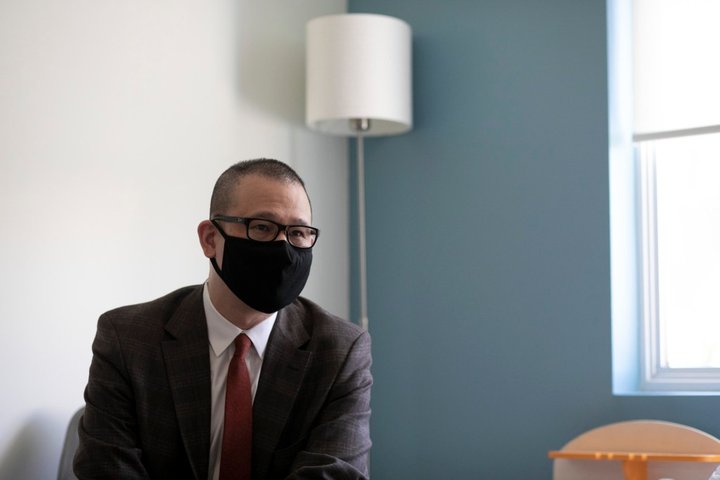
Kelley Gin, chief of clinical programs at WestCoast Children’s Clinic in Oakland, on Sept. 22, 2021. Photo by Anne Wernikoff, CalMatters
Kelley Gin, chief of clinical programs at WestCoast Children’s Clinic in Oakland, said the children he serves — many of them in foster care – are often “treated and streeted,” stabilized in the hospital and then discharged with no long-term plan in place.
After these children leave the hospital, Gin said, many end up staying in inappropriate settings, sometimes including a conference room couch, while child welfare staff search for a place to take them in.
“And then everyone is surprised when the crisis reignites and there’s another hospitalization,” Gin said.
Gin says the system is broken at many levels. Intensive outpatient programs that can treat children outside of a residential setting are “widely unavailable” for children with Medi-Cal, he said. But he says the need to reform the entire system must also include expanding access to non-hospital residential care.
“What’s really most outrageous to me at the moment is the status quo,” said his colleague, Jodie Langs, the clinic’s policy director. “The process is just failing them over and over.”
Advocates splinter over bill’s plan
The bill, which passed out of the legislature unanimously, still faces some strong opposition. Opponents say they are frustrated that it is focused on building out the most restrictive part of the mental health system, rather than expanding options for intensive treatment and crisis care that can be offered while children are living at home.
Melinda Bird, an attorney with Disability Rights California, said she is “very concerned about the potential for abuse” in locked facilities without appropriate safeguards.
She worries that creating more institutional placements is “just the wrong direction,” and will encourage counties to default to more restrictive levels of care.
“We’re trying to move our system away from segregated, locked congregate care facilities,” she said. “They know that they don’t help our kids.”
She wants to see short-term crisis stabilization units — where children in crisis can come for up to 24 hours — built in counties that don’t currently have them.
Jennifer Rodriguez, executive director of the San Francisco-based Youth Law Center, which advocates for foster youth and children in the juvenile justice system, echoed these concerns.
“When you talk to young people who have experienced any institutional locked setting, for them those experiences are traumatic,” she said. “We should only be using them when we’ve tried everything else and there is no other option.”
Rodriguez also worries about the possibility of “warehousing” children who have nowhere to go. She points to Alabama, where child advocates filed a federal class action suit this spring, alleging that the state for years had trapped and isolated children in psychiatric residential treatment facilities.
Proponents of the bill say those concerns can be addressed with appropriate guardrails. These could be outlined by the state and could include time limits, facility size restrictions and ongoing oversight.
Earlier this year, an investigation by the San Francisco Chronicle and a nonprofit publication called The Imprint found that California had sent thousands of children in foster care and the juvenile justice system to for-profit out-of-state residential treatment programs where they suffered physical, sexual and emotional abuse. The state has since banned out-of-state placements for these children.
Some advocates for expanding residential treatment options in California say that situation shows that children should be kept closer to home, where the state can better monitor the services they receive.
Everyone agrees that something must be done to address the growing mental health needs of the state’s children.
The mother of a 14-year-old Santa Barbara area boy who was rushed to the emergency room after he tried to take his own life said that, for him, being hospitalized and sedated “was a really super traumatic thing.”
For her, trying to find help afterward was also overwhelming — she barely slept. She wishes there had been a place for him that was more welcoming and supportive.
“It just feels like you’re on your own,” she said.
###
CALmatters.org is a nonprofit, nonpartisan media venture explaining California policies and politics.
Supporters of a push to require companies to report workplace coronavirus outbreaks publicly say they plan to keep fighting despite recent setbacks that they say allow big businesses to keep outbreaks secret.
In February, Assemblymember Eloise Gómez Reyes, D-San Bernardino, proposed a law requiring the California Department of Public Health to report COVID-19 outbreaks by workplace location, meaning outbreaks at specific businesses would be disclosed to the public.
But that requirement was dropped from the bill’s final version, allowing companies — and public health officials — to withhold coronavirus outbreak information from the public. Instead, health officials will report infections by industry.
Worker advocates say this leaves workers and the public vulnerable and in the dark.
“Public disclosure of this data shouldn’t be as contentious as it is,” said Ana Padilla, executive director at UC Merced Community and Labor Center.
Some say COVID-19 reporting requirement was ‘overreach’
The new bill was supposed to build upon last year’s Assembly Bill 685, which was inspired in part by a joint investigation by CalMatters and The Salinas Californian for the California Divide on unreported COVID outbreaks among guest farmworkers. That bill requires employers to notify workers of COVID-19 outbreaks and allows Cal/OSHA to fine employers and shut down workplaces for serious coronavirus violations and outbreaks.
In an interview last year with The Bee, Reyes said that the original goal was that “individual worksite outbreaks would be publicly reported by the Department of Public Health.” But the final version only required the state to report the total number of outbreaks by industry sector — without naming employers.
Her follow-up legislation, Assembly Bill 654, was supposed to clarify this point.
But the bill faced opposition from Assembly Republicans and business groups, such as the California Chamber of Commerce and Western Growers.
The final version removed the individual worksite outbreak reporting requirement when it failed to get enough votes to pass the Assembly in June. There were 22 “no” votes, primarily from Republican lawmakers.
Assemblymember Jim Patterson, who represents parts of Fresno and Tulare counties, said he supported removing the requirement because it eliminated what he called public shaming” language.
“It was the excessive overreach of the bill,” said Patterson.
Reyes’ office didn’t comment on the removal of the language about individual worksite outbreak reporting requirements. “We will continue to seek solutions that protect workers during the COVID-19 pandemic or any future pandemics,” according to a statement.
Assemblymember Adam Gray, D-Merced, also voted against the workplace reporting requirement. He could not be reached for comment.
Should California companies publicly report COVID-19 outbreaks?
Padilla said that a lack of explicit workplace outbreak requirements should “concern” the public. Outbreak data is crucial to keeping communities safe.
“We need the data to mitigate the spread of COVID in real-time, in particular in workplaces,” said Padilla. “We also need workplace data to inform the development of policies that can improve working conditions and potentially save worker lives.
“By prohibiting the publication of data that tells us where outbreaks are happening, we’re limiting our ability to understand the quickly changing and really dangerous virus,” said Padilla.
Padilla pointed to the COVID-19 outbreak at the Foster Farms plant in Livingston last year, where the plant had a 40% COVID-19 positivity rate. In a September 2020 Merced County Board of Supervisors meeting, health department officials confirmed this was over eight times higher than the COVID-19 positivity rate in Merced County at the time.
“It was eight times higher than the county’s own positivity rate, and still, they were pointing the fingerat the community, saying ‘it’s the community spread,’” said Padilla.
Foster Farms responded to the comments on their COVID-19 response and outbreak reporting.
“Foster Farms has performed over 130,000 COVID-19 tests in California — more than 80,000 in Merced County — with an overall positivity rate of less than 1%, and has provided all of this data to the State of California,” said Ira Brill, vice president of communications for the poultry plant.
“Foster Farms has provided, and continues to provide, its workforce with information about COVID-19 and vaccinations in multiple languages, including Spanish and Punjabi. These are the facts,” Brill said.
Foster Farms wasn’t the only central San Joaquin Valley company to have its COVID protections scrutinized during the earliest months of the pandemic.
Last year, workers at Fresno’s Amazon warehouse criticized the company’s infection reporting policies, saying workers received only vague information about possible exposures and infection numbers.
According to an analysis by UC Merced, most workers who have died of COVID-19 in California’s top 10 high-risk industries were primarily from Latino and immigrant backgrounds. These industries include warehousing, agriculture, and food processing.
“I think the people in the state Capitol that were busy negotiating away the crucial provisions in the bill … don’t share the same background as the low-wage workers of color” who have been disproportionately impacted by the pandemic, said Padilla.
She said she hopes to see another iteration of the bill that requires workplace outbreak data by industry, by county, by employer. Gov. Gavin Newsom has until Oct. 10 to sign or veto the bill.
###
This article is part of the California Divide, a collaboration among newsrooms examining income inequality and economic survival in California. CALmatters.org is a nonprofit, nonpartisan media venture explaining California policies and politics.
This week your President of Positivity returns to the Glass Garage to again visit local marble maker Topher Reynolds and his crew of glass blowing enthusiasts. This time though, Michaele has dragged along with her none other than Eureka Mayor Susan Seaman. Can the mayor blow glass, you’re wondering? Let’s find out!
Albert Franklin Hailstone, Jr., lost a short battle with cancer on
Wednesday, September 22, 2021, in Eureka. He was loved by many and he
will be dearly missed by family and friends alike. Al had a genuine
smile, and a contagious giggle, a loving heart and was fun to be
around. He was imaginative and outright funny!
Albert was born in
Eureka to Albert Hailstone, Sr. and Vivien Risling Hailstone on
January 25, 1942. He was a member of the Hoopa Valley Tribe and a
descendant of the Wintu, Yurok and Karuk Tribes. He attended school
at Hoopa Valley Elementary and graduated from high school in Modesto,
California. He studied art at Shasta College and later obtained a
degree in cosmetology in San Francisco. Al worked for 40 + years as a
licensed hair stylist for Yosh Salons/L Salon in San Mateo,
California where he retired in 2008.
On June 30, 2008,
Al married the love of his life and best friend, Douglas Gene
Coleman. They were together for 40 years. Al was fascinated with
world history, art and culture and traveled the world with Gene, and
often with his mother Vivien too. They saw many of the historical
sites and museums he had often read and heard about. Al and Gene
moved to Eureka from San Francisco in 2012. Al enjoyed being back
“home” in Northern California near his family, and his many
memories. He loved renewing old friendships and meeting new friends.
He loved spending the day working in his beautiful garden or creating
in his art studio. He loved his Indian culture and spent many hours
researching and recording family history and lineage. Al also spent
much time writing, and was in the process of completing three novels.
Albert had many
interests and talents and became an established artist. Besides
creating beautiful paintings, Al’s ability to visualize and
experiment with many different mediums, resulted in the creation of
wonderful unique art forms, such as collages, jewelry and other
outstanding pieces. He had a unique collection of various types of
art and was an expert and an avid collector of traditional Indian
basketry made in the Northern California area during the 18th
and 19th centuries. Al was able to identify the weaver
just by looking at the weave of the basket. His vast collection can
be seen at the Clarke Museum in Eureka. Also there is the
beautiful otter sculpture he painted.
As a young boy,
Al, known as “Sonny Boy” to his family and close friends, spent a
lot of time with his cousins, helping gather and process basket
materials and traditional foods for his grandmother Geneva and his
great aunts Lizzy Smith and Susie Little. He loved his Indian food;
acorns, deer meat, salmon, eels, acorn check chum and so much more.
From a young age Al helped his mother Vivien in their family gas
station and the I-Ye-Quee variety store in Hoopa. He also
participated with family, in his grandfather David Risling Sr.’s
annual Indian Pageants in Hoopa and at other public events, to share
with many others, parts of their Indian culture. As an extremely
talented individual, his traditional dance style was very impressive.
Albert is survived
by his husband Gene, aunt Barbara Phelps Risling and numerous cousins
and friends. He is preceded in death by his parents Albert Hailstone,
Sr., and Vivien Risling Hailstone, his brother, Damon Hailstone, his
grandparents, David W. Risling Sr. and Geneva Orcutt Risling, and
Zachariah Michael Hailstone and Ethel Whinifred (McDonald) Hailstone
Chandler.
Albert was very
concerned, as well as other family members, with the dangers and
spread of Covid. Therefore, there will be no funeral or memorial
service, to prevent the spread of the deadly virus. A private burial
will be held in the future. The family would like to extend its great
appreciation for the outpouring of love during this difficult time.
###
The obituary above was submitted on behalf of Albert Hailstone’s loved ones. The Lost Coast Outpost runs obituaries of Humboldt County residents at no charge. See guidelines here.