

HSCO Arrests Man Who Tried to Stab His Mother
LoCO Staff / Wednesday, Aug. 20, 2025 @ 12:28 p.m. / Crime
Press release from the Humboldt County Sheriff’s Office:
On Aug.19, 2025 at about 9:27 p.m. Humboldt County Sheriff’s deputies were dispatched to the 1900 block of Strawberry Ct. in McKinleyville for the report of an attempted homicide.
The Humboldt County Emergency Communications Center received a series of text messages to 9-1-1 stating a male subject inside the residence was physically assaulting and attempting to stab his mother and had started a fire.
When deputies arrived on scene, a young male adult was observed exiting the residence with his hands raised above his head and he was immediately detained. Based on the witness and victim statements, 18-year-old, Hunter Taula-Sanson, of Waianae, Hawaii was arrested. He was transported the Humboldt County Correctional Facility (HCCF) and booked on the following charges: P.C. 664/187(A)-Attempted Homicide, P.C. 245(A)(4)-Assault with a Deadly Weapon, P.C. 422(A)-Criminal Threats, P.C. 594(A)(2)-Felony Vandalism and P.C.417(A)(1) Brandishing a Deadly Weapon.
This case is still under investigation.
Anyone with information about this case or related criminal activity is encouraged to call the Humboldt County Sheriff’s Office at (707) 445-7251 or the Sheriff’s Office Crime Tip line at (707) 268-2539.
BOOKED
Yesterday: 8 felonies, 8 misdemeanors, 0 infractions
JUDGED
Humboldt County Superior Court Calendar: Today
CHP REPORTS
No current incidents
ELSEWHERE
RHBB: CalNASP Celebrates Record-Breaking Year: 18 Schools Granted Archery Equipment in 2025-26
RHBB: Trinity County Board of Supervisors Concludes CAO Recruitment Process
RHBB: Shasta-Trinity National Forest Announces Seasonal Hiring for Upcoming Recreation Season
SAVE THE DATE! Eureka is Hosting a Pop-Up DUI Checkpoint on Friday, and if You Wrongly Feel That You Have to Drive Drunk Then You Are Invited to Attend
LoCO Staff / Wednesday, Aug. 20, 2025 @ 8:53 a.m. / Safety
Press release from the Eureka Police Department:
The Eureka Police Department (EPD) will conduct a driving under the influence (DUI) and Driver’s License checkpoint on Friday, August 22, from 6:00 p.m. to 12:00 a.m. at a location within the city limits of Eureka.
The exact location is not being disclosed in advance.
The primary purpose of checkpoint is to promote public safety by deterring impaired driving, raising awareness, and removing suspected impaired drivers from the road. Officers will look for drivers who are impaired by alcohol, cannabis, illicit drugs, or prescription medications that can affect driving ability.
“Our goal is simple: prevent crashes and save lives,” said Sergeant Omey. “If you’re planning to drink or use any substance that can impair your driving, plan ahead for a sober ride.”
What Drivers Can Expect
- Vehicles may be stopped in a neutral, pre-determined sequence.
- Drivers will be briefly contacted by officers trained in DUI detection.
- Sobriety tests may be administered as appropriate.
- Delays to motorists will be minimal.
Safety Reminders
- Plan ahead: designate a sober driver, use public transit, rideshare, or taxi.
- If you see an impaired driver on the road, call 9-1-1.
- Medications (including some over-the-counter and prescription drugs) can impair—read labels and consult your doctor.
Driving impaired is not worth the risk. A DUI arrest can lead to jail time, license suspension, and significant fines and fees.
This operation is funded by a grant from the California Office of Traffic Safety (OTS), through the National Highway Traffic Safety Administration (NHTSA).
Why Many California Democrats Are Feeling Angst Over Newsom’s Redistricting
Jeanne Kuang / Wednesday, Aug. 20, 2025 @ 8:42 a.m. / Sacramento

The Senate Standing Committee on Elections and Constitutional Amendments holds a hearing on a potential special election to redraw the state’s congressional districts, at the Capitol Annex Swing Space in Sacramento on Aug. 19, 2025. Photo by Fred Greaves.
###
This story was originally published by CalMatters. Sign up for their newsletters.
###
As Republicans lambasted California lawmakers for rushing through their effort to gerrymander the state’s congressional map, Democrats are facing a quieter angst in their own party.
To counter what they call President Donald Trump’s undemocratic power grab for Republican seats in Texas, they’re asking voters to temporarily ditch California’s nonpartisan map-drawing process — touted as a national gold standard for fair elections and good governance — in favor of a politico-drawn map to tilt seats in Democrats’ favor.
At the polls, they’ll have to overcome not just Republican opponents but also some Democrats and independent voters who say California shouldn’t respond to partisan gerrymandering in Texas with the same frowned-upon tactics at home.
“This is the kind of moral conflict that, if this goes to the ballot, that every California voter is going to be faced with,” said Sara Sadhawani, a political science professor, Democrat and former member of the state’s independent redistricting commission, at a hearing over the measures Tuesday.
Sadhawani helped draw the state’s existing congressional map when she sat on the commission alongside fellow Democrats, Republicans and independents after the 2020 Census. Now she’s one of Gov. Gavin Newsom’s partisan redistricting effort’s most vocal supporters.
Testifying in favor of the plan on Tuesday, she said lawmakers must respond to the “extreme attacks on our core democratic principles” in Texas and other red states that are considering redrawing their own maps.
“It brings me no joy to see the maps that we passed fairly by the Commission to be tossed aside,” she said. “I do believe this is a necessary step in a much bigger battle to shore up free and fair elections in our nation.”
But even as state- and congressional-level Democrats embrace the plan as their answer to voters clamoring for the party to put up a resistance to Trump, there are misgivings among Democrats statewide.
On the other side of the issue in the hearing rooms weren’t the Republicans who have vowed to fight Newsom through lawsuits and at the ballot box. Instead, opponents presented members of prior nonpartisan redistricting commissions: Jeanne Raya and Cynthia Dai, who are Democrats, and Connie Archbold Robinson, an independent, to testify against the measures.
“Our citizens in other parts of the country, who are being held hostage by politicians who do not represent their interests, have been looking to California as the alternative, as the model,” Robinson said. “If we gut the great work that we have been doing there, then not only do we lose our credibility, those efforts actually get stalled and get reversed.”
Voters backed independent redistricting
Voters added the nonpartisan process for redrawing California’s political maps to the state constitution by a slim margin in 2008. In 2010 they approved using that same independent system to draw new congressional maps just as Republicans nationally campaigned to flip state legislatures for the purpose of drawing more GOP House seats in states like Wisconsin, North Carolina and Michigan.
Three other states use a similar process as California to draw congressional maps, but just over half of all states give that power directly to their legislatures, meaning the party in power can tilt seats to their advantage.
The current California congressional map gave Democrats a slight advantage. But while Trump and Vice President J.D. Vance have called the map unfair to the GOP, Republicans in California have been, for the most part, satisfied with it. It maintained competitive districts that the GOP has been able to win or put up significant fights for — districts that will be eliminated under the partisan map voters will likely weigh in on this fall.
Statewide, Democratic voters outnumber Republicans nearly 2-to-1. Recent polling shows voters favor independent redistricting by about the same margin.
California vs. Texas
To sell the redistricting measure to the public, Democrats have leaned heavily on framing it as a fight against Trump — and, ironically, in favor of fairer elections nationwide. In the state Senate elections committee, Democrats grilled the former map-drawers on whether it would ever be acceptable for them to draw new districts for political reasons and whether California ought to retaliate to discourage Texas’ efforts.
“Texas is actively reducing their own competitive seat count,” Sen. Sabrina Cervantes, a Riverside Democrat, said. “So then do you expect our communities to remain silent while their voices are being stripped away from Washington?”
Raya stressed she, too, opposed both the Trump administration and the Republican gerrymandering effort in Texas, which she called “reprehensible.”
“We’re living with … the despair that people have about the current political climate,” she said. “For me, this is not about declaring an emergency, and now, what do we do? This is, every day, we need to be doing something to make the system work and today what we need to do is protect the independent, nonpartisanship of drawing lines.”
But her fellow party members in the Senate said it’s not the time to go high.
“I will speak for myself, the conditions have been met for us to take action,” incoming Senate President Pro Tem Monique Limón, a Santa Barbara Democrat, said to the former commissioners. “I have utmost respect and recognition for the work that all of you do to protect our democracy.”
California Has a Fallback Plan for Trump’s Clean Car Attacks. Does It Go Far Enough?
CalMatters staff / Wednesday, Aug. 20, 2025 @ 7:10 a.m. / Sacramento

Hydrogen-powered trucks at IMC headquarters in Compton on Oct. 29, 2024. Photo by Carlin Stiehl for CalMatters.
###
This story was originally published by CalMatters. Sign up for their newsletters.
###
California regulators, responding to the Trump Administration’s attacks on the state’s climate policy, propose to fight back in part by asking lawmakers to backfill electric vehicle incentives, recommending more private investment, and beginning to write clean car rules — again.
“Clean air efforts are under siege, putting the health of every American at risk,” said Air Resources Board chairperson Liane Randolph. “California is continuing to fight back and will not give up on cleaner air and better public health. We have a legal and moral obligation.”
Several state agencies jointly made the recommendations in response to Gov. Gavin Newsom’s June executive order calling for California to double down on efforts to transition away from fossil fuels.
Proposals unveiled Tuesday also include replacing expiring federal EV tax credits — a tough ask in a tight budget year — and restoring carpool lane access, which would require federal approval. One recommendation seeks to expand vehicle charging access by streamlining utility hookups and simplifying permits for new stations.
The air board is advancing just a few regulatory ideas: one to enact stronger consumer protections for clean car owners, and another to curb diesel pollution from freight hubs such as ports and warehouses. Randolph also said the board would begin work on a new clean cars rule.
A spokesman for the governor said he would review the agencies’ report.
The recommendations reflect the hard shift the state has experienced from a supportive Biden administration toward a hostile one under President Trump, said Guillermo Ortiz, senior clean vehicles advocate for the Natural Resources Defense Council.
“When you have your federal government using every tool at its disposal to attack its own state …how are you able to see every attack angle, every vector, everything that this administration is willing to do to harm California?” he said. “That’s difficult.”
Other experts also said they expected more. “Folks familiar with this kind of policy will read it and feel…underwhelmed,” wrote Earthjustice lawyer Adrian Martinez in an analysis of the plan.
“Nothing jumps out at me as being particularly aggressive,” said Daniel Sperling, a former Air Resources Board member who is the director of the Institute for Transportation Studies at UC Davis. “I’m puzzled, actually, because they had acted like they were really going to do something significant.”
Trucking deal collapses
California offered the remedies as a fallback after the Trump Administration announced it would cancel federal waivers issued under the Clean Air Act that have long allowed the state to set more aggressive car and truck standards.
Attacks on the state’s climate policies escalated last week, centered on the Clean Truck Partnership, a voluntary deal between major truck manufacturers and the state that would continue advancing zero emission truck technology even if the waiver programs fell through.
Last week, four manufacturers filed a lawsuit, seeking to dissolve their commitments under the partnership. The Federal Trade Commission, after launching an investigation into California’s program, declared the partnership unenforceable.
Days later, Trump’s Justice Department intervened in two lawsuits, arguing that the decision whether to ban internal-combustion engines in heavy-duty trucks rests ultimately with the federal government.
California’s climate policies matter most in communities near ports, warehouses and railyards, where diesel pollution chokes the air, said Ortiz of the Natural Resources Defense Council. Truck exhaust is a major source of cancer risk and drives respiratory and heart disease.
Without authority to make aggressive rules or strong voluntary measures like the Clean Truck Partnership, experts say the transition to less-polluting trucks could slow down.
A call for bolder action
Experts who called for bolder action said the state has more power than its executive and legislative branches are using.
Sperling said the state could better disincentivize gas-powered cars with a “feebate program,” which could charge fees on high-polluting vehicles in order to pay for clean-car rebates.
“If you really want to put your money where your mouth is, I think really supercharging those programs to advance transportation electrification could be a massively successful strategy,” said Martinez, who directs Earthjustice’s campaign toward that goal.
Martinez said that the state could better structure existing state programs including the Low Carbon Fuel Standard and the state’s Cap and Trade program to pay for electric cars and trucks.
“California shouldn’t blink” as the Trump Administration moves “aggressively,” he added.
Ethan Elkind, who directs the climate program at UC Berkeley’s Center for Law, Energy and the Environment, said a statewide rule tightening controls at warehouses and other pollution magnets could achieve similar aims to the truck mandates.
Elkind previously has pushed to go further. If the federal government is getting out of the business of regulating tailpipe emissions and making climate policy, he added, California could fill that vacuum in the future.
“The state could take a pretty aggressive approach here,” he added.
Air Resources Board chair Randolph said that California is not backing down, though she admitted that developing a new clean car rule aimed at phasing out gas-powered cars could take time.
“Because these rulemakings take two, three, sometimes even four years, we decided that it would be good to start that process now, and have it … be ready, ideally for a more receptive U.S. EPA,” Randolph said.
OBITUARY: Ethel Ruth Marshall Davis, 1931-2025
LoCO Staff / Wednesday, Aug. 20, 2025 @ 6:56 a.m. / Obits
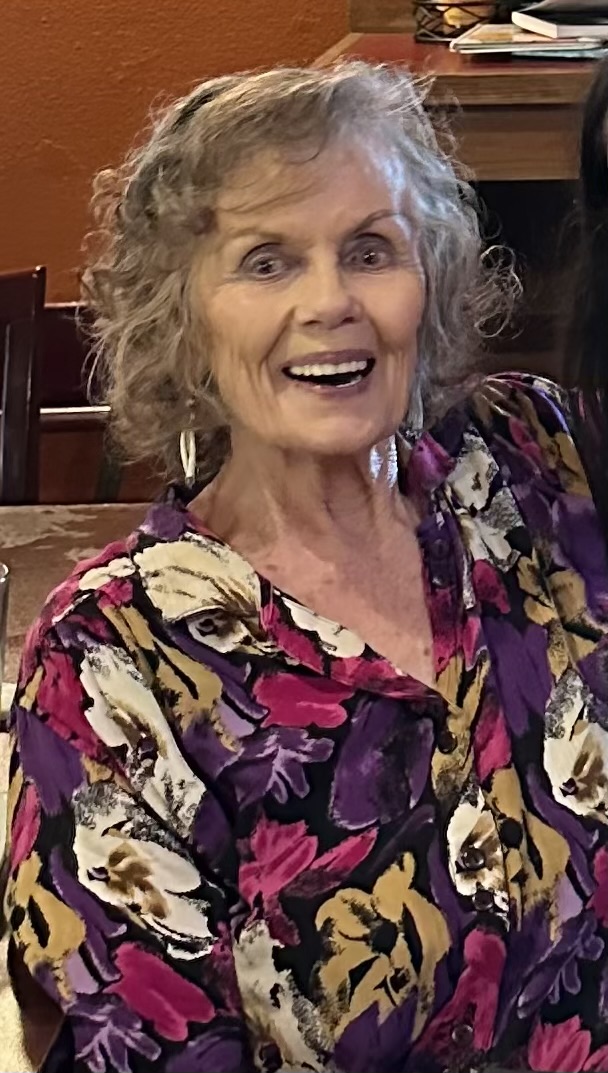
Ethel Ruth Marshall Davis was born on June 23, 1931 in Hoopa and went home to be with her Lord and Savior Jesus surrounded by loved ones on August 17, 2025. Ethel left her large family and loving community with a great legacy of: faith, perseverance, strength, love, kindness, hard work, and lasting memories.
For 94 remarkable years, Ethel met life’s challenges with courage, leaving behind a legacy as a cherished mother, wife, grandmother, aunt, cousin, teacher, and friend. She grew up on the Marshall family farm, where she lovingly cared for her elders and, in the process, blossomed into the woman we all came to cherish and love.
During her 27 years working at Hoopa Elementary School, Ethel made countless lifelong friends, mentored many children, and selflessly dedicated her time and energy to fundraising for youth events and trips. Ethel was deeply proud of her service on the Hoopa Tribal Education Board and the Hoopa Recreation Committee, where she worked to create opportunities that helped shape what is now the second-longest running All-Indian annual basketball tournament in the nation. More than 40 years later, she witnessed her grandsons and other local Natives bring home the championship—an achievement not seen in over 25 years and not repeated since. That year’s jackets were purple, her favorite color, so the team honored her with one of her own, which she will wear on her journey to be reunited with her loved ones.
Ethel had a gift for turning her talents into joy for others. Her famous divinity candy (which she started making at the age of eighteen), fresh bread, and homemade pies weren’t just delicious—they helped support her family, youth fundraisers, and brought smiles to friends and neighbors. Every summer, people knew exactly where to go for the best fireworks, as Ethel proudly became one of California’s top sellers. And if her kids or grandkids were playing ball, you could count on her being in the stands, cheering them on with all her heart — sometimes even threatening to run out on the field or court with her cane if the refs missed a call.
Her love for dancing, including winning contests with the jitterbug, traveling (especially to Hawaii, Reno, and Bishop); the pride she took in her flowers, plants and the beauty of her yard; and nice cars, always bringing a great amount of spirit for Christmas, Easter, Thanksgiving, and Halloween. All were some of the things that made Ethel who she was. She took a lot of pride in self care and maintaining a positive image. She loved music, especially Elvis Presley and was very proud of her dad Gilbert Marshall Sr., one of the first Hoopa Tribal Councilmembers, who played in an all Native band that traveled the country, even playing in presidential inaugurations.
Ethel was the backbone and matriarch of her large family, and a pillar of the Hoopa Community for the better part of the past 100 years. Her personality and stable spirit made it easy for any of her family or friends to lean on her during moments of need. Her smile, charismatic persona, and well-disciplined lifestyle will be deeply missed, but is now embedded into all who she knew. She now enters into rest as the eldest Hupa Tribal Member, a distinction that she was proud of.
She is survived by her sisters Eloise Marshall; Daughters Robyn Reed (Ron Sr.) and Raylyne Davis, Daughter in-law Elizabeth “Tissy” Davis; Grandchildren JJ (Stacy), Jason “Baby Boy” (Ramona), Janelle (Asa), Rony Jr.(Perla), Charley (Danielle), and Ryan Reed, Aaron Williams (Alaina), Talon Davis, Samantha Norton (Travis), Joseph and Stormie Lewis, Angela, Joe (Kayla), and Nancy Davis, Crystal Williams (Dave), Melissa “Annie Bear” Kane (Curtis), April Peters (Mike), Ronny Dean Davis Jr. (Dolli), Celestina, Rayme Lee and Jonah Davis, her nieces Cindi Marshall Sylvia and Amber Baker, Jill Sherman-Warne (Jim), Leslie Sherman-Hunt (Tim), Stevie Davis Jahrnaghan (Joe), Filomena Harvey, Nisha Blake, Mary, Sherri, Gilberta and Cindy Marshall nephew Harold Marshall, Filmore Harvey Jr., Eric Caserdarna, Duane Sherman Sr. (Kayla), Arnold Davis (Connie), great nephews and nieces are Kikya, Cody, Hazel Fletcher, Robert McBride, Josh Dillon, Phylecia, Duane Jr., and Briaunna Sherman, Barbara, Marilyn Randle; close cousin Melvin Marshall, and best friends Gloria Shuster, Joe and Elaine Aguado, Ethel Maloney, Viviana Masten and Lori Davis. Ethel also leaves behind 41 great-grandchildren, 4 great-great-grandchildren. And last but not least her beloved dog, Teddy Bear. Ethel raised and came from a large family so we apologize for anyone who we may have missed.
Ethel is preceded in death by her parents Gilbert Marshall Sr. and Elizabeth Montgomery, sisters Marie and Ronnie Marshall, brothers Goober Marshall and Filmore Harvey Jr., her four sons Reginald Jr. “Babe”, Rayme, Deanie, and Ricky Lee Davis, newborn baby daughter Rory, her husbands Reggie Davis Sr. and Alme Allen, brothers Gillie Marshall, Corky Blacksmith (Duane Abbot) and Filmore Harvey Sr., granddaughter Shana Davis, grandsons Anthony “Lil Tulalip” Williams, Arlen Williams, and Jordan Allen, Uncle Julious Marshall, and many more.
A service in honor of our beloved matriarch will be held on Friday, August 22, at 11 a.m. at the Hoopa Neighborhood Facilities, with Pastor Harold Jones officiating. She will be laid to rest at the Hoopa Tribal Cemetery, followed by a reception at the Hoopa Fire House.
Pall bearers will be Aaron Williams, Talon Davis, Joseph Lewis, JJ, Jason, Rony, Charley, and Ryan Reed, Jonah Davis, Joe Davis, and Ronny Dean Davis Jr.
Honorary Pall Bearers: Curtis Kane, Allen Kane, Ron Reed Sr., Jayden Reed, Mike Peters, David Williams, Asa Donahue, Harold Marshall, Melvin Marshall, Dale Risling, Carlo Miguelena, Chance Carpenter III, Arnold Davis Jr., Duane Sherman Sr., Troy Fletcher, Duane Sherman Jr., Tashone Rice, and Tyler Hunt. Harold Jones, Keoki Burbank, Bobby Perez, Chase Gatlin, Finnigan Gatlin, Joe Aguado, Earl “Babe” Moon, John “Knox” Marshall, Emil Marshall, and John Marshall of Visalia.
Ethel’s family would like to thank everyone who came to visit, her caregivers including the K’ima:w Hospital at Home Team, St. Joseph Hospital, and other family members. Grandma Ethel left a wonderful impact on many, many lives and we will always be thankful. We “love you more,” Grandma.
###
The obituary above was submitted on behalf of Ethel Davis’s loved ones. The Lost Coast Outpost runs obituaries of Humboldt County residents at no charge. See guidelines here.
OBITUARY: Shirley Diane (Roberts) Wilson, 1935-2025
LoCO Staff / Wednesday, Aug. 20, 2025 @ 6:56 a.m. / Obits

Shirley Diane (Roberts) Wilson passed away peacefully on Saturday, August 16, 2025 at the age of 89. She was born November 12, 1935 in Rohnerville, Fortuna at her grandparents, Ed and Gladys Baxter’s home.
Shirley was a graduate of the Rohnerville elementary school in 1949 and Fortuna High, graduating in 1953. As she graduated at the age of 17, she had to wait two years to attend the nursing program at Ben Franklin nursing school in San Francisco. After graduating nursing school she joined the US Navy in 1956 where she became a registered nurse and served 2 years.
After her service, she returned home where she continued her nursing career at the County Community Hospital (the old General Hospital) until her retirement in 1962.
Shirley met her future husband, Earl Wilson in 1958 after the purchase of a horse he was selling. They were married in 1962 for 40 years until his passing in 2002. He always said, he not only got the girl, but the return of his horse as well. They remained in Carlotta, California where they rode horses together, gardened, and raised their two boys.
Shirley leaves behind her oldest son Andrew and wife Cristal, granddaughter Makayla Wilson, grandson Wyatt Wilson (Brynn Ivy). Her youngest son Scott and wife TrinnaLynn, grandson Adam Wilson and wife Kaylee Pogue-Wilson. Brother Edgar Roberts and wife Judy. Nephew Garvin Rollins, neice Melodie Chittenden and husband Dave. Nephews Chuck and Rick Roberts. As well as many more nieces, nephews and friends to numerous to name.
Shirley was preceded in death by her parents Richard and Florene Roberts and husband Earl Wilson.
Shirley lived a long prosperous life and will be missed by her family and friends
Special thanks to Hospice of Humboldt and Katrina Davis for their care in her final days.
There will be a private graveside service. A memorial service will be held on Saturday, August 30, 2025 at noon at the Wilson property in Carlotta. Please bring a potluck dish if you can.
In lieu of flowers the family has asked that you make a donation to either Hospice of Humboldt or the Heart Association.
###
The obituary above was submitted on behalf of Shirley Wilson’s loved ones. The Lost Coast Outpost runs obituaries of Humboldt County residents at no charge. See guidelines here.
TODAY IN SUPES: Board OKs ‘Dark Sky’ Rules to Limit Light Pollution in Unincorporated Humboldt
Isabella Vanderheiden / Tuesday, Aug. 19, 2025 @ 3:35 p.m. / Local Government
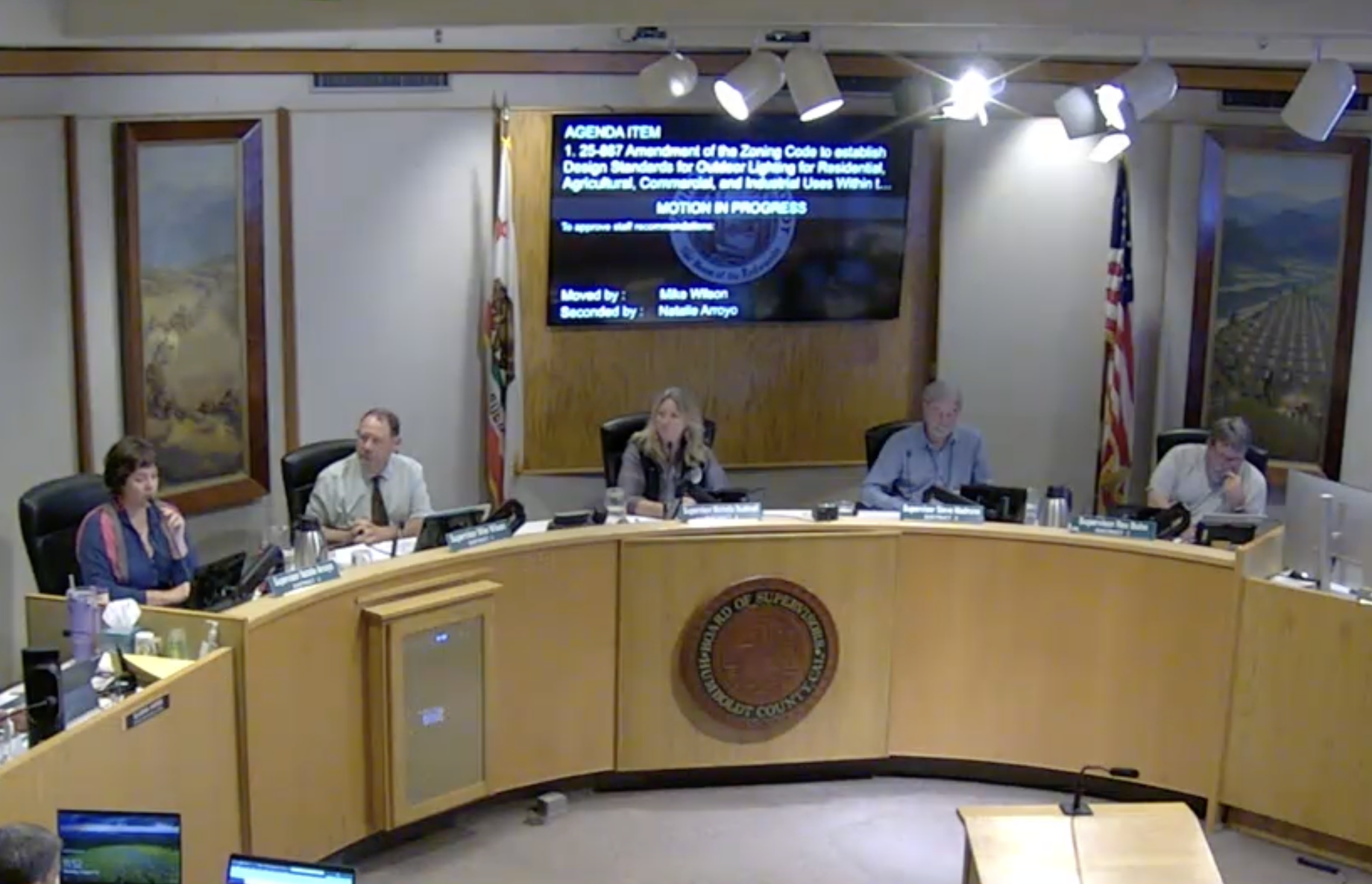
Screenshot of Tuesday’s Humboldt County Board of Supervisors meeting.
###
After two hours of extensive deliberation, the Humboldt County Board of Supervisors today narrowly passed an Outdoor Lighting Ordinance that sets new design standards to reduce light pollution — excessive or inappropriate artificial lighting — in unincorporated areas of the county.
The ordinance, which was approved in a 3-2 vote, with Board Chair Michelle Bushnell and First District Supervisor Rex Bohn dissenting, loosely follows the “Five Lighting Principles for Responsible Outdoor Lighting” issued by the International Dark-Sky Association that require all nighttime outdoor lighting to be useful, targeted, low-level, controlled and warm-colored.

Graphic via County of Humboldt.
The county-issued guidelines limit light intensity, reducing the temperature of light sources to lower temperature bulbs that emit warm, orange light rather than cool, blue light. The new rules also restrict “light trespass” — any artificial light that spills over onto neighboring properties that “eliminates the ability to have darkness on the adjacent property, or shines into or onto neighboring windows, properties or structures” — and encourage light fixtures that point downward to restrict the direction of the beam. Under the ordinance, motion lights would be restricted to a five-minute time limit and cannot be triggered by movement outside of the subject property.
“We are not trying to prohibit [outdoor] lighting,” Associate Planner Reanne Meighan said at today’s meeting. “We are simply trying to minimize unnecessary lighting of areas that transpires onto neighboring properties.”
Why limit outdoor lighting? Meighan explained that light pollution not only limits our view of the night sky, but said it also has “destructive effects” on the circadian rhythms of both humans and animals, especially nocturnal creatures that are active at night and sleep during the day. Warm light, which has a lower lumen output and Kelvin (K) temperature, as seen in the graphic below, has a lesser effect on light pollution.

Graphic via County of Humboldt
The original ordinance that was approved by the Humboldt County Planning Commission in May set a 1000-lumen maximum for residential uses and a 3000-lumen maximum for agricultural, commercial and industrial uses. However, after visiting local hardware stores, staff determined the limits should be set at 1100 and 3200 lumens, which are more commercially available.
Most residents who spoke during the public comment section of the meeting were in favor of the ordinance, with several speakers sharing their own stories about neighbors or local businesses with extremely bright outdoor lights. One woman, who did not identify herself, called out an automotive business in Myrtletown that has “blinding” security lights that threaten pedestrian safety.
“If you are driving east on Myrtle Avenue and are turning left onto Park Street, there is an extremely bright security light that blinds the driver to any foot traffic crossing Park Street or bicyclists traveling westbound on Myrtle Avenue,” she said. “We are very much concerned that someone will be hit by a vehicle where drivers cannot see them because of the serious glare caused by this extremely bright security light.”
Mark Wilson, vice president of Astronomers of Humboldt, also spoke in favor of the ordinance, noting that it would “put Humboldt County in the forefront of protecting the night skies, not only in the state, but nationally and internationally.”
The board’s discussion largely focused on how the ordinance would be enforced. Planning and Building Director John Ford said the enforcement would largely be complaint-driven, though new construction projects would also be subject to review during the normal application process.
“If there are violations of the ordinance, then it’s going to be like any other code enforcement matter,” Ford explained. “We are going to have to spend some time talking to the property owner, finding out what they have, letting them know what the solution is and, hopefully, they will voluntarily just make the change to stop the violation.”
Still, Bushnell expressed concern that outdoor lighting complaints would overwhelm code enforcement staff who already have a lot on their plate. “I think it’s really important that we recognize that sometimes complaint-driven can be a pissed off neighbor that wants to deal with something that isn’t even related to a light ordinance,” she said. “How are we going to address that?”
Ford reiterated the process, adding that complaint recipients are generally compliant. “We’ll have a conversation with them, and they’ll say, ‘Yeah, you know, I didn’t adjust that down, I’ll go turn my light down and make sure that it’s focused down, rather than shining out into my neighbor’s yard.’ And if that happens, [the issue] can be resolved that easily. These shouldn’t be hard to resolve.”
Bushnell was also concerned that the ordinance would target the wrong group of people. “I don’t want to make things so much harder for people in unincorporated areas when you have the municipalities that are glowing like a light bulb, per se,” she said.
The other big point of contention was whether or not athletic fields should be included in the ordinance, even though there is an exemption for such lighting as long as there isn’t any light trespass onto neighboring properties. Bohn felt the athletic fields should be subject to a time limit rather than a lumen limit.

Bohn | Screenshot
“Redwood Acres has a time limit … and if it goes after 10 o’clock, there’s complaints,” he said. “I’ve been involved with youth sports for over 50 years, and there is no reason in the world that a child should be out after 10 o’clock at night playing in an athletic sport. I don’t care if dad thinks he’s going to go pro and makes him stay. … I think we should look at timing [because] timing is a lot easier to enforce. … I do not want to dim it down for a kid having to catch a line drive off a bat.”
Wilson agreed, and asked staff to amend the ordinance to include a 10 p.m. time limit for athletic fields. “I do want to emphasize this isn’t about dimming the field,” Wilson added. “When people are playing ball on those fields, they should be well-lit, and that’s really important.”
Fifth District Supervisor Steve Madrone and Fourth District Supervisor Natalie Arroyo both spoke in favor of the ordinance, with Arroyo noting that the new standards give staff the tools to address longstanding lighting issues. “If there is a persistent problem … it gives people the sideboards for future development and for, frankly, just being a considerate neighbor, whether it’s a residential use or something else,” she said.
As the board prepared to take a vote, Bohn indicated he would vote against the ordinance. “Is this workable? It … looks good on paper, but there’s a lot of holes in this that I don’t know if it’s actually applicable,” he said. “I don’t think we can pass this right now, because there’s so many holes in it.”
After a bit of additional discussion, the board passed the ordinance in a 3-2 vote, with Bohn and Bushnell dissenting. The board directed staff to look into additional standards for street lighting and bring back an amendment to the Outdoor Lighting Ordinance in the near future.


