

California Has a Fallback Plan for Trump’s Clean Car Attacks. Does It Go Far Enough?
CalMatters staff / Wednesday, Aug. 20, 2025 @ 7:10 a.m. / Sacramento

Hydrogen-powered trucks at IMC headquarters in Compton on Oct. 29, 2024. Photo by Carlin Stiehl for CalMatters.
###
This story was originally published by CalMatters. Sign up for their newsletters.
###
California regulators, responding to the Trump Administration’s attacks on the state’s climate policy, propose to fight back in part by asking lawmakers to backfill electric vehicle incentives, recommending more private investment, and beginning to write clean car rules — again.
“Clean air efforts are under siege, putting the health of every American at risk,” said Air Resources Board chairperson Liane Randolph. “California is continuing to fight back and will not give up on cleaner air and better public health. We have a legal and moral obligation.”
Several state agencies jointly made the recommendations in response to Gov. Gavin Newsom’s June executive order calling for California to double down on efforts to transition away from fossil fuels.
Proposals unveiled Tuesday also include replacing expiring federal EV tax credits — a tough ask in a tight budget year — and restoring carpool lane access, which would require federal approval. One recommendation seeks to expand vehicle charging access by streamlining utility hookups and simplifying permits for new stations.
The air board is advancing just a few regulatory ideas: one to enact stronger consumer protections for clean car owners, and another to curb diesel pollution from freight hubs such as ports and warehouses. Randolph also said the board would begin work on a new clean cars rule.
A spokesman for the governor said he would review the agencies’ report.
The recommendations reflect the hard shift the state has experienced from a supportive Biden administration toward a hostile one under President Trump, said Guillermo Ortiz, senior clean vehicles advocate for the Natural Resources Defense Council.
“When you have your federal government using every tool at its disposal to attack its own state …how are you able to see every attack angle, every vector, everything that this administration is willing to do to harm California?” he said. “That’s difficult.”
Other experts also said they expected more. “Folks familiar with this kind of policy will read it and feel…underwhelmed,” wrote Earthjustice lawyer Adrian Martinez in an analysis of the plan.
“Nothing jumps out at me as being particularly aggressive,” said Daniel Sperling, a former Air Resources Board member who is the director of the Institute for Transportation Studies at UC Davis. “I’m puzzled, actually, because they had acted like they were really going to do something significant.”
Trucking deal collapses
California offered the remedies as a fallback after the Trump Administration announced it would cancel federal waivers issued under the Clean Air Act that have long allowed the state to set more aggressive car and truck standards.
Attacks on the state’s climate policies escalated last week, centered on the Clean Truck Partnership, a voluntary deal between major truck manufacturers and the state that would continue advancing zero emission truck technology even if the waiver programs fell through.
Last week, four manufacturers filed a lawsuit, seeking to dissolve their commitments under the partnership. The Federal Trade Commission, after launching an investigation into California’s program, declared the partnership unenforceable.
Days later, Trump’s Justice Department intervened in two lawsuits, arguing that the decision whether to ban internal-combustion engines in heavy-duty trucks rests ultimately with the federal government.
California’s climate policies matter most in communities near ports, warehouses and railyards, where diesel pollution chokes the air, said Ortiz of the Natural Resources Defense Council. Truck exhaust is a major source of cancer risk and drives respiratory and heart disease.
Without authority to make aggressive rules or strong voluntary measures like the Clean Truck Partnership, experts say the transition to less-polluting trucks could slow down.
A call for bolder action
Experts who called for bolder action said the state has more power than its executive and legislative branches are using.
Sperling said the state could better disincentivize gas-powered cars with a “feebate program,” which could charge fees on high-polluting vehicles in order to pay for clean-car rebates.
“If you really want to put your money where your mouth is, I think really supercharging those programs to advance transportation electrification could be a massively successful strategy,” said Martinez, who directs Earthjustice’s campaign toward that goal.
Martinez said that the state could better structure existing state programs including the Low Carbon Fuel Standard and the state’s Cap and Trade program to pay for electric cars and trucks.
“California shouldn’t blink” as the Trump Administration moves “aggressively,” he added.
Ethan Elkind, who directs the climate program at UC Berkeley’s Center for Law, Energy and the Environment, said a statewide rule tightening controls at warehouses and other pollution magnets could achieve similar aims to the truck mandates.
Elkind previously has pushed to go further. If the federal government is getting out of the business of regulating tailpipe emissions and making climate policy, he added, California could fill that vacuum in the future.
“The state could take a pretty aggressive approach here,” he added.
Air Resources Board chair Randolph said that California is not backing down, though she admitted that developing a new clean car rule aimed at phasing out gas-powered cars could take time.
“Because these rulemakings take two, three, sometimes even four years, we decided that it would be good to start that process now, and have it … be ready, ideally for a more receptive U.S. EPA,” Randolph said.
BOOKED
Yesterday: 9 felonies, 10 misdemeanors, 0 infractions
JUDGED
Humboldt County Superior Court Calendar: Today
CHP REPORTS
Us101 N / Newton B Drury Scenic Pkwy Onr (HM office): Trfc Collision-Unkn Inj
ELSEWHERE
RHBB: CHP Details Dramatic Water Rescue After Pickup Swept into Tomki Creek
RHBB: Minivan Over the Embankment After Semi Collision North of Leggett Amid High Water
RHBB: Heavy Rain Pushes Rivers Toward Flood Stage, Roads Impacted Across Northwest California
OBITUARY: Ethel Ruth Marshall Davis, 1931-2025
LoCO Staff / Wednesday, Aug. 20, 2025 @ 6:56 a.m. / Obits
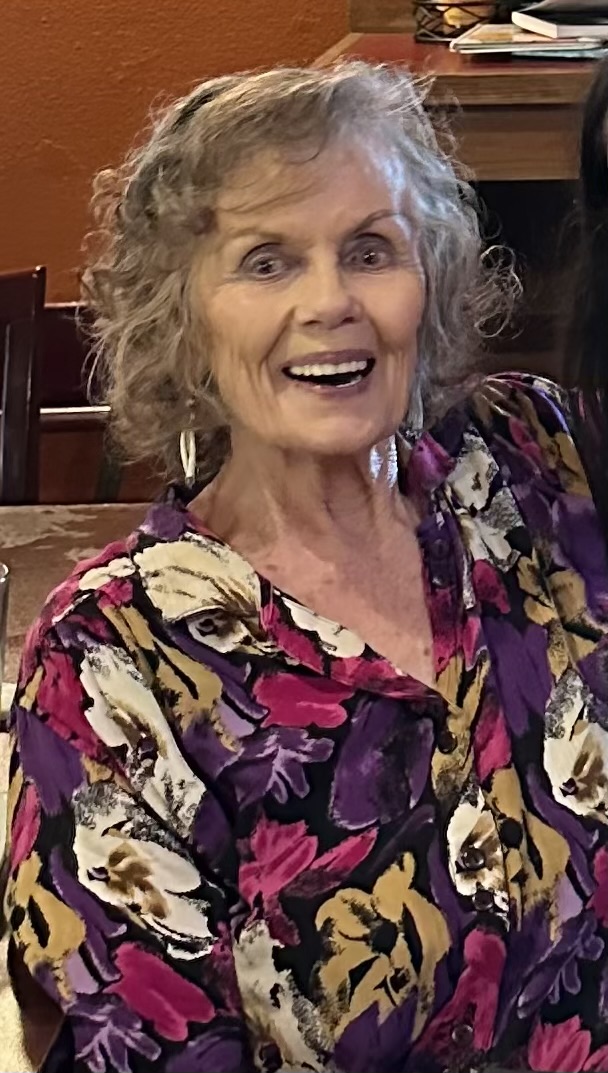
Ethel Ruth Marshall Davis was born on June 23, 1931 in Hoopa and went home to be with her Lord and Savior Jesus surrounded by loved ones on August 17, 2025. Ethel left her large family and loving community with a great legacy of: faith, perseverance, strength, love, kindness, hard work, and lasting memories.
For 94 remarkable years, Ethel met life’s challenges with courage, leaving behind a legacy as a cherished mother, wife, grandmother, aunt, cousin, teacher, and friend. She grew up on the Marshall family farm, where she lovingly cared for her elders and, in the process, blossomed into the woman we all came to cherish and love.
During her 27 years working at Hoopa Elementary School, Ethel made countless lifelong friends, mentored many children, and selflessly dedicated her time and energy to fundraising for youth events and trips. Ethel was deeply proud of her service on the Hoopa Tribal Education Board and the Hoopa Recreation Committee, where she worked to create opportunities that helped shape what is now the second-longest running All-Indian annual basketball tournament in the nation. More than 40 years later, she witnessed her grandsons and other local Natives bring home the championship—an achievement not seen in over 25 years and not repeated since. That year’s jackets were purple, her favorite color, so the team honored her with one of her own, which she will wear on her journey to be reunited with her loved ones.
Ethel had a gift for turning her talents into joy for others. Her famous divinity candy (which she started making at the age of eighteen), fresh bread, and homemade pies weren’t just delicious—they helped support her family, youth fundraisers, and brought smiles to friends and neighbors. Every summer, people knew exactly where to go for the best fireworks, as Ethel proudly became one of California’s top sellers. And if her kids or grandkids were playing ball, you could count on her being in the stands, cheering them on with all her heart — sometimes even threatening to run out on the field or court with her cane if the refs missed a call.
Her love for dancing, including winning contests with the jitterbug, traveling (especially to Hawaii, Reno, and Bishop); the pride she took in her flowers, plants and the beauty of her yard; and nice cars, always bringing a great amount of spirit for Christmas, Easter, Thanksgiving, and Halloween. All were some of the things that made Ethel who she was. She took a lot of pride in self care and maintaining a positive image. She loved music, especially Elvis Presley and was very proud of her dad Gilbert Marshall Sr., one of the first Hoopa Tribal Councilmembers, who played in an all Native band that traveled the country, even playing in presidential inaugurations.
Ethel was the backbone and matriarch of her large family, and a pillar of the Hoopa Community for the better part of the past 100 years. Her personality and stable spirit made it easy for any of her family or friends to lean on her during moments of need. Her smile, charismatic persona, and well-disciplined lifestyle will be deeply missed, but is now embedded into all who she knew. She now enters into rest as the eldest Hupa Tribal Member, a distinction that she was proud of.
She is survived by her sisters Eloise Marshall; Daughters Robyn Reed (Ron Sr.) and Raylyne Davis, Daughter in-law Elizabeth “Tissy” Davis; Grandchildren JJ (Stacy), Jason “Baby Boy” (Ramona), Janelle (Asa), Rony Jr.(Perla), Charley (Danielle), and Ryan Reed, Aaron Williams (Alaina), Talon Davis, Samantha Norton (Travis), Joseph and Stormie Lewis, Angela, Joe (Kayla), and Nancy Davis, Crystal Williams (Dave), Melissa “Annie Bear” Kane (Curtis), April Peters (Mike), Ronny Dean Davis Jr. (Dolli), Celestina, Rayme Lee and Jonah Davis, her nieces Cindi Marshall Sylvia and Amber Baker, Jill Sherman-Warne (Jim), Leslie Sherman-Hunt (Tim), Stevie Davis Jahrnaghan (Joe), Filomena Harvey, Nisha Blake, Mary, Sherri, Gilberta and Cindy Marshall nephew Harold Marshall, Filmore Harvey Jr., Eric Caserdarna, Duane Sherman Sr. (Kayla), Arnold Davis (Connie), great nephews and nieces are Kikya, Cody, Hazel Fletcher, Robert McBride, Josh Dillon, Phylecia, Duane Jr., and Briaunna Sherman, Barbara, Marilyn Randle; close cousin Melvin Marshall, and best friends Gloria Shuster, Joe and Elaine Aguado, Ethel Maloney, Viviana Masten and Lori Davis. Ethel also leaves behind 41 great-grandchildren, 4 great-great-grandchildren. And last but not least her beloved dog, Teddy Bear. Ethel raised and came from a large family so we apologize for anyone who we may have missed.
Ethel is preceded in death by her parents Gilbert Marshall Sr. and Elizabeth Montgomery, sisters Marie and Ronnie Marshall, brothers Goober Marshall and Filmore Harvey Jr., her four sons Reginald Jr. “Babe”, Rayme, Deanie, and Ricky Lee Davis, newborn baby daughter Rory, her husbands Reggie Davis Sr. and Alme Allen, brothers Gillie Marshall, Corky Blacksmith (Duane Abbot) and Filmore Harvey Sr., granddaughter Shana Davis, grandsons Anthony “Lil Tulalip” Williams, Arlen Williams, and Jordan Allen, Uncle Julious Marshall, and many more.
A service in honor of our beloved matriarch will be held on Friday, August 22, at 11 a.m. at the Hoopa Neighborhood Facilities, with Pastor Harold Jones officiating. She will be laid to rest at the Hoopa Tribal Cemetery, followed by a reception at the Hoopa Fire House.
Pall bearers will be Aaron Williams, Talon Davis, Joseph Lewis, JJ, Jason, Rony, Charley, and Ryan Reed, Jonah Davis, Joe Davis, and Ronny Dean Davis Jr.
Honorary Pall Bearers: Curtis Kane, Allen Kane, Ron Reed Sr., Jayden Reed, Mike Peters, David Williams, Asa Donahue, Harold Marshall, Melvin Marshall, Dale Risling, Carlo Miguelena, Chance Carpenter III, Arnold Davis Jr., Duane Sherman Sr., Troy Fletcher, Duane Sherman Jr., Tashone Rice, and Tyler Hunt. Harold Jones, Keoki Burbank, Bobby Perez, Chase Gatlin, Finnigan Gatlin, Joe Aguado, Earl “Babe” Moon, John “Knox” Marshall, Emil Marshall, and John Marshall of Visalia.
Ethel’s family would like to thank everyone who came to visit, her caregivers including the K’ima:w Hospital at Home Team, St. Joseph Hospital, and other family members. Grandma Ethel left a wonderful impact on many, many lives and we will always be thankful. We “love you more,” Grandma.
###
The obituary above was submitted on behalf of Ethel Davis’s loved ones. The Lost Coast Outpost runs obituaries of Humboldt County residents at no charge. See guidelines here.
OBITUARY: Shirley Diane (Roberts) Wilson, 1935-2025
LoCO Staff / Wednesday, Aug. 20, 2025 @ 6:56 a.m. / Obits

Shirley Diane (Roberts) Wilson passed away peacefully on Saturday, August 16, 2025 at the age of 89. She was born November 12, 1935 in Rohnerville, Fortuna at her grandparents, Ed and Gladys Baxter’s home.
Shirley was a graduate of the Rohnerville elementary school in 1949 and Fortuna High, graduating in 1953. As she graduated at the age of 17, she had to wait two years to attend the nursing program at Ben Franklin nursing school in San Francisco. After graduating nursing school she joined the US Navy in 1956 where she became a registered nurse and served 2 years.
After her service, she returned home where she continued her nursing career at the County Community Hospital (the old General Hospital) until her retirement in 1962.
Shirley met her future husband, Earl Wilson in 1958 after the purchase of a horse he was selling. They were married in 1962 for 40 years until his passing in 2002. He always said, he not only got the girl, but the return of his horse as well. They remained in Carlotta, California where they rode horses together, gardened, and raised their two boys.
Shirley leaves behind her oldest son Andrew and wife Cristal, granddaughter Makayla Wilson, grandson Wyatt Wilson (Brynn Ivy). Her youngest son Scott and wife TrinnaLynn, grandson Adam Wilson and wife Kaylee Pogue-Wilson. Brother Edgar Roberts and wife Judy. Nephew Garvin Rollins, neice Melodie Chittenden and husband Dave. Nephews Chuck and Rick Roberts. As well as many more nieces, nephews and friends to numerous to name.
Shirley was preceded in death by her parents Richard and Florene Roberts and husband Earl Wilson.
Shirley lived a long prosperous life and will be missed by her family and friends
Special thanks to Hospice of Humboldt and Katrina Davis for their care in her final days.
There will be a private graveside service. A memorial service will be held on Saturday, August 30, 2025 at noon at the Wilson property in Carlotta. Please bring a potluck dish if you can.
In lieu of flowers the family has asked that you make a donation to either Hospice of Humboldt or the Heart Association.
###
The obituary above was submitted on behalf of Shirley Wilson’s loved ones. The Lost Coast Outpost runs obituaries of Humboldt County residents at no charge. See guidelines here.
TODAY IN SUPES: Board OKs ‘Dark Sky’ Rules to Limit Light Pollution in Unincorporated Humboldt
Isabella Vanderheiden / Tuesday, Aug. 19, 2025 @ 3:35 p.m. / Local Government
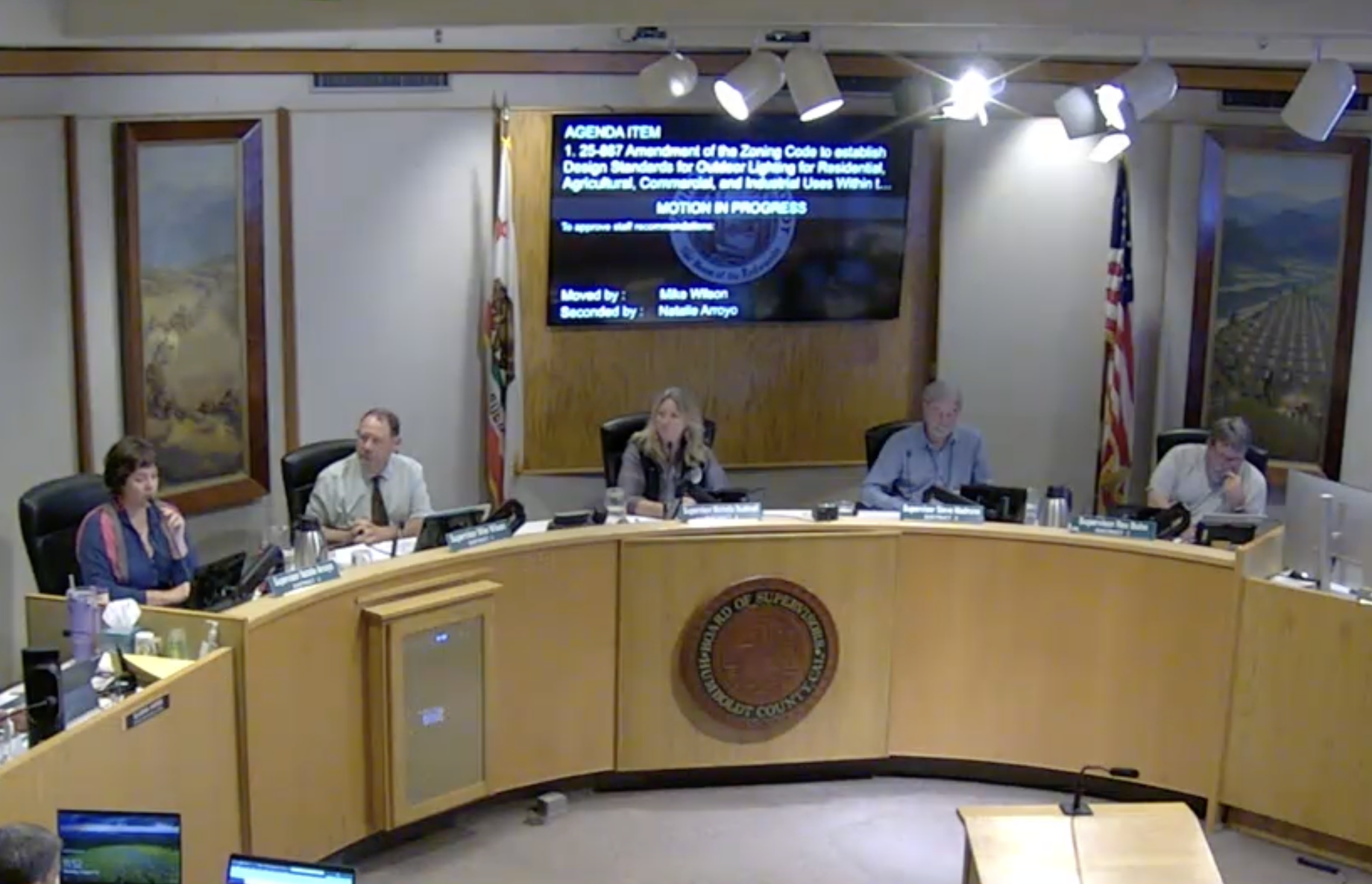
Screenshot of Tuesday’s Humboldt County Board of Supervisors meeting.
###
After two hours of extensive deliberation, the Humboldt County Board of Supervisors today narrowly passed an Outdoor Lighting Ordinance that sets new design standards to reduce light pollution — excessive or inappropriate artificial lighting — in unincorporated areas of the county.
The ordinance, which was approved in a 3-2 vote, with Board Chair Michelle Bushnell and First District Supervisor Rex Bohn dissenting, loosely follows the “Five Lighting Principles for Responsible Outdoor Lighting” issued by the International Dark-Sky Association that require all nighttime outdoor lighting to be useful, targeted, low-level, controlled and warm-colored.

Graphic via County of Humboldt.
The county-issued guidelines limit light intensity, reducing the temperature of light sources to lower temperature bulbs that emit warm, orange light rather than cool, blue light. The new rules also restrict “light trespass” — any artificial light that spills over onto neighboring properties that “eliminates the ability to have darkness on the adjacent property, or shines into or onto neighboring windows, properties or structures” — and encourage light fixtures that point downward to restrict the direction of the beam. Under the ordinance, motion lights would be restricted to a five-minute time limit and cannot be triggered by movement outside of the subject property.
“We are not trying to prohibit [outdoor] lighting,” Associate Planner Reanne Meighan said at today’s meeting. “We are simply trying to minimize unnecessary lighting of areas that transpires onto neighboring properties.”
Why limit outdoor lighting? Meighan explained that light pollution not only limits our view of the night sky, but said it also has “destructive effects” on the circadian rhythms of both humans and animals, especially nocturnal creatures that are active at night and sleep during the day. Warm light, which has a lower lumen output and Kelvin (K) temperature, as seen in the graphic below, has a lesser effect on light pollution.

Graphic via County of Humboldt
The original ordinance that was approved by the Humboldt County Planning Commission in May set a 1000-lumen maximum for residential uses and a 3000-lumen maximum for agricultural, commercial and industrial uses. However, after visiting local hardware stores, staff determined the limits should be set at 1100 and 3200 lumens, which are more commercially available.
Most residents who spoke during the public comment section of the meeting were in favor of the ordinance, with several speakers sharing their own stories about neighbors or local businesses with extremely bright outdoor lights. One woman, who did not identify herself, called out an automotive business in Myrtletown that has “blinding” security lights that threaten pedestrian safety.
“If you are driving east on Myrtle Avenue and are turning left onto Park Street, there is an extremely bright security light that blinds the driver to any foot traffic crossing Park Street or bicyclists traveling westbound on Myrtle Avenue,” she said. “We are very much concerned that someone will be hit by a vehicle where drivers cannot see them because of the serious glare caused by this extremely bright security light.”
Mark Wilson, vice president of Astronomers of Humboldt, also spoke in favor of the ordinance, noting that it would “put Humboldt County in the forefront of protecting the night skies, not only in the state, but nationally and internationally.”
The board’s discussion largely focused on how the ordinance would be enforced. Planning and Building Director John Ford said the enforcement would largely be complaint-driven, though new construction projects would also be subject to review during the normal application process.
“If there are violations of the ordinance, then it’s going to be like any other code enforcement matter,” Ford explained. “We are going to have to spend some time talking to the property owner, finding out what they have, letting them know what the solution is and, hopefully, they will voluntarily just make the change to stop the violation.”
Still, Bushnell expressed concern that outdoor lighting complaints would overwhelm code enforcement staff who already have a lot on their plate. “I think it’s really important that we recognize that sometimes complaint-driven can be a pissed off neighbor that wants to deal with something that isn’t even related to a light ordinance,” she said. “How are we going to address that?”
Ford reiterated the process, adding that complaint recipients are generally compliant. “We’ll have a conversation with them, and they’ll say, ‘Yeah, you know, I didn’t adjust that down, I’ll go turn my light down and make sure that it’s focused down, rather than shining out into my neighbor’s yard.’ And if that happens, [the issue] can be resolved that easily. These shouldn’t be hard to resolve.”
Bushnell was also concerned that the ordinance would target the wrong group of people. “I don’t want to make things so much harder for people in unincorporated areas when you have the municipalities that are glowing like a light bulb, per se,” she said.
The other big point of contention was whether or not athletic fields should be included in the ordinance, even though there is an exemption for such lighting as long as there isn’t any light trespass onto neighboring properties. Bohn felt the athletic fields should be subject to a time limit rather than a lumen limit.

Bohn | Screenshot
“Redwood Acres has a time limit … and if it goes after 10 o’clock, there’s complaints,” he said. “I’ve been involved with youth sports for over 50 years, and there is no reason in the world that a child should be out after 10 o’clock at night playing in an athletic sport. I don’t care if dad thinks he’s going to go pro and makes him stay. … I think we should look at timing [because] timing is a lot easier to enforce. … I do not want to dim it down for a kid having to catch a line drive off a bat.”
Wilson agreed, and asked staff to amend the ordinance to include a 10 p.m. time limit for athletic fields. “I do want to emphasize this isn’t about dimming the field,” Wilson added. “When people are playing ball on those fields, they should be well-lit, and that’s really important.”
Fifth District Supervisor Steve Madrone and Fourth District Supervisor Natalie Arroyo both spoke in favor of the ordinance, with Arroyo noting that the new standards give staff the tools to address longstanding lighting issues. “If there is a persistent problem … it gives people the sideboards for future development and for, frankly, just being a considerate neighbor, whether it’s a residential use or something else,” she said.
As the board prepared to take a vote, Bohn indicated he would vote against the ordinance. “Is this workable? It … looks good on paper, but there’s a lot of holes in this that I don’t know if it’s actually applicable,” he said. “I don’t think we can pass this right now, because there’s so many holes in it.”
After a bit of additional discussion, the board passed the ordinance in a 3-2 vote, with Bohn and Bushnell dissenting. The board directed staff to look into additional standards for street lighting and bring back an amendment to the Outdoor Lighting Ordinance in the near future.
California Republicans Sue to Block Newsom’s Gerrymandering, Point to Legislative Gamesmanship
Maya C. Miller / Tuesday, Aug. 19, 2025 @ 1:20 p.m. / Sacramento

Republican Assemblymember James Gallagher addresses the media during a press conference at the State Capitol in Sacramento on the current national redistricting battle between Democrats and Republicans on Aug. 18, 2025. Photo by Miguel Gutierrez Jr., CalMatters
A group of California Republicans is suing the state to block the Democratic-controlled Legislature from considering the bills that would allow Gov. Gavin Newsom to facilitate a special election on gerrymandered congressional maps.
The legal action could slow down the process by which elections officials, already tight on time, get the maps onto Californians’ ballots for the Nov. 4 special election Newsom wants. But that depends on how quickly the California Supreme Court moves, and whether it suspends the process while considering the lawsuit.
Newsom needs voter approval for the maps because California has an independent redistricting commission that draws election maps after every census. He’s in a hurry to get the measure on the ballot as a response to Republican gerrymandering efforts in Texas that are intended to sway the 2026 congressional elections in the GOP’s — and President Donald Trump’s — favor.
The Republicans argue that Democratic leaders violated the state constitution by bypassing a rule that says with few exceptions legislation must be publicly available for 30 days before lawmakers vote on it.
To get the maps on the ballot, Democrats repurposed two existing bills rather than introduce new legislation that would trigger the 30-day window.
Sen. Tony Strickland, Republican of Huntington Beach and the lead lawmaker on the lawsuit, slammed Newsom and Democrats for drawing up a “backroom deal” with “ “no public input, no transparency, no light of day”
“If they did it right, they would have public hearings, public notice, they would get the authority from the people of California, and then they would draw the maps,” Strickland said.
The bills in question, Assembly Bill 604 and Senate Bill 280, were first introduced and given bill numbers in early February. The new language on the redistricting effort was posted early Monday morning.
Chris Micheli, a longtime lobbyist, said lawmakers “for decades” have viewed a bill’s initial introduction date – often in early January near the start of session – as the date that starts the 30-day clock. For gut-and-amends, the Legislature abides by a different rule added to the state constitution by voters in 2016: the language needs to be published for 72 hours before lawmakers can vote.
“To be fair, it is untested and there’s no court decision on this,” Micheli said of Republicans’ lawsuit. But, “I don’t think it will succeed.”
Lawmakers frequently use the gut-and-amend tactic to skirt deadlines and introduce new legislation late in the season. Rarely, if ever, does the opposition party call on the California State Supreme Court to mediate what is otherwise a wonky game of insider legislative baseball.
But with the redistricting push, Republican lawmakers have doubled down on their defense of the state’s citizen redistricting commission, established in 2010 on a bipartisan basis to prevent politicians from drawing maps that are self-serving.
“The public cannot have a voice if they do not know what’s going on,” said Assemblyman Carl DeMaio of San Diego, who is not party to the lawsuit. “What Governor Newsom and the legislators are trying to do is prevent the public from knowing what’s going on before it’s too late.”
CalMatters’ Jeanne Kuang contributed reporting to this story.
(VIDEO) LoCO SPORTS! A Humboldt Kid and a Speedy* Turtle Just (Shell)Shocked the World
Andrew Goff / Tuesday, Aug. 19, 2025 @ noon / LoCO Sports!

Dustin’ off this silly graphic we made a thousand years ago
It’s been a while, but we’d like to welcome you all to the latest edition of LoCO SPORTS — the only online sports feature powered entirely by proud parents sending LoCO the arguably interesting exploits of their talented children. Let’s get ready to rumble!
This time out: Mega kudos are in order for 10-year-old McKinleyville resident Calvin Koczera, after he and a turtle named “Flash” bested roughly 500 other competitors during the 62nd annual Nisswa, Minnesota Turtle Races. Can we get a cowabunga?
To claim the title, Calvin and his swift-shelled sidekick had to speed through three separate heats. We’ve compiled the videos Calvin’s parents sent us into a sporty montage, which you can watch below. (Note: We’ve condensed the action a bit because, as you might have heard, turtles are slow.)
There you have it. Calvin is a big winner and, by extension, one could make the case that makes all of us in Humboldt big winners. CONGRATULATIONS, CALVIN AND US!
For his part, we are told Flash received some lettuce.

Calvin Koczera, champion turtle splasher
# # #
* - Comparable to other turtles only
Gavin Newsom Wants an Election in a Hurry on His Gerrymander. Here’s What Has to Happen
Maya C. Miller / Tuesday, Aug. 19, 2025 @ 7 a.m. / Sacramento

A row of voters filling out their ballots at the polling place in the Community Center in Kerman on Nov. 5, 2024. Photo by Larry Valenzuela, CalMatters/CatchLight Local
###
This story was originally published by CalMatters. Sign up for their newsletters.
###
Calling a statewide special election sounds simple in theory. But executing one with fewer than 75 days notice? As one California county election official put it, that’s a “herculean” effort.
California voting officials are scrambling behind the scenes to prepare for the special election Gov. Gavin Newsom wants this November on his proposal to redraw the state’s congressional districts. But to do so, Newsom needs voters to approve a ballot initiative in an off-year special election that the state has yet to officially approve and schedule.
Democrats want the proposed California maps to offset President Donald Trump and Republicans’ efforts to stack the next congressional election in the GOP’s favor by squeezing more Republican seats out of red states like Texas, Florida and Missouri.
Newsom only released his proposed maps late last week, and state lawmakers — who just returned from a month-long summer recess — are staring down a hard deadline of Friday to greenlight the ballot language before voters in time for a Nov. 4 election.
County election officials are hustling as if the election is happening so they can make sure they lock down everything from vendors to print their ballots, locations for voting centers and election workers to staff those polling places come Nov. 4. They’ve pushed hard for the state to cover the hefty costs of an unplanned special election, and some have noted that without additional appropriations, they might need to cut back on vital public safety and social services.
“It’s difficult for us, just in a regular election, being a smaller rural county,” said Juan Pablo Cervantes, the registrar of voters for Humboldt County, which has just over 85,000 registered voters. Usually Cervantes and his staff have at least five months of lead time to find voting sites, hire staff and procure all the machines, pens and ballots for a statewide election.
“That’s usually a Herculean effort on its own,” Cervantes said.
A mad dash to find ballots and vote centers
One of the biggest challenges for counties is lining up vendors to print enough ballots – including one absentee ballot for every registered voter in the state, as well as a sufficient number to keep onsite for on-site voting at polling stations. California’s secretary of state has only approved seven vendors to print ballots, not including Orange County, which operates its own printing facility.
The other two logistical hurdles are securing enough sites to serve as vote centers, and hiring and training staff to work them.
Soon after Newsom declared on July 31 that he would call a special election, Orange County Registrar of Voters Bob Page gathered his staff for an emergency planning meeting. He instructed them to identify which supplies they needed to order as soon as possible, prioritizing products like ballot paper, ballot envelopes and toner for their ballot printers – which might not arrive in time to meet deadlines if they waited for official confirmation of a special election.
Should the governor end up abandoning his plan, Orange County would also be able to use those materials in next year’s June primary election, minimizing potential waste of taxpayer dollars.
“I had to make a decision that I couldn’t wait until Aug. 22 to make sure that I could pull this off,” Page said. “I don’t want to be in a position where my county fails in some way to conduct a free and fair election.”
The county also started emailing people with past experience as election workers to gauge potential interest in working at a vote center during the special election.
California’s last special election
California last had a short-notice, off-year statewide special election in September 2021 when Newsom defeated an attempt to recall him from office.
But because the recall campaign was triggered by a signature drive rather than ordered by the state Legislature, Page said counties had plenty of early warning signs to help them prepare.
“We knew when there were enough signatures to require the recall election,” Page said. “We were very involved when the legislature was pitching ideas of trying to shorten the timeline and have the recall election in August of that year rather than September.”
Even then, when the Legislature was hashing out the fine print about when the election would take place, county registrars brought their vendors to testify that they didn’t have enough paper stock to print ballots in time for an August recall election. The date was ultimately set for Sept. 14.
How much will it cost?
The Legislature and the Department of Finance have yet to release official cost estimates for the statewide special election, but experts say that given inflation, the Nov. 4 special election will almost certainly surpass the recall’s price tag.
During that 2021 effort, the state sent counties more than $240 million and an additional $35 million to the secretary of state’s office to administer the election. In the end, the contest cost less than planned — about $200 million in all, with the counties’ costs totaling just over $174 million.
Newsom has repeatedly promised the state will cover the steep cost counties will incur to administer an unplanned statewide off-year election. Yet in the absence of official statewide numbers, county officials and even Assembly Republicans have released their own estimates. The GOP caucus’s budget analysis projected the statewide contest would cost taxpayers $235.5 million.

A voter fills out their ballot at a vote center at Santa Ana College in Santa Ana on March 5, 2024. Photo by Lauren Justice for CalMatters
Page estimated Orange County’s costs will land somewhere between $11.2 million to $12.7 million depending on whether the ballot and county voter information guide will fit in the same envelope or need to be sent separately. Riverside County’s registrar projected upwards of $15 million in costs, and Fresno County was bracing for at least $4 million in unbudgeted expenses.
The counties have implored state leaders to provide them money up front rather than reimburse them after the election.
“The additional expenses tied to a statewide special election would fall almost entirely on counties — imposing a significant and unfunded financial burden on already strained local budgets,” wrote the California State Association of Counties, which represents county supervisors, in partnership with its subsidiary organization that represents clerks and registrars.
H.D. Palmer, spokesman for the Department of Finance, said that the legislation will provide the money to counties in advance, as it did in 2021 before the gubernatorial recall election, although the department has yet to determine the precise amount..
“The state of California is going to pay for it,” Newsom said at a press conference last week, dismissing concerns from county registrars about how they’d afford to administer the election as “deeply disingenuous.”
“There’s no price tag for democracy,” Newsom said.
The governor has also stated that unlike during the recall election, several counties already plan to hold local off-year elections and can add the redistricting question to the existing ballot. As of Monday, only 21 counties are listed as having elections scheduled for Nov. 4, according to the Secretary of State’s website.
But Cervantes, who estimates his county will incur at least $700,000 in additional costs, emphasized that it makes a “massive difference” whether the state pays upfront or requires counties to submit expenses for reimbursement. His vendors won’t allow him to defer payment until he receives the state’s check in the mail.
Cervantes noted that counties pay for elections administration from the same pot of money that funds sheriff’s departments, county jails and the district attorney’s offices, as well as some local wildfire prevention efforts. That’s why it’s so important for the state to cover the costs, he argued.
“You’re talking about taking deputies off the street. You’re talking about reducing social services. Like, it’s a zero-sum game,” Cervantes said. “If I have to spend that money, then other departments won’t be able to.”


