UPDATE, 4:30 p.m.: From the Humboldt County Sheriff’s Office:
On June 28, 2021, at about 3:25 p.m., John Paul Anthony James turned himself in to law enforcement at the Humboldt County Sheriff’s Office Main Station in Eureka. James was booked into the Humboldt County Correctional Facility on charges of assault with a deadly weapon (PC 245(a)(1)), robbery (PC 211), battery (PC 242) and assault (PC 240).
###
Humboldt County Sheriff’s Office press release:
On June 26, 2021, at about 8:20 p.m., Humboldt County Sheriff’s deputies were dispatched to the 2500 block of Freshwater Road near Freshwater for the report of a physical assault and robbery.
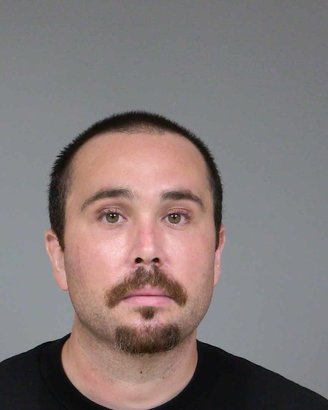
John Paul Anthony James. | HCSO
Deputies responded to the area and located two victims with non-life-threatening injuries related to the assault. Through their investigation, deputies learned that the two victims, a male and female, had reportedly been assaulted at the location by an acquaintance, identified as 32-year-old John Paul Anthony James. According to the victims, the two received a ride from James to a residence in Freshwater. Upon arrival at the location, James and the victims exited the vehicle and began to walk down the driveway to the residence. At some point while walking, an argument occurred between the three, resulting in James attacking the victims with a whisky bottle. James reportedly stole prescription medications and car keys from one of the victims and fled.
Deputies were unable to locate James and he remains outstanding at this time. James is described as a white male adult, approximately 5 feet 10 inches tall, 190 pounds, with brown hair and hazel eyes. He may be associated with a 2001 green Kia Rio, California license plate 4RGS715.
James is wanted by law enforcement on charges of assault with a deadly weapon (PC 245(a)(1)), robbery (PC 211), battery (PC 242) and assault (PC 240).
This case is still under investigation.
Anyone with information about James’ whereabouts is encouraged to call the Humboldt County Sheriff’s Office at (707) 445-7251 or the Sheriff’s Office Crime Tip line at (707) 268-2539.
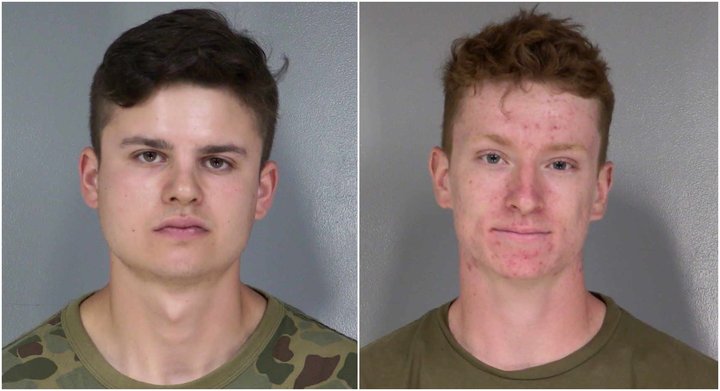
Juan Carlos Newman (left) and Dawson Morris Geanoules (right) | HCSO
Humboldt County Sheriff’s Office press release:
On June 26, 2021, at about 1:55 p.m., Humboldt County Sheriff’s deputies were dispatched to the 2600 block of Clay Road in McKinleyville for the report of a male subject brandishing a firearm.
The victim told Emergency Communications Dispatchers that while driving by a residence on the 1100 block of Hunts Drive in McKinleyville, a male subject outside the residence, later identified as 20-year-old Juan Carlos Newman, brandished a firearm at the victim. The victim, whose family was inside the vehicle, drove home. Newman reportedly followed the victim’s vehicle, arrived outside the victim’s residence and attempted to gain entry inside the home. The victim and her family hid inside and contacted law enforcement, while another male suspect, later identified as 21-year-old Dawson Morris Geanoules, arrived outside the residence.
Deputies responded to the residence and located Newman and Geanoules outside. Both were taken into custody without incident and found to be in possession of loaded firearms.
Newman was booked into the Humboldt County Correctional Facility on charges of exhibiting a firearm (PC 417(a)(2)), carrying a loaded firearm in a public place (PC 25850(a)), false imprisonment (PC 236), criminal threats (PC 422), manufacturing a firearm without a serial number (PC 29180(G)) and conspiracy to commit a crime (PC 182(a)(1)).
Geanoules was booked into the Humboldt County Correctional Facility on charges of exhibiting a firearm (PC 417(a)(2)), carrying a loaded firearm in a public place (PC 25850(a)), false imprisonment (PC 236), criminal threats (PC 422), manufacturing a firearm without a serial number (PC 29180(G)) and conspiracy to commit a crime (PC 182(a)(1)).
This case is still under investigation.
Anyone with information about this case or related criminal activity is encouraged to call the Humboldt County Sheriff’s Office at (707) 445-7251 or the Sheriff’s Office Crime Tip line at (707) 268-2539.
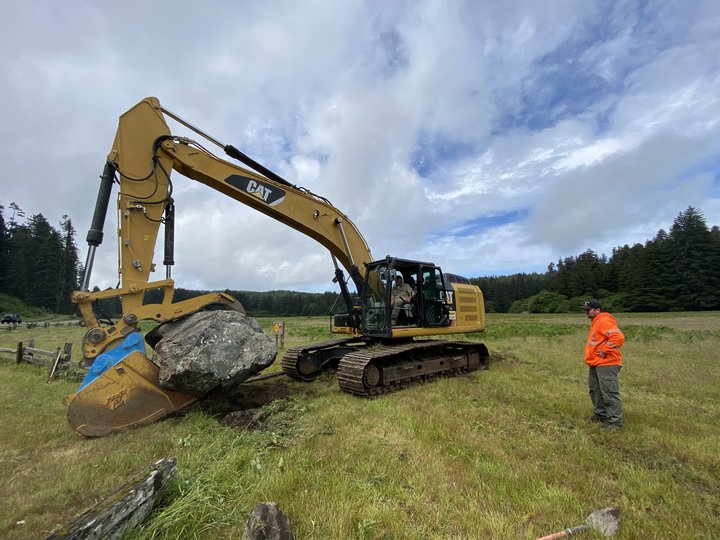
Madison Grant Memorial being removed from Prairie Creek State Park. Photo: California State Parks.
###
From California State Parks:
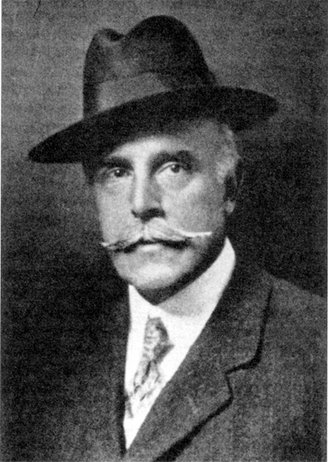
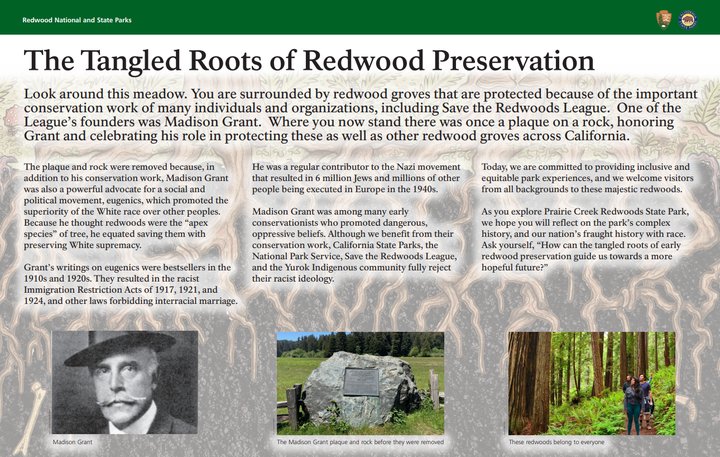
As part of California State Parks’ commitment to redressing racist and discriminatory features within the Parks system, a 1948 memorial honoring Madison Grant in Prairie Creek Redwoods State Park has been removed.
The large stone monument was removed by an excavator during a small ceremony on June 15, attended by California State Parks and National Park Service leaders, history scholars, and representatives of the Yurok Tribe and Save the Redwoods League. The ceremony focused on both acknowledging the past while creating a more inclusive and equitable park system for the future.
California State Parks, Save the Redwoods League, and other partners have been in discussions for several years about how to address problematic historic memorials and outdated interpretive exhibits related to the founders of the Save the Redwoods League, found in several state parks in Northern California. These planning efforts are part of a larger effort within California state government called the Reexamining Our Past Initiative, to identify and redress discriminatory names of features attached to the state parks and transportation systems. The move comes in the wake of a national conversation about the names of geographic features and builds upon Governor Gavin Newsom’s work to support equity, inclusion and accountability throughout the state to better reflect our values.
In 2020, the North Coast Redwoods District of California State Parks took action towards this effort by installing an interpretive sign in “Founders Grove” (Humboldt Redwoods State Park), that added context to the story of the founders of Save the Redwoods League beyond their conservation efforts. That same year the League publicly acknowledged and disavowed the racist beliefs of those same founders.
Additionally in 2020, California State Parks received a letter from 212 academics, requesting the removal of the Madison Grant Memorial Rock in Prairie Creek Redwoods State Park due to Grant’s role in promoting racist, anti-Asian, eugenicist and anti-miscegenation laws. The letter was prepared by David McIntosh, a historian of race and science at UC Santa Barbara, Dr. Paul Spickard (History, UC Santa Barbara) and Dr. Rena Heinrich (Dramatic Arts, University of Southern California). The scholars also presented their letter to the Council of the Pacific Coast Branch of the American Historical Association, which passed a resolution of support.
The North Coast Redwoods District’s superintendent, Victor Bjelajac, decided to take action.
“California State Parks and our partners recognize the dark truth behind some of the 20th century’s most prominent conservationists, including League founder Madison Grant,” said Bjelajac. “Grant used his privilege to advocate for and influence the development of discriminatory laws impacting millions of people across the world. While we value his contribution towards protecting ancient redwoods, we fully reject his racist ideology and are committed to creating a park system for all people, regardless of race, creed, or ethnicity. The Madison Grant Memorial has stood in Prairie Creek Redwoods State Park for three quarters of a century. It is long overdue that we remove it. Going forward, we will focus on honoring those people who build parks for everyone.”
According to Rosie Clayburn, the Yurok Tribal Heritage Preservation Officer, “We applaud State Parks’ decision to remove the Madison Grant Memorial. In addition to espousing racist ideologies, members of the eugenics movement destroyed numerous Native American burial sites to collect the skulls that were used to support their ridiculous and harmful claims. We encourage all conservation groups to take a hard look at their founders and follow the North Coast Redwoods District’s lead when it comes to eliminating monuments to hate.”
In addition to removing the memorial from Prairie Creek Redwoods State Park, California State Parks will be installing a new interpretive sign for the site that tells the fuller story about Grant, his conservation legacy, and his role in the eugenics movement. The exhibit, created with input from the academics, the National Park Service, Save the Redwoods League, and the Yurok Indigenous Community, will be placed on the location where the Madison Grant Memorial previously stood.
“Save the Redwoods League has been working closely with our redwood park partners to share a more honest and complete narrative about the early leaders of the redwood conservation movement, and in particular, to repudiate Madison Grant’s racist beliefs,” said Sam Hodder, President and CEO of Save the Redwoods League. “We collaborated with our partners on the new sign in order to help explain why the rock was removed and provide a fuller accounting of Grant’s legacy. This work is critical to empowering all people to build meaningful connections with our parks, and it’s an opportunity to begin healing ourselves and our communities from historical wounds.”
The new interpretive sign will be installed in the park later this summer and will be unveiled at a public event in the fall. That event will focus on creating a state and national park system welcoming to people of all backgrounds, races, and ethnicities.
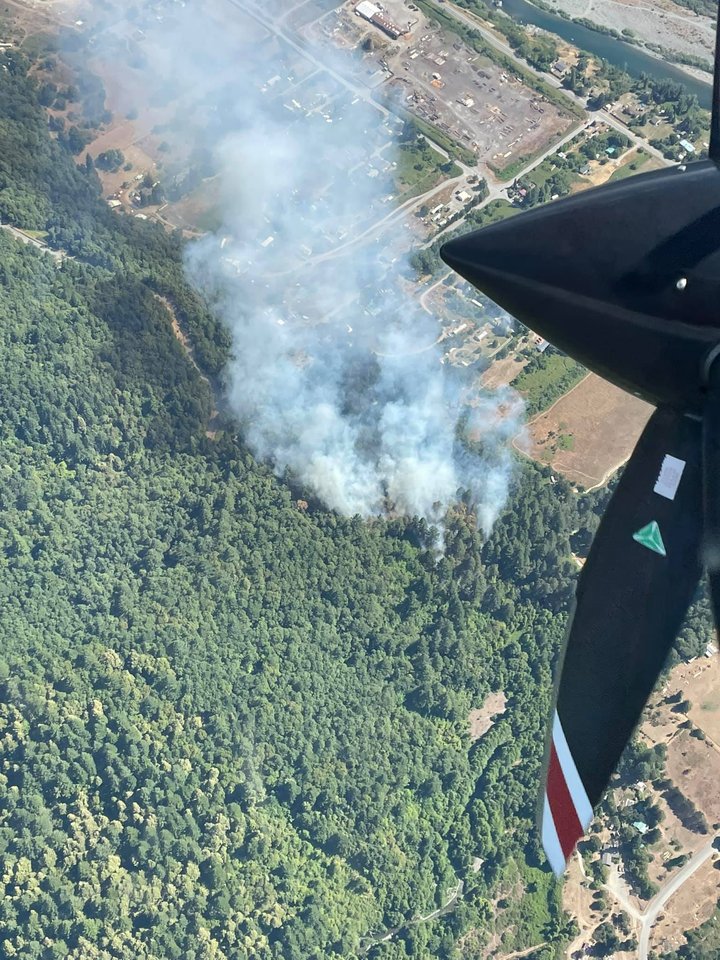
Hoopa Fire Chief Greg Moon reports via Facebook this morning that the fire that broke out along Highway 96 last night — the “Marshall Fire” — has been contained, after a quick and heavy response from his agency and allies.
“I’m super-proud of what happened yesterday,” Moon says. “Our firefighters put the fire out, worked with cooperators, and our community was able to get the information they needed.”
His full message to the community is below:
Moon said that mop-up work will continue throughout the day.
California lawmakers are set to vote today on a record-busting state budget that reflects new agreements with Gov. Gavin Newsom to expand health care for undocumented immigrants, spend billions to alleviate homelessness and help Californians still struggling through the pandemic.
The $262.6 billion spending plan for the fiscal year that begins July 1 was fueled by a $76 billion state surplus and $27 billion in federal aid. Democrats who control the Capitol wanted to use the windfall to help the state recover from the coronavirus pandemic and its uneven toll on Califorinians.
While the state’s top earners continued to accrue wealth from a strong stock market, booming tech sector and rising home values, low-wage Californians suffered from job losses, child care cutbacks and a dysfunctional unemployment insurance system. The state’s progressive tax structure allowed Newsom and lawmakers to infuse social service programs for the needy and middle class with billions of dollars largely from wealthy taxpayers.
“We’re investing that in the unprecedented challenges the state faces, including into addressing the needs of people that are working hard, playing by the rules, and barely making ends meet,” Newsom said Friday.
The pandemic and its economic impacts have not only colored state budget negotiations — they also disrupted California’s political landscape this year, giving rise to a GOP-backed effort to throw Newsom out of office. With the recall now qualified to hit the ballot, electoral politics also loomed over budget negotiations this year.
Here are five things to know about California’s new spending plan:
The budget is still not totally done
Even with the record-busting enormity of this year’s budget and Democrats holding all the power in Sacramento, Newsom and legislative leaders were not able to reach agreement on everything. They did not issue public statements announcing a broad budget deal, even as bills went into print Friday reflecting some new agreements that modify the placeholder budget lawmakers approved on June 14.
The lack of the usual bravado indicates that while this budget meets the legal requirements to craft a spending plan by July 1, significant negotiations will continue. Some key expenditures will likely be approved later this summer through a special kind of legislation known as “budget trailer bills.”
Assembly Budget Committee chairperson Phil Ting, left, talks to Senate Budget Committee chairperson Nancy Skinner during a press conference at The Unity Council in Oakland where Gov. Gavin Newsom announced additional stimulus checks with the state surplus on May 10, 2021. Photo by Anne Wernikoff, CalMatters
For instance, they did not decide exactly how to spend billions of dollars to address the threats posed by wildfires and drought. The budget includes $1 billion over several years for wildfire prevention, $3 billion to alleviate drought and $3.7 billion over three years to mitigate dangers posed by climate change — but Newsom and legislative leaders are still figuring out how to spend the funds.
“We just seem to be at loggerheads with elements within the administration about” how much of the plan to fund, Assembly Speaker Anthony Rendon told CalMatters.
When he ran for office in 2018, “Governor Dad” Newsom campaigned heavily on his support for families and early childhood education. But child care, including pay rates for some providers, was a final sticking point in the budget negotiations, Rendon told reporters. And many details are still to be worked out.
One key piece was settled Friday: In a first-ever agreement with the new providers’ union, the state approved the first increase in pay rates in five years, plus funding to train and license more providers, according to a statement from the union, which said raises of at least 15% would start in 2022.
Child Care Providers United — recognized as a union in a 2019 bill signed by Newsom — held a rally Thursday at the Capitol, attended by Rendon and Senate leader Toni Atkins, to press the governor to sign on to the legislative proposal that called for an additional $1 billion for the pay increases.
Newsom’s team had pushed back, officials close to budget talks told Politico, voicing concerns about the impact increased rates will have when the state does not have a surplus of cash.
The pay rate increase comes at a time when California’s child care sector has been hit hard: During the pandemic, about 8,500 licensed child care sites shut down. That took tens of thousands of slots for kids who need care while their parents work or attend school — and also took employment from thousands of women of color, who make up a majority of the child care workforce.
The agreement also increases the number of child care slots available by 200,000 over the next four years, including 120,000 in 2021-22.
The budget includes a big expansion of health care
California took another step toward trying to achieve universal health care with this budget, as Newsom and lawmakers agreed to offer Medi-Cal health insurance to undocumented residents age 50 and older.
It’s the latest expansion in Democrats’ years-long effort to allow unauthorized immigrants to participate in the state-funded health care program for low-income residents. Previous budgets opened the program to undocumented children, and then young adults as old as 26.
Gov. Gavin Newsom held a week-long series of events promoting $100 billion in proposals to spend the state’s budget bonanza. It started on May 10, 2021, at the Unity Council in Oakland to announce more tax rebates. Photo by Anne Wernikoff, CalMatters
This year, Newsom proposed making undocumented residents age 60 and older eligible for Medi-Cal, while the Legislature wanted to offer it to those age 50 and up. A key sticking point: Covering health care for more people commits the state to ongoing spending that it might not be able to afford in a future recession.
Advocates said this budget makes California the first state in the nation to provide government health insurance to undocumented immigrants at age 50. It also eliminates an earlier rule that made people ineligible for Medi-Cal if they had a small amount of savings in the bank.
Newsom initially did not propose significant funding to rebuild the state’s public health infrastructure, but the Legislature wanted to give local public health departments an additional $200 million annually to add staff and modernize equipment. In the end, the budget gives them $300 million a year, but delays payments until 2022.
It puts billions more into tackling homelessness
Legislative leaders and Newsom ended up on the same page about how much to spend on homelessness and affordable housing — a total of $12 billion over the next two years. But they made a few concessions on how exactly to spend all those billions.
In their proposed budget, the Legislature had made ongoing funding a top priority. They pitched four years in steady funding, to the tune of $1 billion a year for cities and counties to combat homelessness. The key was flexibility, as local jurisdictions would be able to decide what exactly would be most effective. The governor had proposed no money for that purpose.
The compromise split right down the middle: two, instead of four, years of $1 billion annually for local jurisdictions. It’s still the biggest, repeat pot of funding for homelessness in California to date. Funding will be re-evaluated in the third year, and rules must still be hammered out on who will get that money and how they’ll have to spend it to ensure accountability and results.
The budget deal also includes $1.75 billion to build shovel-ready, backlogged affordable housing projects, $300 million to preserve existing affordable rental housing and $130 million to build and maintain farmworker housing.
Earlier Friday, Newsom and legislative leaders announced a deal to extend the statewide eviction moratorium through Sept. 30 and to try to speed up rent relief using $5.2 billion from the federal government.
Democrats used the budget to fight the Newsom recall
Recall Newsom volunteer Pat Miller makes a sign during a petition signing event at SaveMart in Sacramento on Jan. 5, 2021. Photo by Anne Wernikoff, CalMatters
And as Newsom fights to hang onto his job, he’s used the budget process to show voters his priorities. In May, he barnstormed the state, announcing multi-billion dollar budget nuggets in every major media market as he touted that California is “roaring back” from the pandemic. In June, he launched the first TV ads of his anti-recall campaign — featuring the same “roaring back” branding and a focus on the same budget items: funding to house 65,000 homeless people, $600 stimulus payments for most Californians and $4 billion in grants for small businesses.
“Newsom is delivering money to your pocket,” the ad says. “And free Pre-K for every California child, regardless of income.”
CalMatters reporters Sameea Kamal and Manuel Tobias contributed to this report. CALmatters.org is a nonprofit, nonpartisan media venture explaining California policies and politics.
This is how California’s water crisis is going these days: The only functioning well in the rural community of Teviston broke in early June, leaving more than 700 residents without running water as temperatures in the Central Valley soared to triple-digits in a drought.
“It’s day to day” for the people of Teviston, said Frank Galaviz, a board member of the Teviston Community Services District, in an interview with The Fresno Bee.
Teviston residents are relying on limited bottled water for necessities such as staying hydrated, cooking, bathing and flushing toilets. Some residents, like Galaviz, are traveling to neighboring towns to stay with family or friends to shower and wash clothes.
Galaviz shared news of the well’s breakdown during a virtual conference on drought organized by state Sen. Melissa Hurtado, a Democrat from Sanger. The district found sand in the pump, which led to the breakdown.
In response to the well’s failure, the district is delivering cases of bottled water and five-gallon jugs to its residents. Tanker trucks haul water from Porterville, 23 miles away, to fill Teviston’s two water storage tanks.
“It’s just barely enough, and in some cases, not enough,” said Galaviz. “Some families are larger than others.”
Teviston is an unincorporated community in Tulare County that lies off Highway 99, between Pixley and Earlimart. The community’s first residents were primarily Black migrants from the Cotton Belt and Dust Belt states. Today, the majority of its residents are Latino farmworkers.
It may take weeks to get running water back in Teviston households, said Galaviz, who is waiting on the pieces needed to repair the pump.
But fixing the pump may not fix the problem. Galaviz said he fears the well may have dried up.
Water shortage isn’t new
Residents experienced similar shortages when the community’s only well collapsed in November 2017. Like many rural communities in the Central Valley, Teviston did not have a working back-up well.
Four years later, it still doesn’t.
“In the last drought, we learned that local and state drought responses were not coordinated. Families in distress didn’t know who to call, and the state was scrambling to provide support,” said Erick Orellana, policy advocate for Community Water Center, in an email to The Bee. “We don’t want to see emergencies continue to happen, so we’re urging the state to be better prepared for drought this time.”
In 2017, Teviston received state funding for emergency response and partnered with the nearby Pixley for water. One solution that Galaviz suggests includes incorporating Teviston with Pixley to access their water system.
There is a bill making its way through the state Legislature — Senate Bill 403 — which would allow the State Water Board to consolidate communities that risk losing access to clean and safe drinking water, especially disadvantaged communities that rely on at-risk wells.
For now, the agency is in the process of building a new, modern well for Teviston, Well 4, which Galaviz estimates will be completed by 2022 or 2023. “We need the State Water Board to expedite our funding for Well 4,” he said during the conference.
Senator Melissa Hurtado speaks in favor of SB200, a bill that would create a fund to help provide the state with clean drinking water, on July 8, 2019.
“Rural Californians of the Central Valley face inequities when it comes to water, energy, and health,” said Hurtado after a virtual conference call. Leaders from Avenal and Lamont also discussed their challenges with water scarcity, aging water infrastructure and funding needs.
Scott Taylor, general manager of the Lamont Public Utility District, said his Kern County community of 20,000 people, mostly Latino farmworkers, has seven wells. Five of them are contaminated with the cancer-causing carcinogen 123-trichloropropane (TCP), and one is nonfunctional. Taylor said he needs better infrastructure for his aging wells to serve the “severely disadvantaged residents” of Lamont.
State funding is available to improve drinking water infrastructure. The State Water Resources Control Board has up to $130 million to use each year until 2030 to “address funding gaps and provide solutions to water systems, especially those serving disadvantaged communities,” through the Safe and Affordable Funding for Equity and Resilience (SAFER) program, according to the board’s website.
“State partner agencies, like the State Water Resources Control Board, stand ready to assist local agencies and counties as they address these emergencies while also working towards long-term solutions for communities like Teviston through its existing assistance programs,” said Darrin Polhemus, deputy director of the Division of Drinking Water at the board, in an email statement to The Bee.
California’s drinking water crisis
“Local agencies and counties need to prepare now for how they will handle any future emergency response to an immediate drinking water crisis and what resources they will use to meet immediate needs while state resources can be brought online to support,” said Polhemus.
Galaviz and Taylor both said they encountered bureaucratic delays when working with the State Water Board. “The truth is that not only is the water not flowing, but neither is the funding,” said Taylor. “Especially for small agencies like mine, like the others, no funding is no water.”
In May, Gov. Gavin Newsom proposed $5.1 billion for drought preparedness, infrastructure, and response. $1.3 billion of this funding would be for drinking water and wastewater infrastructure, especially for small and low-income communities. According to Orellana, the governor’s proposed investments are “a huge step forward to addressing the more than $4 billion needed over the next five years alone to tackle failing and at-risk water systems across California.”
For rural Central Valley residents and water districts, the money can’t come soon enough.
“We know how difficult it is in the Central Valley to be without water, to have to deal with 100-plus degrees, and many of these families also having to deal with power outages and swamp coolers,” said Hurtado. “Sometimes it feels like we don’t get listened to; we don’t get heard.”
###
This article is part of The California Divide, a collaboration among newsrooms examining income inequity and economic survival in California.
CALmatters.org is a nonprofit, nonpartisan media venture explaining California policies and politics.
This week, what was supposed to be a simple trip to Arcata’s Redwood Park turns whimsical for no discernible reason other than it’s a Monday and that’s what happens to Michaele on Mondays. Once in the woods, your President of Positivity just happens to run into her friends David Wilson, Shoshanna and Matt Filar. Why do these thing keep happening? Why not!
A big thanks to David for helping Michaele peer into his crystal ball. As always, check out his photo work here.


 Assembly Budget Committee chairperson Phil Ting, left, talks to Senate Budget Committee chairperson Nancy Skinner during a press conference at The Unity Council in Oakland where Gov. Gavin Newsom announced additional stimulus checks with the state surplus on May 10, 2021. Photo by Anne Wernikoff, CalMatters
 Gov. Gavin Newsom held a week-long series of events promoting $100 billion in proposals to spend the state’s budget bonanza. It started on May 10, 2021, at the Unity Council in Oakland to announce more tax rebates. Photo by Anne Wernikoff, CalMatters
 Recall Newsom volunteer Pat Miller makes a sign during a petition signing event at SaveMart in Sacramento on Jan. 5, 2021. Photo by Anne Wernikoff, CalMatters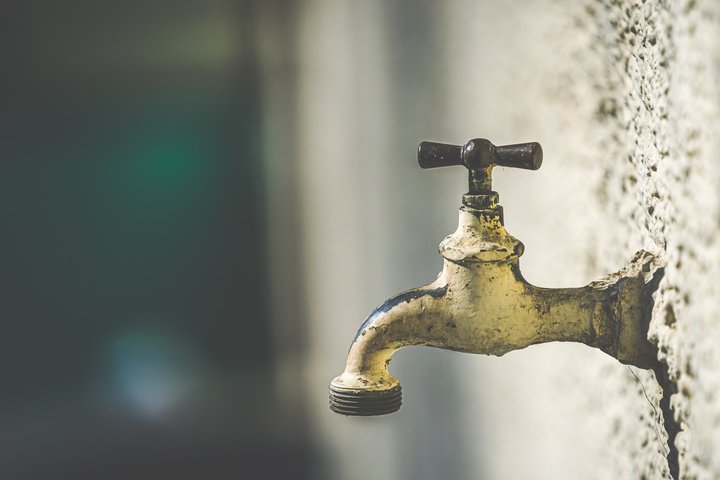
 Senator Melissa Hurtado speaks in favor of SB200, a bill that would create a fund to help provide the state with clean drinking water, on July 8, 2019.


