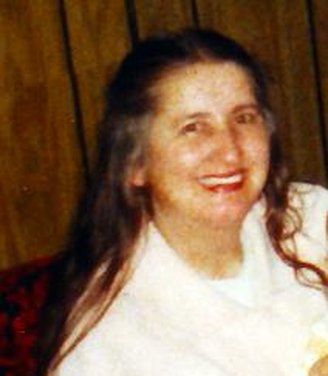
Doris Elaine Randolph was born December 14, 1934 to Carl and Pearl
Randolph in Grants Pass, Oregon. Her parents didn’t give her a
middle name, so when she was old enough she was allowed to choose
her own. She chose Elaine because of how beautiful it was. Doris
passed away in the arms of her son Mark on April 23, 2021.
Doris
was married to Robert Hyatt in 1955. Their brief marriage gave them a
daughter, Brenda. In 1959, Doris married the love of her life,
Sylvester “Lucky” Perkins. They had two sons together, Larry and
Mark. Doris and Lucky experienced many happy years together, enjoying
family and traveling until Lucky passed away in 2001.
Doris
was a sweet person with a compassionate heart and a strong Christian
faith. She loved her children, grandchildren, and great-grandchildren
and kept them all in constant prayer. She loved to sing and had an
excellent ear for picking out harmonies. Hymns were her specialty,
and it was rare to find one she didn’t know. Doris loved people and
gave freely of whatever she had to anyone she felt had a greater need
than herself. She delighted in meaningful relationships with people
and regularly exchanged letters with friends and family who lived too
far away to visit often, routinely asking how they were doing and how
she could pray for them. She was a wonderful example and will be
greatly missed.
Doris
is survived by her three children: Mark Perkins, who was her
companion and caregiver for the past 20 years, Larry Perkins and
Brenda Woods. She is survived by her grandchildren, Krystol Berry,
Dusty Henson, Joshua Woods, Jon Woods, Jessica Leary, Alyssa Perkins,
and Christian Perkins. She was preceded in death by her husband
Sylvester “Lucky” Perkins and her daughter in law Marianne
Perkins.
An
outdoor service was held on Friday, April 30 at St. Patrick’s
Cemetery in Loleta, led by Pastor Chuck Clark of the Wesleyan Church
of the Redwoods, where Doris was a member.
###
The obituary above was submitted on behalf of Doris Perkins’ loved ones. The Lost Coast Outpost runs obituaries of Humboldt County residents at no charge. See guidelines here.
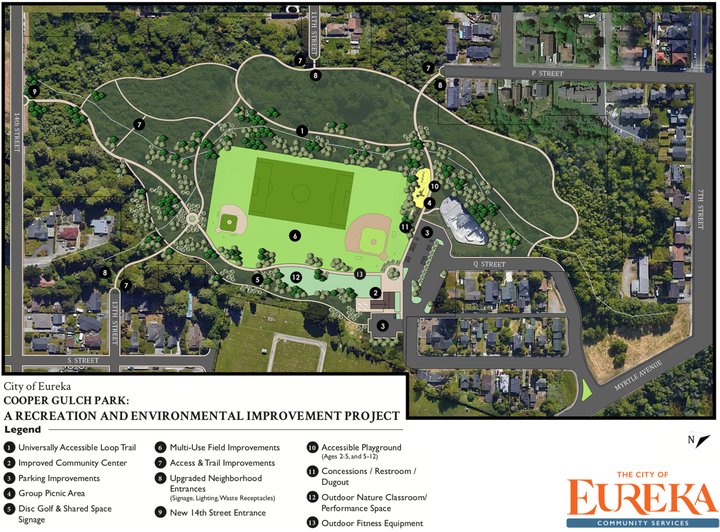
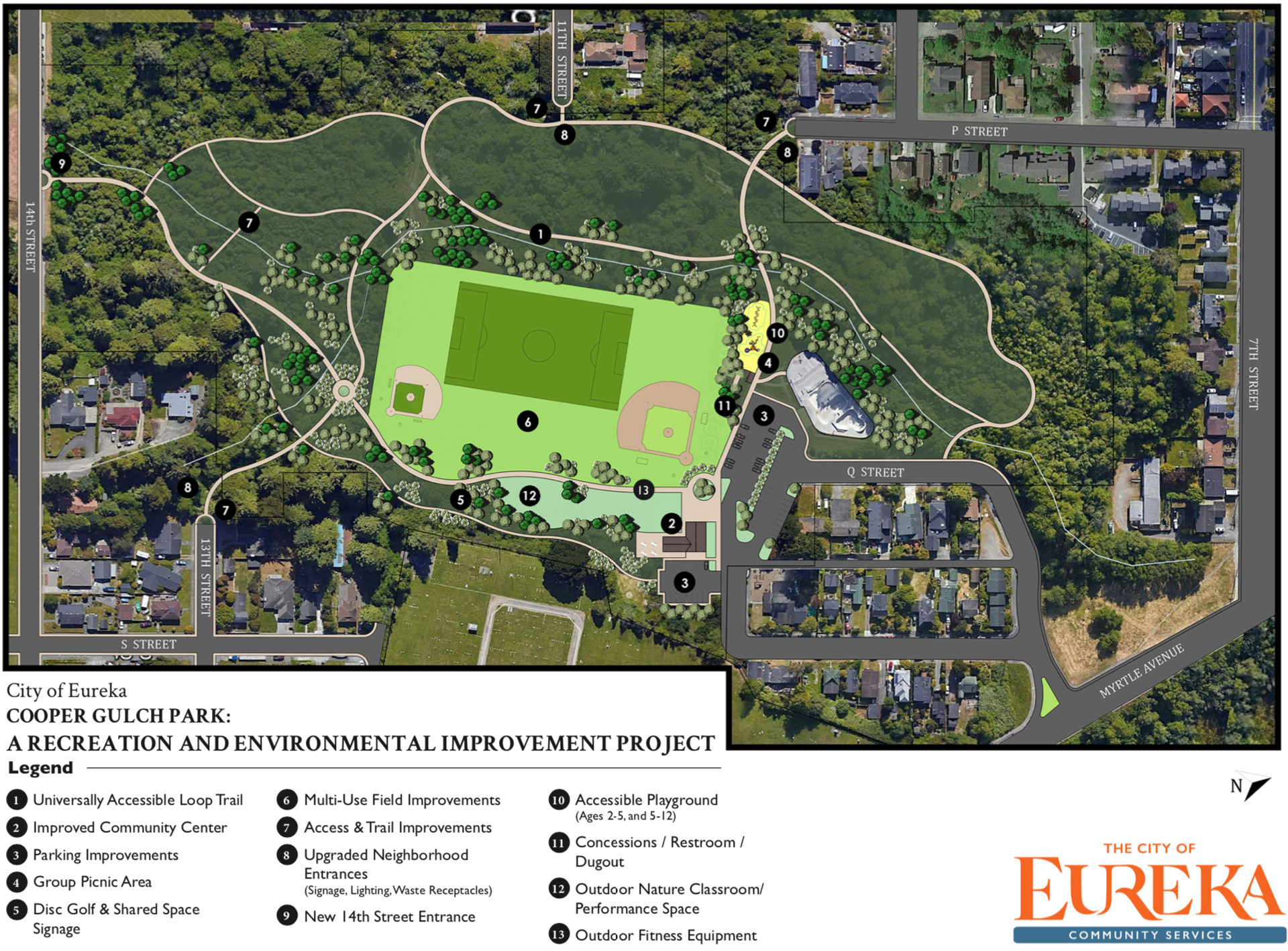
Here’s something to root for. Big changes could be coming to Cooper Gulch, as foretold in the City of Eureka press release below:
The City of Eureka is excited to announce its application for the Prop 68: Statewide Park
Development and Community Revitalization Program. This funding opportunity helps fund park
projects in critically underserved communities. The city is working hard to improve all city parks
with the focus of this grant application being to revitalize Cooper Gulch Park.
A robust community input process took place from October 2020-February 2021 with the support of
neighborhood community group, Cooper Gulch Common Grounds. We would like to thank the
countless individuals who attended the meetings and responded to the survey, along with those who
reached out directly with their input. The conceptual design now available for your viewing is a
direct reflection of this community engagement.
This process resulted in a grant request for $8.4 million for the following park improvements:
Construction of two new, accessible playgrounds for ages 2-12 including a fenced area
designated for ages 2-5
New ADA accessible restroom featuring low-flow toilets and LED lighting
The existing ballfields will be renovated to be multi-use field supporting baseball, softball,
soccer, and special events and will include, new bleachers, new dugout, new scorer’s table,
and drainage improvements to extend the fields usable season
A universally accessible loop trail will be added to the park, curving through and around the
park to support jogging, walking, bicycles, strollers, and skateboards
Upgraded recreational trails throughout the park including upgraded neighborhood
entrances and a new entrance at 14th Street
Group picnic/barbeque area including new picnic tables and ADA accessible tables, and
picnic areas throughout the park
New native plants and trees and creation of rain garden/bioswale to divert Park and parking
runoff
A rentable concession stand
Outdoor environmental classroom to support educational and performance opportunities
Outdoor fitness equipment along trails
Upgrade and improve irrigation for the Park
The community center will be renovated to be more energy and resource efficient and
provide diverse programming opportunities for all ages and abilities
Disc golf course will be renovated with new baskets, launch pads, safety and shared signage,
and paths
Parking improvements including ADA access and rain gardens/bioswales to manage
stormwater
Lighting will be improved throughout the Park to allow for extended nighttime use and to
increase public safety
A notice of award should occur in Fall 2021 should this project receive funding. Due to the success of
the 20/30 Park grant award of $6.3 million from the previous Prop 68 grant cycle, which is currently
being designed this summer, our city is well positioned to again be successful in this competitive
grant program.
We would like to thank all of our community partners who made this project proposal possible:
Cooper Gulch Common Grounds
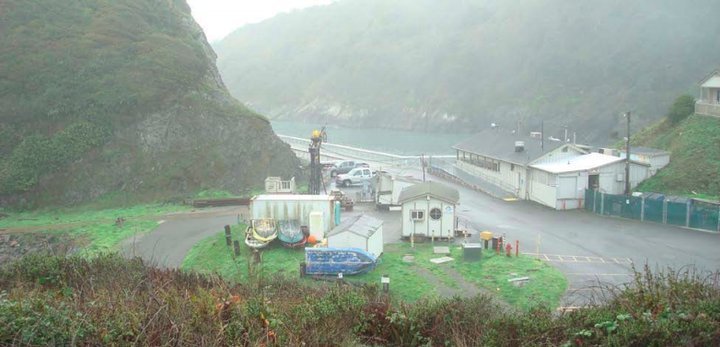
The Trinidad Rancheria Tribal Government is pleased to announce that Seascape Restaurant will reopen on Tuesday, May 4, 2021!
All Seascape employees have been tested for COVID- 19 and quarantined or isolated as needed based on current CDC Guidelines.
While a single known positive case of COVID-19 was present at the Seascape Restaurant, the staff consistently practiced CDC-recommended COVID-19 procedures. Out of an abundance of caution, the Tribe closed the restaurant and worked closely with Humboldt County Public Health on contact tracing and testing to ensure that there were no known cases of COVID-19 transmitted at the Seascape restaurant.
All employees who had contact with the one positive case have been tested and received COVID negative results. Seascape Restaurant has been thoroughly cleaned and disinfected by an independent cleaning company following CDC guidelines. Staff have completed their required exposure quarantine periods and employees are back and preparing to reopen. Seascape employees are eager to see all our guests return and can’t wait to serve you again.
Is everyone ready for some of our famous pancakes, or maybe a hearty omelet or breakfast combo? How about some crispy fish and chips for lunch, a juicy burger with fries, or maybe a fresh salad? And, of course, don’t forget that Erica makes some of the best desserts and sweet treats on the North Coast. We are excited to see you all again.
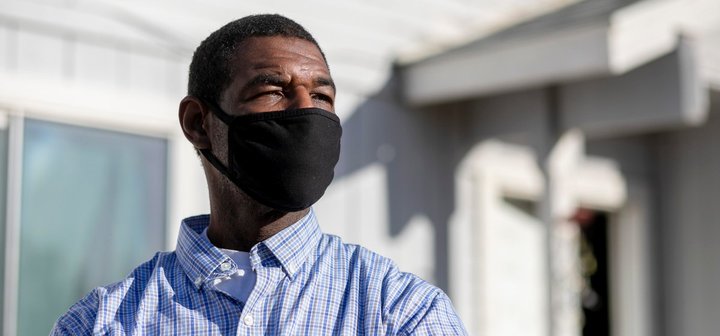
Stacy Estes in front of his home in Sacramento, Calif on Wednesday, April 7, 2021. Photo by Anne Wernikoff, CalMatters
###
Half of Stacy Estes’ pay disappears
every month before it hits his bank account. Each check is about $500
lighter than it should be, intercepted in the name of child support —
which he wouldn’t have a problem with, if it were going to his
kids.
Instead, only $225 goes to his children. The rest is garnished to
repay government debt he began accruing more than two decades ago
when he first got behind on child support payments.
The 53-year-old Estes owes about $47,000 in child support debt,
most of which is compounded by years of government-imposed interest,
according to financial records reviewed by The Salinas Californian
and CalMatters.
Federal
data shows California is keeping an unusually
high portion of the child support payments — more than 3½ times
the national average, paying itself first at the expense of the very
children it’s supposed to be looking out for. That’s because
California is charging families millions of dollars in interest on
past-due child support payments while penalizing low-income parents
who fall behind, making it nearly impossible for many to land
employment, support their children and pay off the debt, according to
state records and expert analysis.
Experts argue these laws are arcane and racist, penalizing Black
and brown fathers through predatory-like interest rates and driver’s
license suspensions. They push parents struggling to make ends meet
into even more precarious circumstances since the average
noncustodial parent makes less than $15,000 a year but owes $39,000
to both their children and the government.
In fact, the state’s own findings suggest nearly all of this
debt is uncollectible because it’s owed by people with low incomes,
people out of state or the debt is simply too old. Advocates urge
lawmakers to erase uncollectible debt entirely, and guarantee that
all child support paid goes straight to the children.
Poor
law
Crafted through a series of federal legislation in the ‘70s and
‘80s, the laws that govern public child support have impacted
parents across the nation for decades. Based on the notion that
people who tap public assistance have an obligation to repay the
government, parents who don’t keep up with payments face the same
federally mandated penalties, like suspension of driver’s licenses.
If states don’t recoup the money from parents, they become
responsible for repaying the government aid out of their own coffers.
Just a few states pass through 100% of monthly child support
payments to families, but only Colorado repays the federal government
for aid to families out of its own pocket, with Washington waiving a
small portion.
“This is a very old policy,” said Vicki Turetsky, who served
as commissioner of the U.S. Office of Child Support Enforcement
during the Obama administration. “It dates back to poor
law: the idea that people who get public
benefits from the government ought to pay them back. It’s a very
old way of thinking about assistance to families.”
Disproportionate
collections
While the federal Office of Child Support Enforcement shows
California
is average in the amount of child support it collects,
Turetsky calculated the state retained 14% of total collections,
compared to a national average of 3.8%, meaning it retains a
disproportionately large share as state revenue.
Share of child support retained by states in 2019
Only the District of Columbia retains more.
“California is an outlier in the proportion of support it
retains to reimburse cash assistance,” she said.
Turetsky said this was because California has a larger cash
assistance caseload, less restrictive eligibility rules for cash
assistance, and it passes less support through to families than many
states. State officials said they do not have discretion over how
much child support collections it retains for recoupment of aid, and
pegged the primary reason for the higher rate to a high welfare
caseload in California. More than a
third of residents are living in or near poverty.
California child support administrators agree that things need to
change, but say they have limited power to make reforms. The most
meaningful alterations that could provide parents relief — ditching
high interest rates and suspension of driver’s licenses — are up
to federal legislators, not the agency, said David Kilgore, director
of California’s Department of Child Support Services. And besides,
he added, sometimes those penalties are the only way to convince
parents to come in and talk to them.
“I can see the argument on both sides,” Kilgore said. “This
is a debt folks need to pay off.”
‘Get-tough
policy’ failure
It starts with public assistance.
When custodial parents — in most cases, mothers — apply for
government aid such as CalWorks, they must sign away their rights to
child support they are already receiving to the government in
repayment. That money, once considered private funds between two
individuals, is now reclassified as public child support, collectible
by the state to repay their aid.
The state continues to pass only a portion of the now-public child
support to the mother and siphons off the rest, which advocates say
is often a nasty surprise to both parents.
“Parents who have their child support taken by the state feel
like they have to choose between supporting their children and paying
their child support,” said Heather Hahn, a researcher with the
Urban Institute.
While the number of California parents who owe child support
wasn’t available, the outstanding balance is staggering. According
to the Department of Child Support Services, California parents owe
$11.6 billion in child support to their families and another $6.8
billion to the government.
But last year, state calculated that more than $11 billion of the
total child support owed was old debt.
California typically collects about $2.5 billion total from
parents annually, one of the largest amounts by state, but
proportionate to its population.
In 2020, about $2 billion of those funds went to custodial
parents. Thanks to various pandemic relief efforts, the state
intercepted not just parents’ paychecks, but their unemployment and
stimulus checks too, driving the collected amount up. As a result,
the state kept about $430 million of the $2.7 billion it collected in
child support. Of that, kept $207 million for state coffers and
divvied up the rest among the federal government, counties and other
jurisdictions. Federal law states half the money intercepted or
garnished goes to the federal government, another 47.5% goes to the
state, and 2.5% to the county the child lives in.
Fatal
flaw
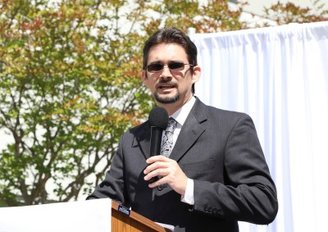
California Department of Child Support Services Director David Kilgore. Photo courtesy of Department of Child Support Services
If noncustodial parents — in most cases, fathers — get behind
on those child support payments in California, that debt is subject
to a 10% interest fee, the second-highest rate in the nation
according to the National
Conference of State Legislatures. That racks up
quickly, parents say.
The nonpayment penalties parents face are steep: The state can
suspend driver’s licenses just 30 days after falling behind on
payments, to start.
Director Kilgore said in many cases, suspending parents’
driver’s licenses can sometimes be the only tool his agency has to
get parents to work with them so they begin to pay their child
support back.
However, parent advocates add that suspending licenses as a
get-tough policy has only made circumstances worse for struggling
fathers.
“Licenses are essential in this economy,” said Mike Herald,
director of policy advocacy for the Western Center on Law and
Poverty, which advocates for the poor. “This has a really fatal
flaw; we think we’re going to somehow get money out of people we’ve
driven underground. How will this increase collections?”
Resistance
to give up millions
In recent years, California has taken small steps to give parents
relief.
In 2017, a report
out of the San Francisco Treasurer’s Office estimated that 70% of
public child support debt in California was owed to the government,
not to families. That figure has since dropped to 40% after a host of
changes were implemented, such as the Compromise
of Arrears Program, a debt reduction program
that lets noncustodial parents discharge their full debt in exchange
for a lump sum up front. For eligible parents, the program, which is
still available, can be a lifeline.
However, advocates say the changes aren’t drastic enough. They
urge lawmakers to erase uncollectible debt entirely, and guarantee
that all child support paid goes straight to the children.
Gov. Gavin Newsom last year embraced increasing the amount of
funds passed through to families in his budget, allowing families
with one child on public assistance to receive $100 a month (up from
$50) and families with two or more children to receive $200 a month
of the child support.
But he vetoed Democratic Assemblymember Reggie Jones-Sawyer’s AB
1092, which would have ended the state’s
practice of charging 10% interest on public child support debt.
Newsom’s veto message read, in part, “I cannot support this bill
as it would lead to an estimated revenue loss of millions of
dollars.”
Child support debt has particularly impacted Black and
Hispanic/Latino people. U.S. census data shows they make up 47% of
the state’s population, but about 60% of parents caught up in this
cycle. Black people in particular are overrepresented, at 6.5% of the
population but about 18% of parents who owe outstanding public child
support debt.
Parent advocates say this rule perpetuates the racist myth of the
welfare queen and the deadbeat dad, separating Black and brown
families.
“The narrative…is that it is child support, and it is not,”
said Mia Birdsong, author and Senior Fellow at the Economic Security
Project. “It is the government extracting resources from Black
fathers. It’s meant to cover overhead, but it’s punishment.”
It took years of making payments before Estes realized all the
money being deducted from his paycheck wasn’t going to his kids,
but rather to the government. As he fell behind on his child support
payments, his debt ballooned under the state’s interest rates and
he began to suffer additional penalties.
His driver’s license has been suspended at least three times.
Each suspension made it that much harder to keep up with the
payments he had fallen behind on, Estes said. He resorted to working
under the table to supplement his income: driving DoorDash under his
fiancée’s name or taking jobs that pay cash. Together, Estes and
his fiancée bring in about $40,000 a year, but he lost his job as
concert security during the pandemic, making things even tighter.
Even when his job comes back, he said, he won’t earn enough to
wiggle out from under the crush of debt.
“How do you live on half of your makings, how do you even get a
house or anything like that?” Estes said. “What about gas,
electric, food? What about just living?”
A
federal issue, too
Jhumpa Bhattacharya, a vice president at the Insight Center for
Community Economic Development, a nonprofit dedicated to building
economic opportunity in vulnerable communities, said she’d like to
see the state send all child support payments to kids and help
noncustodial parents find ways to meet their payments instead of
meting out punishment when they can’t.
“We’ve decimated all our social welfare systems and made them
dehumanizing and demoralizing,” she said. “Black people have a
tenuous relationship to the economy. They aren’t hired, or are
shoved into low-paying, low-dignity jobs, so when they start to
access this system, we punish them for it.”
But, she said, federal legislators need to be the ones to tackle
the aid payback requirement.
“Why,” Bhattacharya asked, “should you have to pay back the
government for helping you?”
In 2020, Maryland Democratic Sen. Chris Van Hollen introduced the
Strengthening
Families for Success Act, which would have
ended recovery of cash aid for good. His measure died in committee
and would need to be reintroduced. Messages to Van Hollen’s D.C.
office were not returned.
Child support collection by states in 2019
An
all-or-nothing program
Instead of being a “wedge that pushes families apart,”
Kilgore, California’s child support services director, says, he’d
like to see federal changes that make it more of a pick-and-choose
program. He believes there’s an opportunity for families to sign up
for DCSS services on an as-needed basis, utilizing it just as a way
to get child support payments without putting their ex in the way of
potential license suspensions or even jail time.
“We are, right now, an all-or-nothing program and we’d like to
be more flexible and let people choose which services they’d like
to implement,” Kilgore said.
The Newsom administration is looking at other ways to reduce the
burden. The Compromise of Arrears Program is undergoing a revamp this
spring, Kilgore said, making it easier for parents to tap the debt
dischargement program. Rather than asking for 10% of the total debt,
it will be based on their wages.
At the county level, directors would like to see certain changes
made, as well.
“I wish we did not collect interest,” said Santa Clara County
Department of Child Support Services Director Ignacio J. Guerrero.
“It feels more punitive than anything else.”
Breaking
down barriers
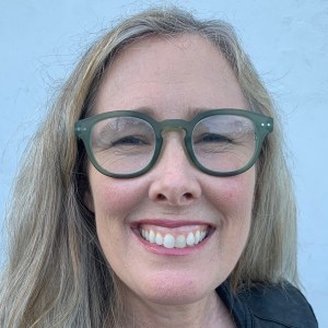
Anne Stuhldreher, director of The Financial Justice Project in the San Francisco Treasurer’s Office.
At least one county has led in removing such stigma. The Financial
Justice Project in the San Francisco Treasurer’s Office launched a
pilot program in recent years for 32 fathers saddled with prohibitive
amounts of child support debt. Some had lost their driver’s
licenses, jobs, and homes as a result.
“We were creating huge barriers in people’s lives,” said the
project’s director, Anne Stuhldreher. “If you can’t pay that
government debt, a lot of really steep consequences set in.”
Stuhldreher’s office wanted to see what would happen when
noncustodial parents no longer owed that debt. The project raised
enough to pay down 10% of these fathers’ child support debt, and
utilizing the state’s debt reduction program, discharged the other
90%, leaving them debt-free.
After following these fathers for a year, Stuhldreher said they
found many of their lives had improved in measurable ways. Fathers
got housing, started making bigger, more consistent child support
payments, and their credit scores rose. Their relationships with
their children and their exes improved, too.
A control group of fathers in similar circumstances saw no
improvements.
Estes said he has resigned himself to never fully paying off this
debt. His youngest is 16, his oldest, nearly 30.
“There’s nothing I can do about it,” he said, from behind
the wheel one evening, making DoorDash deliveries. He hit the turn
signal; a steady tock-tock-tock beat. “I’ve beaten myself up
over, you know, I can’t provide adequately. But my kids are older
now, they understand.”
###
The Mercury News reporter Laurence Du Sault and CalMatters
reporter Jackie Botts contributed to this story. This article is part
of the California
Divide, a collaboration among
newsrooms examining income inequality and economic survival in
California.
Humboldt County Joint Information Center press release:
A recent spike in local cases of COVID-19 has been tied to the more infectious B.1.1.7 variant, sometimes referred to as the UK variant. Humboldt County Public Health officials urge county residents to protect themselves and the community by following COVID-19 prevention measures and getting vaccinated as soon as possible.
Routine genomic sequencing first identified the B.1.1.7 variant locally late last month, and eight more cases have been identified so far. Humboldt County Health Officer Dr. Ian Hoffman noted that this variant was likely circulating broadly in the community before it was detected.
“Our recent increase in cases shows just how contagious this variant is,” Dr. Hoffman said, adding that it’s believed to be the driver of significant outbreaks locally and around the country, most recently in Oregon and Michigan. “Until now, older adults experienced the most severe outcomes of COVID, but now we’re seeing younger people getting sicker and younger people being hospitalized.”
Dr. Hoffman said that the county has seen a rapid rise in hospital admissions believed to be due to the variant. Seventeen people were hospitalized with COVID-19 at one point last week, including several who were transferred out of the county and several who were younger than previously seen hospitalized, including one child in the 10-19 age group.
The Centers for Disease Control and Prevention (CDC) reported the B.1.1.7 variant is now the dominant strain of COVID-19 in the United States. This variant is associated with a 50% increase in virus transmission and potentially leads to more severe illness as well as hospitalizations and deaths in unvaccinated people.
While more study is needed, data from manufacturers show the vaccines to be highly effective at preventing severe illness and death from variants of COVID-19.
Genomic sequencing also found a single case of the P.1 variant, sometimes called the Brazilian variant. This case was first diagnosed in mid-April and was acquired through out-of-county travel. Dr. Hoffman said it does not appear to have spread beyond that initial case. “This individual followed isolation guidance when they returned to Humboldt, and contact tracers have not identified any other local contacts,” he said. “This shows why travel is still risky and that public health measures can help to contain cases when they’re closely followed.”
More cases of the B.1.1.7 variant are expected when results from additional genomic sequencing are returned in the coming weeks, but Dr. Hoffman urged the community to take action now. “Vaccination is the most effective tool we have to stop this disease, and now is the time to get vaccinated. Make sure to receive both shots of a two-dose series so you have as much protection as possible,” he said.
“Given how easily this variant spreads, we still need to wear masks in public, maintain distance and do everything we can to avoid large gatherings, especially indoors, until more of us are vaccinated,” Dr. Hoffman said. “Committing to these safety measures as a community gives us our best chance to contain this outbreak and to protect our friends and neighbors from severe illness.”
Schedule an appointment at a Public Health vaccination clinic through MyTurn.ca.gov or through a local pharmacy at vaccinefinder.org
Some Safeway, CVS Pharmacy, Rite Aid, Walgreen’s and Walmart locations are offering COVID-19 vaccination appointments. See if there are appointments available at one of these locations by clicking on the links below.
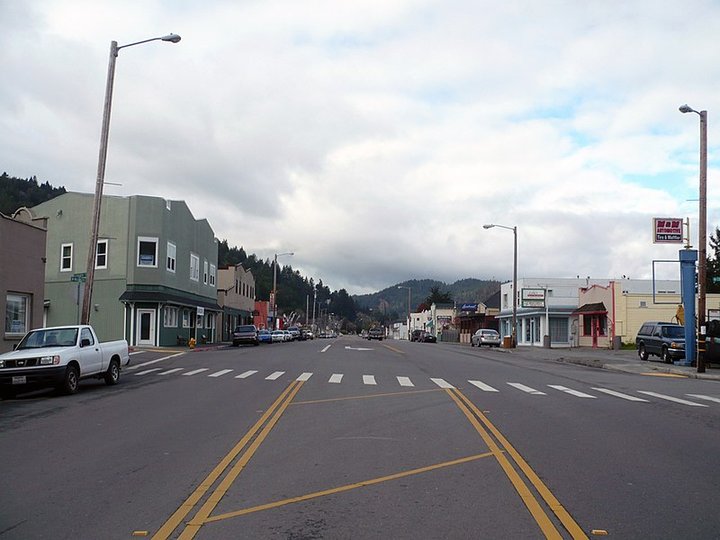
Downtown R.D. Photo: Ellin Beltz, public domain, via Wikimedia.
###
From the City of Rio Dell:
A free vaccination clinic for COVID-19 will be held at the Fire Hall on Thursday, May 6th from 9:00am to 3:00pm with an hour break at noon. The clinic is provided through Humboldt County Public Health, County Mobile Outreach, the Rio Dell Fire District and the City of Rio Dell. Public Health will be administering the Johnson & Johnson vaccine and walk-ins will be accepted.
If possible, please use the MyTurn.ca.gov website to register.
Van rides will be available for residents who need transportation to and from their residence and will be prioritized for the elderly or the mobility challenged. Call 707-764-3532 to request a ride. Masking and Hand Sanitizing will be required.
Please bring a photo ID, along with a health insurance card if you have one. If you do not have health insurance, you still can be provided a free vaccine. Minors over the age of 16 will need to be accompanied by a parent or legal guardian.
Get to work, you happy elves! Six Rivers National Forest press release:
How do you decorate one 60- to 80-foot-tall Christmas tree plus 130 smaller companion trees? With lots and lots of ornaments and tree skirts!
As part of the 51-year USDA Forest Service tradition, the Six Rivers National Forest is providing the 2021 U.S. Capitol Christmas Tree, which will grace the West Lawn of the U.S. Capitol for the holiday season.
“The Six Rivers has the great responsibility of identifying and providing the Peoples Tree for the upcoming holiday season,” said Ted McArthur, forest supervisor. “What better way to showcase the uniqueness and beauty of our great state than by decorating it with ornaments and tree skirts handmade by Californians.”
The West Lawn tree will require nearly 4,000 large ornaments. Separately, the forest and nearby communities will provide an additional 130 smaller companion trees to light up offices of the California congressional delegation, as well as leadership at the U.S. Department of Agriculture, U.S. Department of the Interior, and the USDA Forest Service throughout Washington, D.C., for the 2021 holiday season. These trees require approximately 11,000 smaller ornaments and 130 tree skirts.
With a newly selected theme of “Six Rivers, Many Peoples, One Tree,” all California residents are invited to help showcase the diverse peoples and ecology of California and its North Coast, as well as their creativity, by making ornaments and tree skirts for the U.S. Capitol Christmas Tree and the smaller companion trees. In addition to capturing California’s diversity, we encourage the use of recycled, recyclable, and natural materials as part of Woodsy Owl’s 50th birthday celebration highlighting its “Give a Hoot – Don’t Pollute” catchphrase.
Ornament and tree skirt examples are available to view as a reference at www.uscapitolchristmastree.com. Following are requirements for ornaments and tree skirts:
Ornaments – U.S. Capitol Christmas Tree: 9 to 12 inches, colorful, reflective, and weatherproof to withstand the elements (wind, rain, and snow). 4,000 needed.
Ornaments – 130 smaller companion trees: 4 to 6 inches, lightweight and colorful; however, durability is not a concern as they will be indoors. 11,000 needed.
Tree skirts: 5 feet in diameter. It may be possible for tree skirts to be returned; however, no guarantees can be made. 130 needed.
U.S. Capitol Christmas Tree ornaments and tree skirts may not include logos, political, or religious affiliation or symbols, drug or alcohol references, be divisive or offensive. Ornaments cannot be returned.
Ornaments and tree skirts are due by September 1, 2021, and may be mailed to: U.S. Capitol Christmas Tree, 1330 Bayshore Way, Eureka, CA 95501; or taken to drop-off sites listed at www.uscapitolchristmastree.com.
For additional information about ornaments or tree skirts for the U.S. Capitol Christmas Tree and how your group or community can get involved, contact Maritza Guzman at maritza.guzman@usda.gov or (707) 672-3184.