

65-Year-Old Woman From Utah Perishes in Yesterday’s Incident at the North Jetty
LoCO Staff / Tuesday, Dec. 8, 2020 @ 8:01 a.m. / Crime
UPDATE: The Humboldt County Sheriff’s office has corrected the age of the victim in this case.
###
Press release from the Humboldt County Sheriff’s Office:
On Dec. 7, 2020, at about 12 p.m., Humboldt County Sheriff’s Special Services deputies were dispatched to the North Jetty of Humboldt Bay for the report of a female victim who had been swept into the ocean.
Deputies arrived on scene and learned that the victim, identified as
6765-year-old Mary Malouf of Salt Lake City, Utah, had been visiting the area and had come to the beach with her adult son to watch the waves. The two reportedly walked out to the end of the North Jetty wall and while there, a large wave suddenly swept over the wall. Both individuals were knocked off their feet by the surge. The male victim was able to hold onto the jetty rocks, however Malouf was swept out to sea.The United States Coast Guard, Samoa Peninsula Fire District and Humboldt Bay Fire assisted in the search for Malouf utilizing ground crews, rescue boats and a helicopter. At about 1 p.m., crews located and recovered Malouf from the water.
Malouf was transported via helicopter to a local hospital where she was pronounced deceased.
The Humboldt County Sheriff’s Office sends our deepest sympathies to the family of Ms. Malouf during this incredibly difficult time.
A High Surf Advisory remains in effect through 4 p.m. today for Humboldt County. According to the National Weather Service, breaking waves of 22 to 28 feet will continue to create hazardous conditions for beachgoers and mariners. The public is urged to use extra caution near the surf zone and avoid rocks and jetties.

BOOKED
Today: 4 felonies, 7 misdemeanors, 0 infractions
JUDGED
Humboldt County Superior Court Calendar: Today
CHP REPORTS
No current incidents
ELSEWHERE
RHBB: Wildfire Burning Near Highway 101 South of Laytonville
Governor’s Office: California reminds voters to check their mailboxes and return their ballot ASAP!
County of Humboldt Meetings: Oct. 8, 2026 - Humboldt Housing and Homelessness Coalition General meeting
RHBB: CHP Pursuit Ends With High-Risk Stop at Highway 299 and 101
HSU Faculty Union Says Budget-Driven Class Cuts are ‘Irresponsible’ and Lecturers Are Being Treated as ‘Disposable’
Ryan Burns / Tuesday, Dec. 8, 2020 @ 7:06 a.m. / HSU

The Humboldt State University campus. | Image via humboldt.edu.
###
As Humboldt State University continues to grapple with a major budget shortfall, the local chapter of the California Faculty Association has called on administrators to “push pause” on campus-wide cuts to class offerings, saying the cuts could further reduce the school’s diminished enrollment, thereby threatening the sustainability of smaller departments.
In a press release issued late last month, CFA Humboldt accused HSU management of “taking advantage of COVID-19 by pushing through unnecessary budget cuts and shifting HSU values.” And in interviews with the Outpost, faculty representatives say these cuts are falling disproportionately on overworked lecturers and jeopardizing the quality of students’ educational experiences.
The university, meanwhile, says it is neither feasible nor realistic to carry on without addressing the budget shortfall, which it attributes largely to declining enrollment. Since hitting an all-time high of 8,436 students in the 2015-16 academic year, enrollment at HSU has plummeted more than 20 percent, hitting a 23-year low of 6,431 this semester. (That figure, while low, was actually significantly better than expected.)
In an emailed statement to the Outpost, HSU Communications Specialist Grant Scott-Goforth said, “HSU’s 2020-21 Operating Fund Budget, prior to spending reductions, reflected a shortfall of $16.3 million this year. If changes were not made, it was estimated to grow to a $20 million gap by 2021-22 as previously anticipated.”
The administration managed to reduce ongoing spending by $7.3 million this year, leaving a $9 million shortfall, which is being addressed through a variety of measures, Scott-Goforth said. For example, 60 members of staff or faculty have taken early retirement offers. Tuition revenue from the higher-than-projected enrollment helped, and some “one-time funds” cushioned the blow.
The cost-cutting measure causing the most anxiety among staff and faculty, though, is this: Administrators have ordered “divisional spending adjustments,” setting budget reduction targets for each of the university’s three colleges — the College of Arts, Humanities & Social Sciences, the College of Natural Resources & Sciences and the College of Professional Studies.
Nicola Walters, a lecturer in HSU’s Politics Department, said these reductions are resulting in lecturers being laid off or falling below the workload threshold necessary to qualify for health insurance. In an informal survey of lecturer staff she conducted in September, one in five respondents had either already lost health care or expects to lose it in the spring.
“I had thought HSU would be doing whatever they could to keep lecturers on health care and employed,” Walters said.
Among those still working, the unpaid workload has increased dramatically, she said. In addition to the support students typically require with assignments, the campus community is now dealing with the cataclysms of 2020. Some students have been evacuated from fire zones; others have been forced to deal with power outages or fallout from COVID-19. And many turn to their teachers for help.
“It’s so much,” Walters said. At the start of the semester, lecturers worked long hours to convert their respective courses to online-only instruction, and now they’re worried about losing their health insurance or their jobs.
“People are scared and they feel sold out,” Walters said, “because lecturers are the ones who have been shouldering the burden to get HSU through this pandemic.”
Loren Cannon, president of the CFA’s Humboldt chapter, agreed. An HSU lecturer himself in HSU’s Philosophy Department, Cannon said he and his colleagues upended their own lives to keep HSU going. Many taught courses from their kitchen tables with out-of-school kids underfoot. “Those are the people being seen as disposable widgets,” Cannon said.
[Disclosure: This reporter is friends with both Cannon and Scott-Goforth.]
Cannon argued that HSU needs to “hold tight to the community we have” during this time of so many unknowns, including disruptions from the pandemic and potential policy changes from the new presidential administration taking office next month.
“Why are we doing this when it’s a new day from the federal government?” he asked. “We may be getting a new federal stimulus. What if student debt gets canceled? Some [students] might be more likely to continue on in their studies. … There’s reason to say things are going to get better. We don’t need to have those cuts right now.”
Benjamin Shaeffer, chair of HSU’s Philosophy Department and assembly delegate for CFA Humboldt, said faculty morale is really low right now. Unlike in large cities like Los Angeles, he said, lecturers who come to Humboldt County don’t have a lot of career options if they get laid off.
“We have people in our department and others who are lecturers but who are just incredible teachers,” Shaeffer said. “I just think we need to find better, more creative and equitable ways of dealing with it.”
He and others in the faculty union suggested that a “cut from the top” approach would be more fair and less impactful to students. Shaeffer pointed to a document from the University Resources and Planning Committee from last year, which laid out a set of guiding measures and principles for budget planning. It calls for putting students first while preserving and valuing staff and faculty.
Shaeffer and others in the faculty union suggest that there are less-harmful solutions to the budget gaps, including tapping federal stimulus money and the California State University’s $1.7 billion in reserves. Or cutting from the top.
Cannon suggested that HSU could implement “furlough Fridays” where administrators take one day off each week with a proportional cut in their six-figure salaries.
“I’m not trying to disregard their jobs; they do important things too,” Cannon said. “But we tend to cut the people who are teaching, and doing so at an extreme savings to the state of California because their salaries are so low. I think our priorities are off.”
Scott Goforth said HSU’s strategy for cutting costs was developed through engagement across the university. “The budget plan recommendation was developed by the University Resources and Planning Committee, which is co-chaired by a faculty member and has robust faculty representation,” he wrote. “That budget plan was reviewed by the University Senate.”
He also noted that cutting courses with low enrollment is “standard practice in higher education.”
Colleges and departments within the university are being left to develop their own strategies to meet the budget cuts ordered by administration, an approach that Walters finds convenient for administrators.
“The university would have to confer with the union if they were to institute lay-offs,” she said in an email to the Outpost, “but by putting pressure on department chairs to cut their budgets (which results in lecturers losing their jobs), they are circumventing the union. And the other bonus for administration is that they get to claim that [this approach] is shared governance. The end result: union members are being tasked with terminating other union members.”
In response to suggestions that HSU is top-heavy, Scott Goforth noted that the university actually has the third-lowest percentage of administrative staff in the CSU system. “And HSU has significantly increased the number of tenure-track faculty positions over the last several years,” he added. “In Fall 2015, tenure track percentage of our faculty was 55.5 percent and Fall 2020 tenure track percentage is 62.2 percent … .”
The union disputes those figures. It says the density of tenured and tenure-track faculty at HSU this year is only 47 percent, and that any increase from previous years is likely due to the reduction in lecturers. Cannon said he believes the discrepancy stems from the fact that HSU makes calculations based on full-time-equivalent positions while the union conducts a headcount — “because we believe each lecturer is a full person.”
Scott Goforth said administrators have sought to protect lecturers and professors alike. “University leadership has worked very hard during the pandemic to avoid layoffs of permanent staff and faculty, and have continued to provide jobs to many students,” said said. And he suggested there’s reason to be optimistic about the future, especially considering the potential for HSU to be designated one of just three polytechnic universities in the state.
“HSU has been overwhelmed with positive feedback from faculty, students, staff, and alumni from a wide array of disciplines as well as local, state, and national elected representatives” regarding that possibility, he said, adding that the designation could lead to more grants and donations while attracting students from across California and beyond.
Cannon is skeptical. “I don’t doubt that there’s been a lot of positive feedback, but we don’t know anything about this plan,” he countered. “It’s really easy to get positive feedback when you only give out positive information.”
Many of the faculty members he’s spoken with are concerned that while the polytechnic designation could bolster the university’s already well-regarded STEM programs (science, technology, engineering and math), other programs might suffer, leading to even more layoffs.
“Those include faculty members that have dedicated heir lives to this institution,” Cannon said. Through all these fiscal ups and downs, the people with the most direct contact with students are being taken for granted, “the idea being that they’re the shock absorbers of a bad budget,” he said. “I’m against that thinking.”
Can ‘Fire Hardening’ Solve California’s Home Insurance Crisis?
James Bikales / Tuesday, Dec. 8, 2020 @ 7:05 a.m. / Sacramento
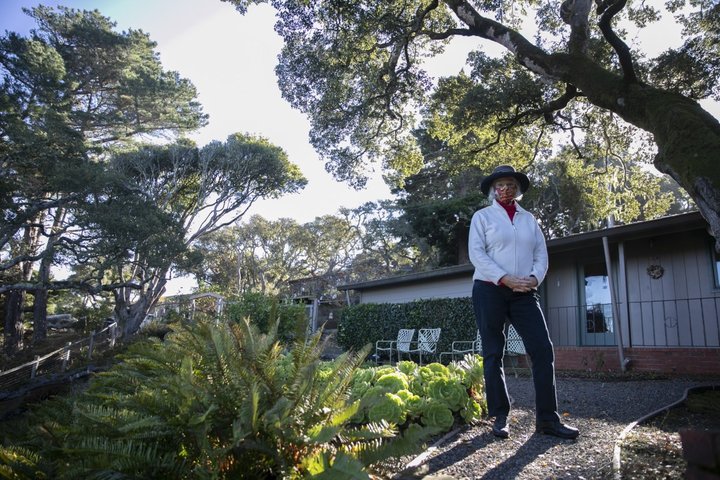
Lucy Smallreed at her home in Inverness on Dec. 6, 2020. Smallreed’s neighborhood, which borders on the Tomales Bay State Park, is a heavily wooded area. Photo by Anne Wernikoff for CalMatters
###
Sue Ladich spent $1,600 clearing brush and trees from around her home in 2014. In 2017, she ponied up $3,500 to clear even more potential wildfire fuel from her property. This year, she spent another $2,200.
But the more than $7,000 and countless hours of work spent in the name of keeping her Truckee home safe from wildfires added up to nothing in the eyes of insurers.
Californians across the state are taking measures to help save their homes from the state’s ever-worsening fires and satisfy risk-averse insurers, but many, like Ladich, are seeing their homeowners’ policy cancelled or premiums jacked up anyway.
“When the local fire department or the Forest Service comes by to inspect our property, we pass with flying colors — they don’t have a single recommendation,” Ladich said. “In my conversations with insurance companies, I’ve raised these items to try to plead our case — it doesn’t make a difference, it’s like they don’t even care to hear these details. They just have a set map and they say, ‘Nope, we’re not insuring in that area.’”
Ladich has been dropped by two companies in three years, and when the third insurer proposed raising her premium from $5,000 to $11,000 this year, she finally gave up and joined the California FAIR plan, the state’s bare bones fire insurance plan of last resort.
She’s far from alone. Homeowners like Susie Williams in Tuolumne County and Lucy Smallreed in Marin have also been dropped by insurers despite efforts at making their homes safer. In 2019, policy cancellations statewide rose by 61%, and the state’s 10 most fire-prone counties saw a 203% increase. Enrollments in the FAIR Plan jumped 225% last year.
Insurers say it’s simply too risky to write policies in these regions — payouts from the 2017 and 2018 fire seasons alone totaled $24 billion, almost completely wiping out the industry’s profits for the previous 16 years.
It’s likely some homeowners would choose to reduce their risk against fire — a practice known as home hardening — regardless of the insurance implications, but state regulators are increasingly eyeing the practice as a potential solution to the burgeoning insurance crisis. In fact, they’re considering whether — and how — to institutionalize it.
Insurance Commissioner Ricardo Lara backed a bill this year, AB 2367, that would have required insurers to renew policies for homeowners that met state standards for hardening their home against wildfire. It died in committee after strong opposition from insurers, and Lara has since said he plans to use regulatory powers to create an insurance program that incentivizes California homeowners to take mitigation measures.
In an October hearing on the insurance crisis and in interviews with CalMatters, both consumer groups and insurance companies indicated that, as a long term solution, they support creating an insurance-based mitigation program. They disagree, however, on the logistics of such a system and whether the state is ready to move that way now.
The fundamental questions that need to be answered are:
- Who will certify that homeowners meet mitigation standards?
- How will those standards be determined?
- Will insurers be allowed more flexibility to adjust rates in conjunction with such a program?
Lara seems to have taken notice of the questions. He is convening a hearing Dec. 10 with fire and home hardening experts and wildfire catastrophe modeling experts to discuss incentivizing home hardening in order to increase insurance availability and affordability.
As Lara has pointed out, when car owners show their insurance company that they’re a safe driver who avoids accidents, they’re usually given a discounted rate. California homeowners who demonstrate that they’ve made their home more immune to wildfire are hoping for the same deal on their insurance policy.
Who will certify?
Some California communities already require their residents to meet certain mitigation standards against wildfire. More than 350 jurisdictions in the state are enrolled in the National Fire Protection Association’s “Firewise” program, meeting certain community-wide mitigation standards. Individual cities and homeowners’ associations sometimes also set their own requirements for cutting back plants or using certain building materials.
Still, insurers are dropping customers who meet these community standards.
Susie Williams, a resident of Groveland, high in the Tuolumne County foothills, has to comply with strict fire mitigation measures stipulated by her homeowners’ association, such as cutting her grass to four inches or less.
Yet since the Rim Fire grazed the town in 2014, Williams has had her homeowners’ policy cancelled by four different insurance companies, despite making no claims.
“It wasn’t one particular insurance company that was dropping people, one particular type of house, full timers or part timers,” she said. “Every time you turn around, you see someone whose insurance was dropped.”
“We keep the brush cut down, we have a metal roof on our home, it’s one story. We’ve done a lot to make it fire-resistant, but that hasn’t resulted in us being able to get insurance.”
— Lucy Smallreed, Marin County homeowner
Even those who have had insurance company inspectors come to their property and followed their recommendations have faced cancellations.
Lucy Smallreed, who owns a home with her husband in the Marin County community of Inverness, said an Allstate inspector visited her home in 2018 and required her to cut back her trees for fire safety. She did that and more, but still received a cancellation in 2019.
“We keep the brush cut down, we have a metal roof on our home, it’s one story,” all measures experts say reduce the risk of a home burning down, she said. “We’ve done a lot to make it fire-resistant, but that hasn’t resulted in us being able to get insurance.”
She’s now on the state FAIR plan, which costs 21% more than her previous comprehensive plan and covers only smoke and fire damage.
Janet Ruiz, communications director at the Insurance Information Institute, a trade group, said insurers are still unsure how to gauge the risk reduction that comes from homeowners taking certain mitigation measures, making it difficult to implement a broader discount program.
“Science is just getting to the point where they’re identifying what things really make a difference,” Ruiz said, adding that the lack of specific standards was the main reason the industry opposed Lara’s fire hardening bill this year.
Waiting for answers
Hoping to advance fire science to allow for more specific standards to be set, the insurance industry has put its chips on the Insurance Institute for Business and Home Safety, a South Carolina-based nonprofit.
The Institute is researching the efficacy of mitigation measures homeowners can take in eight aspects of their home — fuel management, fences, decks, building shape, walls, roofs, roof vents, and eave overhangs — on behalf of 103 insurers, according to its president and CEO, Roy Wright.
By blasting embers at full-scale model homes in its testing center and taking field observations at California wildfires, Wright said the organization aims to give companies a quantifiable figure on the risk reduction that comes from taking any single one of the eight measures.
“Your house can be perfect, every dimension dealt with, and your neighbor who is six or seven doors down is not, and at that point you’re still vulnerable to wildfire.”
— Roy Wright, CEO of the Insurance Institute for Business and Home Safety
“What we cannot yet do is say, okay, if you address just the roof vent, do you reduce the risk by 4%, by 7%, by 12%?” he said. “If you had to say, addressing the deck versus the fence — we know they’re both important, but if you wanted me to put a specific number behind differentiating which one is more likely of ignition, that’s the gap we’re still working on.”
Wright added that a separate complexity for insurers is that fire can spread between closely-placed homes through radiant heat.
“Your house can be perfect, every dimension dealt with, and your neighbor who is six or seven doors down is not, and at that point you’re still vulnerable to wildfire,” he said.
Yana Valachovic, a forest advisor and researcher with the University of California Cooperative Extension, agreed that the science is not there yet to quantify the dollar value from taking particular mitigation measures.
Most of the home mitigation in California thus far has focused on reducing ignition through direct flame contact, but two other ignition types — embers and radiant heat — have not been addressed as frequently, Valachovic said.
Doing the math
Insurers say another essential step to facilitate a home hardening program would be to allow greater flexibility in setting rates.
Currently, California does not allow insurers to use what’s known as catastrophe modeling — statistical models that help insurers predict losses from catastrophic events — to set rates. Insurers say that changing that rules would allow them to more accurately serve customers, and thus, serve more customers. The state isn’t a fan of proprietary (read: private) models, and doesn’t think the insurers need it, anyway.
California currently requires insurers to base rates on 20-years of historical data on both catastrophic and non-catastrophic losses.
Nancy Watkins, principal and consulting actuary at actuarial firm Milliman, said the most comparable situation to California’s current wildfires is the hurricanes in Florida between the mid-1990s and mid-2000s, which nearly brought that state’s property insurance market to its knees.
In their wake, Florida created a home mitigation program, requiring insurers to offer discounts to customers who took action such as installing hurricane shutters. The program foundered, however, with insurers finding that homes without the mitigation measures were actually more attractive to insure than those participating in the program.
Watkins said Florida’s program was implemented without recognition of insurers’ rate setting strategies, and she worries the same might be in store for California.
“The real problem with mitigation is not the concept of it, it’s how difficult it is to be right and how customized a mitigation credit has to be to the insurer’s situation,” she said.
So what does this mean for California?
Creating a successful risk mitigation program in California will require the buy-in of numerous parties, most importantly, the insurance companies and state regulators. One successful model for such a program is Wildfire Partners in Colorado’s fire-prone Boulder County.
Launched in 2014, the program is a public-private partnership between more than 40 organizations — government agencies, insurers, consumer groups, fire districts, realtors, and others. The program is funded independently through state and FEMA grants, and uses those funds to hire former firefighters and forestry professionals. They conduct audits of fire risk on individual homeowners’ properties and provide support to homeowners in mitigating hazards. It certifies properties that meet all of its standards.
The program seems to overcome many of the obstacles California is facing now: the certification is conducted by professionals paid by the program itself, answering the question of who is responsible for the inspections. And unlike the community-scale certification programs that insurers labeled as too broad, Wildfire Partners issues certifications by property, giving individual homeowners evidence of reduced risk they can provide to insurance companies.
Jim Webster, the program coordinator, said Wildfire Partners is unique in that it brings together stakeholders that are often adversaries for a “unified certification process” that encourages mitigation. Because they’ve bought into the program before and trust that its inspectors are professionals, insurers can feel more comfortable continuing to insure those properties or avoid raising premiums.
“Insurance companies took time to buy into the Wildfire Partners approach,” he said. “Anybody can certify and give a person a piece of paper and say ‘I’ve done mitigation,’ but that certification has to mean something.”
As of now, the program has only certified 1,021 homes, but it’s drawing attention nationwide as a model mitigation program. Webster said California could start by piloting a similar program in one county.
Ruiz, the trade group communications director, said the California insurance industry has already been examining Wildfire Partners model and is interested in working together with the Insurance Department to find a solution. And the Department has likewise shown interest in Wildfire Partners, inviting Webster to present at its October hearing.
Susan Hassett, who lived in rural Yolo County until she lost her home to the LNU Lightning Complex fire this year, said such a partnership is exactly what she would have helped her insure her home.
Hassett said that as a former firefighter, she knows she’s doing on home hardening — she spent three years and thousands of dollars reducing the fire risk to her property, including clearing a 400-by-700-foot swath of open space. But in 2017, her insurer cancelled her policy.
“I started grilling them and I asked them questions like, have you driven our road? Will you come out and look?” she said.
The answer was “no,” and when she couldn’t find an affordable alternative plan, she went without insurance. After this year’s fire, she was left with nothing to rebuild.
###
CALmatters.org is a nonprofit, nonpartisan media venture explaining California policies and politics.
Lawmakers Weigh Moratorium Extension as Eviction Cliff Looms
Matt Levin / Tuesday, Dec. 8, 2020 @ 7:05 a.m. / Sacramento
With California’s eviction moratorium set to expire in less than 60 days and 2 million people at risk of losing their rental homes, a group of tenant-friendly lawmakers want to forestall evictions for another year.
The proposal, introduced today by San Francisco Democratic Assemblyman David Chiu, would forbid landlords from evicting renters financially harmed by the pandemic through Dec. 31, 2021. Renters would have until then to come up with a quarter of the back rent they’ve accumulated since last September to avoid being kicked out in 2022.
Chiu’s bill marks the opening salvo in negotiations over one of the most pressing issues state lawmakers and Gov. Gavin Newsom will have to tackle in coming weeks. If nothing is done by Jan. 31, an estimated 240,000 California households with rental debt could be evicted just months away from a vaccine.
“The possibility that tens of thousands of folks could be forced from their homes would make COVID much more likely to spread and have devastating health consequences,” said Chiu. “We can’t allow that to be California’s fate.”
The possibility that tens of thousands of folks could be forced from their homes would make COVID much more likely to spread and have devastating health consequences. We can’t allow that to be California’s fate.
— Assemblyman David Chiu
While landlord groups are open to extending an eviction moratorium for a more limited period of time, they argue they can’t afford nearly two years of missed payments. California landlords have been unable to evict tenants who have lost earnings or faced higher medical costs because of COVID-19 since April, when the state court system temporarily shut down eviction cases.
“We’re not going to see property owners survive all the way through 2021 if (Chiu) takes it all the way through December with no assurance that we’re going to get financial help,” said Debra Carlton, lobbyist for the California Apartment Association. She added that a proposal that revisits the necessity of a moratorium in a few months may be a nimbler approach.
Newsom was instrumental in brokering last summer’s compromise, which has largely stemmed a feared eviction tsunami thus far. This time, he and state lawmakers are looking to Washington, D.C., for help.
“Significant federal stimulus is absolutely necessary – and the governor will keep advocating to President-elect Biden and congressional leaders, making the case for renter and homeowner relief,” said Jesse Melgar, communications director for the governor.
California renters owe about $1.7 billion in back rent, according to an estimate by the Federal Reserve Bank of Philadelphia. That number is likely to grow significantly in the coming months if Congress allows extended unemployment benefits to expire at the end of the year.
Anya Lawler, a lobbyist for the California Rural Legal Assistance Foundation and advocate for other tenant groups, expressed hope that if a major federal rental assistance package is passed in the next few months, tenant and landlord groups could come to a compromise on when the moratorium should expire.
“I think that we are all hoping that that Dec. 31 date is not necessary and that we have the tools we need to work with quickly so that we can craft a long-term solution and the (moratorium) provisions can expire,” said Lawler.
While Chiu has introduced separate legislation that expresses an intent to provide financial assistance to renters and small landlords, the bill does not provide any specifics yet on how much money that would entail or how it would be distributed.
Carlton, the landlord lobbyist, said that a figure in the neighborhood of $850 million would be enormously helpful, and that landlords are willing to accept some losses.
Should the current moratorium expire at the end of January, renters who are able to pay 25% of the rent owed since September will be allowed to stay in their apartment. But landlords are still able to pursue the full rental debt accumulated since last April in small claims court — they just can’t evict tenants for not paying the other 75% of it.
Beyond how long a moratorium extension should last, landlord and tenant groups will grapple over whether any such extension should preempt local governments from providing more generous renter protections, such as a longer moratorium or more time to pay back landlords.
Chiu’s proposal also bars landlords from charging late fees on missed rent, a provision missing from last summer’s compromise that renter groups say some landlords have exploited.
Carlton said landlords don’t object to that provision.

###
CALmatters.org is a nonprofit, nonpartisan media venture explaining California policies and politics.
OBITUARY: Thelma Lee (Coons) Stutchman, 1927-2020
LoCO Staff / Tuesday, Dec. 8, 2020 @ 7 a.m. / Obits

Thelma
Lee (Coons) Stutchman, lovingly known as “Grammie,”
passed away at home, with her daughter by her side, on November 21,
2020, after a long battle with Parkinson’s Disease.
Thelma
was born on November 14, 1927, in Reno to William and Alta Coons. She
enjoyed a happy childhood, despite the family moving many times,
while her father tried homesteading and farming, eventually settling
in Ferndale. Her older brother, Ernest, was her best buddy and
co-conspirator in many childhood adventures.
Thelma
was an excellent student, and graduated from Fortuna High School when
she was 16 years old. A year later her father passed away, and Thelma
helped her mother and brother close down the farm, and move to
Eureka.
One fateful day in 1945, Thelma’s brother suggested they go roller skating at the Municipal Auditorium, to cheer themselves up. It was there that Thelma met the love of her life, Marshall Stutchman. They fell completely in love and were married November 30, 1947. After their wedding, the young Stutchmans established their home in Eureka, and, in 1950, and, 1952, added their children Andrea, and, Gregg to complete their family. Thelma and Marshall remained best friends, and, soulmates, for the 54 years they were married, until Marshall’s death in 2002.
Being a mother was Thelma’s joy, and she did it with her whole heart. She loved totally, and unconditionally. The Stutchman home was a safe, warm, inviting place, full of love. All the neighborhood kids wanted to be there, and often were. Marshall worked hard so that Thelma was able to be a stay-at-home mother. She made it look easy and the Stutchman children enjoyed a magical childhood full of fun and adventures.
When her children started leaving the nest, Thelma entered the next chapter of her life. She went to work at the Humboldt County Department of Welfare, and worked for 22 years as the supervisor of the budget unit. She retired in 1989, so then she and Marshall could spend more time together.
The other focus of Thelma’s joy was her grandchildren, and great grandchildren. Thelma loved spending time with them. She taught her grandchildren to cook; and always let them help her in the kitchen, whether it be making breakfast, creamed peas or pie crust crackers. Grammie was happy to let the grandchildren cut her prized roses from the bushes in her backyard for Sabbath lunch table flowers. Later on, she established great grandchildren traditions of hand washing, and polishing her paperweight collection, and creating art with her mouse stamp collection. Of course, Grammie saved every piece of artwork, proudly displaying them on her refrigerator door.
Thelma became a Seventh-Day Adventist Christian when she was 12 years old, and was active in her church for many years, until her health declined. She was a prayer warrior, and dearly loved her God, and her Lord, Jesus, until her final breath.
Thelma was preceded in death by her parents William and Alta Coons, her brother Ernest Coons, and her loving husband Marshall Stutchman.
She is survived by her children Andrea (Andie) Pfaff of Eureka, and Gregg Stutchman of Napa, grandchildren Kellie and Mark Braithwaite of Rochester, Minn., Jason and Randalyn Young of Burbank, Amber Stutchman of Napa, John Stutchman of Calistoga and Jonathan and Francesca Lucchesi-Stutchman of St. Helena. She is also survived by her great-grandchildren, Kacie and Scott Homen of Eureka, Kami Chattin and Rylan Braithwaite of Rochester, Minn., Allison Young and Dylan Young of Burbank and Alessandro Lucchesi-Stutchman of St. Helena.
Due to the the pandemic, a memorial to honor Thelma will be held at a later date that is to be determined.
###
The obituary above was submitted on behalf of Thelma Stutchman’s loved ones. The Lost Coast Outpost runs obituaries of Humboldt County residents at no charge. See guidelines here.
Video Shows Three People Running for Their Lives as Multiple Waves Nearly Sweep Them Off the North Jetty
John Ross Ferrara / Monday, Dec. 7, 2020 @ 5:30 p.m. / Emergencies
Video by Sequoyah Faulk-Kellogg.
Around the same time that a 67-year-old woman was washed off the North Jetty by heavy surf this afternoon, three others on the exposed walkway were filmed running for their lives to escape the crashing waves.
Reader Sequoyah Faulk-Kellogg sent the Outpost frightening drone footage of the event.
“These three people had just realized that the woman they had seen at the end of the Jetty was no longer there,” Faulk-Kellogg told the Outpost. “I’m not sure if they actually saw her get swept in or not, but they were in the process of talking to 911 when this video was taken.”
Humboldt County Sheriff’s Office spokesperson Samantha Karges told the Outpost that the HCSO only responded to one emergency call at the jetty today, but said that a relative of the victim was also nearly washed off the jetty at the same time.
“The reporting party is a relative of the victim and was almost washed out by the wave but was able to hang onto the rocks to prevent himself from being swept off the wall,” Karges said.
It’s unclear if the people in this video have any connection to the woman who was pulled from the ocean and flown to St. Joseph Hospital in Eureka today.
The Humboldt County Sheriff’s Office released the follow statement addressing today’s events:
While we are fortunate to have beautiful beaches in Humboldt County, with the ocean also comes great danger. Despite many warnings regarding the dangers of sneaker waves and large swells, particularly at our jetties, many people are swept out to sea each year. This is not only devastating to families who have lost their loved ones, it is heart-wrenching for our deputies and our community each and every time it occurs.
The Sheriff’s Office and our Office of Emergency Services, in partnership with the National Weather Service, are continuously seeking to educate the public about the very real dangers of our ocean, particularly on days like today in which a High Surf Advisory has been issued. We urge the public to check with the National Weather Service for relative forecasts and warnings before visiting our beaches and to exercise great caution if choosing to go near the water. Watching the waves is not worth your life. Please use caution at our local beaches and help us spread the word: never turn your back on the ocean.
###
PREVIOUSLY:
Police Searching for Suspects Who Allegedly Shot a Man in an Alley After Trying to Sell Him Heroin, EPD Says
LoCO Staff / Monday, Dec. 7, 2020 @ 4:21 p.m. / Crime
Press release from the Eureka Police Department:

On December 4, 2020, at about 9:35 p.m., officers with the Eureka Police Department responded to an alley near the 2000 block of Summer Street for the report of a shooting that had just occurred.
Officers located a 40-year-old male victim who was bleeding from gunshot wounds. Officers applied a tourniquet while Humboldt Bay Fire and City Ambulance responded. The male was transported to the hospital by ambulance with non-life-threatening wounds.
Based on statements provided on scene, it appears the victim was in the alley when two unknown males approached and tried to sell him heroin. An argument ensued and one of the male suspects brandished a firearm and shot the victim.
The suspects immediately fled through the alley. The suspects were only described as being younger, possibly 18 to 19 years old, and were wearing red face masks. This is an active investigation and additional information will be released as available. Anyone with information is asked to contact Detective Corrie Watson at (707) 441-4032.


