

Driver Narrowly Misses Eureka’s Old Town Carriage Horse Before Colliding With a Tree By the Gazebo
Ryan Burns / Tuesday, Jan. 20 @ 11:32 a.m. / News

Photos by Colton O’Neale.
###
It could have been so much worse!
An elderly woman was hospitalized Sunday afternoon after her vehicle careened through a Eureka intersection, narrowly missing the Old Town Carriage Company horse before crashing into a tree by the gazebo.
Old Town resident Colton O’Neale said he witnessed the crash, which happened at approximately 3:39 p.m. The driver was placed on a gurney and loaded into an ambulance.
“We overheard a firemen tell someone that she mixed up her gas and her brake,” O’Neale told the Outpost this morning.
Laura Montagna, public information officer with the Eureka Police Department, said the unidentified driver (born in 1949) was headed westbound on Second Street immediately before the accident.
Consulting the call logs, Montagna said the driver narrowly missed the horse and struck a light pole, so both PG&E and the Humboldt County Public Works Department were notified.
O’Neale, who lives in an upstairs apartment near the scene, said he heard “frantic shouting” right before the incident.
“I looked [out a window] and saw several people running out of the way as she barreled through,” he reported. “[A] neighbor and I walked up for a closer look and I don’t think she hit anyone.”
BOOKED
Today: 8 felonies, 17 misdemeanors, 0 infractions
JUDGED
Humboldt County Superior Court Calendar: Friday, Feb. 6
CHP REPORTS
Us101 N / Humboldt Hill Rd Ofr (HM office): Roadway Flooding
5859 MM101 N MEN 58.60 (HM office): Trfc Collision-No Inj
ELSEWHERE
RHBB: Crash Blocks Lane on Northbound U.S. 101 at Humboldt Hill Onramp
RHBB: Crash off 101 into Trees North of Willits
Study Finds: When Moths Freeze: How LED Streetlights Are Silencing the Night
High Country News: Trump’s call for deep-sea mining off Alaska raises Indigenous concerns
OBITUARY: Coffee Clay Winans, 1991-2026
LoCO Staff / Tuesday, Jan. 20 @ 8:10 a.m. / Obits

Coffee Clay Winans passed away on the evening of Tuesday, January 6, after years of a complicated battle with addiction. He was born on Friday, December 13, 1991, in Arcata, and lived his entire life amongst our community. His passing is a profound loss for his family and friends that cherished him for the amazing person that he was and for who he was becoming.
Coffee was a man whose heart was even bigger than his genuine and beaming smile, and whose laughter was contagious. He had a deep love for all living things — especially plants and animals. He even grafted and grew his own apple tree. He always had pets and cared for any animal he could. Coffee was known for nurturing life in all its forms. Coffee carried a rare tenderness and respect for the living world around him, no matter how it challenged him.
Known for his great sense of humor and iconic laugh, Coffee had a gift for making people feel at ease. He never failed to tell you exactly what was on his mind- which was always something fun or positive. He loved trading bling with his dad, and gifting beautiful jewelry to his mom. Coffee was known for always doing whatever he felt was the right thing to do. His kindness was sincere, his compassion toward others unwavering, and his presence an overall beacon of warmth to all who knew him.
Coffee’s legacy lives on in the countless lives he touched, the love he shared with us, and the simple bliss he spread so effortlessly. He will be deeply missed and forever remembered.
May we remember him for the true person he was — and not the tragedy that occurred. May his memory continue to grow and bloom in the hearts of all who loved him.
He is survived by a huge family and so many friends! His father, Charles Clay Winans, mother, Chelsea Tuck, brother Isaac Winans and his cat Ewok. Grandparents, Carl and Susan Tuck, Norman and Sharon Crockett, Uncles & Aunts Tom Baker and Kim Olsen , Michele and Mike Marshall, Camille McNeil, Alan and Carlotta Clark, Columbine Donald, Cynthia Tuck and Mikka Kohler, and too many cousins and other extended family to list!
He will be reunited in heaven with his paternal grandparents, Charles Francis Winans and Carolyn Kelly, his little brother Marble Ace Winans (missing since 2011) and many other ancestors and loved ones to guide him. May they all be shining upon us today!
A memorial open to all who care will be held on Friday, January 23, 2026. Graveside service at 2 p.m. in Blue Lake Cemetery, followed by a celebration of his life at Mad River Grange, ending at 5 p.m.
Please consider donating or sharing to others who may be wanting to help: Coffee’s Memorial Funds (Gofundme account).
###
The obituary above was submitted on behalf of Coffee Winans’ family. The Lost Coast Outpost runs obituaries of Humboldt County residents at no charge. See guidelines here. Email news@lostcoastoutpost.com.
OBITUARY: William Marshall Sellman, 1950-2026
LoCO Staff / Tuesday, Jan. 20 @ 8:01 a.m. / Obits

William Marshall Sellman, “Bill,” beloved father, grandfather, husband, brother and friend, passed away peacefully on January 8, 2026, at the age of 75.
Bill was born on March 25, 1950, in Las Vegas, New Mexico, to John and Pauline Sellman. The family moved to Onyx (Lake Isabella area), California in 1960 where he grew up and married his high school sweetheart in 1971. Together, they started a family and moved to Northern California, where they raised their three children.
Bill spent most of his life in Mad River, Willow Creek and Fortuna, where he built a home filled with love, laughter, and steady guidance. After settling in Fortuna, he met his forever soul mate in 2011, who remained by his side until his passing. He was a proud and devoted father who never missed an opportunity to support his children in all they pursued.
Bill worked for over 35 years for the Contel/Verizon phone company and was known for his strong work ethic, integrity, and willingness to help others. Outside of work, he enjoyed fishing, hunting, traveling the U.S. in his travel trailer, and spending time with his family. He especially loved fishing and crabbing in the ocean with his friends and loved ones. Bill was always quick to strike up a conversation and made many friends wherever he went.
He is survived by his children, Shan (Fred) Grundman, Robert Sellman (Adriano), and Ryan (Heather) Sellman; his step daughter Angela Martin; his grandchildren, Saige and Kyle Grundman, Mason and Cole Sellman; his sister, Sharon (Gary) Alexander; his brother, John Sellman; his wife, Kimberly Songer; and many extended family members and friends who will miss him deeply. He was preceded in death by his parents and his stepson, Tony Brown.
Bill will be remembered for his kindness, quiet strength, sense of humor, and unwavering love for his family and friends. His legacy lives on through the lives he touched and the values he passed down. Bill loved his AA family of 38 years and found lasting meaning through service to others. He remained devoted to giving back what was so freely given to him.
We would like to extend our sincere appreciation and gratitude to Kimberly for caring for our dad in her home, to Kimberly’s children for their help and support, and to Bill’s friends who lent a hand and checked in on him.
A celebration of Bill’s life will be held on January 25 at 12 p.m. in the Fortuna Seventh-day Adventist Dining Room (2301 Rohnerville Road, Fortuna).
###
The obituary above was submitted on behalf of Bill Sellman’s family. The Lost Coast Outpost runs obituaries of Humboldt County residents at no charge. See guidelines here. Email news@lostcoastoutpost.com.
Local and State Leaders Slam Trump Administration’s Offshore Oil Drilling Plan at Packed Eureka Public Meeting
Dezmond Remington / Sunday, Jan. 18 @ 1:25 p.m. / Activism
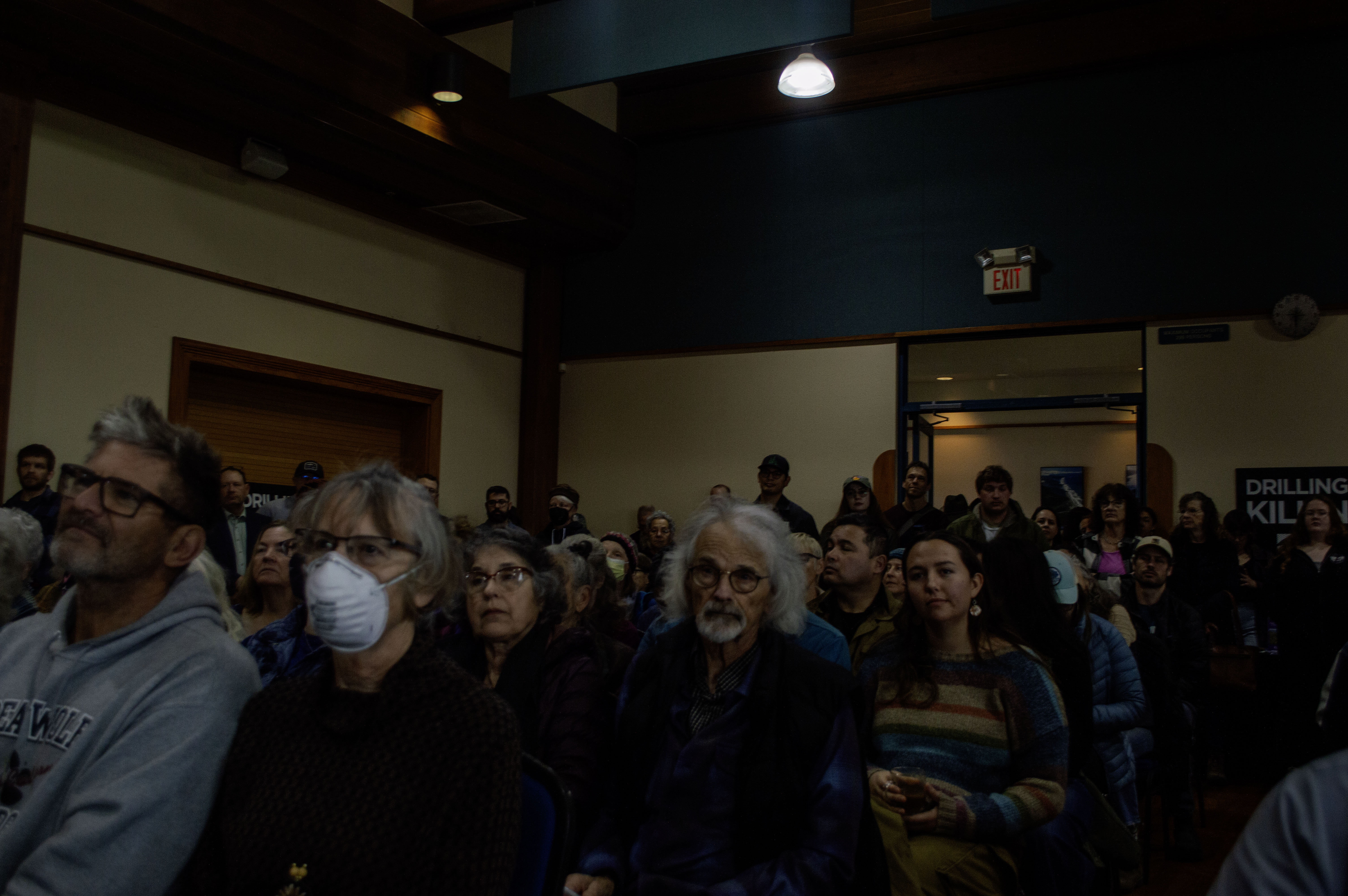
Some of the crowd at today’s meeting. Photos by Dezmond Remington.
California politicians and local activists heavily criticized the Trump administration’s plan to lease coastal waters for offshore drilling today at a standing-room only community meeting.
Held at the Wharfinger Building Sunday morning, over 100 people attended. It was hosted by the Surfrider Foundation, the Environmental Protection Information Center (EPIC), and Humboldt Waterkeeper. Attendees were encouraged to fill out postcards pre-addressed to Secretary of the Interior Doug Burgum with their hostility to offshore oil drilling.
Politicians from every level of government spoke for an hour, all of them to voice their opposition to the scheme: in attendance was Representative Jared Huffman, state assemblymembers Chris Rogers and Damon Connelly, Humboldt County Supervisor Mike Wilson, Eureka city councilmembers Kati Moulton and Leslie Castellano, and a smattering of other local bigwigs and activists. Huffman, Rogers and Connelly have attended several similar meetings along the California coast in the last few days.
They highlighted the negative environmental impacts of Trump’s plan, who said in November he wants to open up millions of acres along the West Coast and Florida to oil companies. Trump claims that drilling will bolster the economy, creating more jobs and lowering gas prices. Speakers focused on the potentially drastic, negative effects drilling has on the environment, as well as the devastation overusing fossil fuels is already causing to the climate and coastal communities. Many of them mentioned past oil spills that killed untold amounts of marine life and polluted waterways for years, like the 1989 Exxon Valdez, 1969 Santa Barbara, and 2015 Refugio spills.
“Thousands of pounds of toxic sludge are released due to routine operations of these facilities,” said EPIC climate attorney Matt Simmons. “I look out at Humboldt Bay, and I shudder to think about what a similar disaster would be for our community, for the jobs, the livelihoods, the cultures that all depend on the bay.”
Economic activities, like seafood harvesting and tourism, related to California’s coast brings in $1.7 trillion a year annually, Huffman claimed. Allowing offshore drilling would only increase that by a fraction while endangering other, more profitable activities.
“First, on the off chance that there’s someone in the Trump administration that still gives a damn about people and communities, we want them to hear loud and clear from us,” Huffman said. “We want them to know that support for offshore drilling is in the single digits, by which I mean the middle digit. I want to put it in terms that maybe Donald Trump can understand…I just want to tell the Trump Administration what part of the California coast they should open for new drilling: none of it.”
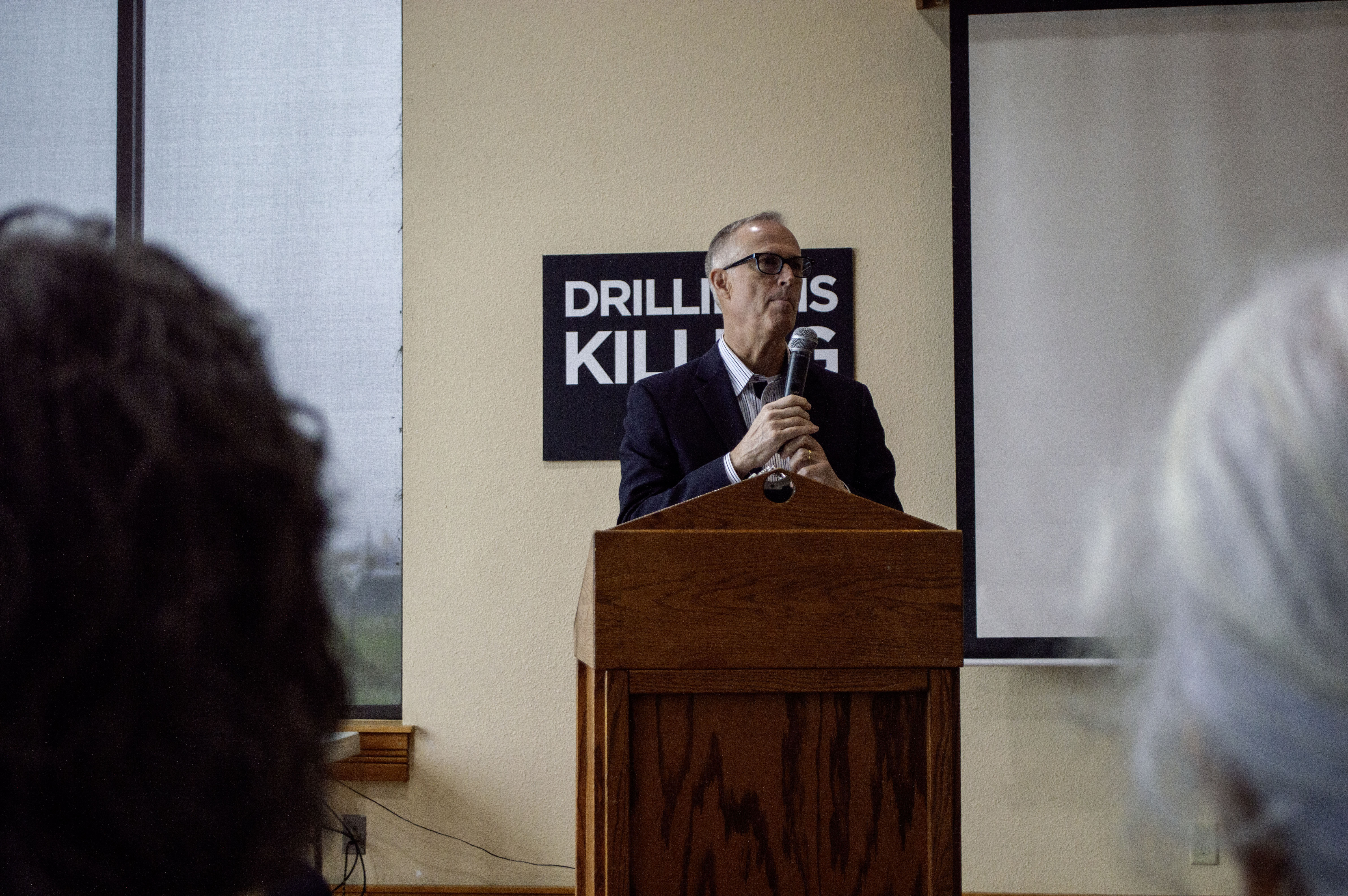
Rep. Jared Huffman addresses the crowd.
The speakers didn’t dive too deep into the specifics of their plans to combat Trump’s proclivity for fossil fuels. Huffman called for legislation that would permanently ban offshore drilling on the West Coast. Connelly mentioned Gov. Gavin Newsom’s 2020 30x30 executive order, which would set aside 30% of California’s land and water for conservation by 2030. Assemblymember Rogers said he was co-authoring a bill with Assemblymember Dawn Addis to block offshore drilling on California’s coast. Supervisor Wilson (who also sits on the California Coastal Commission) brought up the Save My Coast Coalition, of which Humboldt County is a part, that aims to stop offshore drilling.
Eureka city councilmember Kati Moulton spoke about growing up on the Gulf Coast in Texas, kicking at wads of sargassum algae held together by “blobs” of crude oil on the beach, the horizon dotted with oil rigs.
“If you ask the people around there what those are, they say they smell like money. That smells like our local economy,” Moulton said. “Even at their best, they’re a disaster…And then I came up here as a young adult, and Humboldt County really touched me, and I fell in love with this place.”
“I just wanted to point out that there are few communities that could get together and really fight against something, and this is one of them,” Moulton continued. “And I just wanted to echo some of the optimism that I’m hearing, some of the deep-rooted defense of this beautiful place where we are, because if anybody can help make this not happen, it is Humboldt County.”

(PHOTOS) Hundreds Gather for Anti-ICE Protest Outside Humboldt County Courthouse
Isabella Vanderheiden / Saturday, Jan. 17 @ 2:59 p.m. / Activism , Government

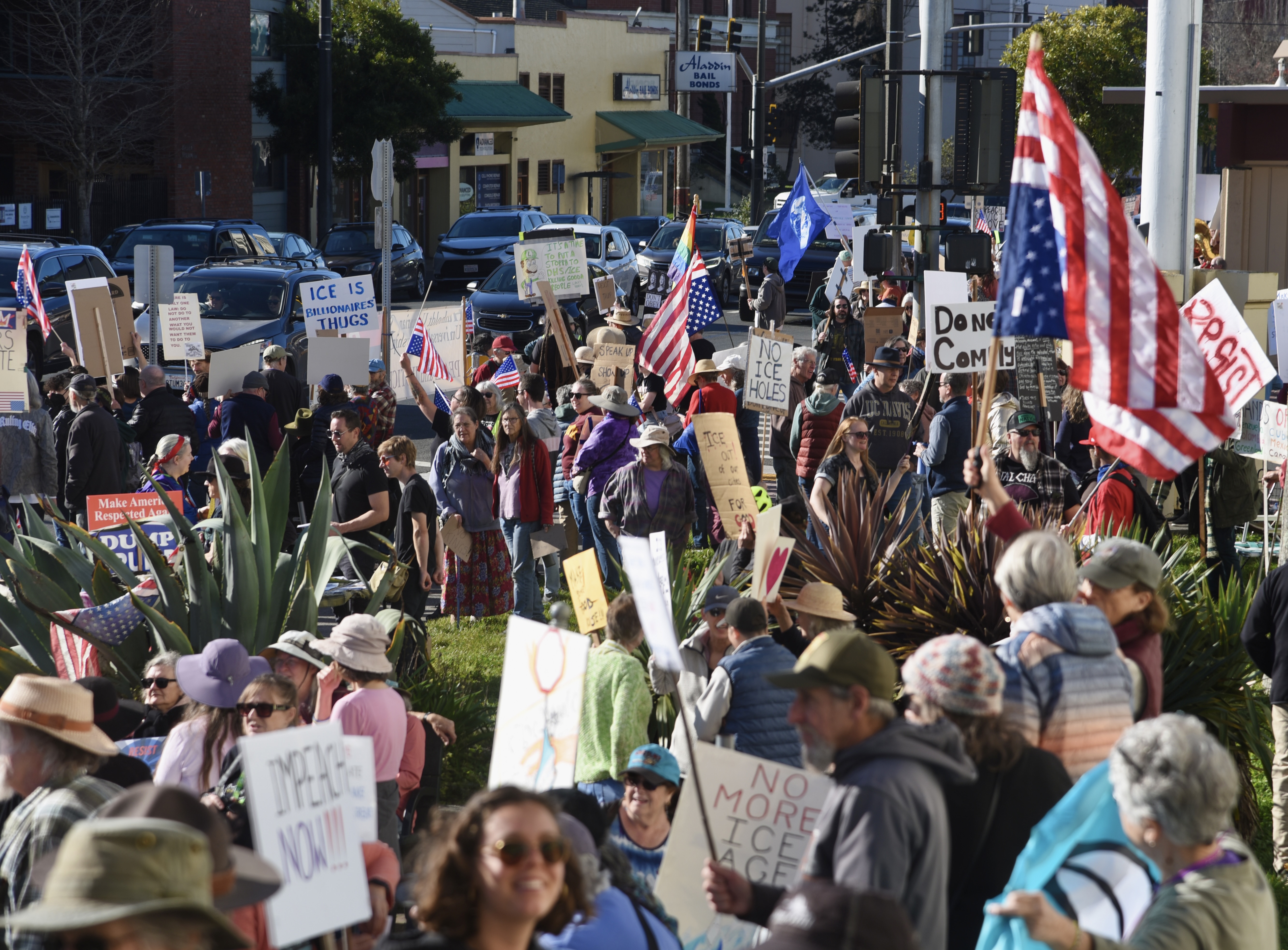
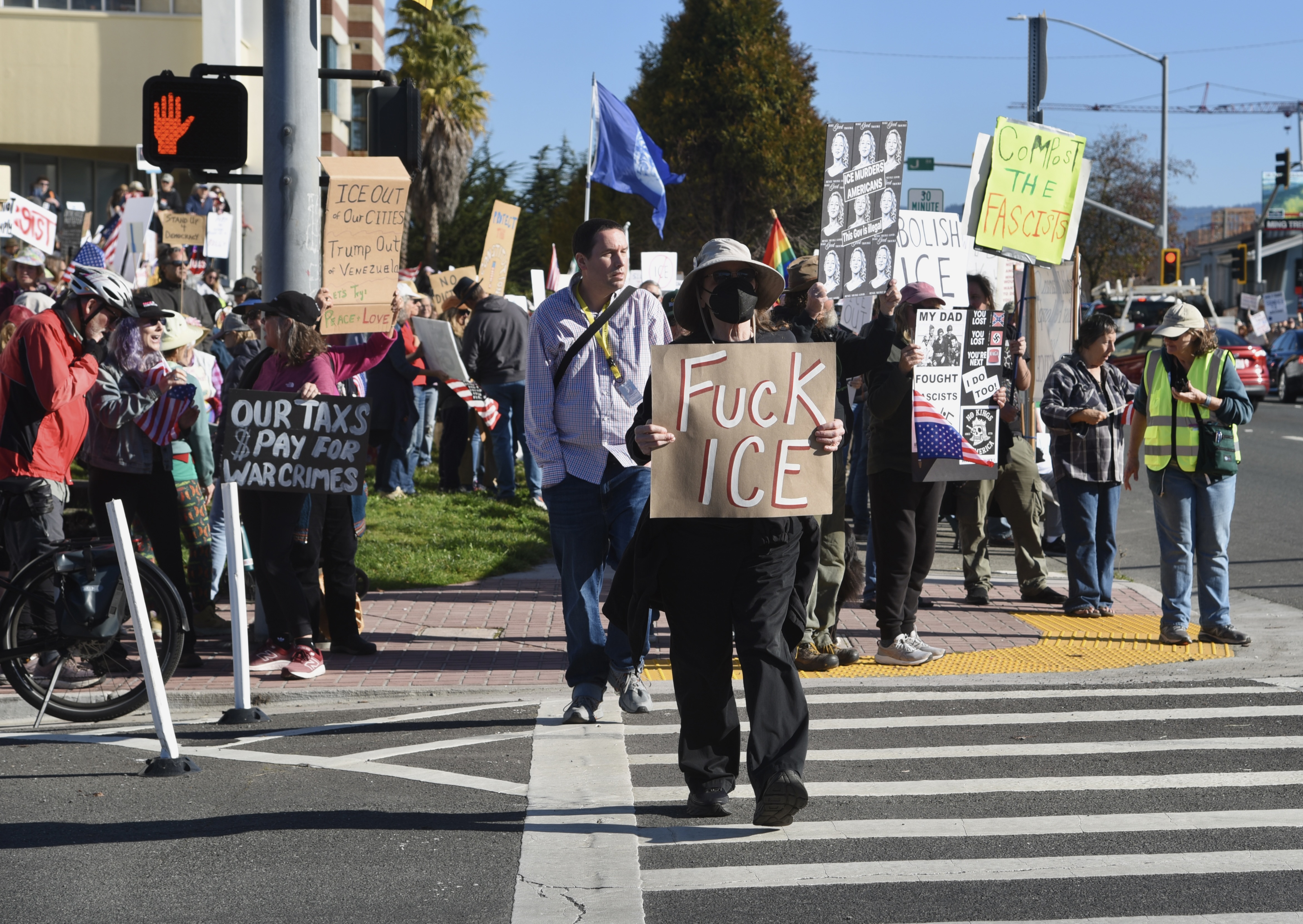
Hundreds of Humboldters turned out for an anti-ICE protest at the Humboldt County Courthouse in Eureka on Saturday. | Photos: Isabella Vanderheiden
###
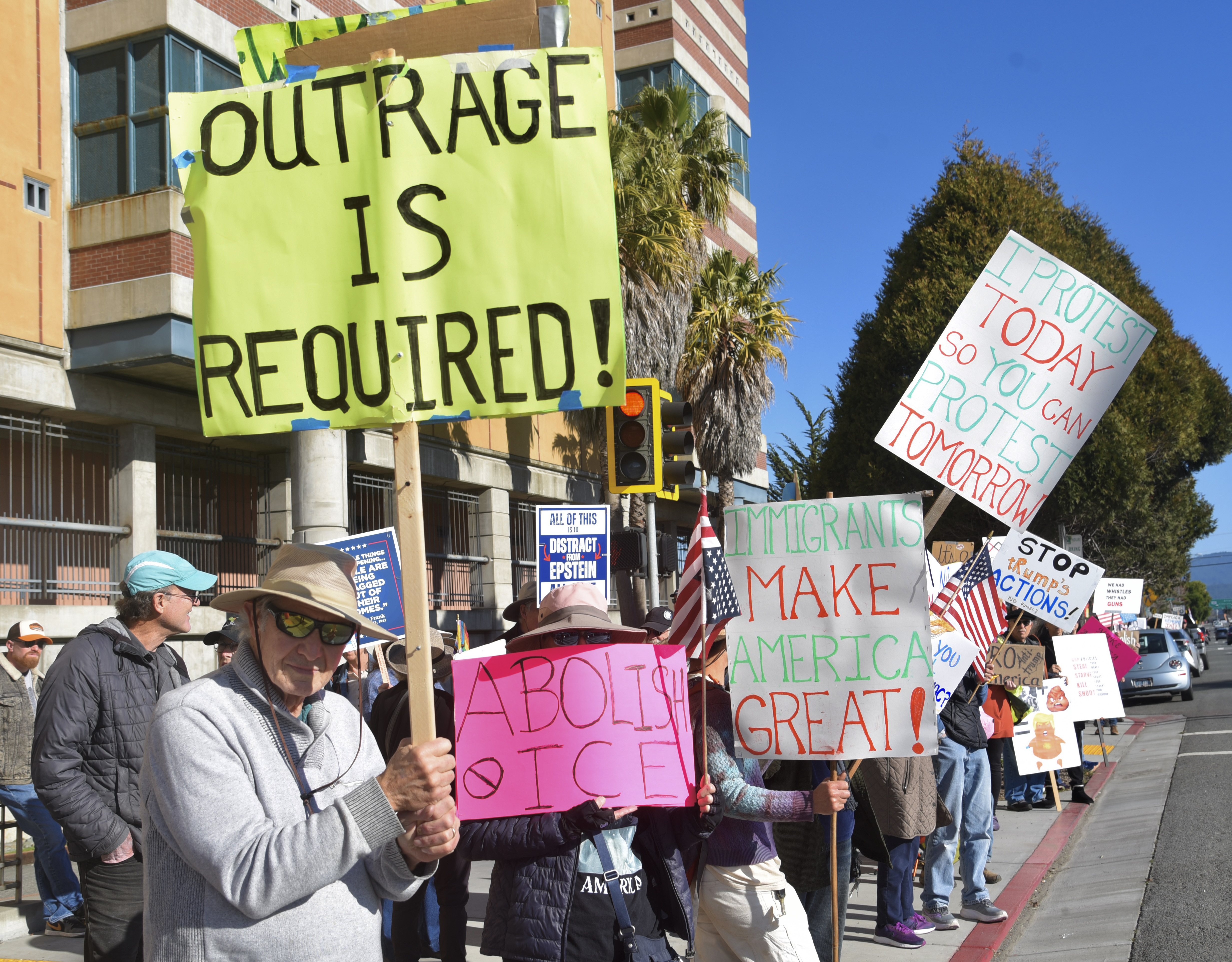
A few hundred peaceful protestors gathered at the Humboldt County Courthouse in Eureka on Saturday afternoon to stand against the Trump administration’s escalating Immigration and Customs Enforcement (ICE) tactics and condemn the fatal shooting of Minneapolis resident Renee Good.
The sign-wielding crowd filled the courthouse lawn and lined both sides of Highway 101 northbound, stretching about two city blocks. Demonstrators were largely cheerful, singing along to protest songs and chatting with their neighbors. The Outpost overhead one of the demonstrators say to a friend, “The thing I like about protests is they’re always fun. They aren’t nasty.”
Several officers from the Eureka Police Department hung out across the street from the courthouse to keep an eye on the crowd. Asked if there had been any issues with the demonstration thus far, EPD Commander Leonard LaFrance said he hadn’t seen anything other than a couple of people standing in traffic and passersby sticking their heads out of sunroofs to wave at protestors.
As usual, your LoCO took lots of pictures of today’s protest. Check ‘em out below.
###




THE ECONEWS REPORT: Climate Action Theatre
The EcoNews Report / Saturday, Jan. 17 @ 10 a.m. / Environment

Image: ChatGPT.
On this week’s EcoNews Report, we are doing something a little different: climate action theatre. Environmentalists drone about the climate crisis a lot, laden with statistics, science, and doom-and-gloom stories, hoping that with just a little more information, people will straighten up and take this issue seriously. What is too often missing is the engagement of our imaginations, essential both to take in the magnitude of the changes happening to our planet and to envision futures where we live within its means.
On this week’s show, Humboldt friends and neighbors perform mini-plays written as part of Climate Change Action Theatre, an international event created to stimulate our climate imaginations. Many thanks to climate advocate Wendy Ring for bringing these plays to life!
Audio below. No transcript this week because it ain’t that kind of episode.
HUMBOLDT HISTORY: The Day They Floated a Complete Two-Story Victorian Across Humboldt Bay
Editor / Saturday, Jan. 17 @ 7:30 a.m. / History

Photo: E.S. Chase, via The Strand.
###
Editor’s note: The story of Humboldt County’s most unusual house-moving project has been told before but not with some of the detail that we have been able to compile for this article. Our thanks go to Eureka resident, Mrs. George (Bobbi) Walker, who called our attention to an article, “How Buildings are Moved,” published in the 1890s in a British magazine called “The Strand Magazine.”
Additional material has been provided by Martha Roscoe, Humboldt County historian.
The house, still standing at the comer of Sixth and N streets, was drastically modified after a fire destroyed the top story in 1935. However, much of its original, impressive ornamentation is still intact. The British magazine item on the house was included in several other accounts of famous moving projects in early U.S. history. The early-day item follows. —HH.
The Strand Magazine, June 1897
An interesting story can be told about the pretty wooden mansion shown on this and the following page, and the operation was certainly one of the most picturesque and scientific feats of modern house-moving. The house belongs to Mr. Ernest Sevier, a prominent lawyer of Eureka, California. It was raised from its foundation in Arcata, a small town near Eureka, and moved on rollers to a marsh on the edge of Humboldt Bay. Here, two large lighters or flat barges, each competent to sustain 300 tons, were in waiting, securely joined together. A square opening had been cut into the edge of the marsh, and in this the lighters were supported with piles, so as to be perfectly stationary at low tide. The house was then shifted to the lighters, and at high tide the piles were withdrawn, and the house and lighters were afloat on Humboldt Bay.
In this fashion, it was towed for eight miles with perfect safety. The house weighed over 100 tons, contained ten rooms, an outside chimney, and was hard-finished throughout. When it reached Eureka, it was transferred from the lighters to the land, in the presence of a crowd of spectators, and then rolled a half a mile within the limits of the City of Eureka … rolling prettily along the street behind a donkey-engine, near its destination. The house was placed on pine timbers, 12 in. by 14 in., running fore and aft, and these again were crossed with other timbers running transversely.

On the move. Photo: J. Vansant Jr., via The Strand.
“The plastering,” writes Mr. Sevier, “was broken in places, but two men repaired it all in one day. Not a panel was started, not a pane of glass broken, and not a brick displaced.” The contractors who moved the house were Messrs. H.M. Mercer and William Berry, and the work was finished in about two months.”
###
Local newspapers printed these items on the Sevier house, also called the Dean house:
Arcata Union, Feb. 23, 1889
Theordore Dean is building a nice residence at the corner of 8th and G streets. [Actually, the site was 7th and G streets. -HH.]

The house in Arcata, shortly after its completion. Unknown photographer, via the Humboldt Historian.
Arcata Union, Oct. 12, 1889
Cards of invitation were sent out last week to a large number of people to attend a house warming at the new residence of Theodore Dean on the corner of 7th and G streets. The party was given under the auspices of the mechanics who performed service in their various callings on building and finishing this model home. The names of the mechanics signed to the invitation cards are: S.R. Wallace, John Bushey, M. Johanson, M. McLeod, W. Boscow, W. Shaffey, T.F. Nicholson, G.N. Stearns, S.B. Clanton, G. Trask, W.A. Trask.
As early as 8 o’clock people began to arrive and at 9 o’clock the house was filled from top to bottom with guests strolling through the rooms, admiring their beauty and convenience and interchanging views in regard to style, finish, etc. The house is an Eastlake cottage containing nine rooms, having two stories and an attic. Mr. Dean, who is an architect and builder himself, superintended the work and made such changes from the established plan of such cottages as were suggested to his taste. Certainly the house is as complete in all appointments as it could be possible to make one of its size. The finish inside is of native wood such as curly redwood, ash laurel and redwood burl. It has high polish and almost dazzles the eye to look at it.
After the crowd had gathered, about 150 in number, J.P. Feaster tuned his violin and with H.S. Stern at the piano and Professor Holland to call, dancing began in the parlor which had been left bare for the purpose. We regret lack of space prevents us from giving a further account of the house.
The Humboldt Times, Oct. 25 1895
Contractors Mercer and Berry have already commenced operations for the removal of the Dean dwelling from Arcata to Eureka and expect to have the structure in position here within a month. As a precaution against accident in transporting the house across the mile of marsh between its present location and tidewater, the route will be planked and timbered to overcome inequalities or soft spots. As the lighters upon which the building will be towed to Eureka cannot be floated nearer than 200 or 300 feet from the dyke, a temporary bridge or wharf will have to be built out to them on the mudflats.
The Humboldt Times, Nov. 15, 1895
Contractor Mercer was in the city yesterday and reported that the Sevier home had been successfully moved onto the lighters at the Arcata dyke and that the steamer Phoenix would start down the bay with the odd tow at noon today. (Sevier purchased the Dean house and had it moved.)
The Humboldt Times, Nov. 19, 1895
The Dean house, which arrived from Arcata by water Thursday, was safely landed at the J St. slip Saturday and is now well on its way up the slope to 2nd St. Contrary to rumors, the building is still intact, chimneys and all, and it is expected by contractors Mercer and Berry that if no accident occurs, the structure will be on level ground on 2nd St. this evening.
The Humboldt Times, Nov. 20, 1895
The Sevier house was successfully hauled up J St. slope to 2nd St. yesterday and last evening had crossed 3rd St. where it rested for the night.
The Humboldt Times, Nov. 23, 1895
The Dean house, brought down from Arcata for Ernest Sevier, is now within one block of its destination on 6th St.
###
Editor’s note from 2026: The house, which stands at 6th and N streets to this day, had a second (third?) notable chapter. Stay tuned to next week’s Humboldt History for that! — LoCO.
###
The piece above was printed in the November-December 1985 issue of the Humboldt Historian, a journal of the Humboldt County Historical Society. It is reprinted here with permission. The Humboldt County Historical Society is a nonprofit organization devoted to archiving, preserving and sharing Humboldt County’s rich history. You can become a member and receive a year’s worth of new issues of The Humboldt Historian at this link.


