Teddy Thollaug eats at the Contra Costa College dining hall in front of the refrigerated food lockers in San Pablo on May 8, 2025. Thollaug works as a student worker at the campus’ Basic Needs Services, which offers weekly free food to low-income students through the lockers. Photo by Florence Middleton for CalMatters.
###
This story was originally published by CalMatters. Sign up for their newsletters.
###
Since 2022, California has been offering free lunches to all students in elementary through high school. But once they reach college, more than two-thirds of students experience food insecurity.
To improve CalFresh outreach and enrollment, California started setting aside annual funds in 2021 for public colleges and universities to establish and operate basic needs centers with food pantries, where students obtain free food staples. The California State University and University of California systems each receive $15 million and California Community Colleges receives $30 million annually. As of 2023, every public higher education campus in the state has a basic needs center and food pantry.
However, for many campuses, these solutions still aren’t enough. To fill the gaps, some have created their own innovative solutions. From free meals to food lockers, staff and students at five campuses around California offer creative alternatives.
Humboldt students level up their food pantry
At Cal Poly Humboldt, through the full-service food program “Oh SNAP!,” students stock the shelves, fill pantry orders and offer CalFresh application support. They also greet their peers as they enter, offering them tea or coffee.
To reduce food waste, students negotiated in 2016 with the campus dining services department to collect unused food to offer at the pantry at no cost to students. The department notifies the basic needs center when leftovers are available; students bring their own containers to package up what they need.
Oh SNAP! has hired a local organic farmer to provide produce and give classes on cooking and gardening. The program also offers pop-up thrift stores where students can fill a bag with clothes and housewares for $5; proceeds go back into the program.
Oh SNAP! “provides peace of mind,” said Anna Martinez, a student studying political science, law and policy at Cal Poly Humboldt. “I don’t have to really worry too heavy on whether or not I can afford food, because if I can’t, there’s always Oh SNAP! I can go to.”
As the social justice, equity and inclusion officer for Cal Poly’s student government, Martinez successfully advocated for the student board to increase funding for cultural foods. She values the sense of community Oh SNAP! provides.
“They’re very welcoming when it comes to different needs,” she said.
The program, vital for the 6,000 students at Cal Poly Humboldt, clocked 30,000 visits to Oh SNAP! last year, according to Mira Friedman, health education and clinic support services lead.
Compton College serves free meals to all
Sara Goldrick-Rab, a Philadelphia sociologist and advocate for college student basic needs, thinks a free meal every day is “exactly what is needed” on college campuses. She conducted a study giving students free, daily meals for three semesters at Bunker Hill Community College in Boston.
“It allowed students to eat in a regular way in the school cafeteria, just like they would in the National School Lunch Program. And lo-and-behold, it increased graduation rates,” Goldrick-Rab said.
Compton College President Keith Curry read about the Bunker Hill pilot program and decided to implement a similar program at Compton. Now, every Compton student — and employee — receives a daily meal. Students also get $20 each week to spend at the campus farmer’s market. Students enrolled in CalFresh receive $50 each week for the farmer’s market and can use their EBT card at campus dining services. The college uses a mix of grants and various campus funds to cover the costs of the meal program.
“We’re doing more than any other community college in the state of California and also nationally,” Curry said. “How many schools can say that students receive one meal per day on their campus from their cafeteria?”
The Compton College campus in Compton. Photo via Compton College
Some California colleges offer a limited number of free meals, such as UC Davis, where a food truck serves between 300 and 400 meals per day and students pay what they want. In fall 2025, West Valley-Mission District in Santa Clara County will begin offering free meals.
Student Corinthia Mims said the first time she entered Compton’s cafeteria, “it was joy, always buzzing,” she said. Her twin, Cynthia Mims, said the free meals bring everyone together like family.
“[Students] feel embraced and they feel important. It’s a feast,” she said.
Feeding students keeps them in school. According to data the college gathered last year, students who received free meals and money for the farmers’ market were more likely to stay in their classes for the entire semester with a completion rate of 1% or 2% higher than the general population.
Curry visits the cafeteria to get feedback from the students. “They’re proud to tell me what they like and what they got today. Because there’s no negative stigma around it, because everyone is treated equally,” he said.
Goldrick-Rab highlights the program at Compton College as an example of what a college student universal meal plan could look like. “It’s a very nice modern version. … It’s not really a cafeteria in the classic sense. It is refrigerators full of prepared meals, the way that adults would go into a Whole Foods and get a grab-and-go,” she said.
In 2019, U.S. Sen. Adam Schiff, a Democrat from California, introduced the Food for Thought bill, which proposes universal meal pilot programs on college campuses. The bill failed and was reintroduced in 2022 and 2023 but never enacted.
Contra Costa College fills food lockers with free meals
At Contra Costa College, students who work full time have difficulty accessing the food pantry during open hours. In April, the college unveiled 20 refrigerated lockers in the campus cafeteria where students can pick up their pre-ordered, free groceries between 7 a.m. and 7 p.m. Monday through Friday. Students order online and student staff fill the orders.
The campus basic needs center, called the Compass Center, also offers free meal vouchers to students three days a week, giving out 50 for breakfast, 75 for lunch and 15 for dinner.
Teddy Thollaug, a first-year student studying art and journalism at Contra Costa College, says they appreciate the hot meals and food lockers, especially on days when their disability makes it too hard to stand and cook. Because Thollaug’s classes are all online, they are not on campus regularly.
Teddy Thollaug at the Contra Costa College dining hall in San Pablo on May 8, 2025. Thollaug works as a student worker at the campus’ Basic Needs Services, which offers weekly free food to low-income students delivered through refrigerated food lockers in the dining hall. Photo by Florence Middleton for CalMatters
A typical order includes fresh fruit and vegetables, butter and cheese, and a “mystery package,” which contains grains, sauces and canned food. “Honestly, I feel like a kid on Christmas every time I open a mystery package,” Thollaug said.
In 2024, the center served 5,008 students and 14,785 families of students, according to Hope Dixon, the basic needs center coordinator.
Antelope Valley College students earn points for food
To encourage and support students to take full course loads, Antelope Valley College initiated Fresh Success, a CalFresh program that “pays” enrolled students in points for enrolled units.
Full-time students get more points, “because that’s our goal. We want you to get your degree, and [if you’re a full-time student,] you’re less likely to be able to run around and get all the other community resources,” said Jill Zimmerman, dean of the Antelope Valley College student health and wellness center.
Fresh Success is part of CalFresh’s Employment and Training program, and is overseen by the Foundation for California Community Colleges. Currently 20 colleges across 18 counties participate in the program, which partially reimburses schools with federal dollars for workforce development services such as job training and job search assistance for low-income students.
Fresh Success allocates points for each unit enrolled, up to 40 points per week. Students use their points at the on-campus pantry to purchase food, toiletries and laundry soap.
For Alliza Wade, having access to Fresh Success means being able to put more time toward school rather than working more hours. Wade, a STEM major at Antelope Valley College, is enrolled in CalFresh but it doesn’t cover all of her food expenses.
“[Fresh Success] has a very, very significant impact on how I’m able to live and eat, and how I’m going to be able to pursue my future, because [it helps with] saving and being able to eat healthy,” Wade said.
Since the college is reimbursed 45 cents for every dollar spent, the Fresh Success program benefits the college as well by providing funds to put towards employment and training support like job-specific clothing and gear, cooking classes and car tune-ups through the campus automotive program.
Cerro Coso feeds students who aren’t eligible for CalFresh
When Lorena Moreno started as the basic needs coordinator in early 2024 at Cerro Coso Community College in the southeastern Sierra region of the state, she noticed that students without permanent legal status were in dire need of assistance. Non-citizens are not eligible for CalFresh.
Moreno tackled the need by creating an on-campus food program called WileyFresh — modeled on Aggie Fresh at UC Davis, which serves students who meet CalFresh requirements but lack citizenship. Eligible students receive a monthly Albertson’s gift card valued at $291, comparable to the amount an eligible single student receives on a monthly CalFresh EBT card.
Like the Aggie Fresh program, students who qualify for WileyFresh are required to participate in workshops that support academic and personal growth. Moreno offers the workshops as a webinar to protect student identities.
The Cerro Coso Community College in Ridgecrest. Photo via the Cerro Coso Community College
Last fall, Moreno increased outreach efforts. Her team of part-time student employees passed out flyers at events to raise awareness. They saw visits to the Wiley Food Pantry grow from about 350 per month in the spring semester to about 500 per week in the fall.
This summer, Moreno intends to expand the program to include more students who can’t enroll in CalFresh. “Because at the end of the day, that’s what it’s intended for — this population who is missing out.”
Research shows students can’t rely on each other’s charity
Many colleges now offer a way for students to donate unused card swipes from their campus meal plans to each other. However, research shows that these donations only reach a tiny fraction of students.
Before 2017, college dining services did not allow students to share their meal plans with other students. This didn’t sit well with students at Morehouse and Spelman colleges in Atlanta. They began a hunger strike to challenge meal plan policies that forbid sharing meal swipes. Their activism convinced their colleges to change the policies and led to a nationwide program, Swipe Out Hunger.
Meal-swipe programs, as they’re called at the approximately 850 colleges nationwide that offer them, allow students to donate unused meal swipes to fellow students who need them. In California, 17 colleges participate in Swipe Out Hunger.
But they are not effective, Goldrick-Rab said. She evaluated Swipe Out Hunger and found that the active programs see just 300 swipes a year.
“At the bottom line, I would rather give people money than food, but I still think the National School Lunch Program is important. I just want all of it. I want the guaranteed basic income. I want a higher minimum wage. Because all of it is scientifically working,” Goldrick-Rab said.
###
Amy Moore is a fellow with the College Journalism Network, a collaboration between CalMatters and student journalists from across California. CalMatters higher education coverage is supported by a grant from the College Futures Foundation.
Kyle David Avelar, 37, passed away on May 18, 2025, in McKinleyville
due to heart complications. Born on October 31, 1987, in Eureka, Kyle
brought light and laughter into the world from the very beginning —
fittingly arriving on Halloween, his favorite holiday.
A proud graduate of
Arcata High School’s Class of 2006, Kyle left a lasting impression
both in and out of the classroom. He was a standout athlete during
his high school years, playing three years of varsity football and
earning both the Circle A and Blanket awards for his dedication and
performance. His leadership extended beyond athletics — he served as
Regional President of the Future Farmers of America (FFA), where he
inspired peers with his commitment to agriculture and community
service.
Kyle’s passion for
horticulture at an early age blossomed into a celebrated talent. He
won multiple awards at the Humboldt County Fair for his flowers—an
achievement that reflected not only his skill but also his deep
connection to nature. Gardening was more than a hobby for Kyle; it
was a way to nurture beauty and share it with others. He even created
a memorial garden for his neighbor Emerald, a gesture that spoke
volumes about his compassion and thoughtfulness.
His love for the
outdoors was evident in his favorite pastimes — camping and river
rafting along the Rogue River were among his most cherished
adventures. Whether tending to plants or paddling through rapids,
Kyle found joy in life’s simple pleasures.
Kyle also gave back
to his community in meaningful ways. He built a Little Free Library
to encourage reading and connection among neighbors — a small
structure that symbolized his generous spirit and belief in sharing
knowledge.
He was an avid fan
of the Sacramento Kings, San Francisco 49ers and Giants, cheering
passionately for his teams through every season. But perhaps nothing
brought him more joy than spending time with those closest to him. He
deeply cherished his role as uncle to Ayva and Axtyn, forming bonds
filled with love, laughter, and unforgettable memories.
Kyle took great
pride in his Portuguese heritage, honoring the traditions passed down
through generations. His family roots were central to who he was.
He is lovingly remembered by his parents Dave and Anne Avelar,
brother Tyler Avelar (Megan), grandparents Darrell and Carol Byard,
aunts Mary Furtado, Olimpia Avelar, Kristie Ghisetti (Troy) and
Shelley Chau (Will), uncles Carlos Avelar (Ruth) and Doug Byard
(Machelle), cousins Diane Sloane (Dave), Steve Furtado (Lorrie),
Mario Avelar (Andrea), Victor Avelar, Kris Avelar (Jessica), Michael
Avelar (Maria), Trevin Avelar (Brianne), Jordan Kauffman (Sam), Ryan
Ghisetti and Luke Chau, niece Ayva, nephew Axtyn, and numerous family
members and friends whose lives he touched with kindness and warmth.
He was preceded in
death by his grandfather Fernando Avelar, grandmother Lourdes Avelar
and uncles Fred Avelar and Angelo Furtado.
Kyle
and his beloved dog, Merlin, are now reunited and will continue their
journey together forever.
Kyle David Avelar
lived with heart, humor, and humility. May his memory bring comfort
to those who knew him and continue to inspire acts of kindness in the
world he leaves behind.
In remembrance of
Kyle’s life, the family asks that any charitable donations be made
to the charity of your choice. A celebration of life will be held at
a later date.
###
The obituary above was submitted on behalf of Kyle Avelar’s loved ones. The Lost Coast Outpost runs obituaries of Humboldt County residents at no charge. See guidelines here. Email news@lostcoastoutpost.com.
A rendering of the proposed Roger’s Garage project. From the City of Arcata.
Seemingly the entire community of Bayside came out to the Arcata city council meeting last night to protest against the proposed Roger’s Garage low-income housing project.
Located across the street from Jacoby Creek Elementary School on Old Arcata Road, the Roger’s Garage project would build 53 new units for people making between 30-60% of Humboldt County’s median income. The property has been zoned for the proposed use since 2008.
The topic came up at last night’s meeting because the council was considering committing $1.3 million Community Development Block Grant (CDBG) Program Income funds to help purchase the property from Danco. The city has to use the Program Income funds soon, before the end of the fiscal year; if they don’t, they may lose access to the CDBG funds, and could be ineligible for this year’s round of grant funding.
The council didn’t end up voting on the resolution. It’ll be back on the agenda on June 4.
Because it was once an automobile wrecking yard, the soil is contaminated with heavy metals like copper, lead, zinc, and cadmium, according to a 2005 metals excavation plan about the property. The city plans on working with the Northcoast Regional Water Quality Control Board to clean the property up, but its questionable environmental state brought dozens of people from Bayside out to the meeting last night to convince the city council not to build the units.
“I’m in support of extended housing and expanding our community,” said one commenter that lives on Hyland Street in Bayside. “But to do so while disturbing the deeply toxic construction site and spreading that toxicity around the neighborhood seems like a grave mistake.”
Many parents of children that attend Jacoby Creek Elementary School, worried about their children’s safety, slammed the idea of building on the tainted soil and potentially harming the students.
“Members of the Arcata city council, I stand before you today with a simple question,” said Michelle Warner, a parent of three Jacoby Creek School students and an employee there. “Are you willing to poison our children for the sake of grant funding?…If you approve this project, you’re telling us that meeting these housing quotas matters more than our children’s health…If this project moves forward, my family’s health is at risk.”
Arcata Director of Community Development David Loya said in an interview with the Outpost today that the comments about toxic dust were “a reasonable concern,” but he also said that the pre-development cleanup of the site included methods designed to contain contamination and remove it safely, as well as ways to prevent “fugitive dust” from leaving the property. The top 12-18 inches would be removed before any construction started.
Many commenters also criticised the project because of its potential negative effects on traffic congestion and parking.
“I have to thank the town for finally repaving Old Arcata Road,” said Bayside resident Miriam Amber. “It’s great. But it’s still pretty crowded…even with the turning lane that goes into Jacoby Creek School, it’s still crowded…It’s going to get a lot worse very soon if a project like this goes through.”
Only two speakers, a representative from Danco and an anonymous Zoom attendee willing to play “Devil’s Advocate,” spoke in favor of the project, citing the need for more affordable housing and the jobs building it would provide.
“Definitely the proper steps need to be taken to protect people’s health and the environment,” the anonymous commenter said. “But we need jobs, we need housing…these are also things that are important.”
Press release from the Humboldt County Civil Grand Jury:
The Superior Court of California, County of Humboldt is requesting that the public submit more
applications for the 2025/2026 Humboldt County Civil Grand Jury (term of July 1st
-June 30th). To
date we have not received enough applications to proceed with our normal member selection process
and timeline.
The primary work of the Civil Grand Jury is to investigate and review citizen complaints concerning the
operations of city and county government, as well as other tax supported and non-profit agencies The
Humboldt Superior Court empanels 19 citizens to act as an independent body of the judicial system each
fiscal year. The Court accepts applications from citizens representing a broad cross-section of the Humboldt
County community. The Civil Grand Jury is currently meeting in-person one day a week and via Zoom one
day a week (their weekly meeting schedule and time commitment may vary from 10-30 hours).
The civil grand jury does not consider criminal indictments.
The application can be found by using the QR code or it can be filled out and submitted at:
https://cty-lf-web.co.humboldt.ca.us/Forms/grandjuryapps. Eligibility requirements can be found on the
first page of the application.
You may complete a paper application at Jury Services in Room G03 (4th Street entrance of the
Courthouse).
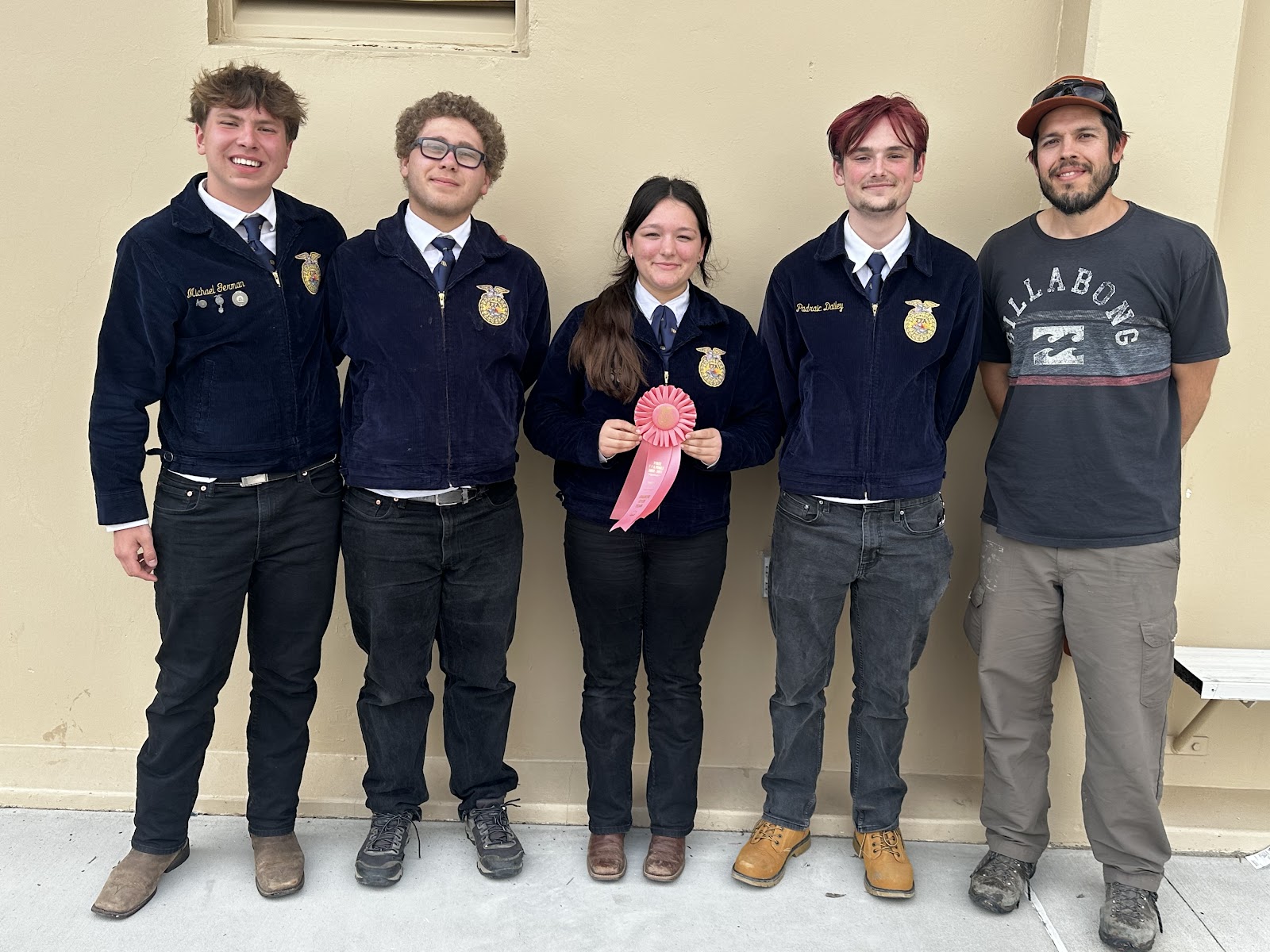
The Eureka High FFA club continues to make Humboldt proud on the big stage. Below, please find a report on their recent strong showings at the Career Development Event State Finals in San Luis Obispo a couple of weeks ago.
As always — or at least until he graduates — this report is from official club reporter Michael German:
FFA (Future Farmers of America), is a High School organization that focuses on teaching students about agriculture, as well as preparing them for the workforce. For the last four months, members at Eureka High School’s FFA chapter have spent numerous hours studying and preparing for their CDE (Career Development Event) competitions, all leading up to their State Finals.
Rabang
On May 3rd, twelve Eureka FFA members traveled to San Luis Obispo to compete in the State Finals for the CDEs. We were lucky enough to have three teams compete, which were Milk Quality and Dairy Foods, Veterinary Science, and Forestry.
After seeing immense success throughout the year, our Milk Quality and Dairy Foods team has been killing it, placing top five high teams at every competition they have participated in, and many of our members placing in the top five high individuals! State Finals had a great turnout for them, with Makela Rabang placing 5th high individual in the whole state.
This was also our first time having a Forestry team in over 10 years, and our team made us so proud, placing 4th high team at State Finals.
The members of all of these teams have put an immense amount of effort and time into studying for their contests throughout the last multiple months, and have all grown exponentially since the beginning of the competition season. We are so proud of you all!
A student works in the library at San Bernardino Valley College in San Bernardino on May 30, 2023. Photo by Lauren Justice for CalMatters
###
This story was originally published by CalMatters. Sign up for their newsletters.
###
Under scrutiny from state and federal lawmakers, California’s community colleges are trying to crack down on financial aid fraud. Scammers have increasingly infiltrated the state’s 116 community colleges, posing as students in an effort to steal financial aid from the state and federal government.
At a meeting Tuesday, the board that oversees California’s community colleges voted to require all students to verify their identity, which is currently optional for most applicants. The board also considered asking the Legislature for approval to charge students a nominal application fee — which many said should be no more than $10. But after more than two hours of debate, the board rejected that proposal and instead asked staff to “explore” a fee policy.
“Some of you were asking questions, ‘Why is this happening so fast?’” said California Community Colleges Chancellor Sonya Christian. “Because on April 8, CalMatters ran an article that got national press. Guess what happened after that? Nine of our congressional leaders emailed the Secretary of Education of the United States and emailed the Attorney General asking them to start an investigation of the California Community Colleges.”
State representatives from bothparties have since called for an audit of the community college system’s financial aid process. Christian said those audits are likely to happen. “We’re on a national stage right now.”
Students from across the state told board members that they were against imposing a fee, sharing stories of times when they were so poor that they didn’t have a bank account or $10 to buy lunch. Many had personal experiences with fake students.
“A bot once took my seat in a class that I needed to graduate and transfer. That fraud almost cost me my future,” said Flo Cudal, a student at Santiago Canyon College in Orange County. “I understand the need for strong protections, but they must not come at the expense of excluding a real student.”
When Love Adu, a student and board member, tried to enroll at Moorpark College, she said she was unable to verify her identity online, so she had to drive five hours to present her documents in person. Incarcerated students, undocumented students, homeless students and students under 18 all struggle with the current ID verification software, she said. “These proposals would make it harder for students to get the very education that we’re trying to serve to them.”
Application fee delayed
California’s community colleges have a mission to serve every Californian and they’re funded primarily based on the number of students they enroll. When applying, students sign an affidavit affirming that their personal information is true. But besides that, only a few college districts mandate online identity verification. There is no fee to apply to community college and tuition is free for low-income students. Once enrolled, a student can obtain thousands of dollars in financial aid, money that can be used to cover the cost of books, housing, food and transportation.
That aid has become an easy target for scammers, who often submit dozens or hundreds of applications at a time, using real California addresses and Social Security numbers in order to create fraudulent college accounts. Last month, CalMatters reported that roughly one-third of community college applicants were fake. The state chancellor’s office said it removed all the fraudulent applicants it detected but many scammers evaded detection and stole taxpayer dollars. In the last 12 months alone, colleges have lost more than $10 million in federal aid to fraud and $3 million in state aid, according to state reports, which CalMatters obtained through a public records request.
Allowing fraud to continue to rise is “irresponsible,” said board member Amy Costa before voting in favor of Christian’s proposal. These “bots” are after government entitlement programs, such as Pell Grants and Cal Grants, and it’s the state’s job to help steward the use of those taxpayer dollars, she said. “We need somebody to say ‘I’m a real person,’ and payment is sort of one of the ways we do that.”
In the proposal, Christian said her office would consider refunding or crediting the application fee to any student with “a demonstrated financial hardship.” Roughly 40% of California’s community community college students qualify for free tuition because they’re considered low-income, according to state data.
Even if the fee proposal had passed, Christian would still need the Legislature’s approval. It would have taken a year and involved many more discussions, including at the board level, Christian said.
But if lawmakers continue to keep the spotlight on this issue, changes could still happen, said Chris Ferguson, an executive vice chancellor with the state chancellor’s office. “If financial aid fraud were to continue to increase, I assure you, at a certain point, there will be measures, whether it’s at the state level or the federal level, that are implemented on us.”
An electric car charges at a station in Union City. Electric cars are a major part of California’s decades-long efforts to clean its air and combat climate change. Photo by Loren Elliott for CalMatters.
###
This story was originally published by CalMatters. Sign up for their newsletters.
The U.S. Senate voted today to block California’s landmark mandate phasing out gas-powered cars, dealing a substantial blow to the state’s aggressive transition to electric vehicles.
The decision to revoke a waiver that the Biden administration granted to California could upend the state’s decades-long efforts and authority to clean up its air pollution — the worst in the nation — and reduce greenhouse gases that cause climate change.
The move by the Senate — following a vote in the House last month — sets the stage for what is likely to become a high-stakes legal and political battle between California and the Trump administration.
Republicans in the Senate and some Democrats in the House who voted in favor of blocking California’s electric car mandate said it is costly and impractical, and prevents consumers from making their own choices.
But Democrats in the Senate who voted against it, including California’s Alex Padilla and Adam Schiff, said the tactic used by Senate Republicans is illegal and that the state’s mandate is vital to cleaning up polluted air.
California Gov. Gavin Newsom, who has made the adoption of zero-emission cars and trucks a top priority, has denounced the move by Congress, vowing that “zero-emission vehicles are here to stay.”
“The United States Senate has a choice: Cede American car-industry dominance to China and clog the lungs of our children, or follow decades of precedent and uphold the clean air policies that Ronald Reagan and Richard Nixon fought so hard for,” Newsom said in a statement on Tuesday, before the vote.Under California’s mandate, 35% of new 2026 model cars sold in the state must be zero-emissions, ramping up to 68% in 2030 and 100% in 2035. It builds on decades of tightening emissions standards for cars sold in the state.
California officials may now have to rely, at least temporarily, on voluntary efforts to clean up cars and trucks in order to meet federal health standards for smog and soot. For instance, state officials could offer financial incentives or rebates to persuade manufacturers to make electric cars and consumers to buy them. The state, however, faces a $12 billion deficit.
Culminating a late-night, marathon session on Wednesday, the Senate vote highlights the growing political division over electric vehicle and air pollution policy as concerns over cost, charging infrastructure and accessibility prevent many consumers from buying them, even in California, which leads the nation in sales.
For almost 60 years, California’s standards for vehicle emissions have been central to cleaning up the air, particularly in the smoggy Los Angeles basin and San Joaquin Valley. Vehicles are still the largest sources of smog-forming gases and fine particles of soot, which can cause respiratory disorders, heart attacks and other serious and deadly health problems.
Because of its highly polluted air and large population, Congress gave California the power to set its own, more stringent vehicle standards under the 1967 Clean Air Act. But before those standards can take effect, the U.S. Environmental Protection Agency must grant the state a waiver for each one.
Before today, over the past six decades, the EPA and Congress have never blocked any of California’s dozens of car and truck rules. Eleven other states and Washington, D.C. have already adopted a version of California’s electric car mandate, according to the Air Resources Board.
“This is a major blow to the decades-long public health protections delivered under the Clean Air Act,” said Will Barrett, the American Lung Association’s senior director for nationwide clean air advocacy. “It is more important than ever that California and all other states…continue to cut tailpipe pollution through homegrown, health-protective policies.”
Senate Majority Whip John Barrasso, of Wyoming, said Republicans reversed a highly unpopular move by the Biden administration.
“They were losers going out the door and they said ‘we’re coming after you — the American people — with our leftist dreams,’ ” Barrasso said. “This is a whole new meaning in California of fantasy land…America can’t meet these impossible standards, not next year, not in 10 years, and the American people don’t want to meet those standards.”
Sen. Shelley Moore Capito, a Republican from West Virginia, called California’s zero-emission standards for both cars and diesel trucks extreme and a threat to the economy. “I want to be clear, I have no problem with electric vehicles. Consumers should be able to purchase the vehicle of their choice, but I do have a big problem with electric vehicle mandates that replace the will of the consumer and the will of the government,” she said on the Senate floor on Wednesday night.
The Senators mostly voted along party lines. Fifty-one senators voted to rescind the electric car mandate waiver, while 44 voted against it. Some Democrats joined Republicans in voting for it.
A view of the Los Angeles skyline during wildfires on February 14, 2025. The region’s poor air quality comes not just from fires but also cars, trucks and industries..Residents in inland parts of the LA basin breathe unhealthful air more than 100 days a year. Photo by Joel Angel Juarez for CalMatters
“I wonder if any other member of this chamber grew up like I did, where on a pretty regular basis, we would be sent home from grade school because of the intensity and dangers of smog that settled over the San Fernando Valley, the city of Los Angeles,” Padilla said during a Senate session on Tuesday, ahead of the vote.
Schiff said on X Wednesday night that Senate Republicans are “doing the bidding of the oil industry,” after Trump promised to help them if they donated $1 billion to his campaign. He said it will mean “Californians and others will be breathing dirtier air, as will others around the country.”
The Senate today also plans to vote on blocking two other California rules approved by Biden’s EPA. One is the Advanced Clean Trucks rule, which was enacted in 2020 and requires manufacturers to meet ramped-up targets for zero-emission heavy and medium-duty trucks for 2024 through 2035. The other is a regulation reducing nitrogen oxides — a key ingredient of smog — emitted by trucks and buses.
President Donald Trump has long opposed California’s unique authority to set its own limits on emissions from cars and trucks. On his first day in office, Trump issued an executive order that aimed to eliminate federal and state electric car regulations and subsidies and restore “consumer choice in vehicles.”
“Trump and his congressional allies have declared war on the environment and this is the first major legislative battle,” said Dan Becker, director of the Center for Biological Diversity’s Safe Climate Transport Campaign.
Included weretwo California House Democrats, both of whom represent districts in the smoggiest part of the state: Rep. Lou Correa of the 46th District in northern Orange County, and newly elected Rep. George Whitesides, from the 27th District in northern Los Angeles County.
“As Americans, we all want to do our part to protect the environment. As a lawmaker, my primary job is to listen to my neighbors and respect their choices to do what is best for their families and their circumstances. That means protecting consumers’ rights to drive whatever vehicle makes sense for them and their pocketbooks,” Correa said in an emailed statement.
California’s mandate has come under fire from auto dealerships and some car manufacturers who once were more in line with the goals of aggressively requiring more sales. Sales of electric cars have undergone a bumpy road, taking off in the post-pandemic years, but they did not increase last year.
About 23% of all new cars sold in California were zero emissions during the first three months of this year, compared to 25% for all of 2024 and 2023, mostly because of a drop in Tesla sales. Californians own 2.2 million zero-emission cars; about 150 models are now sold in the state, 40% more than a year ago, according to the California Energy Commission.
John Bozzella, CEO of an alliance of automakers, in a statement earlier this month welcomed the move by Congress, saying it would “prevent the inevitable jobs and manufacturing fallout from these unachievable regulations.”
The Biden administration’s EPA granted the waivers for California’s electric car mandate and nitrogen oxides truck rule late last year, and for the zero-emission truck rule in March 2023. Under the federal Clean Air Act, the EPA can only legally reject a waiver if it’s “arbitrary or capricious,” unnecessary for addressing air pollution or technologically infeasible due to inadequate lead time.
“Congress voted decades ago to allow California, with the nation’s most smog-choked cities, to adopt stronger vehicle air pollution standards,” Becker, a clean-air advocate, said. “This vote will set a dangerous precedent of overturning state law protecting tens of millions in California and 11 other states that have adopted its strong clean air protections.”
The Senate’s votes could set up a legal challenge from the Newsom administration. Experts say the state could sue claiming improper use of the Congressional Review Act.
That law is meant to allow a new administration to revoke rules recently enacted by the previous administration. But it applies only to regulations, and experts say the waivers are not regulations so they cannot be revoked by Congress. In addition, the three waivers are already in effect, and one was issued more than two years ago, outside the time limits of the review act.
“We’re just in a completely new territory…Congress seems to be willing to use a statute that doesn’t apply, which is highly unusual. We’ve never seen this before.” — Ann Carlson, UCLA law professor
UCLA law professor Ann Carlson said Congress is violating its longstanding practices. She called the decision “totally norm-busting.”
“We’re just in a completely new territory,” she said. Congress “seems to be willing to use a statute that doesn’t apply, which is highly unusual. We’ve never seen this before.”
Carlson said by using the Congressional Review Act, lawmakers are seeking to move fast — bypassing the courts and a potential filibuster.
Big rigs exit the Port of Los Angeles in San Pedro. Heavy-duty trucks are a major source of soot and smog in the region. Photo by Joel Angel Juarez for CalMatters
Combined, the three regulations are designed to eliminate tons of soot and gases from cars and diesel trucks that pollute California’s air by requiring manufacturers to switch to cleaner vehicle technologies.
The stakes are high: The state still has some of the worst air pollution in the country, and failure to meet federal health standards for smog and soot could trigger economic penalties, including the loss of highway funding. People in low-income communities of color are particularly exposed to the unhealthiest air.
Congress’ repeal of the rules follows an earlier blow to California’s efforts to clean the air. Days before Trump’s inauguration, the state Air Resources Board abandoned two of its groundbreaking standards because Trump’s EPA was unlikely to grant waivers for them.
One of them would have amped up California’s earlier zero-emission truck rule by ending the sale of new diesel trucks in 2036 and requiring large companies to convert their fleets to electric or hydrogen models by 2042.
The other abandoned rule would have required railroads in California to transition new diesel locomotives to ones powered by electricity. Under that rule, only locomotives less than 23 years old could operate in California after 2030 unless they were zero emissions.