

TO YOUR WEALTH: Investing Reveals Who You Are: 6 Ways to Build Character and Wealth When You’re Not ‘Rich’
Brandon Stockman / Sunday, May 18, 2025 @ 7 a.m. / Money
I heard one person describe the stock market as a gauge of rich people’s feelings. That’s funny, but overstated. It comes from the overly simplistic Main Street versus Wall Street adage.
Nevertheless, does investing matter for those who aren’t “rich”?
After all, Humboldt County, the home of Lost Coast Outpost, is not considered an affluent county. The median household income is $61,135 per year which is the 7th lowest in the state¹, and 16.7% of the population is in poverty.²
What about those who want to develop healthy financial habits? Where should they start?
First, divest yourself of resentment. Resenting “rich” people may make for punchy social media posts for a particular demographic, but it corrodes and does not inspire self-development or the development of others. Deconstructing everything builds nothing. You can work toward offering solutions for the increasing wealth gap in America, but cynicism alone is not the answer.
The comedian Conan O’Brien, after suffering a setback of losing a popular talk show, said it wisely:
Please do not be cynical. I hate cynicism. It’s my least favorite quality—it doesn’t lead anywhere. Nobody in life gets exactly what they thought they were going to get. But if you work really hard and you’re kind, amazing things will happen.³
His last sentence is far too karmic—amazing things don’t always happen, but his attitude is a model for moving forward in a positive direction.
None of this undermines the reality of many people being in challenging situations who must rely on the financial help of others. Still, there are others for whom the help they need most—even if it’s hard to hear—is to be told to stop asking for it.
Second, before you begin investing money, invest in yourself.
Investing in yourself is not code for following your heart. You may need to spend most of your time in a job you don’t like that simply pays the bills and then use your spare time to follow your passion. The job you don’t want may end up becoming the pathway to fund the job you’ve always wanted.
The key is to never stop learning—be it in an official academic setting or an apprenticeship in a trade school. Find mentors. Take responsibility. Sharpen your craft. Work hard wherever you’re at.
Seek knowledge that, as investor-philosopher Naval Ravikant puts it, is timely and timeless:
If you become a world-class expert in machine learning just as it takes off and you got there through genuine intellectual interest, you’re going to do really well. But 20 years from now, machine learning may be second hat; the world may have moved on to something else. That’s timely knowledge.
If you’re good at persuading people, it’s probably a skill you picked up early on in life. It’s always going to apply, because persuading people is always going to be valuable. That’s timeless knowledge.⁴
Combine both and then start somewhere. Now is better than tomorrow because, as someone once put it, “action is the antidote to anxiety.”
Third, once you establish an income, save it, invest it, and attempt to increase it.
Start an emergency savings account and a retirement account. Begin saving one portion of your paycheck and investing another portion of your paycheck automatically. If you have a job with a 401k or the like where a company is matching funds, take all the free money you can by contributing up to whatever they match.
Investing is important, but investing in the stock market with a small amount of money is not normally going to fix all your money problems. Nick Maggiulli, a personal finance author, writes,
With small amounts of money, the total return over the course of a year will be trivial. It would be far better for an individual to focus on saving more money (or growing their income) than worrying about what return they will get in the short run.⁵
It’s too easy to fall into complacency and not seek to increase your income. This can singlehandedly increase your ability to save and invest. Don’t leave this out of your financial plan. Try asking for a raise, starting a side hustle, networking with new people, or looking for a better paying job.
Fourth, treat investing as a lifelong habit and not a single moment in time. The most recent market activity around tariffs this year is a great illustration. If you were investing the last few months by gut feeling or political tribalism and market commentary, how would you have known exactly when to buy and exactly when to sell and not made a mistake along the way? While timing can be your worst enemy, time in can be your best friend.

Be a gardener more than a gambler. Sure, you might hear of the thirty-year-old dude who took out a HELOC a few years ago, put it in Bitcoin or bet big on Draft Kings (yes, I know those aren’t the same things), and is now rich taking Instagram photos on the beach with his wife drinking piña coladas. It may have worked, but it ain’t wisdom. That could have ended in debt, too much drink, and no wife.
Investing should be a lifestyle, not a lottery ticket. It should be automatic and not just when your nervous system feels like it or your friend found the latest get-rich-quick idea on Reddit.
Fifth, invest consistently to unlock the magic of compound interest. I think it was Benjamin Franklin (didn’t he, along with Mark Twain and CS Lewis, seem to say everything?) who said, “Money makes money. And the money that money makes, makes money.” This is true only if you invest it and don’t just bury it or let it sit in an account doing next to nothing. Unsaved and uninvested money gets eaten by inflation. Money compounded by interest multiplies. Here is a visual:

The younger you are, the better this works out. Investopedia illustrates the power of compound interest by comparing three scenarios over 50 years: investing $7,000 annually (the current IRA contribution limit) in the stock market could yield $4,342,407, while the same amount in a high-yield savings account might grow to $1,312,035, and in a standard savings account to just $395,946.⁶ Obviously this uses past stock market history and present interest rates, but the point is clear: equity ownership, though risky, has been one of the best places to invest to crush inflation and grow capital.
You know who else knows the magic of compound interest? Credit card companies. So, if you are prone to use them and not pay them off, avoid them. The dark magic of credit card debt has kept many under the spell of crushing and ever-increasing balances. The sorcery of “the minimum payment” can make you feel like you are making progress when oftentimes you are spinning your wheels. Make compound interest your friend through intentional investing, not consumer indebtedness.
So much in life compounds. Trauma. Tiny decisions. Addiction. Exercise. Love. The long-term effects can be ruinous or rewarding.
Sixth, aim at a long-term legacy, not status. Wealth building has an inverse relationship with status-seeking. There is no shortage of cocky rich people flamboyantly displaying their wealth, nor is there a shortage of cocky indebted people flamboyantly displaying their spending. Status-seeking, or as some like to call it—pride—is not simply a deadly sin but a deadly life decision. If you’ve “won at money” but have left a legacy of hoarding, hubris, and broken relationships, you’ve lost. Instead focus on long-term outcomes for your future self, your family, and your community over the short-term gratification of self-appeasement and the approval of others.
Our money habits have a revelatory power. They unveil what we truly value and who we really are.
Whether you consider yourself rich or poor, everyone alive invests.
What does how you spend, save, and invest your money say about you?
–—
Sources:
1. Taken from United States Census Bureau. Accessed online: (March 26, 2025).
2. Taken from United States Census Bureau. Accessed online: (March 26, 2025).
3. “Conan O’Brien’s Farewell Has Lasting Impact”, Breeanna Hare, CNN. Accessed online: (February 16, 2010).
4. “Finding Time to Invest in Yourself” (January 13, 2020). Accessed online.
5. “Saving is for the Poor, Investing is for the Rich” (April 4, 2017). Accessed online.
6. “Can You Grow an IRA to Millions or Even Billions” (March 20, 2025). Accessed online.
# # #
Brandon Stockman has been a Wealth Advisor licensed with the Series 7 and 66 since the Great Financial Crisis of 2008. He has the privilege of helping manage accounts throughout the United States and works in the Fortuna office of Johnson Wealth Management. You can sign up for his weekly newsletter on investing and financial education or subscribe to his YouTube channel. Securities and advisory services offered through Prospera Financial Services, Inc. | Member FINRA, SIPC. This should not be considered tax, legal, or investment advice. Past performance is no guarantee of future results.
BOOKED
Today: 6 felonies, 9 misdemeanors, 0 infractions
JUDGED
Humboldt County Superior Court Calendar: Friday, Feb. 13
CHP REPORTS
0 SR36 (RD office): Chain Control
250 Mm271 S Men 2.50 (HM office): Closure of a Road
ELSEWHERE
100% Humboldt, with Scott Hammond: #108. Leslie Castellano—Art, Transit, And A Kinder Eureka
RHBB: RV Fire Near Founders Grove
Politico Magazine: The Friday Read ‘The Industry Comes In and Kills the Work of Local Citizens’
The Guardian: Anatomy of an upset: how Ilia Malinin lost Olympic figure skating gold
SPRINTING ACROSS AMERICA: Denver to Houston – Week Three of Our Major League Baseball Tour Across the Continent
Tom Trepiak / Sunday, May 18, 2025 @ 7 a.m. / Sprinting Across America
Three games this week – home games for the Rockies, Rangers and Astros – as the MLB tour continues. Week One featured reports on home games for the Athletics, Giants, Dodgers, and Padres. Week Two included home games for the Angels and Diamondbacks.

Coors Field. By Thelastcanadian - Own work, CC BY-SA 4.0, Link
Game #7: Padres versus Rockies at Coors Field, May 10
It’s not easy being the worst team in baseball. Each day is a new challenge for the Rockies to underachieve. The fans are still coming out to games, but they are not happy. Fans with bags over their heads make their displeasure known – but they still stay until the final out. “Living in Colorado, we’re used to some kind of winning,” said Antonio “Kreskin” Rivera. “We have the Broncos and Nuggets. It’s disheartening to watch the Rockies.” More on the “Kreskin” moniker later. Rockies owner Dick Monfort is coming under fire from fans. After the seventh inning, one fan who was seated in our row left the game, but made sure I heard his parting shot for Monfort: “Put this in your blog: Sell the team!”
Game atmosphere: Positive
The Padres started fast – and in the middle of the 5-run first inning, Jada Thomas asked her boyfriend, Antonio “Kreskin” Rivera, “Do they have the mercy rule?” The Amazing Kreskin’s response: “Not even if they score 20 runs.” After six innings the score was 20-0. The closest thing to mercy was the Rockies giving their pitching staff a break by offering up catcher Jacob Stallings to pitch the final two innings. It turned out to be quite entertaining for the remaining fans with some of Stallings’ pitches clocking in under 37 mph. And he struck out a batter!
Despite the early indication of a blowout, and a football-score final with the Rockies losing 21-0, more than a third of the 38,000 in attendance stuck it out to the last out. Granted, many of those were likely Padres fans. But the bagged-headed fans stuck it out as well as many other Rockies fans. And the fact that the worst team in baseball is still drawing 38,000 fans shows that this town is not giving up on its Rockies.
Why so many people in attendance for such a bad team? Two reasons: First, very cheap tickets. Second, they know they will get a good show overall even if the baseball team is not providing it. The cheap tickets are in a section called the Rockpile. It’s the uppermost section of the stadium but tickets are only $1 for fans 12 years of age and younger or 55 years of age and older. And $5 for anyone else. They are only available starting two hours before game time. The good show for this game included a pregame parade of more than 1,000 youth baseball and softball players, and the national anthem performed by a choir of 100 elementary students. The between-innings video fillers are mostly live interactive contests with Rockies fans. During the “Hat Shuffle”, instead of collectively trying to guess which cap has the ball under it, fans get to try to help one fan win a cap by helping them pick out which cap has the ball under it. … In this game the fans did The Wave the entire bottom of the sixth inning. I’m not a fan of The Wave because fans pay attention to the wave and stand up in front of those fans who are trying to pay attention to the game. But Rockies fans get grace this time because by the bottom of the sixth there was no longer a reason to keep watching the game.

Disgruntled Rockies fans. Photo: Trepiak.
Ballpark cuisine: Neutral
Why Famous Dave’s – a food truck in the left field stands - doesn’t get all the concession business at Coors Field is a mystery. Their specialty sandwiches, ribs and rib tips offered at their restaurants are also offered here. The ballpark fare special is the BBQ Mac & Cheese Bowl: Mac & Cheese topped with your choice of pork, pulled chicken or BBQ brisket. “The Mac.& Cheese Bowl is not offered in the restaurant,” said Famous Dave’s Tyler Massey. “It is a specialty item only for Coors Field and it’s our best seller. A lot of people come back for it.” Dey Barrandey will be one of those returners. After her first taste, she was a believer. “It’s very juicy and very flavorful. I would definitely get it again.”
Most of the other offerings at the park are standard fare, aside from the Rocky Mountain Oysters at the concessions in Section 144. … The Helton Burger Shack was particularly disappointing. … There are a couple of unusual stops on food row – a gluten free menu and a Kids Favorite menu with prices under $4. Another favorite is Berrie Kabobs which features your choice of fresh strawberries and banana, frozen cheesecake, or strawberries and brownie bites - each on kebobs swirled with white and milk chocolate.
There was also a crazy Amazon concession where you go in, tap your credit card, grab your food, and leave - and your credit card is charged automatically. (How did these Rockies season tickets get on my credit card??)
Club hospitality: Positive
The Rockies provided parking and two tickets down the left field line, 16 rows up.
Game details: Padres win 21-0. Attendance 38,423. Time of game: 2:35.
Helpful tips: Bring your own water bottle/tumbler. There are many hydration stations and the water is cold and filtered. … Parking is nearby for $20 or $18. … Bags must be clear but regular-sized purses are okay.
You don’t see that every day: Twenty-one runs scored – the second most by a team this season, and the most in Padres history. (The Reds scored 24 on April 20 versus the Orioles.) … Stephen Kolek pitched a complete-game shutout. There were only 16 of those in 2024 – and only 26 complete games total. The odds to see a complete game on this trip were 3:1, and 5:1 against seeing a complete-game shutout. (One guessing game question is now answered: Yes, we will see at least one complete game during our 30 games.) … The Rockies manager Bud Black was fired after the game.

Game 8: Rockies versus Rangers at Globe Life Field, May 13
Globe Life Field opened in 2020 and it still seems brand new. Clean, shiny, comfortable, air conditioned. “We’re not outside agonizing in the Texas heat anymore,” said Rangers fan John Nicolini. “There is not a bad sight-line in the stadium, and I’ve been on every level.” On this day at first pitch (7:08 p.m.) it was 92 degrees outside and 74 degrees inside. What sets Globe Life Field apart from most other baseball stadiums is its roomy concession areas with plenty of seating areas. And so many bathrooms that waiting in line is a rarity. The only downside is that there were not drink stations, only drinking fountains. And the water at the drinking fountains was clown water, i.e., it tasted funny.
Game atmosphere: Positive
“We’re coming off a World Series championship (2023), so all games here have a good energy,” said Nicolini. Attendance was down because the Dallas Stars hockey team was playing a home playoff game the same night. Still, that did not dampen the enthusiasm. The baseball-hockey connection showed itself in two ways. First, during the national anthem the words “stars” and the “star” part of “star-spangled” are amped up by the crowd. Second, each Dallas Stars goal was shown on the big screen to wild acclaim. (The Stars won that night, 3-1.)
Besides the hockey highlights, the game book-ended the crowd enthusiasm with great excitement early (the first six pitches the Rangers saw ended up with a single, single and homer for a quick three-run lead), and more excitement late when closer Shawn Armstrong struck out the side to end the game.
Ballpark cuisine: Positive

The eventual consumers of the Boomstick Hot Dog are Megan and Tommy Falcon. Megan graduated from Eureka High in 2009.
Fulfilling its “everything is bigger in Texas” motto, in Section 132 you will find a 24-inch hot dog called the Boomstick. This year they added a 26-inch Boomstick Burrito and a Triple Play option that has a hot dog, hamburger and nachos. The Boomstick is a 1-pound all-beef hot dog topped with chili, nacho cheese, grilled onions and jalapenos. It comes with its own carrying case. Sometimes bigger is not better; bigger is just bigger. But will fans order these massive food portions just for the challenge of eating the whole thing? The answer is, yes, of course they will!
The heart of the concession offering is Hurtado Barbecue with Loaded Brisket Nachos, Smoked Wings, Brisket Sandwiches, and a Birria Quesadilla. Hurtado is a popular local barbecue joint with four locations – five if you count Globe Life Field. Generous portions of brisket are loaded on the nachos – and you can also get the brisket on a baked potato.
Other dining options include Whataburger, Lobster and Mac (lobster mac or lobster roll), Blue Mint Asian Cuisine (crazy noodles), and Going Going Green (vegan nachos or vegan hot dog). There is also an all-you-can-eat section where for $75 your seats include all you want of chicken sandwiches, hot dogs, snacks and drinks.
Club hospitality: Positive
The Rangers have vaulted into the No. 1 spot for club hospitality, providing your LoCo correspondents with media credentials. We were free to roam the park as desired, including pregame field access.
Game details: Rangers win 4-1. Attendance 19,924. Time of game: 2:28.
Helpful tips: No backpacks allowed. Purses okay. One sealed water bottle per guest is allowed, and outside food is allowed as long as it is inside a clear, sealed quart-size plastic bag. Parking is plentiful and costs $25 to $55.
You don’t see that every day: Three swinging and three looking. Starter Mark Leiter for the Rangers struck out the side in the fourth inning, and each strike out was on a swing and miss. (Seven of his 13 pitches that inning were swing and misses.) Then, in the ninth inning, the Rangers reliever Shawn Armstrong struck out the side and each strike out was a called third strike.

Daikin Park. By Another Believer - Own work, CC BY-SA 4.0, Link
Game 9: Royals versus Astros at Daikin Park, May 14
Houston became a Major League town in 1962, the year of the great baseball expansion. They began as the Colt .45s but Houston’s prominence in NASA’s space program called for a change in names in 1965. The team, its new domed stadium and even its turf (needed because the original natural grass playing surface died) all became astronaut-related. Astros. Astrodome. Astroturf. Thankfully, the Astrodome and Astroturf are things of the past. There was nothing as sterile as watching a baseball game in the Astrodome. And Astroturf contributed to tens of thousands of knee injuries nationwide. But the Astros keep plugging along. Daikin Park (formerly Minute Maid Park; formerly Astros Field; originally Enron Field) opened in 2000.
Game atmosphere: Positive
Daikin Park has an old-school intimate feel to it but with all the modern amenities you expect. The left-field side of the stadium is the comfort side. That’s where a train moves along an 800-foot track; it’s where the manually-operated out-of-town scoreboard is located; and it’s where see-through panels allow for a view of downtown Houston. And if you’re seated on the first-base side, still bring your hat even though the roof will likely be closed. You’ll need it for the 20 minutes the sun sets and shines through the panels. The right-field side of the stadium has the massive video screen and it’s where the fireworks erupt after Astros home runs and victories.
“The fans are high energy here,” said lifetime Astros fan and current season-ticket holder Robbie Schubert. “I’ve been going to games my entire life, and I like that they carried some things over from the Astrodome such as the fireworks.” It was not a huge crowd for a Wednesday night game against the Royals, but it sounded like one. Every Astros milestone was met with raucous cheering, engine and horn noises from the train, flashing lights and booming fireworks. Home runs, defensive gems, an eighth-inning rally. Most fans stayed until the final out.
You can also count on a comfortable air-conditioned environment when the roof is closed, like it was for this game. Ushers and game personnel were especially friendly at Daikin Park.
Ballpark cuisine: Positive
The Chicken & Waffle Sandwich rises to the top of the list: crispy fried chicken breast, pepper jack cheese, bacon onion jam, honey chipotle aioli, and two Belgium-style waffles with a generous pouring of maple syrup. Best chicken sandwich ever. You will find it at the Fry-4-3 locations in the 200 and 400 levels of the park. Another go-to is the Mac Daddy Dog – a footlong angus beef frank loaded with chopped brisket, mac & cheese, dill pickles and barbecue sauce. Best ballpark hot dog so far.
There are plenty of other options as well: Beef empanadas, SmokeShack burgers (with cherry peppers and applewood-smoked bacon), Astronautchos (burnt ends, barbecue aioli, jalapeno slaw, pico, green onions and jalapenos), and a limited Chick-fil-A menu (chicken sandwiches and wraps).
Club hospitality: Positive
The Astros provided two tickets 35 rows behind the first-base dugout, parking and a guest credential which allowed us to wander within the stadium.
Game details: Astros win 4-3. Attendance 24,641. Time of game: 2:29.
Helpful tips: Parking is available from $20 to $45 but be prepared for post-game gridlock. Food and bottled water are allowed into the park. Food must be in a clear, plastic bag no larger than one gallon in size. Regular-sized purses are okay.
You don’t see that every day: Pinball double up the middle. Often when a batter hits the ball up the middle, the pitcher’s reflex is to try to nab it and, as a result, he often knocks it away from what would have been an easy play for a fielder. Maikel Garcia of the Royals hit a ball up the middle in the top of the fifth, and pitcher Shawn Dubin successfully side-stepped it as it bounced over the pitcher’s mound. But instead of finding its way to a fielder’s glove, it ricocheted off second base and into left field, turning a ground ball into an RBI double.
###
Tom Trepiak is the former sports information director at Humboldt State and a member of the Cal Poly Humboldt Athletics Hall of Fame.
THE ECONEWS REPORT: Pope Francis’ Environmental Legacy
The EcoNews Report / Saturday, May 17, 2025 @ 10 a.m. / Environment

Detail from a promotional image for “The Letter,” a Laudato Si’ film.
###
Pope Francis centered the climate crisis during his papacy, highlighting the moral obligations that we all share to our fellow humans (especially the poorest among us, as they will be disproportionately impacted by climate change) as well as our responsibilities to the Earth itself. In 2015, Pope Francis released his first encyclical, Laudato si’: On Care for Our Common Home, a 40,000 word treatise on both the Biblical mandate to care for creation but also a holistic discussion of the effects of modernity on the ecological function of the planet. While the encyclical became part of the Catholic Church’s official teaching, the encyclical was written for both believers and nonbelievers.
Catholics are continuing to work together to address climate change through the Laudato Si’ Movement, a nonprofit that joins over 900 Catholic organizations and over 10,000 trained grassroots leaders known as Laudato Si’ Animators to “inspire and mobilize the Catholic community to care for our common home and achieve climate and ecological justice”
Anna Johnson, North American Director of the Laudato Si’ Movement, joins the program to discuss Pope Francis’ lasting legacy of climate action.
Interested in joining fellow Catholics for Climate Action? Laudato Si’ Movement has a California chapter!
###
HUMBOLDT HISTORY: Ah Kow, Lim Gow, Mayor Walsh and Sheriff Brown — Revisiting Eureka’s Chinese Expulsion
Alex Service / Saturday, May 17, 2025 @ 7:30 a.m. / History
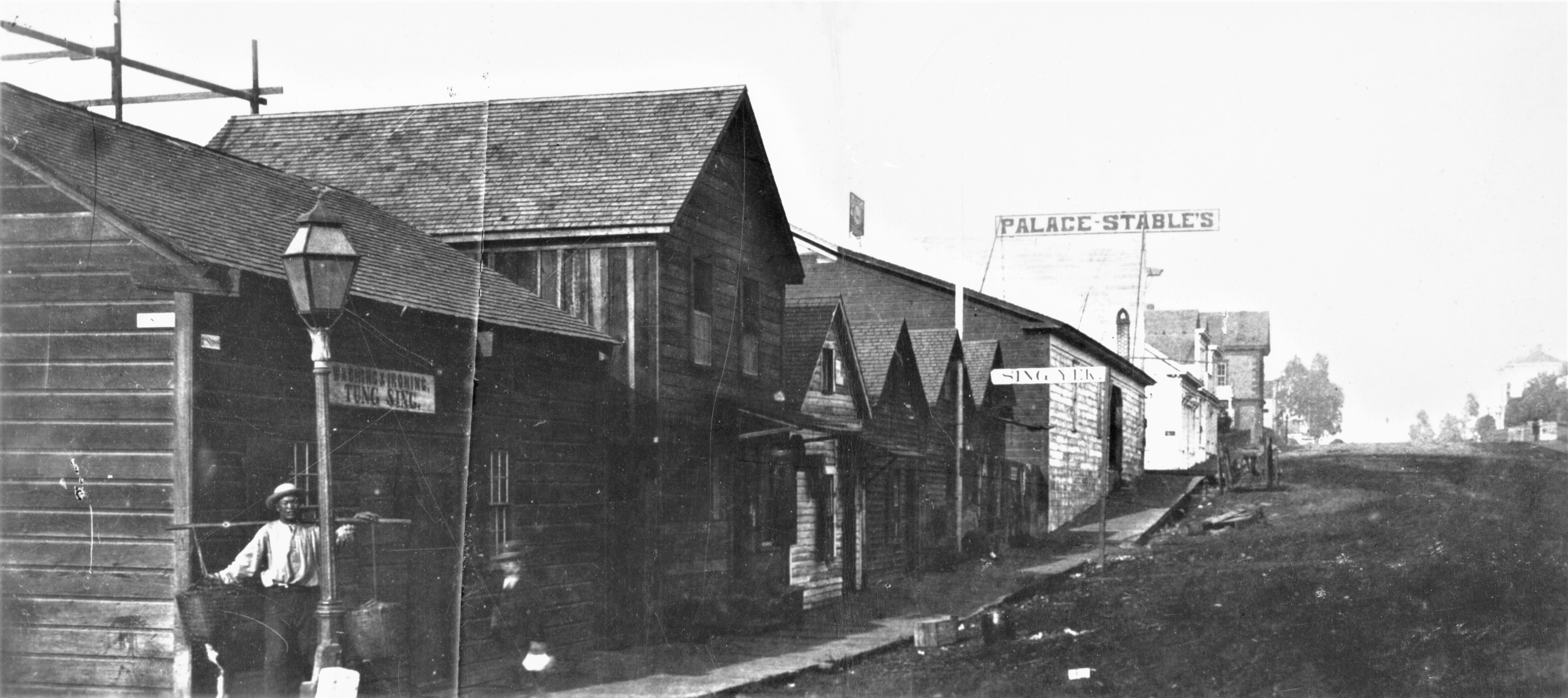
This circa 1884 photo shows the north side of Eureka’s 4th Street, between E and F. Near the middle of the block can be seen the sign for Sing Yek’s store, where the fatal shot was fired on February 6, 1885. The photograph was taken from near the spot where David Kendall was crossing the street when he was shot. (Cal Poly Humboldt Library, Special Collections, 1999.07.3177.) Click to enlarge.
As a historical researcher focusing on Humboldt County’s Chinese history, I was deeply interested to read Shawn Leon’s article “Who Shot David Kendall? 140 Years Later, the Event That Sparked the Chinese Expulsion is Still Shrouded in Mystery” (LoCO, May 3, 2025).
The 1885 Eureka expulsion is a pivotal event in Humboldt history. I applaud Mr. Leon for delving into this important and complicated topic. Leon makes the intriguing point that Eureka’s Chinese community members were probably in the midst of celebrating the festival of the Kitchen God (or “Little New Year”) when the mob violence of the expulsion tore their community apart. As Leon also emphasizes, it is important to study the individual members of Eureka’s “Committee of 15” who directed the expulsion. Such research has the potential to uncover how the characters, politics and beliefs of these 15 men may have helped to shape Humboldt County’s 70-year-long Chinese exclusion policy.
In his article, Leon questions the established account of how Eureka City Councilman David Kendall met his death on the evening of February 6, 1885. Leon suggests that, rather than being the accidental victim of a gunfight between Chinese community members, Kendall was killed by a hidden “clandestine assassin.” Leon further theorizes that this assassination may have been part of a conspiracy involving the Committee of 15 along with civic leaders such as the mayor, the sheriff and the district attorney.
I have spent much of the past two years researching Humboldt’s 19th-century Chinese community, from the 1850s through the mid-1880s expulsions and beyond. Through close reading of local newspapers in online archives and on microfilm, I have encountered many elements of this history which are little-known today. I want to take this opportunity to share some of those discoveries. In particular, I believe that the evidence argues against the “clandestine assassin” theory.
To briefly recap the events of that February night: at 6:05 p.m., David Kendall was shot dead while crossing the street at 4th and E, on the edge of Eureka’s Chinatown. An angry mob soon gathered, blaming the Chinese community for Kendall’s death and threatening to burn Chinatown to the ground. In response, Mayor Thomas Walsh called an emergency public meeting at Centennial Hall, less than a block from Chinatown. At that meeting, 15 prominent citizens were appointed to meet with leaders of the Chinese community and inform them that Eureka’s 300+ Chinese residents had merely 24 hours to pack their belongings and be ready to set out for San Francisco via the two steamships then docked in Humboldt Bay.
In “Who Shot David Kendall?” Leon writes that the Committee of 15 were nominated “to supervise the white mob in carrying out the expulsion … inaugurated and supported by Mayor Walsh, Sheriff T. M. Brown, and District Attorney” George Washington Hunter. Leon interprets the expulsion as follows: “While technically a criminal conspiracy for unlawful detention and abduction, this vigilante justice had the blessing of the Eureka mayor, district attorney and sheriff in a blatant abuse of power.”
I believe this analysis fundamentally misinterprets the interactions of the civic leaders at the February 6 mass meeting, the Committee of 15, and the as-many-as 600 men who attended the meeting.
As word spread through Eureka that Councilman Kendall was dead, Mayor Walsh and his fellow town and county leaders had to be desperately aware that the “thoroughly frenzied crowd” (as described in the Daily Times-Telephone the day after Kendall’s death) could easily become a murderous mob. There was real risk of rioters massacring Chinese residents and possibly setting fire to the town. The Ferndale Enterprise wrote, a week later (Feb. 14, 1885, p. 2):
The anger of the people was worked up to its highest pitch, and it needed but a leader and there would have been committed a fearful massacre … It took much persuasion to restrain them, and as the meeting adjourned it was but the faith in the result of the committee’s mission that prevented them from acting desperately.
Mayor Walsh must have known all-too-well that riot and massacre were horribly likely outcomes. He was almost certainly aware of the infamous Los Angeles Massacre of 1871, when a botched arrest attempt morphed into an orgy of mob violence in which white and Latino townspeople lynched at least 17 Chinese fellow-residents. (This horrific event is explored in depth in The Chinatown War: Chinese Los Angeles and the Massacre of 1871 by Scott Zesch.) A more recent example of mob violence which likely haunted Eureka officials on that February night was the Cincinnati Riot of March 1884, when rioters attacked a jail with the aim of lynching a prisoner, resulting in 56 deaths and more than 300 people injured.
Glimpses of two earlier moments in Mayor Walsh’s career suggest that he had good working relationships with members of Eureka’s Chinese community. On January 28, 1881, when a ban was in place against setting off fireworks in Eureka on any other date than July 4, the Humboldt Times reported, “Mayor Walsh has granted the Chinese of this city permission to discharge fire works in the celebration of their new year,” explaining that “the time embraces twenty-four hours–from this until to-morrow evening.”
The other relevant glimpse of Mayor Walsh’s career was recorded in a Eureka Police Court transcript from a September 1884 trial, The People versus Wah Yee. That transcript itself does not seem to have been preserved in any historical archive, but it was extensively quoted by author Clarence Coogan in an article in his “Paths of the Pioneers” series written in the mid-20th century (Susie Baker Fountain Papers, Vol. 51, p. 335, Humboldt Room, Humboldt County Library). Wah Yee was on trial for making threats against another Chinese Eureka resident. The court interpreter for this trial, known as Ah Kow, testified that he personally had briefly hired local carpenter and handyman Johnny Fox as a special policeman patrolling Chinatown, in response to rising factional tensions in Eureka’s Chinese community.
Ah Kow was quoted as saying, “I hired Johnny Fox myself and paid him two weeks to make it all quiet in China Town. Mr. Walsh (the mayor) he told me I had better do it, and I tried to make every China house pay the money to keep Johnny Fox there all the time.” This mention of Mayor Walsh in Ah Kow’s testimony suggests that Walsh was on good enough terms with some members of Eureka’s Chinese community for that conversation to have taken place.
The Times-Telephone reported that at the mass meeting on the night of Kendall’s death, three men who would shortly be appointed to the Committee of 15 – A. J. Bledsoe, Frank McGowan and James Brown – spoke to the crowd and “dwelt on the evils incident to the hoarding of vicious Chinese in the very heart of our fair town.” In contrast were the next two speakers, Sheriff T. M. Brown and District Attorney Hunter. These two officers of the law, “while sympathizing with the indignation of the audience, counselled moderation” (Daily Times-Telephone, Feb. 7, 1885, p. 2).
The next afternoon, while 300 or so Chinese Eurekans waited under guard in warehouses on the wharf for weather conditions to permit them to sail for San Francisco, Sheriff Brown took an extraordinary action to protect the 21 Chinese men in the jail, ten of whom had been arrested immediately after Kendall’s death. For the first time in Eureka’s history, a law enforcement officer called the National Guard into active service. As reported in the February 14, 1885 Ferndale Enterprise, Sheriff Brown sent the following order:
Commander James T. Keleher, Commander of the Eureka Guards: It appearing to me that an attempt is about to be made to resist the laws of this State on the part of a number of the citizens of Eureka, by taking from me a number of prisoners in my custody, I desire and request you to call into active service the Eureka Guard to aid me in securing the laws and preserving order. Please be at the Court House immediately.
T. M. Brown,
Sheriff of Humboldt County.
The National Guardsmen took up position outside the courthouse, remaining on guard until 10:00 the next morning. By that time the ships had sailed with Eureka’s Chinese community aboard, and Sheriff Brown decided the risk of the jail being stormed by a lynch mob had passed.
I believe the contemporary coverage shows that, rather than being part of a conspiracy to unlawfully evict the Eureka Chinese, officials such as Mayor Walsh and Sheriff Brown worked first and foremost to avert bloodshed, protecting both the Chinese community and the community as a whole.
According to the arguments advanced in “Who Shot David Kendall,” a major point in favor of the clandestine assassin theory is that “There are no known reports of witnesses seeing a gunman, or a suspect fleeing the scene.” This assertion is untrue, as shown by the local newspaper coverage in the months following Kendall’s death.
On February 13, a week after the main expulsion, 16 Chinese men were released from the Humboldt County Jail. They sailed on the regular Saturday steamship for San Francisco. As District Attorney Hunter explained in a letter-to-the-editor in the February 14, 1885 Humboldt Standard, the 21 Chinese men who remained in the jail at the time of the original expulsion were: one detained as a witness, one who “had been imprisoned for several days for some petty offense and he still remains there as his term has not expired,” four “awaiting trial for carrying concealed weapons, the violation of a city ordinance,” five who had been arrested in connection with a previous shooting incident on January 31, and ten arrested on the night Kendall died. DA Hunter wrote,
… soon after Mr. Kendall was shot, some of the police officers entered the Chinese store, from which the shots were fired, and took into custody all the Chinamen in the building, against six of them no charges were preferred. They just happened to be in the house at the time the shooting occurred outside. Not the officers nor anyone else had any proof of their being implicated. Not even the Chinaman who claimed to be an eyewitness to the shooting … was disposed to accuse them of crime. Of course they were set at liberty. The remaining four were charged with murder, and they are now in jail and their preliminary examination will be held as soon as the attendance of witnesses can be procured.
Hunter added that the 16 men “would have been released earlier but for the fact that they were afraid, had no stopping place, and no opportunity to depart.”
The names of the four men charged with murder are given in the records as Ah Kow, Lim Gow, Sing Yek and Ah Chooey. It’s unclear whether this Ah Kow was the same man as the court interpreter who had testified in September 1884 about hiring Johnny Fox as a special Chinatown policeman. Sing Yek was the owner of the store outside which the shooting took place. This store was located about halfway up the block on the north side of 4th Street between E and F (in the area which is currently a fenced-off parking lot beside the old Bank of America building).
Preliminary hearings for the four men were held in late February, and their trials were scheduled for mid-April. An interpreter who traveled from San Francisco to assist with the hearings theorized to reporters that the cause of the “great disturbance” in Eureka’s Chinatown had been “the rejection of Ah Kow as a member of their Masonic fraternity.” (Humboldt Standard, March 2, 1885, p. 3.) The Chee Kung Tong fraternal organization, often referred to as the Chinese Masons, had a lodge in Eureka in early 1880s, as shown by multiple contemporary newspaper articles (for instance, Humboldt Times, Aug. 19, 1881, p. 3). Another theory, put forward by “a gentleman who is very prolific in explanations of the doings of the Chinese,” was that two factions of Chinese Eurekans had quarreled “about the present Franco-Chinese war–the sympathy of one side being for their country and of the other for the French” (Humboldt Standard, Feb. 14, 1885, p. 2). A third theory, stated by the defense in the April 1885 trials, was that the fatal shot had been fired by a man known as Fong Tong, who had avoided being arrested on the night of Kendall’s death. Court records preserved in the collection of the Humboldt County Historical Society show that Fong Tong was involved in legal difficulties with other Chinese community members in the days before the Kendall shooting (Justice’s Court of Eureka, Feb. 5, 1885, “Complaint filed on the oath of Gong (Nan) Foy alleging that the crime of battery had been committed” by “defendant Sin Loy alias Fong Tong”).
For the trials of Ah Kow and Lim Gow, 11 Chinese witnesses returned to Eureka from San Francisco: six for the prosecution and five for the defense (Humboldt Standard, Apr. 13, 1885 p. 3 and April 17, 1885, p3; Daily Times-Telephone, April 24, 1885, p. 3). The main white witness in the two trials was a man named Millard LaGrange, who had been the first to reach David Kendall’s side when he was shot. In Lim Gow’s trial, LaGrange testified that “Lim Gow came from the store of Sing Yek and commenced firing down the street. He stood immediately under a lamp that hung over Sing Yek’s door. LaGrange stood about 9 paces from him while he was shooting” (Humboldt Standard, April 16, 1885, p. 3). In Ah Kow’s trial, evidence “pointed to the fact that the third shot fired was the one that killed David Kendall” (Humboldt Standard, April 14, 1885, p. 2).
Both Ah Kow and Lim Gow were found not guilty. The reasons for their acquittals were not given in the newspaper coverage, but it seems likely that the juries felt incapable of determining which man had fired the fatal third shot. On the motion of District Attorney Hunter, the court then dismissed the remaining two cases against Sing Yek and Ah Chooey, “because of insufficiency of evidence to convict” (Humboldt Standard, April 17, 1885, p. 3).
On April 18, Ah Kow, Lim Gow, Sing Yek and Ah Chooey, along with the eleven Chinese witnesses, returned to San Francisco (Daily Times-Telephone, April 19, 1885, p. 3). A few days earlier, the Humboldt Standard gave a haunting glimpse of these men after Ah Kow’s trial: “The Chinese now confined in the County Jail are feeling jubilant at the acquittal of their comrade, Ah Kow. They were singing last night” (Humboldt Standard, April 16, 1885, p. 3).
Like the juries in 1885, we are unlikely to determine who fired the fatal shot: whether it was one of the four men charged with Kendall’s murder, or Fong Tong, or someone else entirely. It is clear, however, that there were multiple eyewitnesses and suspects. I believe the witnesses’ testimony supports the conclusion that David Kendall had the misfortune to be crossing the street when gunfire broke out between several shooters, instead of being the target of a hidden assassin. Rather than an “unsolved murder,” I would argue that David Kendall’s death was a case of accidental manslaughter.
When 56 of the expelled Chinese Eurekans brought suit in the 1886 case of “Wing Hing versus the City of Eureka,” their charge was that the City officials “had due knowledge of the assembling of the mob and of the riot aforesaid” and that “the said defendant failed and neglected to quell said riot or to disperse said mob, or to protect the property” of the plaintiffs (Wing Hing versus the City of Eureka, Cal Poly Humboldt Digital Commons). To me, this seems a fair evaluation of City and County officials’ actions during the expulsion.
They failed to fully quell the riot, disperse the mob, and protect Eureka’s Chinese residents – although they did succeed in averting a massacre. But evidence does not support the characterization of Mayor Walsh, Sheriff Brown and DA Hunter as conspirators, or Councilman Kendall as the victim of a plot. David Kendall lost his life not to an assassin’s bullet, but to simple bad luck.
###
Dr. Alex Service is curator of the Fortuna Depot Museum.
You like history? Consider a subscription to the Humboldt Historian, a journal of the Humboldt County Historical Society. The Humboldt County Historical Society is a nonprofit organization devoted to archiving, preserving and sharing Humboldt County’s rich history. You can become a member and receive a year’s worth of new issues of The Humboldt Historian at this link.
OBITUARY: Peggy Kathryn Young Buchanan, 1943-2025
LoCO Staff / Saturday, May 17, 2025 @ 6:56 a.m. / Obits

Peggy Kathryn Young Buchanan
Born November 1st, 1943
Died April 22nd, 2025
“My life was my family and my family was my life.”
Peggy Kathryn Buchanan was born November 1st, 1943 in Los Angeles, California to Howard E. Young and Geraldine Stowe Young Kutepoff. She passed peacefully in her sleep on April 22nd, 2025 in her home in Eureka at the age of 81 years. Peggy’s dad always teased her of being “almost a witch” because she was born in the wee morning hours the day after Halloween.
Peggy was the oldest of five children. When she was young her family moved to El Centro to be closer to her father’s job as a railroad engineer. She graduated from High School and one year later married Donald Gene Buchanan, her high school sweetheart. Sixteen year old Peggy met Don when he was home on a weekend leave from the US Navy. She would always talk about how handsome he looked in his uniform. They were sealed June 21st, 1963 for time and all eternity in the Los Angeles temple. Peggy and Don lived in Indio, California where they raised their children: Lucinda, Jeffrey, Kathryn, William and Ryan.
Peggy enjoyed hosting sales parties for Leisure Home and she loved selling Tupperware. She was recognized with several top selling awards including having her name on a plaque placed on a chain around the garden of the Tupperware Headquarters in Orlando, Florida.
In 1976 Peggy and Don moved their family from the bottom of California all the way to Eureka near the top! It is here she decided to become a real estate agent and then broker. She worked for and then managed her own Century 21 real estate agency as well as working for Hartridge House, ABC Realty and Community Realty. She was a member of the Board of Realtors, a licensed notary and also a property manager. Peggy and Don loved to travel. They went to Europe and Germany with their friends Betsy Thode and Jackie Glenn. She also loved Disneyland. She spent her 80th birthday there and was planning on spending her 90th there too.
Peggy was preceded in death by her parents and her husband Don, infant children Lucinda and William as well as her brother Dennis Young, nephew Kyler Young and other beloved family members.
She is survived by their three children Jeffrey (Laurel), Kathryn Luna (Michael) and Ryan (Maria). Siblings Betty Hensley, George (Janet) and Rudy (Patricia). Grandchildren Rhys, Peyton and Cole Buchanan, David, Daniel, Blake, Kohan, Joseph, Brayden and Sarah Luna, Catja, Nikolette, Francesca, Antonio, Freja Buchanan, Several great grandchildren, nieces and nephews who all adored her.
Peggy always liked to be busy and loved helping others. Two years prior to her death Peggy joined the Philanthropic Educational Organization Sisterhood (PEO).
Peggy, a faithful member of The Church of Jesus Christ of Latter-day Saints served in many callings including Relief Society President, Primary counselor, Choir Director and Pianist.
Peggy was a woman of many talents and interests. She enjoyed collecting Cherished Teddy Bears and Santa Claus figures.
She was intent on living a healthy life. She loved to walk and also worked for a while in a Diet Center. She loved performing and was involved in several Humboldt Light Opera productions, including The Pirates of Penzance, Fiddler on the Roof and Oklahoma. She was also in The Sound of Music with her daughter and grandchildren.
Peggy loved music and played the piano, organ and accordion. She especially loved to sing and had a beautiful, strong voice. She sang her final performance with the Eureka ward women’s choir Easter Sunday two days before her passing.
A memorial service will be held at The Church of Jesus Christ of Latter-day Saints, 2806 Dolbeer St. Eureka, CA 95501 Saturday, May 17th at 11:00 am with a viewing at 10:30 am just prior to the service. In lieu of flowers, donations may be made to the American Cancer Society donate.cancer.org or the Chelsea Hutchison Foundation chelseahutchisonfoundation.org
###
The obituary above was submitted on behalf of Peggy Buchanan’s loved ones. The Lost Coast Outpost runs obituaries of Humboldt County residents at no charge. See guidelines here. Email news@lostcoastoutpost.com.
OBITUARY: Sylvia Jean Mays-Townsend, 1940-2025
LoCO Staff / Saturday, May 17, 2025 @ 6:56 a.m. / Obits

Sylvia
Jean Mays-Townsend
March
22, 1940 – May 2, 2025
With great love and deep sorrow, we announce the passing of Sylvia Jean Mays-Townsend on May 2, 2025, at the age of 85. Sylvia’s life was filled with joy, laughter, heartbreak, and resilience — a story that spanned generations and touched countless hearts. Born in Houston, Texas, on March 22, 1940, Sylvia spent her early childhood in the heart of the Lone Star State.
At age nine, in 1949, her life took a pivotal turn when her mother, Lyndell Giacomini Mays, inherited a small ranch on Centerville Road in Ferndale. The family packed up and made the unforgettable journey west along Route 66 in a brand-new sparkling Hudson, settling into the rural beauty of Humboldt County.
Sylvia attended Ferndale Elementary and later Ferndale High School, where she met and fell in love with her first husband, Art Hurd. Together, they had three children: Art Jr., Leslie, and Lisa. Tragically, Art passed away in a drowning accident at the mouth of the Eel River in 1964, leaving Sylvia a young widow at the age of 24. Despite immense grief, Sylvia pressed forward with remarkable strength.
She later married Fred Goff, and they welcomed a son, Stace. That chapter, too, was marked by loss, as Fred died in a car accident in 1970. Sylvia’s resilience never waned. In time, she found companionship and stability again with Jerry “Bud” Townsend, who adopted all four of her children. Though their marriage ended in divorce in 1986, Sylvia remained devoted to her family. In her later years, Sylvia reconnected with Ray Page, a dear friend from elementary school. Their companionship brought light and love to her final chapter.
Sylvia had an artistic soul — not in the traditional sense of paintbrush and canvas, but in the way she made life beautiful. Whether through home decorating, crafting intricate wreaths, or simply finding humor in everyday predicaments, her creativity and spirit shined brightly. She was a constant source of laughter and warmth, lovingly known as Grandma Pill, Gramma, and GG.
Sylvia is survived by her beloved children: Art Townsend, Leslie O’Neil (Jim), Lisa Cooney (Brian), and Stace Townsend (Pegi); 11 grandchildren; 19 great-grandchildren; and one treasured great-great-grandson, Elijah, who held a special place in her heart during her final years.
A celebration of Sylvia’s life will be announced and held later this summer. Until then, her memory lives on in the laughter, love, and stories shared by all who knew her. She was, and always will be, deeply loved.
###
The obituary above was submitted on behalf of Sylvia Jean Mays-Townsend’s loved ones. The Lost Coast Outpost runs obituaries of Humboldt County residents at no charge. See guidelines here. Email news@lostcoastoutpost.com.
OBITUARY: Catherine Gail Blake (Sanderson), 1948-2025
LoCO Staff / Saturday, May 17, 2025 @ 6:56 a.m. / Obits

It is with heavy hearts that we announce the passing of Catherine Gail Blake (Sanderson). Catherine entered into the world on September 8, 1948, the fifth child of Antone and Lucille Sanderson. Catherine left this world and began her journey on February 10, 2025 leaving a legacy of love, courage and commitment that will live on in the hearts of all who knew her.
Catherine (Chachie or Cats as we lovingly called her) was an exceptional person who truly embodied the qualities of both her parents, getting humor and gardening skills from her dad and kindness and love for her family from her mother. She was a loving mother to her two children, Virgil Blake Jr. and Anjulie White, and was always so proud of their accomplishments.
Catherine grew up in Hoopa and attended Hoopa Elementary and Hoopa High schools. During her Freshman year she attended Saint Johns Indian School in Arizona She loved fishing and riding her bike with Steve, swimming with her sisters, and working in the garden with her dad. Later she discovered the love for softball where she was the catcher for the Hoopa Coyotes. She was a person who loved with all her heart and would do anything to help anyone.
Although Catherine lived in Sacramento, she still remained connected to the Hoopa Valley and her roots. She loved gathering blackberries, huckleberries, and mushrooms. Although Hoopa was home, Catherine was so proud the day she purchased her brand new 4-bedroom house in Marysville, Calif. She would spend endless hours decorating and working in her beautiful yard. She grew vegetables every year, her prize was her Meyer lemons of which her family all enjoyed.
Her home became the center of travel, doctors appointments, or just a getaway. She was never hesitant about opening her beautiful home to all who needed a place to stay after a long trip or just to hang out. She hosted family Thanksgiving dinners for her kids, grandkids, sisters, nieces, nephews and anyone who wanted to join in. She always returned home to Hoopa for Christmas to be with her extended family. She was truly Santa Claus making sure everyone had a gift and that her grandchildren had whatever they asked Santa for and would spend hours wrapping those gifts and decorating her house. Catherine was truly a person who loved with all her heart and will be deeply missed.
Catherine is survived by her children Virgil Blake Jr. (Jana B.) and Anjulie White and grandchildren Brittney James, Noelle Blake (Noah R.), Hunter Meeks (Tyler M.), Taryn Van Sweden (Trent VS.), Virgil Blake III, and Inessa Bartholomew and great grandchildren Nylah Ramirez, and River Meeks. Her siblings Erma Marshall (Vernon M., deceased), Denise Ruiz, deceased (Frank R.), Antonette Pratt (Robert P., deceased), Marylou Davis (Francis D.), Stephen Sanderson (Cindy S.), Lorelee Jordan (James D.), Jolene Gates (Charles G.).
Her Celebration of Life is being held at the Hoopa Valley Fire Station on May 24, 2025 at 2 p.m. She requested that this a be joyous and happy time like on of her Thanksgiving get togethers. Her remains will be placed between her mother and father at the Hoopa Valley Cemetery.
###
The obituary above was submitted on behalf of Catherine Blake’s loved ones. The Lost Coast Outpost runs obituaries of Humboldt County residents at no charge. See guidelines here. Email news@lostcoastoutpost.com.


