

OBITUARY: Melinda Elaine Petersen, 1958-2025
LoCO Staff / Wednesday, Dec. 17, 2025 @ 6:56 a.m. / Obits

Melinda Elaine Petersen of Eureka passed away peacefully on September 2, 2025 from Glioblastoma. She was 67 years old.
Melinda was born to Charles and Kathlyn “Kay” Nichols in Fortuna on February 28, 1958. The middle child of five siblings, she attended Ridgewood & Cutten Elementary Schools, Winship Junior High School, and Eureka High School, graduating in 1976. She loved spending time with her siblings, Martin, Mark, Melanie & Kari, helping care for the family pets, and spending summers at Ruth Lake with her Auntie and Earl Dillon.
Melinda married the love of her life, Michael “Mike” Petersen, in 1978 in Eureka. They loved skiing, enjoying trips to Ashland, Mt. Bachelor and Tahoe. They had two daughters, Nicole in 1983 and Heather in 1986. The family enjoyed going on trips to visit family, camping, and engaging in outdoor activities. Melinda worked in a number of positions, including as an Aide at Pacific Convalescent Home when she was a teenager, a Secretary at the Federal Land Bank, an Appraisal Technician at Bank of America, and as a Housing Projects Manager at the City of Eureka. She also co-owned Eureka Overhead Door Company with Mike.
She was a wonderful wife and mother, doting on her family and attending various school and sporting events for her daughters. She always brought people together, frequently hosting joyful family and holiday gatherings. She was an incredible cook and had a number of favorite meals and desserts that she would make for loved ones, including her favorite, Angel Food Strawberry Shortcake. Her kind and gentle nature made her beloved by friends and colleagues alike, and she had many friends and family members that she kept in close contact with. She also loved animals and always had pets that she doted on, including dogs, cats and birds. She especially loved riding and caring for the family’s two horses, Holly & Rusty, passing her knowledge and passion for horses on to Nicole & Heather.
She loved to travel and enjoyed trips throughout the United States, as well as to Canada, England, Ireland, Mexico and Scotland. She enjoyed watching hockey and the family went to many San Jose Sharks games with the Humboldt Hockey Jocks group. She and Mike loved learning about new cultures and hosted three exchange students when Nicole and Heather were teenagers: Matilda from Sweden, Julia from Germany, and Jang from Thailand.
Melinda also experienced health challenges earlier in her life. She was diagnosed with kidney failure in her early 40s. After over a year of dialysis, she was blessed with the gift of a kidney donation from her younger sister, Melanie. She was always incredibly grateful to Melanie for her generosity.
After 25 years, Melinda retired from the City of Eureka in 2020. Mike retired shortly after and together they spent their free time camping and traveling in their RV, including two cross-country trips that took them from California to Yellowstone in Montana, to South Dakota where Mike grew up, to visit her sister, Kari, and her family in Kentucky, to Roswell, New Mexico, and to Mesa Verde in Colorado.
She was involved in community organizations as well, belonging to Humboldt Sponsors, the Humboldt County Historical Society, and the Society of Humboldt County Pioneers. Her favorite pastime, however, was spoiling and spending time with her grandchildren, Josiah, Daphne & Farrah. She also loved tending her beautiful yard and flower gardens, playing cards every Thursday, going to the casino, going to restaurants with family & friends, and watching movies at the theater. She was incredibly warm-hearted and kind, and was beloved by all who knew her.
Melinda was preceded in death by her grandparents, Leland & Athlyn Lawson, her brother, Martin Nichols, her father, Charles Nichols, and her daughter, Heather Petersen.
She is survived by her mother, Kathlyn “Kay” Nichols, her husband, Michael “Mike” Petersen, her daughter, Nicole Petersen-Log (Joseph), and her three grandchildren, Josiah Log, Daphne Log, and Farrah Petersen-Log. She is also survived by her siblings, Mark Nichols (Carol), Melanie Coupe (Robert), and Kari Bradley (Kenny), as well as nine nieces and nephews and their families.
The family wishes to thank the exceptional staff at St. Joseph Hospital and Hospice of Humboldt, as well as her best friend, Laurie Altizer, and sister-in-law Monica Caetano, for their love and support, especially following her cancer diagnosis.
###
The obituary above was submitted on behalf of Melinda Petersen’s loved ones. The Lost Coast Outpost runs obituaries of Humboldt County residents at no charge. See guidelines here.
BOOKED
Today: 4 felonies, 7 misdemeanors, 0 infractions
JUDGED
Humboldt County Superior Court Calendar: Today
CHP REPORTS
5451 Mm101 N Hum M54.50 (HM office): Traffic Hazard
Painter St / Wildwood Ave (HM office): Trfc Collision-Unkn Inj
ELSEWHERE
RHBB: Wildfire Burning Near Highway 101 South of Laytonville
Governor’s Office: California reminds voters to check their mailboxes and return their ballot ASAP!
County of Humboldt Meetings: Oct. 8, 2026 - Humboldt Housing and Homelessness Coalition General meeting
RHBB: CHP Pursuit Ends With High-Risk Stop at Highway 299 and 101
Humboldt County Supervisors Adopt Long-Awaited Climate Action Plan, Set Greenhouse Gas Emissions Threshold
Ryan Burns / Tuesday, Dec. 16, 2025 @ 4:23 p.m. / Local Government
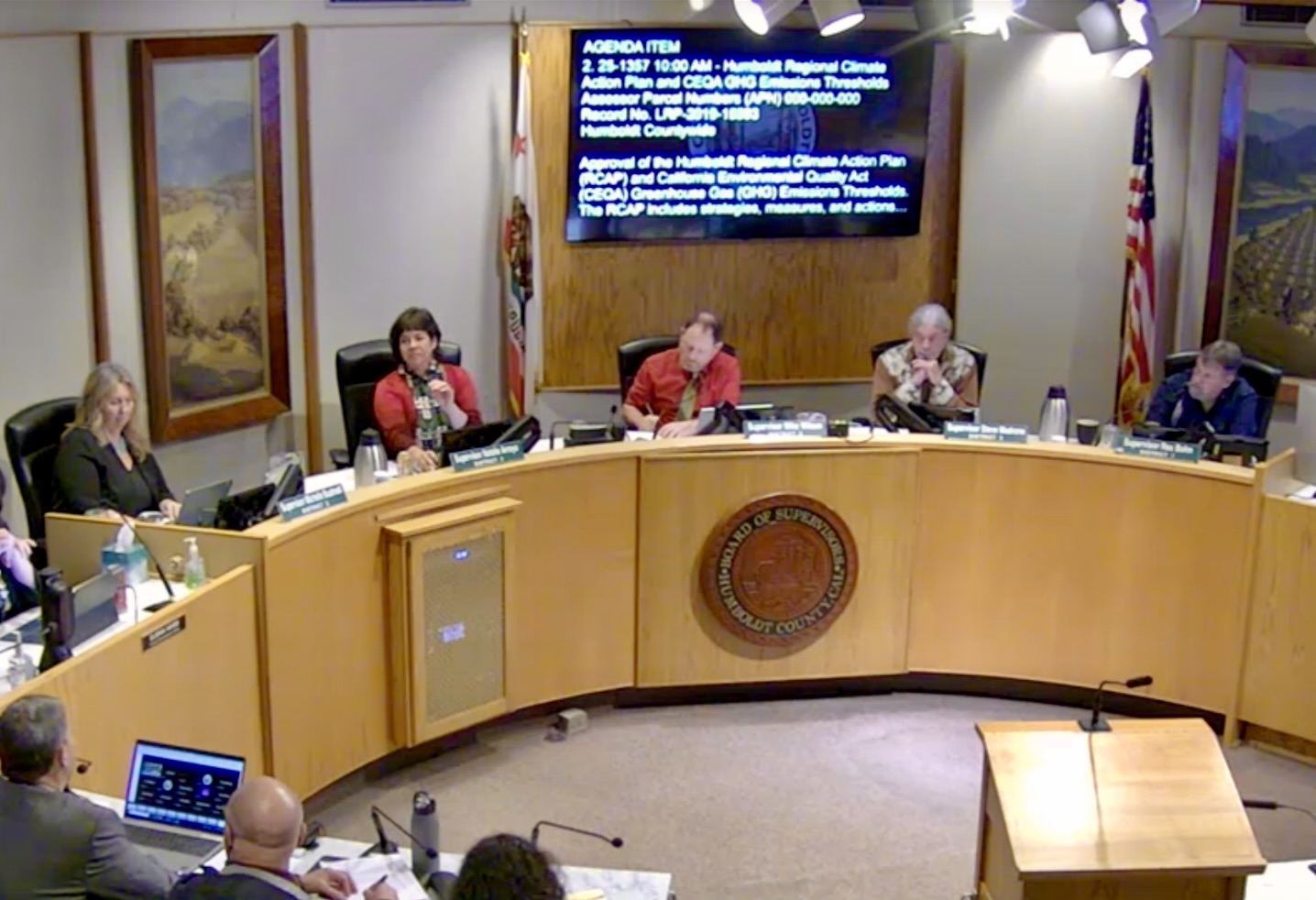
Humboldt County Board of Supervisors (from left): Michelle Bushnell, Natalie Arroyo, Mike Wilson, Steve Madrone and Rex Bohn. | Screenshot.
###
The Humboldt County Board of Supervisors today passed a sweeping environmental document aimed at reducing planet-warming greenhouse gas (GHG) emissions in the coming years.
Passed unanimously, the Regional Climate Action Plan (RCAP), which was developed in collaboration with local cities and other government agencies, includes an array of strategies and measures that, together, are designed to meet certain state and local goals. Specifically, they’re aimed at reducing the county’s GHG emissions to 40 percent below 1990 levels in the next four years and 85 percent below that mark by 2045 while achieving carbon neutrality.
The board also went a step further, setting an even more ambitious GHG threshold that will apply to new development projects requiring review under the California Environmental Quality Act (CEQA) — unless the project in question won’t come online until after 2030. After some deliberations (and confusion regarding percentages), the board agreed to set this threshold 35 percent lower than what’s spelled out in the RCAP.
Confusing? Certainly. Each board member got a bit lost, at one point or another, in what Fourth District Supervisor Natalie Arroyo dubbed the “acronym soup” of this discussion. But the RCAP is actually designed to streamline future development.
“Once the new regulations are adopted, it will better guide future development to locations that are encouraged by the county,” Planning and Building Director John Ford said during today’s meeting. The plan enshrines a tiered environmental review process, which staff said will reduce paperwork and delays by avoiding redundant analysis. In other words, projects that are consistent with the RCAP will have simpler regulatory procedures.

A forecast of the county’s future greenhouse gas emissions shows that transportation is the largest source of such pollutants. | Screenshot.
###
Humboldt County emitted roughly 1.5 million metric tons of carbon dioxide in 2022, according to Planner Megan Acevedo, with road transportation sources accounting for 73 percent of that. The second-highest contributor was building energy use from natural gas, she said.
The plan identifies 12 strategies for reducing emissions, largely focusing on transportation-related measures such as transitioning government fleets to cleaner-running vehicles/fuels while reducing the number of vehicle miles traveled. Land use planning will encourage growth in areas where services and transit already exist, and local governments will promote efficiency upgrades and electrification in homes and businesses.
The RCAP also aims to enhance carbon storage in forests and rangeland; improve energy efficiency in water and wastewater systems; reduce landfilled waste through recycling and organics diversion; and track all of these efforts via annual progress reports.
Ford noted that there has been a lot of confusion regarding the proposed GHG thresholds, as they pertain to new development. Many local residents conflated this with the RCAP. Ford explained that they’re related but distinct components of the county’s climate strategy, and the latter could be adopted without passing the former.
A hired consultant recommended that the county set a GHG threshold 50 percent below what’s spelled out in the RCAP, but when the matter came before the Humboldt County Planning Commission, that body wound up taking a slightly more conservative approach. With a narrow 3-2 vote, the commission suggested splitting the difference by setting a threshold of 25 percent below the RCAP level. Coming in to today’s meeting, staff sided with the Planning Commission, recommending that the board aim for that same 25 percent mark.
First District Supervisor Rex Bohn was skeptical about the whole process leading up to this point. He asked Ford whether staff had consulted with “people that build the houses” and suggested that stringent environmental regulations could prevent future development.
“They [local builders] should have had some input, because the best practices are going to be implemented by them,” Bohn said.
Ford replied by pointing out, “Sometimes people don’t like change, and this, unfortunately, is change.” He also said, “We’re not proposing anything right now that is revolutionary, related to building.”
Both Second District Supervisor Michelle Bushnell and Fifth District Supervisor Steve Madrone expressed concerns about restricting or prohibiting the use of wood stoves for heating rural homes. After doing some research, Ford assured them that wood stoves are still allowed under the RCAP, though they’re regulated through the EPA.
During the public comment period, an attorney representing SN Indianola, a subsidiary of Rob Arkley’s Security National, argued that the RCAP failed to include a planned housing development project along the Indianola Cutoff in its FEIR. Ford later told the board that it was omitted because the developers have yet to submit a permit application.
The majority of public comments came from local environmental activists, who encouraged the board to adopt the RCAP and adopt a lower GHG threshold.
After some more board discussion, Third District Supervisor and Board Chair Mike Wilson made a motion to adopt the RCAP, along with its related documents, and to set the GHG threshold at 50 percent of the RCAP level — a more stringent goal than what was passed by the Planning Commission and recommended by staff.
Bushnell said she wanted to vote in favor of the motion but couldn’t go that far. She requested the GHG goal be 25 percent below RCAP, and Bohn agreed, saying he’d like to defer to the expertise of the Planning Commission.
Percentage confusion ensued as some people did math from point A to B while others were measuring from B to A. Eventually, though, once everyone got on the same page, Wilson suggested a compromise: a GHG threshold of 35 percent below the RCAP.
This middle ground earned unanimous support for the motion.
Tonight’s Eureka City Council Meeting Has Been Canceled
LoCO Staff / Tuesday, Dec. 16, 2025 @ 3:46 p.m. / Local Government

Photo: Andrew Goff.
###
PREVIOUSLY:
###
We just got word from the city of Eureka that tonight’s scheduled council meeting — where they were set to talk about a trans sanctuary resolution and a resolution against war in Venezuela — has been canceled. Presumably those items will be scheduled to a later date.
Press release from the City of Eureka:
The City of Eureka announces that the regularly scheduled Eureka City Council meeting set for Tuesday, December 16, 2025, has been canceled due to the lack of a quorum.
The next regular Eureka City Council meeting is scheduled for January 6, 2026. Any items intended for consideration at the canceled meeting will be placed on a future agenda, as appropriate.
Meeting agendas, updates, and additional information are available on the City’s website at www.eurekaca.gov.
For questions, please contact the City Clerk’s Office at (707) 441-4175.
THAT’S A LOTTA TURKEY! Rotary Club of Eureka Donates Hundreds of Birds During Record-Setting Holiday Turkey Drive
LoCO Staff / Tuesday, Dec. 16, 2025 @ 3:32 p.m. / Feel Good , Food

Left to right: Rotary Club of Eureka President Dale Warmuth, Executive Director of the Eureka Rescue Mission Bryan Hall, and the turkey drive organizer himself, Matthew Owen. | Photo: Rotary Club of Eureka
###
Press release from the Rotary Club of Eureka:
EUREKA, CA — This holiday season, the Rotary Club of Eureka is giving back with its annual turkey drive. The club has already donated a record 239 turkeys to local organizations and expects to give out even more before Christmas. The annual turkey drive, now in its tenth year, aims to ensure that families throughout Eureka have the resources to enjoy a holiday meal.
Volunteers from the Rotary Club delivered turkeys to eight nonprofit organizations serving individuals and families in need. The largest share went to the Eureka Rescue Mission, which received 100 turkeys. Additional recipients included Food for People, the Betty Kwan Chinn Foundation, St. Vincent de Paul, Salvation Army, Jefferson Community Project, Redwood Teen Challenge, and the Boys & Girls Club of the Redwoods. “All the funds raised for this turkey drive came directly from our members,” said Rotary Club of Eureka Dale Warmuth. “Supporting our community, especially during the holidays, is very important to us. Our members know this is a challenging year for so many people, and they really stepped up to help.”
Leaders from partner organizations expressed their gratitude. Bryan Hall, Executive Director of the Eureka Rescue Mission, reported that the turkey donations helped the Mission distribute 122 food boxes and serve 342 meals for Thanksgiving. Carly Robbins, CEO of Food for People, added, “We are exceptionally grateful to the Rotary Club of Eureka. The donation of these turkeys helped us provide food for a holiday meal to families at a time when many are struggling to make ends meet.”
The Rotary Club of Eureka is planning to donate more turkeys in time for Christmas. The turkey drive is part of the Rotary Club’s longstanding focus on humanitarian service both locally and globally. Members hope their efforts will inspire others in the community to lend a helping hand throughout the holiday season. To learn more about the Rotary Club of Eureka or to make a donation, visit www.rotary1.org.
Republicans Ask Federal Court to Overturn California’s New Prop. 50 Maps
CalMatters staff / Tuesday, Dec. 16, 2025 @ 2:36 p.m. / Sacramento

A “No on Prop 50” sign at the Kern County Republican Party booth at the Kern County Fair in Bakersfield on Sept. 26, 2025. Republicans are seeking to overturn the congressional maps voters approved last month. Photo by Larry Valenzuela, CalMatters/CatchLight Local.
###
This story — written by Maya C. Miller and Mikhail Zinshteyn — was originally published by CalMatters. Sign up for their newsletters.
###
Just last week California’s secretary of state officially certified that more than two-thirds of Californians voted to pass Proposition 50, Gov. Gavin Newsom’s plan to temporarily gerrymander the state’s congressional maps in favor of Democrats.
Nevertheless, Republicans and the Trump administration are hopeful that a federal district court panel meeting in Los Angeles this week will intervene to bar the state from using the new maps next year.
California Republicans, who sued Newsom and Secretary of State Shirley Weber the day after the election, are staking their challenge on the argument that California’s primary mapmaker illegally used race as a factor in drawing district lines, giving Latino and Hispanic voters outsize influence at the expense of other racial and ethnic groups, including white voters.
This, the Republicans argue, means the maps amount to an illegal racial gerrymander and a violation of the 14th and 15th amendments. Although Section 2 of the federal Voting Rights Act allows for race-conscious redistricting, they add, case law and judicial precedent have set a strict standard that requires a minority group to prove they have been systematically outvoted by a majority that consistently votes together to deny the minority their chosen candidate.
But the Prop. 50 opponents’ odds look slim, especially after the U.S. Supreme Court’s conservative majority recently blessed Texas’s new maps, overturning a lower court’s finding that Republicans there had engaged in unconstitutional racial gerrymandering.
“It is indisputable that the impetus for the adoption of the Texas map (like the map subsequently adopted in California) was partisan advantage pure and simple,” wrote conservative Justice Samuel Alito in a concurring opinion supported by Justices Neil Gorsuch and Clarence Thomas.
And then there’s the looming possibility that the Supreme Court, in a separate case, could outlaw entirely the use of race in the redistricting process, which could render California’s new maps — as well as the previous ones drawn by the independent citizens commission — unconstitutional. That would also give Republicans a major advantage in Southern states, where several districts drawn to increase Black Americans’ voting power are currently represented by Democrats.
Despite the long odds, the ailing California GOP has run out of other options for resistance. The passage of Prop. 50 is likely to mark the beginning of the end for several of California’s Republican House members, who have been forced to decide whether to run in their current, now less favorable Republican districts, switch to new seats or drop out entirely.
One of them, Rep. Darrell Issa, who represents parts of San Diego County, even considered relocating to Texas and running for a Dallas-area seat that would be more friendly to Republicans, but the president reportedly refused to endorse him for the already contested Texas seat, so he decided to stay.
The legal challenge claims the Prop. 50 maps cause “stigmatic and representational injury” by placing certain candidates, such as Republican Assemblymember David Tangipa of Fresno, who is Polynesian, into districts drawn with a specific racial or ethnic minority group in mind.
Case is in Los Angeles court this week
The challengers, who include Tangipa, the California Republican Party, several Republican voters and the Trump White House, are asking a three-judge panel for the Central District of California to grant a preliminary injunction on the maps before Dec. 19, the date when candidates can start collecting signatures to get their names on the 2026 primary ballot. A preliminary injunction would temporarily prevent the maps from being used in an election.
On Monday in court, the Republican challengers presented their case, arguing that since supporters of Prop. 50 publicly touted that the maps increased representation for Latino voters, state lawmakers and consultant Paul Mitchell, who was hired to draw the maps, took race into account. Therefore, they must justify how their new districts meet the standard for permissible racial gerrymanders, attorneys argued.
“It is legal to race-based redistrict under the Voter Rights Act. Section 2 protects it. But it also gives you guidelines,” Tangipa told CalMatters in an interview after testifying in court on Monday in Los Angeles. “In Sacramento, they did not follow those guidelines.”
Tangipa asserted that even though Democratic lawmakers intended primarily to increase their party’s ranks based on political ideology, “They used race to justify that end goal.”
The plaintiffs sought to have Mitchell testify, but the court denied a request to force him to take the stand to explain whether he intentionally tried to increase the voting power of specific racial and ethnic groups. Since Mitchell lives more than 100 miles away from the court, he was out of the reach of a subpoena. Still, the judges questioned his blanket use of “legislative privilege” to resist producing documents the plaintiffs requested.
At one point, as a redistricting expert testified, the plaintiffs focused on a line from Democratic former Senate President Pro Tem Mike McGuire’s public statement after the Legislature passed the package of bills paving the way for the Nov. 4 special election.
“The new map makes no changes to historic Black districts in Oakland and the Los Angeles area, and retains and expands Voting Rights Act districts that empower Latino voters to elect their candidates of choice,” McGuire’s statement said.
McGuire announced last month that he will challenge Republican Rep. Doug LaMalfa in one of the newly configured Prop. 50 seats.
But proponents of the new maps argue they intended purely to create a partisan advantage for Democrats, and any increase in voting power for certain ethnic or racial groups was incidental.
Ultimately, ‘it was endorsed by the voters’
Also complicating the GOP’s challenge is that California voters overwhelmingly approved the maps.
“Even if we assume that the Legislature improperly considered race, ultimately it went into effect because it was endorsed by the voters,” Emily Rong Zhang, an assistant professor of law at the University of California at Berkeley School of Law, previously told CalMatters. “They would have to show that the voters had the intent to create districts that disproportionately favor the voting power of a racial group over another.”
One unknown is how the Supreme Court will rule on a case that questions whether it’s constitutional to even consider race as a factor when redistricting.
The justices are weighing in another ongoing case, Louisiana v. Callais, whether to strike down a part of the federal Voting Rights Act that requires the creation of districts in which racial and ethnic minorities have a chance to elect their preferred candidate. If the ruling is retroactive, a decision to strike it down could invalidate both California’s old and new maps.
Regardless of how the Supreme Court rules, other states have jumped into the redistricting effort or are contemplating entering the fray. In addition to Texas and California, four other states have already implemented new congressional maps, according to the National Conference of State Legislatures. Virginia, Maryland and Florida have also taken some steps toward redistricting.
More Adults Return to College in California as Inflation and Job Fears Rise
Adam Echelman / Tuesday, Dec. 16, 2025 @ 7:32 a.m. / Sacramento

Graduating students walk into the DeVore Stadium during a commencement ceremony at Southwestern College in Chula Vista on May 24, 2024. Photo by Adriana Heldiz, CalMatters
###
This story was originally published by CalMatters. Sign up for their newsletters.
###
If you want to gauge the health of California’s economy, start with its community colleges.
“When the economy is doing well, our enrollments are down, and when the economy is in a tough stretch or in a recession, we see our enrollments go up,” said Chris Ferguson, an executive vice chancellor with the California Community Colleges Chancellor’s Office, which oversees all of the state’s 116 community colleges.
Ferguson said the state has yet to release authoritative data on fall enrollment, but early data shows upward trends. In interviews with CalMatters, some college presidents said they’re seeing over 10% more students compared to last fall. But they say the state hasn’t provided enough funding to keep up with their growth.
California is not in a recession, but some economic indicators are grim. Unemployment is rising, and it’s getting harder to find a job. The cost of consumer goods, such as toilet paper and cosmetics, is going up, and economists say tariffs and President Donald Trump’s increased deportations could lead to further economic declines in the state.
“Typically when the economy gets a little crazy, like it is right now, people need to upskill or find new work,” and workers look to colleges for help, said Nicole Albo-Lopez, deputy chancellor for the Los Angeles Community College District. In the Los Angeles district, students between the ages of 35 and 54 are coming back to school in droves — up 28% compared to last year, she said.
Other factors may also be bringing students back to school. The COVID-19 pandemic created a sudden and historic drop in college enrollment, and some schools say the influx of students this year is just a return to pre-pandemic levels. A large portion of recent enrollment growth comes from high school students taking college courses, which has exploded in popularity in the past few years.
But most college officials agree that uncertainty about the economy is at least one of the driving forces for new students this semester.
At the Los Rios Community College District, which represents four campuses in the Sacramento metro area, enrollment is up by more than 5% compared to last fall. Part of that is due to “the gap between Wall Street and Main Street,” said Mario Rodriguez, an executive vice chancellor for the system: The stock market has performed well in the past few years, even as job seekers see fewer opportunities and families struggle with inflation. Enrollments in career technical classes are up 10% this semester at the district, the equivalent of almost 4,000 new students.
These job-ready programs, such as medical assisting, welding, and automotive, have always been popular, and some cap enrollment. School officials say waitlists are growing.
Quitting a job, starting school
Carla Gruhn, 29, has worked as a medical assistant in San Jose for 10 years. At one point she was making roughly $50,000 a year, but it wasn’t enough.
“In the last year, eggs started becoming super expensive,” she said. “That’s when I started paying more attention to gas and groceries.” Together with her husband, she started planning ways to scale back — fewer coffee runs, less travel with their truck, cheaper gifts this Christmas. But they needed a long-term solution, too.
In July, she quit her job and enrolled in a two-year radiologic technology program at Foothill College, in the south Bay Area, which will teach her how to read X-rays, CT scans, and MRIs. Her salary will double, maybe even triple, once she graduates with the new credential.
The pay raise could be “life-changing,” she said. At the moment, Gruhn said her family is small, just her husband and her dog, so their costs are lower, but they know it’s going to get more expensive, since they want to buy a house and have kids. “We’re trying to plan for the future too.”
At Foothill College, enrollment is up, especially in science and technology classes, said Simon Pennington, the school’s associate vice president of community relations. Many of these students are looking to fulfill prerequisites to enter careers in the health care sector, he added. Health care is one of the largest and fastest-growing job sectors in the state, according to a recent report from the Public Policy Institute of California.
In Merced, hours away from major urban centers like the Bay Area, Sacramento, or Los Angeles, students are clamoring for classes in electronics, where the fall waitlist numbers have nearly doubled compared to three years ago. Demand is also up for classes in criminal justice and mechanized agriculture, according to James Leonard, a spokesperson for the school.
“When the economy goes bad, enrollment skyrockets,” said Dee Sigismond, Merced College’s vice president of instruction, though she wasn’t certain that a recession would have the same impact it did 15 years ago. Staring during the pandemic, Merced College, like most community colleges, now offers many of its classes online, which can make it easier for students to juggle school with a full- or part-time job. She added that Merced is also experimenting with new, more flexible kinds of instruction, such as competency-based education, which allows students to pass a class by showing they already have the requisite skills.
Colleges call for more funding
California’s community colleges receive most of their funding based on the number of students they serve. When enrollment declined during the pandemic, colleges were set to lose funding, but the governor and the Legislature granted the community college system a special exemption, delaying many funding cuts.
Now that enrollment is ticking up, many colleges say they have the opposite problem — they aren’t getting enough money to serve the influx of new students. That’s largely because the state’s funding formula is based on the college’s average enrollment over the past three years, so sudden changes this year are slow to have an effect. Rodriguez said his Sacramento area district is serving about 5,000 more students than the system is funded to support, representing about $20 million in lost revenue.
This summer, the state agreed to send more money to California’s community colleges to account for recent enrollment growth, but Ferguson said it isn’t enough to fully fund all the new students.
Last month, presidents and chancellors from 10 different community colleges or community college districts, including representatives from Los Angeles and Sacramento, sent a letter to the governor, asking him to change state policy and allow colleges to get more funding in next year’s budget. Though he did not sign the letter, Ferguson said the state chancellor’s office is asking the governor for similar changes.
In 2008, colleges had to cut back on services or classes, even as new students poured in because the state didn’t provide proportionate funding for each new enrollment.
Next year, California is expected to face an $18 billion budget deficit, according to a November analysis by the Legislative Analyst’s Office. For comparison, the state had a deficit of about $24 billion in 2008, worth about $36 billion in today’s dollars.
In Chula Vista, Southwestern College President Mark Sanchez said his district is already saying no to potential college classes in high schools and prisons because of a lack of state funding.
His district had over 32,000 students in the last academic year — the highest enrollment rate since the Great Recession.
OBITUARY: Richard George Kinney, 1938-2025
LoCO Staff / Tuesday, Dec. 16, 2025 @ 6:56 a.m. / Obits

Richard George Kinney passed from this earth November 14, 2025. Born to parents Elsie Brinn and Bruce Kinney in Eugene, Oregon on February 13, 1938. He arrived less than five pounds and lived in a dresser drawer in front of the kitchen stove for many months. Thirteen months later sister Joan arrived.
Years later the family was in a terrible auto accident, sending both Dick and his mother to the hospital, where his Mom stayed for a year. Dick lost a year of school because of this trauma Dick and his sister were sent to live with an aunt and uncle in a small community of Broadbent, Oregon. They were on a large ranch with sheep, cattle and forest. It was here Dick learned about shearing sheep, milking cows and lastly the logging industry. Life was not always work. He, his sister and neighboring ranch kids could cross railroad tracks and swim in the nearby river.
Back home in Eugene, Dick asked his folks for a bicycle. His Dad said he could get a job and earn it for himself. Well, he got a job deliver the Portland Times seven days a week including the double thick Sunday paper. All this was done walking before school started every morning! Dick was able to get the best Schwinn bike available — with a head light, no less! No wonder he was so particular about the upkeep for his tools, cars and trucks.
Dick’s dad being a tree topper and truck driver, hauled the old water tower to Eureka and learned of the lumbering in Humboldt County. He went home and told his family to pack their belongs, they were going to move to California.
Dick’s high school years were filled with the usual pranks, tipping cows, outhouses to driving his best friends grandmothers expensive car around the Fireside Motel parking lot. Now the location of Furniture Design.
Dick learned to drive from his dad. It was not an easy thing. Just try riding and driving with Dick now … well, maybe not! His pranks and sense of humor continued in later year when he drove for himself. Did you ever see the funny faces on the end of logs as they were on the way to the mills? Thank you for the chuckles, Dick!
Dick could tell you of many incidents while serving in the US Army as a tank mechanic in Germany — like seeing Elvis arrive, the music and television he was able to bring, visiting Worms, Germany, the Rhine River and many stories of the town folks. He was proud to be part of “Hell on Wheels.” In his travels he was not able to get to Grafton, West Virginia the home of his father and family. His parents never talked much of their youth.
He enjoyed agate hunting, collecting buoys, shot glasses, ball caps, garage sales and trips to Bandon.
Dick took on the responsibility of helping raise myself at 7 and my brother Anthony at 6. He was only 25. He was patient when we needed patience stern when we needed boundaries. He taught us to work to be respectful and kind. He was a man with strong opinions and stronger love for family. We always felt so blessed to have two dads. He was always a supportive person in our lives.
Years later he and Nancy found each other adding her gentle stability to family. I am forever grateful for them both. He was enormously proud of helping to raise all his step children, Donna, Tony and years later Linda. It was she he first asked if he could marry her mother. That was followed by Phil and then Ellen. Sixteen years of adventures followed their wedding.
Our thanks go to the many people who helped look after Dick — the Veterans Association and medical community and special caregivers Sandy, Mike, Rosanne and Paulette, as well as Hospice of Humboldt and Ayers Family Cremation for their kind help.
Grave side service will be presided over by good friend and best man Kevin Lockhart at Table Bluff Cemetery on Singly Hill Rd in Loleta 2 p.m. on Thursday, January 8, 2026. Dick’s last truck ride will be provided Mike Jones and La Logging Big Iron. Wear your Hickory Shirts and boots if so inclined. Donations may be made to Tunnels to Towers (2361 Hylan Blvd, Staten Island N.Y., 10306) or Hospice of Humboldt (3327 Timber Fall Ct., Eureka, Ca 95503), or plant a primrose or sparaxes bulbs.
Always give a logger the right of way and a friendly wave.
###
The obituary above was submitted on behalf of Dick Kinney’s loved ones. The Lost Coast Outpost runs obituaries of Humboldt County residents at no charge. See guidelines here.


