
GOOD FIRE: Prescribed Burns Planned All Across Humboldt Today
LoCO Staff / Monday, Nov. 3, 2025 @ 9:22 a.m. / Fire

Prescribed burn file photo from Redwood State and National Parks.
###
Press release from Green Diamond Resource Company:
Weather conditions permitting, Green Diamond Resource Company plans to conduct prescribed burning for fuel hazard reduction [on] Monday, November 3, 2025 in multiple locations across the ownership.
Green Diamond will be conducting burning in the Hunter and Wilson Creek areas approximately 4 miles north of the town of Klamath and in the Bald Hills along Johnson Road approximately 7 miles southeast of the town of Orick. Burning will also be conducted in the Redwood Creek drainage 2 miles south of where it crosses Highway 299, in the Headwaters of Little River approximately 10 miles east of Westhaven and in the Sproul Creek area approximately 4 miles southwest of Garberville, along Sproul Creek Road.
Burning operations are implemented in coordination with CAL FIRE and North Coast Unified Air Quality Management District. Please note that smoke may be visible in surrounding areas, including the towns of Hunter Creek, Orick, Garberville, McKinleyville and Highway 299, while prescribed burning activities are being conducted. Green Diamond staff will be onsite monitoring prescribed burning and fuels reduction operations.
BOOKED
Today: 4 felonies, 7 misdemeanors, 0 infractions
JUDGED
Humboldt County Superior Court Calendar: Today
CHP REPORTS
5451 Mm101 N Hum M54.50 (HM office): Traffic Hazard
Painter St / Wildwood Ave (HM office): Trfc Collision-Unkn Inj
ELSEWHERE
RHBB: Wildfire Burning Near Highway 101 South of Laytonville
Governor’s Office: California reminds voters to check their mailboxes and return their ballot ASAP!
County of Humboldt Meetings: Oct. 8, 2026 - Humboldt Housing and Homelessness Coalition General meeting
RHBB: CHP Pursuit Ends With High-Risk Stop at Highway 299 and 101
California Democrats Made Prop. 50 About Trump. Polls Show It’s Working as Voting Ends
Maya C. Miller / Monday, Nov. 3, 2025 @ 7 a.m. / Sacramento

A “Vote Yes on Prop 50” button at the Kern County Democratic Party booth during the Kern County Fair in Bakersfield on Sept. 26, 2025. Photo by Larry Valenzuela, CalMatters/CatchLight Local
###
This story was originally published by CalMatters. Sign up for their newsletters.
###
A day before voting ends for Proposition 50, California voters appear poised to approve Gov. Gavin Newsom’s plan to gerrymander the state’s congressional districts in Democrats’ favor.
Recent opinion polls show strong support for the Yes side. Newsom’s campaign is flooding the airwaves with star-studded advertisements and drowning out its opponents’ faint final pitch to voters. And the governor has even asked supporters to back off on donations, as the influx of contributions was crashing the state’s campaign finance website.
“You can stop donating now. Thank you,” proclaimed the subject line of an email from Newsom’s campaign to supporters last week. “We have hit our budget goals and raised what we need in order to pass Proposition 50.”
If approved, the measure would temporarily suspend California’s current congressional maps, which were drawn by an independent citizens commission, and replace them through 2030 with districts drawn by Democratic insiders.
Newsom and his allies say California must counter mid-decade gerrymandering efforts in Republican controlled states such as Texas, Missouri and North Carolina in order to give Democrats a fair chance to win back the U.S. House of Representatives in next year’s midterm elections. Mail-in voting has already been underway for more than four weeks.
Some of Prop. 50’s major opponents are also privately resigned to the reality that the measure will pass, despite putting on a defiant game face.
“I don’t run away from a fight,” insisted Rep. Doug LaMalfa, a Republican from Oroville whose district would be dramatically altered under the new maps, at a recent No on 50 press conference.
But just moments before, LaMalfa also conceded that the opposition was “outnumbered two-to-one” when it came to spending in the crucial final days of the campaign.
“We are outgunned on the fundraising side,” he said.
A spokesperson for the No on 50 campaign did not respond to an emailed request for comment.
Two of California’s most reputable nonpartisan pollsters last week found that a solid majority of likely voters are supporting, or have already voted for, Prop. 50.
The Public Policy Institute of California found that 56% of likely voters said they would support the measure, compared to just 43% who said they would oppose it. The survey also found that nearly seven in 10 Californians, regardless of party, said the outcome of the special election was “very important” to them. That’s a record high level of interest in a ballot measure.

A “No on Prop 50” sign at the Kern County Republican Party booth at the Kern County Fair in Bakersfield on Sept. 26, 2025. Photo by Larry Valenzuela, CalMatters/CatchLight Local
“The PPIC survey has not registered such a high level of interest in a ballot proposition since we began measuring it over 20 years ago,” said its survey director, Mark Baldassare. The poll relied on responses from 943 likely voters and had a sampling error margin of plus or minus 4.1 percentage points.
The Berkeley Institute of Governmental Studies found an even larger gap between Yes and No voters, with a whopping 60% of likely voters saying they’d vote to pass Prop. 50 and just 38% who would vote no. Similarly to PPIC, the IGS poll also found an extraordinarily high level of engagement, with 71% of likely voters saying they had heard “a great deal” about the measure.
“There are a lot of indicators that suggest the Yes side is going to win comfortably,” said Mark DiCamillo, IGS’ director of polling, in an interview.
The poll interviewed 4,946 Californians who had already voted or were considered likely to vote and had a sampling error margin of plus or minus 2 percentage points.
DiCamillo noted Prop. 50 was likely defying conventional wisdom on ballot measures, which gives the No side an advantage with undecided voters who want to preserve the status quo, because of the hyperpartisan and nationalized message.
“The results suggest that Democrats have succeeded in framing the debate surrounding the proposition around support or opposition to President Trump and national Republicans, rather than about voters’ more general preference for nonpartisan redistricting,” said Eric Schickler, co-director of IGS.
Still, Democrats are taking nothing for granted and are investing heavily in mobilizing their voters. The Yes campaign has rallied tens of thousands of volunteers to knock doors, make phone calls and send texts to up to 16 million voters, said campaign spokesperson Hannah Milgrom. Newsom will also be traveling across the state as part of the final push.
California Prisoners Sleep With ‘One Eye Open’. Should They Have Their Own Cells?
Joe Garcia / Monday, Nov. 3, 2025 @ 7 a.m. / Sacramento
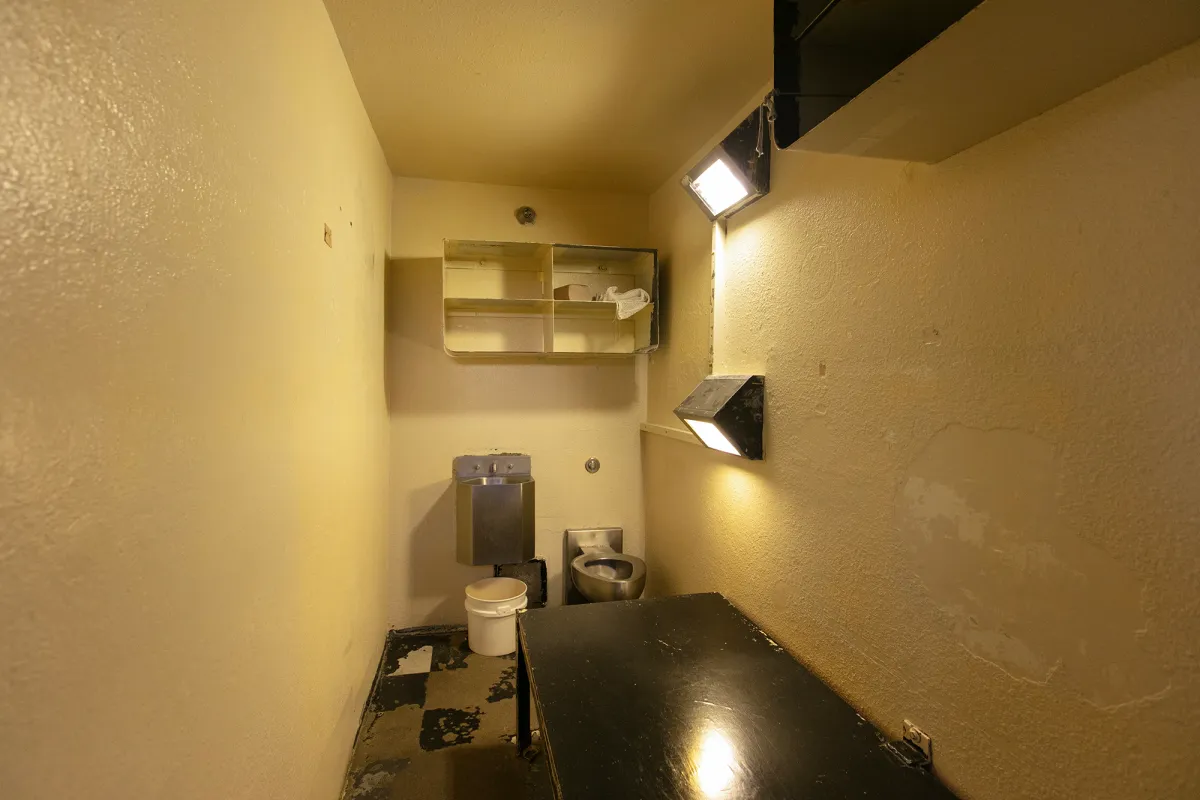
A housing cell at San Quentin Rehabilitation Center on Aug. 14, 2023. Photo courtesy of the California Department of Corrections and Rehabilitation
###
This story was originally published by CalMatters. Sign up for their newsletters.
###
If you’re serving hard time inside a California prison, you’ll often find yourself stuck in a cramped cell with a complete stranger. You hang a bedsheet to manufacture the semblance of privacy between bed and toilet. Any little thing can erupt into a source of tension and angst – body odor, snoring, lights on or off.
Each moment becomes a test to avoid confrontation or brawling. With no immediate help from officers, the fear and anxiety festers inside you. And day by day, your mental health deteriorates.
“You don’t necessarily know what the capacity of this person is, or like what their crime is,” said Steven Warren, a current resident inside San Quentin Rehabilitation Center. “You’re not told any of that when you’re put in a cell with them.
“I don’t know if this person has the propensity to murder me in my sleep or commit a violent act against me just because they’re feeling some type of way.”
Some California policymakers and prison officials believe it’s time to rethink these potentially harmful housing situations. They contend that offering more single-occupancy cells might serve the best interests of prison residents and public safety.
That’s possible because California’s incarcerated population continues to decline — from its peak of over 173,000 people in 2006 to just under 90,000 today. A handful of prisons have closed, while changes in resentencing and parole eligibility have helped release thousands of individuals.
Under former Gov. Jerry Brown and now Gov. Gavin Newsom, rehabilitation and reentry opportunities remain a growing focal point, too. San Quentin Rehabilitation Center stands at the forefront of the discussion, with an “earned living” housing unit comprised exclusively of single-person cells and plans to similarly repurpose the vacated Death Row buildings. A spokesperson for the prison said it is “working toward” making single-person cells available to all incarcerated people by spring 2026.
A bill advanced in the California Legislature this year aims to establish single-cell units at more prisons. The measure did not make it to Newsom, but it’s expected to return in 2026.
“We want people to have the opportunity to return back to our community, and we want them to do that in the healthiest manner,” said San Francisco District Attorney Brooke Jenkins, who helped draft the legislation.
“You can’t do that if you’re in an environment that causes chaos and stress — or you can’t sleep, you’re having confrontations, you’re irritable because you’re sleeping with one eye open.”
Conversations spark change
Jenkins visited San Quentin numerous times over the last two years and spoke with Warren and others. More importantly, she listened.
“One of the conversations that we had inside with a number of the residents was the cellmate on cellmate violence and all of the issues that come with sharing a cell,” said Jenkins.
She reached out to Assemblymember Damon Connolly, the Democrat representing San Rafael. Together, they authored the Assembly bill that proposes establishing single-occupancy cell pilot programs at four California prisons.
“To properly be able to engage in rehabilitative programming,” states the bill’s text. “Incarcerated persons must be able to sleep without fear of physical harm.”

Prison housing cells at San Quentin Rehabilitation Center on Aug. 14, 2023. Photo courtesy of the California Department of Corrections and Rehabilitation
Connolly said that single-cell housing units additionally promote safer work environments for corrections officers and staff. “It fits in, in my view, with the larger objectives that the governor and many of us have pursued.”
The state’s prison union agrees with Connolly and Jenkins.
The California Correctional Peace Officers Association in general has supported Newsom’s emphasis on rehabilitation for prisoners, and it has begun lobbying in public against further prison closures.
The 24,500-member union is a player in the Capitol, where it has given $7 million to state lawmakers since 2015, according to the CalMatters Digital Democracy database. It also kicked in $1.75 million to help Newsom defeat the 2021 recall campaign against him, and another $1 million to back Newsom’s 2024 mental health ballot measure.
“The threat of violence and tension in shared cells… fosters conflicts amongst cellmates, necessitating intervention from correctional officers, who place themselves in jeopardy, thereby escalating the overall risk within the facility for all parties involved,” said the California Correctional Peace Officers Association in a support letter to Connolly.
Warren recalled a 2021 situation of cellmate on cellmate violence that he can’t ever forget.
“A young man beat an older gentleman to death in a cell maybe four or five cells down from me,” he said. “It was crazy. After everything was all said and done, there were so many conversations about how these two people shouldn’t be together — about how one person was having an issue with the other person, but (officers) not giving it full regard of the mental health issues.”
A new era of decarceration
Old prisons, such as San Quentin and Folsom, were originally designed to house one person per cell. In response to mass incarceration and overcrowding in the 1990s and early 2000s, the corrections department threw beds into spaces never intended for housing. They had people sleeping in gyms, hallways, and even stairwells.
And they welded and bolted extra bunk beds into almost every single-person cell.

A housing cell at Folsom State Prison on March 14, 2013. Photo courtesy of the California Department of Corrections and Rehabilitation
Decades of prison rights litigation eventually forced the system to address the issue of housing people at 200% design capacity. Two class-action lawsuits, Coleman v. Newsom and Plata v. Newsom, led to federal oversight and a mandated decrease to 137% capacity.
Current housing rates stand at about 120% design capacity, averaged across all 31 state prisons.
Newsom faces some pressure to close more of them. His administration estimates that shutting down one prison saves about $150 million a year, and it’s the only reliable way to actually bring down corrections spending. He has closed four prisons so far — with one more shutdown in the works.
Some advocacy groups and incarcerated individuals opposed Connoly and Jenkins’ bill to provide more single-cell housing. Known as prison abolitionists, these groups want to see as many prisons close as possible. They believe providing more single-cell units could interfere with that agenda.
Kenthi Porter, an incarcerated resident of Ironwood State Prison, submitted a letter to the Legislature through the abolitionist group Initiate Justice that said single cell policies “may reinforce the infrastructure of mass incarceration… by utilizing current excess bed space and providing a pretext for halting future prison closure or expanding existing prison infrastructure.”
Connolly emphasized that the bill does not attempt to legislate on any prison closure decisions.
“The goal here is not to otherwise keep prisons open that are slated to be closed or to reopen closed prisons,” he said. “I fully understand the goal of reducing incarceration that is aligned with the governor’s goal of closing certain prisons. This is not what that is about.”
Jenkins said that closing prisons to accommodate decreasing prison populations amid fiscal budget considerations may not be the best solution.
“Closing prisons is symbolic,” she said. “I don’t think that it represents a true care for the people who are currently incarcerated. I think we have to think about the conditions that they’re in and not symbolic gestures.”
Incentivizing good behavior
One big roadblock that can derail parole and reentry opportunities is the common prison practice of holding both cellmates accountable for the actions of one. When officers find contraband like narcotics, weapons or cell phones in a cell, they commonly issue a disciplinary rules violation report that holds both occupants responsible for the infraction.
“A write-up could be given to you based on the fact that your cellmate was involved in certain activities,” said Warren. “You have to collectively pay for what this person did because, in here, you’re guilty until proven innocent — and most of the time, they usually find us guilty.”
Disciplinary infractions remain part of an incarcerated individual’s permanent record and affect their chances of parole or resentencing. A mistake or exoneration may get documented, but those reports never completely go away.
Jenkins asked San Quentin administration to provide data on the amount of write-ups that occurred within Donner, its single-cell “earned living” unit for residents who demonstrate disciplinary-free conduct.
“San Quentin had over 3,000 write-ups last year, and out of those 3,000, I believe it was seven that came out of Donner,” said Jenkins. “What you see is that it’s working. It’s effective in that it allows the correctional officers who work in that unit to actually be able to have less stress themselves because they know that these inmates are incentivized to behave.”
Erick Maciel currently resides in Donner and has been there since its inception as an earned living unit in 2023. He said it’s the first and only time he’s had a cell to himself in more than eight years of incarceration.
“Donner feels like I’m on parole,” said Maciel. “It’s the closest thing to almost feeling free in prison because we’re not feeling pressure from correctional officers or anything like that. It’s super important, because now I’m able to just concentrate on myself.”
Staying in Donner requires remaining disciplinary-free, so Maciel and others in the unit act accordingly.
“I am afraid of the consequences,” he said about potentially getting a write-up and losing his single-cell privileges. “I’m very mindful that I’m following the rules all the time — because I appreciate where I’m at.”
###
Joe Garcia is a California Local News fellow.
OBITUARY: Merritt Lindgren, 1953-2025
LoCO Staff / Monday, Nov. 3, 2025 @ 6:56 a.m. / Obits
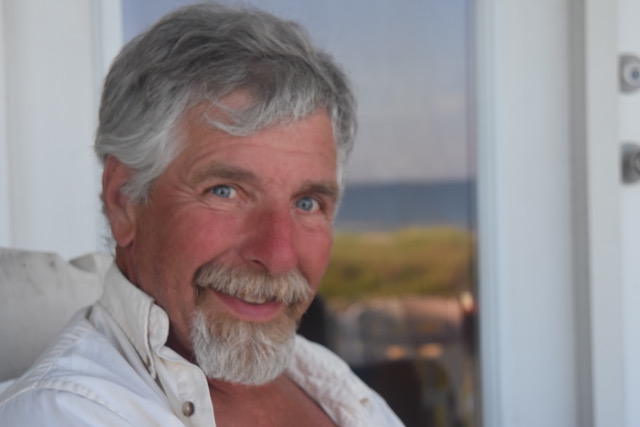
Merritt Lindgren was born the fourth child to Harold and Adele Lindgren on Nov. 29, 1953, and he passed away unexpectedly on Sept. 29, 2025.
Merritt was and is dearly loved by his family — his sisters, Cindy and Corrine Lindgren, Lisa Bernardi; son, Christopher Bernardi, wife, Kate, Alden Perry, Merritt Perry, wife, Kristina Walker, son & daughter Gavin & Maia Perry, niece Stacy Calderone, son Ryan McGrew, nephews Jason Calderone, Joel Calderone, wife, Gina, children Julian and Sadie Calderone.
Merritt was raised in a home built by his father in a forested area of Dix Hills, Long Island, New York, where he loved to roam, unafraid of anything, with his lifelong friends, Fred Gunderson and Grant Steen. In the mid 1970s, Merritt moved to Ukiah to live near his sisters Cindy and Corky, and he later moved to Humboldt to attend Humboldt State University where he graduated with a degree in forestry and worked as a licensed forester for 35 years at NRM until he retired.
Merritt built a life in the community of Blue Lake, where he has been blessed to have so many friends who love and care about him. He loved the woods, the rivers, fishing, and dancing, and his dog, Odin. Friends joined during his several walks a day along the Mad River. He planted trees, fixed trails with colorful rocks and designed sculptures on large driftwood roots with gem like stones where many would stop to admire and/or leave a precious stone of their own
Merritt was one of the founders of the Old Crows, a men’s group that devoted time to the community.
Merritt was kind and thoughtful, with humility. He cared about his community and loved the people around him with his quirky sense humor. We all miss him. Merritt made his mark in the life he lived and will always be loved and remembered.
###
The obituary above was submitted on behalf of Merritt Lindgren’s loved ones. The Lost Coast Outpost runs obituaries of Humboldt County residents at no charge. See guidelines here.
OBITUARY: Niccolo Pearce (‘Nick’) Giannini, 1941-2025
LoCO Staff / Sunday, Nov. 2, 2025 @ 6:56 a.m. / Obits

Niccolo Pearce “Nick” Giannini, beloved husband, father, grandfather, great-grandfather and cherished member of the Eureka community, passed away peacefully at his longtime home on October 19, 2025. He was 84 years old.
Born on January 22, 1941, at St. Joseph’s Hospital in Eureka, Nick was the middle child of Orlando “Babe” and Alyce Pearce Giannini. Raised alongside his older sister Bernadine and younger brother Ralph, Nick grew up in a home filled with warmth, tradition and deep-rooted values. He attended St. Bernard’s schools from kindergarten through high school, graduating in 1958 as class Salutatorian.
At St. Bernard’s High School, Nick distinguished himself as both a scholar and a leader. He served as sophomore class president, senior class vice president, and was an active member of the Key Club and Block B. His athletic prowess earned him the nickname “The Italian Stallion,” as he excelled in football, baseball, basketball and track, earning a remarkable seven All-County stars over the course of his high school career. Yet, despite his many accolades, Nick often said that the greatest gift he received from high school was meeting Judy Johnston, the love of his life and future wife of nearly 58 years.
Nick and Judy married on June 24, 1961, and together built a life centered on love, family and community. Their two sons, John and Matthew, were their pride and joy. Nick and Judy shared a deep and enduring bond, and though Judy passed away in 2019, the family finds comfort in knowing they are now reunited.
Nick’s professional journey was as rich and varied as his personality. He began working for his father as a driver for Burgermeister Beer, a role he held for 15 years. His passion for cooking led him to a successful 15-year career as a chef at Lazio’s Seafood Restaurant during the 1970s and 1980s, followed by time at the Scotia Inn. He generously volunteered his culinary talents for Sons and Daughters of Italy fundraising dinners, and his holiday meals were legendary among family and friends.
In a bold entrepreneurial move, Nick purchased a block of property in Loleta, including the post office, meat market and Loleta Grocery. He operated the grocery store for 15 years, forming lasting friendships and employing several locals — including his sons. Later, he transitioned into real estate, working as a real estate agent with Coldwell Banker Cutten Realty for four years before retiring.
A devout Catholic, Nick was deeply involved in St. Bernard’s parish, attending Mass regularly and serving on the church’s Finance Committee until his passing. His faith was a guiding force throughout his life.
In February 2025, Nick was honored with induction into the St. Bernard’s Hall of Fame, recognizing both his athletic achievements and his lifelong contributions to the school. He served on the Crusader Athletic Board and was a familiar presence at St. Bernard’s sporting events, cheering on the next generation of athletes with pride and enthusiasm — typically accompanied by his brother Ralph, with whom he shared many enjoyable afternoons at the games.
Nick’s hobbies reflected his zest for life. He enjoyed fly fishing on the Eel River, playing adult league softball and following his favorite Bay Area sports teams. In retirement, he found joy in simple pleasures — smoking cigars on the “catio” he built for his beloved cat, Millie, and spending time with family and friends. Along with fellow Crusader Jim Mathias, Nick was a loyal friend to their classmate Diane Luzzi, offering support whenever she needed it. Nick and Jim shared a close friendship and a meaningful connection with Diane, who passed away just twelve days before Nick.
Nick was preceded in death by his parents, Orlando “Babe” and Alyce Pearce Giannini, and his beloved wife Judy. He is survived by his brother Orlando “Ralph” (Nancy) Giannini of Eureka; his sister Bernadine Resso of Eureka; his sons, John Giannini of Lake Havasu City, Arizona and Matthew (Linda) Giannini of Sacramento his granddaughters, Alexis Giannini of Mesa, Arizona and Gianna Giannini of Sacramento; his great-granddaughter Avery Renee Erwin of Mesa; and numerous nieces, nephews and extended family members who will miss him dearly.
Although no formal services are planned at this time, the 12:15 p.m. Mass at St. Bernard’s Church on Friday, November 28, 2025, will be offered for the intention of Nick, as will the 4:00 p.m. Mass on Saturday, January 24, 2026, at St. Joseph’s Church.
In memory of Nick, the family kindly suggests contributions to St. Bernard’s parish, St. Bernard’s Academy or a charity of your choice.
###
The obituary above was submitted on behalf of Nick Gianinni’s loved ones. The Lost Coast Outpost runs obituaries of Humboldt County residents at no charge. See guidelines here.
THE ECONEWS REPORT: The Water Remembers, With Amy Bowers Cordalis
The EcoNews Report / Saturday, Nov. 1, 2025 @ 10 a.m. / Environment

The Yurok people are a fishing people. Since time immemorial, the Klamath River provided for the Yurok, with salmon, eels, eulachon, and other food. Colonization fundamentally upset the balance that existed. The Yurok faced genocide, and those that survived were confined to a small portion of their territory. The Klamath, once a mighty salmon stronghold, was choked by fish-killing dams. But the Yurok persisted. In her new book, The Water Remembers: My Indigenous Family’s Fight to Save a River and a Way of Life, Amy Bowers Cordalis details the long struggle by her family and people to resist, restore and renew tribal sovereignty and the Klamath River.
Come see Amy and get a copy of her new book signed at Cal Poly Humboldt on Thursday, November 13 from 4:30 p.m. to 7:30 p.m. at the Behavioral & Social Sciences building, room 162, as part of their Decolonizing Sustainability Speaker Series.
HUMBOLDT HISTORY: Cattle Dogs I Have Known
Gerald Beck / Saturday, Nov. 1, 2025 @ 7:30 a.m. / History

Looking down at the Beck headquarters on Elk Ridge, known as the Samuels Place. Photo courtesy Jerry Beck, via the Humboldt Historian.
When my dad and I plunged into a hill country ranching enterprise in 1958, we signed a lease on 5,200 acres of mountain rangeland on Elk Ridge, owned at that time by the Samuels-Waddington Estate. This land is located to the south of Myers Flat and west of Garberville, on the divide between the South Fork of the Eel River drainage and the Mattole River drainage. The fact that there was very little active ownership on three sides of the property, and that it bordered on government land toward Gilham Butte and Panther Gap on the west, translated into perhaps fifteen thousand acres of unfenced mountain country.
We purchased some three hundred head of mountain cattle resident on the ranch and were immediately met with the problems inherent in locating, herding and gathering animals that were, in many instances, more “wild” and more cunning in their ability to evade men on horseback than the numerous blacktail deer. These cattle would hear us or catch our scent long before we knew they were around, and quietly disappear. Our dogs provided the only opportunity for finding and controlling these elusive cows and their calves.
My dad had experienced this kind of challenge some forty years before, but I was a greenhorn with only a basic awareness of the tactics required in such an enterprise. The “rodeo” that occurred the first time I witnessed a band of these range cattle in confrontation with a couple of experienced cow dogs was truly a rowdy, incredibly noisy scene. It soon became abundantly clear that gathering these mountain bred cattle was possible only with the help of stock dogs possessing an irrepressible instinct to “do battle” with the animals.
###
My overwhelming wish since childhood was to be a horseman, but for all my love of horses I could not come away from the Elk Ridge experience without incredible admiration and respect for the loyalty and dedication of some of the stock dogs we encountered. Without their assistance the gathering would many times have been impossible. It was a continuous process of acquisition and training, sometimes resulting in amazingly productive work by these dogs, but often ending in their terminal experience.
In 1958 we had really only one shepherd with enough experience in herding livestock to be of much help. He was a forty-five pound McNab, mostly black with a tiny snip of white on his nose, a band of white on his chest and two white feet. Zip was instinctively a “header” — that is, when we encountered stock and they attempted to move away from us, which they nearly always did, he would get in front of them and stop them.
Most mountain cows came to learn that they had to be aggressively protective of their young calves. When gathering we could always depend on the cows stopping to engage in battle with any dog. Zip was particularly adept at teasing the cows into charging him, at which point he would stay just far enough ahead to ensure his safety until the cows stopped their charge and returned to their calves. Zip was what I would call a “double-header.” If the stock moved away from him after first contact he would head them again until they stopped, go through the same teasing routine and continue to head them until he was ordered to cease the “game.”
The great advantage that a good lead dog gave us in gathering was that the dog could quickly travel to places that a man on horseback might not be able to reach for several minutes, if at all. Zip was invaluable in such situations because he loved to herd stock and would run immediately to confront the cattle and continue to head them, essentially not allowing them to go anywhere until we could get there. Of course there were always occasions when an animals performance might have left something to be desired, but the overwhelming percentage of the time they made the difference between success and failure. Once “dogged up,” or bunched, cattle could usually be driven in predictable directions with the help of a dedicated header who would always work on the off side of the cattle. A rider could determine the desired direction of progress by positioning himself opposite that path and “ride drag.”
The work was physically difficult and dangerous, particularly to pups who had not yet developed the discipline to adequately protect themselves. Maintaining the dogs feet was a fairly constant challenge. If the dog had hair between his or her toes, it became a catching place for foxtail. During the dry season, a nightly task involved pulling the injurious grass stickers from between the dogs toes with a pair of tweezers, before the sharp awns could penetrate the skin. Once that occurred it became an extremely difficult downhill task to keep the feet healthy. Even after the foxtail was removed and the puncture healed up, the scar would perpetually remain an entry point for grass stickers.
Zip was prone to flopping into available water holes during fall gatherings where he would soften the skin between his toes, making him particularly vulnerable to the foxtail problem. He often had a series of open holes between his toes that got clogged with foxtails daily. At times tweezers had to be forced inches into the dog’s foot to extract the invading seeds, causing the dog to react to the pain by attempting to bite his assailant. Too much of this activity would leave the dog lame and crippled for weeks at a time.

Zip, lower left, is ready to roll. The author, Jerry Beck, is at right, on Ginger; Yvonne Morrison is on Robin. Circa 1959. Photos courtesy Jerry Beck, via the Humboldt Historian.
###
We would often run a pup along with an older, experienced dog to help the pup learn the ropes. If the young dogs had a strong herding instinct it was at times difficult to keep them out of trouble and prevent them from getting injured.
One year I got a couple of pups from Henry Milsap. Henry was a bear hunter and a true mountain man with a reputation for breeding dogs with guaranteed hunting and herding instincts. These two males were gifted with an insatiable desire to attack any problem with ferocity. They were from the same litter but probably sired differently. Both had relatively long hair but one was all black and the other was brindle. The brindle pup (I can’t remember the name we gave him) was so driven to do battle with the stock that I could not save him one day when we were driving a bunch of cows up a steep backbone to the Dixon Butte corral.
I had hold of my gelding Goldie’s tail, allowing him to pull me up this steep hogback close behind the cows. These pups were milling around, heeling anything they could get hold of, when I heard a solid smack and saw the brindle pup come whimpering back down to me with a bloody nose. I caught him and talked to him. I had no way of restraining him and he seemed okay so I let him go. A few minutes later the pup came gyrating past me, fully airborne, and landed in a patch of poison oak below me. He had gone right back in to grab another cow by the hind leg and was knocked senseless. He had to be put down.
The other Milsap pup, named Hank, stayed with me longer, and we experienced several encounters with livestock. Hank was more athletic than his brother and fast enough to avoid the inevitable charges and kicks. He lacked nothing in the desire to bite cows. Unfortunately I was never able to get enough obedience from Hank to make our attempts at gathering anything but a huge frustration. Nothing would deter this pup. He would charge the cattle, immediately biting anything he could get hold of. If it were a small band they would usually scatter like a bunch of quail, never to be seen again that day.
One day we approached about fifty head on the north side salt ground. As usual Hank raced into the middle of the herd biting at everything he could reach. He actually started and moved the entire band with no cooperation from me. If nothing else, he could really move cattle.
One day we were transferring about forty head from the Dixon Butte corral down to the headquarters. We used a drift fence that had been constructed from the base of the butte directly down the mountain in an easterly direction into the home corrals. Most of the way the fence adhered to gulches grown with willow, pepperwood and buckeye.
The cattle had moved into the shade onto a little buckeye flat against the fence while we rested the horses on a rise to the south. Abruptly a slick red-jawed crossbred heifer came charging back toward us on a dead run. As she drew nearer we saw Hank riding up on the critter’s withers, biting the tortured animal up and down her back, every place he could reach.
The pup rode the heifer past us, over the next rise to the south and out of sight. He returned about half an hour later with his tongue out about a foot saying, “I guess I took care of that heifer!” I didn’t see the heifer again for several months. Since I was unable to expect any obedience from Hank, I thought it was about time to retire him from the training process, as he had a tendency to make the cattle he encountered even wilder than they were before.
###
The situation was hard on most dogs. I had a little black and tan female named Sue. Although a little excitable, she had a great instinct to herd and was learning obedience. When we started out horseback in the morning, she would get so excited that she would run in and heel my horse just as I was trying to mount up, causing the horse to jump out from under me. I often carried her in the passenger seat when trucking back and forth to the valley. She would get so excited when she saw any large vehicle approaching us on the road that she would jump at me across the seat attempting to attack the oncoming vehicle, often grabbing my arm above the elbow. The practice was a little disconcerting when I had my hands full staying on the road and keeping the load stable.
One summer we were helping a neighbor, Ernie Manhart, gather some of his cattle for market. He owned about 1500 acres that he principally used as a hunting ground, on a south slope across Salmon Creek from Elk Ridge. We gathered nineteen grown bulls that day that had never seen the inside of a corral, but that’s another story. I was following some cows along below a stand of tan oak brush when I saw Sue come flying out of the brush rolling over in the grass in apparent pain. Upon closer examination I saw she was totally covered with yellow jackets. I tried desperately to get the bugs off her with my hat and my hands until she was able to quiet down. I babied her at Hydesville for two weeks. She developed large abscesses on each side of her rib cage and was gone in another week. Sometimes there wasn’t much one could do to protect these animals.
###
Our nearest neighbors Bill Thomas and Rae Wright both had excellent herding dogs. Adrian and Florence Thomas had moved down to Weott and Bill and Elvie Thomas lived and ran mostly sheep and a few head of cattle on the old family ranch to the far eastern end of Elk Ridge. Rae ran sheep only on the Harry Hine ranch known as Sunnyside, across the main Salmon Creek to the north and east of us.
Bill’s dog Rowdy was a mean little black McNab that would sneak around and bite any stranger unless specifically restrained by his master. Bill perversely enjoyed these little attacks and once bitten I could expect to be laughed at and told I’d better stay on my horse. At the end of the day. Rowdy could not be faulted when it came to handling cattle.
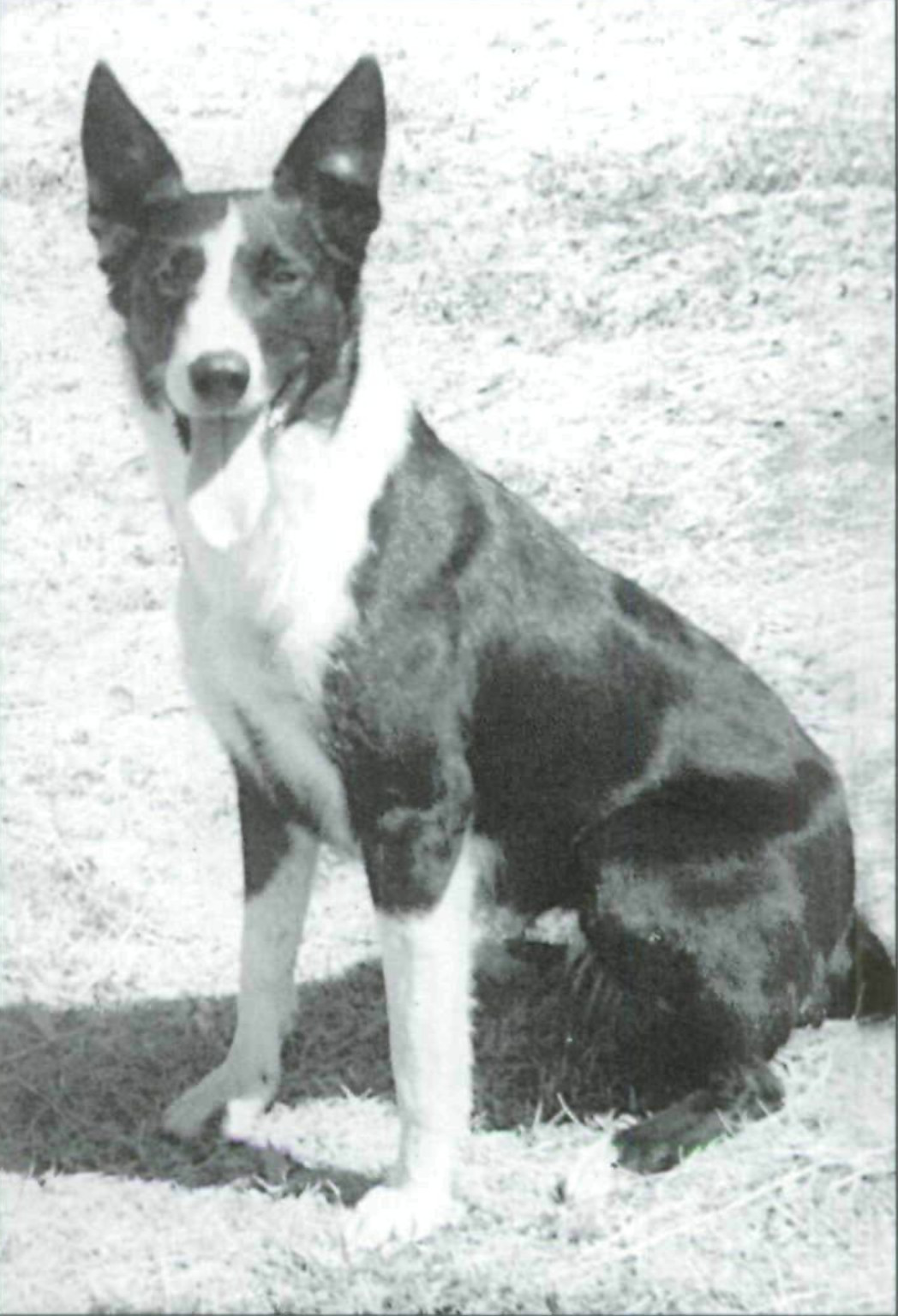
The remarkable Patsy. Photo courtesy Ricky Wright via the Humboldt Historian.
The most remarkable dog I encountered in that time, though, was a black and white McNab that Rae Wright had trained. Rae was good with dogs and this female, Patsy, was truly amazing. Rae also had a little red kelpie that would circle around uphill to jump up and ride on the saddle with him, but Red was a plaything alongside of old Patsy. She was a one-person dog, continually on guard against anyone touching or even coming near Rae’s property. She habitually rode in the passenger seat of his old Chevy pickup and woe to anyone who might try to get too close to the cab. She stood guard over his boots until morning where he left them on the porch at night.
The intelligence, dedication and obedience of this animal were truly exceptional. Rae’s sheep would periodically stray across the creek onto our northeast slope known as the Burnell. He would locate them with binoculars, ride over in the afternoon and I would try and help him return them to Sunnyside. One afternoon we located about eighteen ewes and a number of lambs on the Burnell. Rae had sighted another little flock a mile or so further west. We sat and traded lies for a few minutes and then Rae simply said in a quiet tone of voice, “You stay here, Pat.” And we rode off. I think we were gone about two hours and returned with the other little flock to find Patsy patiently holding the original eighteen ewes in exactly the same spot we had left them.
Patsy knew to change her herding methods for sheep or cattle, being much more forceful when that force was needed for the larger animals. One day when we gathered some of Mr. Manhart’s cattle, I was amazed by the performance of this dog. Bill Thomas was there with his Rowdy, and my dad and I were there with Zip. When we first encountered them, the cattle plunged into a thicket of tan oak brush and weren’t seen again for a good mile. Rae had put Patsy ahead of them and we followed as best we could, not really knowing where the animals were. Once in a while we could hear a dog bark somewhere up ahead of us. We could neither hear nor see the cattle. When we came out of the brush near Ernie Manhart’s makeshift corral. Patsy was waiting, with the entire band under control.
Babe Demello, an active livestock trucker at that time, had his truck and trailer up on Sunnyside one day to haul out a load of sheep. Patsy fell asleep in the road behind the trailer. Far from the motor noise of the tractor there was nothing to awaken her and Babe, unaware of her presence, backed over her. Not only was it the loss of a trusted companion, it was like the loss of at least five experienced men in any mountain herding situation. When I came up to speak with Rae he was looking into the distance with tears in his eyes. These dogs were irreplaceable resources and loved members of our family.
###
The story above was excerpted from an article originally printed in the Summer 2009 issue of The Humboldt Historian, a journal of the Humboldt County Historical Society, and is reprinted here with permission. The Humboldt County Historical Society is a nonprofit organization devoted to archiving, preserving and sharing Humboldt County’s rich history. You can become a member and receive a year’s worth of new issues of The Humboldt Historian at this link.


