

OBITUARY: Shirley ‘Jean’ Browning, 1935-2025
LoCO Staff / Wednesday, Aug. 6, 2025 @ 6:56 a.m. / Obits

In Loving Memory of Shirley “Jean” Browning
March
14, 1935 - June 22, 2025
Shirley “Jean” Browning, a woman of grace, humor, and boundless love, passed away peacefully at age 90 in her home, with loved ones by her side on June 22, 2025.
Jean’s final resting place is Humboldt County, where she had spent the last two decades of her life surrounded by family, music and the redwoods she came to adore.
Born in Medicine Lodge, Kansas, Jean’s early years were spent across Kansas and Illinois before her family settled in Colorado, where she completed high school. Her love for music blossomed early — she started piano lessons at age 4, played the French horn in high school and college, sang beautifully and also learned to play the pipe organ. After retirement and later in life, rarely missed a live performance. Music was her heartbeat, her joy and her constant companion.
Jean was a devoted homemaker and mother extraordinaire to her four children — Barbara, Shelly, Chris and Leisl — before embarking on a successful career as a senior-level Executive Assistant. She brought her signature warmth and precision to her roles at Informatics and later at Paccar, supporting top executives with grace and professionalism.
Her life’s journey took her through Illinois, Kansas, Colorado, California, Idaho and Washington, before she retired to Humboldt County to be near her daughter, Barbara, and her husband, Ron. For the past 20 years, she built a rich life in the community—singing and playing music with the McKinleyville Choir and the Gila Monsters, serving on the board of the Eureka Symphony, serving as secretary of the Oceanwest homeowner group, playing poker and Mahjong and entertaining friends and family with her signature sparkle.
Jean’s sweet tooth was legendary — she adored all things sugary and somehow managed to dodge diabetes despite years of being pre-diabetic. Coke Zero was her drink of choice, and she never turned down a salted caramel treat. Her zest for life was matched only by her love for her dogs, Tank and Lily, and her cherished adventures to Costa Rica, Morocco, Ireland, Wales and Scotland after retirement.
She was deeply loved by her “girlfriends” group from Washington, the friends she met at Oceanwest, her choir companions, her fellow Gila Monsters, her many nieces and nephews and, of course, her children and grandchildren. Her home was always open, her laughter infectious and her stories unforgettable.
Though we may not recall every mischievous moment (and she’d probably prefer it that way), Jean’s legacy is one of joy, resilience and a life lived in full harmony.
Donations in Jean’s name can be made to Hospice of Humboldt.
She will be missed beyond measure and remembered with every sweet note, every shared laugh, and every song sung in her memory.
###
The obituary above was submitted on behalf of Jean Browning’s loved ones. The Lost Coast Outpost runs obituaries of Humboldt County residents at no charge. See guidelines here.
BOOKED
Today: 10 felonies, 12 misdemeanors, 0 infractions
JUDGED
Humboldt County Superior Court Calendar: Today
CHP REPORTS
1656 Union St (HM office): Missing Indigenous
ELSEWHERE
County of Humboldt Meetings: Behavioral Health Board - SUD/Dual Recovery Committee - Sept. 10, 2026
County of Humboldt Meetings: Behavioral Health Board Executive Committee Meeting - July 1, 2026
RHBB: Judge Overturns Search Warrant in Student Activist Case: Devices Ordered Returned
RHBB: Multi-Vehicle Crash Closes South Fortuna Boulevard Near Strongs Creek Plaza
New Bicycle Skills Park Might be Coming to the Arcata Community Forest
Dezmond Remington / Tuesday, Aug. 5, 2025 @ 4:48 p.m. / LoCO Sports!

A map of the park. By City of Arcata.
Several years after getting a gnarly downhill trail and a pump track, the Arcata Community Forest may be getting another bicycle-focused amenity after a high school team pitched it to the city.
The city may fund a bicycle “skills trail,” where mountain bikers can practice difficult techniques on terrain not common to Humboldt. Trails may include a “rock garden” (a path choked with stones, hard to quickly ride), a steep climbing trail, and logs to descend on. The proposed site is located at the top of the Jump and Peanut Butter mountain biking trails, about an acre in size.
The idea came from the Humboldt Composite, a county-wide mountain biking team made up of riders from the 6th-12th grades. Most of their races take place outside the county, where rocky trails and difficult-to-traverse obstacles are the norm. There aren’t many places like that to train here, so they thought it’d be a good idea to reach out to the city to see if they’d be interested. They were, and though it’s not a sure thing yet (Emily Sinkhorn, Arcata’s director of environmental services, said it would need to be approved by the Forest Management Committee and the city council), everyone’s excited about the possibilities.
According to Brenda O’Dell, a coach for the Humboldt Composite, many of the jumps in the forest are too aggressive for many of their riders. A skills park would be a nice way to get their athletes acclimated to the trickier details of controlling a bicycle at-speed.
“It’s a good way of supporting the kids and getting them outside and active,” said O’Dell. “I’m an ER nurse, and I see a lot of kids that are struggling, and I’m like ‘You need to get outside, and get some exercise!’ It just helps build a community that fills a niche for some kids.”
Kneeland School District Shifts to Year-Round Schedule to Combat Learning Loss Among Students
Isabella Vanderheiden / Tuesday, Aug. 5, 2025 @ 3:47 p.m. / Education

Photo: Kneeland School District
###
While their peers savor the last weeks of summer vacation, kids at Kneeland School are heading back to class a little early this year as the district moves to a year-round schedule — the first of its kind in Humboldt County.
The new school year will begin on Aug. 11 and continue through June 25, 2026, with several extended breaks in between, including three weeks for Spring Break and one week each for Fall Break and Presidents’ Break, in addition to the standard time off for Thanksgiving, Winter Break and other scheduled holidays.
The shift away from the traditional two- to three-month summer vacation might sound like a bummer for the students, but teachers and administrators are hopeful that the continuous or “balanced” calendar, which redistributes the standard 180 days of instruction required in most states, will help improve learning retention and address learning loss that occurs over extended breaks.
“Over the years, teachers have noticed that they spend the first month or month and a half of school reviewing material that they had already covered during the previous school year,” Kneeland School District Secretary Cherie Circe told the Outpost. “At first, everybody thought, ‘Oh, no! Who wants to shorten their summer?!’ But after the district presented it as an issue of learning loss and reteaching from the previous year, the families got on board, and the teachers were excited about it.”
The district, which serves two dozen students from transitional kindergarten up to eighth grade, surveyed parents and teachers earlier this year to get a better idea of scheduling preferences. Not surprisingly, their primary request was to ensure that the new schedule lined up with other local school districts to accommodate family vacations.
“We also had to coordinate with the Humboldt County Office of Education (HCOE) … and they were really excited to see if this was going to work for us. I mean, I’m excited to see if it’s going to work for us,” Circe continued. “In the spring, when we go to set our calendar for next year, the school board is going to seek feedback from teachers and families to learn if there was burnout or any other issues, and we’ll go from there.”
Reached for additional comment, HCOE Superintendent of Schools Michael Davies-Hughes told the Outpost that other school districts have explored calendar adjustments in years past, including Fortuna High School and Ferndale Elementary, but no one has “elected to stretch the instructional school year over a greater span of time” in the way that the Kneeland School District has.
“The Kneeland School District’s decision to adopt a modified schedule for the 2025-26 school year reflects a thoughtful, research-informed approach to addressing the challenges of summer learning loss — an issue that many districts across the county and state continue to grapple with,” Davies-Hughes wrote via email. “[W]e have seen evidence across the county that extended breaks can impact student retention and achievement, particularly for our most vulnerable learners. Districts are increasingly looking at calendar innovations, targeted interventions, and expanded learning opportunities to mitigate these effects.”
Additional information can be found in the press release below:
Kneeland, CA – Kneeland School has announced a modification to the traditional elementary school calendar for the 2025-2026 school year to address summer break learning loss.
Superintendent Greta Turney stated, “This decision was made with careful consideration of our students’ academic progress and the overall well-being of our school community. We recognize the impact this may have on family schedules, and we are committed to supporting our students and families during this transition.”
Key updates include:
• First day of school: August 11, 2025
• New last day of school: June 25, 2026
• Break dates:
o Fall Break: October 13-17, 2025
o Thanksgiving: November 26-28, 2025
o Winter Break: December 22, 2025 – Jan 9, 2026
o Presidents Break: February 16-20, 2026
o Spring Break: April 13, 2026 – May 1, 2026
o Other Scheduled Holidays: Labor Day- Sept 1, Staff Day- Nov 10, Veterans Day Nov 11, Martin Luther King Day- Jan 19, Memorial Day – May 26, Juneteenth- Jun 19.
• Transportation services will continue as normal during the modified schedule.Parents and guardians are encouraged to review the updated calendar on the district’s website at http://humboldt.k12.ca.us/kneeland_sd/ and reach out to school administrator with any questions.
“We are grateful for the continued support of our families, staff, and community as we work together to provide the best possible learning experience for our students,” said Superintendent, Greta Turney.
###
MISSING: Eureka Police Department Seeking 37-Year-Old Woman Last Seen in April in Arcata
LoCO Staff / Tuesday, Aug. 5, 2025 @ 2:38 p.m. / Missing

Amber Morris | EPD
The Eureka Police Department announced Tuesday it was seeking information pertaining to the whereabouts of Amber Morris, aged 37, who was last seen in Arcata’s Sunny Brae neighborhood on April 29, 2025.
Morris is described as a white woman, standing 5‘3” with a slim build.
Anyone who has seen Morris of might have information about her location is encouraged to call EPD at 707-441-4044.

‘A Piece of Freedom’: How San Quentin Prisoners Brought World-Class Art Inside Its Walls
Joe Garcia / Tuesday, Aug. 5, 2025 @ 7 a.m. / Sacramento
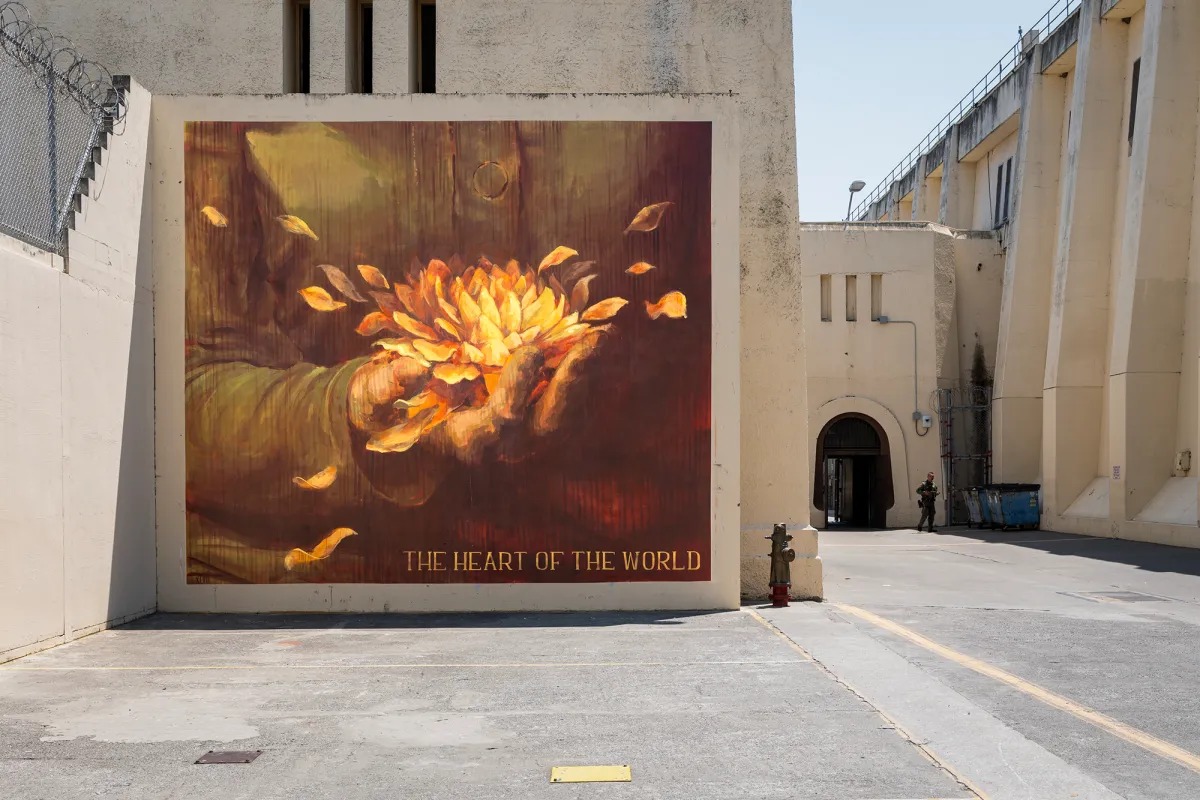
Faith XLVII’s mural, ‘The Heart of the World,’ reflects the afternoon light at the San Quentin Rehabilitation Center on July 11, 2025. Photo by Jungho Kim for CalMatters
###
This story was originally published by CalMatters. Sign up for their newsletters.
###
About a month after I earned my parole and was released from High Desert State Prison in 2024, my buddy Kai Bannon called me from San Quentin through the institutional phone portal. My eyes welled with emotion at being on the other side of these monitored calls for the first time as a free person.
Kai co-founded San Quentin SkunkWorks — a nonprofit social innovation lab focused on introducing and testing moonshot reform ideas, and he and his inside team embarked on a series of community-oriented projects within the prison.
Now Kai wanted my help to realize a bold new vision — to rehabilitate the 19th century architectural landscape of San Quentin by infusing it with light, color, beauty and art.
Gov. Gavin Newsom committed $240 million toward renovating the state’s oldest prison and rebranding it as San Quentin Rehabilitation Center. His plan includes a new multi-building educational complex, as well as repurposing the former Death Row condemned housing unit into living quarters for the general population.
But it doesn’t include changing the drab beige and brown exteriors that surround residents whenever they leave their tiny dark cells, which were built in the late 1800s. The physical environment still signifies oppression, confinement, punishment.
With so much attention focused on the new buildings set to open in early 2026, Kai began to envision SkunkWorks as a platform that might aesthetically elevate the older, less glamorous parts of the facility.
He christened the project Chiaroscuro: Light Within the Shadows. An Italian term of art, chiaroscuro describes the graphic interplay between light and dark highlights. Metaphorically, it underscores the bright juxtapositions of humanity that live deep within our prisons.
We needed to meet two objectives simultaneously: 1) reach out to global artists to see who’d be interested in working inside an incarcerated community; and 2) figure out how to convince prison administrators that our project had merit.
From Dubai to the U.K. to California, world renowned muralists responded. The concept intrigued them, and they wanted to find out more about San Quentin. They wanted to understand the community they might soon visit and hope to inspire through art. The Skunks collected stories of the individuals living inside San Quentin — including officers and staff who spend large chunks of their days working alongside residents.
Much to our amazement, prison officials agreed we were on the right path. With their support, we gained approval for photos and design layouts of the facility to be shared with prospective artists.
“The murals aren’t just about making the place look better. They change the mood out here,” said San Quentin Correctional Sgt. Freddy Brenes. “A calmer yard means a safer yard — for staff and for the people living here.”
We soon felt an immediate connection with Faith XLVII, a South African artist known for creating community-inspired street murals on public wall spaces and buildings.
“My personal view is just that art has been and is, in all traditional societies, very much a part of the cultural fabric of life and the processes of life,” Faith said. “It’s cathartic; it’s therapeutic; it’s psychological. It speaks in a visual language that negates words and can speak directly to the heart through metaphors and symbols.”

Faith XLVII, a South African artist, outside of San Quentin Rehabilitation Center on July 11, 2025. Photo by Jungho Kim for CalMatters
Faith already had a planned trip to San Francisco in June for a gallery exhibit, so talks quickly evolved. Would it be possible to create a mural on a San Quentin wall in July? We’d need clearcut approval by the administration. We’d also need to raise funds to cover materials and costs.
Kai and his team launched a grassroots social media campaign asking for donations. Because it was the debut installment of Chiaroscuro, we felt an added pressure to pull it off without much hitch.
SkunkWorks raised thousands of dollars by June. A percentage of that came from dozens of residents who filled out donation slips inside the facility for money to be deducted from their institutional trust accounts.
“It’s actually kind of cool,” Kai told me. “A number of people came by and said they gave five bucks or 10 bucks. Those are small amounts for people on the outside. But you and I both know how much five or 10 bucks means in here.”
In addition to Faith, we partnered with Shannon Riley, one of the co-founders of Building 180 — an art production and consulting agency responsible for coordinating public art installations all around the world.
With Riley’s outreach, Dunn-Edwards Paints sponsored most of the paint for the mural. Their local distributors mixed and prepared custom colors along with a UV protective finishing coat.
“I think placing art in public spaces can really help connect people in meaningful ways,” said Riley. “It sparks conversation and dialogue, curiosity and confidence — all really important for healing and rehabilitation.”
Faith’s son, Keya Tama, came from New York to help paint. One of the SkunkWorks outside volunteers who was traveling abroad donated her Sausalito residence for them to stay in comfortable accommodations close to San Quentin.

Barbed wire casts shadows on a mural painted by Keya Tama at the San Quentin Rehabilitation Center on July 11, 2025. Photo by Jungho Kim for CalMatters
An artist himself, Keya felt compelled to install his own mural after speaking about the project with residents and staff.
“As soon as I saw the wall, I kind of just had a feeling,” he said. “Much more like finding something that needed to be there — or had always needed to be there.”
‘Like a piece of freedom’
The Faith XLVII mural stands on the outside of West Block, where more than half the population passes back and forth on any normal day.
George Mesro Coles-El has lived in San Quentin for 13 years, and in all that time, the large blank walls seemed to represent only institutionalization and despair.
“To be able to come out over these last few days and see a mural on the wall in front of me — like when I come and get that first fresh breath of air in the morning, it’s really impactful for me,” said Coles-El. “I never thought I would see a mural like that in a dismal place like prison.”
Coles-El, Tony Haro and Luis Maya all worked with Faith XLVII and Keya Tama. They helped organize and prepare the paint, maintained the brushes and rollers and got a chance to color different segments.
“You get to see something just so different, like a piece of freedom,” said Haro. “We’re going back and forth looking at this beautiful mural that has a quote that’s saying ‘the heart of the world,’ you know? The other day, somebody asked me what does that mean?
“And I said listen to what they’re saying, bro — wherever you’re at, you’re the heart of the world. We’re the heart of the world. You carry that with you.”
More than simply transforming the physical surroundings, the mural also helped shift cultural perceptions.
“I honestly have a newfound respect for staff,” said Maya. “A lot of them took extra efforts to see the project through — just being able to be flexible, being receptive of communication. And then seeing how officers need a new change of scenery as much as us.”
A goodbye through a gate
On July 11, San Quentin Rehabilitation Center planned a media event to celebrate the murals. Faith and a news photographer waited outside but were told no guests would be allowed in that day because of an unexpected modified lockdown.

Assistant Warden Yaser Samara and Faith XLVII stand in front of the artist’s mural at the San Quentin Rehabilitation Center on July 11, 2025. Photo by Jungho Kim for CalMatters
But Associate Warden Yaser Samara called and asked them to come back. Despite the lockdown, he was ready to help Faith get photos and commemorate her art before she returned to South Africa.
“I’m sure there’s many perspectives on this, but at least in my experience with the warden, assistant warden and guards — I met some pretty special people who seemed to want to also bring changes to the system,” said Faith. “And that was very inspiring to me to see that.”
But because of the modified lockdown, Kai was not allowed to be outside when photos were taken. He saw Faith through a locked gate, and she came over to say goodbye and shake his hand through the thick iron bars.
“It’s not how I imagined this ending,” he told me. “But maybe it said everything — that like even in this place that’s built to separate us, we’ve still found a way to connect.
“And I think that the handshake said more than words ever could. It’s gratitude. It’s grief. It’s a whole project in a single gesture reaching across boundaries and trying to create something beautiful, even when the system tries to keep you apart.”
###
Joe Garcia is a California Local News fellow.
California Wine Industry Torn on Trump Tariffs
Levi Sumagaysay / Tuesday, Aug. 5, 2025 @ 6:56 a.m. / Sacramento

Jason Haas, owner of Tablas Creek Vineyard, stands amongst rows of grape vines at his vineyard in Paso Robles on July 30, 2025. Photo by Larry Valenzuela, CalMatters/CatchLight Local
###
This story was originally published by CalMatters. Sign up for their newsletters.
###
Tariffs on European wine could be good or bad for California wine producers, depending on whom you ask.
Some American winemakers, restaurateurs and others are urging President Donald Trump to exclude wine from tariffs on goods from Europe, saying European wines are important to the health of domestic wines.
But not all California wine producers are on board. They argue that European winemakers are already subsidized, so American companies having to bear tariffs on just about everything else — including imported corks, barrels and other supplies — puts wine producers in high-cost California at an even bigger disadvantage.
For some wine growers, “it’s certainly hard to hear” about other U.S. wine and hospitality industry players pushing for “zero-for-zero” tariffs on European wines, said Natalie Collins, president of the California Association of Winegrape Growers, which has 650 members. She said it’s tough for California winemakers to price their products to compete with those from Europe.
Trump recently said that he had reached a tariff agreement with the European Union, but some details have yet to be released, including possible exceptions. For now, the EU says the 15% tariffs that went into effect at the beginning of August apply to wine, though negotiations reportedly continue. The U.S. wine industry, which has been facing myriad challenges including new studies that say alcohol is bad for people’s health, falling demand and growing costs, is taking this opportunity to ask for help.


Jason Haas, owner of Tablas Creek Vineyard, inspects the grapes growing on vines at his vineyard in Paso Robles on July 30, 2025. Photo by Larry Valenzuela, CalMatters/CatchLight Local
“We’ve seen two years in a row of declining wine consumption in the United States for the first time in two generations,” said Jason Haas, co-owner of Tablas Creek Vineyard in Paso Robles. “It shows up in less tourism, fewer people visiting wineries, fewer people ordering over e-commerce, less sales through wholesalers, both restaurant and retail,” Haas added.
That’s the ecosystem the U.S. Wine Trade Alliance and other industry groups are saying will feel the pain if European wine prices rise because of tariffs: thousands of wine importers and distributors, tens of thousands of wine retailers and hundreds of thousands of restaurants. California, the nation’s leader in wine-related tourism and exports, could be most affected. WineAmerica, an industry group, said California’s wine industry generated about $88 billion in economic impact in 2022. The state’s wine exports in 2022 totaled $1.3 billion, according to the California Department of Food and Agriculture.
Katie Lazar co-manages the 45-year-old Cain Vineyard & Winery in St. Helena in the Napa Valley.
“We’re a long-term business,” Lazar said during a recent media briefing, echoing what other winemakers said about how growing grapes and making wine takes years. “It takes (the wine industry) so long to react and be able to change that the chaos that is present now is an existential threat to the world that we live in.”
Winemakers like Lazar say the distributors they rely on to sell their wines need revenue from selling European wines as well. Their ability to distribute domestic wine is tied to how much other wine they have coming in, she said in an interview with CalMatters.
Most of the U.S. alcohol industry has a three-tier structure that dates back to the repeal of Prohibition. Winemakers and producers are the first tier, followed by distributors and retailers. All three are facing the uncertainty brought about by tariffs: Some wine imports are on hold, meaning less revenue for distributors and retailers.

An aerial view of rows of grape vines at Tablas Creek Vineyard in Paso Robles on July 30, 2025. Photo by Larry Valenzuela, CalMatters/CatchLight Local
“I’ve never felt so interconnected like I feel now, even with competitors,” said Matt Licklider, proprietor of LIOCO in Healdsburg, a winemaker that sources its grapes from various small vineyards in California. He said his winery sells to 40 distributors, some of which didn’t know whether they would have revenue coming in from imports because of the unknowns around tariffs. So some of those distributors are ordering less from him. “It has put distributors in a more conservative mindset, which doesn’t benefit anyone here,” Licklider said.
For restaurants that have very thin margins, marking up certain items such as wine can help them survive. Licklider said over the years, he has seen restaurant markups go from two to three times to as high as five times a wine bottle’s price.
Paul Einbund, owner of two restaurants in the Bay Area, said “a lot of my diners just won’t drink domestic (wine).” But he does list some American wines alongside European wines at The Morris, his restaurant in San Francisco, and Sirene, his new restaurant in Oakland.
Not knowing what’s going to happen next is the worst part, Einblund said, especially for small businesses that depend on trying to buy their products at the lowest possible prices.
“People up and down the supply chain are in trouble,” he said. “We were getting emails saying pre-tariff pricing, but that’s dried up now. European producers are not selling to Americans right now. European buyers are not buying American wines right now.”
But Richard Samra, who has been growing grapes in the Sacramento Delta and Lodi for 40 years, said he is more worried about selling his grapes to domestic wineries. He said it’s “amazing” that some in the wine industry are asking for no tariffs on the competition.
He said that competition gets plenty of help. The European Commission recently approved $5.6 billion to support exports of French wines and spirits to the U.S. The European Union spends more than 1 billion euros a year to help boost European wine, and some countries have their own subsidy programs.
“U.S. wine grape growers don’t have that,” Samra said.
“We want to level the playing field. We have plenty of grapes and wine available for sale,” Samra added. He said tens of thousands of acres of vines have been pulled out in California as supply outstrips demand, and he expects that to keep growing. He said imports are a major factor: “Profit margins for people are greater when they purchase a product from outside the U.S. and sell it here.”

Jason Haas, owner of Tablas Creek Vineyard, stands amongst rows of grape vines at his vineyard in Paso Robles on July 30, 2025. Photo by Larry Valenzuela, CalMatters/CatchLight Local
Yet, vintners like Haas, in Paso Robles, said he also worries about the relationships that he has cultivated for years and how they’re being affected by the tariffs. Tablas, his winery, has lost all business in Canada this year.
“There’s certainly spillover effects in terms of other countries just being less wanting to support American products, because they feel like they’re being bullied,” Haas said.
Tablas only exports about 5% of what it produces, but Haas wanted to grow that this year. “We did a lot of investment last year, and building up export markets,” he said. “And so to have it be down this year instead of up has certainly been a hit to us.”
OBITUARY: Noel Francis Halker, 1977-2025
LoCO Staff / Tuesday, Aug. 5, 2025 @ 6:56 a.m. / Obits

Noel Francis Halker, known as Sonny Ray Hawk
January 9, 1977 - June 17, 2025
It is with great sadness in our hearts that we announce the passing of a dear member of our community, Sonny Ray Hawk or Sunny Ray.
Sonny was born and raised in the Shenandoah Valley of Virginia and after traveling a while, spent most of his adult life in Humboldt County, California. He affectionately talked about his childhood with great reverence for the natural environment, the mountains, rivers and valleys, the wildlife and the rural culture, all of which he also appreciated greatly about his second home of Humboldt County.
He is survived by his son Galaxy, his mother and father Ana and Noel Halker, sisters; Angela Shirey, Natalie Aldieri and Cora Cloud, a loving family of aunts, uncles and cousins back in Virginia and elsewhere and a large community of friends here in Humboldt who loved and appreciated Sonny’s friendship, music, moonshine, cooking and company on adventures.
Sonny was a dedicated father. Persevering at times through hardship he strove endlessly to express his love for his son. Inspired to create connection and share the great joys of his own childhood he took him out on fun adventures, camping, kayaking, mushroom hunting, crabbing and fishing.
He had a special connection and sensitivity to nature. One time in his youth he was out coon hunting with his cousins and was caught trying to direct them away from the poor animal. Later on in adulthood, helping a friend harvest a flock of home-raised ducks he is remembered as praying over every single one of them in respect and gratitude for their life.
Sonny was somewhat of a jack of all trades, skilled in many things including but not limited to being a trained HVAC technician, farming, carpentry, animal husbandry, cooking and home brewing. He had a deep thirst for knowledge and was constantly learning and adding to his skillset.
His stand out achievement in life however was his gift of music which he shared freely and with all his heart and soul. From epic songwriting to captivating performances Sonny was renowned as a creative genius and master craftsman when it came to his chosen art form.
In his teenage years he played guitar and banjo on the front porch of a neighbor’s house, a bluegrass man Tommy Bledsoe. He was also fortunate to learn the fine art of moonshine-making from his neighbor, a skill which he perfected to such a degree that he gained much admiration and appreciation for it throughout his life. In fact, he acquired his well-loved National Resonator guitar by trading some of this famous moonshine.Later he picked up the harmonica, taking after his mother who played as well, and mastered the instrument playing it like a true bluesman.
Perhaps what he is most well known for though was his phenomenal voice. Sonny’s mother said he sang his heart out throughout childhood, particularly in church where he learned harmonizing and singing with deep soul. One time, at the tender age of 2 1/2 he was coming home with his Daddy from a day of bailing hay (Sonny rode in the wagon) and started singing a song from church. According to his father he sang that entire 37 mile trip home.
Playing around Humboldt County for the past 19 years in his beloved bands, Kindred Spirits, White Deer and Thurston Hawk, as well as with many other groups of musician friends, Sonny always had an open heart and mind to include all musicians. Despite his giant talent he developed and maintained a humble attitude around music making, a true folk musician who didn’t seem to discriminate about playing ability or styles. He was constantly inspired by all forms of music, modern and traditional and across all genres though he was well known for his bluegrass, blues, folk, country and southern rock styles of playing.
What stood out profoundly about Sonnys playing was his spirit. Every song sung like a gospel song, a large and glorious energy emanating from him that captivated all who heard him. He had the ability to move people on a deep level. Not just his audience but also his fellow musicians who he lifted up, encouraged and inspired to reach within and be the best they could be.
The light in his heart and his spirited enthusiasm extended out to friends and strangers alike. Known as a true friend to many he was always ready to lend a hand when needed, to come help you fix something, encourage and emotionally support you, cook food, play some songs or do a fun adventure with you. He was a give-the-shirt-off-his-back kind of friend.
Sonny was deeply loved and will be missed dearly. May we find peace in the words of his song: “Maybe somewhere over the rainbow I will have a sunny day.”
There will be a memorial to honor and celebrate Sonny’s life on Saturday September 13th at the Fieldbrook Country Kitchen (formally the Fieldbrook Market) from 2-4pm with more music to follow.
There is also a Gofundme account set up to support the grieving process of his son if you would like to contribute and support his family.
###
The obituary above was submitted on behalf of Noel Halker’s loved ones. The Lost Coast Outpost runs obituaries of Humboldt County residents at no charge. See guidelines here.


