

OBITUARY: Robbie Young, 1974-2025
LoCO Staff / Thursday, Aug. 7, 2025 @ 6:56 a.m. / Obits

Robbie Young was born on May 30, 1974 in Fortuna and left his tired body for a new one in God’s kingdom on July 9, 2025. He loved Fortuna and spent his entire life here.
Robbie was lovingly raised by his mother, Anna May Young. Many Fortunans can remember Anna May pulling Robbie all over town in a little red wagon. They once even made the front page of the Times-Standard! Oh, how Robbie loved his mother!
Robbie had a most impressive work ethic. He held two jobs while still in high school. He later worked at Winco, which he loved. Robbie was very determined to climb the working ladder at Winco and surely would have had he not suffered a major stroke at just 29 years of age.
Despite his physical disabilities Robbie was a fiercely independent individual. He could be seen speeding all over Fortuna on his three-wheeled scooter. (Heartfelt thanks to the men’s breakfast crews at Our Saviors and Christ Lutheran churches for purchasing Robbie’s scooter for him). And I do mean speeding. His scooter would do over 20 m.p.h., and that’s the only speed he knew. The only place he slowed down just a little was inside Ray’s Food Place and that was only because he couldn’t take the sharp corners at full speed.
Despite many adversities in his life Robbie never complained. Never “why me”? He had an infectious personality, was very social and you need only to meet him once to become a grateful friend. He will be so very missed by so many for so many reasons.
Robbie is survived by his partner in life, Rebecca Arnold. Robbie was so blessed to have Rebecca in his life for over 20 years.
Robbie was preceded in death by his loving mom, Anna May, and his grandparents, Bea and Glen Iversen.
A special thank you to his spiritual friends at the LDS Church and Christ Lutheran Churches of Fortuna. Also to all those who treated Robbie so kindly at Coast Central Credit Union and Ray’s Food Place in Fortuna. Thank you to his personal caregivers (you all know who you are), the kind staffs at Fortuna Rehab and Redwood Memorial and Kathy at Goble’s Chapel. Bless you all.
A celebration of life for Robbie will be held on Saturday, August 23 at 2 p.m. at Christ Lutheran Church in Fortuna.
###
The obituary above was submitted on behalf of Robbie Young’s loved ones. The Lost Coast Outpost runs obituaries of Humboldt County residents at no charge. See guidelines here.
BOOKED
Today: 10 felonies, 12 misdemeanors, 0 infractions
JUDGED
Humboldt County Superior Court Calendar: Today
CHP REPORTS
1656 Union St (HM office): Missing Indigenous
ELSEWHERE
County of Humboldt Meetings: Behavioral Health Board - SUD/Dual Recovery Committee - Sept. 10, 2026
County of Humboldt Meetings: Behavioral Health Board Executive Committee Meeting - July 1, 2026
RHBB: Judge Overturns Search Warrant in Student Activist Case: Devices Ordered Returned
RHBB: Multi-Vehicle Crash Closes South Fortuna Boulevard Near Strongs Creek Plaza
OBITUARY: Jack Casey, 1940-2025
LoCO Staff / Thursday, Aug. 7, 2025 @ 6:56 a.m. / Obits

Jack Casey
October 13, 1940
– August 2, 2025
Longtime Eureka resident Jack Casey left us quietly and without warning on the morning of Sunday, August 2, 2025. He was no stranger to the Irish goodbye – the habit of ending a conversation by walking away or hanging up the phone when done saying what he needed to say, with no pretext or apology, usually to the surprise of the other party who is left hanging. Such goodbyes are not mean spirited, it’s just how Jack was wired. And after 84 years and a full life, it is how he left us.
Jackie Joe (Jack) Casey came into this world as a ten-pound baby on October 13, 1940, in rural Pittsburg County in eastern Oklahoma. He was the fifth of the nine children born to Elsie and Hersel Casey. Jack was a bookish child who loved to read to his younger siblings. As a teen he excelled in school and dreaded the summer break, which brought full-time work on the family farm in the oppressive heat and humidity of an Oklahoma summer. Dust Bowl hardships eventually claimed the farm, and his parents moved the family west to California. Hersel followed work throughout the Central Valley, often taking on three jobs, while Elsie maintained the home. Hersel was strict, especially with Jack, and brooked no lip or tardiness.
By the early-1950s, the family had settled in Laytonville. After graduating from high school, Jack was eager to leave home and returned to Oklahoma to be close to older brothers Jay and Bill. However, tragedy followed, as Bill was diagnosed with terminal service-related bone cancer, prompting Jack to move back to California. Over the following years, he worked odd jobs and took some college courses. As the Vietnam War loomed, Jack became convinced he would be drafted, so he decided to beat the government to the punch and enlist. His favorite part of the Army was completing boot camp, which he thought was easy compared to 12-hour days pulling green chain at the local mill. His first duty assignment was at Fort Sill, Oklahoma, where he served as a general’s clerk. Jack then received orders to ship out to Vietnam, something for which he was prepared but not at all eager. With the combat orders in hand, his general asked him, “Casey, do you want to go to war?” Jack replied, “No sir!” “How fast can you type?” asked the general. “Seventy words per minute, sir!” replied Jack. “Well then,” said the general, “give me those orders.” Nimble fingers kept Jack stateside during his Army service, something he believed may have saved his life.
After an honorable discharge, Jack returned to California. On a fateful night in 1967 he attended a high school play performance in Laytonville, where he met one of the theatre program’s creative stage managers, Diana Penna. Jack and Diana shared many of the classic ’60s liberal values and soon fell in love. Diana lived in Eureka, and Jack followed her there and they soon married. He earned a history degree at Humboldt State and was accepted to UCLA’s doctoral program. It was the early-’70s, and duty of another kind soon called, as Diana gave birth to their first child, son Rion – and two years later, daughter Kirin was born. Family obligations required Jack to shelve higher education aspirations for something that paid the bills, and he began a long career in the US Postal Service – a good portion of which was spent in Eureka’s Henderson Center office.
Jack’s hobbies included music (a true stereophile), woodworking, family back packing outings (most often with good friends Liz and Sef Murguia), and reading an endless collection of World War II and Civil War histories. As the children grew, the Casey house on Lowell Street became central in the community and with the peers of their children. The house had an open door and open fridge policy and was welcoming to all. Jack truly enjoyed hanging out with his children’s friends. He was even known to belly laugh at episodes of Bevis and Butthead while simultaneously stating, “That’s so stupid!” He had a great laugh. Jack was an O.G. techie nerd which included a ridiculously complex stereo system, a voluminous record collection, hundreds of Betamax movies (which he would tell you were far superior to VHS), and a love of researching camera manuals and consumer reviews to find the perfect camera for Diana, an avid photographer. Perhaps Jack’s greatest pleasure was listening to music with others while dishing out some esoteric point related to the song or artist being played.
Jack and Diana were regulars at Maxwell’s and then Café Waterfront, where they made many good friends. When their kids were in their teens, Diana and Jack hosted informal home dinners almost daily. Diana could cook anything (very well), and did, performing kitchen magic while Jack would often hover in the background philosophizing, debating some obscure point with whoever would listen, or serving as DJ with his store of vintage LPs, depending on what the situation called for – while Rion and Kirin and their friends hung out. Theirs was a welcoming, happy home – a second home to many. This is perhaps their greatest legacy.
Jack loved sports. He was a lifelong Giants and 49ers fan and followed college football and basketball with regional and family affiliations. In later years, he was a PGA tour junkie – watching every round and making weekly tournament bets with brother Jim that kept them in consistent communication. He counted Evergreen in Laytonville (sister Judy’s home) and the house and grove in Branscomb (sister Becky and Art’s home) among his favorite places to be. People he loved gathered there. Jack loved his family and was sentimental to his core.
He was preceded in death by his parents, Hersel and Elsie Casey; wife Diana Casey; brothers Bill, Bob, and Jay Casey; and sister Colene Halverson.
Jack is survived by his son Rion Casey (Janet; grandchild Alexandra); daughter Kirin Hickcox (David; grandchildren Thailan, Hayden, Maxwell, and Harper); brother Jim Casey (Susan); sisters Judith Bailey (Guiness McFadden), Debby Comer (Brad), and Becky Harwood (Art); and scores of nieces, nephews, cousins, and countless friends who are as family.
A heartfelt thank you to Julia Sheehan for being there.
A celebration of Jack’s life will be held at 6060 Noe Avenue in Eureka on Saturday, August 30 at 2 p.m. Rion and David will cook – bring a side or dessert if you can. We will push information to family and friends. Contact Rion or Kirin for details or questions.
###
The obituary above was submitted on behalf of Jack Casey’s loved ones. The Lost Coast Outpost runs obituaries of Humboldt County residents at no charge. See guidelines here.
UH-OH! Vero Fiber Down in Eureka While Company Looks for a ‘Possible Fiber Cut’
LoCO Staff / Wednesday, Aug. 6, 2025 @ 6:28 p.m. / Internet
Vero Fiber — the county’s new last-mile fiber Internet provider — has only been up and running in Eureka for a couple of months now, and now it’s dealing with its first major outage.
At least the company is transparent. The following message was sent to Vero customers in Eureka a few minutes ago:

SUBJECT: OUTAGE - Fiber services in Eureka 8/6/25
Dear Vero Customer -
We are aware of an outage affecting all customer fiber services in Eureka. We have techs on site and are looking further into a possible fiber cut. We do not have an ETA for resolution at the moment, but we will keep you posted as we progress to get the issue resolved as quickly as possible.
We appreciate your understanding and patience.
Thank you,
Vero Fiber Technical Support
support@verofiber.com
970-230-8376
CITY COUNCIL ROUNDUP: Eureka Advances New Rules for Stolen Shopping Carts, OKs Rate Increase for Trash Pick-Up, and More!
Isabella Vanderheiden / Wednesday, Aug. 6, 2025 @ 3:25 p.m. / Local Government

Screenshot of Tuesday’s Eureka Council meeting.
###
The City of Eureka is rolling out a new program to address an uptick in stolen and abandoned shopping carts scattered around town.
At last night’s meeting, the Eureka City Council voted 3-1, with Councilmember G. Mario Fernandez dissenting, to advance an ordinance — linked here — that would allow staff to return abandoned shopping carts to the grocery stores and retailers that own the carts, rather than sending them to the landfill or salvage yard. The ordinance, if approved at the council’s next meeting, would implement a citywide tagging, tracking and billing system to hold retailers accountable for abandoned carts.

A group of abandoned Walmart shopping carts. | Photo: City of Eureka
Under the city’s current policy, retailers are subject to an $80.34 per-cart fee to cover the cost of retrieval and disposal, but it isn’t really enforced, according to Eureka’s Chief Building Official Brenden Reilly. The new ordinance would impose additional fees for business owners who fail to adopt deterrents against shopping cart theft.
“An abandoned cart fee is in place with the current policy, but from a practical perspective, we don’t get around to actually charging the fees just because of the number of people that are grabbing them and dropping them off at the corp yard,” Reilly said. “There’s a multitude of departments that are grabbing these things. … I mean, everybody’s working to get these things out of the public view. … It’s just a mess to keep track of, and we don’t have a good system in place.”
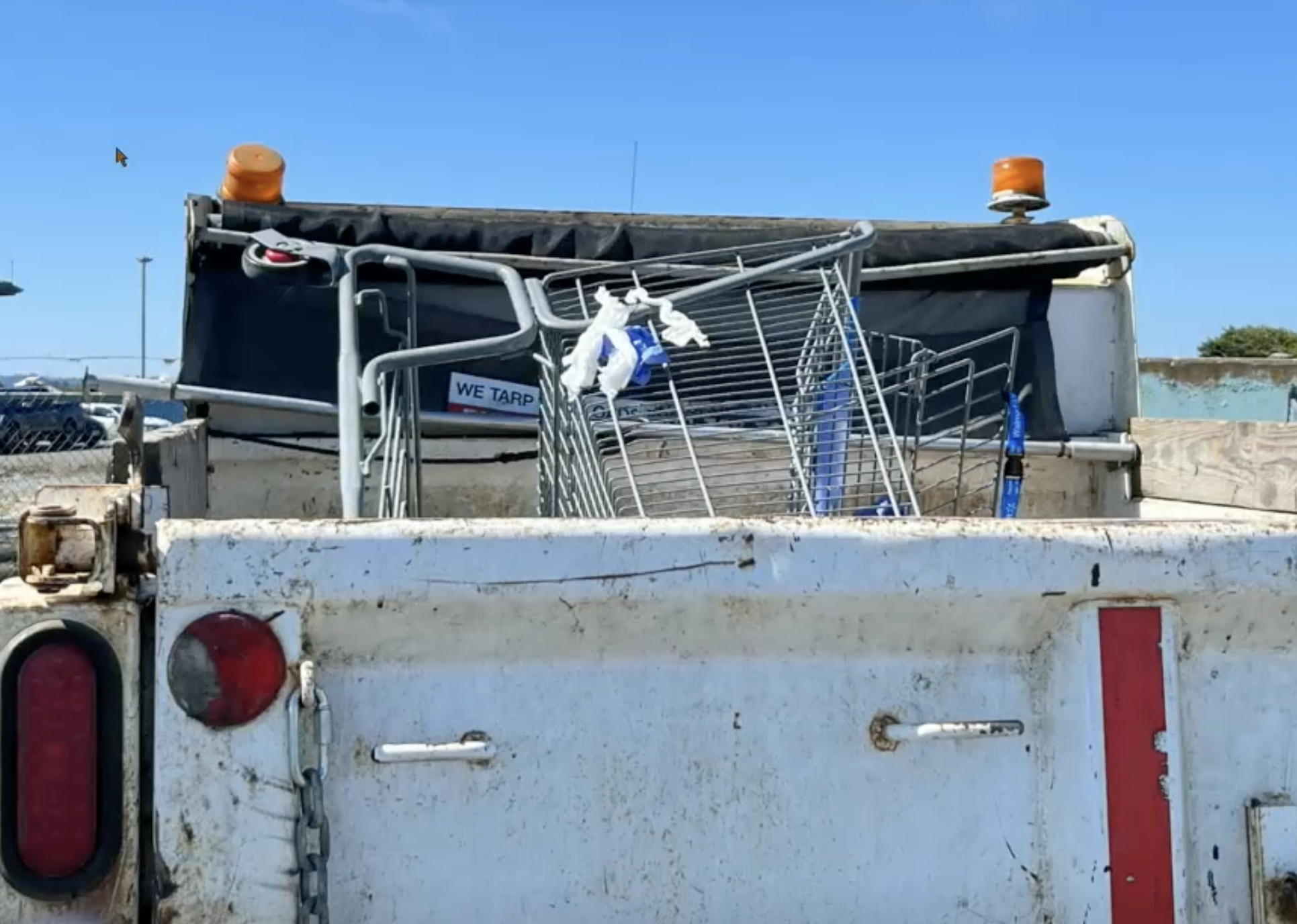
“Off to the dump with ye!” | Photo: City of Eureka
Under the new system, staff will zip tie tags to the carts and upload a picture of the tags into the city’s GIS system. Retailers with tagged carts will be billed at the end of each month.
“Additional fines can be levied against businesses that are repeat offenders,” Reilly continued. “It starts at $50 per incident, which is not per cart; it’s per however many we find in one spot, and then they can escalate from there. … The only change to the ordinance is an added provision that the fees for collecting the abandoned carts can be charged whether we return them to the business or dispose of them.”
Councilmember Scott Bauer asked why it’s taken so long for retailers to be held accountable for so-called shopping cart litter, noting that modern shopping carts often come with an anti-theft locking mechanism that prevents the cart from being wheeled out of a designated area.
Reilly said staff have asked retailers, many of whom are “big out-of-town corporations,” to hire someone to wrangle the carts, but “they just don’t seem to care.”
“It seems to be a cost of doing business,” Reilly said. “We’re trying to come back and try one more push [to] say, ‘Hey, can we get a handle on this?’ and hopefully we can get through to those businesses. Whether or not it’s going to work, I’m not sure, but at least we’ll have a way to recuperate staff’s time for having to deal with all of these carts.”
Development Services Director Cristin Kenyon added that most of the stolen carts are coming from corporate retailers, not local grocery stores.
“We just have some bad actors in businesses that really don’t care about their property getting stolen,” Kenyon said. “Our code enforcement manager would call all [the retailers], and some of them — like Eureka Natural Foods — would be like, ‘Oh, yeah! I want that cart! I’ll come and get it from you.’ The majority of [the carts] are from just a few of these businesses … and when we’d call the manager … they’d never show up to collect them, and then we were responsible for dealing with them.”
Still, Councilmember Renee Contreras-DeLoach expressed concern about the ordinance targeting local businesses. She also took issue with the prospect of charging any retailer — local or corporate — a fine for the return of stolen property.
“I understand the staff time involved, so I get that aspect, but I also just want to be cognizant and careful of not making things more difficult for businesses operating locally,” she said. “Granted, Walgreens is a large chain, but I know the employees there … [are] deeply frustrated at how frequently they’re the victims of theft.”

Another forsaken cart. | Photo: City of Eureka
Councilmember Leslie Castellano made a motion to advance the ordinance, which was seconded by Bauer, and thanked staff for amending the city’s policy to keep stolen carts out of the landfill.
After the motion was made, Contreras-DeLoach and Fernandez floated a few ideas aimed at reducing potential impacts to local businesses. Fernandez asked if penalties could be based on gross earnings or the locality of the business to target corporate entities rather than small businesses. City Attorney Robert Black wasn’t sure if that would be legal, but said he’d be willing to look into.
Contreras-DeLoach suggested a few freebie cart returns to reward businesses acting in good faith. “Maybe there could be, like, a minimum threshold?” she asked, adding that the city could charge retailers more per cart if they exceeded a certain threshold. “That would offset staff time, and it would deal with those larger offenders instead of dragnetting smaller groups.”
Castellano said she would be open to a friendly amendment to her motion, but wasn’t willing to make it herself. A few moments later, Bauer asked to “call the question,” a parliamentary procedure used to end a debate on an ongoing issue and bring the matter to an immediate vote.
The council approved the motion without a friendly amendment in a 3-1 vote, with Fernandez dissenting and Councilmember Kati Moulton absent. The council will make a final decision on the ordinance at its next meeting on Tuesday, Aug. 19.
###
What else happened at last night’s meeting? I’m glad you asked!
- The council unanimously approved a 9.45 percent increase for trash pick-up as a part of the city’s annual rate review and service rate adjustment for solid waste collection in Eureka. The service rate increase is higher than in previous years, largely due to recent wage increases for Recology staff. Staff recently determined that the city has overpaid for street sweeping by about $119,000 over the last decade, which brought the rate increase down from 10.6 to 9.45 percent. The council lamented the ever-increasing cost of living for residents, but acknowledged the importance of wage increases for Recology employees. The item passed in a 4-0 vote.
- The council also approved an appeal to a recent Historic Preservation Committee decision regarding the replacement of three mismatched doors on a former carriage house. The committee approved the request with a special condition that the applicant install a five-panel wooden door. The applicant, who wasn’t able to attend the committee’s June 4 meeting, appealed the decision to the city council, asking that she be allowed to install nine-lite wooden doors instead. Her request was approved in a 4-0 vote.
- The council also approved a small amendment to the city’s inland zoning code to accommodate a state-mandated update for accessory dwelling units (ADUs). The changes allow for up to eight ADUs with an existing multi-family dwelling, as long as the number of ADUs doesn’t exceed the number of units in the dwelling itself. The amendment also grants amnesty to unpermitted ADUS that were constructed before Jan. 1, 2020.
###
Lawsuit Could Force Humboldt County to Regulate Groundwater Pumping in the Eel River Valley
Ryan Burns / Wednesday, Aug. 6, 2025 @ 7:15 a.m. / Environment , Fish , Local Government

Agricultural land in the fertile Eel River Valley gets irrigated during dry months via wells that draw from the alluvial aquifer. A lawsuit argues that this extraction negatively impacts fish habitat in the nearby river. | Photo by Andrew Goff.
PREVIOUSLY
- Friends of the Eel River Sues County for Failure to Protect Public Trust by Regulating Groundwater Extractions in Lower Eel
- County Staff Present Groundwater Sustainability Plan for Eel River Valley
###
In extremely dry years like 2014, when the water level in the Lower Eel River gets so low that in some spots it goes completely underground, does Humboldt County have a responsibility to curtail groundwater pumping in the basin?
A lawsuit brought by Friends of the Eel River (FOER) says it absolutely does. Appearing in Humboldt County Superior Court on Friday, the environmental nonprofit’s attorney, Michael Lozeau, argued that the county has failed to adequately consider, much less protect, the public trust resources in the Eel River during the late summer and early fall. In that time of year, farmers irrigate their crops with water pumped out of the alluvial aquifer, further degrading conditions in the nearby Eel, which serves as critical habitat for Chinook salmon, coho salmon and steelhead.
“The county’s duties under the public trust [doctrine] don’t take the summer off,” Lozeau said before Judge Kelly Neel. “It applies all year round.”
FOER’s suit, first filed in 2022, is built off of a 2018 California appellate court decision in a case up in Siskiyou County. The Environmental Law Foundation (ELF) had sued the California State Water Resources Control Board over the same type of dynamic — the effects of pumping groundwater that feeds into a navigable river, in this case the Scott River. The judge’s ruling in favor of the plaintiffs marked the first time that the public trust doctrine had been extended to include groundwater.
The public trust doctrine, which has roots in ancient Roman law, is a legal principle holding that certain cultural and natural resources are preserved for public use. Here in California, the umbrella of public trust protections has been expanding. While the doctrine has long protected California’s coastal waters and navigable rivers, a landmark 1983 California Supreme Court ruling extended public trust protections to the tributary creeks that feed Mono Lake. It also established that citizen groups like FOER have standing to file suit under the public trust doctrine.
Cut to the 2018 Siskiyou County ruling, which opened the door to more public trust lawsuits concerning groundwater. Just last year, for example, a trial court found that Sonoma County’s groundwater well ordinance violated the public trust by allowing excessive pumping to dry up streams, damaging vital fish habitat. There have been similar public trust cases in Contra Costa, Napa and Kern counties.
Scott Greacen, FOER’s conservation director, told the Outpost that such lawsuits are necessary due to the fundamental inadequacy of California’s Sustainable Groundwater Management Act (SGMA), a 2014 law that established a “framework” aimed at protecting the state’s groundwater resources long term.
“SGMA was much heralded as, ‘California is finally regulating groundwater,’” Greacen said. “It doesn’t.”
Instead, he contends, the law merely requires certain local jurisdictions — those with designated critical-, high- and medium-priority basins — to “put up a decent show” of regulating groundwater.
The Eel River Valley has been classified as a medium-priority basin, much to the annoyance of many locals, including dairy farmers who sometimes consider the water beneath their land part of their own property, and Humboldt County First District Supervisor Rex Bohn, who argued that the designation was unjustified and the extra regulations unnecessary.
Nevertheless, the Department of Water Resources upheld its designation for the Eel River Valley as medium-priority, which forced Humboldt County to develop a Groundwater Sustainability Plan (GSP) for the basin.

Map of the Eel River Groundwater Basin. | Image via County of Humboldt.
###
Greacen, during our interview, unleashed a bit of sarcasm about the resulting document.
“Shockingly,” he said, “that plan found that there are no ‘undesirable effects’” of groundwater pumping.
While the county’s Eel River Valley GSP acknowledges a link between groundwater pumping and surface flows along that stretch of river, FOER’s lawsuit alleges that the modeling on which the plan was based only evaluated groundwater impacts when river flows were at 130 cubic feet per second (cfs) or higher, thus failing to consider impacts during lower summer flows when salmon are holding in pools waiting for rain.
In a phone interview on Monday, FOER Executive Director Alicia Hamann said it’s not uncommon for flows in the Lower Eel to fall below 130 cfs by the end of summer, creating dangerously stressful conditions for fish. In 2015, for example, pre-spawning salmon collected from pools in the Lower Eel River during the late summer and early fall were found to have damaged eyes, brains and spinal cords.
FOER’s brief cites analysis from fisheries biologist Dr. Gabriel Rossi, who concludes that the “obvious inhospitable environmental conditions” in the Eel that year, including anemic flow, warm temperatures, algal accretion and low dissolved oxygen, can reasonably be tied to reductions in surface flow caused by nearby groundwater pumping during such dry times.
“And we know we will have unpredictable and more dry times in the future,” Hamann said.
In March of 2023, six months after FOER filed its lawsuit, the County Division of Environmental Health began doing public trust analyses for new or replacement well permits. But FOER’s lawsuit argues that because these analyses are based on a flawed GSP, it fails to consider impacts to the Lower Eel during low-flow conditions.
FOER’s lawsuit doesn’t request a specific remedy from the county, a fact that Judge Neel remarked upon in court Friday.
“What exactly is your client asking the court to do?” she asked. She noted that the county can’t exactly account for “what are likely the many illegal takings of water for unpermitted [cannabis] grow sites,” so what does FOER want?
Lozeau, the attorney, said they’re requesting an order compelling the county to comply with its public trust duty “to consider the adverse effects of groundwater pumping on this stretch of the Lower Eel [during] this period of time … in particular during critical dry years.”
Hamann put it another way during our phone interview: “We’re asking for the county to do something,” she said. “We just want more than nothing, which is what they’ve been doing.”
Then, striking a note of confidence, she added, “After we win this case I will happily go to the county with lots of ideas for solutions they can enact.”

The lower mainstem Eel disconnected in August 2014, as seen in this aerial photograph by David Sopjes.
The county’s defense
In court on Friday, the county was represented by Christian Marsh, an environmental and land use attorney with the San Francisco firm of Stoel Rives, LLP. Joining him at the defense table was Humboldt County Deputy Director of Environmental Services Hank Seemann, with members of county counsel sitting in the gallery behind them.
In response to Lozeau’s opening remarks, Marsh said he, his clients and their experts “disagree vehemently” with the conclusion that groundwater pumping — as opposed to severe droughts, surface water diversions or other hydrologic factors — is having a substantial influence on water flows in the Eel.
“FOER’s assertion is speculative and confuses correlation with causation,” the county’s opposition brief says.
That document also argues that the county has adequately considered the public trust doctrine through its development and adoption of a GSP, its individual analyses for well permits and its use of scientific modeling to assess impacts on salmon migration. Salmonids adapt to changing circumstances, Marsh said before Judge Neel, noting that when the river disconnects as it did in 2014, fish simply hold off on their upstream migration until conditions are suitable.
One of the county’s own expert biologists, Dr. Charles Hanson, found that salmon originating in the Eel River “have evolved a synchrony” between adult upstream migration and the environmental cues associated with autumnal rainfall.
The county further argues that recent severe droughts may not even have had significant negative impacts on Chinook salmon. Its court brief notes that the number of Chinook that “successfully migrated upstream through the Van Arsdale Fish Station in 2014, 2015, and 2021 did not appear to be statistically lower than in wetter years, likely due to strong fall rainfall events.”
Besides which, Marsh argued, there has been no “triggering event” to sue over — no specific action, such as the issuing of a well permit, that violated the public trust doctrine.
Furthermore, his brief argues, most of the wells that draw from the valley’s alluvial aquifer were installed decades ago, which means FOER is not entitled to any relief from the court.
The brief also notes the county’s active role in working to decommission Pacific Gas & Electric’s Potter Valley Project, a hydroelectric facility with dams and tunnels that divert water from the Eel to the Russian River watershed. PG&E recently filed its application to surrender its license and decommission the facility, which will “restore a free-flowing Eel River and re-establish fish passage to upstream habitats,” the county’s brief notes.
Hamann said that while that’s true — and dam removal has been her organization’s top goal since its inception — she and FOER’s expert analysts don’t expect it to result in significant changes to flow in the Eel.
“Right now they do a pretty good job of mirroring the natural hydrograph,” she said in reference to seasonal water releases. After the dams come down, FOER expects some highs to be higher and some lows lower, which won’t alleviate the inhospitable conditions for salmonids during the dry season.
FOER’s brief notes that Eel River salmon populations are at approximately 5% or less of their historic abundances.
Hamann discredited the county’s defense arguments, noting that its own scientific modeling acknowledges a hydrologic connection between the Lower Eel River and its surrounding alluvial aquifer. She said the county has a “continuous” duty to consider any adverse impacts to the public trust and reiterated that Humboldt County has still not analyzed the impacts of groundwater pumping in the Eel River Valley during the summer months.
Asked for comment, Seemann declined on behalf of the county due to the case’s status awaiting decision.
After listening to both sides plead their cases on Friday, Judge Neel said she will take the matter under submission. She has 90 days in which to issue a ruling.
###
DOCUMENTS
California Cut Coal From Its Energy Supply. Why It Might Plug Back Into Fossil Fuels
Alejandro Lazo and Jeanne Kuang / Wednesday, Aug. 6, 2025 @ 7 a.m. / Sacramento
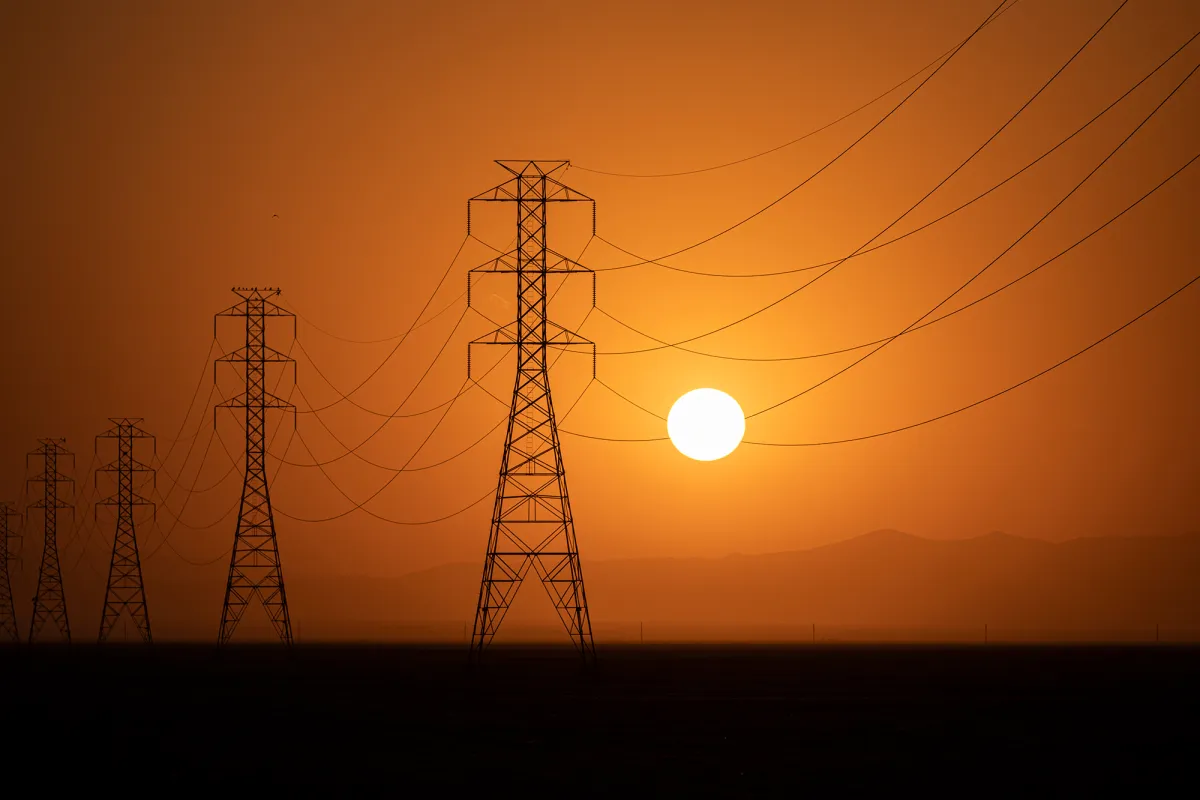
The sun sets behind a row of transmission towers as temperatures rose to a scorching 114 degrees in Fresno County on Sept. 6, 2022. Photo by Larry Valenzuela, CalMatters/CatchLight Local
###
This story was originally published by CalMatters. Sign up for their newsletters.
###
California spent decades building one of the greenest power grids on Earth.
It ditched coal, cut fossil fuels, and built so much solar it now runs the world’s second-largest battery fleet to keep clean power flowing after dark.
Now lawmakers are poised to tie that grid to coal-burning states.
With electricity prices rising and pressure to keep the lights on, California is racing to create an expanded power market with other Western utilities to trade vast amounts of electricity. An expanded market could include climate-aligned states such as Oregon and Washington but potentially also coal-burning ones such as Wyoming, Utah and New Mexico.
Supporters said the proposal cuts costs and keeps the grid stable by letting providers trade energy more freely — particularly at peak times of need, like heat waves. They said expanded trading will help renewable energy proliferate as it competes with fossil fuels.
But the plan has split California’s environmental and consumer groups. Backers said it’s key to selling the state’s solar power to others, which would help bring bills down. Opponents said it’s too risky, leaving the state exposed as President Donald Trump pushes markets toward coal and gas.
The idea of a regional market has failed before. This latest push only gained traction after labor unions, once a major obstacle, got on board.
Senate Bill 540, which paves the way, passed the state Senate earlier this summer with bipartisan support and is now before the state Assembly. Gov. Gavin Newsom wants a deal this year.
“This is about affordability, this is about reliability, it’s about us maintaining our authority and autonomy as it relates to our low-carbon, green growth goals,” Newsom said last week, in response to a question from CalMatters. “I am supportive.”
State Sen. Josh Becker, the bill’s author, has urged lawmakers to move quickly. He said that California could lose trading partners to a competing Western market proposed by an Arkansas-based grid operator that does “not care about respecting our climate policies or energy goals or the interests of California consumers.”
“Make no mistake, if we do not act, we will be worse off,” Becker said in June, urging his colleagues to vote in favor.
Critics call the risk exaggerated. The Utility Reform Network, a consumer advocate group, has taken a neutral position on the measure and threatened to oppose it unless California retains some autonomy and a strict procedure to withdraw.
Momentum has stalled in the Assembly, where some former supporters have backed away, warning those changes could make the plan unworkable for other states. Lawmakers have until mid-September to strike a deal as they juggle a broader slate of energy and climate measures.
A seasonal excess of clean power
California already trades electricity with neighboring states but controls its own grid that covers most of the state through an independent system operator whose board is appointed by the governor.
That matters because California is legally required to run on 100% clean electricity by 2045 — while also electrifying cars, homes, and facing surging demand from energy-hungry data centers fueling the rise of artificial intelligence.
By many measures, the state’s energy transition is a success story: Eight out every 10 days so far this year saw wind, water, and solar meet all of the state’s needs for at least part of the day, according to an ongoing tally by Stanford energy researcher Mark Z. Jacobson.
Solar generation last week hit a new high: 21,750 megawatts at peak. That’s enough solar to power 4 million homes when accounting for day and night, and the fact that solar output changes with the seasons.
Still, California’s clean energy boom has contributed to the highest electricity rates in the country outside of Hawaii.
Clean energy costs just over three cents more per kilowatt-hour than fossil power for California’s major utilities — a gap driven mostly by older, more expensive contracts and other market factors. But energy bills have become a slow-burning political issue: A recent poll showed voters support clean power, but fewer are willing to pay more for it.
Environmentalists said renewables will be cheaper long-term because sun and wind are free.
California is also wasting clean energy. On sunny, mild days in spring and fall, grid operators increasingly shut down solar panels that crank out more power than the state can use. Proponents of regionalization said that energy could be sold to neighboring states.

“We need a modern grid to develop and use this much clean power quickly,” said Katelyn Roedner Sutter, state director at Environmental Defense Fund. “While California generates more clean electricity than ever, it has never wasted more.”
Not everyone agrees that building large-scale projects and expanding markets will bring costs down. Building distant plants and new transmission lines will raise costs, not lower them, said Bernadette Del Chiaro, who leads advocacy campaigns in California for the nonprofit Environmental Working Group.
Del Chiaro argues that expanding rooftop solar and cutting waste — using better insulation, smarter appliances and shifting when we use power — could curb demand without overhauling the grid.
“It makes no sense,” she said. “We have plenty of resources here.”
Another motivation for regionalization: the risk of blackouts, especially as climate-driven heat waves intensify. California experienced blackouts in 2020 and pleaded with residents to conserve power during a brutal 10-day heat wave in 2022. Michael Wara, a Stanford legal scholar who focuses on climate, backs the regional market plan. He said with renewable energy facing political pushback, it’s essential for California to keep its grid stable.
Without those moves, “I really worry about what, politically, would happen … the day after, or in the weeks after, any kind of a system blackout,” he said.
Sharing power between Western states
California’s plan to connect Western power markets would create a system unlike anything else in the U.S. Under the proposed plan, called the Pathways Initiative, energy providers would trade all their available electricity in a shared market while each state keeps its own energy policies and planning authority.
Smarter coordination means better preparation for extreme weather, proponents said. In winter, California and the Pacific Northwest could tap steady sunlight from the Southwest. On sweltering summer nights, they could rely on inland wind power to keep air conditioners humming.
A group of powerful interests that often butt heads backs the effort. Supporters of SB 540 include unions, utilities and business groups that hold significant sway with lawmakers, having poured more than $20 million into legislative races in the past decade, according to CalMatters’ Digital Democracy database.
In the past, labor unions opposed plans they feared would outsource lucrative infrastructure contracts to union-hostile red states. Now, one of the most powerful — the International Brotherhood of Electrical Workers — is all in, eager to build in-state clean energy projects.

Environmental groups once worried that creating a regional grid would flood California with out-of-state fossil power. Now, many are backing the market idea, including the Environmental Defense Fund and the Natural Resources Defense Council, betting it will help unleash more clean energy across the West.
Major industry groups — and tech giants like Google and Microsoft, scrambling to power their AI data centers — are also throwing their weight behind the plan.
PacifiCorp, a six-state Western region utility owned by Berkshire Hathaway, was the first to commit to an expanded market led by California. Portland General Electric, NV Energy in Nevada and Idaho Power are other potential participants.

Solar panels at the Kettleman City Power solar farm on July 27, 2022. Photo by Larry Valenzuela, CalMatters/CatchLight Local
To make it work, California would have to give up some of its hard-fought control. Other states won’t join a market dominated by a board handpicked in Sacramento. That’s why regional players have long pushed to replace California’s grid operator with a new, independent agency to run the West, and why California players have resisted.
The Pathways proposal, though, is more limited than past proposals for a linked grid: It would shift control only of the market to a regional board made up of other states and utilities. Under the current measure, California would still manage its own power lines and keep the authority to decide how it buys electricity, enforce its clean energy rules and could walk away if the partnership doesn’t work.
Could Trump take control?
Critics said this is the worst time to gamble with California’s clean energy future. The Trump administration is waging an all-out ideological war on climate policy and California is a prime target.
Since returning to office, Trump has moved to dismantle dozens of environmental protections, including perhaps most important for federal climate regulations: the legal foundation for climate action.
In June, he teamed up with congressional Republicans to strip California of its Clean Air Act authority to set clean car and truck emission rules. And last month Republicans gutted the Biden administration’s landmark climate law, slashing solar and wind tax breaks that were helping California power its clean energy transition.
In his first term, Trump tried to force more coal into the power market — and even his own regulators said no. This time, he’s aiming to take full control, and he will likely replace independent experts with loyalists to push fossil fuels, no matter the cost, said Tyson Slocum of the consumer advocacy group Public Citizen.
Slocum warned that, by year’s end, Trump could take control of the Federal Energy Regulatory Commission. He could use that commission — which regulates electricity and gas markets across state lines — to tilt the power market toward gas and coal, under the pretext of reliability.
“That’s why efforts to regionalize the West Coast power market right now is the stupidest thing that California could do,” Slocum said. “Is now the time to partner with the federal government? No. This is the last thing that California should be doing.”
Some environmentalists opposed to the plan argue that while a regional market might help California’s emissions fall it could prompt emissions to rise in the rest of the West.
They point to a decision by the Bonneville Power Administration — a clean energy powerhouse based in Portland, Oregon, that controls power from 31 federal hydroelectric dams — to join the Southwest Power Pool, the grid operator competing with California. That move is key because the power provider’s choices help determine how far and fast the Western U.S. can decarbonize.
“The majority of the surplus generation that would be shared is coal, gas, fossil fuels,” said Roger Lin, a senior attorney with the Center for Biological Diversity. “From a climate perspective, it is a bad move.”
Energy Commissioner Siva Gunda told CalMatters the plan wouldn’t further increase California’s exposure to federal regulators, since the state’s grid is already under federal oversight. He emphasized California would still control what power it builds in-state, and argued a larger market could actually accelerate clean energy development across the West by giving other states a stronger incentive to supply California.
“The opening of markets does not open up our ability to have our own destiny — in terms of the resources we want to build in California,” Gunda said.
Estimates of the benefits for a regional market vary, depending on how many entities join. While an expanded market could save Californians nearly $800 million a year, cut emissions by 3% across the West, and reduce natural gas use by nearly a third, that scenario assumes nearly all Western utilities join. Many experts said that is unlikely. An alternate scenario, where the West is divided between two rival markets, would deliver $294 million in savings and far smaller emissions cuts.
Where things stand
Before passing the bill, senators amended it to include more safeguards requested by skeptics.
Those include a newly proposed oversight council, composed of some California appointees and elected officials, which would have to sign off on California’s participation in the market. The council could also direct the state and its utilities to back out in the future — if, say, federal regulation or the new market operator threatens the state’s climate goals.
“It’s about creating an exit strategy,” said Matthew Freedman of The Utility Reform Network. “Given what we’re seeing at the federal level now, we cannot be too careful.”
But the changes have made some of the measure’s original backers balk. The provisions mandate under what conditions California must exit, which market supporters said could send others to the Arkansas market instead. Several environmental groups, businesses and clean energy organizations have said they now oppose the bill.
When lawmakers return from their summer recess on Aug. 18, they’ll have a little less than a month to work it out before they adjourn for the year.
Newsom, state Assembly Speaker Robert Rivas and Assembly utilities committee chair Cottie Petrie-Norris said they want a bill passed this year. But any further changes in the Assembly will have to go back to the Senate, where Senate President Pro Tem Mike McGuire insisted on the oversight council.
“It really undermines all of the benefits of joining a Western market if nobody wants to trade with us,” said Sutter, of the Environmental Defense Fund. “If I’m a utility from another state … I’m going to go with the sure thing, not something that is up to the political whims of California.”
###
Alexei Koseff contributed reporting to this story.
OBITUARY: Benjamin Thomas Branham Sr., 1945-2025
LoCO Staff / Wednesday, Aug. 6, 2025 @ 6:56 a.m. / Obits

Benjamin Thomas Branham Sr. (Ben Cutter, Home Chicken)
Sept. 8, 1945-July 30, 2025
He passed away on July 30, 2025 in Eureka,.
Our treasured husband, father, grandfather, brother, uncle, cousin and friend Benjamin Branham Sr. was born in Eureka, CA, to Adam Branham and Julia Westerman Branham on September 8, 1945. He was the baby brother of his three sisters: Mary, Becky and Maude.
Ben attended Hoopa Valley High School. While in school, he enjoyed playing football and participating in woodshop. He married Sharon Campbell on April 23, 1965. Starting a family of his own, he lived in Willow Creek and Grants Pass for short periods of time. He eventually moved home to Hoopa, where he lived the rest of his life.
He had three sons and, later in life, raised his grandchildren as well. Ben began his career working as a maintenance man for the Hoopa Valley Tribe temporarily, until he pursued a career as a woodsman. He was a logger for over 40 years. Ben also worked side jobs in construction, carpentry, mechanics and arboriculture. He was a hardworking man who valued everything he did.
Ben was a family man who supported and provided for his wife, sons, grandkids, family and friends. He was an avid woodworker, making cribbage boards, clocks, hydroplane boats and more. When not working, Ben enjoyed riding around in the hills, hunting, fly fishing, boat racing, gathering, gardening and most of all — camping.
Ben was known by many and was always willing to help when needed. The skills and knowledge he shared will be remembered by many. He could be regarded as:
“A jack of all trades is a master of none, but oftentimes better than a master of one.” He was a hardworking man, devoted husband, loving father and a proud grandfather.
Benjamin Branham Sr. is preceded in death by his parents, Adam and Julia Branham; his sister Maude Jarose; his brothers-in-law Harold Campbell Sr., Sam Campbell, Jonathan Leach Sr., Harold Muller and Dan Campbell; and his sisters-in-law Marie Muller and Emogene Carpenter.
He is survived by his wife Sharon Branham; his children Thomas & Jennifer Branham Sr., Benjamin Branham Jr. and Troy Branham; his grandchildren Pamela & Chris Heath, Patricia Branham (Andrew), Douglas Branham (Raelene), Thomas Branham Jr. (Newhan), Derrick Branham (Joyce) and Natasha & James Boatsman; and his 16 great-grandchildren.
He is also survived by his sisters Mary Campbell and Elizabeth Henkel; his sisters-in-law Vi Campbell and Harriet Leach; and by his nieces, nephews, great-nieces, great-nephews, cousins, extended family and numerous friends.
Pallbearers:
Smitty, Horse, Benny, Doug, Teej, & Duke Branham, Chris Heath, Brandon Biondini, Trevor & Kyle Brown, O’s, Lil Bob, & Sam Campbell, Dan McCovey, Blaze Carpenter, RJ Marshall, Thomas Masten, Adam Robertson and Rocky Jones.
Honorary Pallbearers:
Jack Biondini, Mike Orcutt, Joe Jarnaghan Sr., David (“Hootie”) Lewis, Merv George Jr., Loren Norton, George Moon, Harry O. Campbell, Bob Campbell Sr., Bill (“Pecos”) Carpenter, Joe Carpenter, Ralph Brown, Travis Brown, Jason Marshall, Billy McCovey, Clyde Moon, Roger Sanderson, Zane Grant, Jeff Lewis, Derrick Ely, Matt Richardson, Jonathan “Buck” Jackson, Paul Sorvino, Patrick Jackson, Abe Camez, Martin Cervantez, Paul Baker, Sam Jones, Arthur Jones and many more.
Graveside services will be held on Thursday, August 7, 2025, at 10:00 a.m. at the Hoopa Tribal Cemetery.
The family would like to thank all who have been supportive as we navigate this difficult time.
He is gone now but will forever be in our hearts.
###
The obituary above was submitted on behalf of Ben Branham Sr.’s loved ones. The Lost Coast Outpost runs obituaries of Humboldt County residents at no charge. See guidelines here.


