Born to Janet and Glenn Griffith of
Eureka, Trevlin entered the world with style in 1958. He graduated
from Eureka High School and went on to graduate from Frederick and
Charles Beauty College in the 1970s.
During the 1980s and ‘90s, Trev
was the owner of Daly’s Hair Designs (located in Daly’s
department store) as well as Serendipity Antiques in Old Town Eureka.
He was well known for his exquisite ability to create unique
tablescapes and floral arrangements, not just for his own home but
also for his friends’ gatherings.
Trev often spent his days off
visiting his former clients who had become shut-ins or were in rest
homes, still styling their hair to help keep up their spirits. He
loved to travel and to entertain, and he was known for his amazing
cooking at dinner parties, as well as the beautiful gardens he
created wherever he lived. He was a great supporter of local theatre
and the arts.
Trev was preceded in death by his
parents, brother Mikel and sister-in-law Lani, late partner George
Hooper, and husband Gary Thissell, all of Eureka.
He is survived by his sisters Helena
Griffith of Eureka and Kat Griffith of Fremont and their families,
nephew John Griffith and nieces Samantha Griffith, Carylyn, Judy, and
Katie White and their families, and of course his cousins by the
dozens located throughout Humboldt County and beyond.
###
The obituary above was submitted on behalf of Trevlin Griffith’s loved ones. The Lost Coast Outpost runs obituaries of Humboldt County residents at no charge. See guidelines here. Email news@lostcoastoutpost.com.
The Humboldt County Board of Supervisors (from left): Fourth District Supervisor Natalie Arroyo, Third District Supervisor Mike Wilson, Second District Supervisor (and board chair) Michelle Bushnell, Fifth District Supervisor Steve Madrone and First District Supervisor Rex Bohn.
###
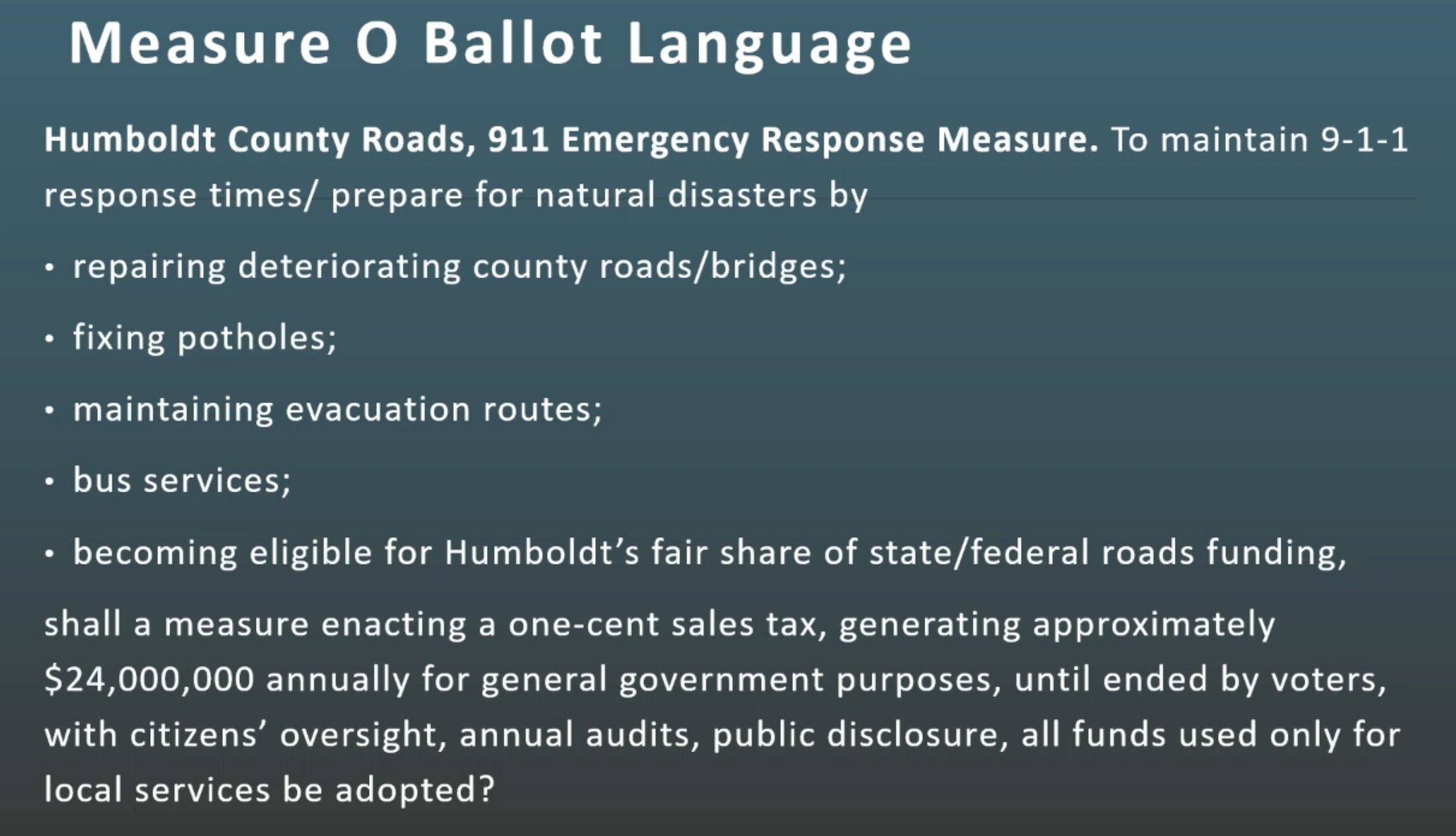
The Humboldt County Board of Supervisors this week decided how to divvy up the first five years of proceeds from a new a new one percent countywide sales tax, which voters approved in November by passing Measure O, the “Humboldt County Roads, 911 Emergency Response Measure.” Eighty-five percent will go toward roads, with the remaining 15 percent going toward transit.
The tax is projected to generate $24 million per year for the county’s General Fund, and officials have publicly committed to spending those revenues on road improvements and public transportation projects, as promised in the measure’s ballot language:
The big debate, since the measure passed, has been: what percentage of those precious revenues should go toward road repairs versus public transit. On Tuesday, after a couple hours of sometimes tense deliberations, the board voted unanimously to approve the 85/15 split.
However, the proceedings left some public transportation advocates crying foul. Here’s why:
The staff report prepared for the matter said a four-fifths supermajority vote was required for the board to pass a motion regarding allocations of Measure O proceeds. However, more than an hour into board deliberations, County Administrative Officer Elishia Hayes said that wasn’t actually the case.
“Technically, for the resolution to pass today … you can get that through with three-two,” Hayes remarked. She said staff wanted the board to reach the higher threshold because this decision was related to the county budget, and future budget revisions and transfers will require a four-fifths vote.
“So we really need your board to be on a 4-1 with this so that we know that we’re in consensus,” Hayes said.
“I wish you would have made that clear earlier,” Fifth District Supervisor Steve Madrone said, “because I was completely under the impression that this needed a four-fifths vote because it’s an allocation of funding.”
The fraction mattered because ideologically, the board fell into two distinct camps in this issue, with First District Supervisor Rex Bohn and Second District Supervisor Michelle Bushnell wanting to give the lion’s share (as much as 95 percent) of Measure O proceeds to road repairs while Madrone, Third District Supervisor Mike Wilson and Fourth District Supervisor Natalie Arroyo said public transit — and the Humboldt Transit Authority, specifically — should get as much as 20 percent.
Madrone’s objection, which was subsequently echoed by Wilson and other public transportation advocates, was that the board majority might have played a bit more hardball in negotiations if they knew they could push their preference through without compromise.
Reached by the Outpost on Friday, Colin Fiske, executive director of the nonprofit Coalition for Responsible Transportation Priorities (CRTP), said that while he’s grateful that the supervisors approved a meaningful amount of funding for public transit, they could very well have allocated more if the process had been properly framed from the outset.
“It was clear from the discussion that the majority of supervisors thought it should be more,” he said, “but the incorrect listing of a four-fifths vote requirement slanted the discussion and resulted in a smaller amount for transit. That is very troubling.”
Tom Wheeler, executive director of the Environmental Protection Information Center (EPIC), agreed, saying his organization is “alarmed that the staff repeatedly misrepresented the required vote threshold and seemingly did so in order to make a vote to robustly fund transit more difficult.”
In a statement to the Outpost, Humboldt County Public Information Officer Cati Gallardo confirmed that staff’s recommendations could have been passed by a 3-2 vote. She continued:
However, under Government Code Section 29125, certain transfers and revisions to the adopted budget made after the Budget Hearings require a four-fifths vote. Since such adjustments are common throughout the fiscal year, staff aimed to establish as much consensus as possible during these initial budgeting decisions to prevent conflicts later on.
Because the agenda items related to Measure Z, Transient Occupancy Tax (TOT), and Measure O were complex, at times contentious and would directly impact the county’s overall budget and community services in a significant way, the County Administrative Office requested that the Board work toward a higher level of agreement. Achieving a super majority vote of four-fifths helps ensure smoother and more efficient budget administration moving forward.
The wording of this explanation — staff “aimed” to achieve consensus and “requested” a higher level of agreement — still differs from the language of the staff report, which said a four-fifths vote was “required.”
Prior to the board’s deliberations, an ad hoc committee met in February to hash out a recommendation. The committee comprised Wilson, Madrone, Fiske and representatives from the Humboldt County Association of Governments (HCAOG), the Humboldt Transit Authority, the Humboldt Builders’ Exchange, the Building and Construction Trades of Humboldt and Del Norte Counties and the McKinleyville Community Services District.
Their recommendation was to split the first five years of revenue 86/14, roads v. transportation — very close to what the supervisors landed on — while including a one-time contribution of $3 million to a Measure O contingency fund to be used if there’s an economic downturn.
In presenting the item to the board, Deputy County Administrative Officer Sean Quincey noted that the county will have $500 million-worth of road pavement needs over the next five years, and the county’s roads fund is already $7 million in the negative.
Local roads have been in bad shape for years. They’re rated “poor” on the state’s pavement conditions index, and they on track to hit “failed” status by 2033, Quincey said.
During the public comment period, half a dozen people urged the board to give a full 20 percent of proceeds to public transit. Arcata resident Peggy Martinez, for example, said, “You all have constituents that would take the bus if there were [more] buses available.”
The county’s interim auditor-controller, Mychal Evenson, also addressed the board, telling them that the increased financial activity related to Measure O will mean a lot more work for his office.
“I fear that we’re going to see delays in payments,” he said. “Roads invoices are among the most complex that we do.”
Evenson asked that one percent of Measure O revenues be allocated to his own office. Bushnell later excoriated him for making this request at the last minute in a public setting.
“I think you had an opportunity to engage the CAO and this board prior to making public comment today, and it is not necessarily the place to do it right now,” Bushnell said. “I don’t appreciate that coming out of public comment time at all.”
Still, as noted above, most of the board’s discussion centered on how to split the revenues over the next five fiscal years. Arroyo, who serves as chair of the Humboldt Transit Authority’s board of directors, said that agency serves an average of 40,000 passengers per month. She also noted that 21 percent of county residents are seniors and 19 percent are disabled.
Arroyo also advocated for giving a portion of any excess revenues above projections to transit, rather than having them go entirely to roads.
Bohn, on the other hand, said most of the people he’s spoken with — including many backers of Measure O — haven’t mentioned bus service at all, whereas he hears all the time from constituents complaining about the condition of county roads. He said he’d like to give just 10 percent of Measure O proceeds to transit, “but I don’t know if that would fly.”
Wilson, like Madrone, was a bit thrown by the revelation that a four-fifths supermajority was not required. He said he came into the meeting with a goal of getting transit’s share up to 16 percent, but later split the difference between that and the staff recommendation, requesting 15 percent.
Following a bit of debate over how to allocate any excess funds above revenue projections, Bushnell made an impassioned argument for giving most of it to roads, given the existing budget deficit and the season-dependent scheduling of road maintenance projects.
“I just really, really, really have to advocate that we’re in a mess in the roads department fiscally,” she said. “Can we please give some money to the roads department to try to make up for their issues right now?”
The motion that finally passed unanimously, offered by Madrone with a little tweak proposed by Quincey, was a bit complex. In addition to the 85/15 split, it called for:
Public Works to aim for spending five percent of its allocations on Complete Streets measures;
staff to develop a plan for providing help to the Auditor-Controller’s Office;
the anticipated $6 million in revenue generated during the current fiscal year (through June 30), plus all future revenue in excess of the projected $24 million per year to be split 50/50, with half going toward road projects while the other half goes toward retiring the debt in the roads division until that debt is paid off; and
after that, all excess proceeds to be be split 85/15, roads v. transportation.
Again, that motion passed 5-0. Measure O’s passage brought Humboldt County’s cumulative sales tax rate up to 8.75 percent. The sales tax rates in Humboldt’s incorporated cities range from 9.5 percent (Ferndale, Rio Dell, Trinidad and Fortuna) to 10.25 percent (Eureka and Arcata). Blue Lake’s is 9.75 percent.
Below is a list of the key needs identified for both roads and transit in the county’s unincorporated areas.
This story was originally published by ProPublica. ProPublica is a Pulitzer Prize-winning investigative newsroom. Sign up for The Big Story newsletter to receive stories like this one in your inbox.
###
Connecticut’s attorney general has sent his second warning in a month to the low-cost carrier Avelo Airlines, telling the startup it has jeopardized tax breaks and other local support by agreeing to conduct deportation flights for U.S. Immigration and Customs Enforcement.
Democrats in the Connecticut legislature, meanwhile, are working to expand the state’s sanctuary law to penalize companies like Avelo for working with federal immigration authorities.
The backlash comes after Texas-based Avelo signed an agreement early this month to dedicate three of its 20 planes to carrying out deportation flights as part of the charter network known as ICE Air. It also follows a report by ProPublica, which Connecticut Attorney General William Tong cited in an April 8 letter to Avelo, revealing flight attendants’ unease over the treatment and safety of detainees on such flights. The concerns airline staffers raised included how difficult it could be to evacuate people wearing wrist and ankle shackles.
“Can Avelo confirm that it will never operate flights while non-violent passengers are in shackles, handcuffs, waist chains and/or leg irons?” Tong’s April 8 letter asks. “Can Avelo confirm that it will never operate a flight without a safe and timely evacuation strategy for all passengers?”
In an April 3 email to Avelo employees obtained by ProPublica and other publications, CEO Andrew Levy called the deportation contract “too valuable not to pursue” at a time when his startup was losing money and consumer confidence was declining, leading Americans to take fewer trips. Avelo would close one of its bases, in Sonoma County, California, and move certain flight routes to off-peak days as resources shifted to ICE Air. Deportation flights would be based out of Mesa, Arizona, and would begin in May.
Avelo has a major hub in New Haven, Connecticut, and it recently expanded to Bradley International Airport near Hartford. In 2023, the airline won a two-year fuel-tax moratorium from state lawmakers after extensive lobbying.
Last Thursday, U.S. Sen. Richard Blumenthal was among the nearly 300 attendees at a rally outside the New Haven airport. “Avelo has to change its course,” he said. “To the president of Avelo: You really stepped in it.”
Members of the public are raising objections as well. An online petition calling for a boycott of Avelo unless it drops its new ICE contract has collected almost 35,000 signatures since April 6. And protests are spreading from Connecticut to cities the airline serves across the country, including Eugene, Oregon; Rochester, New York; Burbank, California; and Wilmington, Delaware.
Tong’s letter to Avelo demanded that the airline produce a copy of its ICE Air contract. The attorney general also asked if Avelo would deport people in defiance of court orders, pointing to March flights to El Salvador carried out by another charter airline, GlobalX, after a federal judge ordered that the planes be turned back. Neither ICE nor GlobalX responded to ProPublica’s requests for comment.
Levy answered Tong with a one-page letter. In it, Levy suggested that if Connecticut wanted more information about Avelo’s ICE Air contract, it should file a public records request. (Federal statistics show that such requests to ICE typically take months or years to be answered.)
If the attorney general wanted to know more about the use of shackles on deportation flights, Levy continued, he should ask the Department of Homeland Security. If Tong wanted to know more about evacuation requirements, he should address questions to the Federal Aviation Administration. For Avelo’s part, Levy assured Tong, the airline “remains committed to public safety and the rule of law.”
“Regardless of the administration or party affiliation,” an Avelo spokesperson told ProPublica in an emailed statement, “when our country calls our practice is to say yes. We follow all protocols from DHS and FAA.”
A Democrat-sponsored bill to expand Connecticut’s sanctuary law has now cleared its House Judiciary Committee in a 29-12, party-line vote, over the strong objections of Republicans, and awaits a full vote on the floor. If it passes, any companies — including airlines — proposing to do business with the state must pledge not to “cooperate or contract with any federal immigration authority for purposes of the detention, holding or transportation of an individual.”
Meanwhile, Avelo’s fuel-tax moratorium expires on June 30. So far, no legislation has been introduced to extend it, and activists are urging Connecticut lawmakers to let the tax break die.
On the above segment from yesterday’s edition of PBS NewsHour, reporter Sarah Varney delves into the case of Eureka chiropractor Anna Nusslock, whose treatment (or lack thereof) at Providence St. Joseph Hospital during a pregnancy emergency last year formed the basis of lawsuits filed by both the California Attorney General’s Office and the National Women’s Law Center.
Review the Outpost’s coverage of those cases through the links below.
36 OPEN AHEAD OF SCHEDULE: Route 36 has OPENED east of Swimmer’s Delight in Humboldt County as we respond to a slide. Travelers should expect delays as we still have a lot of work to do.
PLAN AHEAD: On Friday, this location will be OPEN until 9 a.m. Then traffic will be held for 2-hour stretches, with traffic allowed through at 11 a.m., 1 p.m., 3 p.m., and then OPEN after 5 p.m. for the rest of the evening. We’ll aim for shorter delays outside of those hours in the morning, evening, and weekend. Please remember these delays are subject to change with conditions.
It’s recommended to arrive at this location up to 15 minutes before the road opens. Please travel through the area with caution. Emergency vehicles will be accommodated through the closure.
Press release from the Northern California Community Blood Bank:
The
Northern California Community Blood Bank urgently needs donations of
both type O- and O+ blood, as supplies have reached critically low
levels. This shortage is attributed to increased local demand for O
blood products.
Type
O- blood is especially critical as it is the universal blood type,
safe for transfusions to patients of all blood types, making it
essential in emergency situations and for patients with unknown blood
types. Similarly, O+ blood is in high demand and is crucial for
ensuring that patients receive the life-saving care they require.
The
Northern California Community Blood Bank strongly encourages
individuals with O- and O+ blood types to donate as soon as possible
to help replenish supplies and ensure that those in need can receive
life-saving transfusions. Donating blood is a simple yet impactful
way to give back to the community and potentially save lives.
To
schedule a blood donation, please visit the Northern California
Community Blood Bank’s website at nccbb.org
or call 707-443-8004.
It’s been two and a half years since a 6.4-magnitude earthquake forced the closure of the historic Fortuna Theatre, leaving the Friendly City’s Main Street with a darkened, empty marquee and even fewer local entertainment options than before. Now, a dedicated group of volunteers is rallying support to revive the 86-year-old landmark.
“I always loved going to movies at the theater,” Linda Rasmussen told the Outpost. “It’s right smack in the middle of our downtown, and there’s going to be death by neglect if something isn’t done. … It’s not okay to have it sitting there going to waste, which is where it is right now.”
In partnership with Fortuna residents Donny Miner and Brian Gonzalez, in September 2024, Rasmussen created a Facebook page — “Save Fortuna Theatre Group” — to drum up local support for the theater and create a space for nostalgic locals to share pictures and fond memories of midnight showings, long-awaited movie premiers, first jobs and first dates.
“My first official date with my now husband was in this theater,” one resident wrote in the Facebook group. “I’m so sad that it’s still out of commission. Fingers crossed it can come back to us!”
So, what’s the hold-up?
As many Eel River Valley residents know, the Fortuna Theatre endured extensive water damage after the massive December 2022 earthquake, which broke a fire sprinkler head inside the building, causing an estimated $300,000 in damage to the ceiling and drywall. In a previous interview with the Outpost, David Corkill, owner of Cinema West, the Petaluma-based company that owns the Fortuna Theatre, said he wasn’t sure if repairs were worth the investment, noting that the theater wasn’t turning a profit before it closed.
Corkill did not respond to multiple requests for an interview for this story.
“To me, it just seems like it became too much and it didn’t pencil out anymore,” Rasmussen said. “I’ve never met [Corkill] personally, but I know he would love to see something good come out of it. The only thing I really hold him accountable for is you can’t just do nothing with it and just let it sit there and rot, right?”
In December 2024, Humboldt County was rocked by yet another major earthquake, adding to the damage sustained during the 2022 earthquake. The sprinkler head broke again, though the water system was never turned back on, preventing significant water damage in the auditorium. In a post to the Facebook group, Miner reported minor damage from the little bit of water still in the pipes and damage to one of the screens.
“And sadly, a speaker horn fell and tore the large auditorium screen in a few spots,” he wrote. “Although these setbacks are discouraging, we remain hopeful and committed to restoring our theatre. Thank you for your continued support and belief that brighter days are ahead for this historic treasure. Together, we can overcome anything!”
A sign posted on the door of the vacant theater encourages people to join the “Save Fortuna Theatre” group.
In January of this year, the group took a leap of faith and wrote a letter to Corkill, informing him of their intent to form a nonprofit and asking if he would be willing to donate the theater to the community.
“We’re excited to share that we have officially started the process of forming a nonprofit organization called ‘Save the Fortuna Theatre, ’” the letter reads. “With this new nonprofit status, we are reaching out to discuss the possibility of you donating all or a portion of the Fortuna Theatre building to our organization. Such a generous donation would allow us to take vital steps toward securing grants, funding, and community support for the restoration. Importantly, this contribution could also provide you with meaningful tax advantages, as donations of real property to a qualified nonprofit are often tax-deductible.”
Corkill declined the request. “Unfortunately, we can’t donate our building loan along with the building, so this isn’t really an option for us,” he wrote in an emailed response to the group, noting that Cinema West has invested over $50,000 per year for the past 20 years to cover costs at the theater. “Hopefully, we can come up with some better ideas this year.”
The group remains undeterred. Earlier this month, they met with Gregg Foster, executive director of the Redwood Region Economic Development Commission (RREDC) and president of the Eureka Theater’s board of directors, to get some tips on creating a nonprofit.
Reached for additional comment, Foster said he advised the group to draw up a detailed business plan to identify the cost of repairs, maintenance and regular operating expenses.
“Take it from me, the cost of maintaining these large old buildings can be daunting,” Foster told the Outpost. “The Eureka Theater is looking at a multi-million-dollar restoration cost to restore the auditorium and save its marquee and tower. Fortunately, much work was done at the Fortuna Theater by the current owner, so the restoration cost is, I’m told, much less.”
“If the owner is unable to make the necessary improvements to reopen the theater, the first step is to gain ownership of it,” he added. “The community group will either have to use an existing entity to do that or create one and then raise the money to buy it.”
The Fortuna Theatre was previously listed for sale, but it looks like it’s been taken off the market. Still, Rasmussen said the owner would “probably be willing to work with whoever wants to buy it.”
Although the City of Fortuna doesn’t really have any say in what happens with the theater, City Manager Amy Nilsen told the Outpost that the city is “very supportive” of the group’s efforts to acquire it.
“The City has helped Ms. Rasmussen make connections in the community as well as connect her with grant resources,” Nilsen wrote in an emailed response to our inquiry. “Unfortunately, the City’s finances are extremely limited and prevent the City from becoming financially involved in this endeavor.”
For now, the group is focused on spreading the word as it pursues nonprofit status and potential avenues for funding. In the meantime, the group is encouraging people to advocate for the theater at Fortuna City Council meetings and keep sharing those stories.
“We’ve read so many beautiful stories on the Facebook page of memories and experiences people have with the theater, or even just honoring the building,” Rasmussen said. “We can’t have a building like that fall apart. … It’s a slow-going process, but I’m not letting that stop us.”