

Rural California, Reliant on the Trump Administration for Jobs, Braces for Cuts
Jeanne Kuang / Thursday, April 3, 2025 @ 7:06 a.m. / Sacramento

A view of the rural Siskiyou County community of Happy Camp on Dec. 13, 2024. Photo by Miguel Gutierrez Jr., CalMatters
###
This story was originally published by CalMatters. Sign up for their newsletters.
###
Far from the halls of power in Washington, the forested hamlet of Mount Shasta has long tied its economic fate to a functioning federal government.
Yet even in a county where President Donald Trump’s cuts could hit the region’s economy hard, some are welcoming them. Nearly 60% of voters there supported the president.
The past two months have been a whirlwind for rural towns across California like Mount Shasta, population 3,200, where federal lands abound and outdoor recreation drives the local economy. Probationary federal workers were abruptly fired, then reinstated under court order, as further reductions in force loom. Local organizations scrambled when the federal government froze some grant funds for wildfire preparation, trail maintenance and other work, then some saw the money trickle in again but with no guarantee it’ll continue.
The Sierra Club and other nonprofits are suing the Trump administration to reverse Forest Service firings.
Business owners and officials in forest towns, overwhelmingly dependent on recreation and tourism, are anxious about whether there will be enough federal workers to keep trails open, campgrounds clean and visitors coming.
Some forest towns, like Mammoth Lakes in the eastern Sierra Nevada, are trying to backfill some anticipated federal losses with their own dollars. But that would be a tough undertaking for many others.
“We are a poor, rural county,” said Siskiyou County Supervisor Ed Valenzuela, who represents Mount Shasta. “Federal funding, it’s not like that money is going to be replicated anywhere else.”
Rural California relies on federal funding
He has cause for concern. The namesake mountain towers above the small town, drawing in thousands of visitors to climb and ski. In surrounding Siskiyou County, over 60% of the land is owned and managed by the U.S. Forest Service. As much as 6% of the county workforce is employed by the federal government, according to Census data.
It’s second only to neighboring Lassen County. Both are among the most Trump-supporting counties in the state. In Siskiyou County, nearly 60% voted for the president in November.
Estimates from state labor agencies show other small, forested counties in Northern California and the Sierra Nevada also have high shares of federal employment. By contrast, though federal agencies employ far more people at offices in urban counties, they’re only responsible for 1-2% of the workforces there.
“Things are magnified in a small community,” said Tonya Dowse, executive director of the Siskiyou Economic Development Council, a nonprofit that receives several federal grants to help small businesses, farmers and towns including Mount Shasta. “Small reductions are felt to a greater extent.”
Federal land makes up the majority of many rural counties, which are already dealing with the likely loss of millions of federal dollars that prop up their school systems and public works departments. Rural hospitals are generally more reliant on the massive low-income health program Medicaid. Their populations are older and poorer, making the Social Security Administration and federally funded safety net programs critical.
Federal officials have not been forthcoming about exactly how many workers have been fired and reinstated in recent weeks, and locals say they’re unsure themselves. The Forest Service in February cut at least 3,400 probationary employees nationwide. The Washington Post reported last week that the administration plans new cuts of between 8% to 50% across federal agencies.
A spokesperson for the Forest Service, who would not provide a name, would say only that probationary employees who were fired in February were placed in March under a “phased plan for return-to-duty.” Thomas Stokesberry, a spokesperson for the Shasta-Trinity National Forest, directed a separate request for a breakdown of staffing cuts to the regional Forest Service press office, which did not respond.
In Mount Shasta, everyone seems to know someone who is affected. John Redmond, a bar owner who is also the mayor, said his regulars who work at the local Forest Service district office haven’t been spending as much since they were fired or heard of cuts. Timothy Keating, a longtime mountain guide, said he depends on a fully staffed Forest Service to approve his operating permits.
Down the street, an outdoor goods store manager named Michelle is also worried about economic fallout. She wouldn’t give her last name out of fear of drawing attention to her husband, a federal employee who she said was anxious about losing his job in the next round of reductions in force.
“A lot of federal workers make up our middle class,” she said. “This can really hurt our local tax base and spending levels.”
Trump’s cuts will hit a divided county
Yet others welcome cuts, even if they’ll hit the local economy.
While the town of Mount Shasta is liberal, its streets of Subarus, crystal shops and bed-and-breakfasts welcoming out-of-town mountaineers give way quickly to vast stretches of the county where ranchers and loggers have long clashed with environmentalists and chafed at state and federal regulations.
Longtime resentment over Forest Service management and the decline of the timber industry have split the county.
Many in Mount Shasta cheered when then-President Joe Biden, in his last days in office in January, designated a new national monument on Forest Service lands outside the town, increasing federal protections there. Other Siskiyou County residents, including Supervisor W. Jess Harris, celebrated when Trump indicated last month he may revoke the designation.
Harris acknowledges the county relies on the federal government for both services and jobs — but he said it doesn’t have to be that way. He hopes federal cuts will reduce grants to environmental nonprofits that he says have hampered private industry.
Regulations like those that restrict logging to protect the spotted owl, listed as a threatened species, have “effectively damaged all of our natural resource industries,” he said. “Our area’s just a prime example of what happens when you kill the industry and become reliant on the government jobs.”
Dan Dorsey, chair of the local Republican Party, said he welcomes reducing federal spending and doesn’t believe the cuts will be drastic.
“I think the idea is to sit back and wait and see where the cuts are going to be made, and do we actually need those programs anymore?” he said. “We have too many -ologists all over the place.”
Other local politicians are caught in the middle.
Assemblywoman Heather Hadwick, a Republican from Alturas, represents 11 rural counties across Northern California, including Siskiyou. She said she’s worried about the economic ripple effects of job losses in small towns, and about funding delays in local wildfire mitigation projects, when now is the season to make those preparations.

Assemblymember Heather Hadwick speaks before lawmakers during an Assembly floor session at the state Capitol in Sacramento on Feb. 20, 2025. Photo by Fred Greaves for CalMatters
It’s personal, too. Hadwick’s husband manages a local office of the U.S. Department of Agriculture and she’s seen firsthand how “his people are stressed.” But her district, which she said already holds deep distrust of the government, voted for cuts and spending reviews.
“I think it’s going to be uncomfortable for a while and it’s going to hurt, I know some of those programs that I care about deeply are going to be affected,” she said. “My district is very conservative, and I am very conservative … I’m going to trust in my president and trust what he’s doing is best.”
With both federal uncertainty and local polarization, some are hesitant to speak publicly against the cuts. The leader of one nonprofit in Siskiyou County detailed to CalMatters how the group had a Forest Service grant temporarily frozen, delaying the hiring of contractors. But after meeting with the rest of the organization the leader asked to withdraw their comments, stressing the need to remain “apolitical.”
Other forest towns are preparing
In bluer parts of California, some forest towns are trying to mount a small resistance. Council members in Truckee, near Lake Tahoe, last month passed a resolution denouncing possible federal cuts, citing the impact they would have on the region’s ability to prevent wildfires and accommodate tourists visiting the Tahoe National Forest.
Similar resolutions have passed in a handful of local fire protection districts and in the eastern Sierra Nevada town of Mammoth Lakes.
The town, population 7,200, balloons to nearly quadruple its size on the weekends, from skiers in winter to backpackers, climbers and tourists in spring, summer and fall. It needs the visitors: Nearly three-quarters of Mammoth Lakes’ revenue comes from a bed tax on hotels and Airbnbs, Mayor Chris Bubser said.
Bubser said the city has already hired a new staff member to pick up trash and help maintain local campgrounds in case there aren’t enough Forest Service personnel to do so this summer.
And in March, the Mammoth Lakes Town Council agreed to provide $700,000 in bridge funding for a forest-thinning and wildfire resilience project run by a local nonprofit that spans 58,000 acres of mostly national forest land surrounding the town. The project relies on about $17 million in different federal grants, some of which is frozen, she said. But Bubser said she didn’t want the project to get delayed, risking having contractors leave town if they can’t be hired in time.
“How, as a small-town government, are we supposed to plan and execute when the earth is moving beneath us?” she said. “We have to be prepared for any situation. We’re all alone out here.”
BOOKED
Today: 10 felonies, 12 misdemeanors, 0 infractions
JUDGED
Humboldt County Superior Court Calendar: Today
CHP REPORTS
1656 Union St (HM office): Missing Indigenous
ELSEWHERE
County of Humboldt Meetings: Behavioral Health Board - SUD/Dual Recovery Committee - Sept. 10, 2026
County of Humboldt Meetings: Behavioral Health Board Executive Committee Meeting - July 1, 2026
RHBB: Judge Overturns Search Warrant in Student Activist Case: Devices Ordered Returned
RHBB: Multi-Vehicle Crash Closes South Fortuna Boulevard Near Strongs Creek Plaza
A ‘Missed Opportunity’: Does Newsom’s Plan to Get Californians Into Better Jobs Do Enough?
Adam Echelman / Thursday, April 3, 2025 @ 7 a.m. / Sacramento

Students measure a part of a tractor engine in their agricultural mechanics class at Reedley College in Reedley on Sept. 11, 2024. Photo by Larry Valenzuela, CalMatters/CatchLight Local.
###
This story was originally published by CalMatters. Sign up for their newsletters.
###
California faces stark income inequality, its jobs are increasingly automated and the degrees from its state’s universities are no longer the asset they once were.
Gov. Gavin Newsom has a plan for all of it. Yesterday at a press conference in Modesto, more than a year and a half after he first announced this initiative, he released the full Master Plan for Career Education, setting a new course for the state’s job training and education programs.
“This has been a point of pride,” he said. “This is long overdue.”
Yet certain aspects of the plan will need approval from the Legislature, and it’s not clear whether that will happen. Legislators and the Legislative Analyst’s Office have criticized the governor’s new proposals as “unproven” and “unclear.”
The plan highlights ongoing efforts, such as the state’s new education data system, its recent reforms to financial aid, and the expansion of skills-based learning at community colleges, known as competency-based education. That data system is behind schedule, and the financial aid reforms only arose after CalMatters wrote about the governor’s failure to implement them. Seven community colleges are moving forward with competency-based education, per the governor’s wishes — but at one school, Madera Community College, the reforms have stalled due to faculty opposition.
The governor’s career plan also includes three new budget proposals for this year, which could cost taxpayers over $105 million if they’re enacted:
- A digital “career passport” that will serve as a new kind of resume for students and workers
- More money to community colleges so they can offer college credit for students’ work experiences, a process known as “credit for prior learning”
- A new state body that will bring together education and workforce leaders to create “statewide goals” and help coordinate the distribution of state and federal grants
All of these budget proposals require the Legislature’s approval, including from Assemblymember Al Muratsuchi, a Torrance Democrat and the chair of the Assembly’s education committee. At the press conference, Muratsuchi helped introduce Newsom and stood behind him, listening attentively, for most of the morning.
“I’m not familiar with any of the critiques,” said Newsom at the press conference in response to a question about the Legislature’s concerns. He then thanked Muratsuchi for coming to the event. “He’s a big champion of this broader effort.”
In an interview yesterday, Muratsuchi said he appreciates the governor for prioritizing career technical education, but he said the governor’s plan is “missing an opportunity for significant reform” including the opportunity to streamline state funding.
What actually is a ‘career passport’?
The governor’s plan puts hiring practices at the forefront. “While many employers are interested in evaluating both academic credentials and skills earned outside the classroom, very few employers are adopting this approach,” the plan writes. “One barrier is lack of access to validated information that will help them evaluate candidates based on their skills.”
Enter the “career passport”: an online tool that allows workers to present their academic transcripts and their professional skills in a format that’s independently verified by universities and employers.
“When I go in to create my LinkedIn profile, I can write whatever I want about myself,” said Sharon Leu, an executive in residence at Jobs for the Future, a workforce nonprofit. “I can write that I have a Ph.D. in astrophysics from Harvard and you would not know.”
To be a teacher, for example, applicants usually must prove they have a bachelor’s degree, certain kinds of professional experience, and a state license. “All the data is owned by different people,” Leu said. “It’s scattered.”
Sometimes, accessing academic and professional records can take months — and those administrative delays translate into delays in hiring, she said.
The state has already embarked on a similar initiative to create authenticated, virtual records, she added: California’s mobile driver’s license pilot, which currently allows license holders to fly from certain airports or to buy liquor using a virtual ID. About 1.1 million people have already downloaded their licenses, according to Ronald Ongtoaboc, a public information officer with the DMV. He said the project was funded through a one-time, $10 million investment in the 2021–22 fiscal year.
In terms of costs, Leu said she didn’t think “the education project would be more than that.”
In his plan, Newsom is asking for $50 million for the digital career passport.
The Legislative Analyst’s Office wrote that the governor’s proposal doesn’t address how career passports would be better than using a resume and social networking websites, such as LinkedIn. The “proposed approach is largely unproven,” the office wrote…. “Moreover, it is difficult to assess whether the proposed funding level is reasonable for the proposal, as the administration has not explained how it arrived at the $50 million cost estimate.”
At the press conference, Newsom pointed to efforts in Alabama, which has rolled out a similar career passport. The Alabama career passport took about seven years to develop, said Leu, and launched in 2023.
A ‘disincentive to work together’
While the Legislature and governor may not agree on the solution, they agree on the problem: the state’s job training programs lack coordination. They’re “Balkanized,” Muratsuchi has said repeatedly. In this convoluted system, some people, such as first-generation college students and English-language learners, often struggle to figure out which job training programs are right for them or how to qualify, the plan says.
Newsom proposes using $5 million in state dollars to create a new coordinating body that would bring together college and K-12 leaders, as well as folks from the state’s workforce agency. The body would use labor market data to align programs with demand, and it would “coordinate implementation of specific federal and state programs,” the plan says.
“All the data is owned by different people. It’s scattered.”
— Sharon Leu, executive in residence at Jobs for the Future
Stewart Knox, the secretary for California’s Labor and Workforce Development Agency, said some of that coordinating work is already underway, locally. The state allocated $250 million in 2021 to help K-12 districts, local colleges, and job training programs work together. That money has created programs like Sacramento’s K-16 Collaborative.
In an interview, Muratsuchi said he wants the state’s career plan to go further and streamline the various grants that fund career training. In the current model, different agencies — such as community colleges, K-12 school districts, adult schools and job centers — are incentivized to apply for their own grants, effectively competing against one another. State funding provides “a disincentive to work together,” he said.
The Legislative Analyst’s Office has its own critiques of the governor’s coordinating body, according to a summary of its remarks in a recent hearing agenda: “It is unclear whether a lack of existing coordination is the result of the lack of a venue for such coordination or due to differences in goals between the various workforce and education agencies.”
The Government Operations Agency, a state agency focused on innovation, would ultimately house the coordinating body, if the Legislature decides to fund it. During the hearing, Justyn Howard, the deputy secretary of the agency, noted that the coordinating body would lack authority to make most of the changes it recommends.
Sen. Roger Niello, a Roseville Republican, offered his own concern at the hearing. “This governor has less than two years left in his term,” Niello said. “We’re embarking on a significant organizational initiative without knowing what the next governor is going to think about this.”
OBITUARY: Ganasini Ananda Devi, 1954-2025
LoCO Staff / Thursday, April 3, 2025 @ 6:56 a.m. / Obits

Peggy Ann Iris, known to many as Ganasini Ananda Devi, passed away
peacefully at home in Whitethorn, surrounded by loved ones on
February 18, 2025. She was a beloved mother, grandmother, sister,
wife, and daughter to family, and a cherished friend, mentor,
neighbor, and teacher to countless others. She is sorely missed and
the impact of her loving presence in our lives is cause for
celebration and gratitude.
Peggy was born a little sister in Port Washington, New York in 1954. After completing high school and attending some college in New Jersey, she moved to Eugene, Oregon where she completed her studies in early childhood education. During the late 1970s she followed a job listing for a teaching position at a rural school in California, becoming one of the first credentialed teachers at the Beginnings Inc. Skyfish School in Briceland.
In 1985 she and her husband Jan Iris welcomed their son Bryce into the world and their small homestead on Elk Ridge. She and Jan created and ran Wild Iris Forestry and inspired the foundation of the Institute for Sustainable Forestry.
Throughout Ganasini’s career she taught at Skyfish School, Whale Gulch School, independent study, and regularly taught parenting classes. She spent more than a decade devoted to learning, teaching, and practicing yoga with Standing Wave, through which she adopted the name Ganasini. Ganasini was a dyed-in-the-wool teacher, with a profound ability to listen and co-learn. She acknowledged and embraced everyone exactly as they are, and never missed a moment to connect and “share the love”. Later in life and long after Jan’s death, she married Mike Baker of Shelter Cove and created a home with him in Whitethorn, where she embraced flower growing and her deeply joyful role as Reiko Jean’s grandma. She was a proud camp host at the Needle Rock house for the Sinkyone Wilderness State Park. Needle Rock was a deep source of peace, and her favorite place in the world.
Ganasini is survived by her husband Michael Baker, brother Howard (Patrice) Golde, her son Bryce Iris (Leah), her stepdaughters Cybelle (Todd) and Jessi (Orion) Immitt, stepson Daven Schanche (Lisa), and her granddaughter and step-grandchildren. She is preceded in death by her first husband Jan Iris, her Father and Mother, Bernard and Mildred Golde, and her chosen father, Manuel “Manny” Santanella.
A memorial celebration of life will take place at Beginnings, Inc. in Briceland on Saturday, April 26th at 1:00pm; all are welcome. If you’d like, bring a dish and something of honor (a picture, flowers, anything) for the altar. Beginnings was a place close to Ganasini’s heart; please consider making a donation in her honor. Donations can be made at this link or sent to Beginnings Inc.; Post Box 1090; Redway, California 95560.
###
The obituary above was submitted on behalf of Ganasini Devi’s loved ones. The Lost Coast Outpost runs obituaries of Humboldt County residents at no charge. See guidelines here. Email news@lostcoastoutpost.com.
OBITUARY: Bobby Jay Ratzlaff, 1961-2025
LoCO Staff / Thursday, April 3, 2025 @ 6:56 a.m. / Obits
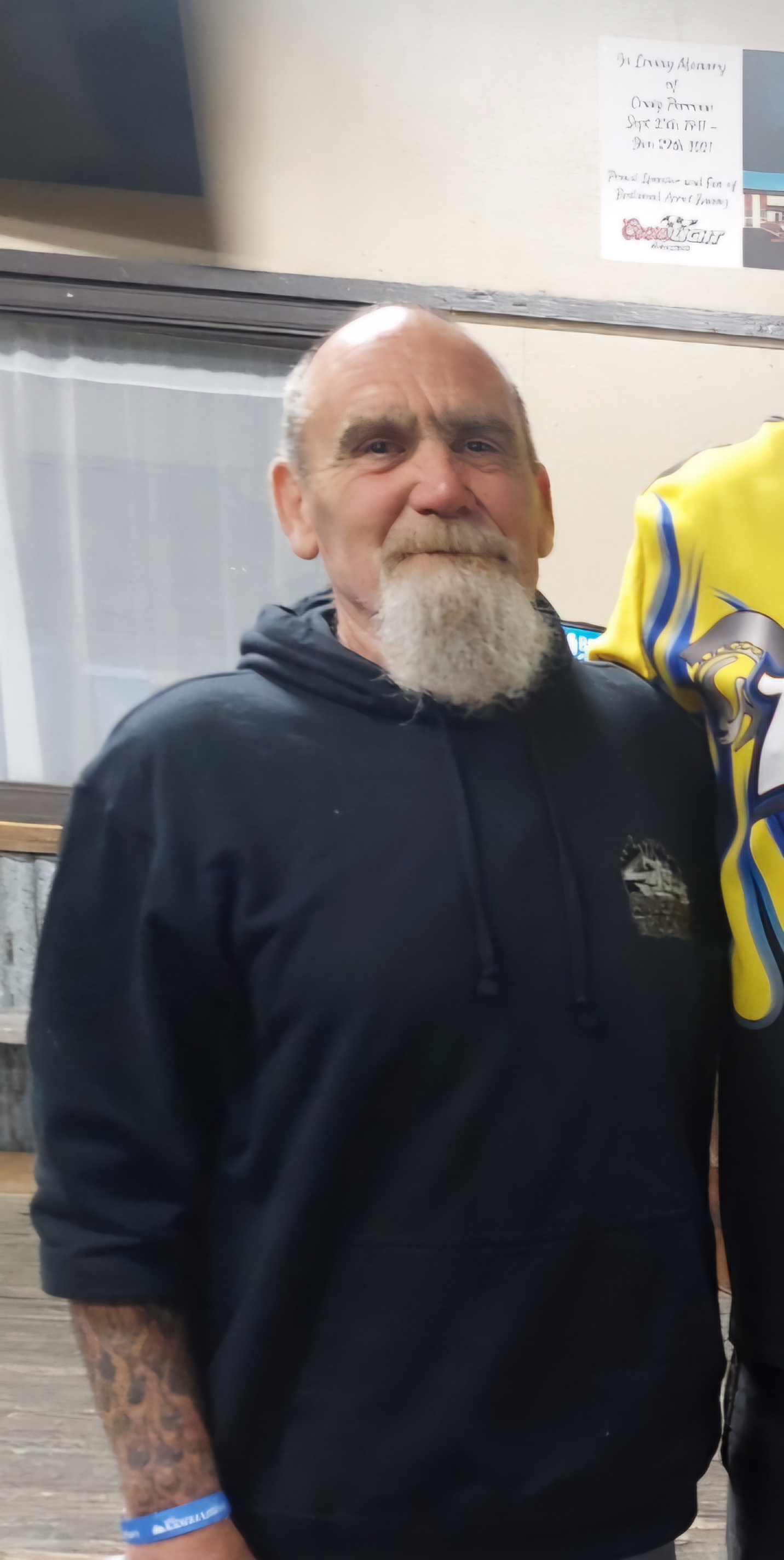
Bob
was born December 17, 1961 and unexpectedly passed on March 24, 2025.
Bob grew up in McKinleyville. He made it his stomping grounds from a young age and never let up. If you were from here as well or spent any good length of time here, I’m sure you knew him or at least knew of the guy they called “Rat.” He loved sports. He loved to talk about sports. He was a huge San Francisco Giants fan. So if you were a Dodgers fan, I’m sorry. If he was watching TV it was a sports game or a race of some sort. He was a big Dale Earnhardt fan. Three was his lucky number, hence why he picked the 3rd of the month for me to be born. Yeah, you could say he was a true fan.
He had many jobs in his lifetime. From installing garage doors to working in a wrecking yard, he could do almost anything. But out of all the jobs he had, being a dad was at the top of his list. If you knew Bob, you knew about me. I’ve been his sidekick since I was born. I could tell endless stories about going out on jobs with him as a kid, sitting in a dugout watching him play ball to being out at Redwood Acres watching the races from the grandstands, the pits or on the track racing each other as passengers in a Bomber. A memory I’ll never forget from the 2023 season is when dad got the opportunity to drive and I was his passenger. We did it all together. He was my best friend. My partner in crime.
Second to being a dad, becoming a Papaw was right up there on his list. It was like watching him and I all over again and he loved every single second of it. Don’t worry dad, we’re still going to that Giants game you promised Skarlet you’d take her to in May. She knows you’ll be there too, making sure the A’s don’t win.
Bob was preceded in death by his maternal and paternal grandparents, aunts, uncles and cousins. And his buddy Grit.
He is survived by his parents, Jay and Peggy Ratzlaff. Brother, Tim Ratzlaff. Daughter, Morgan Mayr (husband Casey). Granddaughter, Skarlet Mayr. Nieces, Tanaua Levin (husband Cameron, children Rian, Eira, Aspen and Dustin), Joie Van Beers (husband Jon), and Tanisha Ratzlaff. Along with several cousins, too many to list, near and far. And Jo, his current buddy that is now lost without him.
To know him was to love him. His rough around the edges exterior might have been slightly misleading, but you wouldn’t have found a more kind hearted, “give the shirt off your back” kind of guy with a sarcastic sense of humor like no other. He was there for his people, always willing to help if you needed him.
Dad, love you more.
There will be a celebration of life at the Moose Lodge in McKinleyville on Saturday May 31, 2025 from 12-4 p.m. We’ll be having a BBQ style potluck, so bring a dish if you’d like or just bring yourself and a story to tell.
###
The obituary above was submitted on behalf of Bob Ratzlaff’s loved ones. The Lost Coast Outpost runs obituaries of Humboldt County residents at no charge. See guidelines here. Email news@lostcoastoutpost.com.
OBITUARY: Kelly Sanders Jenkins, 1962-2025
LoCO Staff / Thursday, April 3, 2025 @ 6:56 a.m. / Obits

Kelly Sanders Jenkins was born on February 6, 1962 in the town of Mt. Shasta to Sharon and Harold Sanders. Kelly passed away peacefully on March 23, 2025 in her home in Eureka. She spent the last 40 years in Eureka. We were fortunate, as Kelly had been in the hospital for almost three weeks prior to coming home on this date. Doctors released her to come home with Hospice care. In doing this Kel was able to be at home when she passed, with family and her dog Daniel laying at her feet. She was where she wanted to be.
As said above, Kelly lived in Eureka, but she also lived in many other places. She also lived in Sacramento, Big Lagoon, Dinsmore, Orleans, North Carolina, Barstow and a short time in Arkansas. But Kelly lived most of her life in Eureka. Kelly graduated from Southern Trinity High School in 1980 where she met and made friends that she kept for a lifetime. It was in Eureka where Kelly met and married her great love and soulmate, Chris Jenkins. Kelly and Chris met at their work (Safeway) and were married on August 5, 1995 in South Lake Tahoe, California. They were blessed with two beautiful daughters, Ashley and Jordyn. Kelly was so proud of her daughters and loved watching them grow into the amazing independent young women they are today.
The world lost a bit of color when Kelly passed away. She had an amazing sense of humor that would leave you in stitches, no matter what the circumstances. She was especially known for her “Kellyisms”, which were amazingly accurate, insightful, quirky observations of life’s moments that would just put a smile on your face. Kelly also had a hidden talent that not too many people knew about. Kelly loved writing poetry and even had one published at one time. She was a very good writer.
One of Kelly’s favorite things to do was to go fishing. Kelly and Chris had a Cabin at Ruth Lake for a few years, and it was always fun watching Kelly fish. As anyone who has gone fishing knows, you have to have some patience. Well patience, fishing, and Kelly were usually things that did not go together well. We loved to watch Kelly fish, nobody ever stared at the tip of their fishing pole more intently than Kelly. Chris tells a story about the first time he met Kelly’s parents in Orleans. Dad Lance worked for the Forest Service and did some river guide work as well. Lance took Kelly and Chris fishing in his drift boat while they were there. As Lance was guiding the boat, Kelly gave her pole a mighty cast. The only problem was Lance’s ear got in the way of Kelly’s hook. Well Lance calmly removed the hook from his ear and we went on fishing. I don’t remember if any fish were caught, but I’ll never forget that.
Kelly endured much physical suffering in her life, from Leukemia in her 40’s with years of treatment and its side effects, to diabetes, heart conditions, lung cancer, kidney disease, and various other issues. But above all Kelly was a warrior who kept the faith, kept on fighting, and stayed here with us for as long as she possibly could. Chris has alway said that Kelly is the toughest person he has ever known. She was an amazing human being with the kindest heart and the gentlest soul. Those of us who were fortunate to know her are better versions of ourselves because she touched our lies. Heaven got an amazing angel when she arrived there.
Kelly was preceded in death by her mother Sharon Rieland and stepfather ‘Dad’ Lance Rieland, and father Harold Sanders. Kelly is survived by her beloved husband Chris, children Ashley and Jordyn, brother Mark Sanders (Brenda) and family, stepbrother Dan Rieland (Heather) and family, and step sister Sherrie White (Chris) and family,
There will be a celebration of life for Kelly where we can all get together in June where those who wish can come and celebrate Kelly and tell their best Kelly story. Sanders funeral home is taking care of Kelly at this time and there will be a viewing at 2:30 p.m. April 3, 2025, Kelly will be interned at Sunset Memorial Park on Friday, April 4, 2025.
###
The obituary above was submitted on behalf of Kelly Jenkins’ loved ones. The Lost Coast Outpost runs obituaries of Humboldt County residents at no charge. See guidelines here. Email news@lostcoastoutpost.com.
OBITUARY: Jocelyn Ellen Schrum, 1940-2025
LoCO Staff / Thursday, April 3, 2025 @ 6:56 a.m. / Obits

It is with a heavy heart that we announce the passing of Jocelyn Ellen Schrum, a beloved
wife, mother, grandmother and friend. She passed away surrounded by her family on March
19, 2025 in Eureka at the age of 85.
Jocelyn was born on January 16, 1940 in Chula Vista, California to parents James and Ellen West. She grew up in Winters with her brother, Jim West, and sister, Jackie West. Jocelyn attended Chico State University until she met her husband, Paul Schrum. They were married for 43 years until Paul passed away in 2001. They had two children, Laura, born in Chico, and Norman, born in Corning. They moved to Guam from 1965-1969, where she got her degree in teaching, before returning to live in Wheatland.
Jocelyn also received her Masters in Education from Humboldt State University later on. She dedicated her life to education, shaping countless young minds as a teacher in Wheatland for over 30 years. She is survived by her loving family, including her brother (Jim), son (Norm), daughter-in-law (Robin), grandkids (Joanna, David, Cara, Christopher, Stephanie, Daniel, Sami and Molly) and great-grandkids. Her love was endless, and her memory will remain a guiding light for all who knew her.
###
The obituary above was submitted on behalf of Jocelyn Schrum loved ones. The Lost Coast Outpost runs obituaries of Humboldt County residents at no charge. See guidelines here. Email news@lostcoastoutpost.com.
Eureka City Council Greenlights Women’s Residential Rehab Facility Planned for Henderson Center
Isabella Vanderheiden / Wednesday, April 2, 2025 @ 3:25 p.m. / Local Government

Screenshot of Tuesday’s Eureka Council meeting.
###
After hearing an hour of impassioned and at times emotional public testimony at last night’s meeting, the Eureka City Council unanimously voted to approve the North Coast Substance Abuse Council’s plans for a short-term women’s residential treatment facility on Harris Street near Henderson Center.
The council’s vote upheld the Eureka Planning Commission’s Feb. 12 decision to approve the project, which was appealed to the city council by a group of Henderson Center residents who argued that the rehabilitation facility was incompatible with the surrounding neighborhood and posed a danger to people living nearby. However, some of those folks had a change of heart after learning that the facility’s executive director, Wesley Harrison, decided to make it women-only.
“I attended the planning commission meeting when this came up and it was proposed as a men’s facility,” said Eureka resident Marilyn Field. “I came here to ask if you were aware of [Dr. Deepak] Stokes’ women’s center going in just across the street from this, and that it would be a very bad fit for a men’s facility to be catty-corner from the women’s health center. But after hearing that it’s going to be for women, I think it’s a great idea.”

Street view of the proposed residential treatment facility. | Photo: City of Eureka
The “non-medical” rehab facility is slated for a 0.3-acre site, located just down Harris Street from the old Spotlight Video, with three existing buildings that would be used for short-term housing (between 30 and 120 days) for women recovering from substance abuse, individual/group counseling sessions and offices for staff. The facility would host a live-in manager and up to 12 residents at a given time. Patients will be subject to a background check and drug test before being admitted to the program and will be drug tested regularly during their stay to ensure eligibility for the program. The program will not admit sex offenders and arsonists.

Aerial view. | Photo: City of Eureka
The proposed facility would be considered a “Level 3.1” under the California Department of Development Services’ service level system, which ranks community care facilities on a scale of 1-4 according to the types of resources provided. The facility will not provide detox services but will focus on behavioral health and personal care to help patients maintain sobriety.
The North Coast Substance Abuse Council currently operates Crossroads, a state-licensed rehab facility on Myrtle Avenue, with 15 beds on the men’s side and five on the women’s. Speaking at last night’s meeting, Harrison said his waitlist for the women’s side is “probably a mile long.”
“There are individuals that have been waiting on my waitlist for well over 90 days,” he said. “There are individuals that are literally desperately calling every day hoping that somebody got discharged in order to be moved up on the list. The need far outweighs what resources we have available.”
Harrison noted that there have been “a lot of assumptions” and concerns about the project, referring to the people who were “all very certain that it was going to be a men’s facility.” Those concerns, as well as the facility’s proximity to the forthcoming women’s health center, influenced the North Coast Substance Abuse Council to focus on women.

Harrison | Screenshot
“This will be our women’s project,” he said, adding that the facility will provide perinatal care for pregnant women. “We think it’s a wonderful opportunity to move the women over there because we understand that Dr. Stokes’ women’s health center is being built across the street. We know that Healthy Moms is two blocks away, which is an outpatient substance use treatment center that serves perinatal mothers. [We’ll be] right down the road from a domestic violence women’s shelter, and it’s a safe place for them to be.”
Responding to a question from Councilmember Renee Contreras-DeLoach, Harrison said the three buildings will have to undergo extensive interior and exterior renovations before anyone can move in.
“The paint jobs, the gutters, the cracked windows, the foundation, the wiring — I mean, there’s literally over $200,000 worth of work that needs to be done on it,” he said. “And then on top of that, there’s licensing and certification, and that process can take … up to six months. If everything were to go absolutely smoothly, I would hope for an [opening date] in July of 2026, but … I think January of 2027 is a much more realistic idea of when we’ll be opening our doors and putting our first lady over there.”
The project description notes that residents will be “contractually required to abide to strict rules” and will only be allowed to leave the facility with pre-approval from the live-in manager. Harrison added that residents can leave to attend AA or NA meetings, which, in the case of Crossroads, is just two blocks away.
“If anybody doesn’t return on time, there are consequences, and people can be removed [from the program] if they don’t return,” he continued. “Most of the time, these things happen without a hitch because they are cherished privileges by our population. … There’s this level of group accountability osmosis that happens where 90 percent of the population really, really doesn’t want to mess up, and … the one individual that maybe doesn’t have the best of intentions immediately gets weeded out.”
Councilmember G. Mario Fernandez also asked how patients are referred to the program and if they take in people who were recently incarcerated. Many Crossroads residents are referred by medical providers, but some people are referred by the county jail, Harrison said.
“I can’t discriminate based upon someone’s probationary status,” he said. “A lot of people will try to classify the population we serve as criminal. Whether we disagree on it or not, drug use is still a crime, and until it’s not a crime I will always be serving criminals no matter what their probationary status is.”
Asked about the frequency of 9-1-1 calls at Crossroads, Eureka Police Chief Brian Stephens said his department received nine calls for service at 1205 Myrtle Avenue in 2024.
“Three were medical aids, two were missing persons reports concerning the same person, one found animal, one absconder resident, and then two verbal arguments. They’ve only produced two to three case numbers a year since 2020 and about 11 calls for service on average from 2020. There’s more calls to service that happen at City Hall than do it these residential sites,” Stephens said, prompting laughter from meeting attendees. “Not trying to be funny, but I’m trying to put it in perspective that they’re not a problem with the police. … We don’t have the stats to show that there’s any increase in any type of criminal activity associated with these locations.”
Councilmember Scott Bauer added that he didn’t even know Crossroads was located on Myrtle Avenue. “I take that as a good sign [if] you don’t even know they’re there.”
Two dozen residents spoke during the public comment portion of the meeting, with the vast majority speaking in favor of the project. Several former Crossroads patients shared emotional recovery stories and praised Harrison and his staff for helping them to get their lives back on track.
“I was homeless, struggling with addiction, living in a homeless camp behind the mall, and I walked into Crossroads and met with Wes, the director, who took me in as a client that day,” said one woman who only identified herself as Chelsea. “This would not have been an option if there wasn’t a bed available [that day]. If I had been turned away, the chances are I wouldn’t have made it back to the program. The program has helped me to become [the] productive member of society that I am today.”
Several medical and child care providers, substance use counselors and social workers spoke as well, all of whom urged the council to approve the proposed plans and underscored the urgent need for more local rehabilitation services.
“I have seen firsthand the impact that facilities like these have had on people’s lives, and it is astronomical,” said Patricia, a local substance use counselor. “I see people who have gone successfully through these programs; they are re-entering the workforce, they are reuniting with their children and their families, getting their own places, furthering their educations, all kinds of really positive impacts on people. … This is so important, especially for mothers and pregnant women who need this help.”

Shepherd | Screenshot
Other residents said they were supportive of the project but felt it should be moved to another location. Henderson Center resident Jean Shepherd expressed particular concern for the woman-owned jewelry store next to the proposed facility, noting that the owner saved her money and opened her store “only to find out the city is moving ahead with a drug abuse recovery house and program located right next to her shop.”
“I want to make it clear that I have no problem with people going into recovery,” Shepherd said. “I have sympathy for people who struggle with drug abuse and need help. The problem here is the location. … I’ve heard the term NIMBY — not in my backyard — tossed around, and I will say I guess I’m a NIMBY. I think any homeowner would worry about trying to sell his or her home if a recovery house was next door.”
Following public comment, Councilmember Contreras-DeLoach made a motion to deny the appeal and uphold the planning commission’s approval of the project. Councilmember Leslie Castellano seconded the action, thanking Harrison and his team for being willing to engage with the community and address concerns about the project.

Castellano | Screenshot
“I think that bodes really well for the work you’re doing, and the fact that addiction is a systemic problem, part of a community problem,” she said. “I appreciate the respect and sense of care that [the audience has] in being here … and in listening to one another and being willing to engage with the questions and change your minds, or reflect on your position.”
Councilmember Kati Moulton, her voice wavering with emotion, acknowledged people who have lost their battle with addiction and underscored the importance of getting people into treatment as soon as they are willing. “When that spark happens and somebody says, ‘I want to get my life right,’ that’s when you need to take advantage of that and give them that opportunity because any delay can cause … that demon to get right back on top of them,” she said.
Moulton also asked if the proposed project would be exempt from CEQA even though it involves renovations of a historic building. City Attorney Autumn Luna simply said, “Yes.”
Fernandez also spoke in favor of the project and called its opponents “disingenuous.”
“How is this not community-oriented care for the neighborhood? How is this reduc[ing] the unique characteristics of Henderson Center?” he asked. “For anyone to say that they support this type of program or facility, but not in a particular area or zone [is] being disingenuous. I’m sorry, where then, if not in my backyard or in our neighborhood? The transient nature of the population cycling in and out of the facility, the clientele doesn’t differ any than if it were a bed and breakfast.”
Councilmember Bauer thanked the group of speakers who spoke in favor of the project. “Your stories, I think, made our jobs a lot easier.”
“I talked to a doctor friend of mine today … and [asked] ‘Shouldn’t this be in a medical district or something?’ and he’s like, ‘Where? … I mean, it’s part of the community. You got to do it.’” Bauer said. “But realistically, you all made this decision so much easier. Just to hear these great stories, and then to see people change their minds based off of your real life situation.”
After a bit of additional discussion, the council approved the project in a 5-0 vote.
###
At the outset of last night’s meeting, Mayor Kim Bergel read a statement into the record aimed at addressing “misinformation” espoused during recent city council meetings regarding alleged police sweeps at local homeless encampments. Speaking in an uncharacteristically curt tone, Bergel attempted to dispel rumors that EPD officers are “harassing and stealing from our community members” and outlined the city’s protocols for clearing encampments.
“The procedures for ensuring public spaces are accessible to all of our community members is a very well-balanced process ensuring compassion and accountability,” she read from a prepared statement. “If the owner is present, EPD staff will provide the notice to vacate form, answer any questions and inform the owner of available local resources. … If the owner is not present, the notice to vacate form is left in a conspicuous area where it can be easily found upon the owner’s return.”
The tagged property is then photographed and stored, Bergel continued. EPD will not store items that are considered to be hazardous or trash, including perishable food items, soiled materials and drug paraphernalia.
“EPD uses sound judgment when determining an appropriate time frame, considering factors as the owner’s physical and mental condition, the amount of property, location and weather conditions,” she said. “I really felt compelled to bring that forward after our last meeting because there’s a lot of misinformation about what’s really happening. And so. just to clarify, our staff is doing a great job out there.”
###


