

OBITUARY: Henry (Hank) Alfus Waelty, 1946-2025
LoCO Staff / Wednesday, Jan. 15, 2025 @ 6:56 a.m. / Obits

Born
in Central Point, Oregon on November 28, 1946, and passed in
McKinleyville on January 8, 2025.
Known by his coworkers, friends, and family for many years as” Hammering Hank” or “The “Hammer,” Hank was the life of the party and the center attraction. He was the team cheerleader for all! One of his favorite mottos was “Been there, done that, and I have the T-shirt” — there wasn’t much that he hadn’t done or tried in this lifetime, and he had all the stories and battle wounds to show for it.
He held many roles at PG&E as part of the line division and was a legend in his own time. After retirement from PG&E in 2004, he then went on to become an inspector for Candus Corporation and traveled all over the state of California.
Hank was a long-time member of the Faith Center Foursquare Church in Eureka. He loved to tell stories and had a passion for the outdoors, whether it be fishing on the Mad River, fishing in the ocean whenever the bar was perfect and the swells were within reason, or trolling the lagoons. He loved to hunt, play poker, collect special coins, can tuna and cheer on his kids, grandkids, nieces and nephews at sports, rodeos and gymkhanas. Hank was the best cheerleader and was always proud to support everyone related or not.
Hank leaves behind Roberta (Berta, or Bert) his wife and partner for 45 years ; daughter Karon, son-in-law Mike Nelson, and grandchildren Michaela, Brittney, and Jacob; aon John and daughter in-law Tara; daughter Kathy and her partner Noah Schiller, and grandchild Kiersten Yorks; sister Mary Bracken; brother John Waelty; great-grandchildren, nieces, nephews, sister-in laws, brother-in laws, his best friends Ross and Donna Hanes, the Faith Center community, and multitude of friends.
Preceded in death by his mother Arla Lewis; stepfather Augie Lewis; father Henry Oral Waelty; stepmother Roberta Waelty; brother Bobby Waelty; and nephew Michael Waelty.
The family would like to give a special thank you to Timber Ridge of McKinleyville, Hospice of Humboldt employees and volunteers, family, and friends that came to visit.
A celebration of life will be held at Faith Center Four Square Church located at 1032 Bay Street in Eureka, CA 95501 on January 25 at 11:30 a.m.
###
The obituary above was submitted on behalf of Hank Waelty loved ones. The Lost Coast Outpost runs obituaries of Humboldt County residents at no charge. See guidelines here. Email news@lostcoastoutpost.com.
BOOKED
Today: 11 felonies, 8 misdemeanors, 0 infractions
JUDGED
Humboldt County Superior Court Calendar: Today
CHP REPORTS
Sr299 / Glen Rd (RD office): Missing Elderly
ELSEWHERE
RHBB: Two Brothers Found Deceased in Trinity River
RHBB: Silver Alert Issued for Missing Humboldt County Man With Dementia and Seizure Disorder
Governor’s Office: FREE MONEY FOR KIDS: Governor Newsom and First Partner celebrate one million families claim CalKIDS “baby bonds” accounts
County of Humboldt Meetings: CAT (Committee for Active Transportation) Meeting Agenda
OBITUARY: Irene Warner, 1945-2025
LoCO Staff / Wednesday, Jan. 15, 2025 @ 6:56 a.m. / Obits

Irene
Warner
February
4, 1945 – January 12, 2025
With heavy hearts, we announce the passing of Irene Warner, who peacefully left this world on January 12, 2025, surrounded by her beloved family. She was 79 years old.
Born in 1945, Irene spent the majority of her life in Humboldt County, with additional time spent in Ukiah, Willits, Oregon and Southern California throughout her journey. Irene was a woman of immense compassion and generosity, dedicating much of her life to caring for others. Whether in her professional role as a caregiver or in her personal life, she always prioritized the well-being of her family and friends. She was known for her selflessness, often opening her home to offer a safe and warm place to stay for those in need. Irene’s nurturing nature extended to all those fortunate enough to know her.
In her leisure time, Irene enjoyed reading and could often be found singing and dancing whenever music played, a testament to her vibrant spirit and zest for life.
Irene was preceded in death by her parents, Bill Augusta and Leona Hamilton; her sister, Mary Lou Augusta; her beloved husband and lifelong companion, Dan Warner; her daughter, Kristina Warner; and her granddaughter, Hailey Augusta.
She is survived by her siblings twin sister, Barbara Augusta and brother Billy Augusta; her daughters, Genave Amorosano and son in law John Amorosano, Melissa Augusta, and Michelle Warner; her son, Dan Warner; as well as her cherished grandchildren, Joshua Winkler, Christina Moody, Joseph Winkler, Amanda Alger, Jeremy Willison, Ashliegh Augusta, Bella Augusta, Lauren, Christopher, Jacob, and Jocelyn. Irene was also deeply loved by her great-grandchildren, Bradley Willison, Kylie Willison, Everly Willison, Paislee Augusta, Gabriel Martinez, Christian Martinez, Mikayla Fornah, Serene Ebo, and Ariel Ebo. Irene’s family extended to numerous nieces, nephews, and cousins, too many to name, but each of whom held a special place in her heart.
Irene’s legacy of kindness, love, and devotion will continue to inspire all who had the privilege of knowing her. Her memory will forever live on in the hearts of her family and friends.
A celebration of Irene’s life will be held at a later date, and details will be shared with family and friends.
###
The obituary above was submitted on behalf of Irene Warner’s loved ones. The Lost Coast Outpost runs obituaries of Humboldt County residents at no charge. See guidelines here. Email news@lostcoastoutpost.com.
TODAY in SUPES: Arroyo Delivers Presentation on Local Medical Provider Challenges, Board Approves Letter of Concern Over Proposed Wood Pellet Biofuel Project
Ryan Burns / Tuesday, Jan. 14, 2025 @ 3:29 p.m. / Local Government

The Humboldt County Board of Supervisors. | Screenshot.
###
Most local residents are well aware of Humboldt County’s challenges recruiting and retaining health care providers, but after dealing with medical issues faced by her own family, Fourth District Humboldt County Supervisor Natalie Arroyo decided to dig deeper in hopes of better understanding the problem and identifying potential solutions.

Arroyo | Screenshot.
At today’s Board of Supervisors meeting, Arroyo presented a summary of what she learned in recent months by interviewing more than 40 local health care professionals, who provided a more complex picture of the challenges influencing this trend than the simple explanations often proffered. Challenges include our county’s shortage of housing options and clinic space; the burdens of insurance reimbursement and administration; the area’s visible poverty and negative self image; as well as cultural shifts that are impacting the industry nationwide (such as the increasing demand among younger people for a healthy work-life balance).
Arroyo’s presentation was a preview, of sorts, to an upcoming community meeting and panel discussion scheduled for the evening of Jan. 27, when local health care leaders will address our region’s recruiting and retainment challenges and respond to questions from the public.
Working her way through an information-dense slideshow, Arroyo began by noting that there is a nationwide shortage of health care professionals, including not just doctors but also nurse practitioners and physicians’ assistants.
“Within about 10 years, we’re going to be facing a physicist physician shortage in the U.S. of over 85,000 physicians,” Arroyo said, citing a figure from the American Association of Medical Colleges. “That was staggering to me,” she continued, later noting that the shortage is especially pronounced in rural areas.
And yet, Humboldt County is in “much better shape” than many other rural areas, Arroyo heard from her sources.
The health care industry has consolidated dramatically in recent years, with small practices getting subsumed into large conglomerates. Meanwhile, providers are being assigned a larger volume of patients while being forced to spend more time on medical records and note-taking, which was listed among “morale-killers” in the industry. Also on that list: the community’s negative self image and patients who take out their frustrations with the system on their care providers.
“People’s negative talk about Humboldt as a whole came up — that was consistent throughout almost every interview,” Arroyo said. “The overall poor self esteem [in] Humboldt County has this outsized impact on recruitment and retention.”
She added that institutional leadership can also “make or break morale.”
The types of providers who thrive in Humboldt are those who are “mission-driven” and enjoy working solo, as well as those who love the outdoors and have existing connections to the community, Arroyo said.
Recent recruitment efforts include residency programs for family medicine, nurse practitioners and dentistry, and Providence has switched from a regional approach, lumping Humboldt in with Napa and Sonoma counties, to one focused on our county specifically.
Arroyo said that people’s faces lit up when she asked about recruitment, but they were less enthused when she brought up retention. Younger providers, often saddled with enormous student loan debt, often seek modest housing, whereas local landlords have created a “borderline predatory environment of furnished rentals,” Arroyo said, quoting unidentified sources from her interviews.
Our region’s shortage of mental and behavioral health resources — particularly counselors who accept private insurance — has meant that the task has fallen largely on primary care providers, who, in interviews, expressed a lot of gratitude for the region’s existing crisis, residential and post-discharge support for people in poverty, Arroyo said.
Our community has “complex substance use and mental health needs,” and Arroyo noted that, “if people are put off by seeing poor people in the community, they probably won’t do well practicing here.”
Workforce development programs through Cal Poly Humboldt and College of the Redwoods aim to help the region “grow our own” providers, and Arroyo said some of these effort have yet to be announced.
County decision-makers can help address these issues by investing in housing and transportation — particularly air travel — and directing resources upstream toward public health prevention efforts and addressing childhood trauma and other social determinants of health, Arroyo said.
There are limited seats available to attend the upcoming panel discussion in person, but the event will also be live-streamed via Access Humboldt’s YouTube page, and the online audience will be invited to engage via an online polling platform.
Letter on biofuels project
Later in the meeting, the board unanimously agreed to send a letter to the CEO and President of Rural County Representatives of California (RCRC) expressing concerns about a proposed project that aims to convert forest biomass into industrial wood pellet stock for energy production.
This endeavor, dubbed the Golden State Natural Resources (GSNR) Forest Resiliency Demonstration Project, has drawn intense scrutiny and criticism from a range of environmental organizations, partly because of concerns over the potential collaboration with the U.K.-based company Drax, which has a long history of violating air emissions limits.
A few months ago the board of supervisors urged the joint-powers Golden State Finance Authority to extend the public comment period for the project’s the Draft Environmental Impact Report, to no avail. Today, the board approved a letter brought forward by Fifth District Supervisor Steve Madrone outlining a list of environmental concerns, alternatives and recommendations.
Board Chair and Second District Supervisor Michelle Bushnell said the county has received “lots of public comment” on this matter, and more was delivered in person and via Zoom at today’s meeting.
First District Supervisor Rex Bohn, who was involved in developing this project as a member of the GSNR board (an appointment that ended on Jan. 1), said at the outset of the conversation that he’d be voting to approve the letter, even though the biofuels project would provide a big economic boost to Tuolomne and Lassen counties. He advised open communication with the supervisors in those counties.
Speakers during the public comment period, including the leaders of several local and regional environmental organizations, were unanimous in their skepticism of the project and support for the drafted letter. Several said the biofuel project would contribute to environmental pollution and greenhouse gas-fueled climate change. Others said its purported economic benefits have been exaggerated with the help of generous government subsidies.
You can read the full text of Madrone’s drafted letter by clicking here. When the matter came back to the board for discussion, Third District Supervisor Mike Wilson said that while he could “nitpick” some of the particulars, he agreed with the broad strokes of the letter, particularly the call to strengthen the environmental analysis. He also noted that there will be more time to comment when the Final Environmental Impact Report is circulated.
Arroyo proposed a couple of edits to the letter — removing a line about prescribed burns, since none are proposed in the project, and adding a recommendation to consult with local tribes. She made a motion to approve the letter with those changes. Bohn seconded the motion, which passed unanimously.
EPD Provides Further Details on Last Night’s Corvette Pursuit
LoCO Staff / Tuesday, Jan. 14, 2025 @ 1:32 p.m. / Crime

PREVIOUSLY:
# # #
Eureka Police Department press release:
On January 13, at about 1705 hours, two single-unit Patrol Officers with the Eureka Police Department observed a Corvette traveling on the 600 block of F Street; the driver was erratically reviving the Corvette’s engine. Upon further investigation, the Corvette’s registration was discovered to be expired.
The Corvette turned off onto a side street and then began traveling south on E Street. When the Patrol Officers attempted a traffic stop on the Corvette for the above violations, the driver refused to stop, and continued south on E Street for over a quarter of a mile. When the Corvette stopped for stop signs, the driver would erratically and loudly rev the engine and then continue south on E Street. Multiple Patrol Officers, including Command Staff and three K9 Units who had just finished training nearby, responded to assist.
The driver of the Corvette, later identified as Judah Demeire, 51 years old of Eureka, stopped on E Street near Humboldt. After stopping, Demeire backed the Corvette into the front of a Patrol Unit. Boxed in by Patrol Units, the Corvette came to a stop. However, Demeire refused to comply with Officers; he remained inside the vehicle, made erratic and concealed movements, opened and closed his window, and yelled nonsensically.
The CSET MIST Officer (Mental Health Officer) who arrived on-scene, attempted to negotiate with Demeire in order to gain his voluntary compliance. However, Demeire refused to de- escalate and/or comply.
Due to his non-compliance, Officers introduced OC spray into the Corvette. This was effective and Demeire exited. However, while exiting, Demeire was again non-compliant with officers and was ultimately forced to the ground and placed under arrest.
After being medically cleared at a nearby hospital, Demeire was booked into HCCF for VC 2800.1(a), PC 148(a)(1), and PC 647(f). This case is still under review for PC 245(a)(1) – Assault with a Deadly Weapon, and PC 69 – Resisting an Officer with Force or Fear.
Those Helicopters Next to Highway 101 Are Indeed PG&E Choppers
Dezmond Remington / Tuesday, Jan. 14, 2025 @ 11:33 a.m. / Helicopters , LoCO Looks Up

A Bell 407. This photo does not depict either of the helicopters PG&E are using. By Md Shaifuzzaman, Wikimedia Commons.
The helicopters doing laps next to Highway 101 this last week aren’t CIA black-ops, foreign agents, or a bored billionaire flexing their aerial domination on cowering commuters. The Outpost has officially confirmed that they are, as many online have proposed, helicopters doing work for PG&E.
The helicopters, two Bell 407s owned by PJ Helicopters in Red Bluff, have been patrolling a transmission line and replacing insulating materials, as well as assisting with pole replacements.
According to spokesperson Megan McFarland, PG&E uses helicopters to limit impact on wildlife and wetlands.
Today is the last day PG&E is using the helicopters.
Fortuna Man Arrested After High-Speed Pursuit on Samoa Peninsula
LoCO Staff / Tuesday, Jan. 14, 2025 @ 9:10 a.m. / Crime
Press release from the Humboldt County Sheriff’s Office:
On Jan. 12 at about 2:15 p.m., a Humboldt County Sheriff’s deputy on patrol in the Samoa area attempted to conduct a traffic stop on a vehicle that failed to yield at a stop sign and had expired registration.
The deputy activated his emergency lighting while behind the vehicle near New Navy Base Rd. and Cookhouse Rd.; the driver, later identified as Marcus Wade Smith, 34, of Fortuna, accelerated through the intersection, failing to yield at another posted stop sign. Smith continued northbound on Highway 255 with speeds varying from 60-85 mph in the 55 mph zone.
The deputy kept lights and siren activated throughout the pursuit of Smith, which ended after 3.8 miles when Smith yielded at the Mad River Slough Bridge. Smith was detained without further incident. The Emergency Communications Dispatch Center confirmed that Smith had a felony warrant and was on felony probation.
During a search of Smith incident to arrest, deputies located multiple credit cards and identification cards belonging to multiple other people.
Smith was then booked into the Humboldt County Correctional Facility for the following charges:
- Flight from traffic officer—VC 2800.1(a)
- Violation of probation—PC 1203.2(a)(2)
Smith was also booked for violation of probation.
Anyone with information about this case or related criminal activity is encouraged to call the Humboldt County Sheriff’s Office at (707) 445-7251 or the Sheriff’s Office Crime Tip line at (707) 268-2539.

Felon Arrested With Fentanyl, Scale, Cash, Says Sheriff’s Office
LoCO Staff / Tuesday, Jan. 14, 2025 @ 9:01 a.m. / Crime
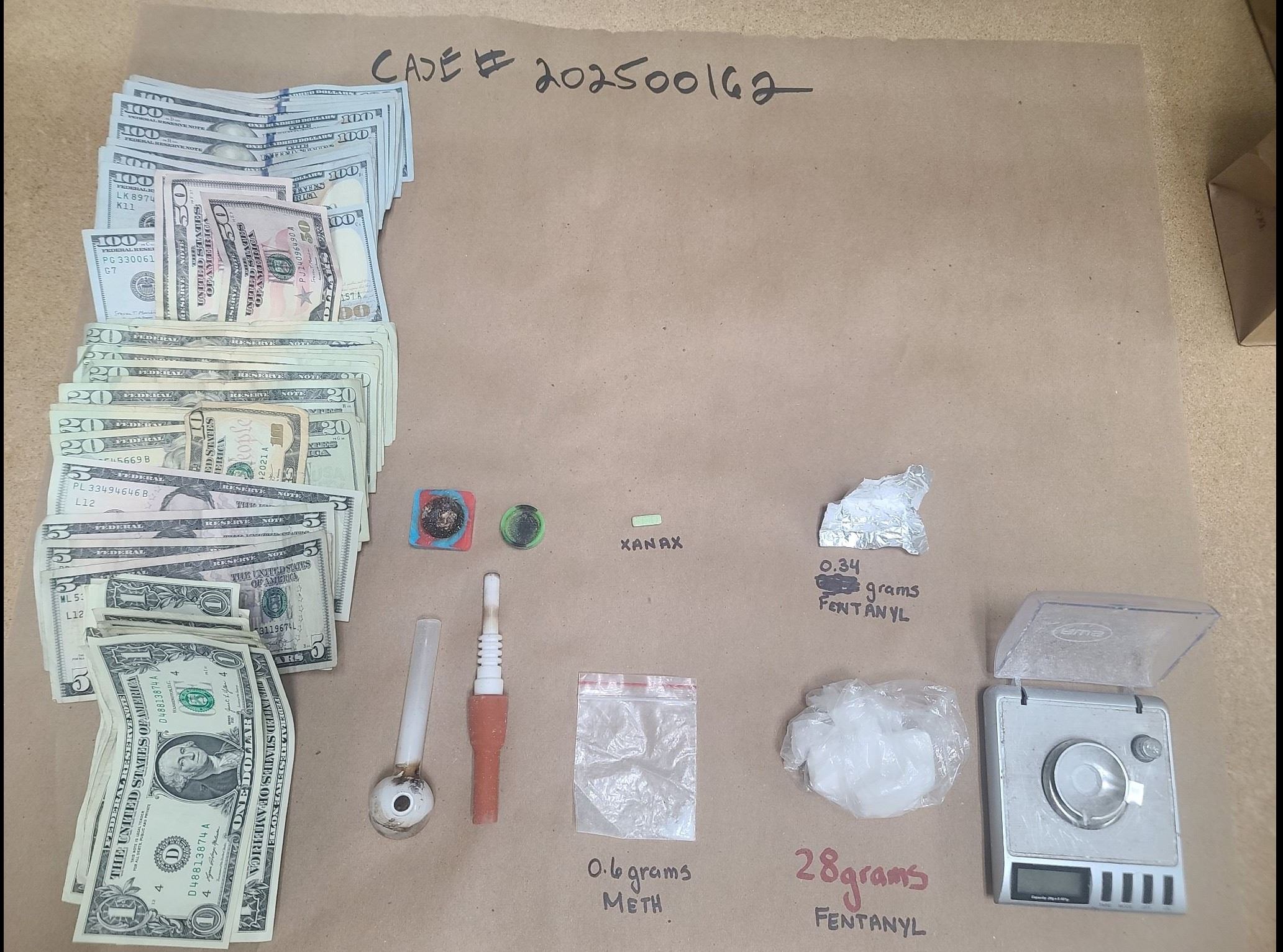
Press release from the Humboldt County Sheriff’s Office:
On Jan. 11 at about 2:45 p.m., Humboldt County Sheriff’s deputies investigated a vehicle on Lucky Star Ct. in McKinleyville, as the driver of the vehicle—Robert Huntzinger, 43, of McKinleyville—was on summary probation for unlawful possession of a controlled substance (HS 11350(a)) with a search clause.
Deputies confirmed Huntzinger’s probation status with the Emergency Communications Dispatch Center and learned that his probation terms included that he must obey all laws. Deputies observed Huntzinger to have a knife on him, so he was detained for the deputies’ safety as it was not yet known if he had other weapons in his possession.
Huntzinger was searched pursuant to his probation terms; deputies located aluminum foil containing fentanyl and a large amount of cash in his pockets. A search of his vehicle revealed additional cash, baggies containing fentanyl, two cell phones, a digital scale, and other drug paraphernalia.
Huntzinger was then taken into custody and booked into the Humboldt County Correctional Facility for the following charges:
- Possession for sale of a controlled substance—HS 11351
- Transportation/sale of a controlled substance—HS 11352(a)
- Violation of probation—PC 1203.2(a)(2)
- Possession of controlled substance paraphernalia—HS 11364
- Possession of a controlled substance—HS 11350
The total amount of cash Huntzinger was carrying was more than $2,200. The fentanyl was weighed, totaling 28.34g.
Anyone with information about this case or related criminal activity is encouraged to call the Humboldt County Sheriff’s Office at (707) 445-7251 or the Sheriff’s Office Crime Tip line at (707) 268-2539.


