

OBITUARY: James Lewis Worthen, 1939-2024
LoCO Staff / Tuesday, Jan. 7, 2025 @ 6:56 a.m. / Obits

James Lewis Worthen, age 85, of Eureka, passed away on Dec. 27, 2024 following an
extended illness. On Aug 15, 1939, he was born in Eureka as the son of the late Jim and
Evelyn Worthen of Eureka. On Nov. 6, 1960, he married Ruth E. Faller of Banning. They
shared 64 years of marriage.
Children and grandchildren include son Jim Worthen and wife Bonnie of Huntington Beach; son Michael Worthen of Eureka; daughter Deborah House and husband Chris of Eureka; and granddaughter Olivia Worthen of Huntington Beach. Siblings include brother Robert Worthen and wife Toni of Oregon; sister Carolyn Powell and husband Gary of Oregon.
He worked for Humboldt Market for 13 years and entered the insurance business in 1968 as an agent. In 1983 he purchased Vickers Insurance as owner/agent. He retired Oct. 1, 2005. He attended Faith Center Church and spent 40 years in the Kiwanis Club. He was active in US Jaycees and spend 12 years as Commissioner for Eureka Housing Authority and 7 years for North Coast Regional Water Quality Control Board.
Jim was born and raised in Eureka, where he lived his entire life. He graduated from Eureka High School, class of 1957. He attended Pasadena College for two years.
He was a lifelong stamp collector and world traveler. Jim was deeply involved in local and state politics and community services.
Some of Jim’s proudest achievements were being elected to Eureka City Council in 1981 and reelected to four years terms in 1984, 1988 and 1992. Jim was active in League of California cities and events. He was elected state president in 1996. Jim was a natural-born leader (often called a statesman). His accomplishments are too many to mention.
Jim acknowledges and thanks the community, family and close friends for their support and involvement over the years. He dearly loved and enjoyed his work in politics. He will certainly be missed by us all.
A family service was held at Ocean View Cemetery. A celebration of life will be held at a later date.
###
The obituary above was submitted on behalf of Jim Worthen’s loved ones. The Lost Coast Outpost runs obituaries of Humboldt County residents at no charge. See guidelines here. Email news@lostcoastoutpost.com.
BOOKED
Today: 4 felonies, 12 misdemeanors, 0 infractions
JUDGED
Humboldt County Superior Court Calendar: Today
CHP REPORTS
Elk Creek Rd / Curly Jack Rd (YK office): Trfc Collision-1141 Enrt
ELSEWHERE
Governor’s Office: Governor Newsom signs legislation 8.31.2026
County of Humboldt Meetings: Fish & Game Advisory Commission Agenda - Regular Meeting
Governor’s Office: Governor Newsom announces appointments 8.31.2026
Governor’s Office: Governor Newsom signs legislation cracking down on cannabis ads and labels that appeal to kids
OBITUARY: Richard ‘Lee’ Lane, 1937-2024
LoCO Staff / Tuesday, Jan. 7, 2025 @ 6:56 a.m. / Obits

Richard “Lee” Lane passed peacefully on December 26, 2024, surrounded by family.
Friends and family are invited to a graveside service on Saturday, January 25, 2025 at 11 a.m. at Greenwood Cemetery at 1757 J St., Arcata, followed by a celebration of life at 1 p.m. in Azalea Hall 1620 Pickett Rd, Mckinleyville.
Born on December 22, 1937, at Trinity Hospital, Arcata to Lee and Peggy Lane, he spent his early years in Willow Creek. The family moved to their ranch on Liscom Hill in Blue Lake, where Lee and his younger brother Ed grew up attending Stewart Elementary, and Arcata High School.
As a young man, Lee loved boxing at the Blue Lake Civic Center, and being a member of the Torques Hot Rod Club, cruising around with pals Larry Kight and Doug Davis. He loved music and could play the pedal steel guitar and would often sing classic Hank Williams songs while driving his old Ford Truck.
After his time in the Marine Corp, Lee married former wife Kay Nielsen of Blue Lake and raised his children Wes and Rita. He worked at local lumber mills before he and his brother Ed joined the Humboldt County Sheriff’s Department and became deputies until their retirement.
Lee loved cars, planes, and boats. And on the weekends, you could find him at car races, air shows, or at the dock with his fishing boat El Bandito.
A naturally skilled craftsman, he enjoyed building and remodeling houses, engines, boats and driving heavy equipment.
Growing up with closely-knit aunts and uncles, Lee had a special bond with his Aunt Katie Moreland, as they shared the same birthday. At family gatherings he learned the art of storytelling and could make you feel as if you were there.
A gentle-natured soul, he was there when you needed him, and always ready to give helpful practical advice to his friends, children, grands, nieces and nephews. His most cherished pastime were the many mornings spent with his good friend Wayne Palmer and the guys gathering over coffee to share stories and laugh.
Lee is survived by his life partner of many years Janice Humphrey, his son Wes Lane and daughter Rita Lane, his grandchildren Ross Lane, Rita (Dane) Clair, Nicholas Oaks. Great grandchildren, Rylynn and Colton Lane, Abigail and Rowan Clair. Niece Corinne and Nephew Dorsey (Kathrine) Lane and their families. Cousins Michael (Linda) Moreland of Carlsbad CA, Rae Ella Murphy (Ordell) of McKinleyville. Darcey Lima and family of Blue Lake, Kay Nielsen Collins, Fred and Rose Nielsen of Korbel. Lifelong Friends Dan and Pat. Johnstone of Novato, and so many more cherished friendships that he made throughout his life.
He was proceeded in death by his parents Lee and Peggy Lane, brother Ed and his wife Maydine, nieces Penny, Vicky, and Tina. Aunts and uncles Katie (Roy) Moreland, Louise(John) Lima, Ed (Mary Bertella) Brown, Richard (Betty) Brown, cousins Darlene (Ken) Swanson of Novato. Linda Brown, Jack, Bill, and Bobby Lima.
We are grateful for the immense love, care, and support given by his granddaughter Rita Clair, and our extended family Krista Partee, Patrick and Claira, Stephanie and the entire Redwood Coast PACE team. A special Thank You to his cousin Michael Moreland for his expertise and guidance on navigating Lee’s final plans.
Our Dad and Grandpa, we will love and miss you always, until we meet again.
###
The obituary above was submitted on behalf of Lee Lane’s loved ones. The Lost Coast Outpost runs obituaries of Humboldt County residents at no charge. See guidelines here. Email news@lostcoastoutpost.com.
OBITUARY: Bob Fosdick, 1949-2024
LoCO Staff / Tuesday, Jan. 7, 2025 @ 6:56 a.m. / Obits

Bob
Fosdick was born in Eureka in 1949 to Virginia and Homer Fosdick, Sr.
He passed away in December of 2024 peacefully, at home, with his
girls by his side, after a battle with cancer — a cancer he had been
free from for 18 years, which then came back very aggressively this
past year. Through it all, Bob managed to make people crack up
laughing even in sad times.
Bob was a resident of Eureka his whole life and grew up near the Henderson Center area. His first job was paper delivery boy which he did riding his bike at the age of 12 with his dog Picolo following him. He was a graduate of Eureka High School, Class of 1968. After high school, Bob went on to enlist in the Army, where he was stationed in Germany and worked as a mechanic. He loved working on cars and made a career out of it. He worked at Shieman’s in Eureka as the head transmission builder for years, and in 1993, his dream of owning his own shop came to life. He opened a transmission shop, K & R Automotive (named after his girls). He worked specializing in transmissions most of his life and he liked to tell the story that he was only 12 years old when he removed a transmission from one car and placed it in another.
For decades, Bob loved being involved in the car races at Redwood Acres. He really enjoyed working on friends’ cars and helped them with their transmissions and pit crews. He was a hard worker and would be in his shop or home garage working on cars morning, noon, night, including weekends. In the rare times he wasn’t working, he would be at other friends’ shops having a beer and talking about cars. With his love of fast cars, he enjoyed traveling to other racetracks including Sears Point Raceway. He was a collector of trucks and classic cars. He reminisced about the days of driving his old truck and his Camaro. For fun, he loved playing the lottery or visiting Reno where he was known to hit a jackpot at the last minute before leaving.
He took his girls on several trips in the ’80s and ’90s, driving his dad’s old ‘66 chevy truck (Old Brown) and his ’70s Cadillac over summer breaks to places like Disneyland, Marine World and Great America. And, of course, he took them to Reno, where he taught the girls how to gamble. He also enjoyed taking them to the horse races out at the Humboldt County Fairgrounds. Bob also loved being with his grandchildren and even bought his own car seats for his truck to drive them around. He loved having them over at his house and would take them to the store to pick out candy, soda and chips. He would also take them out to the stock car races which they all remember fondly. He loved his girls and grandchildren so much; he was always available to rescue them in the drop of a hat no matter the reason, the time of day, and with no questions asked. Although grouchy and stubborn at times, he was a kind and generous man, an amazing dad and grandpa.
In 1976, Bob married Deborah Hendry and they had two daughters in the late ’70s. Together they owned and operated a Shell Service Station in Smith River for a few years with Debbie pumping gas and Bob working on cars. In 1992, Bob married Cynthia Golich. Together they enjoyed stock car races, camping/boating at Trinity Lake, going to Reno to play Keno and slots and spending time with friends. Although divorced in 1997, they remained good friends, always having family gatherings together with their children.
He is preceded in death by his parents Virginia and Homer, Sr. and his sister Janet Fosdick Miller. He is survived by his brothers Homer, Jr. (wife Sherri), and Donald Fosdick, brother-in-law Alan Miller. Survived by daughter, Kimberly Fosdick, her children Justin, Bree and Danica Baeza and their father Daniel Baeza. Daughter, Roberta Conn, her children Alexis, Emily, Fancy and Luca (Michael Offield). Tony Prosser and his son Kanyon. Jolene Prosser and her husband Will Tift and their daughter Maya. Great-grandchildren KJ and Kash Thomas, and Mikey Offield. Niece Abby Fosdick (Max) and their children Aria and Micah.
Special thanks to dad’s good friend Tim McCracken (Amy) for all his help, support and friendship throughout the years — you were more than a friend and considered family. Angelo Marcelli for being a lifelong friend to dad and for taking him on the drives that he loved to go on these past months. Ang and Roberta Marcelli were a staple of our family’s life for decades and we appreciate everything they have done. There are many fond memories of our families together. Thank you to all of dad’s friends around town, too many to name but know that you are appreciated, loved and were talked of fondly by dad. You all made a positive impact on him.
Special thanks to Cindy Fosdick, who took him to doctor appointments and helped at the hospital in Walnut Creek and San Francisco to support his daughters during a tough time as well with his final days of life. Thank you to Jolene Prosser for all her support in dad’s stays at hospitals and in the last days of his life and to Tony Prosser for helping dad into the house after being discharged from the hospital in October.
Special thanks to his granddaughter’s father, Gerald Green, who is always helping at dad’s house including preparing the house for dad’s return from his hospital stays and for anything that was needed.
Thank you Dr. Sumana Jothi, ENT doctor in Martinez, for all the years of excellent care you gave dad. He trusted you like no other medical professional and thought very highly of you.
Thank you to the San Francisco Veterans Medical Center for the kind care you gave dad and for helping us to fulfill his wish of “take me home no matter what.”
Thank you to the very kind and caring people at Hospice of Humboldt. We are grateful for your help during this difficult time.
In September, dad said to be sure everyone knows that he “loved them all very much.” We took this as he loved everyone: family and friends.
Graveside services will be held at 2 p.m. on Saturday, January 11, 2025 at Ocean View Cemetery in Eureka and a celebration of life will be held from 3 to 6 p.m. at the Speedway Club at Redwood Acres under the grandstand. Everyone who knew dad is welcome to attend.
###
The obituary above was submitted on behalf of Bob Fosdick’s loved ones. The Lost Coast Outpost runs obituaries of Humboldt County residents at no charge. See guidelines here. Email news@lostcoastoutpost.com.
OBITUARY: Harmon Hebert, 1941-2025
LoCO Staff / Tuesday, Jan. 7, 2025 @ 6:56 a.m. / Obits

We had to say goodbye to our dad, grandpa, uncle and friend Harmon Hebert on Jan 2, 2025 after
an extended battle with COPD.
He was born March 5, 1941 in Winnsboro, Louisiana to Dwight and Ruby Hebert. They moved to California soon after dad was born.
Harmon grew up in Rio Dell, but attended elementary school in Scotia. After graduating from Fortuna High School in 1959 he joined the Army and spent time stationed in Turkey. After getting out of the Army, Harmon met the love of his life, Elsie Anderson, and they were married in 1967 in Scotia.
Harmon worked for Crocker Bank for several years before getting hired at Pacific Lumber Co. in 1975. He continued to work for 30 years in Mill A, then as a weigh master at the south side of the mill. Harmon retired in 2005 from Pacific Lumber Co. He and his wife of 54 years, Elsie, resided in Fortuna where they would both live out their lives.
Harmon is survived by his four children: Ronda James, Roy Steeves (Denise), David Hebert (Staci), and Danette Lentz (Laughn); his niece Joy Elwell (Tim); grandchildren Teresa Niles (Danny), Carl Steeves, Bre’Ann Hanger, Holly De La Rosa (Joel) Stephanie Lentz, Brooke Hebert, Patrick Steeves, Bailey Hebert; great-grandchildren, Brooklyn & Raedan Niles, Dyllan and Easton Hanger, Damien and Julian De La Rosa, David and Jackson Dedmore.
Harmon was preceded in death by his wife, Elsie Hebert; his mother, Ruby Hebert; father, Dwight Hebert; sister, Lela Crofoot; and brother Dwight Hebert Jr. and nephew Karl Hebert.
Harmon loved his desserts. If you wanted to see him smile, bring him ice cream or a milkshake. But more than anything Harmon loved his family and was always there to lend a hand or an ear. His desire was to be a blessing to anyone he could, no matter if you were family or friend.
Harmon achieved just that throughout his life. Harmon was a devout Christian. God, family and friends were the most important things to him.
You will be missed, Dad.
Dad’s wish was for no service to be held. The family would like to thank the staff at Redwood Memorial Hospital and Fortuna Rehab for taking such great care of him the last two months. All your love and care for our dad did not go unnoticed.
###
The obituary above was submitted on behalf of Harmon Hebert’s loved ones. The Lost Coast Outpost runs obituaries of Humboldt County residents at no charge. See guidelines here.
The Eureka Burger King Will Be Closed for a Little Bit Due to Sewage Problems, According to Restaurant Inspectors
LoCO Staff / Monday, Jan. 6, 2025 @ 5:01 p.m. / Health
Kind of bad news for Whopper™ fans today, after a sewage backup was found to enter a janitorial sink in the Eureka Burger King facility.
That’s according to an inspection report from the county’s Division of Environmental health, which notes that employees interviewed mention this has occurred a couple of times over the last couple of weeks.
The health inspector noted that a plumbing professional was on hand when they arrived, but that wasn’t enough to prevent the suspension of the restaurant’s license, at least for a time. All floors in the facility must be deep cleaned and disinfected before reopening.
Please see the following handwritten Public Health Division report for more information. That’s right: They do it handwritten.

Five Things to Watch as California’s Legislature Returns to the Capitol in 2025
Alexei Koseff / Monday, Jan. 6, 2025 @ 7 a.m. / Sacramento

The state Senate during a floor session of the California Legislature at the state Capitol in Sacramento on Aug. 29, 2024. Photo by Florence Middleton, CalMatters
With the election and the holidays behind them, the California Legislature returns to Sacramento today to kick off a new session in earnest. It will be several more months before the political wrangling over the state budget and thousands of proposed bills truly ramps up, but priorities are emerging as lawmakers try to stake their claim on the hottest issues of the day. Here are some stories to watch at the Capitol in 2025:
Tackling affordability
After a disappointing election for Democrats, legislative leaders reemerged with a message aimed at easing voters’ anxieties about how expensive California is. Senate President Pro Tem Mike McGuire, a Healdsburg Democrat, and Assembly Speaker Robert Rivas, a Salinas Democrat, both told CalMatters last month that their focus this session will be advancing policies that lower the cost of living for working Californians, including by building more housing, making energy cheaper and improving public infrastructure.
“Our only way forward is to acknowledge that we have to do better,” Rivas said. “It’s clear — we haven’t done enough.”
Their colleagues have responded so far with bills that would ease construction standards for small apartment buildings and increase the amount of ethanol that can be blended with gasoline, an effort to reduce prices at the pump. Expect many more proposals as legislators finalize their agendas in the weeks ahead.
But Democrats, who hold a three-quarters supermajority in both houses, face an arduous messaging war with the emboldened Republican minority, which flipped three seats in November. GOP lawmakers quickly introduced far-reaching measures — ending gas and electricity taxes, voiding low-carbon fuel standards, exempting tipped wages from taxation — that will almost certainly go nowhere but stand to make Democrats’ efforts look less consequential by comparison.
“I would call it an invitation to the Democrats,” Assembly Republican Leader James Gallagher of Yuba City said in an interview. “In order to actually do something about affordability, they have to back away from the policies they’ve championed.”
Resistance 2.0
While the response from California politicians to Donald Trump’s victory in the November presidential election has been far more subdued than it was eight years ago, they are still gearing up for a fight.
Days after Trump’s win, Democratic Gov. Gavin Newsom called for a special session to set aside funding for the state to take his Republican administration to court. Democratic lawmakers plan to rush in the coming weeks to appropriate $25 million for legal resources before Trump takes office on Jan. 20.
Though some have warned against getting sidetracked by another showdown with the president, legislators are also already putting forward proposals to safeguard Californians against actions they anticipate Trump will take. These include bills to ensure access to medication abortion, make contraceptives more readily available over the counter, and protect the privacy of patients getting abortions in California, as well as to further limit collaboration by state prisons and school districts with federal immigrant enforcement.
“The United States of America is in the calm before the storm. The hurricane is about to hit,” McGuire told CalMatters last month. “And shame on us if we’re not battening down the hatches.”
But even California shifted toward Trump in November: He gained vote share in all but one county, albeit by only enough for him to reach 38% of the statewide vote. Newly elected Assemblymember Carl DeMaio, a San Diego Republican, said in an interview that the GOP has an opportunity to capitalize on an overwhelming “appetite for change” among Californians.
While Democrats are “dividing and distracting” the public with their fight against Trump instead of “getting things done,” DeMaio said, he plans to use his popular conservative podcast as a daily platform to ramp up public pressure on the Legislature to shift course. He has introduced a 10-bill package challenging liberal orthodoxy on border security, voter identification requirements, tax increases and early prison releases.
“The political system is untethered from where the public is,” DeMaio said. “The only way politicians see the light is when they feel the heat.”
Budget woes
Fiscal advisers to the Legislature warned in November that California’s finances are precarious: roughly balanced for now, but barreling toward increasing deficits in the years ahead. Fear of losing federal funding under Trump, who has repeatedly threatened to withhold disaster aid from the state, is adding another layer of uncertainty.
Yet even as legislative leaders endorsed a cautious approach to the upcoming state budget, Newsom has floated several new programs with hefty price tags — from expanding the film and television production tax credit to reviving a rebate for electric vehicles. His full budget proposal is due by the end of this week.
Lawmakers have yet to meet to discuss their priorities, so it’s unclear how much they will be at odds with the governor as they work to pass a spending plan by the end of June.
Assemblymember Jesse Gabriel, an Encino Democrat who leads the Assembly budget committee, said the Legislature will carefully vet Newsom’s proposals, but any new programs it approves will likely require spending cuts elsewhere.
“We’re very clear-eyed about the fact that there’s potentially a lot of tough choices ahead,” Gabriel said in an interview.
So he expects the Legislature will lean more into its oversight role through the budget process this year to determine which programs are actually moving the needle and delivering results. “If they’re not working as intended, then they don’t deserve continued funding,” he said.
Tilting at tech giants
California remains at the center of tech innovation — and is increasingly at the forefront of regulating it, too. That tension over how to rein in potential abuses of Silicon Valley without kneecapping an industry vital to the state’s economy has become inescapable at the Capitol, especially with the rise of artificial intelligence.
“We still want to be a leader in AI. We don’t want China to surpass us,” Gallagher said. “The trick is really finding the right balance. I think there’s going to be a lot of discussion on this front.”
Lawmakers introduced a gusher of AI legislation last year, though major tech companies managed to beat back the most ambitious proposal, which would have required them to test their models for potential harms to society, by winning Newsom over to their side.
Expect the clashes to intensify this session as legislators seek to weigh in on everything from autonomous vehicles to false impersonation assisted by AI.
Social media use among young people is another charged debate. A bill to hold platforms liable for causing harm to children is back after dying last year amid fierce industry opposition. With the backing of Attorney General Rob Bonta, lawmakers may also consider creating mental health warning labels for social media.
Return of reparations
The previous legislative session exploded into unexpected rancor just before its conclusion last summer when key Black legislators tabled a pair of bills that would have established a new state agency to work on reparations for descendants of slaves, bitterly disappointing activists.
Though a dozen other reparations-related measures were signed into law, the disagreement about how far and how fast to push for a policy that does not enjoy broad public approval opened a schism in the movement that could undermine its political momentum.
Lawmakers have introduced a handful of follow-up bills this session, including to establish admissions preferences at California universities and set aside money in a home purchase assistance program for descendants of slaves.
Assemblymember Tina McKinnor, a Los Angeles Democrat, revived a proposal to provide compensation to people whose property was taken by the government through racially motivated use of eminent domain, a bill Newsom vetoed last year. She said reparations proponents must continue to take baby steps to build support for their ultimate goal of cash payments to descendants of slaves, which she expected would take five to 10 years.
“As leaders, we have to do things sometimes that are unpopular,” McKinnor said in an interview. “I know last year, it ended in a bang. That’s not going to stop the Black Caucus from our plans.”
###
CalMatters.org is a nonprofit, nonpartisan media venture explaining California policies and politics.
Businesses Sue State Over New Workplace Law
Jeanne Kuang / Monday, Jan. 6, 2025 @ 7 a.m. / Sacramento
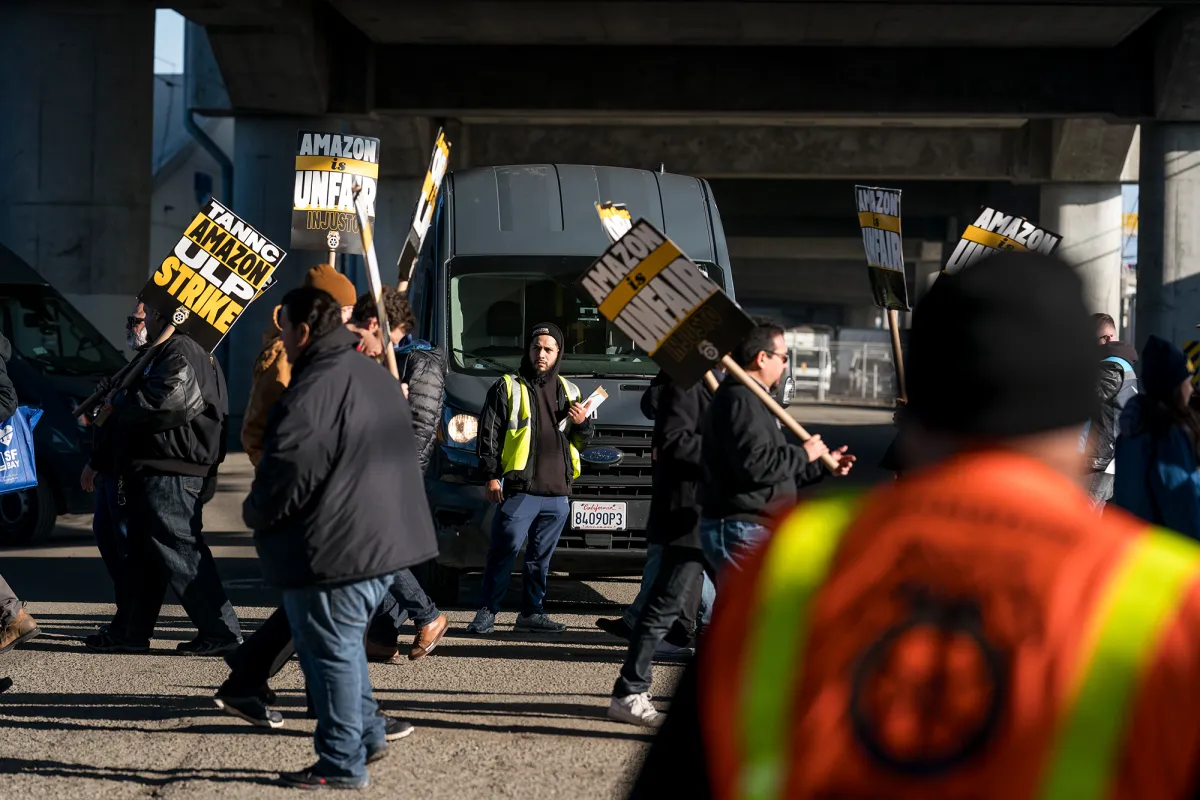
A union worker blocks an Amazon delivery truck from leaving the warehouse at Amazon Warehouse DCK6 in the Bayview District in San Francisco on Dec. 19, 2024. Amazon workers at multiple facilities across the United States went on strike to fight for a union contract. Photo by Jungho Kim for CalMatters
California businesses are suing to halt a new state law that bars them from requiring employees to attend anti-union meetings at work.
The state’s Chamber of Commerce and California Restaurant Association filed the suit in federal court on New Year’s Eve, a day before the new law was to go into effect, seeking to block it from being enforced.
The law prohibits employers from disciplining workers who refuse to attend workplace meetings to hear about their bosses’ “opinion about religious or political matters” — including whether or not employees should unionize. Businesses could be fined $500 a day for violations.
Labor groups said these so-called captive audience meetings intimidate workers out of exercising their right to unionize; business groups argued it interferes with employers’ right to free speech, including discussing how political or policy developments affect their workplaces.
The law, authored by Hayward Democratic Sen. Aisha Wahab, was one of organized labor’s few victories in the 2024 legislative session. California joined about 10 other mostly Democratic states in enacting similar laws amid a surge of labor organizing in recent years. Expecting the Trump administration to be less favorable to them, unions have been counting on the state law to help preserve the more organizing-friendly environment of the past four years.
For example: the National Labor Relations Board, which has for decades generally allowed employers to hold so-called captive audience meetings, in November issued a ruling calling them illegal. But Amazon, the employer in that case, is contesting the ruling and labor experts expect the board to reverse its position under Trump. In that case, the California ban on the meetings would still apply.
But the suit challenging the law is no surprise. Businesses have already sued over similar laws in other states. Wisconsin in 2009 was one of the first states to ban such meetings; when employers filed suit the following year, arguing it conflicted with federal law, the state backed down and agreed not to enforce it. In Oregon, however, a court dismissed a similar challenge brought by the last Trump administration.
The California business groups, in their lawsuit, said the law violates the First Amendment and conflicts with the federal National Labor Relations Act. It prevents employers, they said, from “sharing true facts” with workers including the cost of union dues, “unions’ interference with employer-employee relationships, unions’ prioritization of the collective over the individual employees, and the financial impacts on employers.”
“Employers have the right to express their views and opinions on many issues,” said Jot Condie, president and CEO of the state Restaurant Association, in a statement.
Wahab could not immediately be reached for comment.
###
CalMatters.org is a nonprofit, nonpartisan media venture explaining California policies and politics.


