

OBITUARY: David Neyra, 1970-2026
LoCO Staff / Monday, June 29 @ 9:42 a.m. / Obits

David Neyra passed away, leaving behind a legacy of selfless dedication and a spirit that touched all who knew him. Born on August 16, 1970, in New York City, David moved to Humboldt County, where he became an active and cherished member of the community.
A proud graduate of Arcata High School and Humboldt State University, David channeled his talent and work ethic into his career as the owner of Humboldt Outfitters. He was also a devoted coach to his children, guiding them through soccer, basketball, and flag football during their adolescent years. His commitment to the region extended beyond his business, notably through his service with the Arcata Sunrise Rotary and as President of Arcata Main Street.
Above all, David was a devoted family man and friend. He found his greatest joy in the simple moments of life – whether traveling, cheering for the Warriors, Giants, and 49ers, or sharing his love for music and movies. He will be remembered for his unwavering loyalty, a laugh that could be heard for miles, an infectious, youthful energy, and his profound wisdom. He lived his life prioritizing the well-being of those he held dear.
He is survived by his mother, Janett Price; his stepfather, Leslie Price; his beloved wife, Shawna Neyra; his treasured children, Sasha, Sophia, and Asher Neyra; his sister and brother-in-law Elyse and Jonathan Marshall; his brother and sister-in-law Virgil Moorehead Jr. and Chelsea Reed; parents-in-law, Patsy and Virgil Moorehead; numerous nieces and nephews; extended family members; and many dear friends, including his best friend, Clark Sugata. He was preceded in death by his grandfather, Daniel Neyra, and his cherished dogs, Abi and Nikko. He is also lovingly remembered by his faithful companions, Stella and Mando.
A Celebration of Life honoring David will be held on June 30, 2026, at 3 p.m. in his parents’ garden at 2621 Sunnygrove Avenue, McKinleyville, California. Family and friends are invited to gather to share memories, celebrate his life, and honor the lasting impact he had on all who knew him.
###
The obituary above was submitted on behalf of David Neyra’s family. The Lost Coast Outpost runs obituaries of Humboldt County residents at no charge. See guidelines here. Email news@lostcoastoutpost.com.
BOOKED
Yesterday: 4 felonies, 12 misdemeanors, 0 infractions
JUDGED
Humboldt County Superior Court Calendar: Today
CHP REPORTS
No current incidents
ELSEWHERE
RHBB: Del Norte Razor Clam Fishery Reopens After Domoic Acid Levels Drop
RHBB: Trinity County Fair Community Meeting Rescheduled for September 3
RHBB: 6th Annual Redwood Coast Region Economic Summit Set for October 1–2 in Arcata
Governor’s Office: Governor Newsom signs legislation 8.31.2026
Civil Grand Jury Report Examines How Humboldt County Schools Prepare for Earthquakes and Tsunamis
LoCO Staff / Monday, June 29 @ 8:14 a.m. / Local Government
Press release from the Humboldt County Civil Grand Jury:
Every parent wants assurance that their child will be safe at school. Parents play a critical role in emergency preparedness by understanding their school’s safety plan, knowing their responsibilities, and being prepared to take appropriate action when emergencies occur. Clear and consistent communication between schools and families is essential.
The Humboldt County Civil Grand Jury reviewed school safety plans throughout the county, focusing specifically on preparedness for natural disasters. Our review examined how schools respond to earthquakes and tsunamis. We found that all reviewed schools met California requirements for safety plans, but we also identified several schools and districts that exceed minimum standards through innovative and effective practices.
This report highlights some of the best practices and encourages their adoption by other schools. Because we did not interview every school district in Humboldt County, there are likely additional schools with exemplary safety programs that are not mentioned in this report.
Our primary recommendation is that the Humboldt County Office of Education (HCOE) continue what we started and identify notable safety practices and facilitate sharing this information among schools and districts.
The Civil Grand Jury Report Safety First: How Our Schools Prepare for Emergencies published 6/17/2026 on the Humboldt County website Civil Grand Jury | Humboldt County, CA - Official Website, highlights the positive efforts schools are making and makes recommendations to address shortcomings.
###
PREVIOUSLY in 2025-26 Grand Jury Reports:
- The Humboldt County Grand Jury Has Released its First Report of the 2025-2026 Session, and It’s a Love Letter to the Eel River Conservation Camp
- Humboldt County’s Tsunami Warning System Could Be Improved, Latest Humboldt County Civil Grand Jury Report Finds
- Humboldt’s Planning and Building Department Has Staffing Challenges and Communication Issues, Grand Jury Says
- Our Water and Sewer Bills Need to Increase Regularly If We Want Safe and Reliable Service, Grand Jury Report Concludes
Eureka Police Request Witnesses to Serious Motorcycle Collision on Saturday Evening
LoCO Staff / Monday, June 29 @ 7:48 a.m. / News
Press release from the Eureka Police Department:
On June 27, 2026, at approximately 4:29 p.m., officers with the Eureka Police Department (EPD) and personnel from Humboldt Bay Fire (HBF) responded to a report of a traffic collision near Henderson and C Streets.
Upon arrival, officers located a motorcyclist in the roadway with major injuries. The rider was transported by ambulance to a local hospital before being airlifted out of the area for additional medical treatment.
In accordance with standard protocol, detectives from EPD’s Criminal Investigations Unit, members of the Major/Fatal Injury Team, and Evidence Technicians responded to investigate the collision. During the investigation, surveillance footage of the incident was obtained.
The investigation remains ongoing. Based on the information available at this time, investigators have determined the following:
- The motorcyclist was traveling westbound on Henderson Street.
- The motorcyclist attempted to split lanes between another motorcycle and a passenger vehicle.
- The motorcyclist lost control of the motorcycle, which laid down and slid into a parked vehicle.
- Physical evidence indicates the collision scene extended approximately two blocks.
- Whether alcohol or drug impairment was a factor remains under investigation.
Anyone who witnessed the collision or has information that may assist investigators is asked to contact the Eureka Police Department’s Criminal Investigations Unit at (707) 441-4300.

MUSICAL MEMOIR: The Neville Brothers play College of the Redwoods, September 1977
Paul DeMark / Sunday, June 28 @ 7 a.m. / Music
The Neville Brothers anxiously looked up at a capacity crowd in College of the Redwoods’ big band music classroom.

Promotional poster for the Sept. 30, 1977 performance. | Photo submitted.
One of the premiere music families of New Orleans were in Eureka, California to play a concert at that city’s Old Town Bar and Grill on Sept. 30, 1977, along with the Wild Tchoupitoulas. At College of the Redwoods (CR), a community college just south of Eureka, they’d be speaking at a free music clinic the afternoon before the show.
My friend Harry Duncan, who lived in San Francisco, was co-managing the Nevilles with his New Orleans-based partner, Rupert Surcouf, Jr. They had co-managed The Meters, which included two Neville Brothers — keyboardist/singer Art and percussionist/singer Cyril.
When that highly influential New Orleans funk band broke up in the mid-‘70s, Art and Cyril joined forces with their brothers, vocalist Aaron and saxophonist Charles, to form the Neville Brothers in 1976. Aaron had a huge hit on the pop charts in 1966 with his ballad “Tell it Like It Is.”
The brothers were brought together to provide vocals and instrumentation, along with The Meters, for an album with their uncle George “Big Chief Jolly” Landry, the leader of the Mardi Gras Indian tribe, The Wild Tchoupitoulas.
Landry claimed Choctaw Indian Heritage. It was a natural fit to form his own ceremonial Mardi Gras Indian tribe. According to Wikipedia, the Mardi Gras Indian subculture emerged during the late 1880s. It was a form of cultural resistance when Blacks were not allowed to partake in Mardi Gras celebrations.
The Blacks formed Mardi Gras Indian tribes where they created elaborate, multi-colored costumes adorned with beads, feathers and sequins. They composed and sang their own songs, and created unique dances. In addition to Mardi Gras, the tribes perform annually at a variety of New Orleans events.
The self-titled album, “The Wild Tchoupitoulas,” contained joyous, second-line, Afro-Cuban percussive grooves with feisty vocals. The lyrics focused on traditional Mardi Gras customs and dances. The record garnered critical acclaim and excited fans of New Orleans R&B.
At the time, I was playing in a Humboldt County band, the Rockhouse Street Rhythm Band, which played quite a few New Orleans dance music tunes including Wild Tchoupitoulas songs like “Brother John” and “Hey Pocky A-Way.” We were the first local band playing these songs. People loved the rhythms. (For Humboldt County readers, Rockhouse included Don “White King D” Hunter, Dick Koenig, Charles Horn, Dan Vineyard, Leonard Crawford and later Chuck Garrett.)
Bringing the Wild Tchoupitoulas to Eureka
Harry called in the summer of 1977. He said he had booked the Neville Brothers and The Wild Tchoupitoulas at the Monterey Jazz Festival in September. “I’d like to book some Northern California nightclub dates, including the Old Town Bar and Grill,” he said. “I’d like you to promote it. I’ll have posters designed and mailed to you.”
I was excited to help bring a band I loved to Humboldt for the first time. I was anxious since I’d never promoted a show on my own. I’d put up hundreds of posters for my bands around town in store windows and stapled flyers to telephone poles. That was the main way bands promoted shows in the pre-social media world.
It was an all-analog world.
I needed to learn how to write a proper press release and send it to newspapers, radio and TV stations. I sought out local journalist Sid Dominitz, who taught me the press release basics. I was off and running promoting the show.
A few weeks before the concert, Harry called. He told me to try to book the Nevilles for a mid-day music clinic at CR and ask for $200 for the band. He said to call his partner Rupert Surcouf to work out the details.
“Rupert, before I try to sell this to my music professor at CR, tell me how this music clinic would work,” I asked Surcouf during a phone conversation.
“Brah, Charles Neville (the brothers’ saxophonist) has led many clinics like this,” Surcouf said. “He can talk about how the Nevilles use traditional New Orleans jazz, rhythm and blues and second-line rhythms to create their music. They’ll know what to do.”
For the past year I had been taking jazz improvisation classes from CR Music Professor Jack Wheaton. I approached him about a possible Neville Brothers clinic. A teacher primarily of music theory, swing and bebop jazz, Wheaton had never heard of the group.
I told him what Surcouf said about Charles and the band discussing the history of jazz, R&B and Afro-Cuban rhythms in their appearance. They were experienced in these kinds of presentations, I said.
Wheaton said yes and we set the clinic for one o’clock in the afternoon, a few hours ahead of their Old Town Bar and Grill shows. I promoted the concert and clinic heavily with a few hundred posters, press releases and photos in newspapers and announcements on radio and TV stations. Interest in both events was running high.
About a week before the show, Surcouf called me at home. He was on the road with the band.
“Hey brah, what should the brothers talk about at their clinic? They’re getting nervous about it,” Rupert said.
That made me nervous, too. “Rupert, you told me that Charles knew what to do – talk about the brothers’ musical link to early New Orleans jazz, R&B and Afro-Cuban rhythms. Tell them to talk about that.”
“All right brah, it’ll be cool,” Rupert said. I was not reassured.
When the day of the show arrived, I was riding high. Ticket sales — $3.50 — for the two shows at the Bar and Grill were strong. Around the CR campus and in the community, people were excited about the free clinic.
I met Professor Wheaton in CR’s music rehearsal room about 30 minutes before the clinic was to begin. The room had a wide bottom floor where the professors taught. They shared the space with a baby grand piano and a drum set. The room went up four wide steps where chairs were set up at each level for different musical sections to play or for an audience.
With 15 minutes before the clinic was to start, a standing-room-only crowd waited for the Nevilles to walk through the door. Wheaton walked up to me wearing a stern face.
“Where are they Paul?” he asked impatiently. “I don’t know, Jack,” I answered. Without cell phones, it was impossible to know. “I’ll go outside and look for them.”
I paced in front of the music building looking up and down the road. A few minutes before one, their white van pulled up. Rupert, who was white, stepped out of the van by himself walking toward me.
“Rupert, it’s late, we need to get them in there now,” I said.
“We have a problem,” Rupert said. “They see all these white people and it’s making them nervous. And they’re really high. They’ve been smoking some of your Humboldt bud.”
“They will be welcomed as heroes,” I said. “These people love their music. Let’s go!”
They slowly walked out of the van one by one, with their heads down looking at the ground. When they entered the room, the crowd broke out in applause. The brothers and their uncle, “Big Chief Jolly,” gathered on the bottom floor.
Professor Wheaton introduced them as a great New Orleans jazz and rhythm and blues band. He handed the mic to Art, the eldest Neville. He looked up and surveyed the audience, taking his time.
“Well, what we’re trying to do … is figure out … what we’re trying to do,” he said. Wheaton shot me a look of pure disgust. Charles Neville, the supposed veteran of music clinics, never said a word.
I spoke up immediately trying to save the day. “Art, I have an idea. Let’s set up the instruments and have you guys play some music. Then we can ask you questions afterward.”
He liked that idea. With the piano and drums already there, we moved guitar amps into place and set up a few vocal mics. The guitarists gathered the instruments from the van. They played a few New Orleans funky grooves and then paused to take a few questions.
“How do you incorporate jazz into your style,” someone asked.
Art, now fully engaged, said, “We’ll play a second-line groove, ‘Hey Pocky a-Way,’ add in Dizzy Gillespie’s ‘Night in Tunisia’ and Hank Williams’ ‘Jambalaya on the Bayou.’”
Sure enough. They kicked off the second-line medley with “Jambalaya on the Bayou,” segued into “Night in Tunisia” and finished with their own “Hey Pocky a-Way.”
When they stopped, they received huge applause. Someone asked Art — still not a word from the quiet Charles — if Aaron would sing his hit “Tell it Like It Is.”
When Aaron finished his soulful rendition, he received a standing ovation. Art introduced his uncle saying that Landry played a vintage New Orleans-style piano style similar to the great Professor Longhair. Landry, playing solo, knocked the crowd out with his rollicking, percussive style.
Someone asked if they could see the Wild Tchoupitoulas’ handmade Mardi Gras Indian outfits that they would be wearing at that night’s concerts. Rupert retrieved a couple of them from the van.
Wheaton closed the top of the piano and Rupert laid out the kaleidoscopic-colored outfits. He encouraged the audience to come down and take a close look at them, but not to touch the stunning handiwork. Many oohs and aahs followed.
After their hour-long clinic ended, they received a standing ovation. They headed out to their old white van to get ready for their shows on Second Street in Eureka.
Professor Jack Wheaton looked at me, shook his head and smiled.
As the brothers were walking away, I asked Art what “Hey Pocky A-Way” meant.
“If you don’t want to play then get the hell out of the way,” he said.
The Neville Brothers, New Orleans show business veterans, had delivered one of the most unusual and fun music clinics ever presented in Humboldt County to that point.
Those who were there never forgot it.
(VIDEO) Demonstrators Call for Arrest of Shannon Miranda, Justice for Dogs Amid Criminal Investigation
Ryan Burns / Saturday, June 27 @ 4:12 p.m. / Animals , Crime
Demonstrators gather outside the Humboldt County Courthouse on Saturday afternoon.
###
More than four dozen demonstrators gathered outside the Humboldt County Courthouse on Saturday afternoon — shortly after the “All of U.S. 250” gathering at the same spot — to demand justice for animals and while calling for the arrest of Shannon Miranda, the man at the center of an animal cruelty and fraud investigation that’s making national and international headlines.
Passing motorists offered a stead stream of horn honks in support of the demonstration, which was held less than 24 hours after the Humboldt County Sheriff’s Office announced that investigators had unearthed 117 intact dog carcasses, another 21 skulls and hundreds of bones at Miranda’s Rescue, a facility that bills itself as a “no-kill” animal sanctuary.
Sheriff’s investigators also found more than 600 dog collars inside a barn where they believe the dogs were likely killed.

A collection of dog collars hang from a pole as demonstrators display signs.

###
PREVIOUSLY
- Search Warrant Served at Miranda’s Rescue Amid Allegations of Felony Animal Abuse, Fraud and Conspiracy
- Fortuna, Ferndale and Rio Dell Pause Animal Services Contracts With Miranda’s Rescue as Sheriff’s Office Investigation Continues
- Miranda’s Rescue Search Warrant Reveals Eight Dead Dogs Have Been Recovered; Sheriff’s Investigator Believes Miranda Killed Them for Financial Gain
- ‘This Case Remains a Priority’: Sheriff’s Office Issues Update on Miranda’s Rescue Investigation, Asks Public to Come Forth With Information
- BREAKING: At Miranda’s Rescue, Multiple Agencies, Including the FBI, Execute Search Warrant Authorizing Excavation
- (VIDEO) More Than 700 Dogs From Miranda’s Rescue Remain Unaccounted For, Sheriff Honsal Says; Excavation of Grounds to Continue for Several Days
- ‘It’s Gruesome’: Investigators Dig Up More Than A Dozen Dog Carcasses at Miranda’s Rescue on Day Two of Excavations
- ‘This Investigation is Just Getting Started’: Sheriff’s Office Uncovers 117 Dog Carcasses, 21 Skulls and ‘Hundreds of Bones’ at Miranda’s Rescue
(PHOTOS) ‘All of U.S. 250’ Rally Draws About 200 Protesters to Eureka Courthouse
Isabella Vanderheiden / Saturday, June 27 @ 2:17 p.m. / Activism

A small group of demonstrators posted across the street from the Humboldt County Courthouse in Eureka. | Photos by Isabella Vanderheiden
###
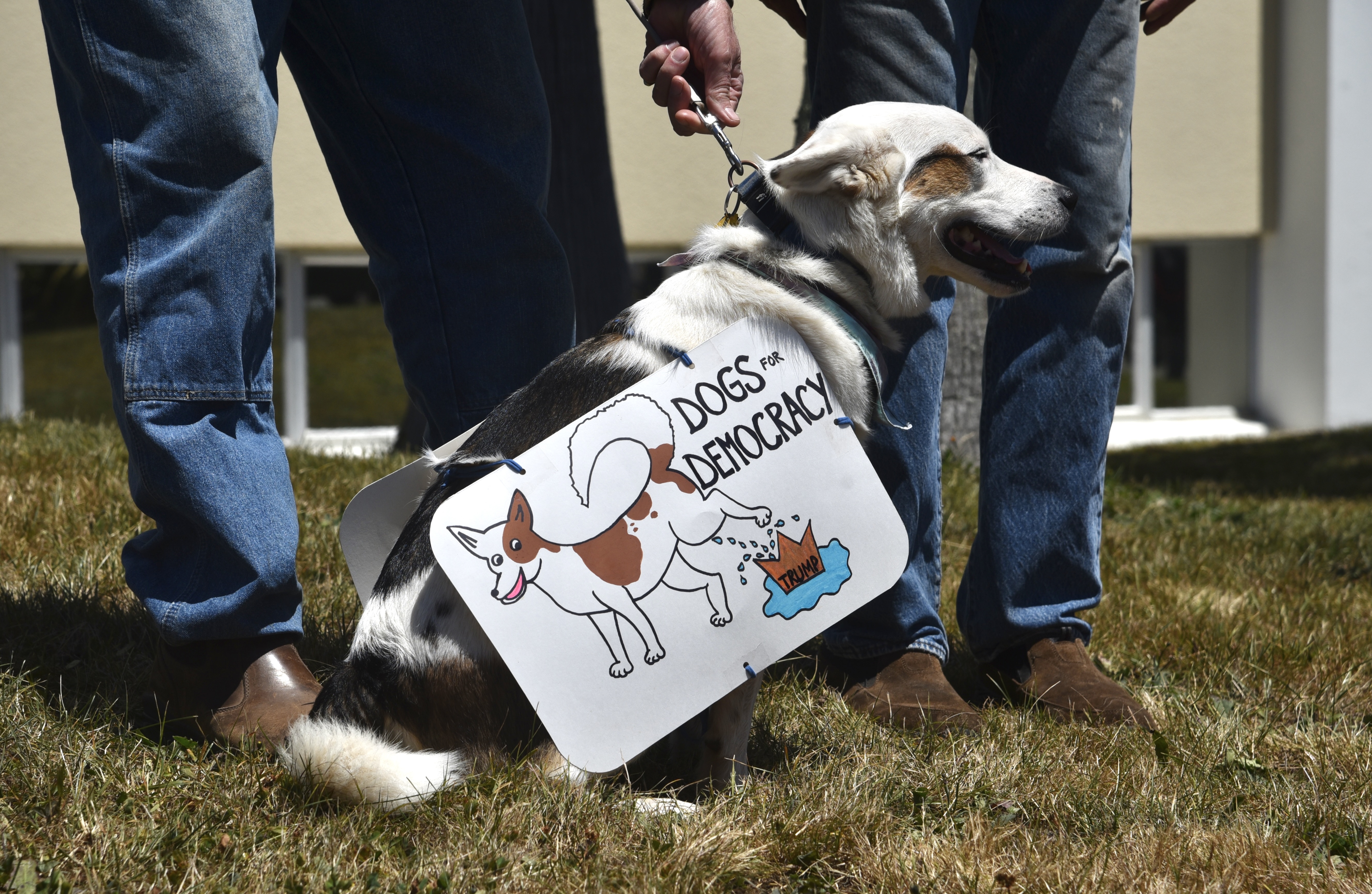
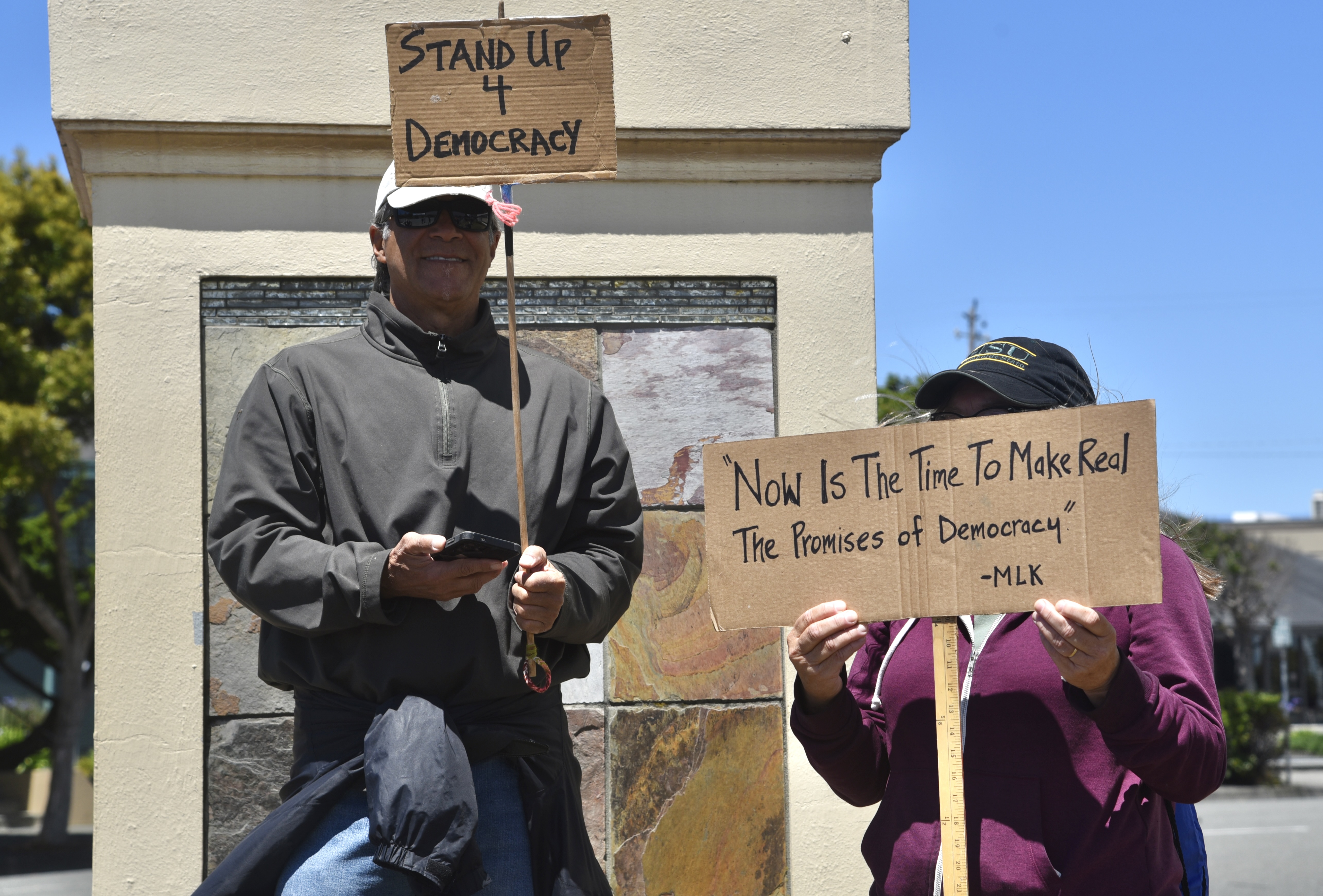
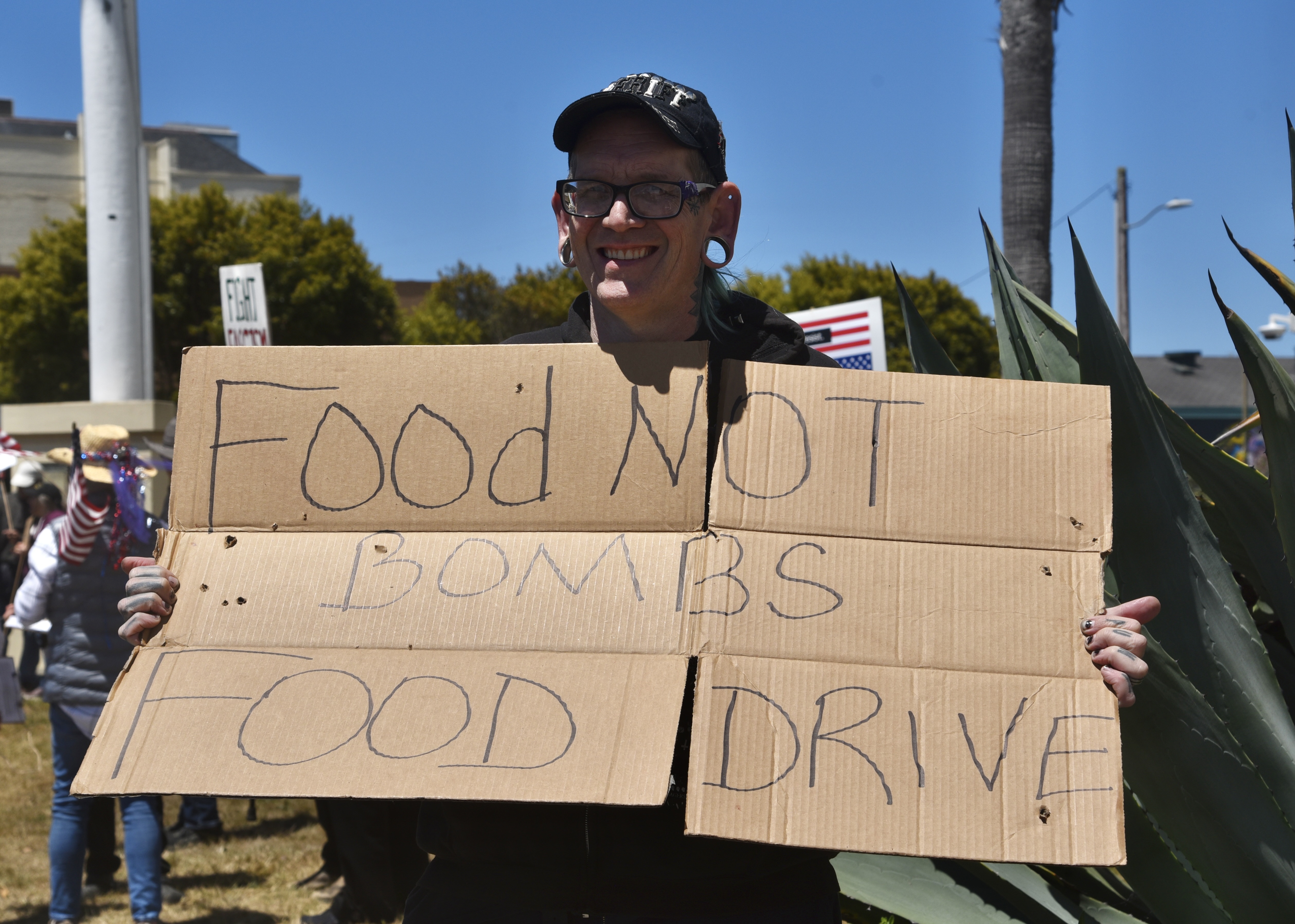
A couple hundred protesters gathered at the Humboldt County Courthouse in Eureka earlier this afternoon for All of U.S. 250, a nationwide rally for “truth, equality and freedom” ahead of next week’s Fourth of July celebrations. The protest was organized by the local chapter of 50501 — 50 states, 50 protests, one movement — the same group that’s hosted recent “No Kings” rallies.
“This is basically our Fourth of July event,” AJ, the lead organizer for 50501 Humboldt, told the Outpost. “All of U.S. 250 is both a protest and a celebration — a celebration of the values that this country was built on, that we believe in, mainly being democracy, freedom and the Constitution. Of course, we’re talking about the modern connotation of those words, not the connotations of 250 years ago. It’s also a protest [against] the loss of those values and the continuation of the fight back for them.”
Today’s demonstration was much smaller than the local “No Kings” rallies held since President Donald Trump took office in January 2025, which drew thousands. AJ estimated that today’s event drew about 175 people.
“I’m actually very happy with the turnout,” she said. “We have a very loyal core group here, a lot of familiar faces.”
This is probably the last major protest of the summer, AJ added, unless one is called by the national 50501 group. In September, 50501 Humboldt will host a month of action with several volunteer opportunities. Check out their Instagram for more information.
In the meantime, keep scrolling for more photos from today’s event.
###




(VIDEO) HUMBOLDT OUTDOORS: The History of Humboldt Bay’s Jetties and How the Dolos Arrived on Our Shores
Isabella Vanderheiden / Saturday, June 27 @ 10 a.m. / Humboldt Outdoors
###
If you’ve spent any significant amount of time here on the North Coast, you’ve surely ventured out to Humboldt Bay’s jetties at least once or twice. While traversing the finger-like breakwater, you may have asked yourself, “Why are there gigantic concrete jacks scattered all over the place?”
Those 42-ton wave-dissipating structures are called “dolos” (singular) or “dolosse” (plural), and they are a feat of human engineering.
In today’s episode of Humboldt Outdoors, local documentarian Ray Olson delves into the history of the dolosse and learns how they got their unique shape. He’s joined by local historians Barry Evans and Jerry Rohde, who describe decades of failed efforts to protect the jetties from the unrelenting Pacific Ocean, and how the invention of dolosse changed the game.
Click “play” on the video up top to learn how Humboldt became the first place in the United States to deploy dolosse and how one ended up on Eureka’s waterfront.
###
PREVIOUS HUMBOLDT OUTDOORS:
- (VIDEO) HUMBOLDT OUTDOORS: The Covered Bridges of Humboldt County
- (VIDEO) HUMBOLDT OUTDOORS: A Look at the Historic Ghost Town of Falk
- (VIDEO) HUMBOLDT OUTDOORS: The Ruins of Humboldt County’s First Lighthouse
- (VIDEO) HUMBOLDT OUTDOORS: Mysterious Wood Carvings in the Arcata Community Forest
- (VIDEO) HUMBOLDT OUTDOORS: Ray Olson Cracks the Case on the Mysterious Arcata Community Forest Wood Carvings
- HUMBOLDT OUTDOORS: Venturing Inside the Loleta Tunnel
- (VIDEO) HUMBOLDT OUTDOORS: Retracing Jack London’s 1911 Journey Through Humboldt County
- (VIDEO) HUMBOLDT OUTDOORS: Ray Olson Takes Us on a Camping Trip to Prairie Creek Redwoods State Park
- (VIDEO) HUMBOLDT OUTDOORS: Ray Olson Takes a Peek at the Timber Heritage Association’s Future Railroad Museum in Samoa
- (VIDEO) HUMBOLDT OUTDOORS: Ray Olson Goes Back in Time to Teach Us About the History of Earth Day
- (VIDEO) HUMBOLDT OUTDOORS: Ray Olson Traverses Jolly Giant Creek From Its Headwaters in the Arcata Community Forest to Humboldt Bay
- (VIDEO) HUMBOLDT OUTDOORS: Ray Olson Meets the Group of Local Veterans Working to Restore the WWII-Era Ship Beached in Samoa
- (VIDEO) HUMBOLDT OUTDOORS: Ray Olson is Joined by Local Authors Barry Evans and Jerry Rohde for a Tour of the Historic Table Bluff Cemetery
- (VIDEO) HUMBOLDT OUTDOORS: Ray Olson Takes Us Through the Lower Deck of Historic 1091
- (VIDEO) HUMBOLDT OUTDOORS: Ray Olson Introduces Us to Humboldt’s Cutest Herd of Lawn Mowers
- (VIDEO) HUMBOLDT OUTDOORS: Ray Olson Takes Us on the Second Leg of His Journey Along Jolly Giant Creek
- (VIDEO) HUMBOLDT OUTDOORS: Ray Olson Takes Us to the Ruins of the USS Milwaukee Shipwreck
- (VIDEO) HUMBOLDT OUTDOORS: Check Out the Trillium Blooms Before They Disappear for the Season!
- (VIDEO) HUMBOLDT OUTDOORS: Ray Olson and Friends Explore the Historic Bridges of Bridgeville and Beyond
- (VIDEO) HUMBOLDT OUTDOORS: The Navy Submarine That Ran Aground on Samoa Beach
- (VIDEO) HUMBOLDT OUTDOORS: Exploring Trinidad’s 150-Year-Old Lighthouse
- (VIDEO) HUMBOLDT OUTDOORS: Uncovering the Legacy of the Mysterious Cabin in the Arcata Community Forest
- (VIDEO) HUMBOLDT OUTDOORS: Local Anti-Vietnam War Activists Recall the Largest Student Protest in Campus History
- (VIDEO) HUMBOLDT OUTDOORS: Ray Olson Uncovers the Ancient History of the ‘Weird, Rare’ Forests of the Ma-le’l Dunes
- (VIDEO) HUMBOLDT OUTDOORS: One Team’s Grueling (Yet Glorious) Quest for the Kinetic Grand Championship


