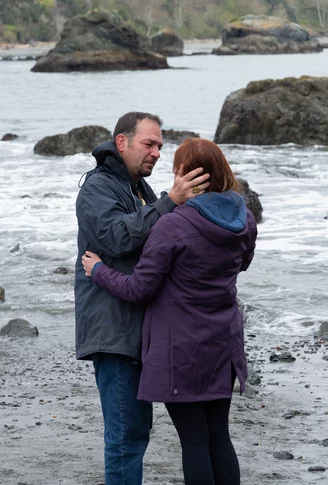
Born: April 29, 1959 in Huntington Park, Calif.
Passed: April 29, 2024 in Eureka
Ron was a quiet man who enjoyed being a homebody. He did woodworking most of his life as a cabinet
maker. As a hobby, he purchased older vehicles and restored them to re-sell. He was also an avid
fisherman, loved gold panning, hiking trails, back-roading in his Jeep, playing his harmonica and
spending time with his wife and their pets. Ron was known for his quick wit and distinctive humor.
After high school, Ron served in the Navy. He resided in Paradise, Calif., where he met his wife, Leanne, in 1997, and lived there until they were burned out in 2018 by the Camp Fire. They settled in Humboldt County, where Leanne had grown up, and due to Ron’s health conditions, he opted to retire, and they became 5th wheel dwellers and resided on the river bar in Rio Dell.
Those that knew him on social media enjoyed his unique satire! Despite his lone wolf demeanor, he
made a huge impact on the people he interacted with and loved. He passed away on his 65th
birthday.
Ron is predeceased by his brother, Micheal Sherman; his sister, Lequitta Langston; and his stepdad,
Robert Wilson. He is survived by his loving wife, Leanne Langston; his daughter, Ariel Janko; 0his
mother, Lila Wilson; and his dog, Coopie.
Ron’s arrangements were made at Goble’s Mortuary. In lieu of a funeral, a celebration of life will
be planned later in the summer.
###
The obituary above was submitted on behalf of Ron Langston’s loved ones. The Lost Coast Outpost runs obituaries of Humboldt County residents at no charge. See guidelines here.
The Eureka Police Department is still investigating the horrific, multivehicle crash that killed one pedestrian on I Street last week. They’re looking for more witnesses. If you saw that crash and haven’t spoken with them yet, please give them a call.
Today they released the identity of the person who was killed in the crash.
Press release from the Eureka Police Department:
Humboldt County Coroner’s office has identified the decedent as David Sprague from Eureka.
The investigation is ongoing and EPD is asking if anyone witnessed the collision to please
contact the Criminal Investigations Unit (CIU) at 707-441-4300.
Press release from the U.S. Fish and Wildlife Service:
The U.S. Fish and Wildlife
Service is designating 1.2
million acres of critical
habitat in northwestern California and southwestern Oregon for the
coastal distinct population segment of the Pacific marten, also known
as the coastal or Humboldt marten.
In
this final rule, the Service identified critical habitat, or areas
that are essential for the coastal marten to thrive based on
information received during two public comment periods held in 2022.
Final critical habitat land
ownership includes approximately 1.1 million acres
of federal, 23,724 acres of state and 13,008 acres of private or
unassigned lands.
This
final rule also identifies approximately 140,705 acres of critical
habitat the Service determined as appropriate for exclusion under
section 4(b)(2) of the Endangered Species Act. These areas include
those being managed under several
collaborative agreements with the Service
that will provide ongoing conservation efforts for marten.
Two
of these efforts include the Yurok Tribe and Green Diamond Resource
Company, both of whom have a Memorandum of Understanding with the
Service for managing land to benefit the conservation of the species.
In addition, Green Diamond has a safe harbor agreement with the state
of California.
Critical
habitat designation requires federal agencies to ensure that actions
they plan to undertake, fund, or authorize do not destroy or
adversely modify that habitat. It does not establish a wildlife
refuge, allow the government or public to access private lands or
require non-federal landowners to restore habitat or recover species.
The
coastal marten is a cat-sized mammal in the weasel family that
currently exists in four small, isolated populations in forested
habitats of northern coastal California and coastal Oregon. The
species has lost over 90% of its historical range and was listed as
threatened under the ESA in November 2020. Loss of habitat, effects
from historic trapping, catastrophic wildfire, and impacts from
vegetation management were determined to be key threats to the
marten’s survival.
The final rule will publish in
the Federal Register on Wednesday May 29, 2024, and may be viewed at
this link
by searching Docket Number FWS-R8-ES-2020-0151.
This rule will become effective on Friday, June 28, 2024.
The ESA is extraordinarily
effective at preventing species from going extinct and has inspired
action to conserve at-risk species and their habitat before they need
to be listed as threatened or endangered. Since it was signed into
law in 1973, more than 99% of all species listed under the law are
still with us today.
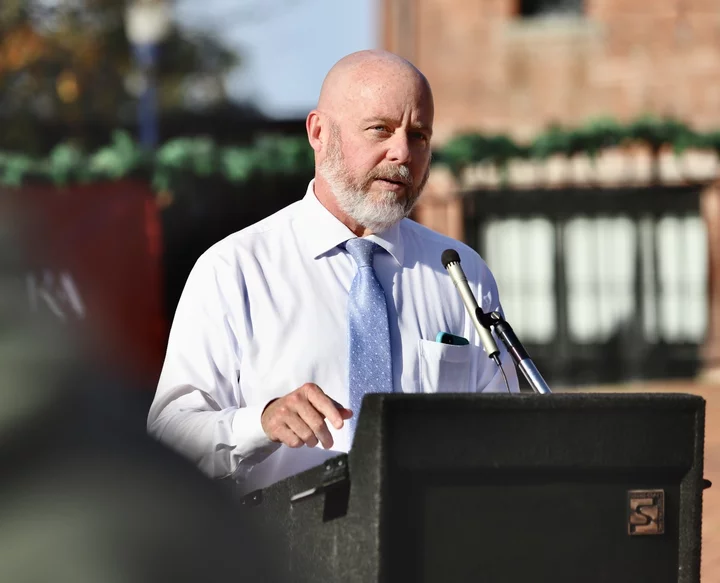
Kreis at his re-election campaign launch in December. | File photo.
###
As of today, Gregory Kreis is not only a former presiding judge of the Humboldt County Superior Court but a former judge, period, in the state of California.
Less than four months after the California Commission on Judicial Performance launched an investigation into 19 counts of alleged misconduct, including inappropriate sexual behavior, drug and alcohol use and making false or misleading declarations in court, Kreis has resigned from the bench and agreed to never again seek or hold judicial office in the state.
Per the terms of a signed agreement reached last month, Kreis has been publicly censured over 17 acts of admitted misconduct. Also per the terms of the deal, which the commission accepted on May 15, the misconduct investigation is now over.
Many of the charges in the investigation stemmed from an alcohol-fueled Memorial Day celebration in 2019. Former Public Defender Rory Kalin filed a lawsuit accusing Kreis of verbally and physically attacking him, repeatedly calling him “Jew-boy” and throwing him off of the houseboat on which the party took place.
That lawsuit was dismissed in December, and the agreement reached last month does not include an admission of antisemitism. But Kreis acknowledges misconduct in his failure to disclose his personal relationship with both Kalin and former Assistant Public Defender Luke Brownfield, a “close personal friend,” in cases over which he presided.
Kreis also admits to various other ethical violations across a series of cases. Those violations include:
nepotism and favoritism
prejudicial misconduct
abuse of authority
making false or misleading statements about himself
making sarcastic or gratuitous comments
failure to disclose his personal relationships with attorneys and his familiarity with individuals involved in matters before him
failure to be patient, dignified and courteous to people he dealt with in an official capacity
failure to remain faithful to the law regardless of partisan interests, public clamor, or fear of criticism, and
failure to cooperate with judicial disciplinary agencies.
“Judge Kreis’s misconduct seriously undermines public confidence in the integrity of the judiciary,” Commission Chair Michael A. Moodian writes in the agreement.
Kreis also admits to an allegation that in 2018, after an evening of drinking and socializing with friends, he slapped a woman’s buttocks despite the fact that she had firmly told him not to.
The document released by the commission today says its members take that matter particularly seriously. “Sexual misconduct severely undermines public esteem for the integrity of the judiciary,” Moodian writes. “Treating women disrespectfully, including unwanted touching, reflects a sense of entitlement completely at odds with the canons of judicial ethics and the role of any judge.”
The commission says that Kreis’s resignation and agreement not to seek or hold judicial office “effectively reaches the same resolution as removal” while maintaining public confidence in the integrity of the judicial system.
Kreis was appointed to the bench in 2017 by former Governor Edmund G. Brown, Jr. The investigation into his misdeeds made national headlines, and in March he lost his re-election bid to challenger April Van Dyke.
Humboldt County Superior Court today announced that Judge Kelly L. Neel is now the new presiding judge, with Judge Timothy A. Canning serving as assistant presiding judge.
Kreis’s vacancy will be filled by
visiting judicial officers until the end of the year, after which Van Dyke
will assume her spot on the bench.
Press release from the Humboldt County Drug Task Force:
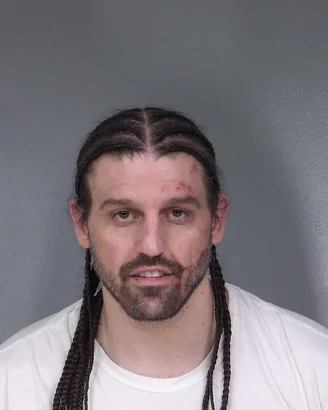
Reed.
On
May 27, 2024, Humboldt County Drug Task Force (HCDTF) Agents, with
the assistance of the California Highway Patrol and the Humboldt
County Sheriff’s Office (HCSO) SWAT Team, served a search warrant
at a hotel located in the 100 block of 4th
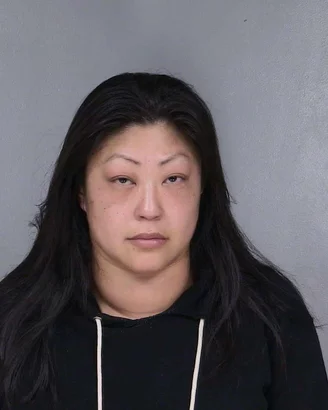
Street in Eureka, and arrest warrants on Michael Caleb Reed (Age 39)
and Pa Cheng (Age 32). After a multi-month
investigation, the HCDTF gathered evidence that Reed and Cheng were
traveling to southern California to purchase large quantities of
narcotics. Reed and Cheng would transport the narcotics back to
Humboldt County for the purpose of sales. Reed is a convicted felon
and is currently on parole for felony evasion. Reed has a lengthy
history of leading law enforcement on highspeed chases throughout the
state of California, one of which resulted in a collision where a
Eureka Police Officer was severely injured in 2020.
Cheng.
During
the investigation, HCDTF Agents authored search warrants for Reed and
Cheng’s social media accounts. Upon reviewing the data on Reed’s
account, Agents discovered a video of Reed and Cheng having sexual
intercourse with a minor under the age of 16. Agents also discovered
that Reed had distributed the video of him and Cheng having sexual
intercourse with the minor, as well as other sexually explicit
images/videos of the same minor, to other individuals.
Upon
reviewing the messages and data on both Reed and Cheng’s social
media, Agents located evidence indicative of Reed and Cheng engaging
in human trafficking and prostitution. It is believed that the
victims observed on the social media accounts were also potential
juveniles.
At
1730 hours, HCSO SWAT Operators and HCSO K9 Rex set up in a parking
lot of a business located in the 100 block of 6th
Street and awaited Reed and Cheng’s arrival on the Amtrak Bus. Once
the bus arrived both Reed and Cheng were apprehended. Reed was in
possession of several duffle bags. Inside the bags Agents located two
ounces of cocaine, one ounce of heroin, one pound of fentanyl, two
pounds of methamphetamine, and a loaded handgun.
After
Reed and Cheng were detained, Agents responded to their hotel room
where they located a stolen handgun hidden in the wall, and more
evidence indicative of human trafficking and prostitution.
Reed was transported to the Humboldt County Jail where he was booked for the following charges:
PC 288.2(A)(2) Showing/sending harmful material to seduce a minor.
PC 261.5(d) Statutory rape of a minor
PC 287(B)(2) Oral copulation with a minor under the age of 16
PC 182(A)(1) Conspiracy
PC 311.11(a) Possession of child pornography
PC 30305(a) Felon in possession of ammunition
PC 25850(a) Illegal possession of a firearm
PC 29800(a) Felon in possession of a firearm
HS 11370.1(a) Possession of a firearm with a controlled substance
HS 11352(a) Transportation of Narcotics
HS 11352(B) Transportation of narcotics, noncontiguous counties
HS 11351 Possession for sales, narcotics
HS 11379 (a) Transportation of controlled substance
HS 11379(b) Transportation of controlled substance, noncontiguous counties
HS 11378 Possession for sales, controlled substance.
The HCDTF will also be investigating additional charges for the stolen firearm located in Reed’s room, human trafficking, pimping, pandering, and distribution of child pornography.
Cheng was transported to the Humboldt County Jail where she was booked for the following charges:
PC 287(B)(2) Oral copulation with a minor under the age of 16
HS 11352(a) Transportation of narcotics
HS 11352(B) Transportation of narcotics, noncontiguous counties
HS 11351 Possession for sales, narcotics
HS 11379 (a) Transportation of controlled substance
HS 11378 Possession for sales, controlled substance.
This is an ongoing investigation. Anyone who has information about this case in regard to the victims of human trafficking please call the Humboldt County Drug Task Force at 707-267-9976.
Eureka City Schools (ECS) is pleased to announce that construction
has commenced on the Albee Stadium and Bud Cloney Field renovation project.
The ECS Board of Education discussed and approved the base low bid for the project at $24.5
million from Adams Commercial General Contracting, Inc. (ACGC) during the May 2, 2024 Board
meeting. The funding for the project, a testament to our community’s support, is made possible
through Measure S and Measure T, along with additional funding from the state of California at
$14.7 million. The construction, which officially began on May 20, 2024, is estimated to
continue through late summer 2026.
The scope of work includes rehabilitating the failing storm drain system and improving the
facilities to support physical education and athletic programs. Improvements at Albee Stadium
include but are not limited to, the replacement of the existing track and field facilities,
installation of all-weather surfaces for the football and softball fields, a new fieldhouse, and
construction of new public restrooms and concession stand. Various auxiliary, utility, and
stormwater management improvements are also planned.
The project at Bud Cloney Field involves renovating the baseball field facilities, including
installation of all-weather surfaces, removal of the portable agriculture classrooms and sheds,
and building a new parking lot.
In 2014, the passage of bond Measure S facilitated repairs to aging, deteriorating schools
throughout the District. Subsequently, Measure T was passed in March 2020 due to imminent
health and safety risks to ECS students and staff caused by the failure of the storm drainage
infrastructure at Albee Stadium and Bud Cloney Field.
ECS graduation and promotion ceremonies will occur at Albee Stadium in June of 2024. The
facility will then be closed until the project is complete.
Press release from the makers of “Where the Heart Lies”:
This Wednesday, May 29th, the Humboldt community
is invited to a special screening at the Minor Theatre to
honor the life and legacy of Hunter Lewis through the
short film Where the Heart Lies directed by Brianna
Chapman. Get your tickets at www.minortheatre.com
before they sell out. All proceeds go towards
submitting the film to festivals.
Hunter, a 21-year-old from Humboldt County, was
known for his boundless energy and adventurous spirit.
He meticulously planned an elaborate treasure hunt for
his friends and family, reflecting his love for
challenges and the outdoors. Tragically, Hunter went
missing during a solo canoe trip to hide the final
treasure, just off Trinidad State Beach, a place he
cherished since childhood.
Brianna dedicated her Chapman University senior thesis
project to sharing Hunter’s legacy. The two years of
preparation for this ambitious travel shoot led up to just
one week of filming in Humboldt, which Brianna
described as “magical.” “The connection, love, and
community forged during production exceeded
everything I dreamed of. The cast, crew, and greater
community united with Hunter’s spirit and created
something beautiful.” Her co-executive producer and
director of photography, David Murillo Galiano,
expressed that “as a filmmaker, you hope to one day be a
part of a project like this, where you can put your heart
and soul into something you know people care deeply
about, and I hope audiences feel the love and care we all
put into this film.”
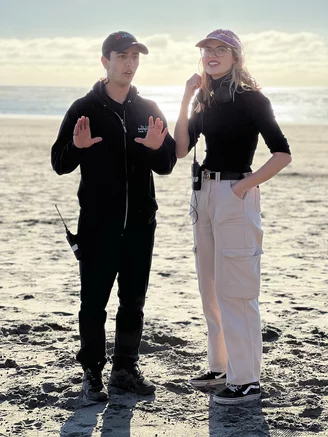
Co-executive producers David Murillo Galiano & Brianna Chapman on set at Moonstone Beach
The film was shot over six days in March 2024, with a
crew of Humboldt locals as well as several key
members from Southern California. The outdoor
filming locations included Trinidad State Beach,
Moonstone, and the Arcata Community Forest, which
immersed the crew in Humboldt’s beautiful landscape
and imparted a sense of adventure akin to Hunter’s real
life treasure hunt. From hanging a camera 25 feet in the
air for a rock climbing scene, to lighting a redwood
forest at night, the crew was pushed out of their comfort
zone to film in conditions unlike traditional Hollywood
soundstages.
Sean Lindsey, the 1st AC and a close
friend of Hunter’s, reflected that “it was a challenge for
everyone to shoot this film on unforgiving outdoor
terrain. We had so much necessary gear to haul over
long distances to our shooting locations. We worked
tirelessly, but passionately, ‘cause we were all doing
this to honor Hunter. It was a labor of love. No
challenge could overcome the drive within ourselves to make this film.”
Two of the shooting days were spent at Hunter’s childhood home, graciously offered by
Hunter’s father Corey, who supported the project from its inception. “As Hunter’s father
I could feel the love all the cast and crew have for my son and his story with all the pieces
of my broken heart. It was a powerfully healing process.”
The cast and crew were bonded by this
powerful love. Finn Mackimmie, the
actor portraying Hunter, never got to
meet him in person, but says he “got to
know him through the memories and
words of his closest people.” He said:
“The amount of love felt for Hunter by
the cast and crew was so palpable and his
spirit was undeniably felt by everybody.
He touched and transformed each and
everyone of us and I hope this film does
the same for anyone who watches it.”
Corey Lewis, Hunter’s father, on set with Alexandra Boulas, the actress portraying Hunter’s girlfriend Kinsley Rolph
The screening this Wednesday will be an emotional
homecoming, bringing together friends, family, and
community members to honor Hunter’s memory. Join
us to celebrate the life and legacy of Hunter Lewis, a
true adventurer whose spirit will forever be a part of
Humboldt County.
Hunter’s father Corey said: “Many of us in Humboldt County have lost loved ones to the ocean and rivers that
we love. This film and cast and crew shares our grief
and our inspiration to live large like Hunter in the most
beautiful way. I hope it will connect you to your lost
loved ones.”
Note: The film will screen at 5:30 p.m., 6:30 p.m. and 7:30 p.m. Wednesday. Check The Minor’s website for showtimes and to buy tickets.