
New Ramen Bar to Open Across the Street From Japhy’s, Which is Closed Forever as of Yesterday
Jacquelyn Opalach / Friday, May 24, 2024 @ 4:48 p.m. / Food
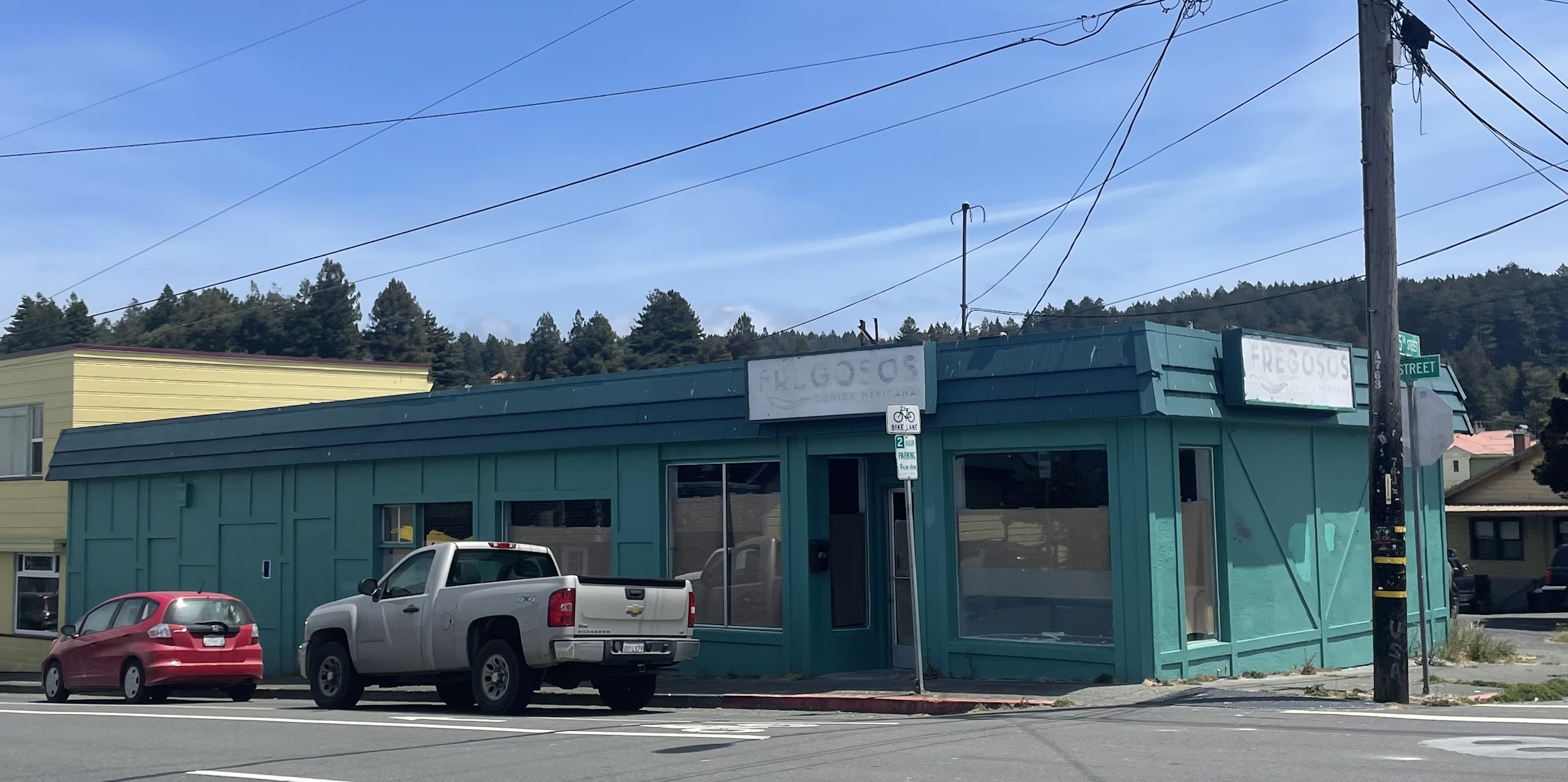
Susukino Ramen Bar will be at 1504 G St in Arcata | Jacquelyn Opalach
Japhy’s Soup and Noodles served its very last bowl of soup last night, after 25 years of serving bowls of soup (and also other things). The couple of days leading up to the restaurant’s sudden closure were mighty busy, with lines of people spilling out the storefront and down the block. It goes without saying: local soup-lovers are in a sad place.
But G Mehta, Ronuk Patel and Roshan Patel say they have something to cheer Arcata up. The three are opening up a new ramen bar – and it’s right across the street from where Japhy’s was, up on G street in Northtown.
Noodle-based soups are about the only thing the two businesses have in common, though.
Susukino Ramen Bar, named after a neighborhood in the city of Sapporo, Japan, will be a late-night restaurant with a bar atmosphere and live DJ sets on Fridays. They hope to open in late June.
“We’re trying to really make it like a real Japanese izakaya, basically,” Ronuk told the Outpost during a tour of the space, still in the renovation stage. “You come and hang out, have a beer and eat good food, you know? And it’s just supposed to be that kind of vibe.”
The restaurateurs, who own the cannabis farm Devi, said they’ve wanted to open a restaurant for a while, and Japanese food is the obvious choice. Inspired by a decade of annual snowboarding trips to Japan, Ronuk recruited his friend Gori for the restaurant, a chef who recently moved here from Sapporo.
Gori will serve up four types of ramen, classic Japanese appetizers, and yakitori skewers, made with ingredients sourced locally when possible, Ronuk said. A bowl of ramen will probably cost about $15. They’ll pour wine and beer, but hope to open a full bar eventually – and they plan to stay open as late as 2:30 a.m. on the weekends.
Located at 1504 G St, the relatively large space has seen a couple of restaurants come and go over the last several years. “It’s tough business, it’s not easy,” Ronuk said. “It really is passion for us, because we love food so much. We love Japanese food. We love ramen.”
He and his business partners are confident that Arcata wants and needs what they’re serving up.
It’ll be the “neighborhood spot,” Roshan said. “We can bring a whole community together and build a culture around it: bring that Japanese vibe that’s super homey and friendly, everyone just come in here kicking it, grab beers, eat some meats, just enjoying their time.”
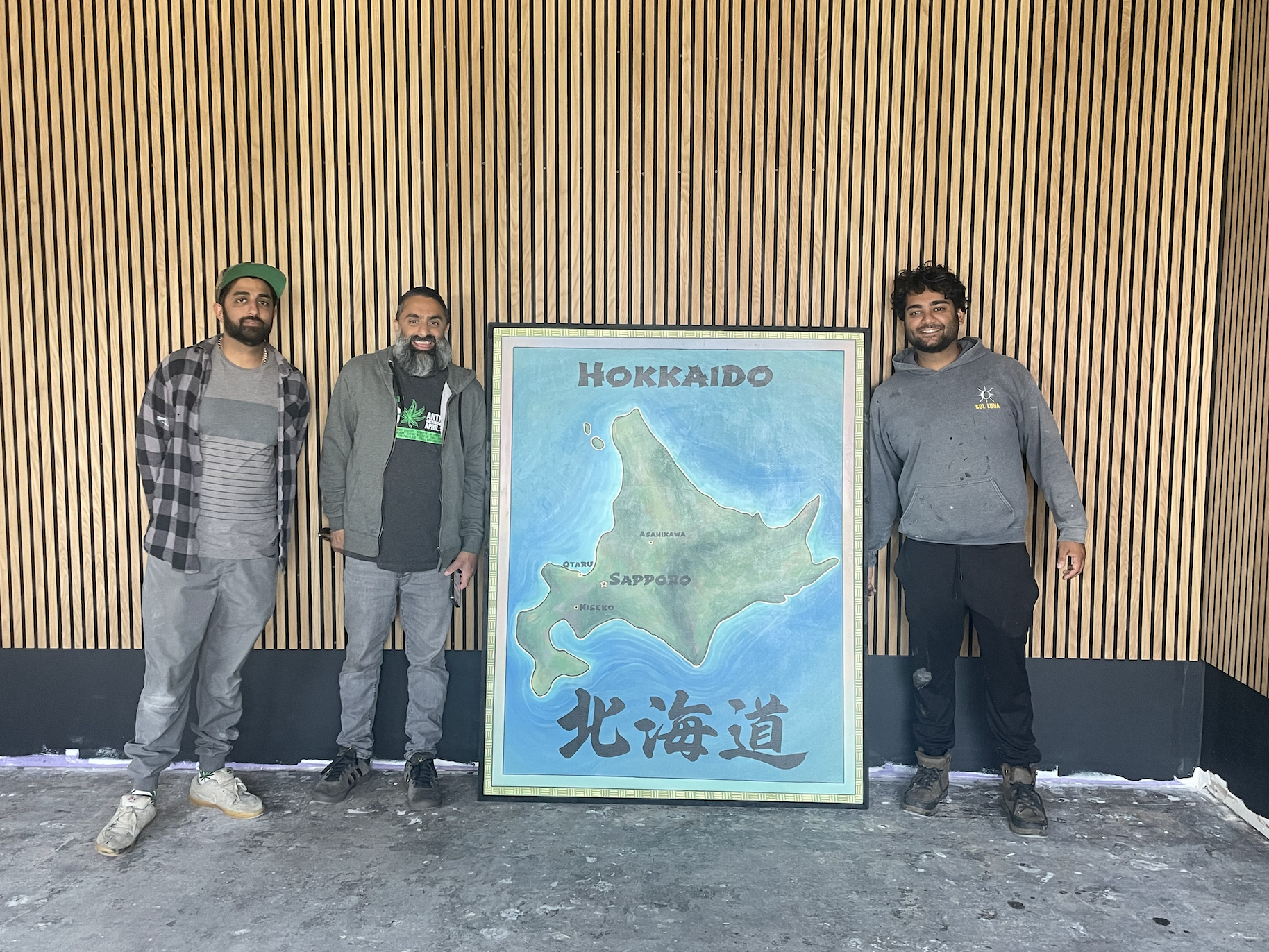
Ronuk Patel, G Metha and Roshan Patel with a painting of the northern Japanese island Hokkaido, by local artist Laci Dane
BOOKED
Today: 10 felonies, 12 misdemeanors, 0 infractions
JUDGED
Humboldt County Superior Court Calendar: Today
CHP REPORTS
1656 Union St (HM office): Missing Indigenous
ELSEWHERE
County of Humboldt Meetings: Behavioral Health Board - SUD/Dual Recovery Committee - Sept. 10, 2026
County of Humboldt Meetings: Behavioral Health Board Executive Committee Meeting - July 1, 2026
RHBB: Judge Overturns Search Warrant in Student Activist Case: Devices Ordered Returned
RHBB: Multi-Vehicle Crash Closes South Fortuna Boulevard Near Strongs Creek Plaza
SALMON BONANZA! CDFW Releases More Than 2 Million Chinook Into the Klamath
LoCO Staff / Friday, May 24, 2024 @ 3:58 p.m. / Fish

Photo via CDFW.
###
PREVIOUSLY: ‘These Baby Fish Represent Hope’: CDFW Releases 500,000 Juvenile Salmon into Klamath River
###
Press release from the California Department of Fish and Wildlife:
The California Department of Fish and Wildlife (CDFW) this week successfully completed the release of more than 2 million fall-run Chinook salmon smolts into the Klamath River.
On Wednesday, May 15, CDFW released approximately 1.3 million fall-run Chinook salmon smolts below the Iron Gate Dam and carried out another release of approximately 800,000 fish from the same location on Wednesday, May 22.
The salmon smolts were trucked about 7 miles to the release point from CDFW’s new, state-of-the-art Fall Creek Fish Hatchery. The fish carried coded-wire tags and had their adipose fins clipped to later identify them as being of hatchery origin and provide scientists and hatchery managers with data about their life histories and the success of the release.
Although still undergoing the final phases of construction, CDFW’s new Fall Creek Fish Hatchery, which replaces the 63-year-old Iron Gate Fish Hatchery on the Klamath River, has already exceeded its production goal of 3.25 million salmon in its first year of operation, the combined result of the excellent water quality in Fall Creek, a tributary to the Klamath River, along with improved efficiencies of the facility itself.
The salmon smolts are about six months old and average just under 3 inches in length. The smolt releases began earlier than scheduled last week due to warming temperatures in the Klamath Basin and C. Shasta disease concerns. C. Shasta – or Ceratonova shasta – is a naturally occurring freshwater parasite native to the Klamath River that can cause disease in young salmon. The fish are particularly susceptible in warmer water temperatures. Those concerns were alleviated this week, however, with a return of cooler temperatures to the Klamath Basin.
Dam removal provided a dramatic backdrop to CDFW’s salmon releases. The three remaining Klamath River dams targeted for removal – JC Boyle, Copco 1 and Iron Gate – are all being actively deconstructed. Their removal is ahead of schedule and could open up free fish passage and access to hundreds of miles of new spawning and rearing habitat to salmon returning from the ocean as early as this fall.
CDFW plans another release of 250,000 to 300,000 yearling fall-run Chinook salmon later this year. If dam removal proceeds at its current pace, CDFW expects to release the fish directly from its Fall Creek Fish Hatchery into Fall Creek, which has been inaccessible to salmon due to its location behind the Iron Gate Dam.
Dam removal, the transition to the state-of-the-art Fall Creek Fish Hatchery, increasing variability in hatchery releases at different salmon life stages to supplement in-river production and the strong relationships forged with tribal partners that have made these actions successful are all critical components of the California Salmon Strategy for a Hotter, Drier Future released by Gov. Gavin Newsom in January 2024.
WELCOME to PANAMNIK! That Town in Far Northeastern Humboldt Now Has Gorgeous New Signage
LoCO Staff / Friday, May 24, 2024 @ 1:55 p.m. / Infrastructure
Photos: Caltrans
###
PREVIOUSLY:
###
Press release from Caltrans District 1:
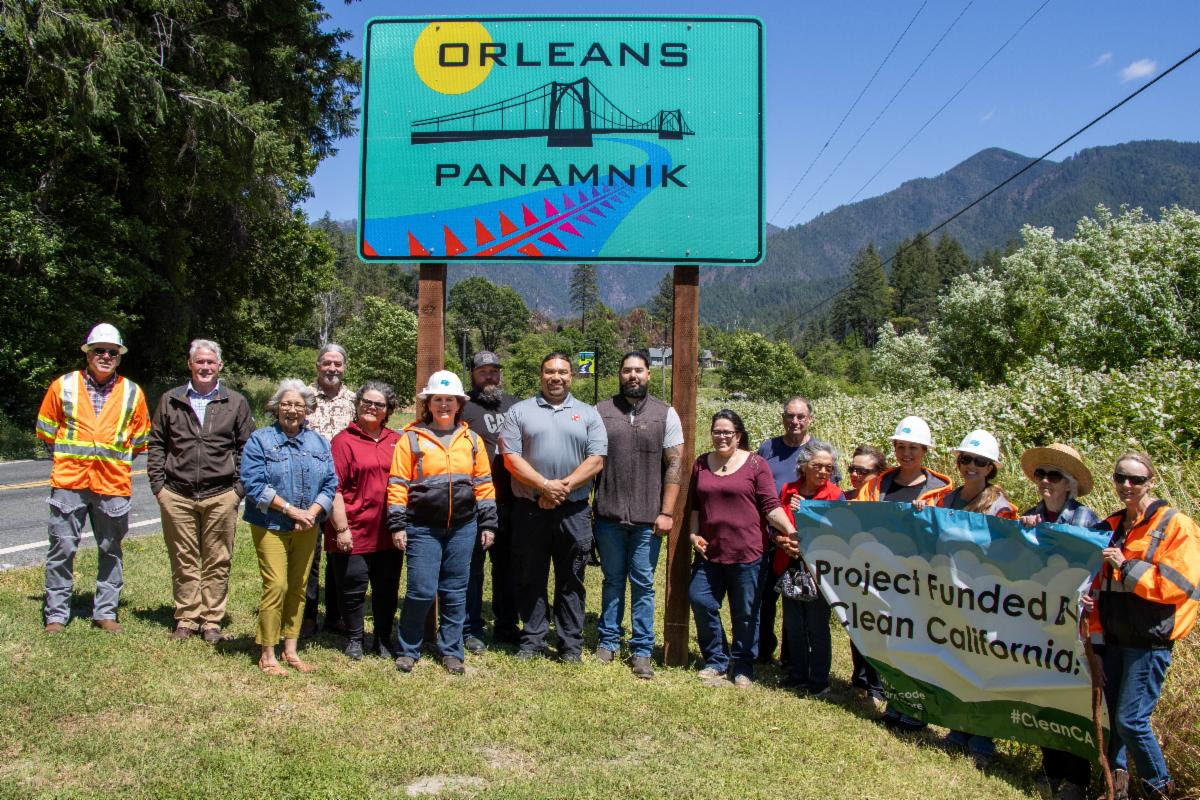
In collaboration with the Karuk Tribe, the township of Orleans, and Humboldt County, Caltrans recently completed work on the Orleans Community Enhancement Project, a nearly $500,000 effort that highlights the area’s native culture and promotes safety along State Route 96, the Bigfoot Scenic Byway.
The project was made possible by Governor Gavin Newsom’s Clean California initiative – a sweeping, $1.2 billion, multiyear clean-up effort led by Caltrans to remove trash, create thousands of jobs, and join with communities throughout the state to reclaim, transform and beautify public spaces.
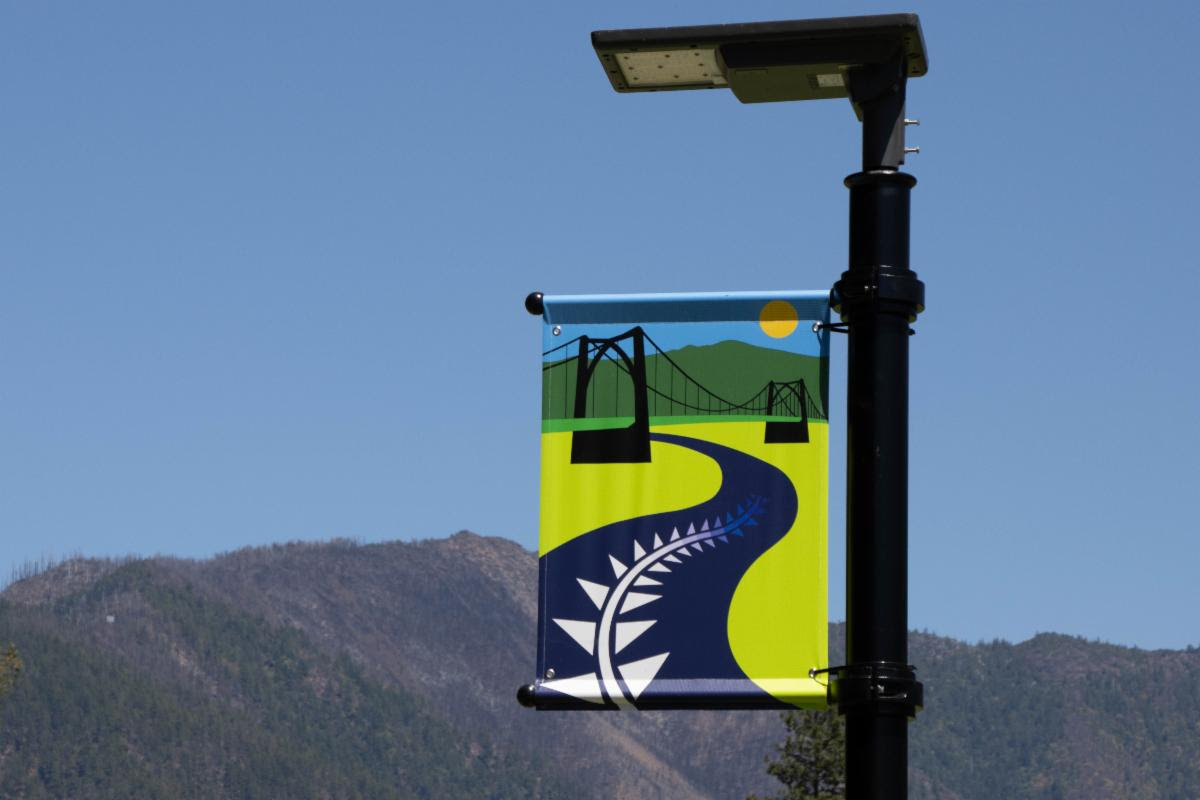
The Orleans Community Enhancement Project features two new gateway monuments that mark the town’s north and south boundaries and bear the community’s name in both English and Karuk (Panamnik) languages. Tribal designs now adorn Orleans’ lone crosswalk, and changeable banners reflect the area’s rich Karuk heritage.
The Project also installed 10 decorative solar light posts to illuminate previously dim areas and pathways, increasing safety for pedestrians and cyclists. These features help to create a visual sense of place within the community and encourage travelers to slow down, and even stop to visit when driving through the community.
“The Karuk Council is very impressed with the concerted efforts of Caltrans, Humboldt County, and the Karuk Tribe Department of Transportation under the direction of Misty Rickwalt,” said Karuk Chairman Russell “Buster” Attebery. “The new custom gateway monuments, crosswalks, tribal designs, and solar lighting will make the town of Orleans a safer place and bring an awareness to the area’s rich Karuk heritage.”
“These enhancements not only pay tribute to Orleans’ history but also help make the town safer and more visually appealing for all of its residents and visitors,” said Caltrans District 1 Director Matt Brady. “The completion of this project marks a big step forward in revitalizing our local public spaces and promoting community pride.”
Since launching Clean California in July 2021, Caltrans and its local partners have picked up more than 2.3 million cubic yards of litter – enough to fill about 700 Olympic-size swimming pools. This represents a substantial increase compared to the department’s previous trash collection efforts and can largely be attributed to Clean California, along with other Caltrans litter removal efforts. Caltrans has hosted more than 500 free dump days in communities throughout the state – resulting in the collection of 12,000-plus mattresses and nearly 50,000 tires. The initiative has drawn more than 10,000 community clean-up volunteers and created 15,000 jobs, including positions for individuals who were formerly incarcerated, on probation, or experiencing housing insecurity.
For more information, visit CleanCA.com.
Sheriff’s Office Urges Caution Near Local Rivers This Memorial Day Weekend
LoCO Staff / Friday, May 24, 2024 @ 11:34 a.m. / Safety

Humboldt County Sheriff’s boat patrolling Klamath River. Image via HCSO.
###
Press release from the Humboldt County Sheriff’s Office:
The Humboldt County Sheriff’s Office wishes everyone a pleasant Memorial Day weekend. As we honor those who have served in our military and enjoy the outdoors, we urge caution regarding swimming in our local rivers. It remains too early in the season to safely swim in several of our waterways, notably the Trinity River. Both the Trinity and Klamath Rivers pose significant risks due to high water levels, cold temperatures, submerged obstacles, and swift currents. Even experienced swimmers may struggle in these conditions. Therefore, we advise the general public to refrain from swimming in these rivers at this time.
For those choosing to swim in one of our local waterways, we offer the following safety recommendations:
- Check river levels and flow information provided by the National Weather Service.
- Avoid swimming alone.
- Stay near the shoreline.
- Avoid swimming into strong fast-moving currents. If the current seems too strong, get out of the water.
- Refrain from consuming alcohol while swimming.
- Do not substitute inflatable water toys for a life jacket. Ensure young children wear a life jacket and supervise them closely while swimming.
The Sheriff’s Office emphasizes the importance of exercising caution and using common sense when enjoying our counties rivers and the ocean. Your safety should always be the top priority.

California Lawmakers Advance Apology for Slavery, Funding Frameworks for Reparations
Wendy Fry / Friday, May 24, 2024 @ 8:19 a.m. / Sacramento

California State Senator Steven Bradford, right, and Assemblymember Reggie Jones-Sawyer, left, at a reparations meeting in San Diego on Jan. 28, 2023. Photo by Ariana Drehsler for CalMatters
California lawmakers voted to offer an official apology for the state’s role in supporting slavery and moved several other reparations bills but let others die.
Assemblymember Reggie Jones-Sawyer, a Democrat from south Los Angeles, authored AB 3089, the apology bill, after serving on a nine-member state task force that studied harms committed against Black residents.
“We were people’s properties in this state. And it was defended by the State Supreme Court and other courts,” Jones-Sawyer told the Assembly ahead of the vote.
Four Democrats and 12 Republicans did not vote on the apology bill. The Assembly approved the bill 62–0, including six Republicans who voted for it. Now it heads to the state Senate and, if approved, to Gov. Gavin Newsom’s desk.
State lawmakers embraced and applauded as soon as the bill passed. Jones-Sawyer said Alabama, Connecticut, Delaware, Florida, Maryland, New Jersey, North Carolina, Tennessee, and Virginia have all enacted some form of apology for their role in slavery.
His bill is one of more than a dozen in a package of reparations bills supported by the California Legislative Black Caucus. In February the state Assembly approved a resolution acknowledging “harms and atrocities” state leaders inflicted on Black residents over the years. Assemblymember Akilah Weber, a Democrat from San Diego, authored that bill.
Other key bills in the Black Caucus’ reparations package cleared important hurdles.
A proposal by Democrat Sen. Steven Bradford of Inglewood to compensate Black residents for land unjustly taken by eminent domain moved forward.
The California Senate also advanced proposed legislation that would create an agency to help Black families research their family lineage and confirm eligibility for any future restitution measures, and a bill that would establish a reparations fund. The bills will now head to the state Assembly for another vote.
State Sen. Steven Bradford, a Los Angeles-area Democrat, said the state “bears great responsibility” to atone for injustices against Black Californians.
“If you can inherit generational wealth, you can inherit generational debt,” Bradford said. “Reparations is a debt that’s owed to descendants of slavery.”
A bill that would require state licensing boards to prioritize Black applicants passed the Legislature’s appropriations committees. The Pacific Legal Foundation testified in opposition, saying it is unconstitutional.
“The state’s licensing laws are already too burdensome. Making race a factor is an insult to the state’s workers who just want the means to earn an honest living,” Andrew Quinio, a foundation attorney, told lawmakers April 23.
Two other proposals aimed at implementing the California Reparations Task Force recommendations quietly died in the suspense file last week: SB 1007 would have provided financial aid for buying or maintaining a home and SB 1013 would have granted property tax relief to descendants of slaves. Bradford wrote both bills, but the Black Caucus did not designate them as priority bills this year.
###
The CalMatters Ideas Festival takes place June 5-6! Find out more and get your tickets at this link.
CalMatters.org is a nonprofit, nonpartisan media venture explaining California policies and politics.
Hundreds Arrested and Suspended: How California Colleges Are Disciplining Faculty and Students Over Protests
CalMatters staff / Friday, May 24, 2024 @ 7 a.m. / Sacramento

Protestors display a Palestinian flag at Hepner Hall during a pro-Palestinian protest at San Diego State University in San Diego on April 30, 2024. Photo by Kristian Carreon for CalMatters
###
By Christopher Buchanan, Christina Chkarboul, Atmika Iyer, Briana Mendez-Padilla, Jacqueline Munis, Jada Portillo, Hugo Rios, Elizabeth Wilson, Amelia Wu and Mikhail Zinshteyn
###
While some universities in California are negotiating with student protestors, hundreds of students and faculty throughout the state are facing legal and academic repercussions for protesting the Israel-Hamas war.
Protesters, who have largely been non-violent, have disrupted events, occupied buildings and public spaces, erected encampments, and skirmished with counterprotesters, resulting in university leaders citing campus policy violations and calling in law enforcement to forcefully remove protesters. According to a CalMatters analysis, at least 567 people, many of whom are students and faculty, have been disciplined by their universities or arrested since the Palestinian militant group Hamas attacked Israel on Oct. 7, killing over 1,100 and sparking a counter-offensive by Israel that has killed 35,000 Palestinians.
For months, pro-Palestinians have been intent on forcing their universities to divest from weapons manufacturers and companies with ties to Israel, and pro-Israelis have insisted the language and actions of the pro-Palestinian groups have been creating anti-semitic environments.
At some campuses, students and faculty are facing consequences for what they see as engaging in their First Amendment rights to speech and to peaceably assemble. An unknown number of students have been suspended or warned of possible suspension, while other students and faculty have been arrested on suspicion of trespassing, attempted burglary and unlawful assembly. And although some campuses are dropping charges, students and faculty throughout California face long-term repercussions.
Students and faculty face legal consequences
Law enforcement officers in riot gear have arrested hundreds of students and faculty for participating in pro-Palestinian encampments on several campuses, including Pomona College, University of Southern California, Cal Poly Humboldt, UCLA, UC San Diego and UC Irvine.
Twenty students arrested at Pomona College on April 5 were suspended and cut off from their access to housing and the campus. At USC on April 24, 48 were students, three faculty members and three staff were arrested on suspicion of trespassing.


First: A pro-Palestinian protester is arrested by Los Angeles Police Department officers during a protest in Alumni Park at the University of Southern California in Los Angeles on April 24, 2024. Last: Pro-Palestinian protesters listen to speakers during a protest at Alumni Park at the University of Southern California in Los Angeles on April 24, 2024. Photos by Jules Hotz for CalMatters
 Protesters are slowly pushed towards the gates behind them as Los Angeles Police Department officers move to close the University of Southern California campus during a pro-Palestinian protest in Los Angeles on April 24, 2024. Photo by Jules Hotz for CalMatters
The next day, UCLA students began an encampment. The ensuing violence by counterprotesters and law enforcement against the camp protesters has drawn condemnation and resulted in the reassignment of UCLA Police Chief John Thomas on May 22, according to a statement from vice chancellor for strategic communications Mary Osako.
Third-year philosophy student Aidan Doyle said despite being aware of potential legal and academic consequences, including dispersal notices from the university and law enforcement, he and many other students felt it was absolutely necessary to continue their protest to call attention to the many deaths in Gaza.
“Despite all the roadblocks that the university and even the police presented to protesters, there’s still an electrified student base who wants to take the side of Palestine,” Doyle said.
After an aggressive group of counterprotesters stormed the UCLA campus in the early morning of May 1, the university moved all instruction online and called in outside law enforcement to clear the encampment that night. Officers arrested 254 protesters and dismantled the encampment. A CalMatters analysis of video from the sweep at UCLA found 25 instances of police brandishing “less-lethal weapons” in students’ faces.
After being injured by police during the sweep, Doyle was among the students and faculty members taken in packed prison buses to the Metropolitan Detention Center in Los Angeles. He has been charged with trespassing, though he and his lawyer believe the charges will be dropped.“(The encounter with counterprotestors) was such a heinous assault and nobody got arrested. Then, the very next day, 200 people who acted peacefully were arrested,” he said. “It’s a hard pill to swallow that the administration is predisposed to dislike us.”

Last: Groups of pro-Palestinian protesters gather at an entrance to their encampment at UCLA on the late evening of May 1, 2024. Law enforcement would eventually clear the encampment on the morning of May 2, 2024. Photo by Ted Soqui, CalMatters
Despite the violent apprehension of students at UCLA, two more UCs called in law enforcement to clear protest encampments over the following two weeks. Police arrested 64 individuals at UC San Diego’s Price Center on May 6, 40 of whom are students now facing charges including failure to disperse and resisting arrest, as well as suspension from the school. And at UC Irvine, law enforcement cleared the encampment on May 15, leading to 47 arrests including 26 students and two employees.
A fourth-year UC San Diego student who asked to be identified as Jewish but also requested anonymity for fear of academic consequences was arrested for failure to disperse while attempting to secure the encampment after police arrived.
“No one really wanted to be the person who broke rank [in holding the encampment perimeter] because we all believed in what we’re doing,” the student said. “We wouldn’t have done anything different.”
UC San Diego Chancellor Pradeep Khosla said in a statement that the arrests were made after multiple orders from police officers to disperse were ignored: “UC San Diego encourages and allows peaceful protests, but this encampment violated campus policy and the law, and grew to pose an unacceptable risk to the safety of the campus community.”
Faculty members at UC San Diego condemned Khosla’s decision to involve law enforcement and are demanding the university reverse suspensions of arrested students.
“We are outraged at what our administration has done here,” said Gary Fields, a communications professor at UC San Diego for 22 years. “I’ve seen a lot of protests, but I’ve never seen anything like what Chancellor Khosla did.”

A University of California campus police officer pushes a pro-Palestinian protester away from a moving San Diego Sheriff’s bus with arrested protesters onboard at UC San Diego on May 6, 2024. Photo by Adriana Heldiz, CalMatters
Students suspended, banned from campus
The encampment sweeps were not the first crackdown of pro-Palestinian demonstrators on California campuses. As far back as Jan. 23, a group of protesters gathered outside Cal Poly San Luis Obispo’s Recreation Center as the university hosted a career fair inside that included military-defense company Lockheed Martin. Eight people were arrested, including three students and one faculty member.
One of the students arrested, who asked to remain anonymous due to the ongoing case, said they were also suspended for two academic quarters due to their participation. The student was supposed to graduate this spring. However, the suspension includes a ban from campus events.
“I thought they were rooting for us but I was really proved wrong there and they’re not looking out for our well-being at all,” the student said.
Other universities have also opted to enforce strict academic consequences. They have handed out suspensions, academic probations and event bans, though most schools will not disclose how many students have been disciplined.
After Stanford students established a second encampment on April 25 following a previous 120-day sit-in that ended in a deal with campus administrators, the university is taking a punitive approach to overnight protests. Stanford President Richard Saller and Provost Jenny Martinez sent a letter to about 60 students at the encampment saying they would be referred for disciplinary action for violating university policy, and that they could be arrested. They also announced that any student groups helping to maintain the encampment would also face disciplinary actions.
The university has already put an unknown number of students on academic probation, mandated community service hours and taken away university-funded fellowships for violating policies. The protesters risk losing campus jobs and university-sponsored internships.
“I get a lot of fellowship money from Stanford. I get a lot of medical support from Stanford. Being on academic probation is something I’m really, really scared of, just because I know those things would probably be in jeopardy,” said a student at the encampment, who requested anonymity due to fear of academic and professional retaliation.
USC suspended at least 29 students who participated in the protest, according to the student group Divest from Death Coalition, which has been collecting suspension letters.
“They were suspended for bringing items onto campus with the intent to use those items for the construction of the encampment,” said Jess, a doctoral candidate and member of the coalition who asked to be identified by her first name only for fear of repercussions.
Additionally, USC canceled its mainstage commencement ceremony due to the lack of security provisions for the expected 65,000 attendees.
In response to a growing encampment at Cal Poly Humboldt, the university shut down completely at the end of April and shifted classes online for the remainder of the semester.
According to Humboldt’s Communication Specialist Iridian Casarez, the university suspended 77 students related to protest activities. The suspension notice cited the alleged destruction of property, trespassing, resisting arrest, and obstruction of pedestrian traffic. Environmental studies major Stella Baumstone was among those, and said her initial concern was whether she’d be receiving her diploma. She knows of one student who lost a campus job due to the suspension and has been struggling to pay rent.
“It’s hard to see what they’re doing is having real material harm for people,” Baumstone said.
On April 30, 40 protesters were arrested when they refused law enforcement’s request to disperse and instead barricaded a building. Charges ranged from unlawful assembly and vandalism to conspiracy.


First: Pro-Palestinian protesters demand police officers leave campus during a protest outside of Siemens Hall at Cal Poly Humboldt in Arcata on April 22, 2024. Last: A pro-Palestinian supporter leads a chant during a protest at Cal Poly Humboldt on April 22, 2024. Photos by Mark McKenna for CalMatters

People gather after demonstrators took over Siemens Hall at Cal Poly Humboldt during a pro-Palestinian protest in Arcata on April 22, 2024. Photo by Mark McKenna for CalMatters
Rouhollah Aghasaleh, an assistant education professor, was the only faculty member arrested that day. The professor received a two-month suspension from the university and is barred from going to campus, attending university events including online, and contacting students.
“They are using a similar template for faculty suspension as if for a faculty member under investigation for a Title IX case,” Aghasaleh said. “I don’t think I’m dangerous for my students. My students also don’t think I’m dangerous for them.”
Faculty consequences are muddled on some campuses. John Branstetter, a political science lecturer at UCLA, was arrested after standing between students and police during the raid, trying to quell violence. He said the university has not promised to review “everybody who was caught up in it and apply the rules of the (employment manual) to us, although it’s not clear to me what those are.” He added he is particularly vulnerable as a non-tenured faculty member.
Students and faculty at UCLA have yet to face academic consequences for their participation in the encampment. Both Doyle and Branstetter believe the university will likely not follow through with suspensions or punishment. However, UCLA did not respond to multiple requests for comment.
On May 20, a rolling strike began at UC Santa Cruz when graduate students and other academic workers represented by United Auto Workers 4811 were the first to walk off the job. Strikes at UCLA and UC Davis are planned to begin May 28, adding to the work stoppage. That would mean roughly a third of the UC system’s graduate workers – who teach and grade a large portion of the undergraduates – will be withholding their labor.
The union demands that the UC drop disciplinary charges against some graduate workers who were arrested at pro-Palestinian demonstrations in the past month. The UC calls the strike illegal, which the union disputes, and argues that it cannot change disciplinary rules just for graduate workers. The union argues these disciplinary rules are new and unilaterally change their working conditions, which they say is a violation of labor law.
Faculty and students at several universities have also held additional protests calling for district attorney offices to drop charges and for campus officials to offer academic amnesty for those they say expressed their right to speech and assembly.
And protesters continue to block public spaces and buildings, leading to further law enforcement action. On May 23 at Cal Poly San Luis Obispo, a group blocked a main entrance to campus while chanting for a “free Palestine.” Eight people were arrested, including four students and one faculty member, for “unlawful assembly, willfully obstructing a street or sidewalk and resisting arrest,” according to university spokesperson Matt Lazier. The Cal Poly Police Department has temporarily banned those arrested from campus.
Meanwhile, also in the morning of May 23, at UCLA, a group of a few dozen pro-Palestinian protesters erected a short-lived encampment that cleared out once officers arrived. In the afternoon, a larger group of about 200 occupied Dodd Hall, a classroom space, using their bodies to block doorways and stopped students of at least one class from entering.
Fourth-year student Ricky Ramirez, who was trying to attend his 5 p.m. sociology class, said he was sympathetic to the protesters and had joined previous pro-Palestinian rallies at campus. “I understand why it’s happening,” he said. “I wish the school would inform us more and keep us up-to-date.”
After witnessing several campus security guards grab and then push a student who was standing outside a back door of Dodd Hall, Ramirez said, “It’s really scary, honestly. I feel like it could just happen to me and I’m just trying to get into class.”
University police officers cleared out the students by about 5:30 p.m. It did not appear that any arrests were made.
Kenza K., a third-year UCLA undergraduate student who identified herself as a spokesperson for the student protesters, said the day’s actions were a test to see if students were just as mobilized as they were three weeks ago. And, according to her, they were. Their goal was not to get arrested, she added, “though students are willing to take a lot of risk because they believe that they’re not doing anything wrong.”
Some campuses turn to peacemaking
Some universities have been able to avoid police intervention and come to agreements with pro-Palestinian protesters. Most of these deals include provisions that would make investments by universities more transparent and bring recognition to Palestinian losses. Encampments have cleared following negotiations at San Francisco State, Sacramento State, Sonoma State, UC Riverside, UC Berkeley and Chapman University.

Various movements in solidarity with Gaza joined the “Free Palestine Camp” demonstration outside of Sproul Hall at UC Berkeley on April 23, 2024. Photo by Manuel Orbegozo for CalMatters
Sacramento State President Luke Wood said there would be full transparency for the university’s investments following the protests. Sonoma State’s president Mike Lee promised the same but added one caveat. Without prior approval by Cal State Chancellor Mildred Garcia, Lee agreed to cut ties with student and faculty exchange programs in Israel. After Garcia placed him on administrative leave for insubordination, Lee announced he would retire, leaving the deal in limbo and student activists in the Cal State system calling for Garcia’s resignation.
In stark contrast to the other three UC campuses, UC Berkeley Chancellor Carol Christ said she’d be reevaluating whether the university’s investments align with the UN Principles for Responsible Investment — which prohibits investment in companies who are threatening any public safety — and that she’d call for a ceasefire in support of Palestinian and Jewish lives. UC Riverside has agreed to consider investment strategies that direct money away from weapons manufacturers.
“This is a step forward for our community,” said a statement by the group Students for Justice in Palestine at UC Riverside. “However, our work is not done. Innocent people are STILL dying, enduring displacement, and suffering. This is not a victory and, more importantly, this is not defeat.”
###
Sergio Olmos contributed to this story. Buchanan, Chkarboul, Iyer, Mendez-Padilla, Munis, Portillo, Rios, Wilson and Wu are fellows with the College Journalism Network, a collaboration between CalMatters and student journalists from across California. CalMatters higher education coverage is supported by a grant from the College Futures Foundation.
The CalMatters Ideas Festival takes place June 5-6! Find out more and get your tickets at this link.
CalMatters.org is a nonprofit, nonpartisan media venture explaining California policies and politics.
How California and the EU Work Together to Regulate Artificial Intelligence
Khari Johnson / Friday, May 24, 2024 @ 7 a.m. / Sacramento

Illustration by Adriana Heldiz, CalMatters; iStock
While the federal government appears content to sit back and wait, more than 40 U.S. states are considering hundreds of AI regulation bills.
California, with its status as a tech-forward state and huge economy, has a chance to lead the way. So much so, in fact, that the European Union is trying to coordinate with the state on AI laws. The EU opened an office in San Francisco in 2022 and dispatched a tech envoy, Gerard de Graaf, to better communicate about laws and regulations around AI.
We are living through what de Graaf calls “the year of AI.” De Graaf and deputy head of the EU office in San Francisco Joanna Smolinska told CalMatters that if California lawmakers pass AI regulation in the coming months, the state can emerge as a standard bearer for the regulation of AI in the United States. In other words: California’s laws could influence the future of AI as we know it.
Last month, de Graaf traveled to Sacramento to speak with several state lawmakers key to AI regulation:
- Assemblymember Rebecca Bauer-Kahan, a San Ramon Democrat, is author of a bill that requires businesses and state agencies report results of AI model tests in an effort to prohibit automated discrimination
- Democratic State Sen. Scott Wiener from San Francisco is author of a bill to regulate generative AI
- Assemblywoman Buffy Wicks, an East Bay Democrat, is author of a bill that would require online platforms put watermarks on images and videos generated by AI sometimes referred to as deepfakes ahead of elections this fall
- And Sen. Tom Umberg, chair of the Senate Judiciary Committee, who was referred to by Politico as the “California’s chief gatekeeper for AI rules.”
The meeting to discuss the bills was at least the sixth trip de Graaf or other EU officials made to Sacramento in two months. EU officials who helped write the AI Act and EU Commission Vice President Josep Fontelles also made trips to Sacramento and Silicon Valley in recent weeks.
This week, EU leaders ended a years-long process with the passage of the AI Act, which regulates use of artificial intelligence in 27 nations. It bans emotion recognition at school and in the workplace, prohibits social credit scores such as the kind used in China to reward or punish certain kinds of behavior and some instances of predictive policing. The AI Act applies high risk labels for AI in health care, hiring, and issuing government benefits.
There are some notable differences between the EU law and what California lawmakers are considering. The AI Act addresses how law enforcement agencies can use AI, while Bauer-Kahan’s bill does not, and Wicks’ watermarking bill could end up stronger than AI Act requirements. But the California bills and the AI Act both take a risk-based approach to regulation, both advise continued testing and assessment of forms of AI deemed high risk, and both call for watermarking generative AI outputs.
“If you take these three bills together, you’re probably at 70-80% of what we cover in the AI Act,” de Graaf said. “It’s a very solid relationship that we both benefit from.”
In the meeting, de Graaf said they discussed draft AI bills, AI bias and risk assessments, advanced AI models, the state of watermarking images and videos made by AI, and which issues to prioritize. The San Francisco office works under the authority of the EU delegation in Washington D.C. to promote EU tech policy and strengthen cooperation with influential tech and policy figures in the United States.
Artificial intelligence can make predictions about people including what movies they want to watch on Netflix or the next words in a sentence, but without high standards and continuous testing, AI that makes critical decisions about people’s lives can automate discrimination. AI has a history of harming people of color, such as police use of face recognition, deciding whether to grant an apartment or home mortgage application. The technology has a demonstrated ability to adversely affect the lives of most people, including women, people with disabilities, the young, the old, and people who apply for government benefits.
In a recent interview with KQED, Umberg talked about the importance of striking a balance, insisting “We could get this wrong.” Too little regulation could lead to catastrophic consequences for society, and too much could “strangle the AI industry” that calls California home.
Coordination between California and EU officials attempts to combine regulatory initiatives in two uniquely influential markets.
The majority of the top AI companies are based in California, and according to startup tracker Crunchbase, for the past eight months, companies in the San Francisco Bay Area raised more AI investment money than the rest of the world combined.
The General Data Protection Regulation, better known as GDPR, is the European Union’s best known legislation for privacy protection. It also led to coinage of the term “the Brussels effect,” when enforcement of a single law leads to outsized influence in other countries. In this case, the EU law forced tech companies to adopt stricter user protections if they wanted access to the region’s 450 million residents. That law went into effect in 2018, the same year that California passed a similar law. More than a dozen U.S. states followed suit.
Defining AI
Coordination is necessary, de Graaf said, because technology is a global industry and it’s important to avoid policy that makes it complicated for businesses to comply with rules around the world.
One of the first steps to working together is a shared definition of how to define artificial intelligence so you agree on what technology is covered under a law. De Graaf said his office worked with Bauer-Kahan and Umberg on how to define AI “because if you have very different definitions to start with then convergence or harmonization is almost impossible.”
Given the recent passage of the AI Act, the absence of federal action, and the complexity of regulating AI, the Senate Judiciary staff lawyers held numerous meetings with EU officials and staff, Umberg told CalMatters in a statement. The definition of AI used by the California Senate Judiciary committee is informed by a number of voices including federal agencies, the Organization for Economic Co-operation and Development, and the EU.
“I strongly believe that we can learn from each other’s work and responsibly regulate AI without harming innovation in this dynamic and quickly-changing environment” Umberg told CalMatters in a written statement.
The trio of bills discussed with de Graaf in April passed their respective houses this week. He suspects questions from California lawmakers will get more specific as bills move closer to adoption.
California lawmakers proposed more than 100 bills to regulate AI in the current legislative session.
“I think what is now the imperative for the Legislature is to whittle the bills down to a more manageable number,” he said. “I mean, there’s over 50 so that we focused particularly on the bills to these assembly members or senators themselves.”
State agency also seeks to protect Californians’ privacy
Elected officials and their staff aren’t the only ones speaking with EU officials. The California Privacy Protection Agency — a state agency made to protect people’s privacy and require businesses comply with data deletion requests — also speaks regularly with EU officials, including de Graaf.
Most states with privacy protection laws rely on state attorneys general for enforcement. California is the only state with an independent agency with enforcement authority to audit businesses, levy fines, or bring businesses to court, said agency executive director Ashkan Soltanti, because key elements of the EU’s privacy protection law influenced the formation of California’s privacy law. De Graaf and Soltani testified about similarities between definitions of AI in California and the EU in an assembly privacy committee hearing in February.
“The roots of the agency were inspired at great length by the General Data Protection Regulation (GDPR),” Soltani said. “There’s an interest and a goal, and in fact, our statute directs us to where possible, make sure that our approach is harmonious with frameworks in other jurisdictions, not just states but internationally as well.”
Soltani was hired when the agency was created in 2021. He told CalMatters international coordination is a big part of the job. After hiring staff and attorneys, one of his first orders of business was joining the Global Privacy Assembly, a group of 140 data privacy authorities from around the world. California is the only U.S. state that is a member of the group.
Alignment is important for setting the rules of the road for businesses but also for consumers to protect themselves and their communities in a digital world where borders blur.
“They don’t think whether they’re doing business with a California company or a European company or an Asian company, particularly if it’s all in English, they just think they’re interacting online, so having consistent frameworks for protection ultimately benefits consumers,” Soltani said.
Like California lawmakers, the California Privacy Protection Agency is in the process of writing rules for how businesses use AI and protections for consumers, students, and workers. And like the AI Act, draft rules call for impact assessments. Its five-member board will consider passing rules into law in July.
The last day of the legislative calendar year for California lawmakers to pass a bill into law is Aug. 31.
###
The CalMatters Ideas Festival takes place June 5-6! Find out more and get your tickets at this link.
CalMatters.org is a nonprofit, nonpartisan media venture explaining California policies and politics.


