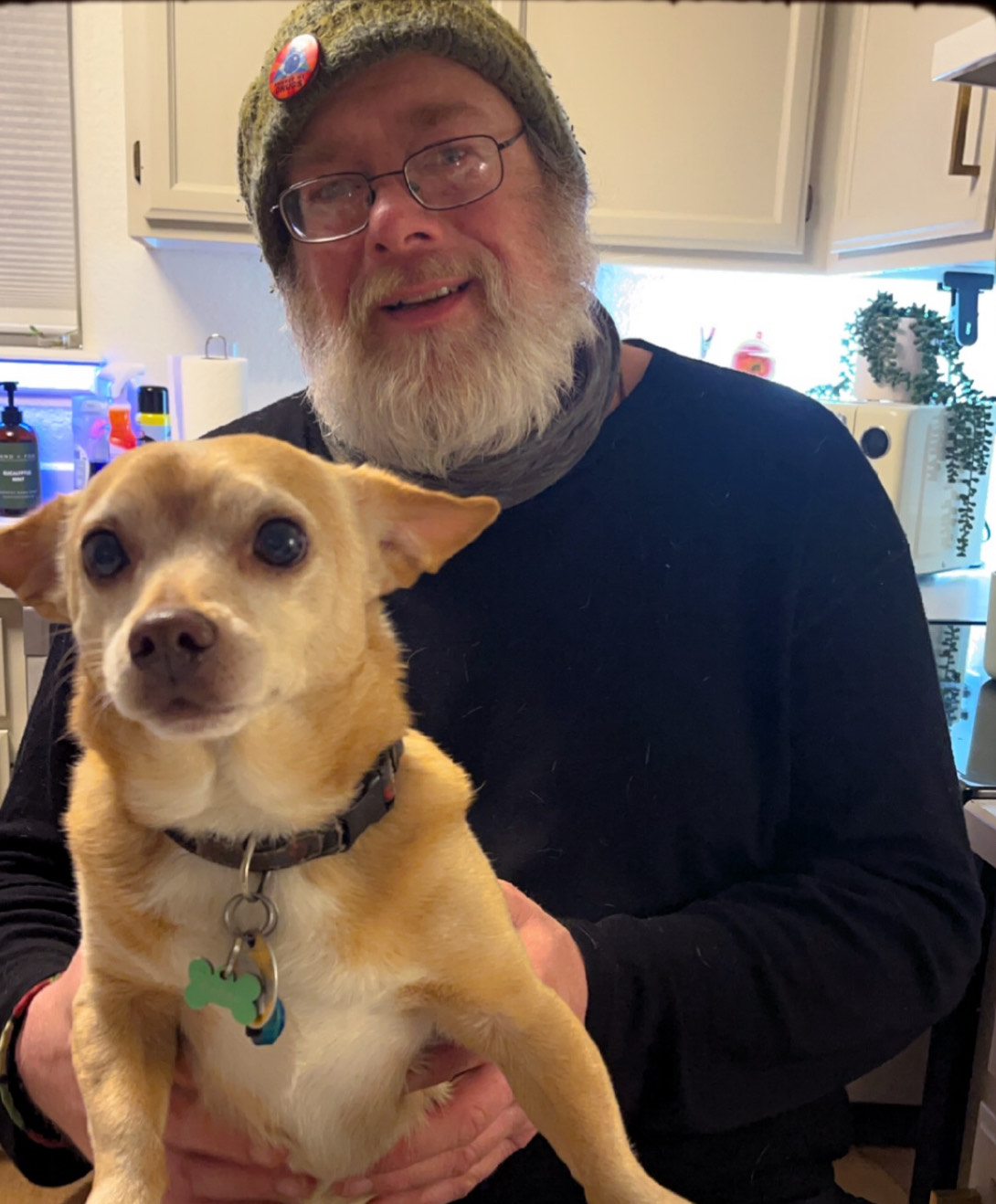
Jacob
“Jake” Zukowski passed away peacefully in his sleep on
March 5, 2024 at the age of 48. Jacob was born on November 16, 1975
in Pittsburgh, Penn.
He
was the beloved son of the late Robert and Claudia (Cygnarowicz) and
the adored brother of his late sister, Robin. Although preceded in
death by his parents and sister, he forever carried cherished
memories and great love for them for all of his remaining days. Jake
is survived by his large and loving family — aunts, uncles and many
cousins — all who love him dearly. And all whom Jacob dearly loved.
He truly felt grateful and blessed to be a part of his family. Jake
truly loved Kat, his most-beloved friend and soulmate. Jake loved
Rubin (and Arlo and Otis) and all dogs and received great joy from
their company. Jake was fortunate to be surrounded by dear friends.
He cherished them and enjoyed having fun and spending time with each
of them.
When
you were with Jake, you were in a “judgment-free” zone!
Jake accepted everyone and met them where they were. He offered
kindness and love to all. Jake had a big loving, caring and giving
heart and he appreciated everyone and everything. His welcoming smile
and laughter reached out to so many. His sharp wit and sense of humor
made him so much fun to be around.
Jake
was a graduate of the Pittsburgh Culinary Institute and worked for
many years as a chef. He created exquisite dishes that were enjoyed
by folks on both the East and West coasts.
For over five
years Jake worked at the prestigious Ingomar Club at the Carson
Mansion in Eureka, where his talents were appreciated by all who had
the pleasure of tasting his dishes and where his kind and generous
spirit and fun-loving wit were held dear by coworkers. He then chose
to move on and merge his culinary skills with his love of the
outdoors. Most recently, Jake was a chef at the Vermillion Valley
Resort (VVR) located in the Sierra Nevada Mountains in Lakeshore,
Calif.
He was able to use his cooking skills while also helping people along
their travels on the Pacific Coast Trail — a personal favorite
destination for Jake.
Jake
loved listening to music and camping. He enjoyed researching and
collecting different camping equipment to help make his outings
successful. He found solace and peace while spending time outdoors.
Jake was filled with passion,
persistence and trust in God. His spirit was strong and courageous.
He was filled with gratitude and appreciation. Never bitter or
resentful, he forgave everyone. He truly loved. And he loved in a
truly pure way. His light will forever shine and his love, ever pure,
will remain with us forever.
###
The obituary above was submitted on behalf of Jake Zukowsi’s loved ones. The Lost Coast Outpost runs obituaries of Humboldt County residents at no charge. See guidelines here.
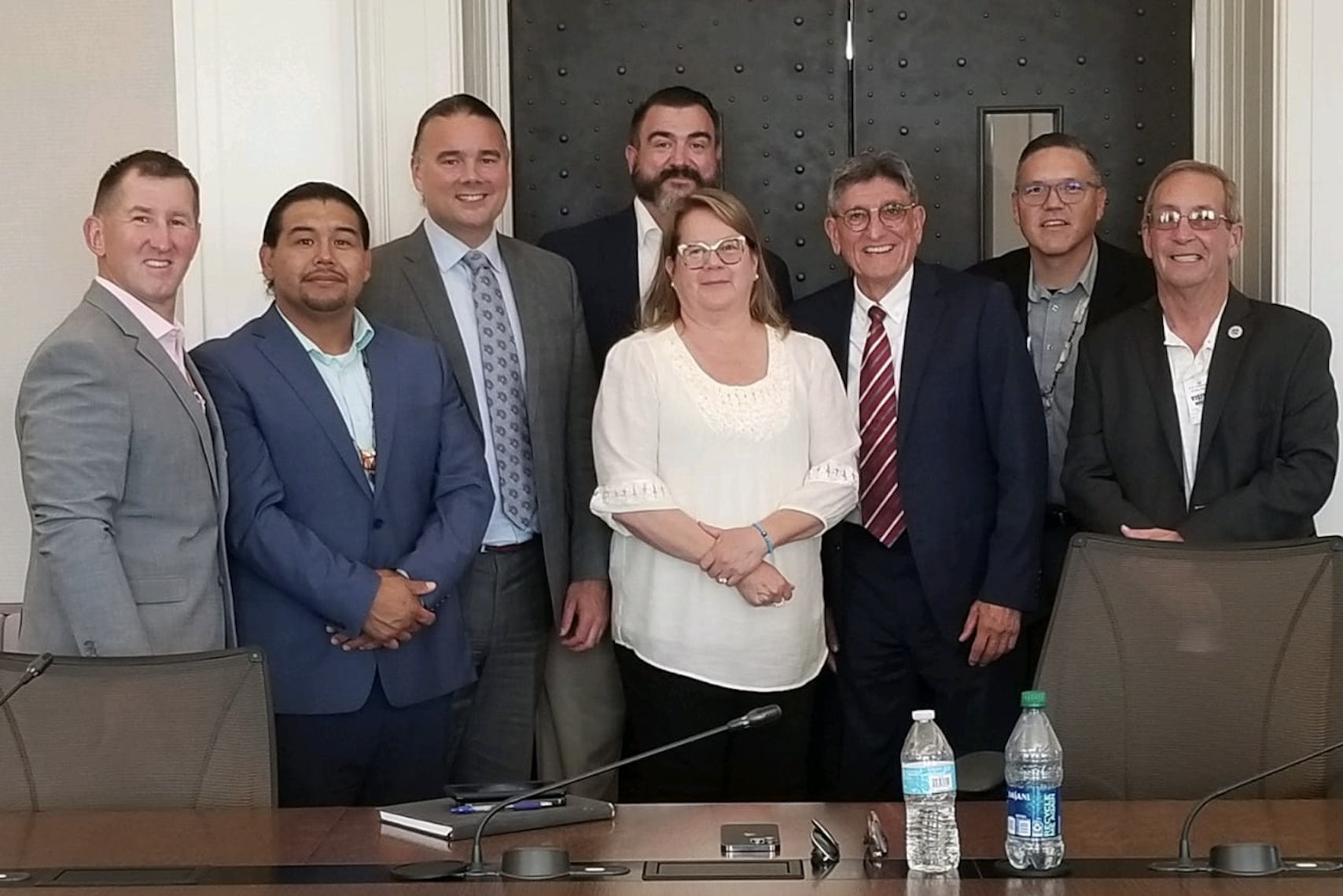
Front left: Chicken Ranch Rancheria Chairman Lloyd Mathiesen; Hopland Band of Pomo Indians Chairman Sonny Elliott; Assistant-Secretary for Indian Affairs Bryan Newland; Blue Lake Rancheria Chairman Jason Ramos; Secretary of the Interior’s Office of Indian Gaming Director Paula Hart;; attorney Lester Marston; Chemehuevi Indian Tribe Chairman Glenn Lodge; and Robinson Rancheria Chairman Beni Cromwell. | Photo courtesy Lester Marston.
###
After a protracted legal battle, five California Native American tribes, including the Blue Lake Rancheria, have been granted independence from state authority over their casino operations, giving them the right to regulate themselves, with oversight from the National Indian Gaming Commission.
[DISCLOSURE: The Blue Lake Rancheria is a minority owner of the Outpost’s parent company, Lost Coast Communications, Inc.]
This landmark arrangement stems from an Eastern District of California Court ruling, and subsequent Ninth Circuit appeal, in the case of Chicken Ranch Rancheria v. California. The rulings triggered a mediation process required under the Indian Gaming Regulatory Act (IGRA). And finally, with a “joint stipulation and order for dismissal” issued in late January, Department of the Interior Secretary Deb Haaland approved new gaming procedures for the five tribes.
Ukiah-based attorney Lester Marston, who represented four of the five tribes in the case, described this as a significant victory for tribal authority.
“At this point, the State of California has no regulatory role and no say whatsoever about how the tribe conducts Class III gaming on its reservation,” Marston said when reached by phone last week. (Class III games include banked card games such as baccarat and blackjack as well as slot machines and casino games such as roulette, craps and keno.)
“This is a game changer,” Marston continued. “It not only has far-reaching implications across the state, it has far-reaching implications across the nation.”
Under the new federally approved gaming procedures, the five tribes can put an unlimited number of gaming machines in an unlimited number of casinos on their reservations, though economic conditions will likely dictate how many are actually deployed.
Perhaps more significant, according to Marston, are the financial implications. Typically, California tribes have to negotiate new gaming compact provisions with the state periodically. Each new compact comes with a fixed term, which has historically prevented tribes from acquiring 30-year bond financing from banks.
“The State of California allows every single government within the state — every city, every county, every special district, even the State of California itself — to engage in 30-year bond financing,” Marston said. “Why? Because we recognize that construction of infrastructure improvements doesn’t generate revenue, but yet they have to be done.”
Cities need functioning roads, sidewalks, water and sewer systems to attract business and serve residents, for example, and bonds are the means by which such infrastructure typically get financed.
“Tribes can’t [do that] because banks are only going to loan the tribes money that can be paid back within the term of their compact — because it’s the gaming revenue that the tribes are going to use to repay the loan,” Marston explained.
Under the new arrangement with the National Indian Gaming Commission, the five tribes involved now have a compact in perpetuity.
“No other tribe has this … ,” Marston said. “So it opens up a whole new financing avenue that’s available to them.”
Blue Lake Rancheria Chairman Jason Ramos said this case never would have gone to court if the state hadn’t tried to overstep its authority through the gaming compact negotiation process.
“I think it’s important for people to understand that the tribes really were trying to get a deal with the state,” he said. “We really made an effort.”
The root of the tribes’s dispute with the state concerned negotiations over a new gaming compact. In Chicken Ranch Rancheria v. California, the tribes argued that California illegally tried to force them to negotiate provisions relating to matters that had no direct connection to playing games on the casino floor.
This included matters of family law, such as child support and spousal support orders, as well as environmental regulations and liability for personal injuries or property damage that occur anywhere on casino grounds, including restaurants and parking lots.
The Indian Gaming Regulatory Act strictly limits the topics states may include in tribal-state Class III compacts to those directly related to the operation of gaming activities. While the state tried to draw such connections, the Ninth Circuit Court found that the proposed provisions were “far outside the bounds of permissible negotiation” under the Indian Gaming Regulation Act and struck them down.
A press release issued by Marston’s law office put it this way: “The Court held that
the imposition of State law unrelated to gaming was a bad faith attempt to use the compacting process as subterfuge
for expanding State jurisdiction in Indian country.”
The tribes also argued that various fees demanded by the state amounted to an illegal tax under the Indian Gaming Regulatory Act because, in negotiations, the state failed to offer the tribes a meaningful concession in exchange.
Marston likened this to extortion.
“The state put a gun to the tribe’s head and said, ‘You’ve got a choice: You can either pay up the money — let us rob you — or you can not have Class III gaming,” he said.
Again, the Ninth Circuit Court agreed with the tribes, ruling in their favor and sending the matter into court-imposed mediation.
Ramos said this process works just like baseball arbitration: Each side presents its last best offer to an arbitrator — in this case, retired federal district court judge Raul Ramirez — who then must determine which of the two competing offers best comport with federal law.
“And you don’t mix them up,” Ramos said. “You either pick one or the other.”
Last March, the judge selected the tribes’s offer. Two months later, according to the Press-Democrat, the office of California Attorney General Rob Bonta signaled its refusal to consent to his decision, automatically sending the gaming compact matter directly to the Secretary of the Interior.
In consultation with the tribes, Halaand was then
required to prescribe procedures that are consistent with the Indian Gaming Regulatory Act, the relevant provisions of state law and the proposed compact selected by the mediator.
Ramos said the decision in the Chicken Ranch case “reset expectations about what were proper subjects of negotiation [under] the Indian Gaming Regulatory Act.”
He added that the Blue Lake Rancheria doesn’t currently have any plans to add more casino games or secure bonds to finance any new facilities, such as a hotel expansion or new casino facilities.
“In the current state of this county’s economy? I don’t think anybody does,” Ramos said.
But the new secretarial procedures will give the tribe more long-term stability.
“What it says is that our business, as it is now, can continue to operate,” Ramos said. “Our team members, including those union team members, their jobs are safe. Moving forward, we can continue business as usual, and if we have an opportunity in the future, if it’s a financial or economic reality, [then] we have an opportunity to do some new things.”
Asked if he was worried that things might have gone the other way — that the courts or the mediator might have upheld the state’s compact rather than the tribes’s — Ramos replied, “I didn’t sleep for three years, man.”
Looking back, he said the fight was worth the risk.
“We were not willing to make those those concessions to the state, especially in light that they had no meaningful concessions on their side … ,” he continued. “We were really forced to take this route, and I’m glad we did. And I’m glad we prevailed, but it was not certain that we would. But we didn’t give up and we didn’t we didn’t give ground when it came to those areas of our tribal sovereignty.”
Why does this case have such large implications for tribes throughout California and beyond? Marston said that the precedent established in the Chicken Ranch case can now be cited during current and future gaming compact negotiations.
“Right now, for example, the tribes in Arizona and New Mexico have provisions in their compact that require them to pay a percentage of their slot revenue to the state,” he said. “In Arizona it’s 8 percent; in New Mexico and 16 percent.”
Unlike in California, where voter-approved Proposition 1A (1999) waived the state’s 11th Amendment immunities, tribes in Arizona and New Mexico can’t sue over gaming compact provisions.
“But now those tribes have a remedy,” Marston said. “What’s the remedy? Well, now they can stop making their payments to the state. The state is then left with a choice: They can either do nothing and the tribes get to keep the money, or they can initiate the dispute resolution provisions in those compacts in Arizona and New Mexico, and they can sue the tribe.”
Once those states go to court voluntarily, they waive their 11th Amendment immunity.
“If New Mexico or Arizona goes into federal court to sue the tribe [that stopped paying percentages of its slot revenues] … the tribes then can assert as a defense the Chicken Ranch decision and argue that it’s an illegal tax, because the states never gave the tribe a meaningful concession in exchange for the payment of the tax.”
Eventually, through such proceedings, more tribes across the country could join the five from this case in becoming self-governing when it comes to casino gaming operations.
Here in California, two other groups of tribes are in their own federal court processes, according to Ramos, with about half a dozen tribes headed for mediation. The Bear River Band of the Rohnerville Rancheria is among the tribes currently in negotiations, and Ramos said negotiators are pointing to the Ninth Circuit Court ruling in the Chicken Ranch case, along with the newly approved secretarial procedures, and asking the state to adhere to the precedents they established.
Marston said his law firm is currently representing the Buena Vista Rancheria of Me-Wuk Indians, based in Amador County, in a lawsuit against Governor Gavin Newsom’s office. The suit argues that certain provisions of the tribe’s 2016 compact “are invalid and unenforceable as a result of the United States Court of Appeals for the Ninth Circuit’s decision in Chicken Ranch Rancheria.”
Marston’s firm is also representing the Picayune Rancheria of Chukchansi Indians (Madera County) in negotiations over a new gaming compact.
“And surprisingly enough,” Marston said, “the Governor has taken the exact same position with Picayune that he took with the five tribes in their negotiations. So I’m not optimistic that we’ll reach an agreement, and if we don’t, Picayune will be filing suit against the government for that.”
The Outpost emailed a number of questions to Governor Newsom’s office. Among them, when the Eastern District Court ruled that the state had been negotiating in bad faith, why didn’t Newsom’s office simply go back to the negotiating table to pursue a new agreement, rather than filing an appeal, thereby opening itself up to litigation?
In response, a spokesperson replied via email that the office has no comment beyond an explanatory paragraph describing the chain of events in terms that imply inevitability:
After the Ninth Circuit ruled against the state in July 2022 in Chicken Ranch Rancheria v. California, 42 F.4th 1024, the state and tribes proceeded through the remedial process required under the Indian Gaming Regulatory Act. That process concluded when the U.S. Department of the Interior issued secretarial procedures for the tribes on January 31, 2024. Once the remedial process had finished, there was no further action for the court to take and the parties agreed to dismiss the case.
Marston said he was surprised that the state never petitioned the U.S. Supreme Court for review of the Ninth District ruling.
But now, that ship has sailed. When it comes to regulating gaming for these five tribes, the State of California is out forever, he said. “They will never, ever be allowed again to have any say in what these five tribes do regarding gaming on their reservation.”
On March 19, 2024, the Cher-Ae Heights Indian Community of the Trinidad Rancheria (Trinidad
Rancheria) Tribal Council approved a resolution opposing offshore wind, expressing support for
the National Congress of American Indian’s (NCAI) resolution requesting a moratorium on
offshore wind energy development, and urging the Department of the Interior and the Bureau of
Ocean Energy Management to halt all scoping and permitting for offshore wind projects.
The Cher-Ae Heights Indian Community of the Trinidad Rancheria is a federally recognized
tribe located on the Pacific coast of Northern California in Humboldt County. The Trinidad
Rancheria has ancestral ties to the Yurok, Wiyot, Tolowa, Chetco, Karuk and Hupa peoples.
While they share similar cultural and historical traditions, each tribe has a distinct heritage. The
Rancheria is within the aboriginal territory of the Yurok peoples with an ancestral territory which
includes the Pacific coastline from Damnation Creek, south to Little River and is located in an
area of great cultural significance to the Trinidad Rancheria and other local tribes. The Trinidad
Rancheria is situated on a bluff overlooking the Trinidad Bay, an area of Special Biological
Significance and the Tribe has a longstanding commitment to the stewardship of its ancestral
coastal and marine environments. The Tribe is inextricably connected to the marine environment
and continues to be involved in several marine initiatives to foster responsible and sustainable
stewardship, healthy and diverse ecosystems, as well as preserve and protect tribal rights within
our marine waters.
The Trinidad Rancheria stands in solidarity with other local Tribes in opposition of offshore wind
projects until there is shared tribal jurisdictional authority over, and tribal management of,
offshore renewable energy activities. There is insufficient scientific research on the adverse
impacts associated with the floating wind turbines and platforms, the effects to marine life from
the subsea transmission cables and the overland transmission lines, and there has been minimal
effort to consult with Tribes on this project that would have massive impacts on our ancestral
lands and waters. We have significant concerns regarding the impact to view shed from sacred
cultural sites and the impacts to the cultural landscape overall. Additionally, this project is not
benefiting the local community and instead asks us yet again, to sacrifice our cultural and marine
resources for the benefit of communities far from home.
The Trinidad Rancheria Tribal Council strongly urges the Department of Interior and the Bureau
of Ocean Energy Management to halt all scoping and permitting for offshore wind projects until
completion of a comprehensive and transparent procedure adequately protecting Trinidad
Rancheria environmental and sovereign interests is developed and implemented.
Trinidad Rancheria Tribal Council Resolution TC-24-07 attached for reference.
Redwood Region RISE’s Outreach Team at North Coast Opportunities synthesizing conversations that are taking place with local communities throughout our region to surface local needs | Submitted by Leoni Fohr
###
After receiving $14 million in funding through the California Jobs First initiative, Redwood Region Resilient Inclusive Sustainable Economy (RISE) – a relatively new community coalition – is developing a vision to bring more good, sustainable jobs to our region.
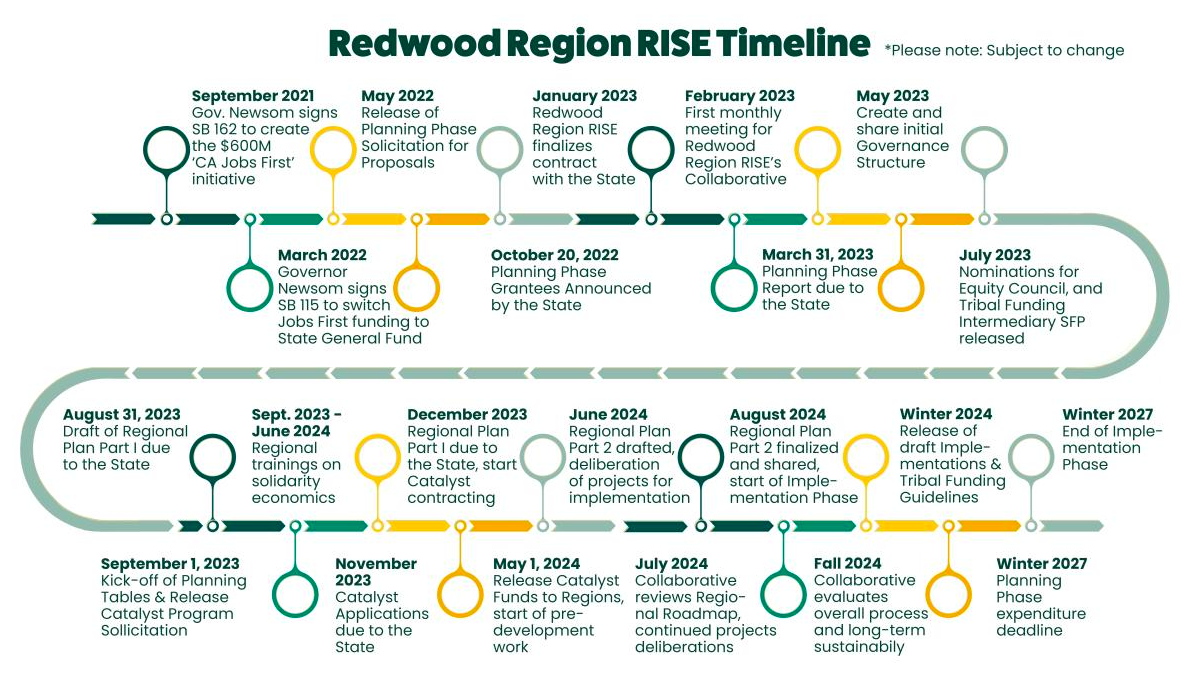
Leoni Fohr, a communications associate for the California Center for Rural Policy (CCRP) at Cal Poly Humboldt, told the Outpost that RISE was formed in 2021 after the California Jobs First initiative (SB 162, formerly known as the Community Economic Resilience Fund) was signed into law with the intent of supporting statewide economic recovery from the distress of COVID-19. It took a while for things to really get going, Fohr said, and the coalition started meeting regularly in February 2023.
“This past year has been a lot of building up the program, conducting outreach and education and getting folks involved,” Fohr said in a recent phone interview. “We have close to 1,000 members in our community and a lot of representatives from community-based organizations.”
Those members are made up of representatives from local tribes, education, environmental justice groups, labor unions and government bodies, collaborating to create a 10-year vision to create more jobs and foster a sustainable economy in Humboldt, Del Norte, Lake and Mendocino counties and tribal lands. The California Center for Rural Policy acts as part of the coalition’s “convening team,” which is in charge of bringing together the various groups and organizations, and also includes representatives from the Arcata Economic Development Corporation, North Coast Opportunities and True North Organizing Network.
Chart showing RISE’s timeline | From RISE’s website
Currently RISE’s vision is still in the planning phase, Fohr said, and it’s working to identify which projects and programs the coalition wants to support. RISE has been accepting project proposals, and Fohr said that the $14 million funding will go toward continuing the selection process and prepping the chosen projects to ready them for additional grant funding. Though the $14 million will not go far enough to actually launch the selected proposals, Fohr said, it will allow RISE to get the projects “shovel-ready,” so that they are eligible for competitive grants to keep the projects going.
“It takes a lot for a project to move from planning to implementation,” Fohr said. “That’s where a lot of projects get stuck – there is funding for the planning, but not enough funding to keep them running. At the end of August 2024, there’s $26 $260 million becoming available in competitive funding. We’re hoping to get the projects ready to apply for that funding.”
RISE is selecting a wide range of proposals, Fohr said, that would support job creation or workforce development, including developing youth job-training centers, healthcare training and scholarship programs for training firefighters. RISE is particularly interested in supporting programs that offer creative solutions to more than one economic problem, Fohr said. For example, one project RISE is looking to support would work with local healthcare partners to establish an art therapy program and train local artists to lead the classes. This would address our area’s lack of mental healthcare, while also creating jobs for out-of-work artists.
If you have a great idea for a project or program that will stimulate our regional economic development, RISE is still accepting proposals via its Project Inventory Intake Form. RISE will continue accepting submissions on an ongoing basis, but the deadline to be considered for implementation funding is March 28.
And if you don’t have a proposal to submit, but are still interested in being involved in RISE’s decisions or just want to learn more about the coalition, you can attend one of RISE’s monthly Collaborative Meetings, held over Zoom on the last Thursday of each month. That means the next meeting is coming right up – Thursday, March 28, from 11 a.m. to 12:30 p.m. You can join by following this link.
RISE is meant to be a community-led coalition, so Fohr encourages everyone to get involved in whatever way they can to help RISE hear directly from members of the community on their needs.
“It’s a fairly new approach to really working with communities…to hear from them what they need,” Fohr said. “This is so valuable on a state level, because it’s hard to picture what it’s like living in a rural area. If RISE does a good job we can show our area’s unique difficulties, but also show our resilience.”
###
CORRECTION: This article has been changed from its original version to reflect that $260 million, not $26 million, will be available in competitive funding. That’s a big difference! It has also be changed to reflect that CCRP is a part of Cal Poly Humboldt.
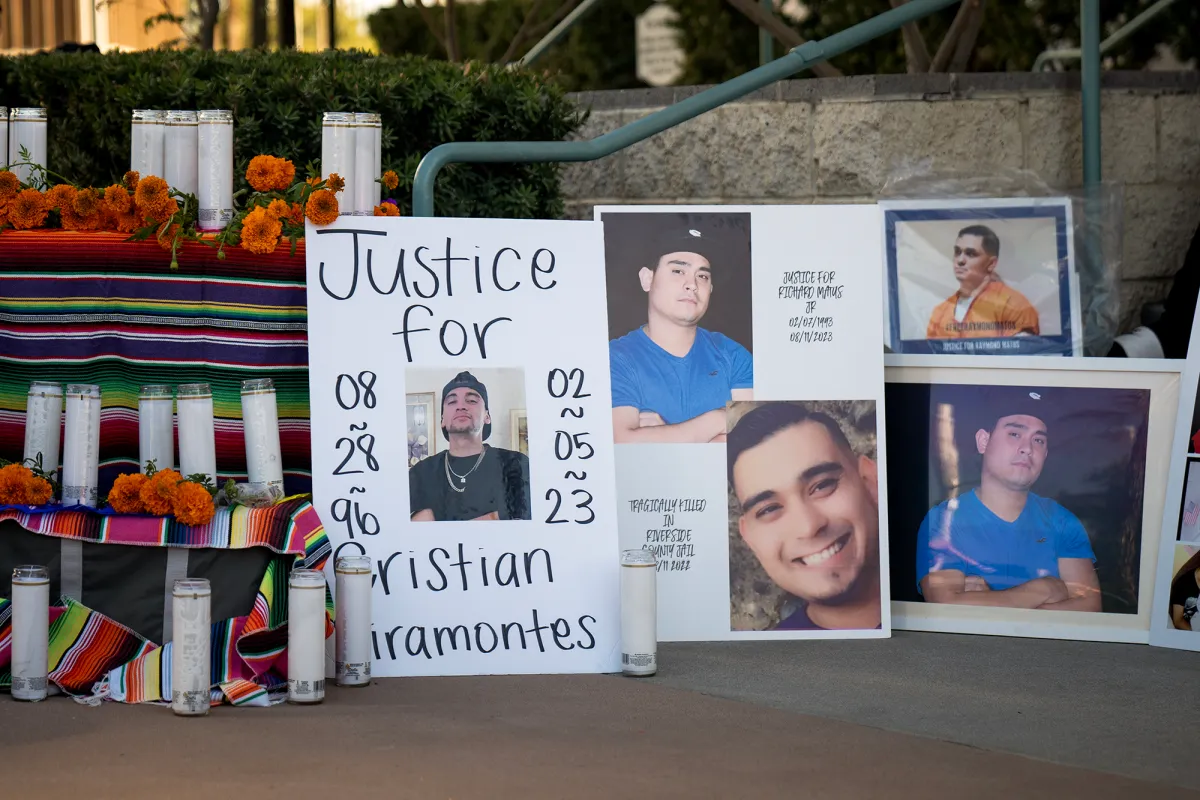
A Dia de los Muertos altar outside the John F. Tavaglione Executive Annex in Riverside county in honor of those killed in the custody of Riverside Sheriff’s Department deputies, on Oct. 31, 2023. Photo by Jules Hotz for CalMatters
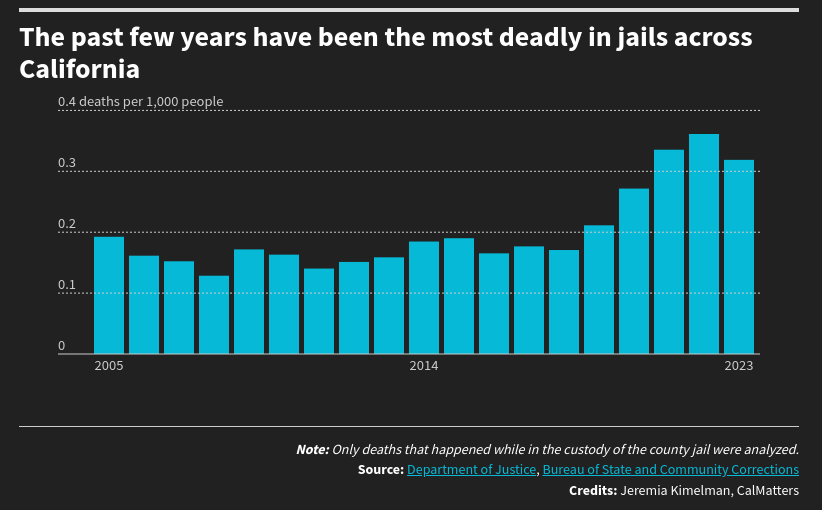
People are dying in custody at record rates across California. They’re dying in big jails and small jails, in red counties and blue counties, in rural holding cells and downtown mega-complexes. They’re dying from suicide, drug overdoses and the catch-all term natural causes.
The number of jail deaths is up even though the number of people in jail is down.
The state is aware. Reams of reports from oversight agencies have repeatedly pointed to problems in individual jails and the state board that oversees them.
Gov. Gavin Newsom pledged almost five years ago that the state would take a stronger hand to prevent deaths in the 57 jail systems run by California county sheriffs.
In every year since, more people have died in California jails than when Newsom made that pledge — hitting a high of 215 in 2022. Tulare, San Diego, Kern, Riverside and San Bernardino counties’ jails set records.
Nor was the pandemic the driving factor: California in 2022 had the smallest share of deaths due to natural causes in the past four decades. A surge in overdoses drove the trend of increasing deaths. And almost every person who died was waiting to be tried. A previous CalMatters investigation found that three-quarters of those held in county jails had not been convicted or sentenced, with many awaiting trial more than three years.
A state board was supposed to put in place measures that would keep inmates safer. Newsom committed to working through that board when he said in 2020, “I’ve got a board that’s responsibility is oversight. I want to see them step things up.”
But since then, Newsom and the Board of State and Community Corrections have been unable to slow the deaths. Until recently, the board was not even notifiedabout deaths inside the county-run lockups, and a 2021 State Auditor’s report criticized the board for failing to enforce its own rules and standards on mental health checks and in-cell wellness checks of inmates.
The state has begun to take a somewhat stronger role.
The governor appointed a formerly incarcerated person to the Board of State and Community Corrections, and also signed a bill last year that added to it a licensed health care provider and a licensed mental or behavioral health care provider.
Following through on his 2021 budget proposal to increase the frequency of jail inspections and allow the board to perform them unannounced, Newsom directed an additional $3.1 million each year to the oversight board. The board reported that last year it conducted 31 unannounced jail inspections, a change from past practice when it would visit jails just once every two years, and told jail authorities in advance when inspectors were coming.
And a new law in July will add a staff position to review in-custody deaths, a position to be appointed by Newsom and confirmed by the Senate.
But critics say those steps have been insufficient. For instance, the original bill would have put jail death monitors in every county.
From right, Gov. Gavin Newsom, along with Senate President Pro Tem Toni Atkins, and Attorney General Rob Bonta, speaks in support of Prop. 1 during a press conference at the United Domestic Workers of America building in San Diego on Feb. 29, 2024. Photo by Kristian Carreon for CalMatters
CalMatters sent nine questions to the governor about jail deaths, the effectiveness of the state board, and his own 2021 pledge to strengthen jail oversight.
Newsom’s office did not answer the questions, instead sending a list of accomplishments to reflect “the Governor’s extensive record in this space.” Those mostly applied to his policies for state prisons, such as a death penalty moratorium.
When CalMatters asked him about high statewide jail deaths at a March 1 press conference in the Inland Empire, Newsom responded by saying:
“The governor,” Newsom said, “just signed legislation to actually be able to create a point person specifically responsible for overseeing what’s happening in county jails, working with (Attorney General Rob Bonta), who’s also been advancing investigations. One very close to home here in Riverside County, related to 18 in-custody deaths in 2022 with the current sheriff.”
The officials with the greatest influence over what happens in jails — the state’s elected county sheriffs — say additional state oversight is unnecessary. California State Sheriffs’ Association president Mike Boudreaux, who is also the sheriff of Tulare County, said he already answers to a state oversight board, the state Justice Department, county grand juries, federal courts, state courts and the media.
“What we see is that people criticize jails, they criticize sheriffs’ offices,” Boudreaux said. “And the reality of it is, they’ve never been inside a jail. They’ve never worked side-by-side with the sheriffs’ offices. They’ve never sat in meetings that we sit in to make sure that not only are we doing things right, we’re doing things that are for the safety and security of those inmates.”
In 2011 California — as it thinned severely overcrowded state prisons by sending tens of thousands of recently convicted offenders to county-run jails — created an oversight board for prisons and jails. This 13-member Board of State and Community Corrections is composed mostly of people with law enforcement and probation experience. The governor appoints eight, with one each appointed by the Judicial Council of California, Speaker of the Assembly and Senate Rules Committee.
The other two current board members are the state prison system’s chief and its director of parole operations.
The board’s initial mission was to lend independent expertise to jails and prisons and act as a “data and information clearinghouse.” The board gives out $400 million each year to jails, prisons, tribes and community organizations. It also sets standards for correctional facilities, from the hourly checks performed on inmates to the time set aside for recreation.
Almost immediately after its formation, the board was confronted with the limits of its powers: It lacked authority to mandate that all California sheriffs report their data – including in-custody deaths.
That will change when the state board’s new reviewer of in-custody death starts this summer.
When asked by CalMatters why more people are dying in California jails, despite a declining jail population, Board of State and Community Corrections representative Adam A. Lwin responded, “The BSCC is not in a position to comment on this question with respect to deaths in jails.”
“Until the passage of (the new law adding a detention monitor), the BSCC did not have specific responsibilities related to deaths in custody, beyond inspecting for the local agency’s policy and procedures related to reporting on any death in custody,” Lwin wrote in response to CalMatters’ questions.
So why are so many dying in California jails?
The reasons people are dying at record rates in California jails are a matter of circumstance, although in interviews with more than 70 people involved in California jails systems, from sheriffs and prosecutors to inmates and nurses, some patterns emerged.
Natural causes have long accounted for the biggest share of jail deaths, followed by suicides.
Suicide prevention should be a higher priority for jail staff, said University of Texas School of Law professor Michele Deitch, among the nation’s foremost authorities on deaths in prisons and jails.
“The vast majority of these deaths are preventable,” she said.
The causes of a significant number of deaths for recent years are still pending – meaning that the sheriff’s office hasn’t yet identified the cause or the Justice Department hasn’t updated the cause in its data collection.
But the recent increase in deaths came from the third largest cause overall, accidental deaths including fentanyl overdoses. Overdoses accounted for 43 deaths in 2022.
Fentanyl overdoses present a far deadlier challenge now than the previous dominant drug in jails, methamphetamine. Other factors are the same ones Newsom cited a few years ago: suicide; failures in health care or psychiatric evaluations; and less commonly, violence among inmates or by jail guards.
Protestors hold signs outside the John F. Tavaglione Executive Annex building in protest of jail deaths in Riverside County, on Oct. 31, 2023. Photo by Jules Hotz for CalMatters
First: A row of cells in an inmate housing unit at the Tulare County Adult Pre-Trial Facility on Sept. 18, 2023. Photo by Larry Valenzuela, CalMatters/CatchLight Local. Last: Sabrina Weddle protests in front of the San Diego Central Jail in San Diego on Oct. 24, 2023. Waddle’s brother, Saxon Rodriguez, died while in custody at the jail after overdosing on fentanyl in 2021. Photo by Adriana Heldiz, CalMatters
Shannon Dicus, San Bernardino County’s Sheriff and a member of the Board of State and Community Corrections, said the rise in deaths in part reflects trends that are unfolding outside of jails, including an overstretched mental health system and widespread use of potentially deadly opiates.
For his deputies, a persistent issue is people who know they are in violation of their probation terms hiding drugs in their bodies before they’re returned to jail.
“So a lot of these folks are secreting opiates in their rectum,” Dicus said. “We run dogs through. We do a number of things. We’re spending $250,000 on body scanners. And what happens is some of these people, they’ll have it in their bodies where we can’t detect it.
“They go into the jail, they get housed in their general housing assignment, and then all of a sudden I have seven fentanyl overdoses. And that’s the truth.”
Dicus said jails also find letters sent to inmates in the mail that were dipped in diluted fentanyl or methamphetamine.
But sometimes the jail-keepers themselves are responsible. During the pandemic, when jails were closed to visitors, drugs still found a way in. Jail deputies in Riverside and Fresno counties have been charged with drug smuggling, and an Alameda County civil grand jury found that a private jail contractor fired the medical director of the county’s jails for writing fake prescriptions to obtain opioids for herself.
Sheriffs have sometimes resisted outside pressure to more closely monitor their employees. In San Diego County jails, where according to Justice Department statistics 47 people died between 2021 and 2023, Sheriff Kelly Martinez and her predecessor have repeatedly refused requests from the local civilian law enforcement review board to put her deputies through scanners before they start their shifts. Two jail deputies pleaded guilty to drug-related charges last year, one for burglary of medication from a jail prescription medication drop-off box and the other for possession of cocaine on jail property.
Burned out jail medical staff
Jails could do a better job beginning at intake and reception, said Corene Kendrick, deputy director of the American Civil Liberties Union National Prison Project. She noted that people who have been arrested often are asked deeply personal questions about their substance use and history of self-harm, within earshot of jail deputies and other inmates.
If they don’t disclose that they have drug or alcohol dependency – perhaps fearing that will lead to more charges – Kendrick said the immediate cutoff can pose an enormous health risk.
And for people who are on psychiatric medication but don’t like the side-effects or don’t want to disclose their condition, the cessation of their medication can send their mental health into a tailspin.
The pandemic also badly dented jails’ ability to provide quality health care, critics contend.
When jails reopened to their regular capacity, Kendrick said, the arrival of new inmates and the resignations of burned-out health care workers stressed the systems beyond their breaking points. “A lot of jails have said that they’re having problems with correctional and health care staff who quit during the pandemic,” she said.
“I was not able to offer the kind of medical care that I wanted to be able to offer and that contributed to burnout for me.” — Dr. Lauren Wolchok
One of those was Dr. Lauren Wolchok, who worked in Los Angeles County jails from 2016 to 2021. Before and during the pandemic, she said, the number of opioid-dependent patients she saw skyrocketed. But those jails strictly restricted opioid treatment, she said, confining it to a small subset of the population that needed it.
“I was not able to offer the kind of medical care that I wanted to be able to offer and that contributed to burnout for me,” Wolchok said. “I had long struggled with the existential crisis of, am I doing more harm than good by working in this terrible setting or am I sort of fighting against the system and getting people care that they otherwise wouldn’t have?
“Especially as the quality of the care that I felt I was delivering declined, it became harder and harder for me personally to decide that I was fighting the good fight.”
Drug overdoses, insufficient medical treatment, suicides — all of those causes of jail deaths could be minimized by more stringent policies. Academics, inmates and their advocates suggest scanning jail workers for drugs, providing a ready supply of the opioid-blocking naloxone nasal spray, ensuring inmates go through intake in a more private area, performing more frequent checks of inmates, and instituting local oversight boards.
Those decisions fall to one person: The county sheriff.
An overdose? Or a heart attack?
Some of California’s deadliest jails are in Riverside County, where 45 people have died since Jan. 1, 2021. One of them was Richard Matus.
Matus knew he wasn’t feeling well days before he died.
In journals he kept during his incarceration, which his family provided to CalMatters along with his medical records, Matus complained of feeling ill and receiving no medical help in jail.
“Its hard to deal with being treated as a sick animalan feelinglike im just waiting to die,” he wrote in one entry. “Iv put in medical slips to see a doctor because I felt sick, very dizzy, bad head ack, felt like I was running fever and completely lost my sense of smell witch was really weird. They never followed up I believe it was twice I put in medical slips an no response so I gave up.”
Matus, whose family said he hadn’t used drugs besides marijuana before his incarceration, was found dead in his cell on Aug. 10, 2022, of a fentanyl overdose.
The Riverside County Sheriff’s Department coroner’s death record for Richard Matus Jr. Illustration by Miguel Gutierrez Jr., CalMatters
In a lawsuit filed in March 2023, Matus’ family alleges that Matus was lucid and communicative on the phone with his mother, Lisa, hours before his death. They allege that his “dire need for emergency medical intervention went unnoticed by the (jail’s) custody staff.”
An autopsy conducted eight hours after Matus’ death found something else. His left anterior descending artery, which provides half the heart’s blood supply and is known colloquially as “the widowmaker,” was 80% to 90% blocked. A medical form filled out by Matus on Sept. 26, 2021, indicated that a doctor told him his cholesterol and blood pressure were far above normal.
“Every time he complained to that (jail medical) office, they gave him cholesterol pills and told him to lose weight,” Matus’ mother, Lisa, told CalMatters. “They never sent him to the hospital, even though his blood pressure and cholesterol was (above normal). The whole time, he needed medical care and they just ignored him.”
That contention became part of the family’s lawsuit.
“Due to the great delays in securing adequate emergency medical attention for Richard Matus, Jr., and the failures on behalf of the (jail’s) custody staff in performing the required safety and welfare checks,” Matus’ family wrote in the lawsuit, “Mr. Matus did not respond to medical intervention and died.”
The Riverside County Sheriff’s Office responded to the lawsuit by denying all liability and said that Matus’ death was his own doing.
The family of Richard Matus Jr. stands outside the John F. Tavaglione Executive Annex with memorial photos of Richard, who died in-custody of the Riverside Sheriff’s Department in Riverside County. Photo by Jules Hotz for CalMatters
“If Plaintiffs sustained any injury or damages,” they wrote, “such injury or damages were solely caused or contributed to by the wrongful conduct of other entities or persons other than the answer Defendants.”
Some sheriffs have changed their practices to avoid in-custody deaths. Others say they’re looking for solutions. But Riverside County Sheriff Chad Bianco has instead taken an adversarial approach.
Criticism of his policy and practices, Bianco told the Riverside Press-Enterprise, are a “political publicity stunt of the far left.” He did not answer questions from CalMatters.
After an inmate died in 2022, the Riverside Press-Enterprise posted an interview with Bianco. In the comments under the story, someone who identified himself as Bianco interacted with commenters, referring to the demands of people whose family members had died in his jails.
“Did they demand their family members not commit suicide or consume drugs while they were in custody?” he wrote. “Did they ever demand that their family members not commit crimes in the first place? Did their parents ever demand that they take responsibility for their own actions?”
The ACLU sent a letter in September 2021 demanding that the state investigate Riverside County jails. In 2022, another 19 people died, including Matus. After the ACLU wrote again demanding an inquiry by the state’s jail oversight board in early 2023, Attorney General Rob Bonta launched an investigation.
The Justice Department refused to answer any questions about its investigation. Bianco did.
“This announcement comes as a shock but at the same time should have been expected from our California DOJ and the attorney general who cares more about politics than he does about transparency and the truth,” Bianco said in a video the day the investigation was announced.
“This investigation is based on nothing but false and misleading statements and straight out lies from activists, including their attorneys. This will prove to be a complete waste of time and resources.”
‘All we’re doing is making recommendations to sheriffs’
The attorney general has two open investigations into jails, one in Riverside County and one in Santa Clara County. But the organization charged with overseeing day-to-day operations of California’s jails is the Board of State and Community Corrections.
The board can wield significant power.
When it repeatedly found the Los Angeles juvenile hall were unsuitable for housing last year, it shut down the system and directed the county probation department to find new housing for about 300 young people.
But that was an exception.
A Feb. 9, 2023 board meeting turned contentious when it came to the Riverside County jail system, the 15th-largest in the U.S.
Avalon Edwards, a policy associate of Riverside-based social justice organization Starting Over Inc., said the board was not enforcing its own standards of inmate care.
“If (Riverside County) can kill 20 people in 13 months and fail to provide any information to the families impacted, fail to report those deaths to the DOJ within the 10-day mandated reporting period, continue to lie to the public about the cause of death for all these people,” he said, “what are those minimum standards accomplishing?”
Edwards urged the board to withhold funding from noncompliant departments or, if they wouldn’t, he asked every board member to resign.
Critics argue that the board lacks the ability to effectively regulate jails.
“It is not set up with the kind of enforcement power, or teeth, to be able to meaningfully hold accountable agencies that are failing to comply with standards,” recently recalled San Francisco District Attorney Chesa Boudin told CalMatters. “So that’s one problem. And I don’t say that as a criticism of the organization or the people there so much as of the structure.
“I mean, it doesn’t have the ability to actually impose remedies even when it is aware of violations,” he said.
The State Auditor’s Office, meanwhile, zeroed in on San Diego County jails in February 2022. It found that the San Diego Sheriff’s Department failed to prevent deaths in its jails and that its practices “likely contributed to in‑custody deaths.” The auditor’s office also found fault with the state corrections board, saying its jail regulations are inconsistent and its answers to the audit were “deficient or misleading.”
Even one member of the state corrections board feels the board’s hands are tied.
“All we’re doing is making recommendations to sheriffs,” said board member Norma Cumpian. “You’re like, hey, 20 people have died in your jails. We recommend that you, you know, report it quicker. Like, that’s not a lot.”
A Tulare County Sheriff stands guard at an inmate housing unit at the Tulare County Adult Pre-Trial Facility on Sept. 18, 2023. Photo by Larry Valenzuela, CalMatters/CatchLight Local
Cumpian, a former inmate who served nearly 20 years in prison for killing her abusive partner, said she often senses indifference or complacency from her colleagues.
As for plans to add a detention monitor, a dubious Cumpian said “I don’t know, this bill is supposed to release reports to the public. Like, what is that gonna do?”
Dicus, the San Bernardino sheriff who operates the seventh-largest jail system in the U.S., doesn’t see a problem with the way the oversight board operates. He said the oversight board is doing its job in accordance with its mission: assessing the policies and procedures of the jails it oversees while ensuring facilities are up to code.
He said the blame for in-custody deaths extends beyond the jails.
“Locally, try getting some help,” Dicus said. “Our local department of behavioral health, and this is not me throwing stones at them, but they’re 9 to 5. We live in a 24/7 environment where people are in crisis. And the crisis that we’re experiencing, the cops are there 24/7, but we need some of these other service providers to have the same level of response.”
He said the state has to rethink how it operates the social safety net at the county level, especially for mental health and substance abuse.
“It’s just typically this is the way we’ve handled everything, and we need to break out of that,” he said. “I think we need kind of a statewide revisit of what’s working and what’s not.”
###
CalMatters.org is a nonprofit, nonpartisan media venture explaining California policies and politics.
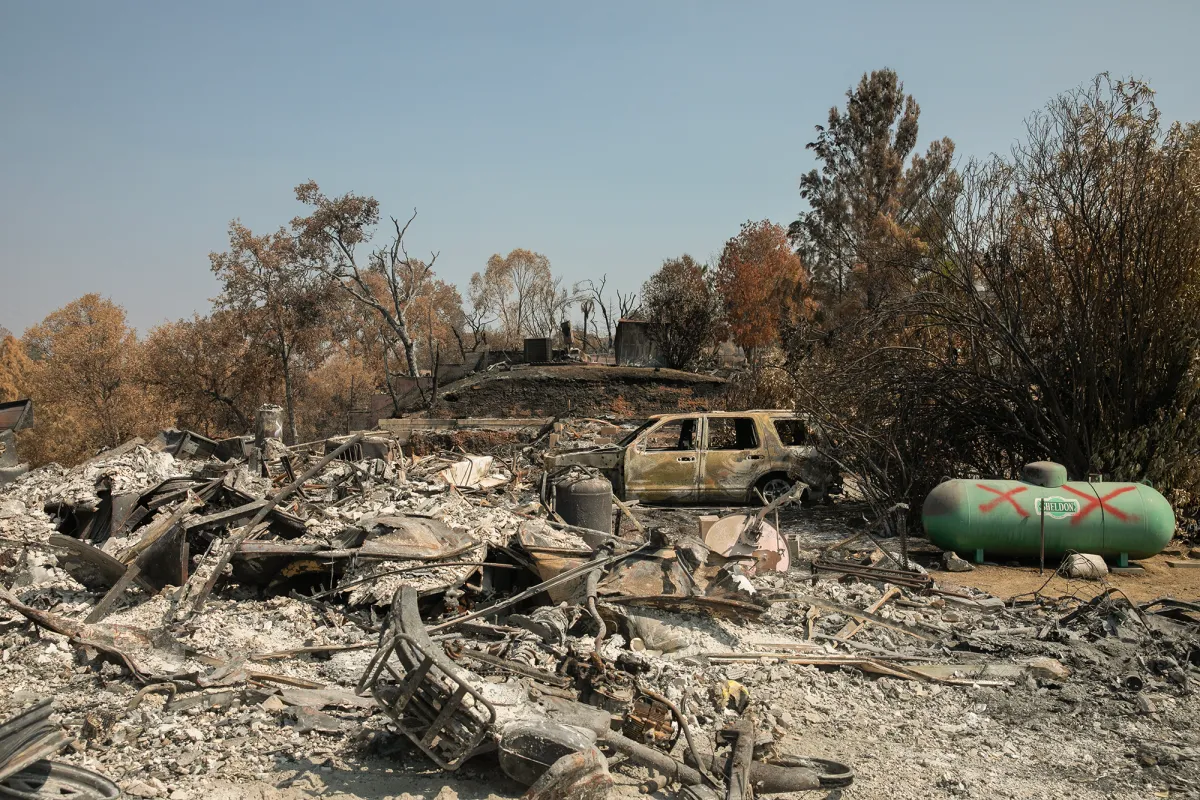
The remains of a burned home in Berryessa Highlands on Sept. 21, 2020. Photo by Anne Wernikoff for CalMatters
With more California homeowners just discovering their insurance policies are getting canceled — and hundreds of thousands of others stuck with a pricey option of last resort — state Insurance Commissioner Ricardo Lara’s efforts to fix the home insurance market can’t come quickly enough.
Lara has introduced two main regulations, with more to come. The first, unveiled last month, aims to streamline rate reviews. State law gives the Insurance Department the power to approve or deny insurers’ requests to raise premiums. Insurance companies complain the process has been holding up the increases they seek as a result of what they say are increased costs due to rising climate-change risks and inflation.
The second regulation will let insurers use catastrophe modeling — which combines historical data with projected risk and losses — along with other factors when setting their premiums. California is the last state to allow for catastrophe modeling.
“We’re undertaking the state’s largest insurance reform,” Lara said during a press conference earlier this month. “We can no longer look solely to the past to guide us to the future.”
He said catastrophe modeling will lead to “more reliable rates,” “greater insurance availability” and “safer communities,” because he said it would further encourage and reward wildfire mitigation by homeowners and communities. Insurance Department spokesperson Michael Soller said success will mean fewer homeowners needing to turn to the FAIR Plan, the state-mandated insurer of last resort.
Insurance trade groups, which stand to benefit most from the new regulations, agree with Lara’s support for catastrophe modeling and support his so-called sustainable insurance strategy. So do fire chiefs, to an extent. But almost everyone else — homeowners, consumer groups and former insurance commissioners — has lingering concerns.
U.S. Rep. John Garamendi, a Democrat representing parts of Solano and Contra Costa counties, had two stints as state insurance commissioner in the mid-1990s and early 2000s. He says the insurance market is “in chaos” — and that Lara should be holding public hearings and demanding insurance company executives testify to explain to Californians why their premiums are rising.
“One of the critical things a commissioner does is to analyze the market and provide the public with information,” Garamendi said in an interview with CalMatters. “(Lara) didn’t use his power to control the industry and second, to inform Californians.”
The criticism drew a retort from Soller: “Commissioner Lara is fixing decades-long neglected issues that have led to this crisis. He is focused on safeguarding the integrity of the state’s insurance market, not second-guessing from predecessors who had their chance and failed to act.”
Dave Winnacker, chief of the East Bay’s Moraga-Orinda Fire District, said the upsides of catastrophe modeling include being able to credit what homeowners, communities and governments do to lessen wildfire risk. That includes being able to account for the numbers and proximity of firefighters in certain areas, Winnacker said.
“Depending on where you are in a state, and that’s tied to population density, the number of firefighters available could affect the outcome (of a wildfire),” he said, adding that catastrophe models should reflect that.
He also said he and other fire chiefs are working to make sure the interests of consumers, fire professionals, insurers and the state are aligned. Insurers may not know what homeowners, communities and local fire departments are doing to reduce wildfire risk. One idea: a database to share that information.
“There is no future in which we can price our way out of this crisis with just premiums,” Winnacker said, adding that everyone needs to work together.
Dave Jones, the state insurance commissioner for eight years before Lara took over in 2019, said he is “trying to avoid looking over the shoulder of my successor.”
Jones is now director of the Climate Risk Initiative Center for Law, Energy & the Environment at UC Berkeley School of Law. He said it is good for consumers that the catastrophe-modeling regulation could take forest management into consideration. But he said he’s not sure Lara’s actions will be sufficient.
State Insurance Commissioner Ricardo Lara speaks during a press conference with Los Angeles labor leaders and advocates in Commerce on Sept. 26, 2022. Photo by Alisha Jucevic for CalMatters
Before the end of the year, Lara is also expected to issue a regulation that will allow insurers to factor reinsurance costs into their rates. Reinsurance is insurance for insurance companies in the event of large payouts. That plus the other new regulations may “help in the short to mid term,” giving insurance companies the ability to raise premiums, Jones told CalMatters.
But he said those actions may “ultimately be overwhelmed by our failure to stop the fossil-fuel industry, which is contributing to rising temperatures” and therefore insurance losses.
Jones also pointed out that Florida has long allowed insurers to use catastrophe modeling and has let them factor in reinsurance costs in their rates — yet its insurance market is in worse shape than California’s.
“Florida has done what insurers are asking for,” Jones said. Yet “Florida’s rates are three or four times the national average.”
Mark Friedlander, spokesperson for the Insurance Information Institute, an industry group, confirmed that the group estimates that Florida’s average home insurance premium was $6,000, or three-and-a-half times the national average, in 2023.
In addition, Jones said Florida’s version of California’s last-resort FAIR Plan — called the Citizens Property Insurance Corp. because it’s funded with a surcharge on policyholders — has more than 1 million policies. California’s growing FAIR Plan, run by a pool of insurers, has 373,000 policies, its president told state lawmakers recently.
“That raises the question,” Jones said. “Giving insurers (higher rates) and shifting the burden to all Californians… whether that’s going to be enough in the face of growing background risk associated with climate change.”
“There is no future in which we can price our way out of this crisis with just premiums.” — Dave Winnacker, chief of the East Bay’s Moraga-Orinda Fire District
Meanwhile, last week State Farm said that it is not renewing policies for 30,000 California homeowners, as well as refusing to cover all commercial apartments by not renewing 42,000 of those policies.
This is happening despite California approving State Farm’s requests to levy double-digit premium increases last year.
“One of our roles as the insurance regulator is to hold insurance companies accountable for their words and deeds,” said Soller, the Insurance Department spokesperson. “State Farm General’s decision… raises serious questions about its financial situation — questions the company must answer to regulators.”
State Farm spokesperson Sevag Sarkissian would not comment beyond the statement the company put on its website last week, which read in part: “This decision was not made lightly and only after careful analysis of State Farm General’s financial health, which continues to be impacted by inflation, catastrophe exposure, reinsurance costs, and the limitations of working within decades-old insurance regulations.”
Sarkissian also referred CalMatters to the Personal Insurance Federation of California, which counts State Farm as a member. The industry group’s spokesperson, Rex Frazier, said in an email last week that allowing insurers to use catastrophe modeling would help with insurance availability. Yet in its statement, State Farm acknowledged the actions Lara is taking to try to fix the insurance availability and affordability crisis in California, even as it announced its decision not to renew tens of thousands of homeowners.
“If a big chunk of your insurance rate is behind a ‘black box,’ then that’s not what the voters passed.” — Carmen Balber, executive director of Consumer Watchdog
Joyce Kaufman, a retiree in June Lake in Mono County, recently got a notice of non-renewal for her homeowners insurance with Farmers, which she said she and her husband were dreading but expecting.
“I’m not really sure what the state’s trying to do, both at the commissioner and legislative level,” Kaufman said. And losing the ability to renew her policy is affecting her other insurance needs, she said. As her broker helps look for an alternative, her auto premium is now going up about $300 a year because it will no longer be bundled with home insurance.
As the new regulations give insurance companies what they had asked for, one part of Lara’s strategy — which he first laid out last year after an executive order by the governor — is conspicuously missing. Lara had said insurance companies would be required “to commit to writing at least 85 percent of their statewide market share in wildfire-distressed underserved areas.”
That provision is nowhere in the text of Lara’s unveiled regulations so far — an omission not lost on consumer groups or former commissioner Jones.
“Where is that 85 percent?” asked Carmen Balber, executive director of Consumer Watchdog. Soller, the Insurance Department’s spokesperson, said that part of the commissioner’s strategy is coming.
Balber also said she is concerned that the catastrophe-modeling regulation “appears to not comply with the transparency requirements of Prop. 103,” the voter-approved law that regulates the insurance industry.
According to the text of the regulation on catastrophe modeling, the public will be able to take part in reviewing catastrophe models before they’re deemed acceptable. But anyone who helps review the models will be required to sign a nondisclosure agreement.
“If a big chunk of your insurance rate is behind a ‘black box,’ then that’s not what the voters passed,” when they passed Proposition 103 in 1988, Balber said. “At the end of the day, if the commissioner passes something that hides something behind closed doors, we’ll have to consider challenging it.”
###
CalMatters.org is a nonprofit, nonpartisan media venture explaining California policies and politics.
Donald Eugene Cloney was born December 11, 1921 in
Eureka and died March 10, 2024 at the age of 102 in
Eureka. He was the son of Eugene Showers and Matilda (Johnson) Cloney
of Eureka. He was the second of four sons.
He graduated from Nazareth Academy (St Bernard School), Eureka
High School, and UC Berkeley. He was a veteran of WWII, serving as a
medic in the 89th Infantry, Third Army in Europe. He
started working after school as a boy of 14 in the family drug store,
The Red Cross Pharmacy, and after WWII came back and became a
business partner with his father, then brother, and then son.
He was an active member of St. Bernard Catholic Parish, an
original sponsor and promoter of the Society of St. Vincent de Paul,
a 4th degree Knights of Columbus, member of the Native
Sons of the Golden West, and a member of the Elks Lodge.
He was preceded in death by his brother Gerald R. Cloney,
parents Eugene S. and Matilda J. Cloney, Patricia Mary (Brogan)
Cloney: his wife of 56 years, son Joseph T. Cloney, and his brother
William J. Cloney. He is survived by his sister-in-law Adella Cloney,
brother Stanley E. Cloney (wife Carlotta), son Patrick E. Cloney
(wife Renee), daughter Janice M. Johns (husband Bruce), 3
grandchildren: Rhiannon Johns, Gavin Johns, and Aeryn Johns, and so
very many cousins, nieces, and nephews.
Rosary will be held 5 p.m. Friday, April 26 at
Sanders Funeral Home with the Funeral Mass 11 a.m. on Saturday April
27 at St. Bernard Church. Reception following the
Funeral Mass at the Parish Hall. Interment will be at a later date.
Memorial remembrances can be sent to St. Vincent de Paul Society,
St. Bernard Church, or the charity of your choice.
###
The obituary above was submitted on behalf of Donald Cloney’s loved ones. The Lost Coast Outpost runs obituaries of Humboldt County residents at no charge. See guidelines here.