Naomi Neil “Neil” Ogimachi died at his home in Eureka on March
28, 2024. He was born in Los Angeles in 1925, the fourth of five
children of Japanese immigrants.
He grew up during
the Great Depression. Like many Americans, his family struggled
through poverty, providing their living by picking vegetables in the
fields and trucking them to market, which required he and his
siblings to work in the fields. His family, along with others of
Japanese ancestry, were incarcerated at Manzanar concentration camp
in the California high desert. He graduated from Manzanar High School
and was drafted by the United States Army and inducted in Manzanar in
1944. He trained at boot camp in Camp Hood, Texas and was deployed to
the European Theatre. His military specialty was a “Survey and
Instrument Man.” In Darmstadt, Germany, 19-year-old Sergeant
Ogimachi spent five months in charge of the military police and
prison office of Civilian Internment Enclosure 91 — a P.O.W. camp.
25,000 war criminals were detained in the camp, over half being
Gestapo. He contemplated how ironic that he went from being guarded
to being the guard.
After the war, he
enrolled at U.C.L.A. on the G.I. bill. as a chemistry major. He found
work at the China Lake Naval Station in California’s Mojave Desert,
making explosive parts for nuclear weapons. While at China Lake, he
was able to procure financing for graduate studies at U.C. Davis by
working as a graduate teacher, eventually earning a Ph.D in organic
chemistry from U.C. Berkeley. He found employment with the DuPont
Company in Wilmington, Delaware where he met his future wife,
Frances, or “Jean,” Bennett, a registered nurse, during a party.
They had a brief engagement, were married in 1956 and moved back to
California where he worked again at the China Lake Naval Station. He
adopted her three-year-old boy, David, and they added a daughter,
Catharine, or “Katie” in 1957 and a son Shawn, born in 1958 while
living there.
After the deployment
of Sputnik by the Soviet Union, the United States space program
accelerated and scientists, including chemists, were in demand.
Rocketdyne, the company that supplied all the major engines for the
Saturn Rocket, which propelled the Apollo missions, employed him in
1959 through 1969. His work was primarily in the development in
rocket oxidizers and was involved in several patents at Rocketdyne
while living in suburban Canoga Park, California. In 1962, the couple
added their second daughter, April. All four of his children went on
to graduate with college degrees.
As the Apollo
program was being phased-out, he found new employment and moved the
family to Bogota, New Jersey, working as a chemist in nearby
Hackensack. After five years, the family moved back to California,
settling in the central coast beach town of Aptos. He commuted to
Hollister and worked for Teledyne McCormick Selph until retirement in
1989.
While in retirement
in Eureka, he served for many years as a Trustee of the United
Methodist Church and volunteered building homes with “Habitat for
Humanity.” He and his wife traveled extensively during retirement
including cruises and tours to every continent and many countries in
the world.
He was preceded in
death by his wife of 66 years in marriage, Francis “Jean” Bennet
in December 2022. He is survived by his two sons and two daughters, four
grandchildren (Neil Ogimachi, Mindy Ogimachi, Andrew Jenner and
Eleanor Jenner) and two great-grandchildren (Lyla and Rylan
Ogimachi).
Services will be
held at Oceanview Cemetery April 13, 2024 at 11 a.m.
###
The obituary above was submitted on behalf of Neil Ogimachi loved ones. The Lost Coast Outpost runs obituaries of Humboldt County residents at no charge. See guidelines here.
On Tuesday, April 2, 2024, at approximately 7:45PM, Officers with the Eureka Police
Department were dispatched to the 3000 block of M Street on a report of 3 juvenile
males having kicked and pounded on the front door of a residence, then ran away.
Officers responded to the vicinity but were unable to locate juveniles. Surveillance
footage was provided to the officers and forwarded to the School Resource Officer
(SRO). On April 3, 2024, the juveniles were identified and contacted by the SRO and
reprimanded for their actions. The SRO then contacted the parents of the juveniles and
made them aware of their children’s disturbing behavior.
The Eureka Police Department became aware of a dangerous, viral social-media TikTok
trend called “The Door Kick Challenge.” The prank encourages people to pound and
kick on a door to a residence so it sounds like a home invasion. We believe this is what
occurred during this incident.
The Eureka Police Department wants to bring this to the attention of the community
and to let you know if this happens to you, please report it immediately. This behavior
will not be tolerated. This trend is not only dangerous to those performing the
challenge, it is also disturbing for our residents. This type of activity could potentially
lead to criminal charges against the perpetrators.
Officers and neighbors said they’re worried about how people might react when they’re
caught off guard in their own homes and believe someone might be attempting to break
in and they feel the need to protect themselves. Police encourage parents to talk with
their kids about this challenge and warn them of how dangerous it can be.
“This is a foolish and dangerous ‘Challenge’ for the youth of our community that could
have severe consequences and potentially lead to someone getting injured or killed. It is
not ‘funny’ and will not be tolerated in our community. I implore our youth to make
better decisions, think about the impacts of your actions, and respect the quality of life of
our community members. I also ask for the parents in our community to discuss the
potential life altering impacts this could have for you and your children should something
horrible occur. This isn’t like the old time Ding-Doing-Ditch prank, this prank may get
you killed.” ~Chief Stephens
The City of Eureka is moving forward with a proposal that could influence future development at the former Jacobs Middle School Campus.
During last night’s regular meeting, the Eureka City Council voted 4-1, with Councilmember Renee Contreras-DeLoach dissenting, to direct staff to develop a “Mixed Neighborhood” overlay zone that would “add special requirements, limitations, or enhanced flexibility” on top of the base zoning designation of the Jacobs Campus. The overlay zone would provide design standards to ensure future residential or commercial development of the site fits in with the Highland Park neighborhood’s overall scale and character.
In simpler terms: The overlay zone, if approved, would prevent a developer from building something at the site that doesn’t match the rest of the neighborhood, like a high-rise apartment complex or a huge department store.
The push to control development at the long-disused school site comes about three months after the Eureka City Unified School District board of trustees unanimously voted to exchange the site to a mysterious private developer, known only as “AMG Communities-Jacobs, LLC,” for another small property and $5.35 million. The controversial land exchange, which has yet to be finalized, came about several months after the Citizens for a Better Eureka launched its “Housing for All and Downtown Vitality Initiative,” which would require the city to amend its General Plan to accommodate single- and multi-family housing on the Jacobs Campus.
The Jacobs Campus is currently zoned as “Public Facilities,” a designation that restricts land use to government facilities and schools. The Housing for All Initiative, if passed, would apply its own overlay zone that would authorize high- and low-density residential uses, public and quasi-public uses “compatible with a residential setting,” principally permitted commercial neighborhood-serving uses and uses allowed under the Downtown zoning designation.
During last night’s meeting, Development Services Director Cristin Kenyon noted that the initiative “doesn’t talk at all” about form and design standards for future development. “[The city’s] overlay would be focused on form, not use,” she said.
Contreras-DeLoach | Screenshot
Contreras-DeLoach asked if the overlay would “prevent any of what the initiative is trying to do” and whether it would still allow for commercial uses.
“It would still allow the same uses,” Kenyon said. “[We’re] talking about what the buildings will look like, and the building could be occupied by any of those uses. … [There are], like, 100 uses that could be allowed under the initiative.”
The overlay zone could be applied to other Eureka neighborhoods. Kenyon emphasized that the proposal before council would be the first step in the development of the overlay zone. “We would develop an overlay and then we bring it to you to adopt into the code [but] it wouldn’t yet apply anywhere,” she said. “And then, separately, you could take an action to apply it in the future as you thought fit.”
At the council’s last meeting on March 19, Councilmember Scott Bauer expressed concern that the overlay project would get in the way of other important projects. During that discussion, Kenyon admitted that staff “was swamped” but said hiring a consultant to help develop the overlay would offer some relief.
Councilmember Kati Moulton returned to the issue and asked if staff had any other concerns about the overlay development process and potentially putting it in front of other projects.
“I don’t think staff could tell you specifically what this would delay or anything like that, but obviously putting this on there would be an additional workload for staff,” said City Manager Miles Slattery. “Things pop up all the time … . Emergencies happen and priorities get changed, but it’s up to council to determine what direction that staff [chooses].”
Bauer | Screenshot
Bauer spoke in favor of the overlay but said he was “still torn” about taking staff away from other important projects. “I think this is a good idea, I really do,” he said. “But we have a lot of stuff on our plate and we’re adding another thing that might delay other things. I struggle with that, you know? I really want us to explore this but is this the [right] time?”
Councilmember Leslie Castellano said the overlay would serve as one more tool in the city’s toolbox.
“I think of an overlay as a tool [that] we don’t have thus far,” she said. “We use hammers all the time in our zoning code, but maybe we don’t have a really cool router for a special custom carpentry. … Sometimes we don’t need that router but every now and again, we’re gonna make a really cool cabinet with [it] that … has some cool regenerative community building component that we would have never had before. … That’s why I support it.”
During the public comment portion of the meeting, Eureka resident Thomas Stewart said “rezoning [the] Jacobs [Campus] without information from the developer [would be] improper.” Like many others, he speculated that Security National President and CEO Rob Arkley was behind the land exchange, although company founder Rob Arkley has denied any involvement. Stewart was so sure of himself that he put up a bet. [CORRECTION: Stewart did not specifically mention Arkley.]
“I will wager here tonight 10 Bitcoin,” he said, placing something on the podium. “If I’m wrong, you can keep them. If I’m right, please give them back to me. Any questions?”
Confused by the gesture, Eureka Mayor Kim Bergel called for a “point of order” and said the council could not accept his bet. “We appreciate that, but we can’t accept it,” she said.
After a bit of confusion and Stewart claiming he would be “a dead man” if he took the Bitcoin back, he admitted that they were fake and he had bought them on eBay for 10 bucks.
Michael Munson, one of the proponents of the Housing for All Initiative, asserted that the proposed overlay zone would conflict with the upcoming ballot initiative and urged the council to wait for the November General Election before taking any action on the matter.
“According to Election Code 9217, if the initiative were adopted, it would prohibit the city from adopting a General Plan or zoning [amendment] that would be in conflict with the initiative,” Munson said. “Also, the proposed overlay zone is purported to be exempt from CEQA [California Environmental Quality Act]. That’s not true either. … I think this is just a huge waste of money at this point.”
A section of the aforementioned section Election Code states, in part, “No ordinance that is either proposed by initiative petition and adopted by the vote of the legislative body of the city without submission to the voters, or adopted by the voters, shall be repealed or amended except by a vote of the people, unless provision is otherwise made in the original ordinance.”
City Attorney Autumn Luna did not address Munson’s claims directly but, at one point during the meeting, reiterated that staff was “simply asking council to authorize some money and some additional staff time” to look into the development of an overlay zone. “We are not changing the zoning code tonight.”
Luna did not respond to the Outpost’s immediate request for additional comment. We’ll update here if we hear back.
After a bit of additional discussion on the matter, Moulton made a motion to direct staff to hire a contractor for up to $40,000 to develop a “Mixed Neighborhood” overlay zone for the Jacobs Campus. The motion was seconded by Fernandez.
Before voting on the item, Contreras-DeLoach warned the council that she would be voting against the item because she wasn’t comfortable with the precedent that the overlay zone would set.
The motion was approved 4-1, with Contreras-DeLoach dissenting.
###
Other notable bits from the meeting:
The city council unanimously approved a Memorandum of Understanding (MOU) between the city, Ink People Center for the Arts, Eureka Main Street and Wiyot Tribe for the recertification of the Eureka Cultural Arts District (ECAD). The ECAD is one of 14 cultural arts districts in California. The city was recently awarded $671,429 from the state to further local artistic endeavors. The funds will be disbursed over a five-year certification period.
The city council also received an update on Eureka’s Capital Improvement Program. The council received an extremely thorough report from City Engineer Jesse Willor, who went over dozens of projects that have been completed in the last year, and dozens more that are in progress, including various road improvement projects.
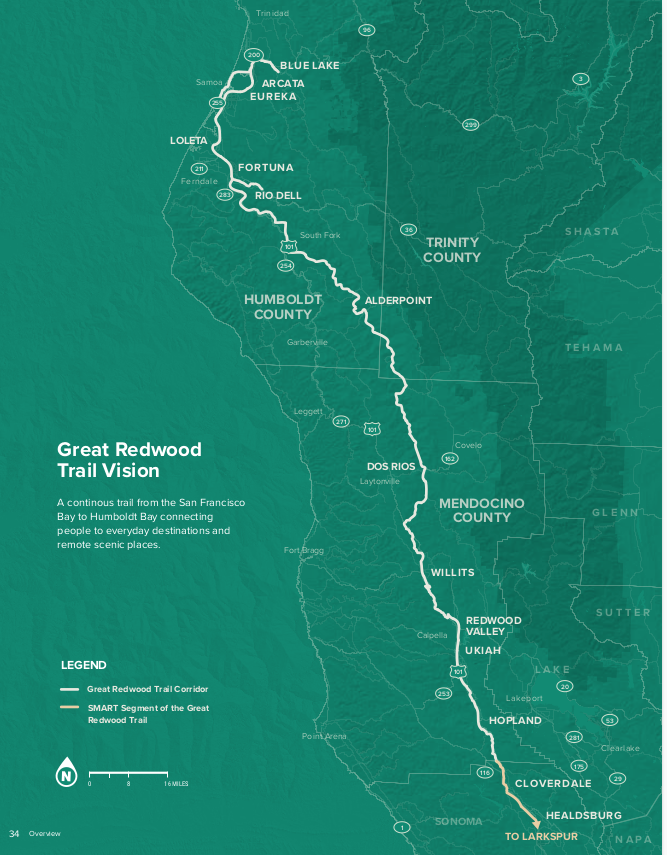
A future Loleta, as transformed by the Great Redwood Trail and envisioned in the Great Redwood Trail Draft Master Plan.
Two
and a half years after Gov. Gavin Newsom officially brought
the Great Redwood Trail Agency to life, that state body today
unveiled a first draft of its master plan – the document that will
guide efforts to transform the old railroad line from Humboldt to
Marin County into a continuous 300-mile hiking, biking and equestrian
trail and, some hope, a major tourist attraction.
“We
live in a big part of California,” writes state Sen. Mike McGuire
in an introduction to the agency’s new, 586-page Draft Master Plan.
“Big trees. Big skies. Big waves. And big dreams.”
“This
is what the Great Redwood Trail is all about.”
Map of the line. Click to enlarge.
The document amounts to a sort of giant to-do list for the entire project, or at least from the Mendocino-Sonoma County line north to Blue Lake. (The southern section of the trail is under the direct control of a different agency — Sonoma-Marin Area Transit, which runs commuter trains in those counties.)
It includes designs for possible amenities which might be located along the length of the trail, including welcome centers and bathrooms and campgrounds. It has drafts of the types of signage that will be installed. It calculates the annual economic benefit of the trail to be $102.5 million annually, and it breaks down that figure by jurisdiction. (Humboldt stands to gain $28.8 million in tourism revenue, it figures, and an additional $20 million in transportation and health benefits.)
Perhaps most importantly, the Draft Master Plan prioritizes action on certain sections of the trail. What sections should be built first? Which are most feasible to build, and which confer the most benefit? A few of those top-priority sections are here in Humboldt County, including an extension of the Humboldt Bay Trail all the way down to Scotia and up to Blue Lake.
Perhaps more surprisingly: The agency is also listing a stretch of the remote, geology-challenged Eel River Canyon — from Island Mountain to Alderpoint to Fort Seward — as a “Tier One” priority.
In this vision, Alderpoint — just half an hour from Garberville and Highway 101 — would serve as a hub for the very first nature-centric stretch of the Great Redwood Trail. Campgrounds and river access could be located on a 30-acre parcel just outside town that the Great Redwood Trail Agency owns. There would be possibility of “trail-oriented development
including lodging, retail and
dining opportunities.” And though much of this of the Eel River section of the trail would be unpaved, meaning unfriendly to cyclists, the Draft Plan envisions a possible bicycle loop trail between Alderpoint and Fort Seward, just downriver.
A future Fort Seward.
It doesn’t sound terribly like Alderpoint as it is, but at least some of the locals are pretty stoked. The Great Redwood Trail Agency’s press release about the Draft Master Plan quotes a couple of them:
Sterling Kercher, Alderpoint volunteer Fire Chief, logger, builder, and local landowner, said the trail is “a good thing for the
community to give them the opportunity to make some money. It’s a community thing, to unite us and to bring people together.”
Equitable access to the Eel River Canyon and beyond is attractive to locals and visitors alike, including Shannon Stillwell, Alderpoint
volunteer firefighter and multi-generational resident.
“How can we enjoy the Eel River Canyon if we can’t see it?” Stillwell asked. “Our waterways are God-given, and I want my grandkids
to be able to hike up the canyon where their ancestors lived and enjoy the natural landscape.”
Elaine Hogan, the Great Redwood Trail Agency’s executive director, told the Outpost today that the Alderpoint-Fort Seward section of the trail scored high in the priority list for a few reasons. It’s close to major roads, it has less bridge and tunnel damage than other areas of the Eel River Canyon’s old train right of way, and the agency’s assets — including that 30-acre parcel and the old Fort Seward Depot, pictured above — could be redone as tourist attractions with relative ease.
Still, Hogan said, other “Tier One” areas, including the Humboldt Bay Trail extension, will likely get more attention, at least until partnerships or money can be found to take it on.
“[The draft plan] is a really fluid document, in terms of prioritization,” Hogan said.
The Great Redwood Trail Draft Master Plan is currently being circulated for public comment. If you have a laptop or a desktop computer, you should really download the thing and scroll through it. Here’s the direct link. It’s beautifully produced, and it thinks through an enormous range of questions regarding this ambitious project.
Comments on the plan are due June 3. Instructions on how to comment are available at this link.
And next week the agency will be hosting an open house on the Draft Master Plan at Eureka’s Sequoia Conference Center (901 Myrtle Ave.). It’ll be on Tuesday, April 9, from 5:30 p.m. to 7:30 p.m., and Hogan tells us there’ll be tons of exhibits and people on hand to explain things and take your questions.
Amorphophallus konjac, commonly known as the corpse flower or corpse plant, blooms in the Cal Poly Humboldt greenhouse. | Photos by Ryan Burns.
###
On Wednesday morning, students filed in, one or two at a time, to the humid air of the geodesic Dennis K. Walker Greenhouse on the campus of Cal Poly Humboldt Wednesday morning, excited to get a look and a whiff of the resident corpse flower (scientific name: Amorphophallus konjac) that has bloomed for the first time since 2021.
The flower — or, more precisely, the inflorescence, a stalk of many flowers — looked frankly excited, too. (Fun science fact: Amorphophallus comes from the ancient Greek for shapeless or deformed penis.)
A sour, earthy smell hits you as you enter the greenhouse, but some brave students were compelled to lean down, dipping their nose into the burgundy collar (or spathe) for a deep inhale of the rotting flesh aroma that gives this plant its name.
“Dead rat,” one student offered as a descriptor.
A Cal Poly Humboldt student poses for a photo with the pungent plant.
###
Native to warm, subtropical to tropical areas of southwest China, the Amorphophallus konjac can grow up to 36 inches wide, with the inflorescence growing as tall as six feet. The burgundy bloom currently up on campus has more modest proportions, but students were still impressed.
“The ones that really bring people in in droves … is the Amorphophallus titanum,” said assistant greenhouse manager Andy Goldman. “It’s gigantic.”
An excited student nearby said, “There’s one in San Diego; I missed that one, though.”
While the climate here in Humboldt County is quite different than this plant’s native environment, Goldman said he once saw an Amorphophallus konjac bloom in the backyard of his home in Cutten.
“Apparently the people that owned the house before us were big gardeners and they planted bulbs,” he said. “It was in a pretty specialized little spot — south-facing, next to the foundation of a garage so it stays nice and warm. But yeah, I’ve lived that for 20 years and I’d never seen in flower. It flowered seven or eight years ago and I haven’t seen it since.”
The corpse flower’s pungent smell serves a botanical purpose: attracting the dung beetles, carrion flies and other carnivorous insects that serve as its primary pollinators, who may be searching for a suitable site to lay their eggs.
“Once pollination is complete, the flower collapses, a process that takes only two to three days,” Cal Poly Humboldt explains on its website. For members of the public wishing to get a gander at this beauty, the greenhouse is open Tuesdays through Fridays from 10 a.m. to 2 p.m., though, again, the bloom won’t last for long.
To sum up: Its scientific name means “malformed penis,” it smells like death and it doesn’t last very long. And yet somehow it still manages to please people. Good for you, buddy.
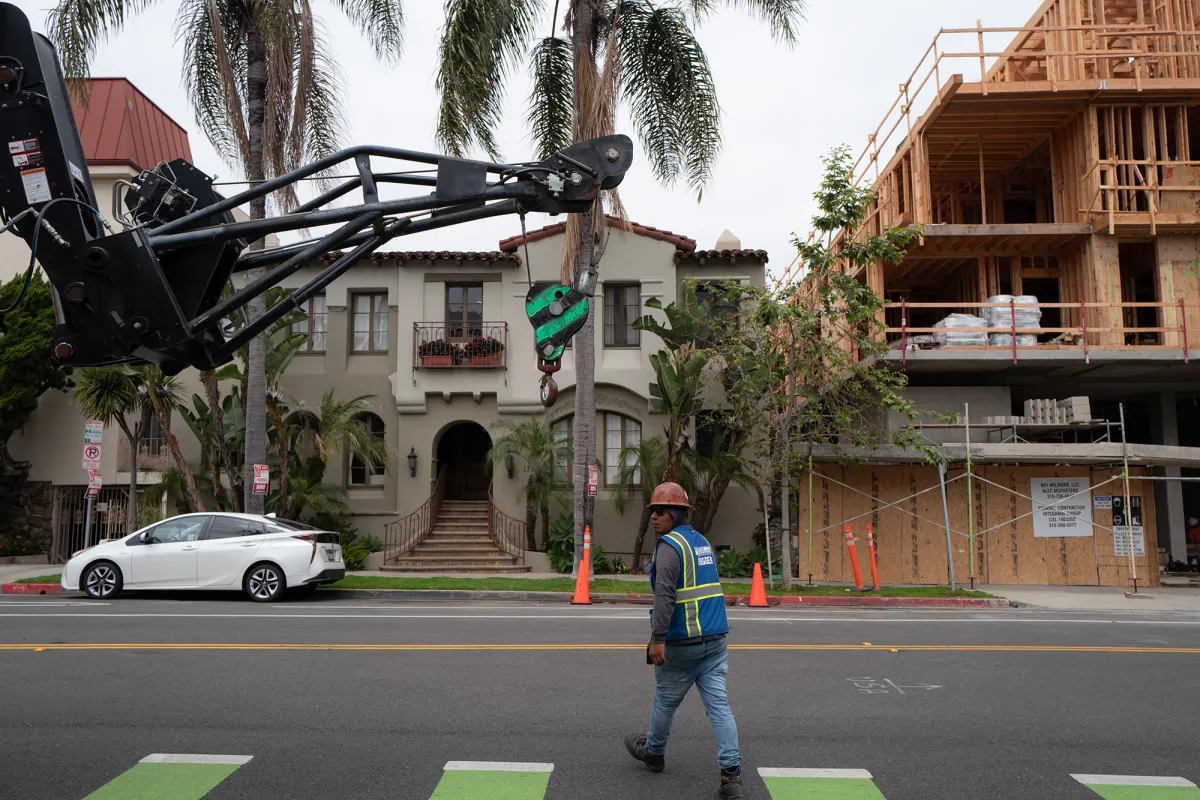
A building set to have 40 apartment units with four retail stores is under construction at the intersection of Wilshire and 6th Street in Santa Monica. May 24, 2023. Photo by Zaydee Sanchez for CalMatters.
For the last two years the “builder’s remedy” has been the unruly teenager of California housing laws.
Running roughshod over zoning regulations while sowing angst among local elected officials, the law lets developers build as much as they like, wherever they like, in cities and counties that have blown past deadlines to get their housing development blueprints certified by state regulators.
Despite its use as a hardball negotiating tactic by aggressive developers, no project has broken ground, much less finished, as a result of the builder’s remedy. That’s partially because relatively few developers are willing to make use of the confusingly-worded law for lack of legal certainty.
Now, some of California’s most powerful Democratic lawmakers are pushing legislation that would clear up, but also rein in, the state’s most controversial housing statute. Nearly a year and a half since a developer first used the law to propose a zoning-code-blowing project, 2024 may be the year that the builder’s remedy grows up.
“The ‘builder’s remedy’ has sort of lived in the Twitterverse, but actually making it a clear law, so that everyone is following the same rules of engagement and we know what the rules are…(that) is really what we’re aiming to do here,” said Assemblymember Buffy Wicks, a Berkeley Democrat, who chairs the Assembly appropriations committee and who authored AB 1893, which she said would “modernize” the law.
The proposed overhaul, outlined in a newly amended draft of the bill published yesterday, includes new perks for developers, textual edits to clear up how the law would apply and a new “streamlining” provision that would let developers bypass environmental review and public hearing requirements so long as they pay their workers union-level wages and meet basic environmental requirements.
But the bill would also put a cap on how big builder’s remedy projects can be, while prohibiting its use in industrial zoned areas. That’s a break from current law, in which the sky — and the California Building Code — is the limit.
“We tried to land this bill in a place where it is a stick — it’s holding our cities accountable — but it’s not overreaching in its scope,” said Wicks.
Wicks’ bill is backed by Attorney General Rob Bonta, who has ramped up the state Department of Justice’s enforcement of housing production law since coming into office in 2021.
“It has been over 30 years since the builder’s remedy was enacted and it’s remained in effect, largely unchanged, since then,” Bonta said in a statement. The bill is meant to provide clarity to “local governments, planners, developers, and courts,” he added, while also ensuring that housing actually gets built in cities and counties that don’t have certified housing elements, rather than getting stuck in legal limbo.
This is one of at least two bills aimed at tying up the builder’s remedy’s perceived loose ends.
The builder’s remedy has been on the books for more than three decades, but was only recently given new life by pro-housing legal scholars and state housing regulators.
As cities and counties have scrambled to plan for their share of the 2.5 million new homes that Gov. Gavin Newsom wants built across California by the end of the decade, the builder’s remedy — which spells a total loss of local control over land use — has been among the most menacing possible consequences of non-compliance.
It’s also been a reliable path to litigation.
Though the state doesn’t gather data on builder’s remedy projects, the pro-housing legal advocacy group YIMBY Law has identified 93 projects with roughly 17,000 potential units spread across 40 mostly affluent California cities. Jurisdictions have refused to process nearly half of these applications, arguing that the law doesn’t actually apply, that it’s been misinterpreted or that the law itself is unconstitutional. Eight of the projects are the subject of current lawsuits. Few, if any, builder’s remedy projects have actually resulted in new housing — yet.
Defenders of the current law say that isn’t surprising: Large residential developments take years to complete and the current legal ambiguities in the newly unearthed law are being ironed out by the courts in developers’ favor.“The builders remedy is already a very successful program at motivating cities to get in compliance with the housing element law and in generating applications for housing that would otherwise not be possible in the highest income, highest opportunity places in California,” said Sonja Trauss, YIMBY Law’s founder. The group has not taken a position on Wicks’ bill.
Though all builder’s remedy projects remain on paper, the law has taken on an outsized significance in the politics of California housing over the last 15 months.
For “Yes In My Backyard” activists who blame development-averse local governments for the state’s housing shortage, the builder’s remedy has been celebrated as the policy equivalent of the “F — - Around and Find Out” meme.
Jen Wolosin is a Menlo Park city council member whose district includes the former headquarters of Sunset Magazine, now the site of a proposed builder’s remedy project with three residential towers and 805 housing units. The tallest would reach 421 feet. Nothing is moving forward just yet. The builder’s remedy application simply holds the project’s place in the permitting queue. Even so, Wolosin, who was endorsed in her 2020 election by Peninsula for Everyone, a local YIMBY group, called the proposal “jaw dropping” and “outrageous” in its scale relative to the surrounding low-lying neighborhood.
“I don’t like seeing cities flaunt state law and exacerbate the housing crisis,” she said. “That offends me.”
But, she added, in lacking all “guardrails,” the builder’s remedy “can turn off people who would otherwise want to help solve the housing crisis.”
A sizable chunk of California municipalities are still legally vulnerable to the “remedy.” At last count, nearly 40% of cities and counties have failed to have their “housing elements” certified by the state.
Legal gray areas hold back widespread adoption
Wicks’ bill would add some of those guardrails.
The bill would cap projects at twice the current zoned density. That doesn’t include whatever add-ons are allowed under the state’s density bonus law, which gives developers added height and density in exchange for building affordable units. The bill would also allow cities to impose “objective” standards of development, including architectural style requirements, if they already apply to other dense multifamily areas and aren’t prohibitively expensive to abide by.
“This is just a crazy-making provision of the law.” — Chris Elmendorf, Law professor, UC Davis
Putting restrictions on the builder’s remedy may seem an ideological 180 for Wicks and Bonta, both of whom have allied themselves with YIMBY activists. Even so, the bill has received outright support or optimistic neutrality from many of the state’s pro-housing organizations. Leaders of California Community Builders and Habitat for Humanity California are attending a press conference in Sacramento today where Bonta and Wicks will unveil the latest version of the bill.
“Part of why the YIMBY movement emerged was to have a clear process in place to have homes actually being built and if you’re going to have to end up in court all the time, that’s not really ideal,” said Matthew Lewis, a spokesperson for the state advocacy group, California YIMBY.
The group does not yet support the bill, but Lewis said it agrees with Wicks’ general intent. “The builder’s remedy is fantastic, we love it, it’s one of the most popular things among YIMBYs. But with the big asterisk — not if a city decides to sue you all the time.”
Supporters of the legislation say it will resolve two problems that are currently slowing the law down.
The first is legal. As written, the builder’s remedy includes seemingly self-contradictory provisions that seem to simultaneously allow developers an unlimited amount of density while also empowering local governments to apply their own standards. Both of those things can’t be true at the same time.
Setting explicit numeric limits on what is allowed could make it more difficult for opponents to argue that a builder’s remedy project isn’t consistent with the law.
Converting the builder’s remedy from a supersized bargaining chip in an open-ended negotiation into a policy that “anyone with a calculator can figure out” would likely encourage more traditional developers to make use of it, said Dave Rand, a land-use attorney who represents many builder’s remedy projects.
In a perk for developers, the bill would also reduce the number of affordable units that builder’s remedy projects are required to provide. Currently developers have to set aside at least 20% of the units for lower income renters or buyers. The bill would cut that number to 10% while exempting projects of 10 units or fewer from any affordability requirement.
A credible housing threat
Keeping developers from proposing supersized “completely preposterous” developments could also help limit the political backlash to the law, said Louis Mirante, a lobbyist with the Bay Area Council, which regularly backs legislation to speed up housing construction. “Legislators are worried about maintaining the credibility of housing laws to their housing skeptical colleagues.”
The proposal is likely to face plenty of skepticism regardless. The bill is scheduled to go before the Assembly’s Housing and Community Development committee on April 17.
As negotiations continue over future amendments continue, pro-development lawmakers and lobbyists will need to come to a shared conceptual understanding of what the builder’s remedy is actually for, Elmendorf said.
For cities that failed to get their housing plans enacted on time, the builder’s remedy has been seen as a “punishment,” he said.
This new bill could represent a different way of thinking about the law, one that doesn’t unleash unmitigated chaos on a city’s planning department, Elmendorf said, but kicks in “as a default statewide zoning code that applies when cities haven’t come up with a good enough alternative on their own.”
###
CalMatters.org is a nonprofit, nonpartisan media venture explaining California policies and politics.
To counter recent legislation that would step up penalties on petty crimes, a group of progressive state lawmakers yesterday offered a rival approach, focusing instead on more services for offenders and survivors of crimes.
They are backing a new legislative package — dubbed “#SmartSolutions” — to address retail theft, fentanyl abuse and support for crime survivors.
The proposals come amid the ongoing tension among Democrats, who are split over how to address the growing public concern about crime, even though statistics paint a mixed picture. For example, retail theft rose in recent years but still remained below pre-pandemic levels in 2022, according to an analysis from the Public Policy Institute of California.
Some Democratic legislators and local officials — eager to show they are acting especially during an election year — have advocated for tougher sentences for retail theft or backed a ballot measure to roll back Proposition 47, a voter-approved measure in 2014 that raised the felony threshold for shoplifting to $950.
Others, however, argue that raising penalties and undoing Prop. 47 could mean California is reverting back to the tough-on-crime policies in the 1980s and the 1990s that led to mass incarceration.
“Some lawmakers have responded (to retail theft) by pushing policies that solely focus on punitive measures that deepen our crisis of mass incarceration at a time when California has pledged to walk away from it and dismantle it,” said state Sen. Lola Smallwood-Cuevas, a Los Angeles Democrat.
Smallwood-Cuevas is sponsoring two bills that would require counties to set up diversion programs for theft-related offenses and increase staffing at grocery store checkout counters.
“I’m not saying that we are not going to be holding folks accountable to the actions that they take,” she said at a state Capitol press conference this morning where three other legislators spoke. “We will not rely on incarceration as a solution, but rather look for ways to build training, create career skills, build industry networks that drive our folks into contribution to our communities.”
Also this morning, two bills toughening state law around petty crimes, such as retail thefts and the “smash-and-grabs,” cleared the Senate Public Safety Committee. They are part of the “Safer California Plan” championed by new Senate President Pro Tem Mike McGuire, a Santa Rosa Democrat.
Under Senate Bill 1242, introduced by Sen. Dave Min, an Irvine Democrat who is running for Congress, those who set fire during organized retail theft might face harsher penalties for reckless arson at the discretion of the judge.
Rachel Michelin, president of the California Retailers’ Association, which supports the bill, pointed to a September incident where a woman set fire in a Target to steal baby formula. “When these businesses fall victim to arson, it not only results in financial loss but disrupts the local economy, leading to job losses and decline in community morale,” she said during the committee hearing. “Stronger penalties serve as a deterrent to potential offenders and help protect both property and human life.”
Another bill sponsored by Sen. Scott Wiener, a San Francisco Democrat, would create new crimes for those who break into vehicles to steal and for those who steal and try to sell more than $950 worth of items. The bill would fix the “locked doors loophole” in state law, which currently requires district attorneys to prove the doors to a car or a house were locked when prosecuting burglars, Wiener said.
Carl Nicita, principal legislative liaison for the San Francisco Police Department, said that requirement is hard to meet: “Victims are often asked to testify in court that their vehicle was locked. But when a victim is a tourist or a visitor, as is often the case in San Francisco, it can be very difficult to secure the testimony of a victim because they live elsewhere.”
The bill, Nicita said during the hearing, would “send a message that, if you break into cars, you will be held accountable.”
Several other bills on retail theft that would increase penalties or give law enforcement more authority have not had a hearing yet. Assembly Bill 1990, by Assemblymember Wendy Carrillo, a Los Angeles Democrat, would allow police officers to make warrantless arrests on misdemeanors of shoplifting offenses, even if they were not present when the alleged crime occurred.
SB 923, from Sen. Bob Archuleta, a Norwalk Democrat, would subject shoplifters with multiple prior convictions to as long as three years behind bars. The bill was scheduled for a hearing yesterday but was then rescheduled for Apr. 16.
###
CalMatters.org is a nonprofit, nonpartisan media venture explaining California policies and politics.