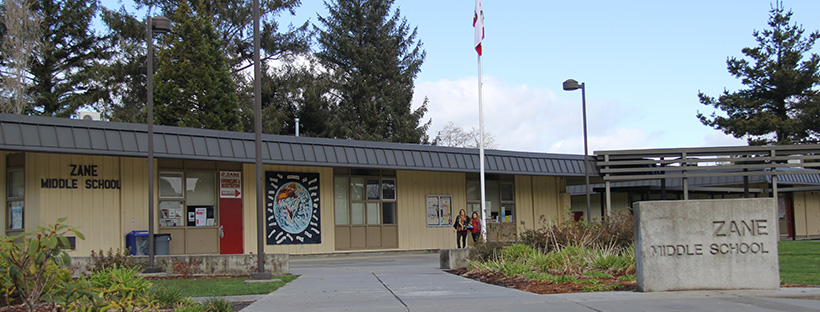
Zane Middle School on Lockdown, Says EPD
Andrew Goff / Tuesday, April 2, 2024 @ 9:36 a.m. / News
UPDATE, 12:35 p.m.
# # #
UPDATE, 10:02 a.m.: EPD says all clear:
Zane is now off lockdown. Two involved juveniles are in custody for criminal threats.
A press release will be released later today.
# # #
Original Post: The Eureka Police Department took to social media Tuesday morning to announce that Zane Middle School is on lockdown.
“There is no active threat to any students or staff. Please do not come on campus until advised, as Eureka Police Dept is investigating,” the department said on Facebook. “Again, there is no immediate danger.”
LoCO will update when we know more.
BOOKED
Today: 6 felonies, 10 misdemeanors, 0 infractions
JUDGED
Humboldt County Superior Court Calendar: Friday, Oct. 2
CHP REPORTS
Central Ave / Reasor Rd (HM office): Live or Dead Animal
Us101 / Shamrock Ln (HM office): Traffic Hazard
ELSEWHERE
RHBB: First Week of October is the Annual Week Without Driving
RHBB: Arcata’s Annual Pavement Maintenance Project Underway
RHBB: CDFW Seeks Public Comment on Draft Bobcat Conservation Plan
Tracy Man Killed in Solo Vehicle Crash Near Fernbridge
LoCO Staff / Tuesday, April 2, 2024 @ 9:21 a.m. / Traffic
Press release from the California Highway Patrol:
On March 31, 2024 at approximately 4:48 P.M., CHP Humboldt Communications Center received a report of an overturned vehicle on Northbound US-101, north of Fernbridge. Emergency personnel responded to the scene and located a 2017 Ford F150 off the east roadside, down an embankment, and actively burning. The passenger, 19-year-old Jozef Borges of Tracy, CA, was able to self-extricate from the vehicle. He was subsequently transported to St. Joseph Hospital with major injuries. The driver, 59-year-old John Borges, also of Tracy, unfortunately sustained fatal injuries as a result of the crash. It is unknown what caused the Ford to travel off the roadway, however, impairment is not considered to have been a factor at this time.
The California Highway Patrol extends its sincere condolences to the family and thanks all responding agencies for their assistance in managing the scene. The CHP Humboldt Area office is continuing its investigation and asks anyone who may have additional information to contact the California Highway Patrol at 707-822-5981.
Foster Kids Miss Out on Sports and Music. A New California Plan Aims to Help Them Catch Up
Ana B. Ibarra / Tuesday, April 2, 2024 @ 7 a.m. / Sacramento

Photo by Pixabay.
Foster kids often miss out on Little League or music lessons. That’s one of the consequences of changing homes, or living with a family on a tight budget.
Now California has a new plan to give them opportunities for the kinds of extracurricular activities that can build character and community.
It’s included in a proposed revision to how the state pays for foster care that’s intended to make more money available to high-needs kids. Youth advocates are especially enthusiastic about the funding for extracurricular activities, which would come in the form of a monthly stipend of at least $500.
“These kids are always underfunded,” said Brian Blalock, senior directing attorney at the Youth Law Center. “And especially when the kids are with grandma and the kids are with relatives, often on fixed income. It’s where we most want these young people as a system, and as a consequence, grandma’s maxing out credit cards to keep the grandbaby in basketball and dance and tutoring.”
The California Department of Social Services put forward the proposal last month, as part of a restructuring to the state’s foster care payment system that was prompted by a 2015 law. Lawmakers are expected to consider it in budget deliberations this spring. By law, the state must adopt updated foster care pay rates by Jan. 1, although the changes would not roll out until 2026.
Aside from the money for activities, the proposal includes a new scale for payments to foster families and money earmarked for support services like therapy and mentoring. Children with greater needs would receive more money.
If the Legislature and Gov. Gavin Newsom sign off on the plan, the department estimates California will spend about $1 billion a year by 2028-29 on foster care payments.
Some money will come from the federal government, but the vast majority will be put up by the state’s general fund. For comparison, California spent a total of $459 million in foster care pay in 2023-24.
State officials say the proposal is meant to create room for positive experiences in foster care.
“Most importantly it is attuning to the fact that all of these children have strengths, and focusing on those strengths and building those strengths is really key to addressing that trauma and improving the well-being of all of our children,” said Angie Schwartz, deputy director of the Children and Family Services Division at the California Department of Social Services, during a webinar in March.
Assessing children’s needs in foster care
Under the state’s proposal, compensation for caregivers would be based on a tiered system of kids’ assessed needs. This would range from $1,788 a month for most kids to $6,296 for kids with the greatest needs for support.
That would replace the current model which bases a caregiver’s pay on where a child is placed. Right now group homes are paid a higher rate than grandparents or foster families, for example.
The acuity of a child’s needs will be evaluated with a tool known as the Child and Adolescent Needs and Strengths assessment. While this assessment is used today, it doesn’t determine funding. Kids are usually assessed every six months.
This assessment takes into account a number of things, including kids’ behavioral and emotional needs, risk behaviors and how the child is doing in school, socially and physically.
Foster care services providers and the Legislative Analyst’s Office have raised questions about the reliability of the assessment tool and whether it will be done consistently.
“There’s real worry about children potentially being scored at a lower tier or at a lower level, and then that determining the tier of services that they would get,” said Christine Stoner-Mertz, CEO of the California Alliance of Child and Family Services, which represents organizations that work in child welfare.
Stoner-Mertz said the state needs to figure out a process for when children switch tiers, especially if their level of need begins to decline and they are bumped down to a lower funding level.
“How are we working with families to prepare them for what could often be perceived as losing those supports that are, in fact, making the child more stable in their home?”
For the first time, children and their caregivers may also be eligible for “immediate needs” dollars, which would fund support services like therapy and mentoring. This would come in amounts between $1,000 and $4,100 a month and would be reserved for the 25% of children with the greatest needs.
Supporting home-based foster care
For the past several years, the state has been working to place more kids with families rather than in group homes. Research shows that kids tend to do better at a home with a family. The state has decreased the number of children being placed in congregate settings by almost 60%, according to the social services department.
Organizations that support foster families are watching the state’s proposal closely, and some are worried it does not provide enough money for the nonprofits that do the work to place kids in homes.
The nonprofits, known as foster family agencies, play an important role in this process by recruiting foster parents and training them, as well as providing social work support.
The California Alliance of Child and Family Services notes that the rate paid to foster family agencies has remained mostly flat for almost 20 years.
A recent survey by the alliance showed foster family agencies have high turnover rates of social workers because they cannot compete with the salaries offered by other employers. The survey also showed 68% of foster family agencies are at risk of downsizing because of insufficient funding.
As proposed, the state would pay the nonprofits $1,610 a month for most children and up to $7,213 for kids with the greatest needs. The alliance representing the nonprofits says the monthly rates need to be between $2,245 and up to $10,650 to be sustainable.
“We want to have more home-based care, and this is what (foster family agencies) do and support,” said Adrienne Shilton, vice president of public policy at the California Alliance of Child and Family Services. “So we’re perplexed by that, in terms of stated goals and then (the rates) we see here.”
###
CalMatters.org is a nonprofit, nonpartisan media venture explaining California policies and politics.
OBITUARY: Evelyn Paine, 1929-2024
LoCO Staff / Tuesday, April 2, 2024 @ 6:56 a.m. / Obits
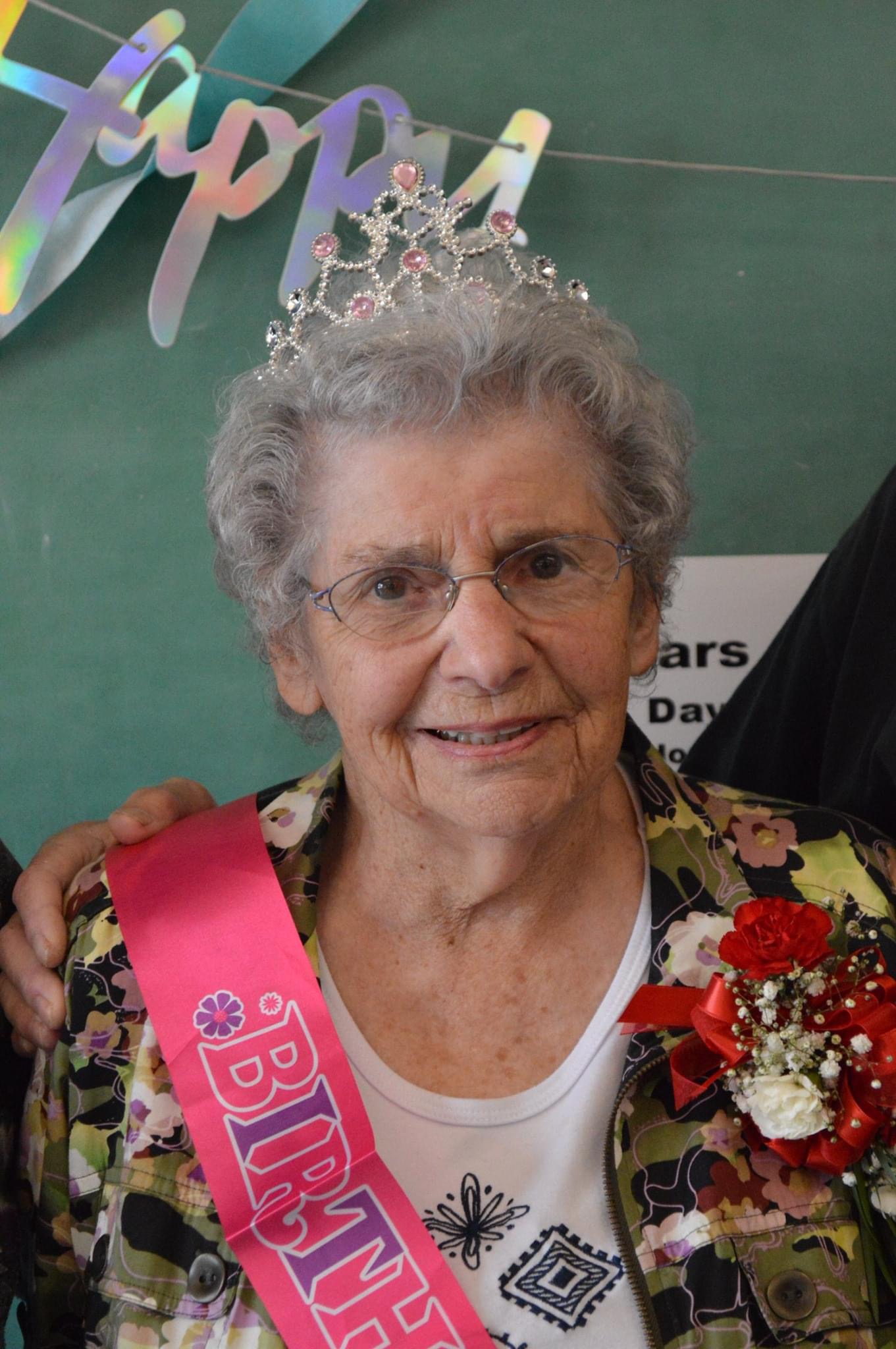
Evelyn Angelina Leonardo was
born October 19, 1929 at her parents’ home in Table Bluff. She
passed away the way she always said she wanted to go, at her house
peacefully in her sleep, and with family playing cards at the dining
room table.
Her parents, Joseph G. Leonardo and Mary August Borges, were both immigrants from the Azores. Her Portuguese heritage was something she was proud of. She was the Holy Ghost Festa’s big Queen in 1948, and spoke of how her mother had mailed the dress back to the Azores to be used by family members. She was a member of the UPCC and SPRIS Lodges and had bought life insurance policies for many of her grandchildren and great-grandchildren in the SES, now P.F.S.A., so they could be members as well. She volunteered on the festas committee many times. Even this past year she assisted her sister Ione and sister-in-law Silvia in selling sweetbread and linguica at the celebration.
She grew up in Ferndale and was a lifelong member of the Assumption Catholic Church, where she was married to the love of her life, Allen Rae “Timer” Paine, on February 12, 1949. They were active in the church, with grandma even having her”pew” where she sat every week prior to COVID. Grandma was a member of the ladies’ guild and altar society for many years.
In 1950, Evelyn gave birth to her daughter Linda, soon to be followed on her birthday in 1951 with son David, and in 1953 her family was complete with the birth of Patricia. In 1955 they bought their first home on Madison Street. When the lot next door became available they bought the lot and began building her forever home. It was a family affair, with her brother-in-law Eddie Christensen as their contractor. Timer and the kids worked on the house until it was completed in 1964. Many family gatherings were held at that home from wedding receptions, Christmas Eves, baby showers and so much more.
Evelyn was known as a hard worker, she started working as a teenager doing bookkeeping at a local grocery store. She spent many years working at the Valley Grocery. She was bored with being retired, so she went to work for Larry Martin at his ice cream shop, she then moved across the street to work at Rings Pharmacy. She also volunteered with the Ferndale Senior luncheon for many years.
Even though Timer was the musician in the family, grandma loved music. They were active dancers, being members of the Jolly Time Dance Club for many years. She would turn on the radio in the mornings while she ate her breakfast. In her final days she was caught tapping her feet and waving her hands to the music we played for her.
Holidays were big family affairs, and once they outgrew the houses the Leonardo side of the family began renting halls to hold Thanksgiving, Christmas and Easter. Evelyn was big on family and loved them so much. She made every child, grandchild and great-grandchild feel like they were her favorite. She loved when family would come over and if there were enough card players Pedro was being played. Sometimes the card table had to be set-up in the living room due to there needing to be a second game. Grandma would make everyone laugh when her team was close to winning and she would say “we’ll just slide right out.” She and Timer had played cards for years with friends and family alike.
Grandma enjoyed traveling and her and grandpa enjoyed many vacations both with friends like the Alexandres to places like Hawaii and Portugal, and to see family. Grandma even once took a train to Hanford, Calif. so she could visit her great grandchildren Brittani and Jasen.
In the early 1960s Evelyn and Timer started attending the Bear River picnics at Earl Ambrosini’s cabin. The Sweets, the Bryants, the Lorenzos all had generations of family attending those picnics.
Grandma turning 85 was hard on all of us, as that is when she decided to retire from baking. She will be forever missed for the cookie can that was always full. For many of the grandkids, the first thing that they did when walked in the house was to stop by the cookie can. It was so missed that a baking day was planned at her house by her granddaughters. That day Evelyn got to sit and play cards while overseeing her granddaughters and great-granddaughters bake cookies using her recipes. Her freezer was stocked for months.
She was preceded in death by her parents Joseph G and Mary (Borges) Leonardo, her beloved husband of 48 years Allen “Timer” Paine, her in-laws Leslie Rae and Zella “Claire” (Benjamin) Paine; her siblings Joseph Leonardo, Frank Leonardo, Mary (Leonardo) Manzi, Ione (Leonardo) Franz and her infant brother Frank Leonardo; her sisters-in-law Janice (Paine) Christensen, Helen (Paine) Baldwin, Alice Gaye (Paine) Lorenzo and brothers-in-law Clifford Paine, Earl Paine and Garth “Newt” Paine; her son-in law David Galbraith and step-granddaughter Evangela “Angie” (Torgerson) Hopkins.
Evelyn is survived by her three children, Linda Brito, and husband George; David Paine and wife Joanne and Patricia “Petie” Galbraith. She also leaves behind her grandchildren Heather (Paine Cook) Peugh and husband Scott; Craig Brito and wife Rosie; Jessica Paine; Melissa (Hackett) Shepherd and husband Dave; Ken Brito and wife Cori; Jennifer (Brito) Hayes and husband Jacob; Kevin Galbraith; Aaron Pain and wife Ashley; and Justin Paine and girlfriend Devon Thompson. Her Step grandchildren Holly (Lucas) Martella and husband Jeff and Jeremy Lucas and wife Patti. She was affectionately called Nammie by her great grandchildren: Ariel, Aurora and Jake Peugh; Owen and Ansley Brito, Braden Paine, Brittani Hackett-Little and fiance David Hall, Jasen Shepherd and wife Zuri; Lauren and Emma Rae Brito; Myra, Olivia, Audrey and Lucy Hayes, Aliese Galbraith, Zeb, Eloise and Atlas Paine and Jayden and Ruka Paine. Her step-great grandchildren: Kobe Martella and wife Brittany, Andrena (Martella) Diven and husband Brayden, Chase Hopkins and girlfriend Korrie Morris, Haylee Hopkins, Madison Hopkins and partner Shantel Fixsen and Denali Hopkins. Her great grandchild Adalyn Evelyn Hall and step-great grandchildren Riven and Brooklyn Hopkins. She is also survived by her sister-in-law Silvia Leonardo and brother-in-law Lee Franz as well as too many nieces and nephews to count between the Leonardo and Paine families.
A visitation will be held on Friday, April 5 at 7:30 p.m. at the Ferndale Assumption Catholic Church with the rosary to follow at 8 p.m. A Catholic Funeral Mass will also be held at the church on Saturday, April 6 at 10 a.m., with burial to follow at St. Bernard’s Cemetery in Eureka. She will be laid to rest with her soulmate Timer. Reception to be held at the Catholic Church hall after the burial.
The family would like to thank Providence Home Health and Hospice of Humboldt for their assistance in allowing grandma to be home as she wanted in her final days. In lieu of flowers please donate to the Ferndale volunteer Fire Department or the Ferndale Holy Ghost Festival in her name.
###
The obituary above was submitted on behalf of Evelyn Leonardo’s loved ones. The Lost Coast Outpost runs obituaries of Humboldt County residents at no charge. See guidelines here.
OBITUARY: Nicol Eileen Roby, 1985-2024
LoCO Staff / Tuesday, April 2, 2024 @ 6:56 a.m. / Obits

It
is with great sadness that we announce the passing of our beloved
sister, Nicol Eileen Roby, who passed away on February 22, 2024 the
age of 38.
Nicci, as she was fondly known, was born on July 11, 1985 in Ukiah. She grew up in Eureka alongside her siblings, and attended Eureka High and Zoe Barnum high school, where she graduated.
Nicci was a loving mother, sister and friend, always willing to lend a helping hand and a listening ear. Her warm personality, infectious smile and generous heart made her an instant favorite among all who knew her. She was crazy at times, but she was never fake.
Despite facing many challenges in her life, Nicci remained resilient and persevered through it all. She was a fighter ‘til she couldn’t anymore.
Nicci is survived by her husband, Phelix Roby, her sons Oscar Roby and Justin Roby , her brothers John Urich III and Dustin Whitten, nieces and nephews Faith Thomas, Savannah Hodge, Avi Hodge, Ivy Urich, John Urich IV and a host of other relatives and friends.
We will miss her dearly, but take comfort in the fact that she is now in a better place, free from pain and suffering. May her soul rest in eternal peace.
There will be a celebration of life on May 3, 2024 at 1011 Waterfront Dr. at 1 p.m.
###
The obituary above was submitted on behalf of Nicci Roby’s loved ones. The Lost Coast Outpost runs obituaries of Humboldt County residents at no charge. See guidelines here.
Starting Today, Berry Summit Vista Point Will Be Closed to Highway 299 Travelers Until Summer
LoCO Staff / Monday, April 1, 2024 @ 4:17 p.m. / Traffic
Caltrans
Caltrans release:
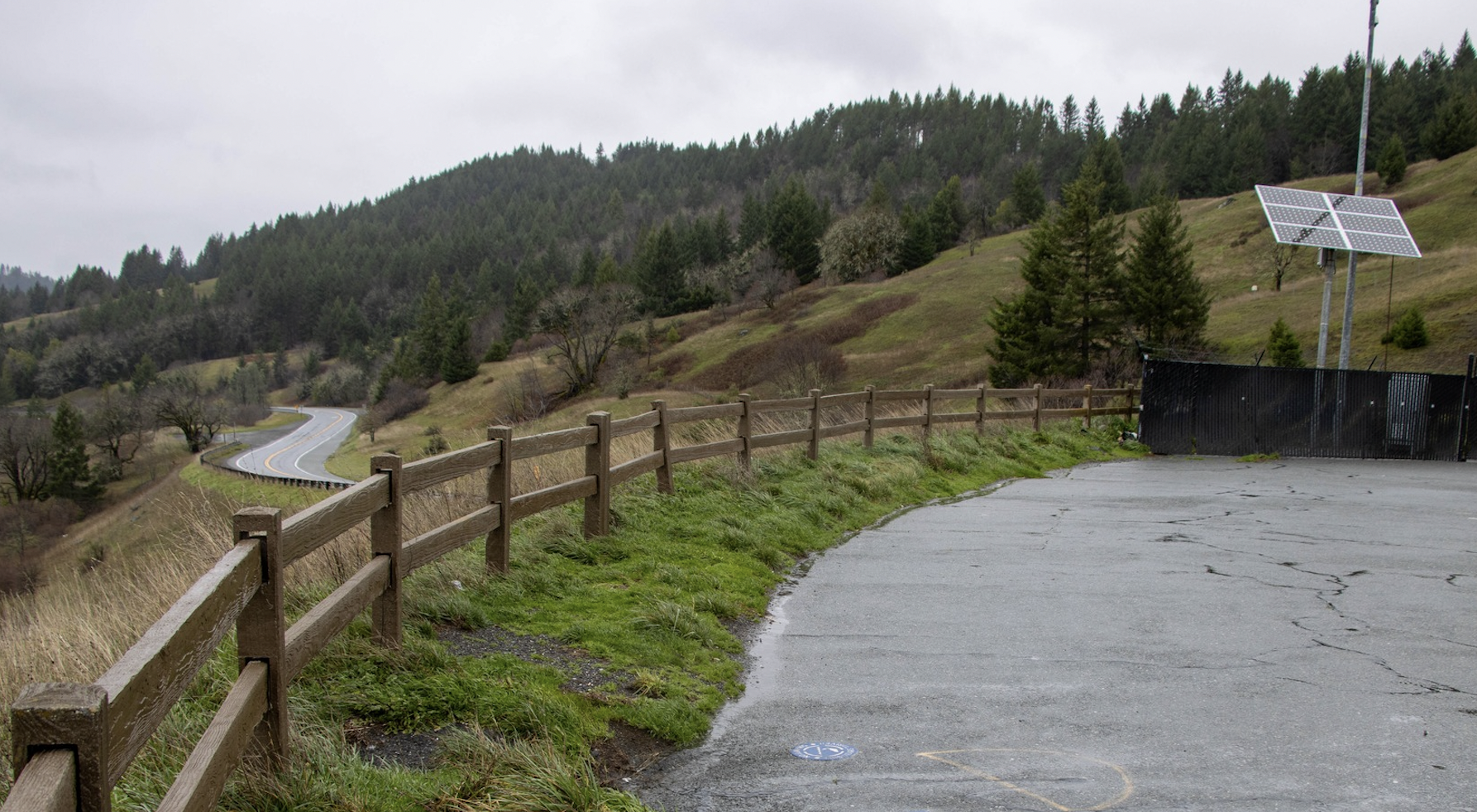
Caltrans partnered with several Humboldt County tribes to break ground recently on a project that will improve welcoming amenities for visitors to the popular Berry Summit Vista Point and honor the lives and history of the Yurok, Hoopa Valley, Karuk, Whil’kut, and other tribes that inhabit the area.
The Berry Summit Vista Point along Route 299 is renowned for breathtaking views and starry nighttime skies, but it has long lacked key services for travelers. The project will add toilet facilities, solar-powered electric vehicle charging stations, a picnic area featuring local drought-resistant vegetation, night-sky-friendly solar lighting, informational kiosks, and decorative garbage cans.
Expected to be completed by early summer, the $759,000 effort was made possible by Governor Gavin Newsom’s Clean California Initiative – a sweeping, $1.2 billion, multiyear clean-up effort led by Caltrans to remove trash, create thousands of jobs, and join with communities throughout the state to reclaim, transform and beautify public spaces.
These enhancements to the popular scenic overlook destination will improve safety, increase convenience, and make for a more enjoyable recreational experience for travelers from across the state.
“A major element of Clean California is to inspire local pride and stewardship,” said Caltrans Director Tony Taveras. “This project reflects that spirit through the involvement of many exceptional local development partners, including local tribes, Humboldt County, the Humboldt County Association of Governments, CHP-Humboldt, and CAL-ORE Life Flight.”
Yolanda Latham of the Whil’kut tribe added, “This project will surely help those traveling through our region and ancestral territory, and I hope that many families will feel a bit safer when traveling with the elderly and little ones.”
Humboldt County Supervisor Steve Madrone added, “The efforts by Caltrans and the Clean California team have been commendable. The project at Berry Summit Vista Point was developed by reaching out to tribes and the community to make meaningful improvements.”
Clean California has funded 319 projects statewide to revitalize and beautify underserved communities, some of which are already complete and now sources of community pride. Projects are improving public spaces, tribal lands, parks, neighborhoods, transit centers, walking paths, streets, roadsides, recreation fields, community gathering spots, and places of cultural importance or historical interest in underserved communities.
Since launching Clean California in July 2021, Caltrans has removed nearly 2.3 million cubic yards of litter from state highways – or enough to fill about 700 Olympic-size swimming pools.
The program has also created more than 15,000 jobs that have helped Californians overcome barriers to employment and drawn more than 10,000 volunteers to events ranging from community cleanups to large debris collections for appliances, tires, and mattresses.
Wondering About the Circus Tent Near Carlson Park in Valley West? Playhouse Arts and the North Coast Environmental Center Are Using it to Help Unhoused People Make Art Out of Garbage
Stephanie McGeary / Monday, April 1, 2024 @ 12:31 p.m. / Art , Community

The tent that will be used for art-making | Photos: Stephanie McGeary.
###
If you’ve driven down Giuntoli Lane in Arcata’s Valley West neighborhood recently, you may have noticed a big, red and blue circus tent peeking over the top of a fence on Carlson Park Drive. If you thought that the circus was coming to Valley West, sorry to say, that is not the case. The tent – which was set up a couple of weeks ago by the Arcata Playhouse/ Playhouse Arts – will actually be used as a space for unhoused people to make art out of the garbage from abandoned camps.
Jacqueline Dandeneau, executive artistic director for the Playhouse, told the Outpost that the project is an extension of Playhouse Art’s Our Space program, which offers free art classes to unhoused or housing insecure folks in our community. This specific project, which is collaboration between Playhouse Arts and the Northcoast Environmental Center (NEC), was funded by an Upstate California Creative Corps grant and aims to provide a creative outlet for houseless and housing insecure artists, while diverting trash from the wastestream into the artstream.
“The purpose of the grant is using artists to help address community issues,” Dandeneau said in a phone interview Thursday. “So we’re addressing homelessness and the environment, because the camps are environmental degradation.”
NEC has been helping with cleanups of homeless camps for about two years, and started working with the Our Space program about a year ago. Caroline Griffith, executive director of NEC, said that the partnership came about because NEC wanted to figure out a way to reuse some of the items being left behind at abandoned camps.
Griffith said that NEC was seeing a “troubling trend” of campers being shuffled around from place to place, which causes the litter to be more spread out. Also when people are forced to leave their camps, they often don’t have the resources – such as dumpsters, recycling cans or transportation to the dump – to adequately clean up their camps.
When Griffith went to check out Our Space – then located in a storefront on Ninth Street – she found a very welcoming environment, where people were having conversations, sharing food and making cool art. NEC thought that providing the artists with reusable items recovered during the cleanups would be a great way to support the program, while also diverting waste from the landfill. The two agencies started working together and have since collaborated on art/ environmental projects like the Craft for the Coast Trash Art Contest.
For the project in Valley West, Griffith said that it is still in the very early stages and NEC is currently setting up the system for bringing in and sorting materials and will soon start holding building sessions with unhoused people from the community that they have been working with through the Our Space program and through helping with the camp cleanups.
And the circus tent for art-building is not the only cool thing that’s happening on this little patch of property in Valley West. The site has been occupied for some time by Isaac Lyons and his business Humbuildt Homes – which has a warehouse on the north side of the site. After another tenant that was sharing the property left, Lyons decided to lease the entire parcel. But since he didn’t really need the entire space for his company, he decided to sublease to various nonprofit organizations.
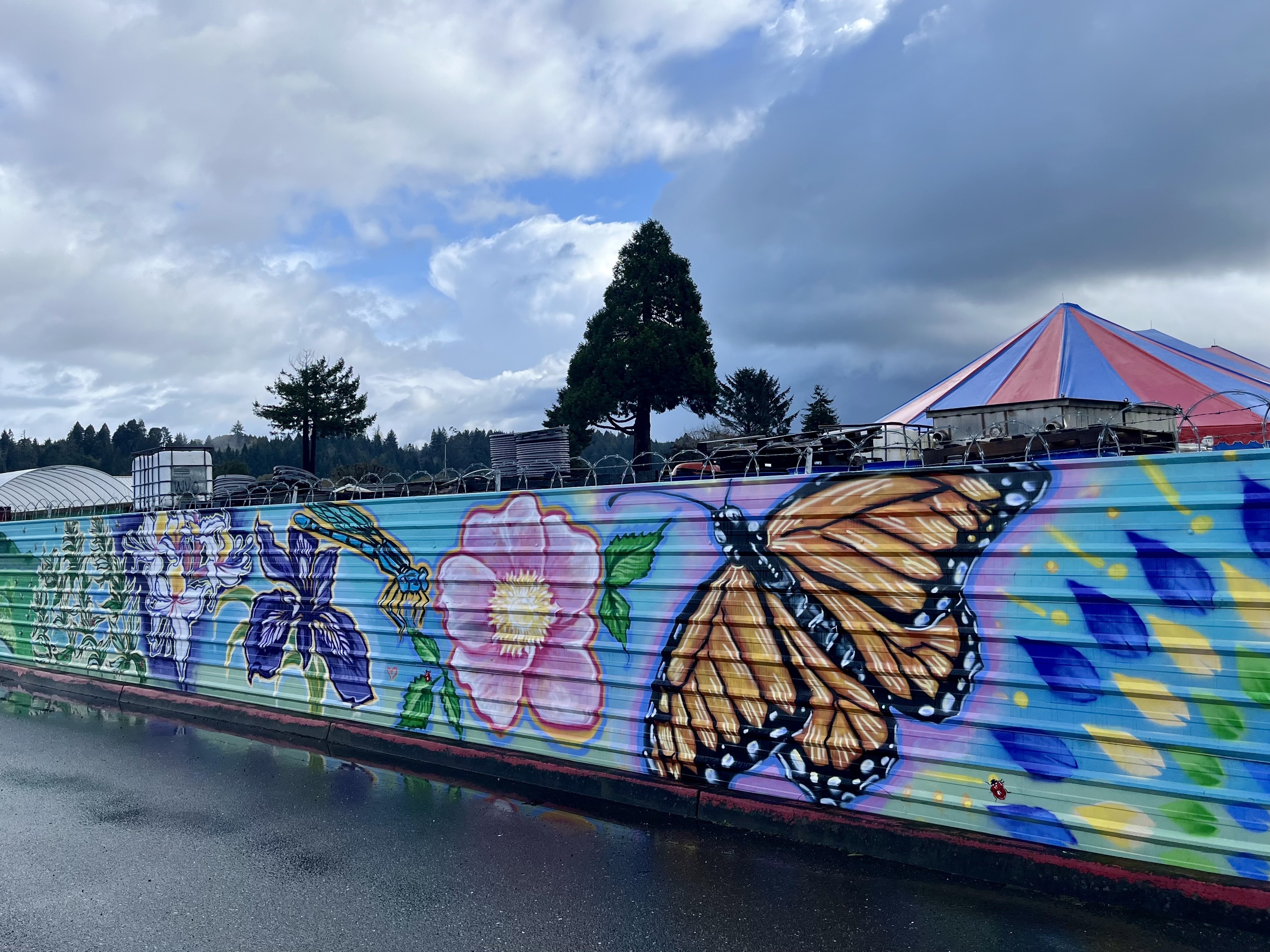
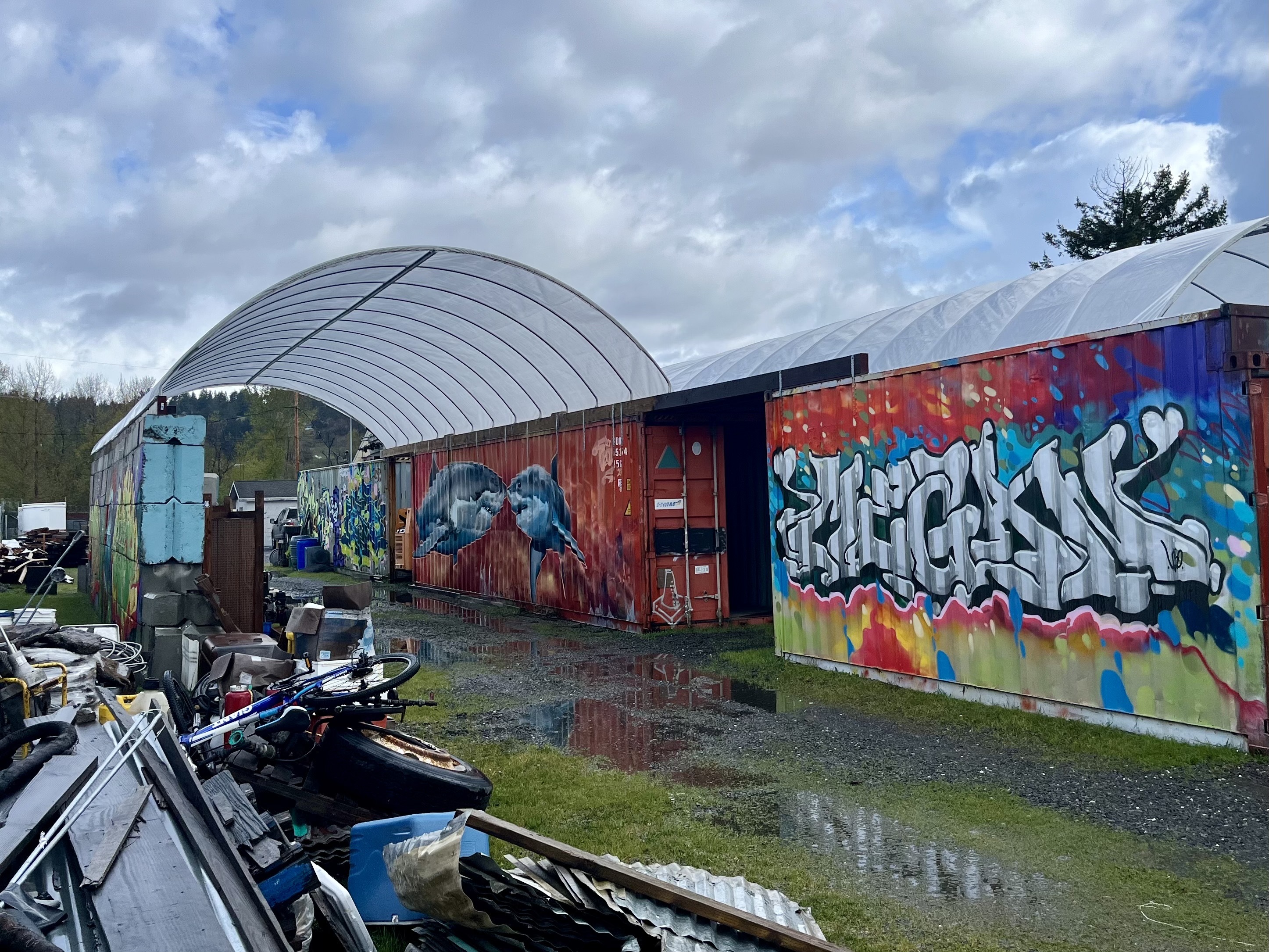
Murals on the outside fences orchestrated by Julia Finkelstein
For about a year Zero Waste Humboldt has been renting a shipping container on the site for its Reuse Center – a thrift store for craft and construction materials, such as doors, windows, scrap metal, hardware and more. The store is open every fourth Saturday of the month between 10 a.m. and 4 p.m., and by appointment.
Cooperation Humboldt also plans to use the site to open a tool library – a place where folks who don’t have the money or space for their own tools can borrow them to work on a project – and Julia Finkelstein, a local artist and owner of Epitome Gallery in Eureka, has also been using the space to showcase street art and helped paint colorful murals along the outside fence and on the shipping containers inside.
Lyons said that his dream is to turn the site into a hub for sustainable development that houses multiple business and nonprofit organizations, offering classes and other community resources. Lyons said that his business is currently working on a line of modular, prefabricated homes that he hopes to be able to showcase on the site. Lyons said his team is also setting up classrooms in the warehouse so that they can offer classes on general carpentry and construction techniques, plumbing, solar installation and more. Eventually Lyons would like to create a pathway for community members to become a general contractor, something that he feels could address the shortage of licensed contractors, while also helping people who maybe can’t afford to hire contractors for their projects.
“Currently, with the number of tradesmen out there and general contractors – that’s part of the issue and challenge — there’s not enough of them to ever create enough housing for all the people who need it,” Lyons said in a recent phone interview. “And people who need [a home] often can’t afford to have it built for them. We need to teach people essentially how to fish.”
As far as when all of these services will be up and running and accessible to the public, it’s hard for Lyons to say. All of the various groups are still figuring out how everything can come together. But there are plans in the works to hold a couple of outdoor events on the site in the summer.
“We’re hoping there’ll be some synergy there between all of us and that we can create something that is fun and can be offered to the public,” Lyons said.
As for the Our Space program under the big tent, things are already underway and Griffith said that the volunteers are planning to build several sculptural pieces out of objects that they find a lot of at camp cleanups, such as bicycle parts and tent parts. Griffith didn’t want to give too much away about the sculptures, but said that they will likely be mobile in some way and that the group plans to bring them to some public events in the late summer/ fall.
The Playhouse and NEC are only committed to keep the tent at the site until November 15, at which point the tent will be coming down to protect it from the elements. That’s also when the grant funding for the project dries up. But if the project is successful, Dandeneau and Griffith said it is likely that they’ll pursue additional funding to keep the space running and help transform the property into a thriving community center for Valley West an area that has been historically underserved.
When asked why the Our Space project was important for our community – particularly the unhoused or low income folks in Valley West – Dandeneau and Griffith said that programs like this are not only a great way to help keep waste out of the landfill, but also help those contributing to the project to feel productive and even empowered.
Though they understand that helping unhoused people make art is not going to solve the issue of homelessness, they feel that it can be a part of a multifaceted approach to improving the lives of those who are struggling to survive.
“I’m a big believer in creative placemaking and that the arts are a vibrant part of mental health, community health, individual health, social health, and that the arts really are a place where people can express themselves and people can feel pride of place,” Dandeneau said. “We’ve kind of gone on this linear wellness train, thinking that if we give someone a job and a roof over their head, that they’re fine. And we all know that that’s not the truth.”