OBITUARY: Richard Tognetti, 1945-2024
LoCO Staff / Thursday, Jan. 25, 2024 @ 6:56 a.m. / Obits

Richard Tognetti, 78 years old, passed away on January 22, 2024, at
his home in Fortuna.
Rich was born and raised in Half Moon Bay and graduated from HMB High School in 1963. He went on to become a diesel mechanic working in the South San Francisco area for 35 years.
Everyone who knew Rich knew he was an avid duck hunter and fisherman. He also enjoyed going to car shows, rebuilding hot rods, camping, bowling, traveling, gardening and working on projects, never letting any grass grow under his feet.
Rich was a loving husband, father, friend and all-around great guy with a great sense of humor. He would tell crazy funny stories that made you laugh so hard you cried and there was never a dull moment in his presence.
Rich is preceded in death by his parents, Elia and Rose Tognetti; his sisters, Gloria Bettencourt and Yolanda DalPorto; his brother-in-law, Bruno DalPorto; his niece, JoAnne Nerli; and granddaughter, Mikaila Lucido.
Rich is survived by his wife, Chris Tognetti; his daughter, Linda Taylor (TJ); his son, Eddy Lucido and stepsons, Peter and Matthew Rice; his grandchildren, Travis Taylor, Tiffinny Hoisington (Tate), Carina Jackson (Brad) and Dante, Dominic and Dio Lucido; his great-grandchildren, Jayden and Lacey Taylor and Quintin and Kolby Hoisington; he is also survived by numerous nieces and nephews.
In accordance with his wishes, no services are planned. Donations can be made to Ducks Unlimited in Rich’s memory.
###
The obituary above was submitted on behalf of Richard Tognetti’s loved ones. The Lost Coast Outpost runs obituaries of Humboldt County residents at no charge. See guidelines here.
BOOKED
Today: 6 felonies, 8 misdemeanors, 0 infractions
JUDGED
Humboldt County Superior Court Calendar: Today
CHP REPORTS
W Harding Ave / Truman Ct (HM office): Traffic Hazard
Myrtle Ave / Felt Rd (HM office): Traffic Hazard
1500 Mm96 E Hum 15.00 (HM office): Closure of a Road
5700 Mm101 N Hum 57.00 (HM office): Assist CT with Maintenance
ELSEWHERE
Governor’s Office: First Partner Siebel Newsom, Governor Newsom, and #HalfTheStory launch California’s first Teen Tech Council
KINS’s Talk Shop: Talkshop August 11th, 2026 – UC Co-op
Governor’s Office: Governor Newsom fast-tracks 1,700 new affordable housing units
County of Humboldt Meetings: Humboldt County Workforce Development Board Executive Committee
OBITUARY: Carleene Blaire Luther, 1946-2023
LoCO Staff / Thursday, Jan. 25, 2024 @ 6:56 a.m. / Obits

Carleene Blaire Luther, age 77, of Eureka, passed away December 25th, 2023. Carleene was born on August 21st, 1946, to Carl and Miriam Compton (Business owners of the local Union 76 Gas Station, in Eureka.)
Carleene grew up in Eureka, where she attended Eureka High School with two of her lifelong friends Arlene and Suzie, just to mention a few.
She lived in Eureka, where she enjoyed the ocean and the nature thriving here. She enjoyed many live community events throughout the years here.
Carleene may have had some struggles, but lived life to the fullest. She loved bowling, attending the senior league at Harbor Lanes every week with her husband Art Luther.
Carleene loved baseball, especially the San Francisco Giants, which she shared a common interest with her long-time friend Bonnie. They would always sing their song “Our boys are on fireeeeee!” every time the Giants won a game.
Carleene enjoyed Yahtzee nights with the girls every Friday. She and her girlfriends Renie, Susie, Sherrie, step-daughter Tammy and step-granddaughter Katalina would play and enjoy the evening together.
Carleene Luther was predeceased by her father, Carl Compton and her mother, Miriam Compton. She is survived by her husband, Art Luther.
Our family is grateful to know that Carleene is finally at peace. While no services will be held per Carleene’s wishes, our family would feel honored if you kept us and Carleene in your thoughts during this difficult year. We were not prepared to lose Carleene as suddenly as we did, but know that unlike most, she accomplished much of what she set out to do.
###
The obituary above was submitted on behalf of Carleene Luther’s loved ones. The Lost Coast Outpost runs obituaries of Humboldt County residents at no charge. See guidelines here.
At Town Hall Meeting, Frustrated Residents Discuss Future Development of Eureka’s Jacobs Campus; Mystery Developer Still Mysterious
Isabella Vanderheiden / Wednesday, Jan. 24, 2024 @ 5 p.m. / Community , Local Government
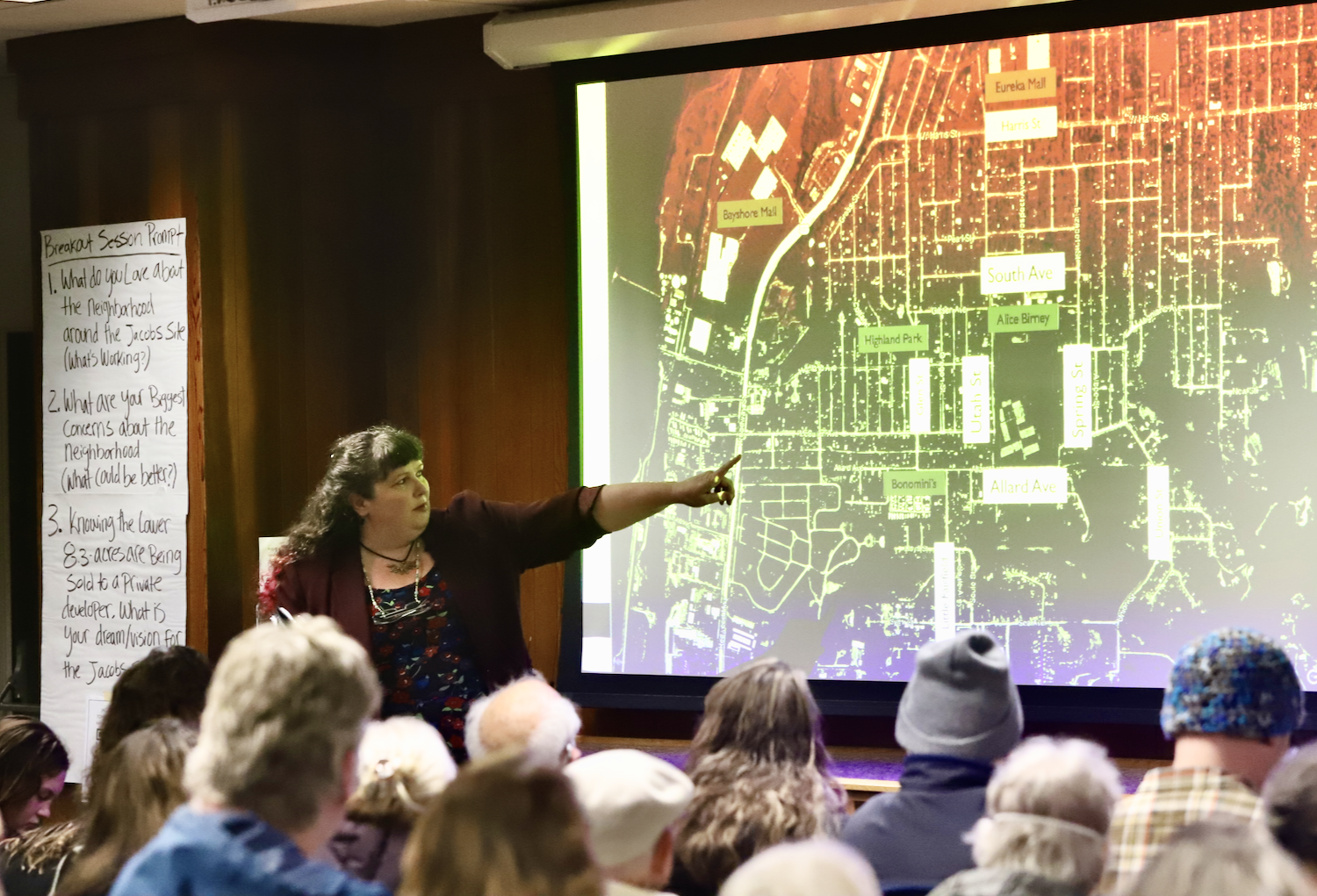
Councilmember Kati Moulton hosted a town hall discussion on the future of the Jacobs Campus at Eureka City Hall this week. Photos by Andrew Goff.
###
Residents of Eureka’s Highland Park neighborhood filled city council chambers on Tuesday evening seeking answers about the impending sale of the long-blighted Jacobs Middle School campus. No such answers would be revealed. At least at the meeting, that is.
“Our purpose for this town hall is to talk about what we think should and shouldn’t happen at the old Jacobs campus site in Eureka’s Second Ward,” Councilmember Kati Moulton said during Tuesday’s town hall. “The future development of Eureka is a complicated machine with a lot of moving parts. Tonight we are really going to focus on just one very specific very important part, and that is what the people of Eureka want to see done with this 8.3-acre [site].”

The town hall was spurred by the Eureka City Unified School District’s recent decision to sell the Jacobs Campus. Last month, the school district’s board of trustees unanimously voted to exchange the Jacobs Campus to a mysterious private developer, known only as “AMG Communities-Jacobs, LLC,” for a small home on ⅛ acre lot, plus $5.35 million. The controversial decision put an abrupt end to years-long property negotiations between the school district and the California Highway Patrol, which had hoped to build its new headquarters on the site.
It remains unclear who exactly is behind AMG Communities-Jacobs, an LLC that was registered with the Secretary of State’s Office just two days before the land swap was approved by the school board. Some have speculated that proponents of the “Eureka Housing for All and Downtown Vitality” initiative or Security National President and CEO Rob Arkley, the initiative’s financial backer, could be behind the property exchange. Both parties have emphatically denied any involvement.
However, a recent report from the North Coast Journal identified a common thread between Arkley and AMG Communities. The NCJ obtained a copy of the property exchange agreement from Eureka City Schools that is signed by attorney Brad Johnson, the same attorney who filed lawsuits against the city on behalf of the Arkley-affiliated group Citizens for a Better Eureka.

“Housing for All” proponents Mike Munson and Michelle Costantine.
We spotted Mike Munson, local business owner and proponent of the “Housing for All” initiative, at the meeting and asked if he knew anything about Johnson’s relationship with AMG Communities. Munson said he didn’t know who was behind AMG Communities, adding, “It’s just like a doctor, you know? They’re not going to talk to me about their other clients and I don’t know who they are [or] what their overall plan is for the property.”
Munson added that he’s “super excited to see with what the developer wants to do with the property.”
The “Frequently Asked Questions” section of the developer’s new website – thejacobscommunity.com – specifically addresses the question: “Is Rob Arkley an owner or investor in AMG Communities?” The website maintains that he is not.
AMG Communities refers to itself as “a single-purpose entity that was formed solely for the purpose of acquiring” the Jacobs Campus. “No firm plans have been developed yet,” the FAQ states. “The site, which is approximately 8.6 acres, is large enough to support a mix of housing and some neighborhood-serving commercial uses. The site will not be developed entirely into affordable housing. Any redevelopment plans will be formed with community input.”
If the sale of the property goes through, the developer can initiate a zoning change. Moulton emphasized that, in general, any zoning changes are subject to city council approval.
“The City of Eureka does not own [the property] … but what we can do is affect the zoning,” Moulton said. “And through the zoning, we can control [and] we can dictate what kinds of development are there.”
Another factor at play is the “Housing for All” initiative, which, if passed, would force the zoning change through an amendment to the city’s General Plan. The ballot measure seeks to rezone the Jacobs Campus, currently designated as “public facilities,” to accommodate single and multi-family housing.
Cristin Kenyon, the city’s Director of Development Services, noted that the initiative would rezone “at least 40 percent” of the site to high-density residential, which could result in as many as 44 dwelling units per acre.
“If you’re looking at 40 percent of the entire [11.4-acre] site, that would be 5.6 acres dedicated to high-density residential,” Kenyon said, adding that the pending property sale is for 8.3 acres. “Assuming that the ball fields will remain a public facility, 40 percent of the area being sold to the private developer would be 3.3 acres. Higher-density residential equates to 22 to 44 dwelling units per acre. On 3.3 acres, that would be somewhere between 73 and 145 new dwelling units.”
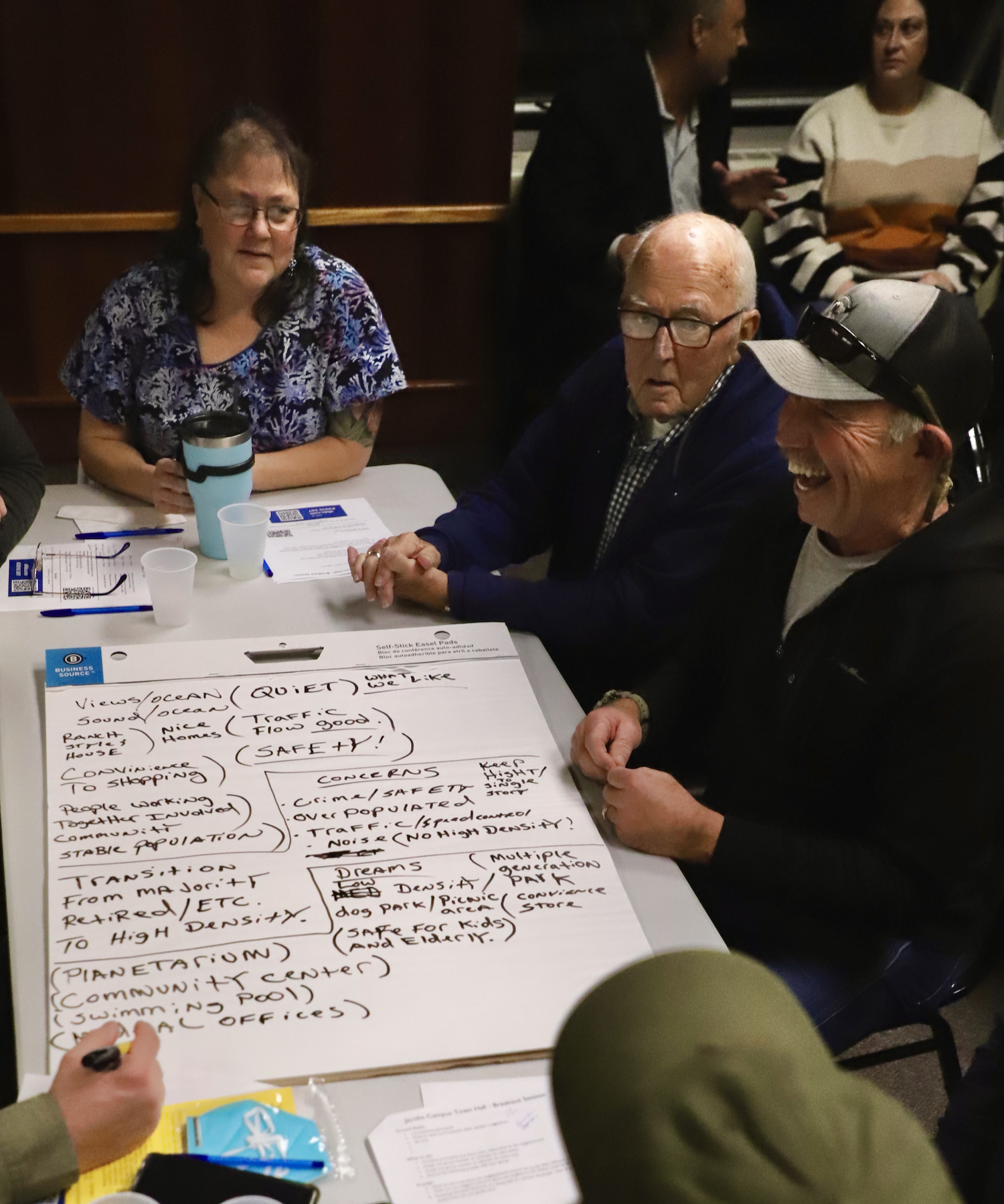


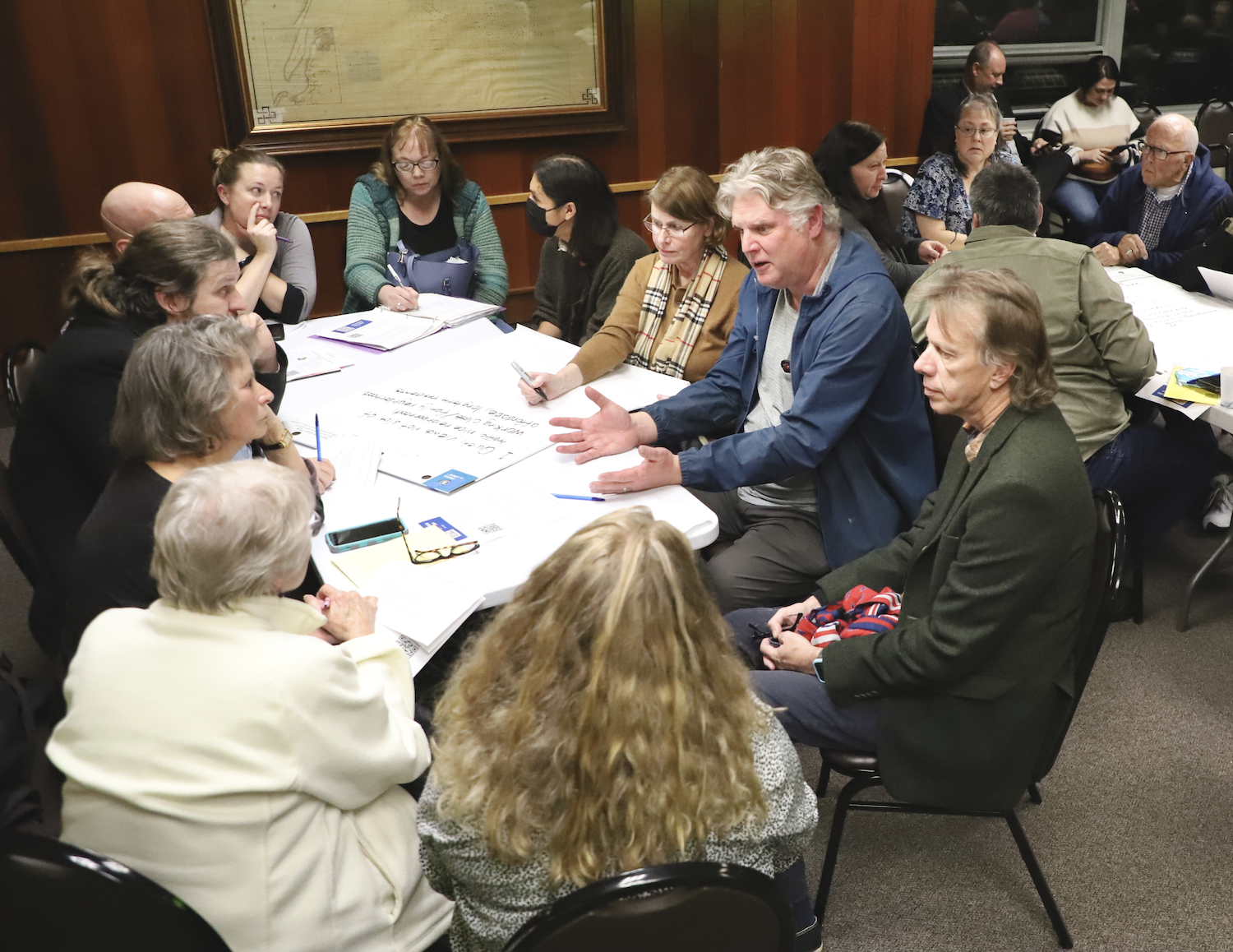
Residents discuss their hopes and dreams for the Jacobs site.
Following a staff’s presentation, meeting attendees were divvied up into large groups to discuss their concerns with the current state of the Jacobs site and how it could be improved.
The Outpost sat with a group of about 15 people who spoke in favor of more community-oriented development, such as a community center, a children’s park, or a dog park. They weren’t too crazy about the prospect of a housing development on the site, especially high-density housing. “It just wouldn’t fit in with the neighborhood,” one woman said.
Another woman in the group said she was disappointed that the CHP deal didn’t work out because it could have enhanced safety in the neighborhood. “Pardon my language, but I really think they got screwed,” she said. “I think the school district did them dirty.”
The rest of the audience had similar views on how the land ought to be used, with most folks advocating for community-oriented facilities and low-density housing in the neighborhood. One person thought it would be cool to build a planetarium on the property.
The conversation returned to the zoning issue during the Q&A period. One person asked if the city council would have the authority to change the zoning designation of the Jacobs Campus if the “Housing for All” initiative passes. For example, he asked, what if the site ended up unused like the Balloon Track? Moulton said the zoning overlay would remain in place “unless or until another ballot initiative removes it.”
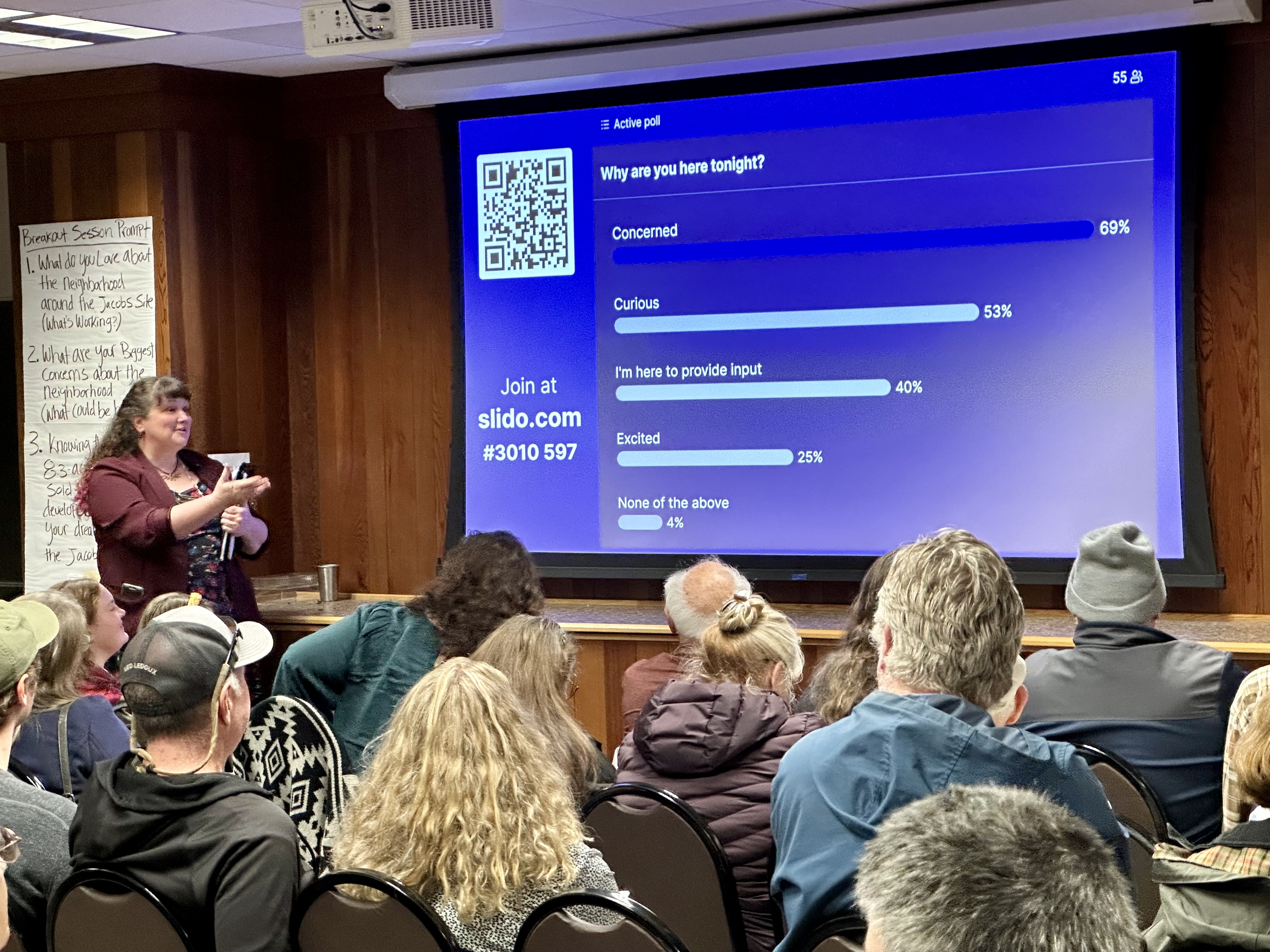
Residents were asked why they attended the event and what they hoped to see on the Jacobs Campus site. Click the photos above and below to better read their responses.

Another resident expressed concern about the process surrounding the land exchange between the school district and CHP.
“This secret stuff bypassed all … four years of negotiations with CHP,” he said. “There’s the problem and that’s why we’re here, because of what [Eureka City] Schools did and the developer was able to do in private. No one to this day really knows.”
If there were any representatives of AMG Communities or Eureka City Schools in the audience, they didn’t make their presence known. AMG Communities emailed a statement to the Outpost shortly after Tuesday’s meeting:
We appreciate every member of the community who showed up to share their ideas for the future of the Jacobs site. We understand there are very strong opinions on the potential plans for the site, and want to be clear that we are listening and all want what is best for Eureka.
We are very early in this process, as the property is still in escrow. AMG Communities invites the community to engage with us in this process through both continuing to share their opinions and, if they’re interested, becoming a financial community partner. More information can be found on our website at thejacobscommunity.com
We are excited for the potential of this property, and all that it can bring and mean to the local community. We look forward to continuing this important dialogue as the process moves forward.
###

Councilmember Moulton takes questions from the audience
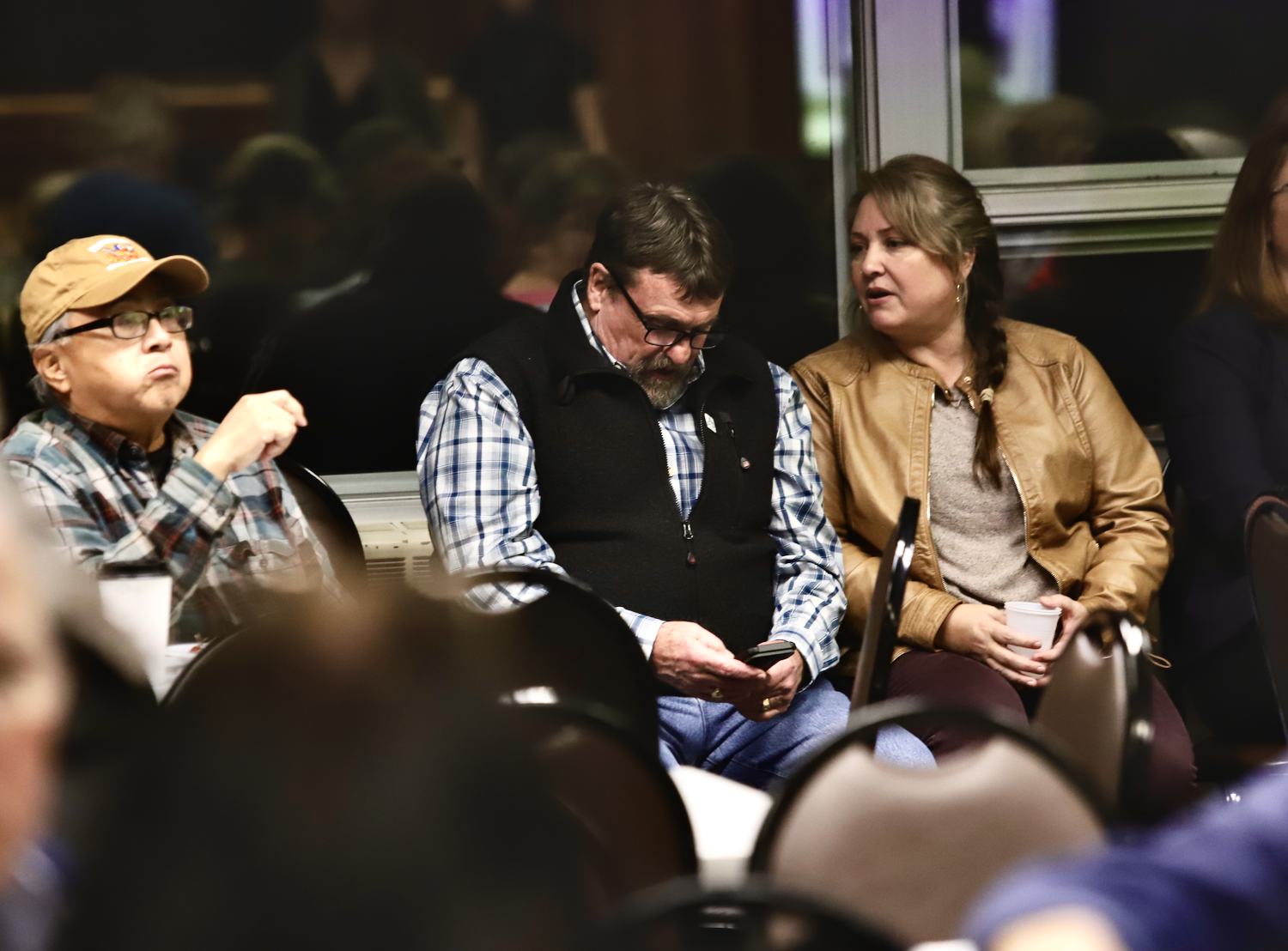
Supervisor Rex Bohn chats with Eureka City Councilmember Renee Contreras-DeLoach

Eureka Police Chief Brian Stephens stood in the hall to monitor the event

One resident, who opted not to show his face, had an idea for where Eureka could build housing
PREVIOUSLY:
- Who Will Get the Former Jacobs Campus? Bidders for Blighted Site in Highland Park Are the City of Eureka and California Highway Patrol, with a Decision Coming Soon
- The CHP Would Like to Build New Headquarters on Property Championed by People Opposing Downtown Housing Development, and There was a Meeting About it Yesterday
- Mystery Item on Tonight’s Eureka City Schools Agenda Suggests Imminent Action on Jacobs Campus, but the School District Won’t Share Details
- Eureka City Schools Board of Trustees Unanimously Votes for So-Called ‘Land Exchange’ with Mystery Developer
- The Eureka City Schools Board Voted on a Resolution Last Week That Was Not Published Before the Meeting. Is That Legal?
‘To the Next 100!’ Longtime Local Swimming Instructor Junie Speier is Turning 100 and Everyone is Invited to Celebrate
Stephanie McGeary / Wednesday, Jan. 24, 2024 @ 4:21 p.m. / Party!!!

Speier chilling in the hot tub at the Arcata Community Pool | Photo provided by Shannon Speier
In a pink sweatsuit and purple sequined slippers, Junie Speier – a nearly 100-year-old woman and longtime Eureka resident – sits at her kitchen table, sipping a cup of Constant Comment tea. I sit down to join her and two of her children, who offer me a cup and some oatmeal cookies, as I look through photo albums and scrapbooks documenting the amazing life that Speier has led.
In just more than two weeks, Speier will celebrate her 100th birthday, and because of the impact she has had on so many lives locally the family is inviting the entire community to join the celebration.
“We will be celebrating Junie Speier’s 100th birthday on Saturday, Feb. 10 at the United Congregational Church in Eureka from 1-3 p.m. in the Fellowship Hall,” the family wrote in a press release sent to the Outpost. “The public is invited & the family requests you be Covid negative or wear a mask in order to protect Junie & others who are attending the party.”
When asked if she was excited for her big party, Speier laughed and said “I might leave town.”
Clearly, this seasoned woman still has a robust sense of humor.
Born and raised in Los Angeles, Speier moved to Eureka with her husband, Ted Speier, in 1947. Speier began teaching at Eureka High School and helped the effort to build the school’s swimming pool, which opened in 1950 and closed in 2008. Speier spent many years teaching swim lessons both for children and for adult education classes. She also started the “Frolic Club,” where she taught social dancing and etiquette to fifth through seventh graders.

Speier’s award from the American Red Cross | Photo: Stephanie McGeary
Speier has long possessed a passion for the water, and during her time in LA, Speier worked as a swimming instructor and as an American Red Cross lifeguard. She was also a Red Cross volunteer for 62 years and in 2004 she received a Red Cross volunteer Lifetime Achievement Award.
Hearing the stories of Speier’s life, it seems clear that she was a bit of a firecracker and not afraid to go after what she wanted. When she was in high school, Speier wanted to become a cheerleader, an activity that was exclusively for men back in those days. Knowing that they wouldn’t let a girl join, Speier went to the barber before auditions and cut her hair very short and auditioned as a boy. After she made it on the team, word got around that she was a girl. Fortunately instead of kicking her out, the school changed the rules to allow girls on the cheer team.
As a talented swimmer (and, I also must say, a total babe), Speier received a lot of attention in her younger years, and was even offered a part in an Esther Williams film. Speier turned down the offer because “I was busy,” she said. She also, not surprisingly, received a fair amount of attention from the fellas. This is made clear in one of Speier’s photo albums, she titled “The Men in My Life, Volume 1,” which contains pictures of Speier’s many hunky boyfriends.
“There was never a ‘volume two’ because she met dad,” Speier’s son, Spencer, said jokingly.

Speier at Big Lagoon in 1961 | Photo provided by Shannon Speier
Speier met her husband in LA in 1943, while he was on leave from the Army. Having borrowed her brother’s convertible, Speier and one of her girlfriend’s were cruising through Hollywood, when they stopped in front of a group of men in uniform and told them to “jump in” and the gang went out dancing all night at the Cocoanut Grove. Junie and Ted hit it off immediately, and the next morning the two attended the Easter Sunrise Service at Hollywood Bowl.
After “going steady” for a while, the two were married in 1944, just three days before Junie’s 20th birthday.
Though things were good in LA, Speier wanted to start a family and didn’t want to do it in a big city. Her husband was born and raised in Samoa, and hearing about and seeing pictures of Humboldt County, Speier decided that it was the perfect place to land.
“[LA] was a good place to grow up when I did, and there were many opportunities,” Speier said. “But this is a good place to raise a family.”
The couple’s marriage lasted 75 years, until Ted passed away in 2019, and brought them three children and two grandchildren.
The Speiers passed on their love of the water to their children, and the family spent many summers at their other property near Big Lagoon, where they would swim, fish and water ski. The family still spends time there, Speier’s daughter, Shannon, said, though the activities are much more mellow and they mostly hang out and “take care of mom.”
Though she can no longer participate in the more extreme sports, Speier still enjoys swimming and her daughter takes her to the Arcata Community Pool at least a couple times a month. Speier said that staying active has likely contributed to her living such a long and healthy life, as well as eating right. Her mother always provided nutritious, home-cooked meals, Speier said, and she picked up healthy eating habits from a young age.
When asked if there were any other factors that helped her live for at least a century, Speier’s shrugged and just said, “luck.”
We then raised our cups of Constant Comment in a cheers. “To the next 100,” she said with a laugh.
###
If you are one of the many people in Humboldt who have had the joy of knowing Speirs, then join the family for her 100th birthday celebration on Saturday, Feb. 8 10 from 1 to 3 p.m. at the in the Fellowship Hall of the United Congregational Church – 900 Hodgson Street, Eureka.
Let the Debate Forums Begin! KEET, League of Women Voters Announce Schedule for Televised Supervisorial Candidate Forums
LoCO Staff / Wednesday, Jan. 24, 2024 @ 3:18 p.m. / Elections

Clockwise from top left: First District Supervisor Rex Bohn, Gordon Clatworthy, Gerald McGuire, Third District Supervisor Mike Wilson, Rogelio “Roy” Gomez, Brian Roberts, Jeana McClendon, Second District Supervisor Michelle Bushnell.
Press release from KEET-TV:
Supervisor Forums 2024: Your Voice, Your Vote!
Get ready for an exciting series of Candidate Forums presented by the League of Women Voters of Humboldt County in collaboration with KEET-TV. These live forums, held on February 5th, 7th, and 12th from 7 p.m. to 8 p.m., will prepare you for the March 5, 2024, Presidential Primary Election, focusing on candidates vying for the Humboldt County Board of Supervisors positions.
You can contribute to the discussions! Submit your questions early by emailing leaguehumboldt@gmail.com. Your voice matters, so take the chance to shape the conversation and ask some questions.
Take advantage of the live broadcasts on KEET-TV’s main channel. Before the forums kick off each night, dial into the action as KEET’s phone lines open at 6:45 p.m. Call 707-445-0811 and have your questions ready to share with the operator.
Mark your calendar with the following broadcast schedule:
- Monday, February 5th: Board of Supervisors Candidates for District 1. Candidates for this position include incumbent Rex Bohn and challengers Gordon Clatworthy and Gerald McGuire.
- Wednesday, February 7th: Board of Supervisors Candidates for District 2. Candidates for this position include incumbent Michelle Bushnell and challengers Brian Roberts and Jeana McClendon.
- Monday, February 12th: Board of Supervisor Candidates for District 3. Candidates for this position include incumbent Mike Wilson and challenger Rogelio “Roy” Gomez.
If you miss the live broadcasts, don’t worry! KEET will share the recorded broadcasts on its YouTube Channel and KEET.org/candidateforums. Redwood Community Radio, KMUD, is set to rebroadcast the LWVHC forums on February 6th, 8th, and 13th, airing from 6 p.m. to 7 p.m. Tune in to Garberville at 91.1, Eureka at 88.1, Laytonville at 90.3, and Shelter Cove at 99.5.
Join us in this informative journey to empower voters and shape the future of Humboldt County. Your participation makes a difference.
Governor Gavin Newsom Endorses Rusty Hicks for Assembly
LoCO Staff / Wednesday, Jan. 24, 2024 @ 1:07 p.m. / Elections

Hicks (left) and Newsom.
###
Press release from the Rusty Hicks for Assembly campaign:
Today the Rusty Hicks for Assembly (AD-2) Campaign is proud to announce a major endorsement from California Governor Gavin Newsom. “I support Rusty Hicks for State Assembly because he delivers real results for working families – such as his leadership in raising the minimum wage for one million workers,” said Governor Gavin Newsom. “He’s the one we can count on to help make housing, health care, prescriptions, college, and broadband more accessible and affordable. He doesn’t back down from big fights. We can count on Rusty to protect our air, water, forest, and coastline — and tackle the climate crisis head on.”
Rusty’s personal life experience informs his belief in the power of a second chance and a quality education for all. At 14-years old, Rusty attended his father’s graduation when he earned a high school diploma while incarcerated. This moment had a profound impact on them both. As a result, Rusty currently serves as an Associate Professor at College of the Redwoods and teaches American Government to incarcerated students at Pelican Bay State Prison. Each week, he brings more than 20 years of first-hand experience to the classroom to share the story of our Nation’s founding, and the many challenges and opportunities we face.
“Rusty Hicks has a different life story and will bring a fresh perspective to the State Legislature,” Governor Newsom added. “Raised by a single mom, Rusty has dedicated himself to service as a union leader, veteran, and educator. His father was incarcerated as he was growing up. Now, Rusty teaches students at Pelican Bay State Prison because he believes in the power of a second chance.”
Governor Newsom joins current Assemblymember Jim Wood, and former Assemblymembers Patty Berg and Wesley Chesbro - all three of the most recent Assemblymembers to represent the North Coast for the last 20 years in the State Assembly - in endorsing Hicks.
Click here to view the complete endorsement list.
(PHOTOS) The Biggest Federal Grant in Humboldt History? Huffman, Assorted Worthies Gather on Woodley Island to Celebrate $426 Million in Infrastructure Funding for Offshore Wind
Hank Sims / Wednesday, Jan. 24, 2024 @ 12:06 p.m. / Economy

Congressman Jared Huffman makes his big announcement Tuesday | Photos: Andrew Goff
PREVIOUSLY:
###
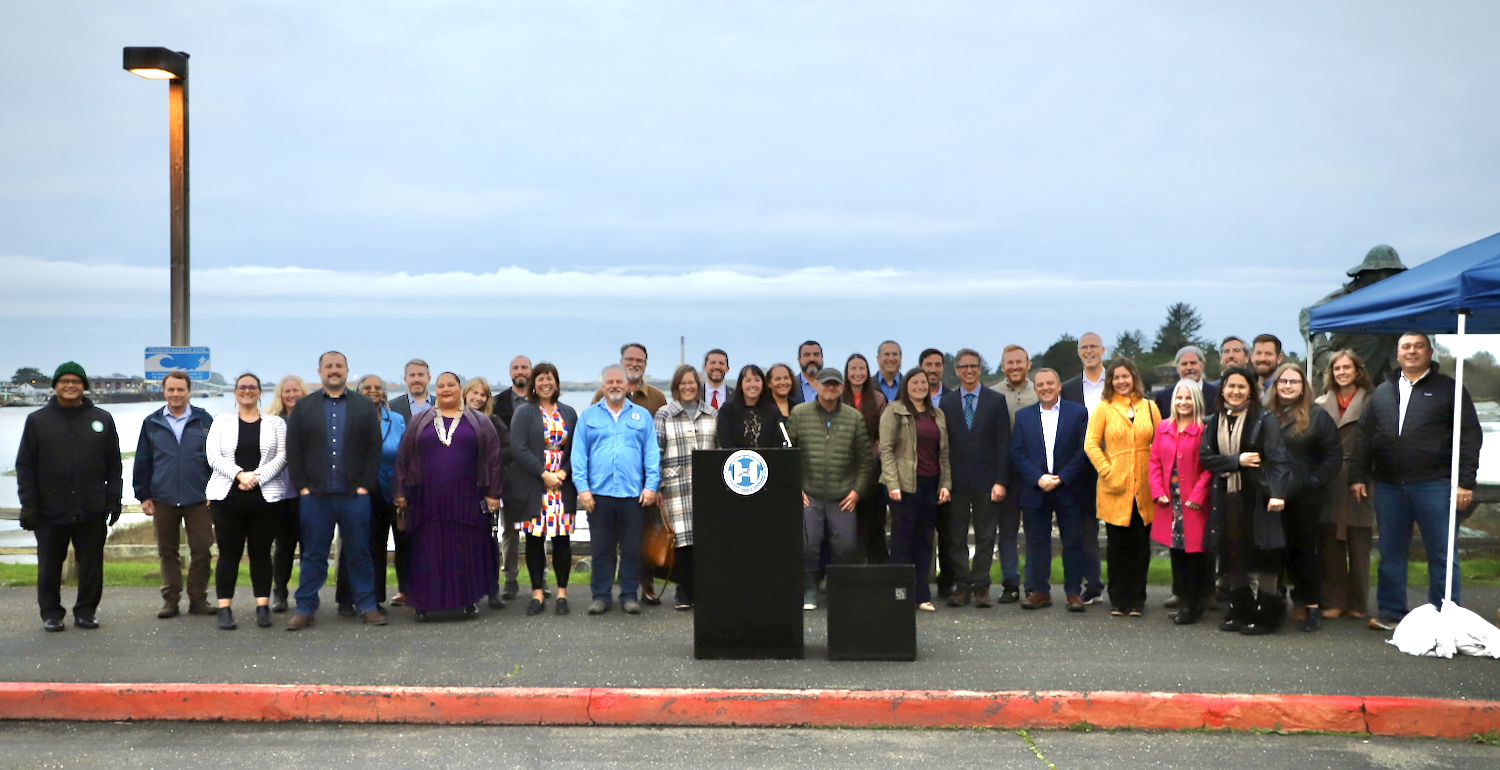
It was a high-powered affair on Woodley Island yesterday afternoon, as people gathered to hear Rep. Jared Huffman officially announce a $426 million Department of Transportation grant to build a port terminal for the coming offshore wind industry. A section of the island’s parking lot was roped off for the event, so that the VIP guests would have a convenient place to park for the ceremony, which took place beneath the Fisherman statue.
And come they did. Supervisors Steve Madrone and Natalie Arroyo were in attendance, as were Eureka Mayor Kim Bergel, Hoopa tribal chair Joe Davis, Jason Ramos of the Blue Lake Rancheria, county administrative officer Elishia Hayes, Cal Poly Humboldt president Tom Jackson, various emissaries from the local business community, harbor district personnel and representatives from the major international firms investing in offshore wind.

Why?
As Huffman said when he took the mic, the $426 million grant – all
of it originating from President Biden’s 2021 Infrastructure
Investment and Jobs Act – is kind of a big deal.
“The federal department of transportation INFRA Grant that we are celebrating today, to my knowledge, may be the biggest federal investment in this region in 50 years,” Huffman said. “It’s a big, big deal. It’s a game-changer. And for those of you that share in the excitement and the vision and all the possibilities that this offshore wind project has brought to this community, this is a huge step forward in making all of that real.”
What will the $426 million pay for? Not only for the dock and warehouse facilities themselves, but for various improvements that, together, are designed to make the new offshore wind facility a true “green port,” which Huffman hoped would “show the way” to other ports around the world.
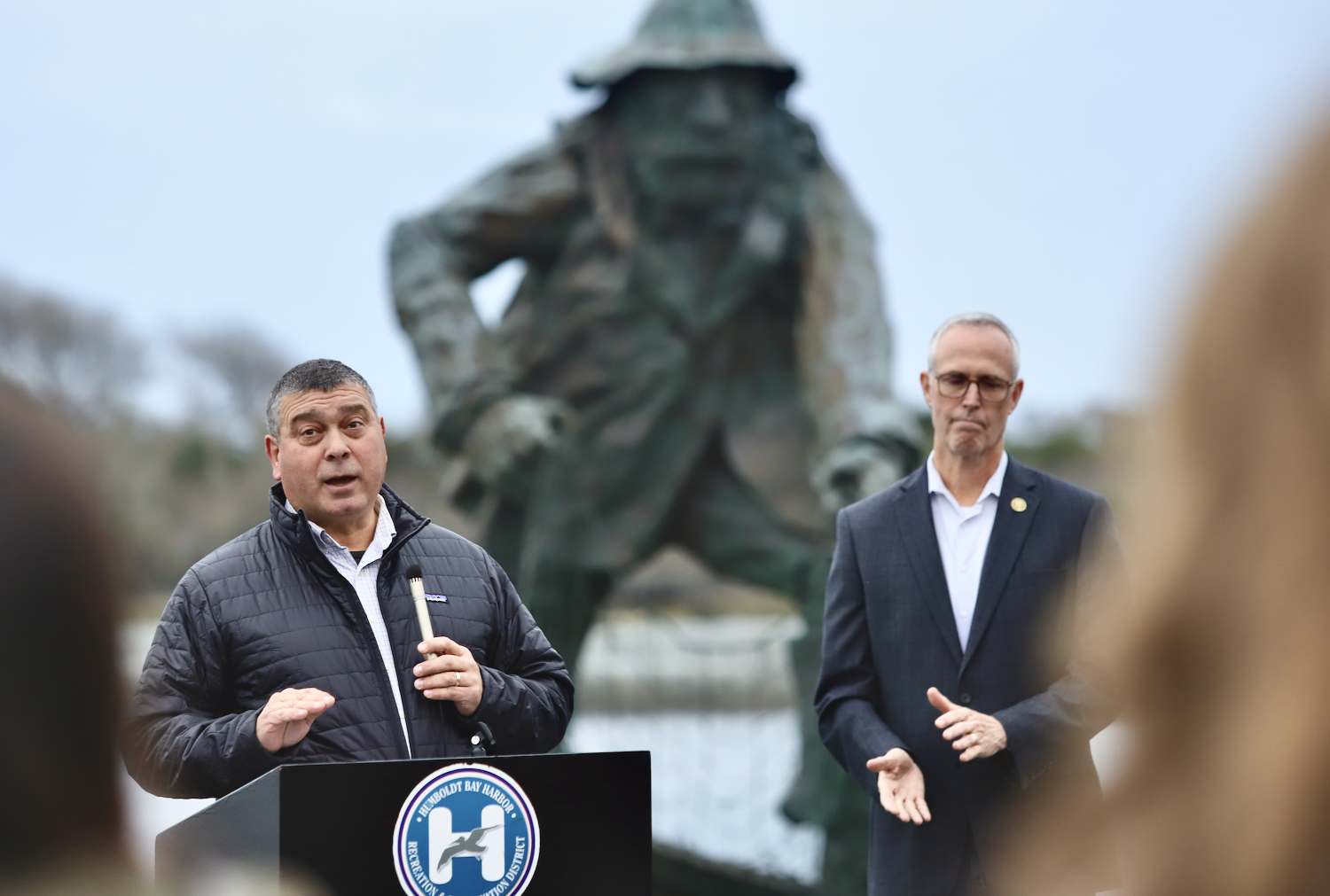
Harbor Commissioner Greg Dale
An emotional Greg Dale, the chair of the Harbor District’s board of commissioners – the body that will administer this massive cash injection — had a partial list of these green amenities when he followed Huffman at the podium.
“In this $426 million dollar grant, there’s $51 million dollars for environmental restoration,” he said. “$51 million dollars – [the federal government] probably hasn’t spent $51 million dollars on environmental restoration on Humboldt Bay in the entirety of the district’s time as a district.”
Dale also mentioned $10 million for a large solar array, and just over $1 million apiece for a trail and a public access pier. The grant also includes a $6 million community benefits program for “tribe, fishermen and local residents,” Dale said.
The federal grant comes with some sort of matching commitment from private industry, which in theory should add up to a billion dollars on-hand to build the huge facility, which is planned for the Samoa terminal currently owned by the Harbor District. The vision is that this new terminal will serve a nascent offshore wind industry along a large swath of the Pacific coastline, with absolutely massive floating windmills manufactured and assembled in Humboldt Bay, then towed out to the open sea by tug.

Chris Mikkelsen, Harbor District executive director
Not much was said about this matching commitment, or who exactly would be anteing up funds, and how that match affects the ultimate ownership of the new facilities. Crowley Wind Services, the would-be operator of the port, has not yet signed a deal with the Harbor District – the two sides are still in the “exclusive right to negotiate” phase of their relationship. Chris Mikkelsen, the Harbor District’s executive director, told the Outpost that the private match could come from many quarters: Crowley, a different operator, perhaps from the wind energy firms – the operators of the windmills – themselves.
Mikkelsen said that the district is trying to put together ways to communicate directly with the public on these sorts of sticky questions, perhaps in the form of quarterly updates. “No news is not good news,” Mikkelsen said.
This morning the Harbor District put out its own press release about the grant, and Crowley announced that it has purchased the country’s first all-electric tugboat.
More photos from yesterday’s event follow.

Rob Holmlund, Humboldt Bay Harbor Recreation Conservation District Director of Development

Amy Monier, Crowley Wind Services’ director of projects for the Humboldt Offshore Wind Terminal Project
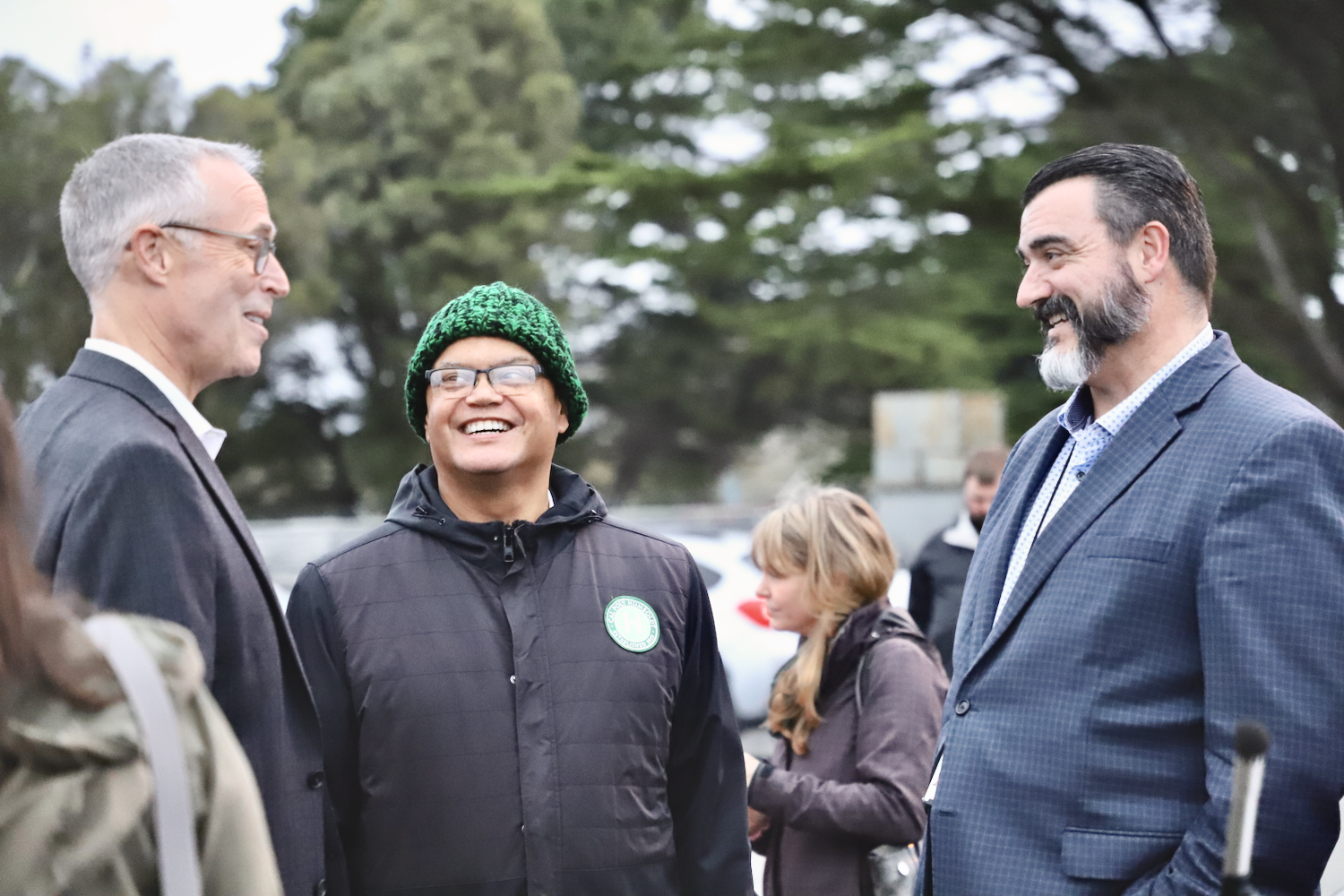
Congressman Huffman chats with Cal Poly Humboldt President Tom Jackson and Blue Lake Rancheria CEO of Business Operations Jason Ramos