

Environmental Review Period Begins for California Offshore Wind Lease Areas
LoCO Staff / Wednesday, Dec. 20, 2023 @ 10:01 a.m. / Energy , Offshore Wind

Image via the U.S. Department of Energy.
###
Press release from the Bureau of Ocean Energy Management:
Supporting the Biden-Harris administration’s goal of deploying 30 gigawatts (GW) of offshore wind energy capacity by 2030 and 15 GW of floating offshore wind energy capacity by 2035, the Bureau of Ocean Energy Management (BOEM) today announced it will conduct a regional environmental review of potential development activities on the five offshore wind lease areas off California’s central and north coasts. A Notice of Intent (NOI) to prepare a Programmatic Environmental Impact Statement (PEIS) will publish in the Federal Register on Dec. 20, 2023, initiating a 60-day comment period. The input gathered during the comment period will inform the scope and alternatives of the PEIS.
“The Biden-Harris Administration is committed to responsibly harnessing the clean energy and economic potential of offshore wind in California,” said Doug Boren, BOEM Pacific Regional Director. “This regional environmental analysis will help ensure that timely decisions can be made to advance offshore wind while protecting the ocean environment, marine life, and other ocean uses. This approach also ensures both a comprehensive review of the California areas and improved efficiencies for future offshore wind project reviews.”
The PEIS will describe the potential impacts of federal offshore wind energy development activities off the coast of California, as well as the change in those impacts that could result from adopting programmatic mitigation measures. BOEM will conduct subsequent site-specific NEPA analyses and consultations for individual proposed wind energy projects as construction and operations plans for those projects are received.
Additional information on the California Offshore Wind Energy PEIS and scoping webinars is available on the BOEM website at https://www.boem.gov/caoffshorewindpeis.
The five offshore wind energy lease areas off the coast of California were awarded through BOEM’s December 2022 auction that brought in over $757 million and will result in over $117 million for workforce training programs and U.S. domestic supply chain investments for the floating offshore wind energy industry.
###
DOCUMENT: Notice of Intent to file a Programmatic Environmental Impact Statement
BOOKED
Today: 11 felonies, 14 misdemeanors, 0 infractions
JUDGED
Humboldt County Superior Court Calendar: Yesterday
CHP REPORTS
6858-7051 Us199 (HM office): Trfc Collision-Unkn Inj
ELSEWHERE
Governor’s Office: Governor Newsom statement on compromise to address wildfire risk, support fire survivors, and create stronger accountability
RHBB: CDFW Announces Angling Closure at Mouth of the Klamath River
RHBB: Humboldt Bay Area Plan Planning Commission Workshop on Thursday, Sept. 3
Domestic Violence Shelters, a Guardrail Against Homelessness, Face Steep Funding Cuts
Jeanne Kuang / Wednesday, Dec. 20, 2023 @ 7:37 a.m. / Sacramento

The library and counseling room at Community’s Child in Lomita on Sept. 29, 2023. Community’s Child is a shelter and resource program that provides supplies, food and housing for women and infants who are struggling with homelessness, addiction and poverty. Photo by Alisha Jucevic for CalMatters
By the time the 2,000-plus domestic violence survivors come to the Family Violence Law Center, both their safety and housing are often at risk.
A survivor who’s successfully gotten an abusive partner ordered out of their shared apartment must next shoulder the rent on their own, said Erin Scott, executive director of the Oakland nonprofit. Moving out on their own brings them face to face with a daunting Bay Area housing market. Becoming homeless would exacerbate everything for a client already recovering from trauma.
Scott’s organization uses a grant program that pays for anything a client may need to stay housed, such as renegotiating leases with landlords, covering missed utility bills, or fixing their car so they can get to work.
“We are doing mostly homelessness prevention,” Scott said.
But the nonprofit’s program, Domestic Violence Housing First, sees a grim financial future on the horizon: Federal funding cuts are likely in 2024, which will affect the more than 17,000 households across the state who get those services, and the more than 13,000 people who visited domestic violence shelters in 2021-22.
Across California, similar shelter and housing programs for survivors are bracing for cuts next year. Also affected are a range of operations including county law enforcement’s victims’ services, court-appointed child advocates, rape crisis centers and legal assistance for victims of sexual assault and human trafficking.
The federal funding that pays for the services has been on the decline, prompting Congress to restrict the amount of money distributed to the states. Advocates for the programs, including the California Partnership to End Domestic Violence and the anti-sexual violence group Valor, are hoping California will backfill an expected 30-40% loss with the state’s own funds.
The last time the state did that, in 2021 with a $100 million supplement, California was flush with cash. Now, the advocates’ request for $200 million a year comes at a tight time for the state’s finances. Amid lower-than-expected tax revenues, state budget analysts have projected a record $68 billion deficit next year.
Cuts from the federal government, reflected in President Joe Biden’s budget and bills in both the House and the Senate, won’t be final until Congress passes and Biden approves a spending bill in early 2024. California, anticipating it will receive less, is considering reducing its grants to counties and nonprofits beginning in the next state fiscal year, which begins July 1.
A spokesperson for the state Department of Finance declined to comment on California’s plan to address the federal cuts, which is expected to be included in the state budget that Gov. Gavin Newsom will propose in January. Brian Ferguson, a spokesperson for the Office of Emergency Services also did not comment, saying only that funding levels for the grants are controlled by the federal government. Nor would the agency release minutes from July and August meetings in which officials discussed the funding, saying the minutes have not been finalized.
Domestic violence, homelessness linked
Among those facing the higher cuts in California are the housing and shelter programs for domestic violence survivors, a group particularly vulnerable to becoming homeless. That could mean cuts to services as California’s record homelessness continues to worsen. The Housing First program at Scott’s organization, among other housing services facing cuts, is funded entirely by the federal grants.
In California, state data for the first half of 2023 show 21% of those seeking homeless services reported having experienced domestic violence — outside of some shelters specifically serving survivors. A survey last year of unhoused women in Los Angeles County found 44% said domestic violence caused them to become homeless, and 29% said they left a permanent housing placement because of it.
“For a lot of our clients, domestic violence is the last straw,” Scott said. “They were already kind of on the brink of homelessness just because of the high cost of housing. They were in a two-income situation and for their own well-being and safety, they aren’t, all of a sudden.”
The nonprofit has already lost out on the renewal of a legal assistance grant this year because of the cuts, she said. That amounted to the cost of one staff attorney, who stayed on only because another staff member left.
The dollars in question come from the federal Victims of Crime Act fund, a pot of money maintained by the U.S. Department of Justice. Going into the fund are fines collected from people convicted of federal crimes. Every year, Congress decides how much of the fund goes out to states.
For years, the fund grew while the amount going to states remained mostly flat, below $1 billion. In 2015, Congress allowed more than $2.3 billion to be released. But the fund balance has been falling since 2017, as changes in federal prosecution strategies have netted less in fines for the fund. Though Biden in 2021 signed a law allowing more sources of money to go into the fund, it hasn’t yet grown back.
The Department of Justice did not respond to requests for comment.
Versions of the congressional spending plans being considered by both the U.S. House and the Senate include a $700 million reduction going toward states in the federal 2024 fiscal year, compared to the year before. That would amount to a 36% cut.
In California, the state from 2020 to 2023 distributed an average of $230 million a year in crime victims grants. Next year, it’s expecting to get between $105 and $132 million from the federal government.
Krista Colon, senior director of public policy strategies at the California Partnership to End Domestic Violence, said the seesawing federal funding shows the state should help keep these programs funded on its own.
“We think it’s really essential to provide that stability,” she said.
Without it, the hundreds of organizations across the state that receive the grants are scrambling to keep their services afloat.
In southern California, the crime victim grants make up about half of the East Los Angeles Women’s Center’s budget. They pay for services such as a 24-hour, bilingual rape crisis center that responds to calls from three local hospitals, a transitional housing service where survivors can stay for two years as they get back on their feet and services tailored toward sexual assault or human trafficking victims in low-wage industries commonly reliant on immigrant labor. There already is a 100-person waitlist for therapy, and beds in the housing programs are “always filled,” said executive director Barbara Kappos.
“I am desperately looking at other ways to fund these programs,” Kappos said.
###
CalMatters.org is a nonprofit, nonpartisan media venture explaining California policies and politics.
TODAY IN SUPES: Board Tables Decision on Humboldt County Visitors Bureau Contract, Agrees to Continue Tourism Marketing Services With the Agency Through May 2024
Isabella Vanderheiden / Tuesday, Dec. 19, 2023 @ 5:02 p.m. / Local Government

Screenshot of Tuesday’s Humboldt County Board of Supervisors meeting.
###
Representatives of the local tourism and business sector showed up to today’s Humboldt County Board of Supervisors meeting to urge the board to preserve the county’s relationship with the Humboldt County Visitors Bureau (HCVB) or risk adverse impacts to the local tourism industry and economy.
Following nearly three hours of deliberation, the Board of Supervisors agreed to wait until May 2024 before making any changes to its contractual agreement with the HCVB to provide more time for the Tourism and Travel Ad Hoc Committee time to reevaluate the county’s tourism assets and discuss the issue with local municipalities.
The board approved the formation of an ad hoc committee back in October 2022 to oversee some of the revenues and expenditures associated with the visitors bureau, which is funded through the county’s Transient Occupancy Tax (TOT), and look for ways to improve the county’s overall travel and tourism marketing strategy. The ad hoc committee’s report, presented during today’s meeting, expressed “concern for the HCBV’s use of county funding” and questioned whether the bureau was capable of fulfilling its agreement with the county.
“The agreement covers tourism and marketing services with a total payable amount equal to 18% of TOT received by the county annually from July 18, 2018, through June 30, 2024,” according to the staff report. Of the TOT paid to the HCVB under the agreement, 42 percent passes through “gateway organizations,” including the Southern Humboldt Visitor’s Bureau (SHBVB) and the Arcata, Garberville, Orick and Willow Creek chambers of commerce.

Adair | Screenshot
A significant portion of the HCBV’s allotment is “eaten up” after the gateway organizations get their piece of the pie, said Economic Development Director Scott Adair. Most of the funding covers rent, utilities and staff salaries, leaving “very little funding to actually perform an efficient and effective marketing campaign for Humboldt County.”
The ad hoc offered up two potential solutions to address the HCVB’s financial issues: Allocate additional funding to the organization or terminate its marketing contract with the county and develop a new marketing fund.
“It’s important to identify and recognize that HCVB is the lead agency charged by your board with the overall success or failure of marketing, travel and tourism initiatives in Humboldt County,” Adair told the board. “It’s important to state that what we’re discussing today is not about the who; this is about a programmatic decision that sits before your board.”
Speaking during the public comment portion of today’s meeting, HCVB Executive Director Julie Benbow sought to “clarify – on record – some misinformation presented” in the staff report, which, she said, focused on the bureau’s shortcomings “without acknowledging the tremendous national and international marketing successes that we’ve accomplished with a small budget … .”

Benbow | Screenshot
“In 2022, travel-related spending brought in half a billion dollars to the county – over $49 million in tax revenue into the General Funds,” Benbow said. “Tourism is the only consistent, non-resident source of revenue coming into the General Fund. If the [HCVB] is defunded, there would be a critical adverse effect on revenue and loss of support from businesses throughout the county. … We urge the Board of Supervisors to increase funding and not endanger the quality of life for the people of Humboldt County.”
Several others echoed Benbow’s comments, including Marc Rowley, a former HCVB board member, who urged the board to seek more information from tourism industry experts before deciding on the matter. He also asked for more collaboration between the HCVB and the Humboldt Lodging Alliance (HLA). “Those are your travel professionals,” he said.
Similarly, Alex Stillman, local mover and shaker and Arcata City Councilmember, urged the board to think about the tourism industry as a whole rather than several separate components.
“I don’t know how to pull it all together,” she admitted. “We’ve always had tourism. We have gone through many other things … where we’ve had fisheries and lumber and so forth, but we’ve always had tourism. I think it’s one of [the] most [important] economic development tools that we can have.”
Early on in the board’s discussion, Fifth District Supervisor and Board Chair Steve Madrone suggested the board table the discussion and do some more research before deciding on the matter.
“I think no matter what we’ve got more work to do and I think we need to keep the ad hoc working together to bring forward some more concise recommendations,” Madrone said. “We’ve got some good ones here today, but I don’t know that we’re gonna get all this resolved. … I think we’re going to need to reevaluate the gateways and where that money goes and how that works.”
Third District Supervisor Mike Wilson emphasized the importance of adopting modern tourism marketing strategies. “We’re really talking about the future,” he said. “Where we came from is some relevance but really, it’s about the future. It’s about the future of what people want to do. It’s about the future [of] how people communicate and receive information and how we direct that.”
Second District Supervisor Michelle Bushnell noted that today’s discussion was not meant to determine whether or not the HCVB has done a good job at marketing, but whether the bureau has adhered to its contractual obligations with the county.
“If we’re not going to hold people to contracts that are signed, then we need to rework those contracts,” she said. “I think it’s super important that we, as an organization, hold people to that and if it’s not working, it’s adjustable. Let’s sit down at the table with them and go over the contract and figure out why it’s not working or why it’s not achievable.”
Bushnell made a motion to return to the subject in six months to allow time for staff and the ad hoc committee to go over the county’s contract with the HCVB. She also requested that the ad hoc committee discuss the county’s marketing strategies with gateway organizations. Madrone seconded the action.
After a bit of additional discussion, the motion passed 5-0.
Enrollment Open for ‘Humboldt Income Program,’ Which Will Provide 150 Expecting Parents With $920 a Month for 18 Months
Stephanie McGeary / Tuesday, Dec. 19, 2023 @ 3:47 p.m. / Community Services
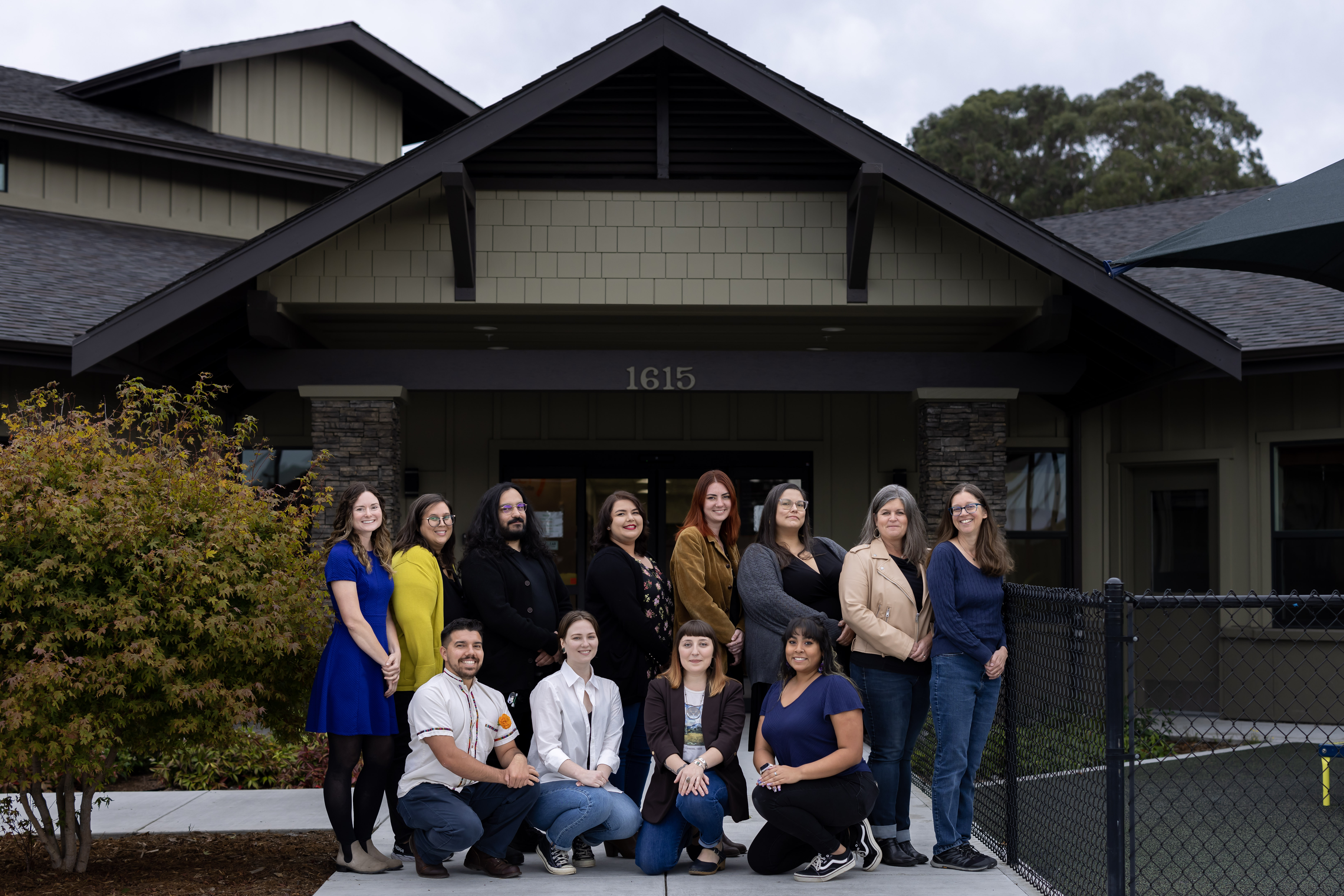
The Center staff pose in front of The Center in McKinleyville | Photo: Brianne Nicole Photography
###
After announcing last year the launch of the Guaranteed Basic Income Pilot Program, the McKinleyville Family Resource Center (McKFRC) announced today that the program is now accepting referrals for eligible individuals and families to receive $920 per month for a year and a half.
The program, which McKFRC has locally named the Humboldt Income Program, is one of seven Guaranteed Income Pilot Programs funded by the California Department of Social Services (CDSS) across the state. Out of the seven selected nonprofits, McKFRC is the only one that serves a rural area, Robin Baker, co executive director of McKFRC, told the Outpost, and was awarded nearly $2.5 million for the program last year.
The pilot program is designed to help pregnant individuals and young adults who have aged out of the foster care program, and each of the participating nonprofits has a different set of criteria for accepting applicants. The Humboldt Income Program is geared toward people within their first two trimesters of pregnancy.
The program is available to anyone who is at least 18 years of age, lives in Humboldt County, is currently within their first 27 weeks of pregnancy and is at or below 200 percent of the federal poverty level. Here are the current income levels by family size to qualify.
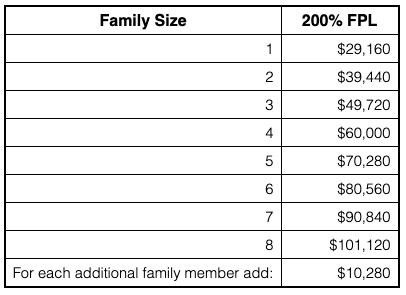
Image from McKFRC’s website
Applicants must be referred by one of MckFRC’s referral partners, including United Indian Health Services, Open Door Community Health Centers, North Country Prenatal Services and Redwood Community Health Center Pregnancy Services, Hoopa TANF, Redwoods Rural Health Center, Providence Medical Group, K’ima:w Medical Center, CalWORKs, or Providence St. Joseph Hospital Paso a Paso and CARE Network programs. If you would like to apply, you should call whichever of those agencies you use. Once you’re referred, you will receive a text or email with a little bit of paperwork to fill out, but it is very easy and should take about 15 minutes to complete, Baker said.
If you read the Outpost’s previous story about the program, then you might have noticed that the amount of the payments has decreased from the monthly $1,000 that was initially promised. Baker said this was because each recipient of the grant had to also match one third of the funds through their own fundraising efforts, and, unfortunately, McKFRC did not meet their goal. But the nonprofit was still able to round up more than $1 million through local donations and worked with CDSS to lower the monthly payment amount to $920 for 18 months.
The referral period started on Dec.4, and Baker said that they have already enrolled 39 people in the program, which means there’s still space for 111 more. Enrollment will continue until all 150 people have enrolled.
Baker said that she is very excited to be launching this program, especially at a time when financial assistance is badly needed. McKFRC is a part of The Center, a multi-agency facility that provides assistance with many assistance programs, including WIC, CalFresh, MediCal, Child Welfare Services and more. Baker said that since opening in early 2022, the Center has seen “a higher need” recently for all of its assistance programs.
Though the Humboldt Income Program is only able to help people through pregnancy and very early parenthood, Baker hopes that if the pilot program is successful, it can be extended to help more people in the future. Unlike many other assistance programs, which only provide assistance for specific needs, such as groceries, the guaranteed basic income program has “no strings attached,” Baker said, and can be used by the recipients however they see fit, which aligns with McKFRC’s mission.
“The McKinleyville Family Resource Center holds the belief that people are experts in their own lives and their own needs,” Baker said. “We’re not going in and telling them how to spend the money.”
You can find more information on the Humboldt Income Program on McKFRC’s website.
New Four-Story Building Slated for Old Town Would Bring 13 Apartments and New Retail Space to Eureka
Ryan Burns / Tuesday, Dec. 19, 2023 @ 2:06 p.m. / Housing , Local Government

This proposed mixed-use commercial/residential building, from local architectural general contracting firm ACGC, would bring 13 apartments and ground-floor retail space to the corner of Third and G streets in Eureka’s historic Old Town. | Image via City of Eureka.
###
As Eureka’s pitched battle of parking proponents versus housing advocates heads toward showdowns in court and at the ballot box, a new project slated for the corner of Third and G in Old Town offers one example of what the city’s future development might look like.
Designs for the four-story building, by Eureka-based Adams Commercial General Contracting, Inc. (ACGC), include 13 apartments atop two ground-floor commercial spaces, and the applicant is seeking a variance from zoning regulations that generally require such projects to include designated parking spots.
“The City supported us [in that request],” said Raelina Krikston, ACGC’s real estate development director and community liaison. “Given the size of the lot it wouldn’t be possible to put in this kind of development and still include parking.”

This building at Third and G was erected by Humboldt County pioneer Joseph Russ in 1880. | Image via City of Eureka.
The 4,460-square-foot parcel, formerly home to Russ Meat Market and Globe Imports, has sat vacant since the historic old building burned to the ground in 2006. A sign currently affixed to the chain-link fence surrounding the lot suggests some possible downstairs tenants: retail, light manufacturing, bar/microbrewery, restaurant, office or café/bakery.
ACGC is actively seeking commercial tenants, and Krikston said the downstairs spaces can be built to suit a tenant’s specifications.
The apartments on the top three floors will include a mix of studio, one- and two-bedroom units with three fully accessible ADA units. Krikston said the location — near several existing municipal parking lots and catty-corner to the future mass transit hub of Eureka’s EaRTH Center — offers convenience to future tenants.
“If you have more people living close to shopping it’s better for everyone,” she said.

The vacant lot at Third and G. | Photo by Ryan Burns.
###
Earlier this month the project came before Eureka’s Historic Preservation Commission, which was an odd state of affairs, as one commissioner pointed out, since there’s nothing of historic significance left on the site — nothing at all, really, save some slabs of old concrete. But Senior Planner Lisa Savage explained that the parcel was created via a 2021 subdivision from the lot next door, owned by Globe Properties. So, for the time being, it remains on the city’s historic registry.
Presenting the project to the commission, Savage ran through some of the building’s other amenities, including rooftop solar, skylights, indoor and outdoor bicycle parking and both full-sized and Juliet balconies.
“The new construction will not create a false sense of historic development as it will bring a more modern look while also incorporating several features into the proposed design that echo back to the Victorian Era heritage,” Savage said. She noted design features such as exterior cornice molding, “which mirrors the Italianate architecture in nearby buildings,” and the structure’s tall, narrow dimensions, which “echo the Victorian Era.”

Another perspective on the proposed building. | Image via City of Eureka.
###
The project was unanimously approved, but not before commission member Bruce Sievertson broached the inevitable parking question, even though it was outside the commission’s purview.
“How can you justify not having parking with all these units, and potentially a restaurant downstairs that requires parking?” he asked ACGC architect Julian Berg. “You know what parking is like downtown. It’s not going to get any better.”
Berg said he agreed, later adding, “I have my own feelings that I probably won’t strongly voice this evening.” But he went on to say, “It’s a very small lot, and we strongly feel we need housing in the downtown core because it creates a more dynamic, urban core.”
Berg also said that ACGC owner Will Adams is looking into renting parking spaces in an adjacent lot.
During the public comment period, local resident Midge Catching said the project will be a nice addition to the city, and she pushed back on the calls for dedicated parking spots.
“I think if parking were insisted [upon] for this building, there’s no way it would be built,” she said. “The lot isn’t big enough to do anything else. Plus, across the street will be the transit hub.”
She went on to offer this blunt assessment of the city’s parking situation:
Body Found During Search Confirmed to be That of Missing Piercy Man, Mendo Sheriff’s Office Says
LoCO Staff / Tuesday, Dec. 19, 2023 @ 1:58 p.m. / News

Scott Harris
PREVIOUSLY:
###
Press release from the Mendocino County Sheriff’s Office:
On 12-10-2023 searchers located a deceased person in the missing person investigation established search area.
On 12-19-2023 at 9:30 AM the Mendocino County Sheriff’s Office Coroner’s Division reported they had identified the deceased body after recent dental comparisons were conducted by a Forensic Odontologist.
Dental comparisons confirmed the deceased person found during the 12-10-2023 search efforts as being Scott William Graves.The Coroner’s Division and Sheriff’s Detectives are continuing investigations in an attempt to determine the manner, cause and circumstances of Graves death. Anyone who might have information that could assist Sheriff’s Detectives in this investigation are urged to contact the Sheriff’s Office Tip-Line by calling 707-234-2100 or the WeTip Anonymous Crime Reporting Hotline by calling 800-782-7463.
California Approves Rules That Turn Sewage Into Drinking Water
Rachel Becker / Tuesday, Dec. 19, 2023 @ 12:12 p.m. / Sacramento

Luis Canela, a water quality technician, injects sodium hypochloride and armonium sulfate to treat water at the Pure Water Southern California Demonstration Plant in Carson, on July 28, 2023. Photo by Lauren Justice for CalMatters
In a milestone for creating a major new source of drinking water, California has approved its first standards for turning sewage into potable water supplies delivered to homes and businesses.
The State Water Resources Control Board, In a unanimous vote today, outlined for the first time how water suppliers can treat recycled water and send it directly to taps. Currently recycled water is mixed into aquifers or used for irrigation and other non-drinking purposes.
The new rules — which have been more than a decade in the making and were mandated by a state law — outline a slew of requirements aimed at ensuring that germs and chemicals are scrubbed from treated sewage.
Often dubbed “toilet-to-tap,” the process is actually much more extensive and complex, requiring multiple treatment steps overseen by 63 pages of detailed rules. The new rules also call for extensive monitoring to ensure the treatment is working.
The sewage will be bubbled with ozone, chewed by bacteria, filtered through activated carbon, pushed at high pressures through reverse osmosis membranes multiple times, cleansed with an oxidizer like hydrogen peroxide and beamed with high-intensity UV light. Valuable minerals, such as calcium, that were filtered out will be restored. And then, finally, the wastewater will be subjected to the regular treatment that all drinking water currently undergoes.
California will be following Colorado, which already has regulations, and Texas, where the nation’s first direct potable reuse plant was built a decade ago. Rules are in development in Florida and Arizona, as well.
Nothing will go into effect immediately; the regulations must undergo a final review by the Office of Administrative Law before being implemented, likely next summer or fall. The first facilities are several years away.
“A city produces wastewater during a drought, and having that source available to augment other (drinking water) supplies can be critical,” said Darrin Polhemus, deputy director of the state water board’s Division of Drinking Water.
The water is expected to be more expensive than imported water, but also provide a more renewable and reliable supply for California as climate change continues.
The expense of the treatment and monitoring means that it will likely be limited to large urban water providers, Polhemus said.
“It will offer a resilient source in drought times for large water systems to be part of their portfolio. It’s not going to be a singular water source for some small community on the coast — that’s just not going to work out well the way these regs are written,” Polhemus said.
A panel of independent experts determined that the regulations “adequately protect public health,” but reported that some requirements, such as for removing disease-causing germs, might be on the more conservative side, driving up costs.
This could “push utilities toward less environmentally desirable alternatives, such as extracting groundwater without replenishing it,” the panel said in a memo to the state board in September. It could also “limit the ability of smaller communities to use” the recycled water as drinking water.
“I don’t think anyone should be surprised that a water board regulator would choose to err on the side of public health,” said Kevin Hardy, executive director of the National Water Research Institute, a non-profit that coordinated the expert panel.
The Metropolitan Water District, the giant agency that imports water to Southern California, is already on its way to being among the first to directly use recycled water for drinking supplies with Pure Water Southern California, a multi-billion dollar project with the Los Angeles County Sanitation Districts.
By 2032, the plant is expected to produce about 115 million gallons of recycled water a day, enough for 385,000 Southern California households. Most will replenish groundwater, but some is expected to be added to drinking supplies upstream of Metropolitan’s treatment plant for imported water.
Mickey Chaudhuri, interim chief of operations at Metropolitan, applauded what he called a historic milestone.
“This marks a pivotal moment in California’s water management history,” he said at the public hearing today.
Last year, Gov. Gavin Newsom called for increasing recycled water use in California roughly 9% by 2030 and more than doubling it by 2040.
Most treated sewage — about 400 million gallons a day in Los Angeles County alone — is released into rivers, streams and the deep ocean.
###
CalMatters.org is a nonprofit, nonpartisan media venture explaining California policies and politics.


