Coriell reports this morning that the local title companies are fully up and running once again.
###
UPDATE, Nov. 29, 1 p.m.:
Bryn Coriell called the Outpost a few minutes ago to report that a few employees at the two local title companies have had their access to Fidelity National Title’s online systems restored, which he took to mean that the rest of the staff will soon be up and running as well.
###
Original post:
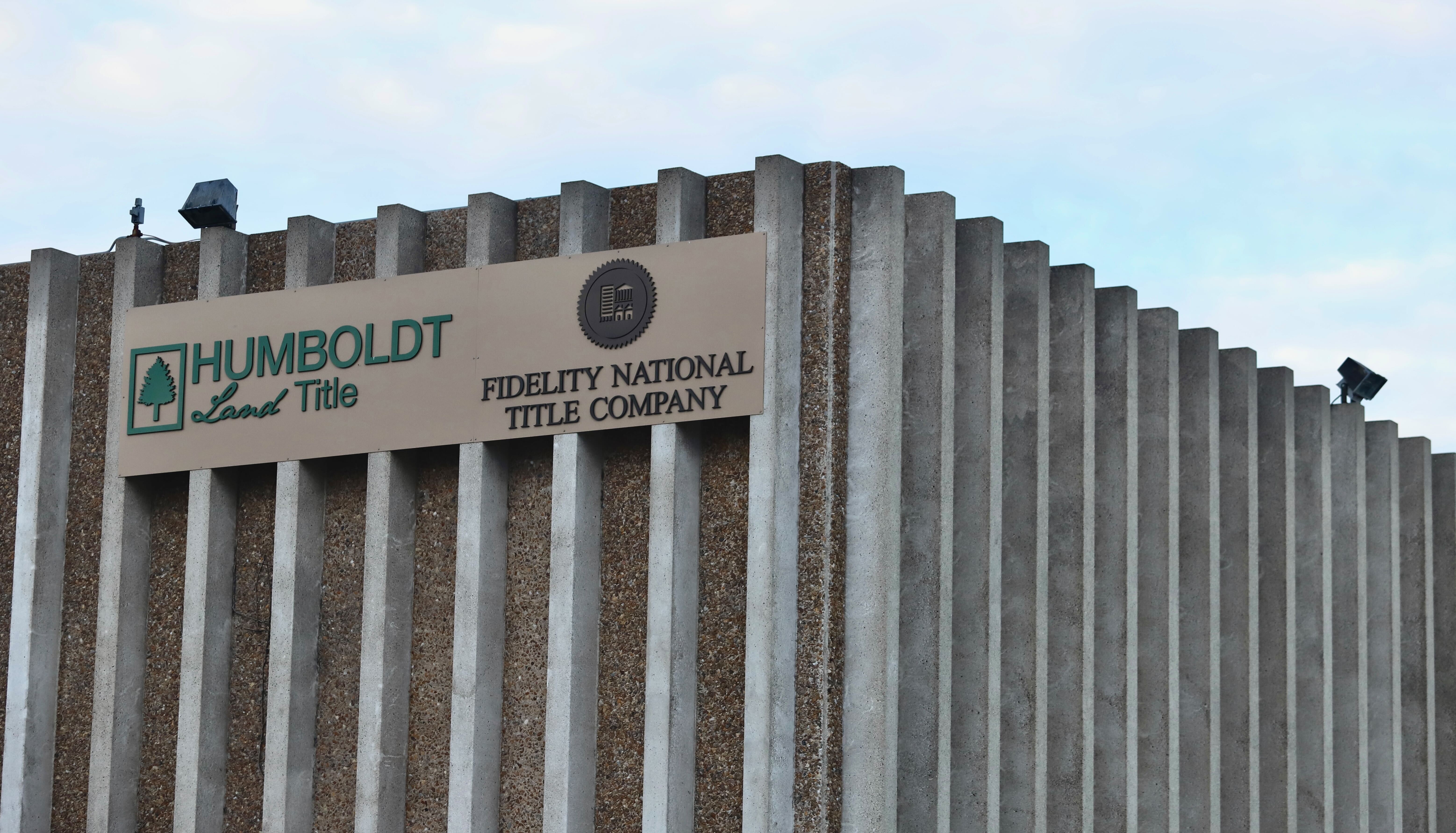
Humboldt Land Title and Fidelity National Title Humboldt, located in the former Times-Standard building on Sixth Street in Eureka, are the only title companies left in the county. Both are owned by Fidelity National Title. | Photo by Andrew Goff.
###
Virtually all local real estate transactions have been indefinitely delayed since last Tuesday thanks to a failed cyberattack on Fidelity National Title, a Fortune 500 company that owns the only two title companies left in Humboldt County: Humboldt Land Title and Fidelity National Title Humboldt.
The unexpected shutdown could wreak havoc with pending escrow closures and cause major financial impacts to borrowers, according to Bryn Coriell, president of the Humboldt Association of Realtors and broker-owner of Coldwell Banker Sellers Realty in Arcata (DRE# 01997964).
“At this point, Humboldt County is in total gridlock,” Coriell said. “We can’t close a single escrow or facilitate the signing of settlement statements.”
Speaking only about the incident’s impact in his own office, which employs 20 agents, Coriell said, “We have at least three deals that are supposed to close this week and we had one or two last week that are not going anywhere.”
After being targeted with a ransomware attack last Tuesday, Fidelity National Title responded by shutting down some of its systems, which is impacting mortgage transaction services nationwide, as the company explained in a regulatory filing with the U.S. Securities and Exchange Commission.
In an emailed message to fellow members of the Humboldt Association of Realtors this morning, Coriell explained that as a result of Fidelity’s ongoing internal review, the company is having to reboot each employee’s system access one by one, which is time-consuming. “This process involves authenticating each unique user and ensuring compliance with the SEC,” his message explained.
Nearly a week after the attack, local employees of the two Fidelity-owned title companies still don’t have access to the systems required to complete home loan transactions, he said.
A woman who answered a phone call to Humboldt Land Title told the Outpost that all inquiries must be sent to Fidelity’s national marketing team. We sent an email but aren’t holding our breath for a response since other news outlets have been trying to get answers for more than a week, to no avail.
Meanwhile, the local real estate market has come to a screeching halt. One local lending professional, who asked to remain anonymous so as not to burn any business-related bridges, said the cyberattack is hitting Humboldt County especially hard because there are no alternatives to Fidelity here.
“It’s kind of scary because we used to have multiple companies doing the same thing, and Humboldt Land Title used to be employee-owned,” he said. “Fidelity bought them out. Since then, [Humboldt Land Title and Fidelity National] operate under two different names, but really it’s one company. Each transaction is typically going through them, so if they go down, we all go down.”
The lender explained that interest payments on home loans are paid in arrears. So, for example, a December loan payment covers the necessary principle amount plus November’s accumulated rent.
“When we fund a loan, [the borrowers] start paying interest from the day we fund, which is normally fine and dandy,” he said. “But last week we funded a loan and it hasn’t recorded, so our borrower is paying interest on a loan that hasn’t been recorded because Fidelity/Humboldt Land is unable to trace the funds for the loan and get into their system to verify everything.”
He’s hoping that the title company will cover any excess interest amount that his clients have to pay but he doesn’t know if that will happen.
Another employee of that lending company said borrowers could wind up losing their down payment as a result of their loan following through, costing them $15,000 or more. “I don’t necessarily trust banks to recognize that this is an extenuating circumstance,” he said.
Last week, one worried realtor told Coriell that clients were pulling into Humboldt County in a 40-foot moving truck and had no idea what would happen if their loan didn’t close.
Coriell wanted to make it clear that local employees of the two Fidelity-owned title companies have always been top-notch, and they’ve done their best to help during this incident, reaching out to corporate higher-ups by phone, delivering checks for earnest money deposits and so forth. But for the most part they’ve been locked out of the systems required to do their jobs.
In most cases, the delayed home sale closures aren’t a huge deal, Coriell said, because a delay of a day or two — or even a week — won’t make a big difference in the long run, though of course people might get upset about having to cancel reservations for cleaning companies, moving vans or other services.
“The real trouble,” Coriell said, “is when people who are loan-funded lose their rate lock.” Banks and other mortgage lenders often pre-approve home loans at a guaranteed interest rate, but if the deal fails to close within a set timeframe, that guaranteed rate can be lost.
When the borrower applies again, Coriell said, “the rates might be a lot different. They [the borrowers] might not qualify for that loan and so they can’t buy that house. That’s the real kicker.”
In his message to fellow realtors, Coriell said leadership at Fidelity was hopeful that its systems could be back online as soon as today, though there’s no way to know how long it will actually take.
With people waiting to close what may be the largest financial transactions of their lifetimes, the stakes of this shutdown are getting larger every day.
“We tend to run on pretty strict schedules,” Coriell said. “These are people’s lives.”
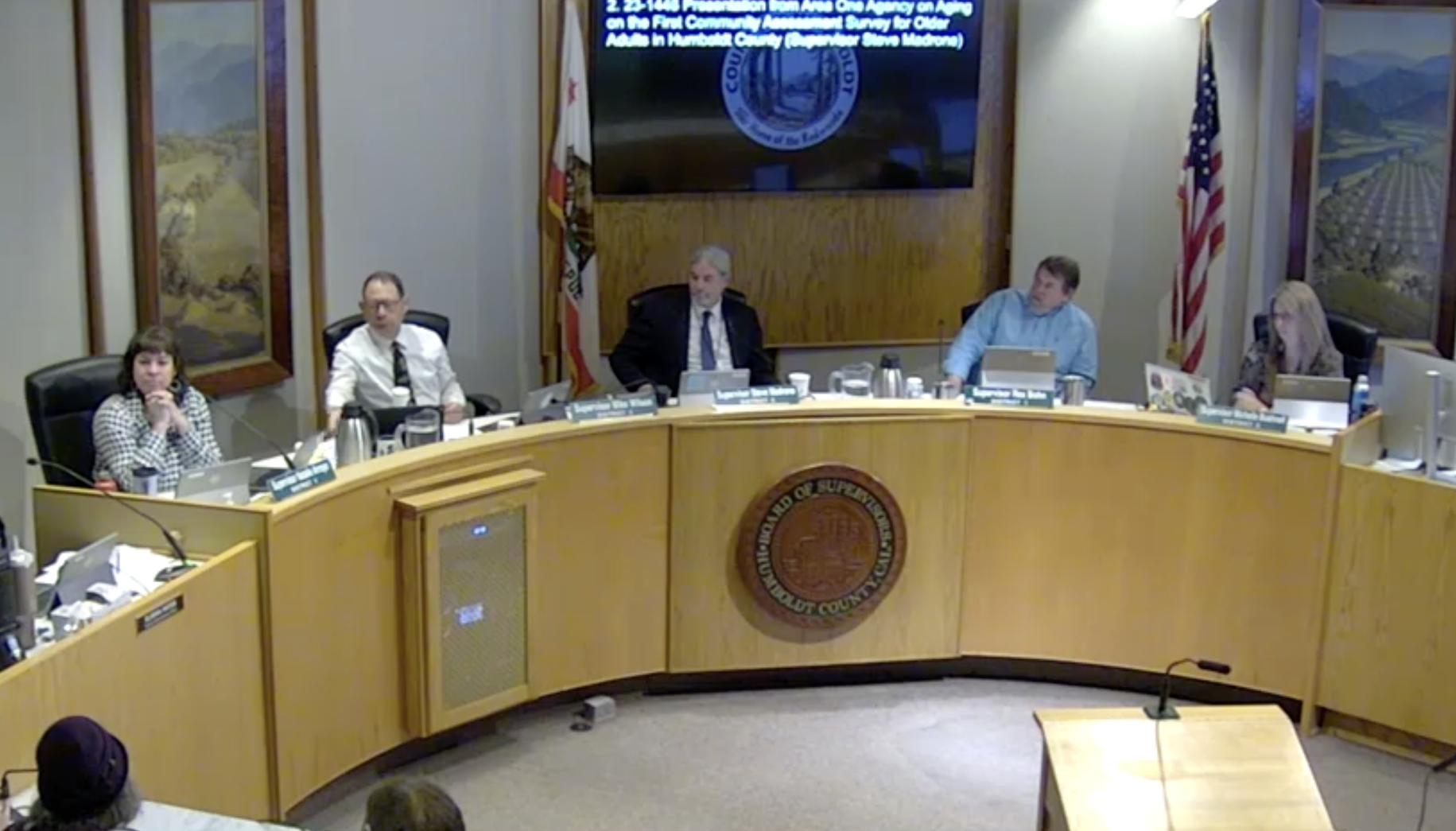
Screenshot of Tuesday’s Humboldt County Board of Supervisors meeting.
###
The Humboldt County Department of Finance is a no-go, for now at least.
The Board of Supervisors today voted 4-1, with Third District Supervisor Mike Wilson dissenting, to nix a proposed ballot measure that sought to consolidate the county’s Treasurer-Tax Collector’s office and Auditor-Controller’s office into a unified Department of Finance, whose director would have been appointed by the board rather than elected by the public.
[CORRECTION: The Outpost originally reported that Wilson abstained from the vote. However, county staff recorded his vote as a “no.”]
A similar proposal was presented to Humboldt County voters in 2016 through Measures Q and R, but the pair of ballot measures did not pass. But after the tumultuous tenure of former Auditor-Controller Karen Paz Dominguez, the Board of Supervisors last year decided to revisit the consolidation concept and directed staff to draw up a new version of the measure.
Speaking during this morning’s meeting, County Administrative Officer Elishia Hayes noted that the Treasurer-Tax Collector Amy Christensen and Auditor-Controller Cheryl Dillingham “have both indicated opposition to the measure.”
“Furthermore, your board is not in it’s not unanimous in support around placing this on the ballot,” Hayes continued, noting that Fifth District Supervisor and Board Chair Steve Madrone had voted against the item during the board’s Nov. 7 meeting. “[That] is a little non-typical when placing a ballot measure before the voters [because] it reduces the confidence level around the success of such a measure. That is something for your board to consider as you provide final direction to move forward with this.”
First District Supervisor Rex Bohn, who was absent during the board’s last discussion on the matter, acknowledged that “there was a time that this [would have been] the greatest thing since butter and popcorn.” However, he didn’t feel consolidation was necessary, as the current leaders of both departments have successfully steered the county back on track.
“I don’t know the amount of vendors we lost in the previous four years,” Bohn said. “It was trying times … but those are issues that are under the bridge. … I think we’re digging ourselves out and we will soon be whole again.”
Second District Supervisor Michelle Bushnell took a more neutral stance. “I do think that the current electeds are doing a fabulous job,” she said. “I really am happy with whatever the board chooses.”
Similarly, Fourth District Supervisor Natalie Arroyo said, “I don’t think that it’s imperative that we move forward with this right now.”
Wilson spoke in favor of putting the matter to voters, noting that “there are cogent arguments in both directions.”
“Mostly, this is a risk calculation,” he said. “What we would be asking the public is, ‘Is there a risk of fraud and abuse by consolidating [and] having the auditor-controller be hired [by] this board?’ … And then on the other side of that is the risk of the politicization of the office itself through a democratic process.”
Wilson criticized the notion that the matter should be set aside because there are “good people” currently leading the departments who are likely to be re-elected.
“That is an assumption of political succession, which I think is also something that is not as democratic as one might imagine,” he said. “I do actually believe that the people we have working in these offices right now are very competent, doing a very good job, and from that perspective … that risk factor is quite a bit lower now, but … the future is unknown.”
Speaking during the public comment portion of today’s meeting, Christensen urged the board to keep the two departments separate “to maintain the strict internal controls currently in place.”
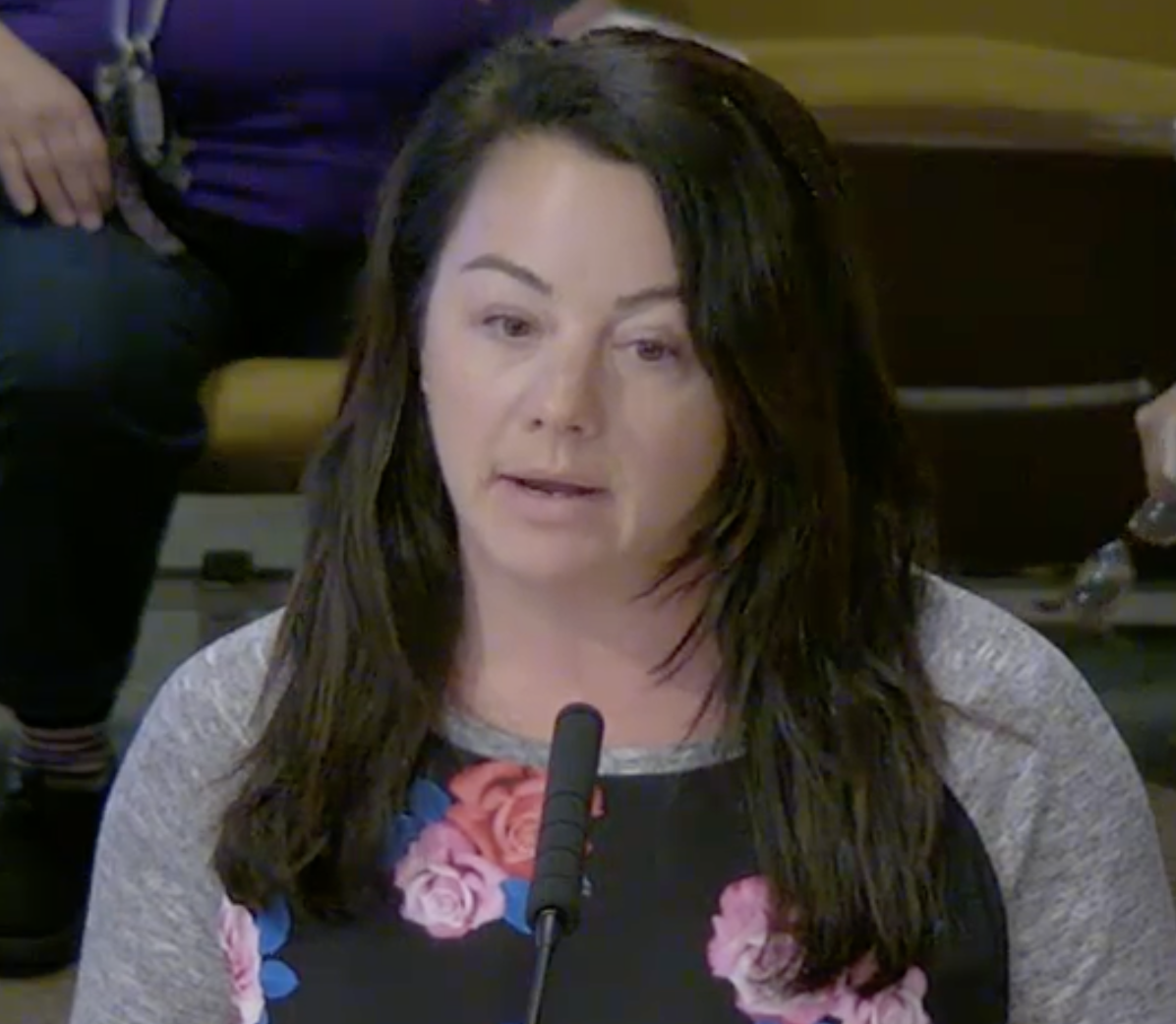
Christensen | Screenshot
“It is critical that the offices of the auditor-controller and the treasurer-tax collector remain independent and elected by the people of Humboldt County,” she said. “Cross-training between those two departments cannot happen. Operations between the Treasurer-Tax Collector and the Auditor-Controller are running efficiently, and I am confident that I see that continuing for the long term.”
Following public comment, Bushnell asked whether the checks and balances would remain in place if the two departments were combined. Hayes said each department “would still have their [own] processes in place,” but they would answer to a single department head.
After a bit of additional discussion among board members, Madrone made a motion to quash the proposal for the time being. Bohn seconded the action.
###
Check back on Wednesday for more coverage of this week’s Board of Supervisors meeting.
Press release from the Humboldt County Department of Health and Human Services:
A dashboard that tells the story of the health of the Humboldt County community was launched this week after years in the works. Thanks to Live Well Humboldt (LWH), a group of community partners working together to improve health equity in the county, the free dashboard can be used to learn more about community health data and other health resources, like funding opportunities, promising practices and reports.
Made up of county departments and divisions, local medical providers, Tribal partners, cities, Cal Poly Humboldt and other government agencies, LWH partners previously worked together to create the Community Health Improvement Plan (CHIP), gathering and reviewing community health data and deciding on which health topics the community will focus on for the next three to five years. The group will also be working together on the Community Health Assessment (CHA) in the coming year.
Humboldt County Department of Health & Human Services (DHHS) Public Health Director Sofia Pereira said, “Public Health staff has been working with Live Well Humboldt partners to create the dashboard to share community health data more broadly with partners and community members. The dashboard makes it easier to keep data up-to-date and improves public availability of information about the health of our county, including how our community is doing with pressing issues like education, housing, access to food and health care.”
The Live Well Humboldt Community Health Dashboard will also be used to follow progress on the CHIP and help community partners continue to work together to improve health outcomes for everyone in the county.
DHHS Public Health Program Coordinator Ashley Gephart said the Live Well Humboldt dashboard has been a long time in the making and it will be updated regularly. “Publishing this dashboard is exciting. It paints a picture of our community, where we are making positive impact and the opportunities we have to improve health outcomes. The dashboard will continue to provide information that tells the story of health in Humboldt County.”
On November 27, 2023, at approximately 0825 hours, CHP Humboldt Communications Center received a report of a head on vehicle crash on US 101, north of Lostman Creek, between a semi truck/trailer and a passenger vehicle.
The passenger vehicle [a 2015 Audi Q5, driven by Sudipta Sarkar of Irvine] traveling southbound on US 101, for reasons still under investigation, veered into the northbound US 101 lane, directly into the path of the semi truck/trailer [a 2023 Freightliner driven by Isaiah Coleman of Gilbert, AZ].
The driver of the Freightliner was unable to take evasive action and the front of the Audi struck the front of the Freightliner. The Audi overturned during the stabilization of the crash, trapping the occupants upside down against the front of the Freightliner.
As a result of the crash, the right front passenger of the Audi suffered fatal injuries. The middle rear passenger of the Audi was transported to the hospital where she later succumbed to her injuries.
The driver and left rear passenger of the Audi were airlifted to the hospital [Mercy Medical Center in Redding] with major injuries. The right rear juvenile passenger was transported to the hospital [St. Joseph] with moderate injuries. [Note: The identities of all unnamed parties have been withheld pending notification of family members.]
The driver of the Freightliner was uninjured.
Drugs and/or alcohol are not suspected to be a factor in the crash.
Emergency personnel including Cal Fire, CA State Parks, Caltrans, US National Park Service, Orick Volunteer Fire Department, Arcata/Mad River Ambulance, and Humboldt County Sheriff’s Office responded to assist and render aid.
The CHP Humboldt Area office is continuing its investigation and asks anyone who may have additional information to contact the California Highway Patrol at 707-822-5981.
UPDATE, 2 p.m.: Press release from the Humboldt County Sheriff’s Office:
On 11/28/2023, at about 11:25 a.m., Humboldt County Sheriff’s deputies were dispatched to the area of McKinleyville High School for the report of male subject, possibly armed with holstered handgun on his waist, entering the high school campus.
As HCSO deputies responded to the area, McKinleyville High School administration was contacted to be advised of the report. Both McKinleyville High School and neighboring Morris Elementary School campuses were placed on lockdown by school administrators as a precaution. Deputies, with assistance of officers from the California Highway Patrol, California State Parks, and Blue Lake Tribal Police began checking the area as contact was made with school officials.
As campuses were being cleared by law enforcement, additional information was received that indicated the possibly armed subject had been witnessed near the intersection of Hwy. 101 and Murray Road and had not been observed entering the high school campus as the initial report was believed to indicate.
After a thorough check of the area and campus, law enforcement was unable to locate the suspicious subject or identify any threat to the students, staff, or neighboring area.
The HCSO would like to thank the allied law enforcement agencies that responded to assist as well as the administration of both schools for their quick response in working to ensure the safety of their students and staff.
Anyone with information about this case or related criminal activity is encouraged to call the Humboldt County Sheriff’s Office at (707) 445-7251 or the Sheriff’s Office Crime Tip line at (707) 268-2539.
###
UPDATE, 1:12 p.m.:Email from Northern Humboldt Union High School Superintendent Roger Macdonald:
At 11:30 am a community member reported to McKinleyville High School administration that they had seen two men with weapons in the vicinity of the high school. As a precaution the school was immediately put into lockdown and law enforcement called. The Humboldt County Sheriff’s Office and the California Highway Patrol responded in force and cleared campus. Students were released for lunch and law enforcement will patrol the neighborhood all afternoon.
McKinleyville High School, Mad River High School, Independent Study and the District Office staff were all affected. I was impressed with the reaction of all of our staff, admin and students in response to the lockdown and am grateful for the rapid and thorough response of our law enforcement partners.
Student Support Services staff from across the District will be available after lunch in the MHS Library for any student or staff member that was negatively affected by the lockdown.
###
UPDATE, 12:17 p.m.: Lt. Josh McCall of the Humboldt County Sheriff’s Office confirms to the Outpost’s Andrew Goff, on scene, that around 11:25 p.m. a.m. their office received a report of a person with a handgun, possibly walking toward campus. The high school and Morris Elementary both went into lockdown while law enforcement began its response.
McCall says deputies have been searching the area and have been unable to locate anyone matching the description they were given. They’re now in the process of clearing the campus.
“As of right now we are just in the process of continuing to ensure there is no threat at the school,” McCall says. “There’s nothing at this point to indicate that there is.”
The school will remain on lockdown as they continue to clear buildings.
###
UPDATE, 12:11 p.m.: A dispatcher was in contact with the person who called in the incident. She reports to field officers that it began when a person was spotted walking down Murray Road with a weapon in a holster. The person was never seen to enter the school, she says. This is per scanner traffic.
###
McKinleyville High School is currently on lockdown. A few minutes ago, Superintendent Roger Macdonald sent out a message to parents saying that the lockdown was prompted by a “suspicious off-campus threat.”
According to scanner traffic, the Sheriff’s Office is searching the campus and the California Highway Patrol is maintaining a perimeter around the scene.
We have a reporter en route. We’ll update when we know more.
Press release from the Humboldt County Sheriff’s Office:
On 11/27/2023, at about 8:00 am, Humboldt County Sheriff’s deputies were dispatched to the 2300 block of First Street in McKinleyville for the report of wanted person seen in the area.
Deputies arrived on scene and located a male subject matching the description of the wanted person. Deputies contacted the subject and identified him as felony warrant suspect, 43-year-old Jackson Parrott. As the deputies went to arrest Parrott, he fled into a nearby residence. Deputies pursued Parrott and once inside the residence he resisted. A brief physical altercation ensued, and Parrott attempted to reach into the waist band of his pants. Deputies were eventually able to detain Parrott in handcuffs without injury. Parrott was then searched, and a loaded semi-automatic pistol was found concealed inside Parrott’s waist. Deputies also located over 11 grams of Methamphetamine on Parrott.
Parrott was booked at the Humboldt County Correctional Facility for possession of a controlled substance while armed (H&S 11370.1(A)), felon in possession of a firearm (PC 29800(A)(1), possession of a controlled substance (H&S 11377(A)), drug paraphernalia (H&S 11364(A)), resisting arrest (PC 148(A)(1)), prohibited person possessing a firearm (PC 30305(A)(1), and PRCS violation (PC 3455(A)). Parrott was also booked on his outstanding felony warrant.
This case is still under investigation.
Anyone with information about this case or related criminal activity is encouraged to call the Humboldt County Sheriff’s Office at (707) 445-7251 or the Sheriff’s Office Crime Tip line at (707) 268-2539.
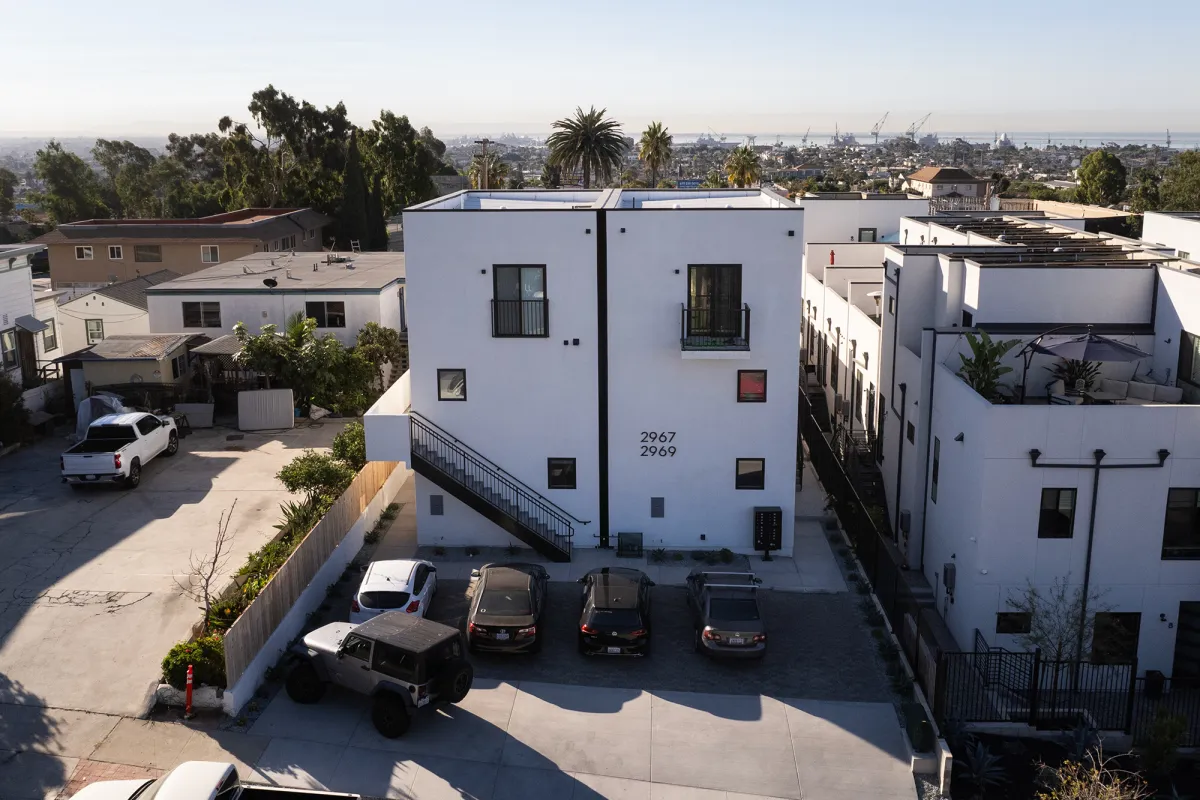
An ADU complex in the Golden Hill neighborhood of San Diego on Nov. 2, 2023. Photo by Adriana Heldiz, CalMatters
In the minds of most Californians, accessory dwelling units — ADUs, short — bring to mind words like “small,” “subtle” and “cute.”
None of which describe the side-by-side ADU duplexes on E Street.
Perched at the edge of San Diego’s desirable Golden Hill neighborhood, there’s nothing dainty or diminutive about these three-story structures. “Backyard cottage” is another term used to describe accessory dwelling units, but these are out front, practically hiding the five-unit multiplex to which they are technically “accessory.”
Like dozens of small and not-so-small apartment buildings across San Diego, the structures on E Street are ADUs in only one way: They were permitted under the city’s ADU Bonus Program.
The city’s one-of-a-kind ordinance offers landlords a one-for-one deal. If they agree to construct an ADU and keep the rent low enough for San Diegans making under a certain income, they’re automatically permitted to build a second “bonus” unit, which they can rent at whatever price they like.
In parts of the city far from public transit, the 2021 city program offers a one-off: Alongside the main house and the two ADUs already permitted under state law, the city allows for a maximum of five units on one property.
But in bus-and train-adjacent “transit priority” areas — a designation that covers much of San Diego’s urban core — a landlord can alternate affordable and bonus units again and again and again. Technically, there are limits. City zoning set a maximum height on buildings, and a more complicated regulatory formula caps how much built floorspace can dominate a parcel.
But you can squeeze in an awful lot of ADUs within those parameters. Hence, the project on E Street: A single family lot with nine apartment units on it, four of them ADUs, two of them affordable. And that’s not an especially extravagant use of the program.
“It’s really ADUs only in name.” — Dave Pearson, Partner, PALO
A typical ADU bonus project application includes between 4 and 7 additional units, according to data provided by San Diego’s Development Services Department. Projects with a dozen or more units are not unheard of. The largest proposed project to date, planned for the city’s gentrifying majority Black and Latino Encanto neighborhood, is 148 units.
Dave Pearson, whose design shop, PALO, designed the E Street duplexes, said his largest permitted project, located behind an existing 76-unit apartment building, comes with 36 “ADUs.”
There’s a word for 36 units stacked in row on top of one another. Even Pearson can’t help but grin and use scare quotes when he uses the term “ADU.” The city’s “crafty little maneuver” allows developers to “effectively build an apartment building out of ADUs.”
“It’s really ADUs only in name,” he said.
David Pearson, co-founder PALO, in Imperial Beach on Nov. 2, 2023. PALO, an architecture company, helps homeowners in San Diego build different types of housing. Photo by Adriana Heldiz, CalMatters
Depending on your perspective, San Diego’s “crafty little maneuver” is either an ingeniously clever use of state law to provide a much needed boost to the local housing supply or a sneak effort to foist an intolerable degree of construction and density upon unsuspecting residents while only providing a token degree of affordability.
The program is just beginning to take off. A total of 159 projects with 1,200 units have been submitted to the city, as of October. Less than half of the projects have actually been permitted. Far fewer have broken ground. Even so, supporters, detractors, researchers and policymakers are sitting up and taking note.
“San Diego may have stumbled on to the quickest solution to producing a lot of ‘missing middle’ housing,” said Andrew Wofford, a graduate student researcher at the UC Berkeley Center for Community Innovation who has been evaluating the program for the state’s housing department.
“Missing middle” describes an approachable (and, one hopes, more affordable) scale of development that occupies a middle ground between uber-dense highrises and sprawling single-family homes. Adding an ADU behind an existing home represents the mildest housing of this type. The novelty of San Diego’s program is in redefining “ADU” from a specific building type to a broad privileged regulatory chute into which developers are now encouraged to throw small apartment buildings.
First: A sign in opposition to the construction of ADUs or granny flats in the Talmadge neighborhood of San Diego on Nov. 5, 2023. Last: A sign in opposition to the construction of ADUs or granny flats in the Talmadge neighborhood of San Diego on Nov. 5, 2023. Photos by Adriana Heldiz, CalMatters
Meanwhile, local critics of the program have already begun to mobilize. Signs inveighing against “granny towers” and “backyard apartments” are common lawn ornaments in many of the city’s residential neighborhoods. The local backlash has already spilled over to other areas of local housing policy and now threatens Mayor Todd Gloria’s broader “Yes In My Backyard” vision.
Even some supporters are surprised by the program’s ambition. Denise Pinkston said her experience with local housing politics would have led her to rule out anything quite so far-reaching. A San Francisco real estate attorney and the go-to ADU whisperer for state lawmakers hoping to hop aboard the “backyard revolution,” Pinkston is also board chair of the Casita Coalition, a nonprofit that advocates for ADU-friendly policy.
But looking at the results so far in San Diego, she paraphrases Shakespeare: “What’s in a name?”
“Actually, it doesn’t really matter what you call it,” said Pinkston. “What you get is more housing.”
Now, anywhere in California, city permit review is limited to 60 days. Development fees and construction-cramping setback requirements are capped. Public hearings and design reviews are banned. In many cases, so are the impositions of costly parking, landscaping and storage requirements.
As a result, California has experienced an ADU boom. While other, more ambitious and controversial pro-housing policies have flamed out in the state Capitol or made it through the legislative gauntlet only to produce less impressive results in the real world, ADUs now make roughly one-in-six of all new units permitted.
Some cities have found ways to quietly obstruct those efforts. Others have rolled along with them. None have gone quite so far as San Diego with its bonus program.
Earlier this year, Gov. Gavin Newsom signed a bill ramping up the added density afforded to apartment projects in exchange for additional affordable units. It was modeled on a San Diego ordinance. When state lawmakers passed a law banning local parking requirements for many new housing projects, they were following San Diego’s lead. And as California rolled out its various laws greasing the skids for ADUs, San Diego passed its own rules that greased them further.
“In a lot of cities, the only reforms they’re doing on housing are those that are triggered by the state,” said Colin Parent, a state Assembly candidate and CEO of Circulate San Diego, a nonprofit that advocates for public transit and dense housing. “San Diego has done a bunch of things that go above and beyond what the state reforms require.”
The ADU bonus program is the latest example.
The University Heights neighborhood of San Diego, where there are several ADU units, on Nov. 5, 2023. Photo by Adriana Heldiz, CalMatters
In 2019, state lawmakers passed a bill requiring local governments to “incentivize and promote” the building of more affordable ADUs. City planners in San Diego took this directive to heart in a way that no other city did.
To fans of the program, San Diego offers a policy lesson that goes far beyond backyard cottages. Cities don’t “have to reinvent the wheel to build more housing,” said Muhammad Alameldin, a researcher at the Terner Center for Housing Innovation, who wrote an overview on San Diego’s ADU program earlier this year. The promise of nearly unlimited density is an irresistible perk for many developers. Cities that want more of a particular type of housing — or more housing in general — can tack on an uncapped density bonus and watch the permit applications flood in, he said.
“They found the formula.”
But there are reasons to believe that this particular formula might not work quite so well in other parts of the state. Even by the standards of auto-oriented Southern California cities, San Diego’s lots are on the big side, making it easier for developers to pack more onto the average parcel while staying beneath other zoning limits.
Local economics play a role, too. In San Diego, the median apartment rent (roughly $2,700 a month, according to Zillow) is less than $400 over the maximum allowable rent for a state-designated affordable apartment in San Diego County. That’s good news for landlords, who don’t have to take quite so large a hit when they set aside certain units for lower-income renters. In places where that gap is larger, the incentive to participate is smaller.
Jake Wegmann, a professor of urban planning at University of Texas at Austin, said he thinks the same “slam dunk economics” of the program in San Diego would likely apply in “other very high rent regions, like the Bay Area,” though perhaps not so much in lower cost metro areas, such as Sacramento or Fresno.
Even within San Diego, there are only so many parcels where it makes sense to pack in a cluster of multiplexes: Some lots are just weirdly shaped or lack access to water and power, for example. “We should be cautious in assuming it’s going to run rampant over the whole city like kudzu,” said Wegmann.
Waiting for copycats
Jared Basler, an ADU developer and the Casita Coalition’s policy director, said “there are a lot of people who are already looking into how to take it up to the state level” — though none of the state legislators interviewed for this story would confirm as much.
But even a program booster like Basler isn’t quite so sure going statewide with the idea would be a good thing: “When we take these really successful local programs statewide, they do get watered down.”
A “watered down” version of the program might include higher affordability requirements or some of the stringent labor standards that have been tacked onto other high-profile housing bills. Those added requirements would raise costs and result in fewer overall units. That’s a trade-off proponents aren’t willing to make.
Jared Basler, director of policy and strategic initiatives at Casita Coalition, at Liberty Station in San Diego on Nov. 4, 2023. Photo by Adriana Heldiz, CalMatters
Other places — and even the state as a whole — are welcome to take a look at the program, said Gary Geiler, assistant director of Development Services Department. But they should proceed with caution.
“Other jurisdictions might have a different geography and topography and built environment,” he said. Instead of opting for the “unlimited option,” allowing for as many affordable-bonus pairs as can fit on the lot, a single bonus allowance “could always be the starting point,” he said.
Pushing that “unlimited” option also carries a broader political risk.
One of the reasons ADUs have been such a political success in California is that backyard cottages are, generally speaking, human-scale. Grandma’s backyard bungalow will not cast unsightly shadows on nearby parks or jam the nearby side streets with cars. Unlike large apartment complexes that might be railed against as the work of faceless, greedy developers, ADUs are generally paid for by, and stand to financially benefit, a neighbor.
Turning ADU policy into a backdoor apartment program threatens to bring those faceless developers back into the debate, upending a tried and true strategy, said Parent of Circulate San Diego.
“Most people who own a house — the vast majority of them — are never going to build an apartment building,” he said. Under the San Diego program, “there are some projects that are really, really big, because there are an unlimited number of allowable units,” he said.
“That word ‘unlimited’ is going to be challenging for some people.”
Backlash begins
From the roundabout at Adams and 49th, in San Diego’s historic Talmadge neighborhood, the two ADU duplexes peek over the single-story house out front like a pair of peeping Toms. To Geoffrey Hueter, they’re about as welcome here.
These are the first ADUs built under the San Diego bonus program and the reason that Hueter got into housing activism. They’re the reason he rallied his friends and co-founded Neighbors for a Better San Diego. They’re the reason that just a few houses down, a front yard sports a sign calling for “No Backyard Apartment Buildings.”
Hueter is the soft-spoken, bespectacled face of the political backlash that housing advocates like Parent worry about. With a retired software engineer’s mind for detail, Hueter will respond to a simple question (“What do you think of the city’s bonus ADU program?”) with a seeking verbal essay on the history of Southern California automobile culture, the rate of local land turnover, social housing in Vienna, and optimal property tax rates for small businesses.
But eventually he will reply: “It’s bad policy.”
A single-family home with an ADU complex in the backyard area in the Talmadge neighborhood of San Diego on Nov. 5, 2023. The ADUs were the first constructed under San Diego’s density bonus program. Photo by Adriana Heldiz, CalMatters
Before developers got their hands on the 49th Street site, it was a single home. Now there are six: Four new one-bedroom units, plus a new studio carved off from the main house’s garage. When it wrapped up in the late summer of 2022, Mayor Gloria showcased the project as an example of “gentle density” even as some neighbors started to complain. Their chief sources of angst were a decline in privacy and the prospect of noisy college kids renting out the units.
Standing a few houses down from the 49th street project, Hueter acknowledged that the buildings aren’t especially imposing or out of character. “It’s not horrible horrible,” he said, though he still worries about the lack of parking and the sheer number of trash cans required to service the new tenants.
More than the details, it’s what he sees as the duplicity of the program that encroaches on “lawlessness” that bothers him most. “Don’t call them ‘accessory’ if they’re dominant,” he said. “If you say something is ‘gentle density,’ it should be gentle.”
In a weekly newsletter published just after his visit to the site last year, Gloria also noted that the project was “a huge improvement aesthetically from what it was before.”
For Hueter, who has helped fundraise to beautify Talmadge and who is married to the president of neighborhood historical society, that was an unforgivable insult.
“Don’t tell people they live in a s–t neighborhood,” he said. “Be smarter about who you pick a fight with. This is a very politically active neighborhood.”
“Actually, it doesn’t really matter what you call it. What you get is more housing.” — Denise Pinkston, co-chair, Casita Coalition
The mayor’s administration has learned that the hard way. Earlier this year, Gloria introduced a collection of housing proposals, which he branded “Housing Package 2.0.” One of the proposals would have adopted a 2021 state law that allows small apartment projects of as many as 10 units to skip environmental review if they’re close to transit — so long as a city opts in.
That proposal was swatted down by the city’s planning commission after hundreds of residents, many under the banner of Neighbors for a Better San Diego, led a months-long protest movement against it.
“A lot of the reason [that law] got beaten here is because there was a lot of experience from the bonus ADU law,” said Hueter. “People were already sensitized to what was going on.”
Earlier this month, the city council rejected the mayor’s entire housing package. Gloria has said he plans to reintroduce a revised version next year, but Neighbors for a Better San Diego were happy to consider it a feather in their cap.
Technically affordable vs. truly affordable
Hueter stressed that the group isn’t anti-ADU. The group’s membership leans propertied and graying, so more than a few have backyard units of their own.
Like most local groups pushing back on new housing laws, the members of Neighbors for a Better San Diego have an easier time rallying around what they oppose than what they would like to see instead. At public hearings and protests, historic preservation, a lack of parking, the unseemly prospect of developer profits, an influx of rental apartments — or a more naked condemnation of lower-income renters, themselves — all motivate opposition to new city housing policy.
Maybe the most popular argument of all against the city’s ADU program is the claim that the resulting units aren’t “truly” affordable.
A single-family home with ADUs behind it in the College Area neighborhood of San Diego on Nov. 5, 2023. Photo by Adriana Heldiz, CalMatters
In College Area, the residential neighborhood anchored around San Diego State University, a newly built ADU may rent for a little more than $3,000. The “affordable” units are cheaper, but not much. In order to qualify for the program, rent can’t exceed 30% of the monthly paycheck of someone earning 110% of the county’s median income. That works out to $2,249 per month for a studio.
And unlike traditional affordable housing, which has to be set aside at those lower rates for 55 years, the bonus ADU program only requires a 15-year commitment. If a landlord lowers the rent further to someone earning 80% of the typical area income, the commitment is only 10 years.
That second option remains a hypothetical. So far, each of the 159 projects submitted to the city has targeted the highest “affordable” income level.
“We have a lot of neighborhood opposition groups that will go on Zillow, and find the most outrageously expensive ADU and then use it to oppose any kind of ADU incentive program.” — Heidi Vonblum, Director, San Diego city planning
Asked about the bonus program as an affordable housing solution, city planning director Heidi Vonblum confessed that the question made her nervous.
“We have a lot of neighborhood opposition groups that will go on Zillow, and find the most outrageously expensive ADU and then use it to oppose any kind of ADU incentive program,” she said in a Zoom interview.
But even if the program isn’t serving the most desperate, making it easier to build modest duplexes provides an escape valve for young professionals, essential workers and other middle class San Diegans who would otherwise be competing for the region’s scarce rentals, she said.
“Maybe an ADU that comes online might have really high rents, but then that frees up housing within the housing ecosystem for people to live in,” Vonblum said. “That’s really hard to explain to, you know, an average community member, because everybody wants us to solve everything with some silver bullet right now.”
Pitching the program
On a Saturday morning in early November, Mayor Gloria dropped by a conference center in San Diego’s master-planned Liberty Station neighborhood to meet up with the builders, housing financiers, politicians and academics gathered at the Casita Coalition’s annual convention.
If any of the efforts by Hueter and his fellow activists have shaken his confidence, the mayor doesn’t show it. He recalls his visit to that first ADU bonus project on 49th Street. “It’s no surprise that new developments typically get a lot of notice and a lot of signage,” he said. “But the people I met that live there are service members and college students. And where are they gonna go?”
San Diego Mayor Todd Gloria speaks to attendees of Casita Coalition’s event, Build the Middle: A National Housing Convening, in San Diego on Nov. 4, 2023. Photo by Adriana Heldiz, CalMatters
On paper, the conference is a celebration of the ADU-ification of the California housing market and an industry meeting-of-the-minds. But much of the programming serves as an unofficial advertisement for the host city’s out-there ADU program.
After Gloria departs, the conference attendees line up outside for a morning bus tour of the city’s built up backyards. The tour passes by the 49th Street site, but does not stop in Talmadge. In College Area, outside a seven-unit project, bus riders are advised to keep their voices down, lest an already irate neighbor grow more irate. The ADU tourists disembark at each site to pad around the stacked in-law units on display, cooing with giddy disbelief and inquiring about square footage.
First: Attendees tour an ADU complex during a Casita Coalition’s event, Build the Middle: A National Housing Convening, in San Diego on Nov. 4, 2023. Last: Attendees tour an ADU complex during a Casita Coalition’s event, Build the Middle: A National Housing Convening, in San Diego on Nov. 4, 2023. Photos by Adriana Heldiz, CalMatters
Getting off the bus back at the convention center, Analise Ortiz, a Democratic Arizona state representative marvels at what San Diego has done. Phoenix legalized backyard “casitas” this fall, though without the other developer-friendly goodies that San Diego offers. Recent efforts to permit ADUs statewide and to otherwise make it easier to build dense housing have failed in the Arizona Legislature. The debate there is a familiar one, said Ortiz: Concerns about affordability, neighborhood character and parking dominated.
“I think this shows that a lot of those concerns are exaggerated…We’re going to try again next year and I think putting a visualization of what it can look like will hopefully help move some of our colleagues along,” she said. “We’re hoping we can have the same thing in Arizona.”
###
CalMatters.org is a nonprofit, nonpartisan media venture explaining California policies and politics.