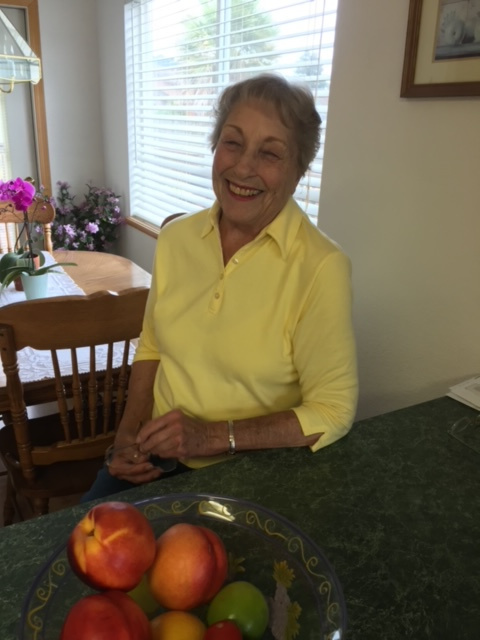
Bertha Ann Britschgi Nov. 25, 1932 - July 16, 2023
It is with profound sadness that we announce the passing of our beloved Bertha Ann Britschgi on July 16, 2023. Born to Mary and Otto Collenberg of Humboldt County, she touched the lives of many throughout her life when she worked in the benefits and accounting department at LP and volunteered at St Mary’s and will be deeply missed by all who knew her.
Bertha’s life will be celebrated in accordance with her wishes:
Viewing:
Monday, July 24, 2023 Paul’s Chapel 1070 H St, Arcata, CA 95521 Viewing: 4:00 pm Rosary: 6:00 pm
Funeral Services:
Tuesday, July 25, 2023 St Mary’s Catholic Church 1690 Janes Rd, Arcata, CA 95521 Service: 10:00 am
Graveside Internment: (Immediately Following)
Tuesday, July 25, 2023 Sunset Memorial Park 3975 Broadway St, Eureka, CA 95503
In lieu of flowers, our family kindly requests that you consider contributing in memory of Bertha Britschgi to support St Mary’s or your local animal shelter to honor her love of animals.
Bertha is survived by her loving daughters, Ann Wriker and her husband Rick; Kathy Reed and her husband Jeff; five grandchildren, and nine great-grandchildren; her nephew Dan Collenberg and wife Karan and nieces Toni Collenberg, Reba Johnsen and Joslynne Blasdel.
Preceded in death by husband Carl Britschgi, Tony & Lavina Collenberg (brother & sister-in-law), Sabina Blasdel (sister), Randall Collenberg (nephew).
She leaves a legacy of warmth, kindness, and cherished memories forever in our hearts.
May she rest in peace.
###
The obituary above was submitted on behalf of Bertha Britcschgi’s loved ones. The Lost Coast Outpost runs obituaries of Humboldt County residents at no charge. See guidelines here. Email news@lostcoastoutpost.com.
It is with great sadness we announce the passing of our mother, Mary Greene, on June 23, 2023 at the age of 90. Mary was born December 10, 1932 and resided in Fortuna.
Born Mary Ludtke, she lived all of her life in Humboldt County. She lived a long and good life here.
She met the love of her life, Robert Greene, in high school at Eureka High. They were married in 1950 and had four daughters: Debbie, LIsa, Cindy and Susan.
Mom loved gardening and traveling. She traveled abroad with several girlfriends and had many great times. She also loved going to their cabin in Mad River, where she was quite the angler. She was known by her cabin neighbors as “Mad River Mary.” She was also a huge Giants fan and attended many Giants games with family and friends.
She is preceded in death by her husband Robert Greene and daughters Susan Ekin Greene and Deborah Greene.
She is survived by her daughters Lisa Ransford (Michael Ransford) and Cindy Smith of Fortuna, grandchildren Natalie Huston, Chris Huston, Emily Ekin, Kaylee Ekin, four great-grandchildren, and numerous nieces and nephews
If you would like to make a donation in Mary’s name, please consider the American Cancer Society or the charity of your choice. There are no plans for services at this time.
###
The obituary above was submitted on behalf of Mary Greene’s loved ones. The Lost Coast Outpost runs obituaries of Humboldt County residents at no charge. See guidelines here. Email news@lostcoastoutpost.com.
A recent CalMatters story highlighted the funding challenges facing First 5 organizations throughout California, and we at First 5 Humboldt wanted to share some local context about how declining revenue is affecting us here in Humboldt County, and how we are adapting in response.
First 5 Humboldt is a local public agency working to improve the health, early learning, and well-being of young children and their families in Humboldt County since 1998. That’s when California voters approved Proposition 10, creating a First 5 organization in every county with funding from significant new taxes on tobacco.
This “sin tax” approach has helped accomplish two very different and important goals: reducing the use of tobacco and funding local programs to support young children and families. Unfortunately, this approach also created a declining funding source for First 5 Humboldt and our fellow County First 5’s statewide, and that decline has now accelerated.
First 5 Humboldt funds are under local control, with a nine-member Commission appointed by the Board of Supervisors determining — with parent and community input — how funds should be spent. Current programs include over 20 free weekday, evening and weekend Playgroups throughout the County for families with young children, which include early developmental screening; local parenting education and support services, including a partnership with Open Door Community Health Centers; supporting local child care providers with training, mentoring, and stipends to support quality care and stabilize child care availability; helping fund children’s services in the County Library network; advocating for children and families in local and statewide policy; helping support families at risk of substance use disorder; working with and coordinating local home visiting programs; raising awareness of the effect of trauma on young children and how to counteract it; and providing small grants to local organizations that serve young children and their families.
First 5 Humboldt’s annual revenue from Proposition 10 has declined more than 60 percent from its peak in 2000 and is projected to drop another 28 percent over the next four years.
In response to declining revenue, First 5 Humboldt has worked to access state and federal grants to bring in outside dollars to support local services to children and their families. Over the last seven years, the organization has moved from being solely funded by tobacco taxes to now relying on grants to fund about 50 percent of its work.
While First 5 Humboldt’s efforts at grant writing have been mostly successful, grant funding is unpredictable, short term (one to three years), and targeted to very specific projects or programs defined by the funder.
Unfortunately, we are having to reduce our support for family services. Over the last several years, First 5 Humboldt has had to reduce or eliminate financial support to Family Resource Centers, young children’s dental programs, Humboldt County Office of Education programs focused on early childhood mental health, and our own staff support of Playgroups.
We have reduced our annual community investments by over $300,000 in recent years and will have to continue reducing our investments and our staffing on the current trajectory. During the first several years of Prop 10, the founding Commission set aside funding to be used during the declining revenue years. The current Commission is creating a plan to expend those dollars in a way that will soften the blow to local families and programs over the next few years, despite the coming cuts in services.
Supporting the health and wellbeing of our youngest citizens is both the right thing to do for our state’s children and families and a prudent investment in our future. Proposition 10 has served Californians well, but its success in reducing tobacco use is seriously undercutting the investment in young children and families that Californians support.
Knowing that 90 percent of a child’s brain development occurs before age 5, the state needs to find a sustainable solution for providing services and supports to these most vulnerable California residents.
Press release from the Humboldt County Sheriff’s Office:
On July 23, 2023, at about 7:51 p.m., a Humboldt County Sheriff’s deputy on patrol in the Eureka area observed a vehicle fail to fully stop at a stop sign. The deputy conducted a traffic stop on the vehicle near the intersection of Harris Street and Sequoia Avenue, and contacted two adult males.
During the investigation, the deputies learned that one of the men, later identified as 26-year-old Benjamin Ervin James Dimmick, provided deputies with a false name. Once properly identified, Dimmick was found to have a local misdemeanor warrant and a felony warrant out of Mendocino County for his arrest. During a search of Dimmick, deputies located nearly 2 grams of methamphetamine and drug paraphernalia. Upon being placed under arrest, Dimmick physically resisted deputies in a failed attempt to flee.
Dimmick was booked into the Humboldt County Correctional Facility on charges of false identification to a peace officer (PC 148.9(a)), possession of a controlled substance (HS 11377(a)) and resisting arrest (PC 148(a)(1)), in addition to a warrant charge of resisting arrest (PC 148(a)(1)).
Anyone with information about this case or related criminal activity is encouraged to call the Humboldt County Sheriff’s Office at (707) 445-7251 or the Sheriff’s Office Crime Tip line at (707) 268-2539.
Misty Marie Milligan and Tasha Ticheal Jantz | HCSO
Press release from the Humboldt County Sheriff’s Office:
On July 23, 2023, at about 8:09 p.m., Humboldt County Sheriff’s deputies were dispatched to the Hammond Trail’s south entrance, located off Mad River Road near Arcata, for the report of a vehicle burglary.
Deputies met with an adult female victim whose vehicle window had been broken and her purse stolen. According to the victim, while walking on the trail she received an alert from her bank notifying her of multiple unauthorized purchases, totaling nearly $2,000. When she arrived back at her vehicle, she learned that the burglary had occurred.
Utilizing the victim’s purchase history, deputies were able to track and eventually identify the suspect as 37-year-old Misty Marie Milligan of Eureka. On July 24, at about 1 a.m., Sheriff’s deputies observed a vehicle associated with Milligan traveling in the area of 4th and R Streets in Eureka. Deputies conducted a traffic stop on the vehicle and contacted Milligan and her passenger, 50-year-old Tasha Ticheal Jantz. Milligan was taken into custody without incident. During a search of Milligan and the vehicle, deputies located the victim’s stolen purse, approximately 6 grams of methamphetamine, 4 grams of fentanyl and drug paraphernalia.
Milligan was booked into the Humboldt County Correctional Facility on charges of theft by forged/invalid access (PC 484g(a)), possession of a controlled substance (HS 11377(a)) and possession of a controlled substance paraphernalia (HS 11364).
Jantz was found to have an outstanding felony warrant. She was arrested and booked into the Humboldt County Correctional Facility on warrant charges of convicted felon in possession of a firearm (PC 29800(a)), vehicle theft (VC 10851(a)), DUI (VC 23152(a)) and violation of probation (PC 1203.2(a)).
Each summer the Sheriff’s Office receives reports of vehicle burglaries occurring near recreation sites, such as local beaches and trails. You can protect yourself from vehicle burglaries by taking the following precautions whenever you are leaving your vehicle:
Always remove valuables from inside your vehicle. The Humboldt County Sheriff’s Office commonly receives reports of purses, bags, briefcases and wallets being stolen from vehicles – even those that have been hidden from plain view, such as under a seat. We have even received reports of thieves breaking in to steal a pair of sunglasses. Even if you do not believe the item is of value, remove it from plain site.
Be cautious when storing valuables in your trunk. If your vehicle is equipped with a trunk release button on the inside, car prowlers can easily access your vehicle’s trunk space. While “hiding” items in your trunk may reduce the chance for your vehicle to be a target, the action will not completely protect you from theft.
Remove garage door openers, key cards, and house, work or car keys from your vehicle.
Always lock your vehicle, even if you are home. In public places, it may be tempting to leave your vehicle windows down to avoid vandalism. However, this puts you at even more risk, leaving vehicle registration and insurance information accessible to anyone nearby and increasing your chances of falling victim to identity theft, burglaries at your home and vehicle theft.
Anyone with information about this case or related criminal activity is encouraged to call the Humboldt County Sheriff’s Office at (707) 445-7251 or the Sheriff’s Office Crime Tip line at (707) 268-2539.
At 1712 hrs on Saturday July 22, 2023, Blue Lake Fire responded with one Engine and
one Chief to the report of a residence on fire with an explosion. While responding to the
initial call, it was reported that there was a powerline down in front of the residence. The
dispatch included an all call for Arcata Fire, Fieldbrook Fire, Humboldt Bay Fire, and
Westhaven fire. PG&E was also in route. The Blue Lake Chief arrived on scene and
found heavy fire and smoke coming from the residence, all occupants were outside upon
arrival.
The first Engine on scene established a water supply from the hydrant at the end of
Buckley Road. Arcata’s Assistant Chief and One Arcata Fire engine arrived on scene and
assisted the Blue Lake engine with fire attack. Humboldt Bay Fire arrived with one
engine and one Battalion. Fieldbrook Chief, and one Westhaven Engine also arrived on
scene. Fire attack established a defensive attack, and had the fire knocked down shortly
after. After fire was knocked down, a transitional attack began. PG&E arrived on scene
and secured the downed powerline.
After the fire was knocked down and overhaul operations began, all mutual aid resources
started to be released at approximately 1800. Blue Lake remained on scene for an
additional hour and a half to complete overhaul and investigate the cause of the fire.
There were no civilian or Firefighter injuries and the fire controlled within 30 minutes of
the arrival of the first Engine. Damage is estimated at $430,000 and following a fire
investigation the cause of the fire was determined to be accidental in nature.
Blue Lake Fire District would like to thank our allied partners for their assistance during
this incident, Arcata Fire Department, Fieldbrook Fire, Westhaven Fire, and Humboldt
Bay Fire. We would also like to thank PG&E.
Drug test cups at the Opiate Treatment Outpatient Program at Zuckerberg San Francisco General Hospital on July 20, 2023. The program uses reward incentives to combat substance abuse and addiction. Photo by Mark Leong for CalMatters
Among the most difficult addictions to witness at San Francisco general hospital’s drug clinic is methamphetamine, which leaves users tearing at their skin and unable to eat, sleep or sign up for help.
The worst part: The clinic workers largely are powerless because unlike with opioid addiction, for which doctors prescribe medications such as methadone, there is no medicine for stimulant use disorder.
“We live day in and day out watching people suffer in a way that’s hard to imagine,” said Dr. Brad Shapiro, medical director of the Opiate Treatment Outpatient Program at Zuckerberg San Francisco General Hospital. “They’re just dying in front of us.”
Faced with that immense suffering, California will try a new approach to stimulant addiction: Paying people with gift cards to reward them for staying sober.
This model, known as “contingency management,” rewards people with financial incentives each time their drug tests are negative for stimulants. It’s been shown to have success in clinical trials — and the U.S. Department of Veterans Affairs has been using it for more than a decade — but it hasn’t taken off in California. Medicaid previously wouldn’t cover it, so there was no funding to expand its use.
To Shapiro, that’s inexcusable.
“It’s actually, in my opinion, really quite criminal that we’ve gone decades knowing this is an effective treatment and the powers that be have failed to make a pathway for treatment for people,” he said.
The program is expanding now, thanks to a recent waiver by the federal Centers for Medicare & Medicaid Services that allows the agency to cover its costs. California was the first state in the nation to win approval for a contingency management program under Medicaid. The Golden State is launching pilot programs in 24 counties, including San Francisco, Sacramento and Los Angeles. Costs for what collectively is called the Recovery Incentives Program will be reimbursed by CalAIM – the state’s recent expansion of Medi-Cal services.
“All of a sudden we have money to provide this incredibly effective intervention,” said Shapiro, whose clinic is launching one of three pilot programs coming to San Francisco. “So it makes a huge difference.”
Fighting meth with gift cardsFighting meth with gift cards
Shapiro’s clinic focuses primarily on opioid addiction, but more than half of their patients also have a stimulant use disorder, he said.
While the deadly opioid fentanyl gets most of the attention in the drug epidemic in California and across the country, experts say stimulant use is a major — and growing — concern. In 2021, 65% of drug-related deaths in California involved cocaine, methamphetamine or other stimulants — up from 22% in 2011, according to the California Department of Health Care Services. Nationally, there were 15,489 overdose deaths involving stimulants other than cocaine (largely methamphetamine) in 2019, up 180% from 2015, according to a study by the National Institute on Drug Abuse.
And with California in the midst of a dire homelessness crisis, stimulants are wreaking havoc on the state’s unhoused community. Among unhoused residents who use drugs, amphetamines are by far the most common choice, according to a recent study by the UCSF Benioff Homelessness and Housing Initiative. Nearly one-third of people surveyed reported using amphetamines three or more times a week, compared to just 11% who used opioids with the same frequency. Some people who live on the street reported using stimulants to stay alert at night, when they fear being attacked if they fall asleep.
To combat stimulant addiction among its patients, Zuckerberg San Francisco General Hospital recently launched a six-month contingency management program as part of the statewide pilot. The hospital opened enrollment on July 17, and staff hope ultimately to serve about 50 people. Clinicians will test participants for stimulants once or twice a week. Each time patients test negative, they’ll get a $10 gift card to Walmart or another retailer. The amount of the gift card gradually will increase, for a maximum of $26.50 per test. If they test positive, they get nothing.
Participants can earn a maximum of $599 over the course of the program. That’s because payments of $600 or more must be reported to the Internal Revenue Service.
The Opiate Treatment Outpatient Program at Zuckerberg San Francisco General Hospital on July 20, 2023. Photo by Mark Leong for CalMatters
“We’re all excited to try it and see if it does help retain people in treatment for longer periods of time so they are more successful,” said Tammy Ramsey, program manager for the Drug Medi-Cal Organized Delivery System in the county’s behavioral health department.
Contingency management works
Other programs in counties throughout California — including Alameda, Fresno, Nevada, Sacramento and Los Angeles — will follow the same model.
If the trials are successful, Shapiro hopes the state will allow them to expand and serve everyone on Medi-Cal.
The model already has proven effective for the Department of Veterans Affairs, according to Dominick DePhilippis, the department’s deputy national mental health director for substance use disorders. The VA started using contingency management in 2011, and as of the beginning of July, the program has treated more than 6,300 veterans. Those veterans have attended about half of their appointments and produced nearly 82,000 urine samples – of which more than 92% were negative for the targeted drug, DePhilippis said.
It’s not just the VA. Of 22 studies testing contingency management’s impact on stimulant addiction, 82% reported “significant increases” in participants’ abstinence, according to a 2021 meta-analysis published in JAMA Psychiatry.
Dr. Brad Shapiro is director of the Opiate Treatment Outpatient Program at Zuckerberg San Francisco General Hospital. Photo by Mark Leong for CalMatters
Shapiro believes the model works because it replaces the reward a patient’s brain craves (the drug) with a different type of prize.
“It’s a little bit like winning something,” Shapiro said. “It triggers that reward place in the brain that otherwise they would be turning to the drug for.”
But Tom Wolf, who has battled addiction and homelessness himself and now advocates for drug policy reform, said he worries using Medi-Cal to fund contingency management will create bureaucratic hurdles to treatment as patients wait for the state to decide if they are eligible. Still, he said, the program is worth a shot.
“At this point I’m willing to try it, basically because we have such a dearth of options for people that are struggling with addictions in California,” he said.
Because of how difficult it is to treat his patients that use stimulants — many of them use methamphetamine every day — Shapiro would be happy if even a quarter of participants significantly reduced or stopped using. There is also concern, as with any type of treatment, that patients will relapse once the program is over, he said. To help prevent that, the hospital will provide six additional months of counseling after the contingency management program ends.
It’s not a perfect solution
Rewarding people for staying sober doesn’t work for everyone. Even before it was covered by Medi-Cal, Zuckerberg San Francisco General Hospital was experimenting with the model in small programs.
One of the participants in those programs, 54-year-old J.W., ended up in the emergency room with heart failure after two decades of methamphetamine use. After his hospital stay, he enrolled in a 12-week program called Heart Plus, which caters to cardiac patients with a history of stimulant use. Every time J.W. did something positive, such as show up to an appointment, take his medication or get a negative drug test, he got to draw a Safeway gift card out of a hat. The cards’ value ranged from $5 to the “elusive” $20, and J.W. — who asked to go by his initials out of fear of being stigmatized for his drug use — estimates he earned about $180 throughout the entire program. He wasn’t working at the time, so the cards helped him get treats such as deli sandwiches and fancy bottles of kombucha.
“It was definitely something to look forward to,” he said. “And it was something fun to spend.”
But it wasn’t enough to get J.W. off drugs. Now that the program has ended, he’s still using methamphetamine — sometimes as often as three times a day — though he says he’s taking smaller doses. And he said he feels much healthier than when he showed up in the emergency room last year, out of breath after the slightest amount of exertion.
J.W. isn’t sure why he didn’t quit using during the program. But methamphetamine has become an entrenched routine in his daily life. He uses upon waking up, in a ritual he compares to having a morning cup of coffee.
“I still kick myself wondering why I didn’t quit altogether,” he said. “There’s no better opportunity.”
###
CalMatters.org is a nonprofit, nonpartisan media venture explaining California policies and politics.