HUMBOLDT TODAY: Winter weather causes havoc on Humboldt’s roadways, a pair of Ferndale’s favorite farmers receive a big award, plus LoCO readers were kind enough to send in their snow videos! Those stories and more in today’s newscast with John Kennedy O’Connor.
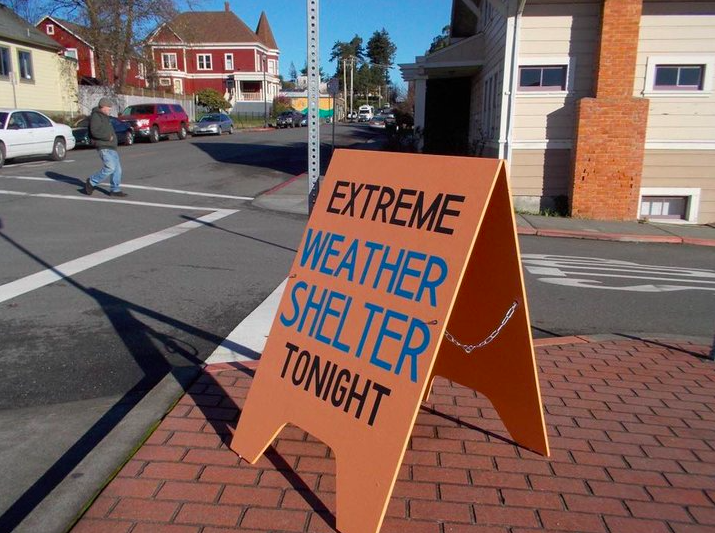
With Northwest California in the midst of an intense winter storm, many of our local nonprofit organizations and emergency centers have opened extreme weather shelters to provide refuge for those living outdoors, or who have been displaced by the weather conditions.
Most of these shelter locations were sent out in a press release on Tuesday from the Humboldt County Office of Emergency Services. Arcata House Partnership also contacted the Outpost Wednesday to let us know that the nonprofit will also be opening its extreme weather shelter this evening (Feb. 22) and expects to remain open until Feb. 26. Arcata House is also in desperate need of volunteers to help run the emergency shelter. If you are able to help out, you can call 707-382-0385.
Here is a current list of the extreme weather shelters available in Humboldt. If you know of any other shelters not listed here, feel free to email the information news@lostcoastoutpost.com and we will add it to the list.
Arcata
Arcata House Partnership: February 22-26. Call 707-296-4230 to check availability. Call 707-382-0385 if you would like to volunteer.
Eureka
Eureka Rescue Mission: Overnight sheltering, dinner and showers -Men - 110 Second Street, Eureka. Arrive between 5:30-6 p. -Women- 102 Second Street, Eureka. Arrive at 6:30 p.m.
Betty Kwan Chinn Day Center: Overnight sheltering, dinner and showers. Call before 4 p.m., 707-407-3833 or visit the Day Center at 133 Seventh Street, Eureka.
Southern Humboldt
SoHum Housing Opportunities (SHO) Warming Recharge/Warming Center -Tuesday, February 21: 11 a.m. - 4 p.m. at Redway First Baptist Church (1055 Redway Drive, Redway) - February 22-24 (Wed. - Fri.): 1 - 4 p.m. at Mateel Community Center (59 Rusk Lane, Redway)
Redwood Rural Health Centers (RRHC) Extreme Winter Weather Shelter: Call to check capacity: 707-923-2783, ext. 1361
Northern Humboldt
Lower Trinity River Prescribed Burn Association Warming Center: February 22-23 (Wed.-Thur.) 8 a.m. - 6 p.m. at 111 Mayfair Street, Willow Creek
The Heights Casino Warming Center: February 22-24 (Wed.-Fri.) 8 a.m. - 4 p.m. at the Heights Bingo Hall 27, Scenic Drive, Trinidad
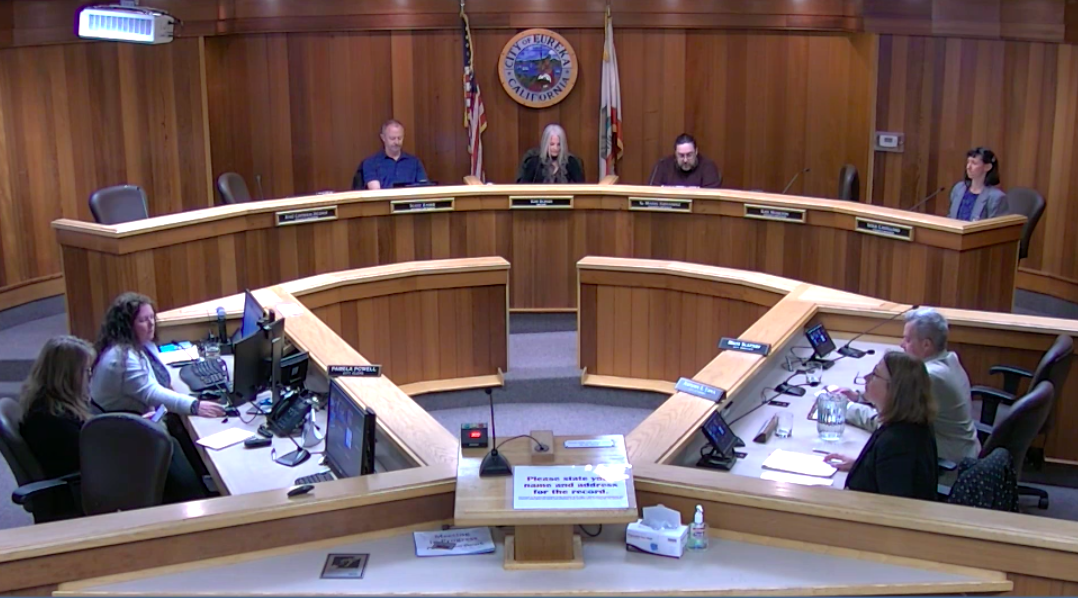
Screenshot of Tuesday’s Eureka City Council meeting.
###
Rising interest rates and building costs are complicating efforts to bolster Eureka’s affordable housing stock. In an effort to ease that burden, the Eureka City Council approved a request from staff to submit an application for additional funding through the California Department of Housing and Community Development’s Permanent Local Housing Allocation program.
If approved, the funds would alleviate construction costs for the new senior affordable housing complex being built on Myrtle Avenue. The complex will contain a mix of one-bedroom, two-bedroom and studio apartments for 36 seniors with an income of 60 percent or less than the Area Median Income.
However, the cost of the project has increased significantly since its inception, according to Chris Westlake, a consultant with affordable housing developer and city partner Danco Communities.
“This project is under construction, but due to cost overruns on materials and interest rates, the project [cost] has increased over $2.8 million,” Westlake explained during Tuesday’s council meeting. “In addition, the tax credit pricing was affected before we closed on it. The tax credit application cost another several thousand dollars.”
Danco contacted city staff late last year to look for a way to “bridge some of this gap on the project,” he said. Staff identified a funding source through the state Department of Housing and Community Development and submitted an application. However, the state requires the city council to pass a resolution approving the application request before it can be processed.
Looking beyond the senior housing project, Councilmember Scott Bauer asked if increasing interest rates and material costs will affect the city’s ability to provide housing in the future.
“We’re seeing it statewide,” Westlake said. “You know, for the last couple of years it was rising construction costs. In the last six, eight months it’s now become the interest rates on their construction firm loans, as well as the tax credit pricing. It’s nothing new and … it’s starting to become normal, unfortunately.”
Councilmember Kati Moulton asked if there were any specific projects on the horizon that would be subject to similar financial constraints.
“Not at this time,” said City Manager Miles Slattery. “[Other projects] are in the earlier stages and haven’t even gotten to the point of getting funding. The only other project I can think of that’s not really similar to this is Betty Chinn’s [housing] project [on Hilfiker Lane]. We’ve awarded the [request for proposals] and we’re having discussions with the consultant that received the award and we’re working through those issues. We’re hoping that it is not going to be an issue, but … it is related to the cost of goods that we’re looking at.”
Councilmember Leslie Castellano made a motion to adopt a resolution authorizing the submittal of the funding application. Both Bauer and Moulton offered a second.
Before voting, Castellano noted that “it would be nice if [this item] came to council before it was applied for,” but she was sympathetic to the surrounding circumstance.
“I’m glad to see this particular development moving forward,” she added. “I can’t wait for people to be living in this [complex] after, you know, the many years it’s taken to see it through.”
The council voted 4-0, with Councilmember Renee Contreras de Loach absent, to approve the item.
End of Local COVID Emergency
After nearly three years of living through the pandemic, the council unanimously approved a resolution to terminate the local emergency declaration regarding COVID-19.
The item, which was pulled for discussion from the agenda’s consent calendar, acknowledged that California “has the tools needed to continue fighting COVID-19 when the State of Emergency terminates” on Feb. 28, including “vaccines and boosters, testing, treatments, and other mitigation measures.” While the virus continues to spread, “the conditions necessitating the local emergency due to COVID-19 are steadily improving and … will no longer be warranted,” according to the staff report.
The end of the local state of emergency means the City of Eureka will also terminate its moratorium on water shutoffs, said city Finance Director Lane Millar.
“The good news is, we will give our customers a fresh start,” Millar said. “We will take their current water debt – if they have any – and we will separate that from their utility account so, going forward, they will have at least two billing cycles before any chance of a shutoff. … We will work with customers to the best of our ability to keep people’s water on.”
There are still programs in place for folks struggling to pay delinquent utility bills. There is $15,000 available for utility assistance through the city’s participatory budgeting program, in addition to $200,000 in Community Development Block Grant (CDBG) funds. “That might be a little bit harder [to apply for] than the participatory budget program,” Millar noted. “But I encourage anyone out there to reach out to the city’s finance department to get more information.”
Councilmember G. Mario Fernandez asked how much the city is owed in delinquent utility payments. Millar said the city is owed “roughly a million for both water and sewer,” but noted that the city was already owed around $800,000 before the pandemic.
Castellano made a motion to approve the resolution terminating the local COVID emergency, which was seconded by Bauer.
Before voting, Castellano asked Millar if the staff would consider adding a checklist of some sort to help residents determine if they’re are eligible for utility assistance. Millar said, “Sure, that would be no problem.”
The motion passed unanimously, with Contreras de Loach absent.
Humboldt Bay Fire Update
Last summer, Humboldt Bay Fire Chief Sean Robertson reported a “significant and unprecedented” staffing shortage at the department, forcing the department to implement a temporary rotating closure, or “four-station model,” of one station per day. Humboldt Bay Fire lost 12 employees last year, seven of whom left in a single month.
Fortunately, Robertson said things are looking up. In the last six months, the department has filled all but four positions and is actively recruiting to fill the remaining vacancies.
“We are also modifying our training programs for driver operators and company officers to try to get more of our folks qualified early in their career, and just make it a better development program to have a more long-term solution to this problem,” Robertson said during last night’s meeting. “Our resignations occurred at about every position in the organization. The two resignations we had at the administration level were really significant … and we’re still recovering from that loss [but] we’re thankful for the folks who have joined us.”
Bauer asked if the Humboldt Bay Fire’s response time was impacted by the four-station model. Robertson said it added one to two minutes in additional response time “assuming we’re at the end of a jurisdiction.” The department’s typical response time is between six and seven minutes within the entire jurisdiction, he said.
“Our five stations are strategically located,” he continued. “We have had a Standards of Response Coverage Study to verify that. Our call volume is going to continue to increase with all the tremendous development projects that are happening in the city and in the county. So, maintaining those orientations that are well-vetted are going to stand the test of time, I believe.”
Humboldt Bay Fire’s calls for service in 2022 | Screenshot
Earlier in his presentation, Robertson provided a breakdown of the department’s calls for service and incident types for 2022. Fire-related incidents accounted for 3.5 percent of the department’s calls for service whereas the vast majority of calls – 63.6 percent – were for rescue and emergency medical services. He added that Humboldt Bay Fire’s jurisdiction typically sees more annual fires per capita than the rest of the state.
“I think it’s just our particular demographic and construction features,” he said. “We have a lot of older houses and commercial buildings, whereas a lot of developments and communities in the Bay Area, for example, have a lot of newer construction, they are required to have sprinklers and there’s much more fireproofing. Generally speaking, that would account for some of the differences.”
The council agreed to accept the report but did not take any action on the item.
Zero Waste Action Plan
The council also received an update on the city’s Zero Waste Action Plan. The plan outlines the city’s strategies to maximize recycling while minimizing waste and reducing overall consumption.
Robin Praszker, the city’s environmental project manager, outlined three primary goals listed in the draft document: waste reduction in city offices and facilities, waste reduction for public functions/special events, and leading by example.
“In essence, we’re in this together,” Praszker said. “The first strategy is to invest in city staff education and training [by] setting expectations of waste reduction as a duty of city employees and investing in specific staff who can be leaders. The second strategy is seeking department and community collaborations. … And lastly, to sustain and promote best practices the true effort of leading by example, which means folding in zero waste goals into other city planning documents and asking public officials to serve as role models in zero waste behaviors.”
The first draft of the city’s Zero Waste Plan is nearing completion. It will be presented to the council in the coming months.
The council agreed to accept the report but did not take any formal action on the item.
###
You can find a recording of Tuesday’s meeting here.
On Wednesday February 22, 2023 the Humboldt County Drug Task Force served a search warrant on the 2600 block of Hall Avenue in Eureka after receiving information that 60 year old Brian Fleming was selling large amounts of methamphetamine out of his residence. When agents arrived on scene, Fleming was scene attempting to flee out the rear of the residence where he was detained without incident.
Upon a search of the property agents located over two pounds of methamphetamine, a firearm, ammunition, metal knuckles, and a digital scale. Fleming was subsequently arrested on the following charges:
H&S 11378(a)- Possession of a controlled substance for sale
H&S 11370.1- Possession of a controlled substance while armed with a firearm
H&S 11366.5(a)- Maintaining a residence for narcotics use
PC 29800(a)(1)- Felon in possession of a firearm
PC 30305(a)(1)- Felon in possession of ammunition
Anyone with information regarding this case is encouraged to contact the Humboldt County Drug Task Force at 707-267-9976
A College of the Redwoods student died this morning after being found unresponsive in her dormitory room, located on the school’s main campus, a college spokesperson confirmed to the Outpost this afternoon.
The student, whose identity has not yet been released, was taken by ambulance to Providence St. Joseph Hospital in Eureka, where hospital staff were unable to resuscitate her, according to Molly Blakemore, CR’s director of marketing and communications.
“Local authorities are currently investigating the cause of death and we are working with them to determine the events and circumstances surrounding the event,” Blakemore said via email.
We will update this post when and if any further information comes in.
Thomas and Cody Nicholson Stratton | Image via CAFF
Press release from the Community Alliance with Family Farmers:
Humboldt-based farmers the Foggy Bottoms Boys have been honored as the 2023 “Climate Smart Farmers of Year”, an annual recognition awarded by Community Alliance with Family Farmers (CAFF) to producers who exemplify practices that sequester carbon and promote a healthy ecosystem.
Every year, CAFF honors change-makers, trailblazers and those giving back to their local food and agricultural communities throughout California. Selected from nominations that pour in from every corner of the state, this year’s honorees represent the changing face of California farming and a commitment to equity, access and sustainability. “From innovative farmers to grassroots organizers, this year’s honorees give us hope for the future,” said Evan Wiig, CAFF’s Director of Membership & Communications.
For six generations, this family farm has operated in the foggy bottoms of the Eel River Valley. Today, Foggy Bottoms Boys is led by Thomas and Cody Nicholson Stratton, with help from their father, grandfather and even their little son. This duo is bringing new regenerative practices to their farm, while improving upon time-tested traditions. Their highly-diversified farm produces organic dairy, beef, lamb, poultry, eggs, and even yarn made from their sheep, goats and angora rabbits. From cover crops to maintaining wild habitat for biodiversity to ensuring a pasture-based approach, they pay close attention to the health of their land and animals.
Today Thomas and Cody are experimenting with new methods, such as no-till to increase their soil organic matter, sequester carbon and preserve a healthy soil biome. With a strong focus on their local community, the Foggy Bottoms Boys are working hard to ensure a healthy future for even more generations to come.
“Congratulations to the Foggy Bottoms Boys,” said Wiig. “We commend them for their integrity and their commitment to ensuring a healthy food future amid a fast-changing climate.”
This year’s awards ceremony will take place virtually on Tuesday, February 28th at 6pm as part of this year’s California Small Farm Conference.
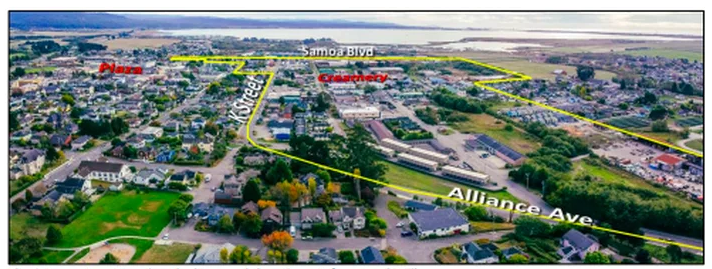
Do you have thoughts and feelings about Arcata’s Gateway Area Plan? Of course you do! The somewhat controversial plan to rezone 138 acres of land surrounding the Creamery District to facilitate the creation of more high-density housing has been the talk of the town for more than a year now. And if you live in Arcata (or even if you don’t), you must have some opinions that you’re dying to share.
Well, now is the time to speak your mind! Because over the next couple of months the City of Arcata will be holding multiple public workshops and meetings to provide the community with an opportunity to learn more about the plan – specifically the form-based code that the city will be using to guide proposed developments in the Gateway Area – and to give you a chance to tell the City what you want new buildings in Arcata to look like. And the next workshop you’ll want to attend is on Thursday, Feb. 23.
“We’re basically asking the community for input on design that we will turn into code, so that the community, future developers and decision makers can all look at the code and have a good expectation of what the buildings might look like when they get built,” David Loya, Arcata’s community development director, told the Outpost in a phone interview on Tuesday.
Since late last year, Arcata’s Planning Commission and city staff have been discussing every detail of form-based code and how it can be used to guide the Gateway Area Plan. If you don’t fully understand what a form-based code is, you are not alone. It’s a new planning concept for the city. Loya helped give an explanation of how this code works and why the City is utilizing it for the Gateway Plan.
“[Form-based code] is really all about the design of the buildings and how those buildings interact with the public space,” Loya explained to the Outpost. “That contrasts with a typical zoning code, which pays a little less attention to how buildings look… and focuses much more on land uses and trying to segregate land uses.”
The City has broken up the Gateway Area into four smaller zones: the Barrel District (pale yellow), the Gateway Corridor (orange), the Gateway Hub (teal) and the Gateway Neighborhood (brown)
Because the Gateway Area Plan aims to facilitate mixed-use developments –buildings that contain a mix of things like housing, offices, restaurants and storefronts – the City does not want the land to be zoned for different specific purposes, which is what has been done in the past. Instead, the City is looking to zone the different sections of the Gateway Area in such a way that there are specific design requirements that developers must adhere to, including materials, setbacks (how far the building is from the sidewalk), window design, roof design, landscaping/open space and even paint colors. By having all of the code elements established ahead of time, the city will have more control over the aesthetics of future developments.
Of course, this code also includes what has probably been the most controversial aspect of the plan – building heights. There has been a lot of talk about new buildings in the Gateway Area possibly being as high as eight stories, which many people say is too tall. The Planning Commission has discussed building height many times and, although no decision will be officially made on height restrictions until the plan is adopted, the commission has agreed to allow for seven stories in the Barrel District, six stories in the Gateway Hub, five stories in the Gateway Corridor and four stories maximum in the Gateway Neighborhood. Again, the maximum building heights could change by the time the council reviews and adopts the plan.
Loya said that the public workshop on Thursday evening will primarily focus building design, open space (parks, recreational spaces or green spaces that the developments will leave undeveloped) and streetscape improvements, which include how sidewalks will look, how the buildings will interact with the sidewalks, and how the stoops of the buildings will look.
The workshop will include guided group discussions and surveys, allowing all participants to voice their thoughts on the design elements of the code. The feedback provided at the meeting will be used to guide the Planning Commission’s next study session on the form-based code. The exact date of the study session has not yet been set. But like the most recent session, Loya said, it will take place on a Saturday and will be roughly four hours long.
There will be several more public workshops on form-based code between now and April, which will continue to guide the Planning Commission’s discussions and decisions. The goal, Loya said, is to then release a draft of the form-based code, a revised draft of Gateway Area Plan and an Environmental Impact Report by late June or July. If everything goes to plan, Loya said the City may be able to adopt the Gateway Area Plan and the City’s General Plan by the end of December.
“I know that we’re asking a lot of the community to keep coming out time and time again,” Loya said. “We just really appreciate everyone’s persistence and everyone who has made a comment. I think it’s really important to engage in what’s going on in our community. So I just want to encourage people to stick with it for just a few more months. Keep coming out, telling us what you think and bring a friend.”
The Gateway Area Plan workshop will be held on Thursday, Feb. 23 at 6 p.m. over Zoom. You can join the meeting by following this link. The meeting ID is: 868 1570 1066 and the passcode is: 492062.