

California’s Only HBCU Aims to Solve Black Doctor Shortage
Alyssa Story / Thursday, Dec. 15, 2022 @ 7:45 a.m. / Sacramento

Allison Leggett, a fourth-year student at Charles Drew University, on campus in the Watts region of Los Angeles on Dec. 7, 2022. Photo by Lauren Justice for Cal Matters
Medical student Allison Leggett knows the power of her presence as a Black health professional. During her clinical training she met a young patient with social-developmental delays, who was very sick and spent a lot of time in the hospital alone because her father, her sole caretaker, worked three jobs. “At first I thought she didn’t like me, but when I told her it was my last day and I was leaving, she started crying!” said Leggett “Afterwards, her dad pulled me aside and told me, ‘I don’t think you realize how much of an impact you made on her.’”
That moment also had an impact on Leggett, who realized how representation at the bedside can put a family at ease. “Having a Black physician on the team really made him feel comfortable, especially since he couldn’t be there all the time advocating for his daughter, and he really felt like we were taking care of his baby girl,” she said. “He was extremely scared, but he knew we were fighting for him and for her.”
As a student, Leggett wants to fight for the community that raised her, which is why she began her medical career at Charles R. Drew University of Medicine and Science in Los Angeles, California’s only historically Black university. The university has graduated more than 900 physicians since 1981 through a joint program with the University of California Los Angeles.
Next year, Charles Drew will start its own medical school in the hopes of training even more culturally-competent doctors like Leggett.
Sometimes the difference between great care and a patient slipping through the cracks can come down to who is in the room, research shows. A 2020 study, for example, found that Black infant mortality in the first year of life is halved when treated by a Black physician. But in California, Black doctors have for decades made up around 3% of the state’s total physicians. The nationwide figure is 5%, according to a Georgetown Review study, compared to 14% of the country’s population.
“We have to get students out into the community, especially marginalized communities, so they can experience first hand what is happening to patients outside of the system.”
— Leon Clark, chief research and health equity officer at Sutter Health
One reason the study cites for the shortage of Black physicians: a lack of medical schools that serve Black students. Of the country’s 102 historically Black colleges and universities, only six are accredited to operate medical schools, but a recent push for medical equity and diversity has opened pathways for more accreditation.
“Many African American medical students are interested in treating African Americans and in closing the health disparities gap – and by opening this new MD Program, CDU provides greater opportunities to study medicine in a setting where the mission of the institution is the same – closing the gap,” said Dr. Deborah Prothrow-Stith, the inaugural dean for Charles Drew’s new College of Medicine.
Founded in wake of the Watts riots in 1966, Charles Drew trains nurses and physicians and assistants and offers specialized residency programs, in addition to the joint medical degree. Its mission is, “excellent health and wellness for all in a world without health disparities.”
Medical students in its joint UCLA program do their pre-clinical training at UCLA, focusing on the same subjects as students at other medical schools. But they also get the support and resources of an HBCU, and the opportunity to be part of a diverse student body that more accurately reflects the communities they hope to impact in the future – 33% of Charles Drew students identify as Black, 22% as Hispanic or Latino and 22% as Asian. Leggett says the connections she has with her peers have been critical as she navigates medical school, an experience she described as “like drinking from a fire hose,” and including having to deal with microaggressions and racism while doing clinical rotations.
A recent study in the Journal of General Internal Medicine found that Black medical students at HBCUs felt a greater sense of belonging and reported higher confidence in their academic abilities compared to those attending predominantly white medical schools
“One of the reasons I chose to go to Drew in the first place is because they are very clear and steadfast in their mission to work with our most marginalized communities, and it wasn’t just by words, it was through action,” said Leggett, who’s in her fifth year of the joint Charles Drew-UCLA program. “Drew was my first interview and I fell in love with the community, I fell in love with the students and the home environment.”
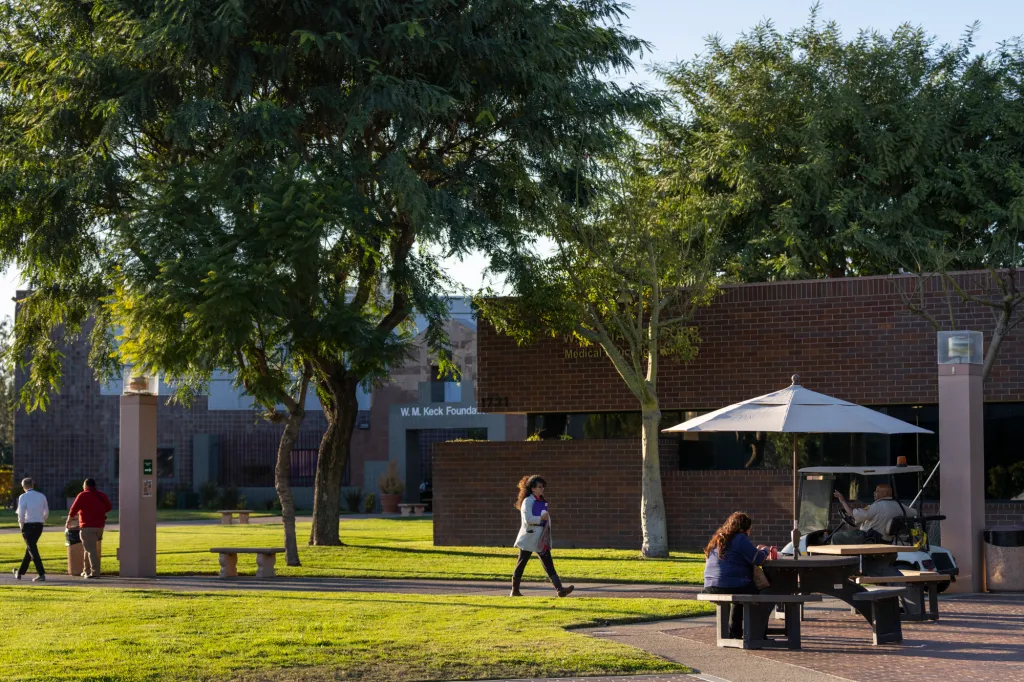
Charles Drew University in the Watts region of Los Angeles on Dec. 7, 2022. Photo by Lauren Justice for CalMatters
Leggett, who grew up in South Central Los Angeles and received her undergraduate education at predominately-white Loyola Marymount University, said attending a program that allowed her to focus on giving back to her home was essential. “If you look at the campus, you’ll see we really are in South Central,” she said, “versus other campuses which are just a college town.”
The university is located next to Martin Luther King Jr. Community Hospital, the only full-service hospital in the Watts/Willowbrook area. Students do rotations at the hospital and other sites that offer primary care to underserved communities.Watts is one of the most densely populated places in California, and the country, with more than 18,000 people per square mile. The area is also 85% Latino and 15% Black, more than double the California average.
Having its own medical school will allow Charles Drew to focus on its mission without influence from the goals of another institution, Prothrow-Stith said. The university will accept 60 students for its independent program, set to start in July 2023, and another 24 will continue its joint UCLA program. The California Legislature set aside $50 million to support the new program, which school leaders say will be used to build a new Health Professions Building with a simulation and virtual anatomy training facility. Construction is scheduled to begin in 2023 and be complete in 2025.
The curriculum will train students to identify health problems affecting low-income, urban areas, including lack of access to fresh fruits and vegetables, asthma induced by insect excrement, overcrowded and stressful living spaces, lead exposure and pollutants from bus parking lots, said Prothrow-Stith. That’s in addition to meeting all the standard requirements for pre-clinical training. The curriculum will also include a service learning component, in which students will work alongside community health workers and provide care to homeless people through mobile clinics.
By training more Black doctors and getting them out into the community, Charles Drew’s new program could help improve health care for the state’s Black patients, said Leon Clark, chief research and health equity officer at Sutter Health.
To provide equitable care, he said, medical schools should require training in qualities such as sympathy and unconscious bias, combined with immersive experiences.
“We should be in the classroom, in the hospital, but at some point we have to get students out into the community, especially marginalized communities so they can experience first hand what is happening to patients outside of the system,” he said.
And representation matters, he said.
“I want to be clear, that is not to suggest only Black doctors can treat Black patients. I think things like empathy, cultural humility, bias, are things that can be taught and trained,” Clark said. “But on the other hand, there is a comfort level, a baseline of trust, that is enhanced when you see folks (who) you feel understand what your needs are, what your preferences might be.”
Leggett said her medical school experience has illustrated the importance of that cultural competency. She recounted another experience with a patient, during her first year of training. She was observing a team of practitioners treat a child with severe burns down her back. Unsure how the child ended up with such an injury, the team didn’t know the best way to treat her, Leggett said, and was about to ask Child Protective Services to investigate possible abuse.
Noticing the fresh braid style the patient had, Leggett mentioned the burns may have occurred when dipping the hair in hot water, a way of sealing synthetic hair extensions. The doctors confirmed the explanation with the child, Leggett said. Even though she was the lowest ranking member on the team, she said, she was able to help expedite care and keep a child with her parents.
“Medical school is just a microcosm of what happens in our world,” said Leggett. As future doctors at an HBCU, she said, “we are constantly interacting and seeing the beauty of diversity within the community.”
###
Story is a fellow with the CalMatters College Journalism Network, a collaboration between CalMatters and student journalists from across California. This story and other higher education coverage are supported by the College Futures Foundation.
CalMatters.org is a nonprofit, nonpartisan media venture explaining California policies and politics.
BOOKED
Today: 6 felonies, 19 misdemeanors, 0 infractions
JUDGED
Humboldt County Superior Court Calendar: Today
CHP REPORTS
Us101 S / Fernbridge Dr Ofr (HM office): Animal Hazard
ELSEWHERE
Governor’s Office: California’s economy isn’t just bigger than Texas and Florida — it’s growing faster, too
RHBB: A Healthy School Year Starts with Back-to-School Vaccines
RHBB: Major Roadwork Scheduled Friday, July 24 through Thursday, July 30
OBITUARY: Evelyn Mendes, 1928-2022
LoCO Staff / Thursday, Dec. 15, 2022 @ 6:56 a.m. / Obits

Evelyn Mendes passed away on Thursday December 12, 2022 at the age of 94. Evelyn was born June 11, 1928, to Luis and Maria Molles in Dinuba, California. Evelyn’s father passed away when she was a young girl. The family moved to Humboldt County after that and settled here.
Evelyn met her husband, Joseph A. Mendes, here, and they were married in 1946. They lived all of their married life in Ferndale. Evelyn and Joe were a successful dairy family for many years in Port Kenyon and then on Dillon Road. Evelyn was a busy mom of six children and also was involved with the local 4-H as a sewing leader. Evelyn was also involved in the local V.F.W. and American Legion and SES. Evelyn was a huge asset to Joe as he served a year as Supreme President of the SES .
Evelyn lived a fulfilled life as a wife and mother. Evelyn is survived by her children — Kathleen Jorgensen, Fred Mendes, Joanne Smith and Debbie Martin — as well as eight grandchildren and 10 great-grandchildren and many nieces and nephews.
Evelyn was preceded in death by her husband, Joseph A Mendes; her parents, Louis Molles and Maria Freitas; her sister Alice Hyde and brother Wesley Molles; her sons Mark Allen Mendes and Joseph Donald Mendes; and grandsons Quincy Mendes and Marcus Zgraggen; and great-grandson Ben Pierson.
There will be a private family graveside service for Evelyn in January at Saint Mary’s Cemetery. Donations can be made to your favorite charity
The family would like to thank Frye’s Care Home for their constant and loving care they showed mom these last challenging years. In addition, thanks to Hospice for their support and care to our mom and family.Special thanks to Tiara and Kaitlyn at Frye’s.
###
The obituary above was submitted on behalf of Evelyn Mendes’ loved ones. The Lost Coast Outpost runs obituaries of Humboldt County residents at no charge. See guidelines here. Email news@lostcoastoutpost.com.
OBITUARY: Judith ‘Judy’ Van Zelf, 1940-2022
LoCO Staff / Thursday, Dec. 15, 2022 @ 6:56 a.m. / Obits

Judith “Judy” Van Zelf, 82, of Eureka, passed away peacefully on November 5, 2022. She was
the second child born in her family and the last survivor.
Judy attended Lincoln Elementary School, Eureka Junior High School and Eureka Senior High School, and graduated in 1958.
Judy married Robert Van Zelf in October 1965, and was a stepmother to Bobby, Rene and Andy. After Judy and Robert divorced, she remained single the remainder of her life.
Judy began her career as a dispatcher for the Humboldt County Sheriff’s Department in 1962. She took a leave of absence in 1966 and returned to work part-time from 1967 to 1974 as a Dispatcher, Clerk Typist and Matron. Judy served as a Matron in the Humboldt County Jail before there were any accredited female peace officers. Judy was one of only two Matrons who accepted the opportunity to attend the academy and became deputies. She was the only one to pass the Field Training Officer (FTO) test. Judy was hired as a full-time Matron for the Humboldt County Jail in 1974 and promoted to Deputy Sheriff in 1977. Judy worked as a Deputy in Detention until 1979 when she transferred to patrol. In 1988, Judy transferred to the Court Services as a Bailiff where she worked for 14 years. She retired on July 27, 2002, after 38 years of service.
Judy was a member of the CHP/HSCO pistol traveling team and competed on this team. They won many trophies which some of them are still displayed at the Peace Officer Hall in Freshwater.
While living in Freshwater, she was the caretaker of the Humboldt County Peace Officer Hall. There were many get togethers over the years with family and friends. Whether it was a birthday, holiday, baby shower, wedding, she loved to host them all. We all have fond memories of the parties that she hosted there.
Judy was a beautiful soul with a huge heart, and was a mother to all. She was a strong and very independent lady. Judy was always up for a good time. She enjoyed camping every year at Wages Creek and Ruth Lake with family. She loved playing Bunko. She was an avid book reader and could go through a book in one day. She loved to collect pig figurines and trinkets. We all knew what to get her for any special occasion. Anything with a pig on it or her favorite perfume, “Charlie.”
She was preceded in death by her parents, Walter and Esther Anderson; her brother Robert (Bob) Anderson and his wife Jo Ann; her sister Joanne (Jo) Olsen and her husband Bud; sister Jeanette (Jay) Watkins; and her brother Charles (Chuck) Anderson. She is survived by her brother-in-law Gary Watkins, her 11 nieces and nephews, 21 great nieces, and 5 great great nieces and nephews. She is already missed so much, but knowing she’s reunited with her family makes it easier.
A celebration of life luncheon will be held in her honor on Saturday, February 18, 2023, at 1 p.m., at the Humboldt County Peace Officer Hall, 2351 Freshwater, CA. Please bring your favorite stories that you have of Judy.
###
The obituary above was submitted on behalf of Judy Van Zelf’s loved ones. The Lost Coast Outpost runs obituaries of Humboldt County residents at no charge. See guidelines here. Email news@lostcoastoutpost.com.
‘The Lost Lewis Treasure’: Father Plans Epic Community Treasure Hunt on Anniversary of His Son Being Lost at Sea
Stephanie McGeary / Wednesday, Dec. 14, 2022 @ 2:28 p.m. / News

The wooden treasure box, map and four metal cryptex that will be a part of the Hunter Lewis Memorial Treasure Hunt | Image provide by Corey Lewis
###
PREVIOUSLY:
###
It’s been nearly a year since 21-year-old Hunter Lewis headed into the Pacific Ocean on a canoe to hide the final piece of an epic, multi-day treasure hunt he planned for his friends and family. He never returned.
Now Hunter’s father, Corey Lewis, is planning a treasure hunt on Dec. 30 – the one-year anniversary of Hunter’s passing – and invites anyone who was touched by Hunter’s story, or is just looking for some adventure, to join.

Hunter Lewis, 21, had recently received his pilot’s license
Treasure hunts have been a part of the Lewis family for decades. The tradition started with Corey’s mom, who would organize scavenger hunts as an activity whenever the family was all together. One year when Corey’s parents were visiting the family in Humboldt, Corey took the tradition a step further and put together a treasure hunt for his sons, Hunter and his younger brother, Bodie. Corey drew a pirate’s treasure map with burnt edges and hid it in a book about pirates. The boys were about seven and 10 years old at the time.
Over the years the treasure hunts grew more involved and complicated. Corey organized another treasure hunt a few years later, when the boys were about 14 and 17, in the Colorado mountains near his mother’s cabin.
Hunter had taken the treasure hunt to the next level with the excursion he planned for his friends and family in 2021. The hunt started on Christmas Day, when Hunter gave his family members and his girlfriend, Kinsley, each envelopes containing an announcement of the treasure hunt and a link to the first set of clues. Hunter had been putting together the treasure hunt for about two years.
Over the next several days, Hunter’s friends and family searched for clues and solved cryptic riddles as Hunter followed along, often laughing and filming them trying to solve his puzzle. But the treasure hunt took a tragic turn on Dec. 30, when Hunter went out on that canoe.
It is presumed that Hunter was lost at sea while attempting to reach Flatiron Rock off the coast of Trinidad. For days following his disappearance, hundreds of people coordinated online to look for Hunter. The search for the final treasure became a search for Hunter himself.

Hunter’s friends and family hold a birthday celebration for Hunter at his memorial bench in Trinidad
The beautiful, tragic irony of Hunter’s story naturally made many people assume that someone would want to make a movie about it. Corey would joke with some folks about who would play Hunter or him in the film version. Not surprisingly, a major motion picture company learned of Hunter’s disappearance through a story published in Rolling Stone and is planning to make a film based on the story.
Corey has been in communication with the film people, he told the Outpost, but he is not yet allowed to disclose any names or much additional information. The one thing he could say was that the studio is signing Corey and Kinsley both on as associate producers, and they will have some creative control over the story, something that is very important to Corey.
Though, again, he couldn’t mention names, Corey said that the screenwriter is from Northern California, which Corey is very excited about. He said he really hopes that the film will be shot in Humboldt County so that the beautiful places that Hunter loved, that were a part of his treasure hunt, and even the place where his life was ultimately lost, can be seen in the film.

Corey Lewis at the memorial bench
While such exciting opportunities to share Hunter’s story have helped keep Corey feeling positive, the last year has certainly not been easy for him. Grief took its toll on Corey’s relationship, and he and his wife have been separated and are now filing for divorce, he told the Outpost.
“It’s tough, but I see the purpose in it all,” he said. “… A new chapter of my life is coming up.”
Keeping Hunter’s memory alive helps Lewis get through the difficult times. He and other family and friends of Hunter’s spend a lot of time visiting a memorial bench that Lewis constructed for his son. The bench is located at Hunter’s favorite place – a clearing on top of a cliff overlooking Trinidad State Beach – and is shaped like a key that Hunter had made with a 3-D printer as a part of his treasure hunt. When you stood on the cliff and held up the key, it lined up with the rocks in the ocean, pointing to Flatiron Rock. This was how Lewis and Kinsley figured out where Hunter had gone in the canoe to hide the final treasure. It was mostly while sitting on the bench that Lewis decided to plan another treasure hunt in Hunter’s honor.
On Dec. 30 between 10 a.m. and 2 p.m., Lewis will be handing out treasure maps and packets at his studio – the Sunyi’s Academy of Tae Kwon Do, at 1215 Giuntoli Lane in Arcata. At 2 p.m that day, Lewis will also post the information to the Search for Hunter Lewis Facebook group. And the treasure hunt will begin!
The hunt will include four different riddles that, when solved, will lead the treasure hunters to four different metal cryptex locks located throughout the Trinidad area. The locks will then need to be opened using a code to unveil a clue. Whenever someone finds one of the locks and unveils the clue, they will have to post it to the Facebook group. It is only when all four locks have been opened that the clues will make sense, Lewis said. The four clues will then lead participants to the final treasure – a wooden box, which was given to Lewis by Six Rivers Brewery and contains all kinds of goodies, including jewelry and cash.
It might seem strange to some people that Lewis would plan a treasure hunt, when that was the very activity that led to his son’s passing. But Lewis wanted to be very clear that this hunt should be in no way dangerous. None of the clues are hidden in places that require boating, swimming or climbing to get to. If you end up someplace that seems dangerous, Lewis said, you are off track and should get out of there.
It was important to Lewis that this treasure hunt be safe and accessible to lots of different people. He does want it to be challenging, but not too challenging for anyone to participate. That is also why he designed the challenge to require that people post the clues to the Facebook Group, so that people who don’t live in the area, but who follow the group — which has more than 5,000 members — can participate by helping to solve the clues.
Lewis says he is really excited to share this experience with the community and he is excited to share Hunter’s story with more people. The fact that so many people seem touched by Hunter’s story helps keep Lewis hopeful.
“The only thing we really need to learn to do in life is deal with change – change that we choose and change that we don’t choose,” Lewis said. “And I’ve gotten pretty good at that.”

The final treasure will be inside this wooden box
Dealer From the Largest Seizure in Humboldt Drug Task Force History Pleads Guilty, Could Face 18 Years in County Jail
LoCO Staff / Wednesday, Dec. 14, 2022 @ 2:17 p.m. / Courts
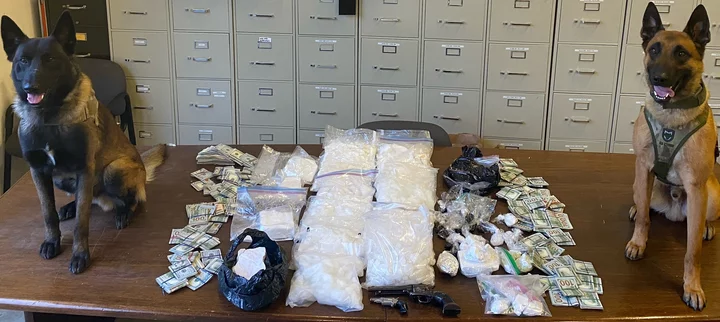
File photos via HCDTF
# # #
Press release from the District Attorney’s Office:

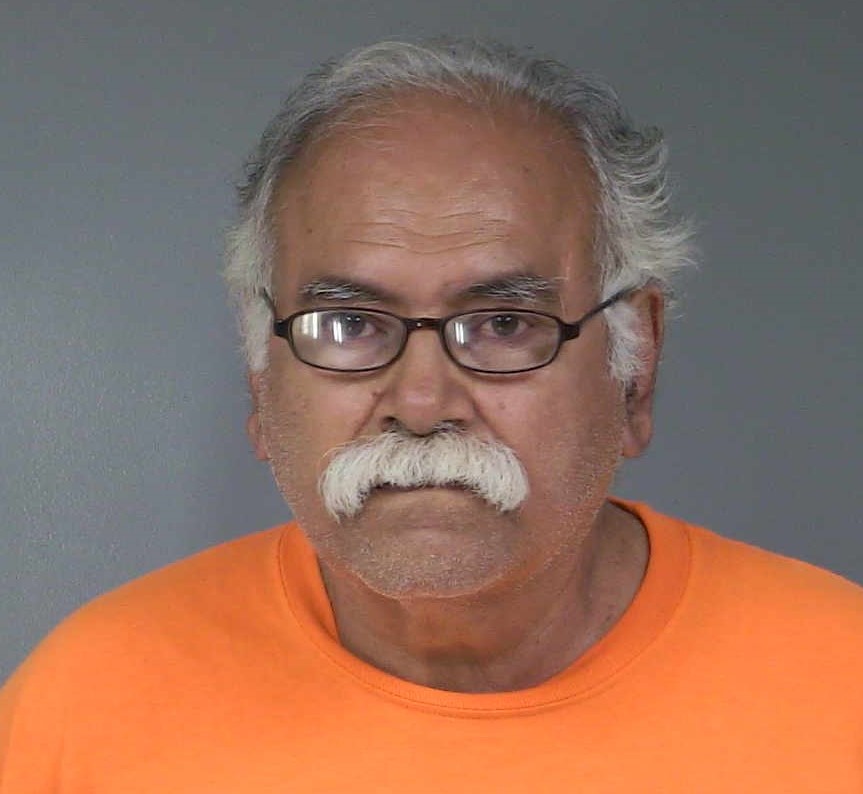
On December 13, 2022 Jose Lomeli Osuna pled guilty to all the charges and enhancements he faced following his September 15, 2022 arrest by the Humboldt County Drug Task Force (DTF).
On that date DTF served warrants on three locations: at a Creamery Alley, Arcata location agents found 3 pounds of methamphetamine, 4 ounces of fentanyl and over $114,000 in cash; at a Myrtle Avenue, Eureka location agents found 1.3 ounces of cocaine; and at a storage unit in McKinleyville they located 24 pounds of methamphetamine, 3 pounds of heroin, 1.25 pounds of cocaine and 5.83 pounds of fentanyl.
The defendant pled guilty to possession with intent to sell heroin, methamphetamine, cocaine and fentanyl, with enhancements for possession of: methamphetamine over 10 kilograms (22 pounds), heroin over 1 kilogram and fentanyl over 1 kilogram. He also admitted to two prior convictions for transportation of drugs for sales.
Recent changes to the Penal Code (1170(h)) dictate that individuals convicted of selling, transporting or possessing drugs for sales cannot be sentenced to prison. However, a judge could sentence Lomelli Osuna to as much as 18 years in the Humboldt County Correctional Facility. Given the defendant’s record and his major role in Humboldt County drug dealing as indicated by the large quantities seized by DTF, the District Attorney will seek to maximize Lomelli Osuna’s time in custody.
Freshwater Woman Arrested for Domestic Violence Physically Assaults Correctional Staff, Sheriff’s Office Says
LoCO Staff / Wednesday, Dec. 14, 2022 @ 9:21 a.m. / Crime
Press release from the Humboldt County Sheriff’s Office:
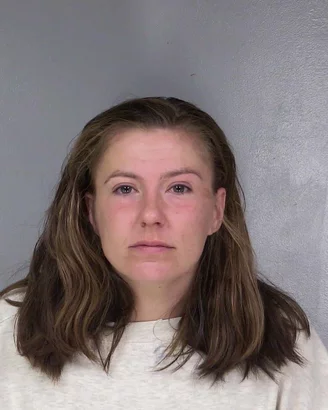
On Dec. 13, 2022, at about 10:27 p.m., Humboldt County Sheriff’s deputies were dispatched to a residence on the 1100 block of Freshwater Road in Freshwater for the report of a domestic disturbance.
Upon arrival at the residence, deputies contacted an adult male victim and an adult female suspect, identified as 34-year-old Amber Charmaine Mentink. During their investigation, deputies learned that Mentink and the victim were involved in argument, during which Mentink reportedly physically assaulted the victim.
Mentink physically resisted deputies while being taken into custody. While in custody, Mentink became combative, physically assaulting a deputy.
Mentink was booked into the Humboldt County Correctional Facility on charges of battery against a cohabitant (PC 243(e)(1)) and resisting/obstructing a peace officer (PC 69).
Anyone with information about this case or related criminal activity is encouraged to call the Humboldt County Sheriff’s Office at (707) 445-7251 or the Sheriff’s Office Crime Tip line at (707) 268-2539.
‘Catastrophic Staffing Shortage’ Hits California’s Rural Police First, and Hardest
Nigel Duara / Wednesday, Dec. 14, 2022 @ 7:38 a.m. / Sacramento
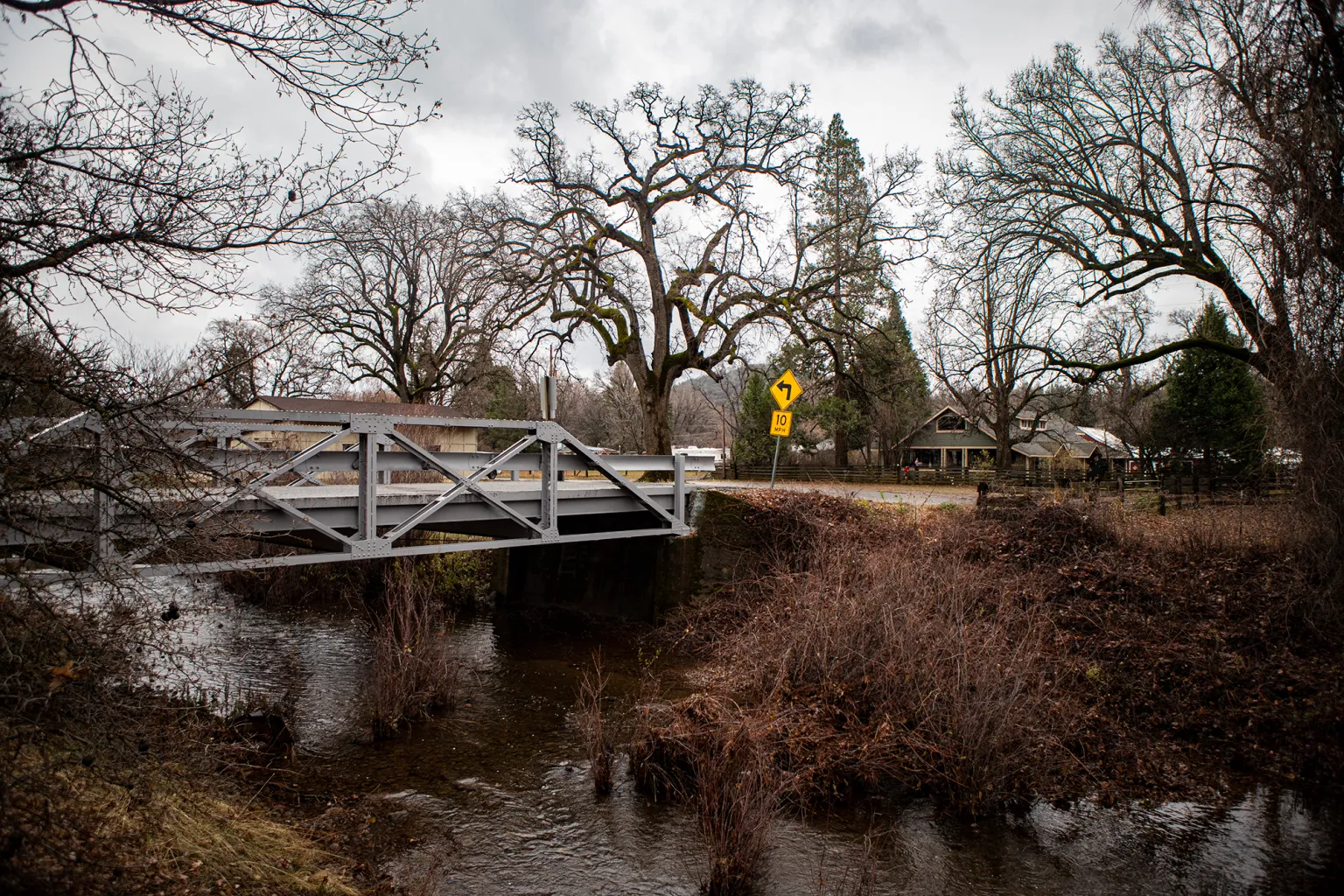
A bridge going over the creek leading to the rural community of Paynes Creek on Dec. 9, 2022. Photo by Larry Valenzuela for CalMatters.
Under a low, heavy sky threatening sleet or snow, State Route 36 twists and turns along tree-topped ridges. In many spots, there’s no guardrail — just a spit of dirt between a driver and a thousand-foot drop.
This is a county where people are expected to take care of themselves, and in the last month, Tehama County itself has been operating without its own guardrail: Outgoing Sheriff Dave Hencratt said last month that deputies would no longer patrol during the day.
“This added reduction of services is necessary to manage a catastrophic staffing shortage throughout the agency,” Hencratt said in a Nov. 8 press release.
On a recent December morning, lots of people’s faces hung low and heavy as the clouds.
The sheriff frowned when he met a reporter at midday on the edge of his property, dressed in barn clothes, declining to comment. The county administrator frowned because the sheriff’s abrupt decision threw his office into chaos. The tavern owner frowned because he works 23 miles outside of town and hasn’t seen a patrol car in weeks. The elected leaders, the motel owners, the rural residents left to their own devices — everyone, it seems, in this stretch of land between national forests, is unhappy with the circumstances, and they each have a different idea for how to solve it.
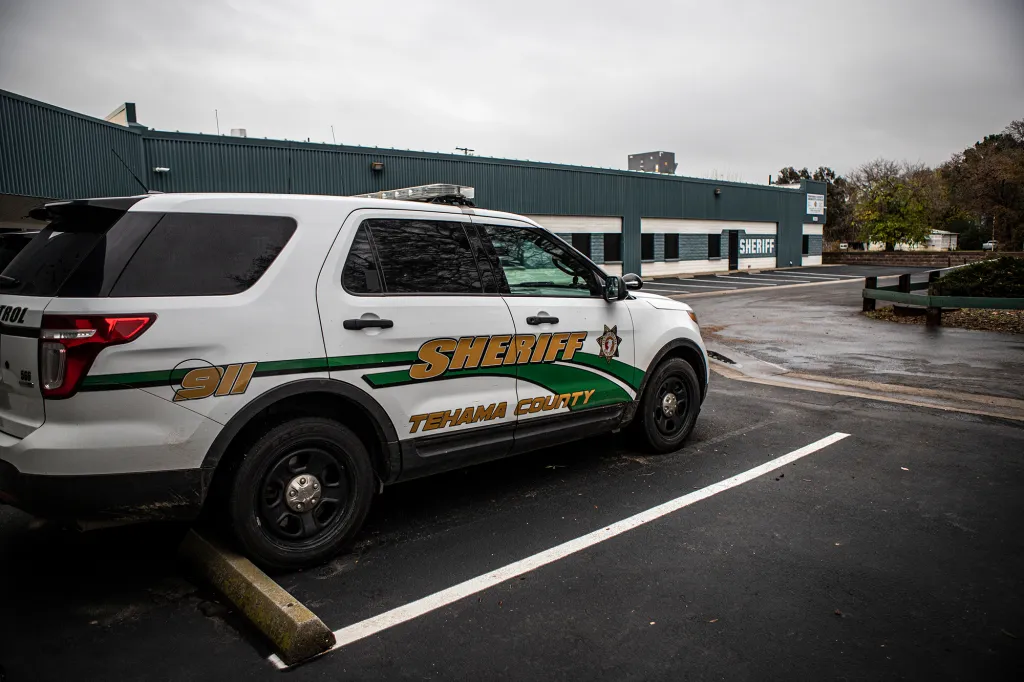
A sheriff squad car at the Tehama County Sheriff’s Office in Red Bluff on Dec. 9, 2022. Photo by Larry Valenzuela for CalMatters
Some gave up on the sheriff’s office a long time ago.
“When we called 911 even before they stopped patrolling, they’d say ‘Sorry, we can’t make it, handle it yourself,’ ” said Catherine Gasper of the tiny town of Mineral. “That’s not what someone wants to hear when you’re getting beat up. But most people are armed up here, so we don’t worry too much.”
Low pay and a higher bar
The decision to end daytime patrols — which generated sensational headlines and coverage from tabloids in New York City and London for a county whose entire population could fit inside Levi’s Stadium — was rooted in twin problems plaguing law enforcement across California and the country: There aren’t enough qualified new recruits to fill open positions, and a small, rural sheriff’s department like the one in Tehama County doesn’t pay its deputies enough to keep them long.
The state, meanwhile, isn’t making it any easier to hire police officers — particularly those who leave larger departments with shoddy disciplinary or criminal records and find employment at smaller organizations. New laws have raised the minimum hiring age of law enforcement officers to 21 and require the community college system to create a “modern policing” degree program by 2025, laying the groundwork for a statewide officer education minimum.
In Tehama County, tensions had been building for months, if not years. Hencratt told the Red Bluff Daily News in February that other law enforcement departments were treating his office like a “supermarket of employees.”
“When (the) Redding Police Department says, ‘You know what chief, we’re down officers,’ ‘Well go down to Tehama County, go down the officer aisle and pick some,’ and that’s what they do. They’re cherry picking our people,” Hencratt told the newspaper.
Tehama County usually makes its hires from newly graduated applicants, said Tehama County Administrator Gabriel Hydrick. Since the county pays so poorly — about 22% below market rate, according to a county-commissioned compensation study from August — the new recruits don’t stay long. The police department in the county seat of Red Bluff pays better, and law enforcement in the nearby city of Redding and surrounding Shasta County both offer higher salaries and hiring bonuses of several thousand dollars.
The system operated well for decades: Sheriff’s deputies left for higher-paying jobs, and their roles were filled by new recruits. But the labor market is tight and policing isn’t what it once was. Scores of incidents filmed on cell phones across the country have revealed the casual brutality of so-called bad apple cops, which legislators and civil liberties advocates argue drives potentially qualified applicants away from policing. Applications for policing are down, according to the Commission on Police Officer Standards and Training. Fewer applicants means smaller graduating classes. Their absences show up first in places like Tehama County.

Tehama County Chief Administrator, Gabriel Hydrick, stands in front of the County Administration office in Red Bluff on Dec. 9, 2022. Photo by Larry Valenzuela for CalMatters
Since 2012, the Commission on Police Officer Standards and Training, or POST, has certified on average about 3,200 officers each year. A basic certificate means that the applicant passed both the POST academy and a field training program, then completed a probationary period at the agency that employs them. The entire process takes about two years.
In 2022, however, the agency issued just 2,424 basic certificates as of Dec. 13, the lowest number of basic certificates issued since 2013, and well below the 10-year high of 4,530 issued in 2020.
“I would agree that it’s harder to be a police officer now than (in years past),” said Hydrick, the county administrator. “There’s a lot of disincentives to being an officer. The culture isn’t behind you anymore. We have more laws about policing and being a police officer than other states.”
But Hydrick also blames the working attitudes of the new generation making up the youngest ranks of law enforcement — or, in this case, not making up that new generation.
“We can keep throwing money at it, but if there’s a generation that’s not willing to work or apply for jobs, the money’s not going to fix that,” Hydrick said. “The younger generation wants to be gamers and YouTubers; maybe they cobble an income together from being an Uber driver.
“We’re not seeing people want to become professionals anymore.”
Is it time to increase police funding in small counties?
One of the architects of California’s push for tougher regulations on police and policing is Assemblymember Reggie Jones-Sawyer, a Los Angeles Democrat and chair of the Assembly Public Safety Committee. He said he doesn’t see a conflict between police hiring problems and the state’s stronger hand in hiring officers and the practice of policing.
“It’s almost like, if you’re saying the regulations are too stringent, you’re saying we can’t get people who are not racist, who do not want to brutalize people of color,” Jones-Sawyer said. “We’re not the ones making police officers look bad. It’s the bad police officers who are discouraging the good ones from applying.”
“We probably do need to look at subsidizing smaller police departments so they can level the playing field.”
— Assemblymember Reggie Jones-Sawyer, chair, Assembly Public Safety Committee
But Sawyer-Jones said it may be time to consider having the state send money to the smallest departments, like the one in Tehama County, to make sure they can afford to pay competitive rates.
“We probably do need to look at subsidizing smaller police departments so they can level the playing field,” he said.
The Tehama County Sheriff’s Office didn’t respond to dozens of emails and phone calls seeking comment. Hencratt, the sheriff whose term is expiring in January, did not return calls, and told a CalMatters reporter who approached his property that a press release would be the extent of his comments.
“Over the past decade, police lobbying organizations have said that any measure that increases transparency or accountability for officers will either increase crime or make people not want to be police,” said Peter Bibring, senior counsel at the American Civil Liberties Union of Southern California.
“They said that about the measure to strengthen the ban on racial profiling in 2015, about the transparency over disciplinary records, changes to use of force law. So this is just, you know, the latest.”
But, Bibring said, those portents of doom haven’t come to pass. If law enforcement agencies are having trouble recruiting a new generation, he said, they should probably look to the misconduct within their own ranks.
Lasting shortages
Police departments nationwide are calling for more officers, but in the smallest offices covering the largest geographic areas, the situation is more dire. In Shasta County, north of Tehama County, the sheriff’s office closed one level of the jail and blamed a lack of deputies. Sacramento has had a police officer shortage since the Great Recession 15 years ago, and in Los Angeles, the police department has no staffing problem, and is instead requesting more helicopters.
It’s not like policing pays badly in California — sometimes the opposite. At the opposite end of the spectrum, a Beverly Hills assistant police chief earned $716,284 in total compensation in 2021, making him the highest-paid municipal employee in the state. But Tehama County is no Beverly Hills: The entire county drew less than one-half the revenue that Beverly HIlls did in the 2020-21 fiscal year, the latest year for which numbers were available
One recruiter who works with police departments said that law enforcement has been slow to change its recruiting practices, and that’s reflected in the smaller number of people joining the profession.
“This isn’t 1997,” said Epic Recruiting CEO Sam Blonder. “You’re not going to get 1,000 people signing up for the (policing exam).”
The issue isn’t just pay, Blonder said, citing research showing that the newest generation of recruits looks for work-life balance ahead of pure compensation. But policing’s issues also extend to intransigence among the old guard. His work to recruit new officers, Blonder said, is as much about convincing police brass to do the recruiting.
“Among command staff there’s this attitude that I shouldn’t have to do this,” Blonder said. “Ask 150 high school kids who wants to be a police officer — you won’t get one that will raise their hand. It’s not for me to say why that’s happened, but sometimes an industry needs a shakeup like that.”
That shakeup is happening in real time in Tehama County.
“People have expressed to me fear and concern based on the lack of the daytime sheriff’s office patrol,” said Tehama County District Attorney Matt Rogers. “Simply put, if they pick up the phone and dial 911, is someone going to come?”
“Ask 150 high school kids who wants to be a police officer — you won’t get one that will raise their hand.”
— Sam Blonder, CEO, Epic Recruiting
Any Tehama County officials wishing for tax hikes to generate more county revenue watched those hopes fizzle in March 2020, when voters rejected the county’s 1-cent sales tax increase. And it didn’t just fail, it was crushed, 84% to 16%.
Tehama County is also setting aside money for about 30 vacant sheriff’s office jobs, eight of them for deputies and 13 for deputies in the county jail. Hydrick, the county administrator, said the sheriff’s hope was to eventually fill those positions and restore the sheriff’s office to its 2017 size of approximately 84 deputies.
But in the meantime, all of those vacant positions “encumber,” or put a hold on, the salaries those positions would be paid. That, Hydrick said, amounts to about $3 million each year in unused money by the sheriff’s office, which then reverts to the county’s general fund.
In place of the absent deputies will be the California Highway Patrol, which has 14 officers for the 15-county region that encompasses Tehama County.
“Since Nov. 20, the CHP has received numerous requests for assistance (from residents) to calls in Tehama County that don’t include their usual duties,” California Highway Patrol spokesperson John Crouch said in an email.
Butte County Sheriff Kory Honea, whose county borders Tehama and whose office pays more, said background checks are as much an obstacle to making new hires as the recruiting process is.
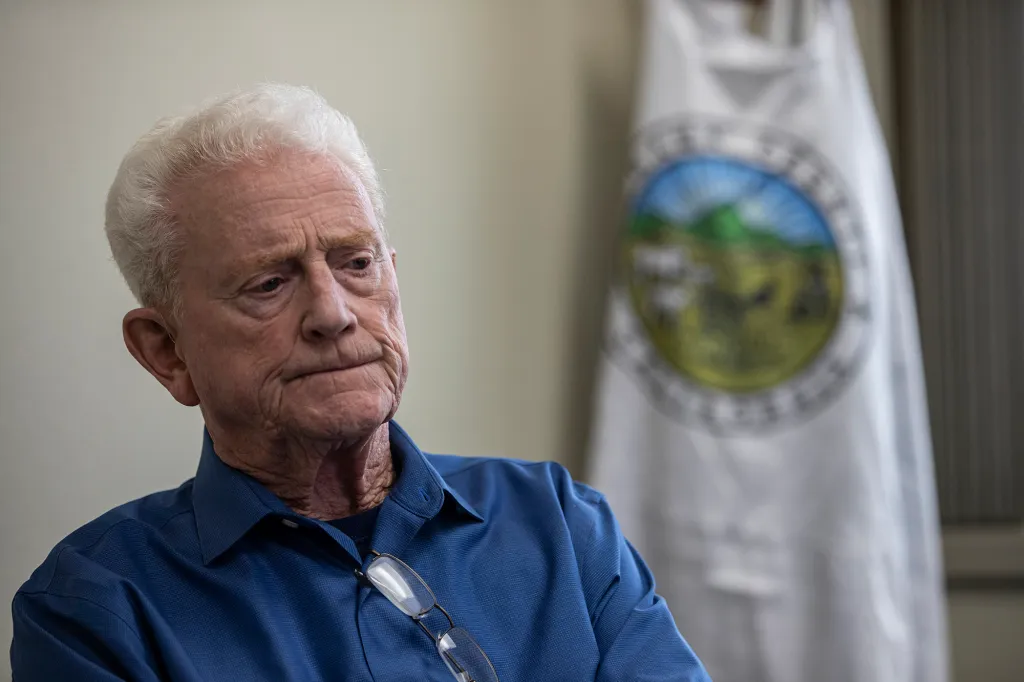
Tehama County Supervisor Bill Moule. Photo by Larry Valenzuela for CalMatters
“It’s a challenge to find people you would want to entrust with the authority to carry firearms,” said Honea, who is also president of the California State Sheriffs’ Association.
Honea said his office tries to focus on retaining the people they already have by offering free gym memberships and yoga classes.
“I would hope I’m never in a position in Butte County to make that decision (to end daytime patrols),” Honea said. “I would exhaust other options before I did that.”
For some longtime residents like Tehama County Supervisor Bill Moule, the end of daytime patrols is a return to the county’s past.
“I moved to this county in 1978, and the first question I asked was, ‘What kind of service do you have in the rural areas?’” Moule said. “The sheriff was kinda this big guy, been sheriff a long time. He looked at me and said, ‘Son, get yourself a shotgun and a dog.’
“It’s no different today than it was in 1978.”
###
CalMatters.org is a nonprofit, nonpartisan media venture explaining California policies and politics.


