Press release from the Humboldt County Sheriff’s Office:
On Sept. 11, 2022, at about 7:54 p.m., Humboldt County Sheriff’s deputies were dispatched to a residence on the 39,000 block of Highway 299 in Willow for the report of a possible arson.
According to the reporting party, a female suspect, later identified as 24-year-old Tiffany Jane Lilly, was observed standing near a vegetation fire. When contacted by residents, Lilly fled the area. While enroute to the location, deputies received an additional report of Lilly attempting to start another fire near a building on Panther Creek Road. Deputies located Lilly in the area, and she was taken into custody without incident. No one was injured and no structures were lost as a result of these fires.
Lilly was booked into the Humboldt County Correctional Facility on charges of arson (PC 451(a)) and possession of an incendiary device for purposes of arson (PC 453(a)).
Anyone with information about this case or related criminal activity is encouraged to call the Humboldt County Sheriff’s Office at (707) 445-7251 or the Sheriff’s Office Crime Tip line at (707) 268-2539.
Illustration generated by DALL-E, an artificial intelligence.
###
Living through a pandemic sucks, but for Diana McLaughlin, early 2020 was especially bad: A divorce in February 2020, societal shut-down in March, and as part of the COVID-19 economic fallout, she lost her job in April of that year, returning to full-time work only 18 months later.
California lawmakers had economically distressed folks like McLaughlin in mind when last year they approved half a billion dollars on education grants worth $2,500 to help workers displaced by the pandemic acquire new job-related skills.
McLaughlin is among the first 3,000 or so recipients of this grant, adult learners who were issued checks in a pilot program this spring and summer. Now the state is opening the grant to a wide range of adults with low incomes who lost their jobs or saw their hours severely cut during the pandemic. Half of the grant funds are reserved for displaced workers with children under 18.
Among the few stipulations to receive the grant, applicants must fill out a short application that takes about 10 minutes to complete and attest that they lost a job or hours after March 4 2020, when Gov. Gavin Newsom declared a state of emergency. Applicants also must affirm that they weren’t enrolled in an educational or job-training program when they lost their jobs. There’s an income threshold as well.
Part of what makes the application quick to complete is how little it asks. Unlike other grant applications for college, this one is self-reported and self-certified, wrote Judith Gutierrez, spokesperson for the state financial aid agency running the grant, in an email. “We are not requesting any documentation,” she added.
McLaughlin wasted no time once she received her grant in June, 2022. After taking courses part-time at American River College, a community college in Sacramento, since October of 2020, she decided to go full-time to pursue her first ever-degree this fall and chose accounting as her major.
“I feel that it’s showing him how important an education is and to never give up because here I am, 47, and in college.” — Diana McLaughlin, grant recipient
The $2,500 is paying for her textbooks, software required for schoolwork and other supplies — anything remaining she’s putting in a personal education account. Though she receives tuition waivers as part of a state financial aid program and additional dollars through the Cal Grant, the Golden State grant gives her extra confidence that she can afford an education while earning around $38,000 a year.
Diana McLaughlin in Citrus Heights, California, September 9, 2022. Photo by Fred Greaves for CalMatters
“I spend my lunch break doing schoolwork,” she said. After returning from the office, she takes her associate degree courses online. McLaughlin’s younger son is a virtual charter school student, so the two complete their homework side by side.
“I feel that it’s showing him how important an education is and to never give up because here I am, 47, and in college,” she said.
Expanding financial aid in California
At first blush the Golden State Education and Training grant, which will last through 2024 and is funded mostly through one-time federal stimulus funds, is yet another example of the state’s growing effort to lower the cost of college for adults and bring more Californians into college classrooms.
In the past two years, public funding grew by nearly 50% for the California Student Aid Commission, which oversees most of the higher-education grant aid to students, to nearly $3.6 billion. That growth includes more tuition and cash support for community college students, middle-class students at the University of California and California State University, students formerly in foster care, students raising children and the Golden State training grant, among others.
But the Golden State grant’s eligibility rules start where other state and federal grants drop off, extending cash assistance to would-be students who otherwise wouldn’t be eligible for traditional college financial aid.
The Golden State grant can cover education programs that are shorter than about four months — something the federal Pell and state Cal Grant do not. Students receiving the Golden State grant may also use the money for extension and so-called noncredit programs, such as English-as-a-second-language courses, bicycle repair and various landscaping certificates. There’s no minimum program length for this grant — and because state dollars cover some of the grant costs — undocumented students are also eligible for the $2,500. Anyone getting the grant needs to already know which training program they plan to pursue.
Getting the word out
So that displaced workers with no ties to a college also apply, the Student Aid Commission is working with regional workforce boards, The California Workforce Development Board and other agencies to get the word out about the grant, said Jake Brymner, director of governmental relations for the Student Aid Commission.
Grant recipients can also use the funds if they enroll in certain workforce training and apprenticeship programs unaffiliated with colleges or universities. The Student Aid Commission is reviewing which workforce training programs are eligible and will soon add those to the approved list on the grant application. Students will only be able to use their grants at California public colleges, universities and these approved workforce training programs.
During the pilot when only public colleges and universities were eligible, 84% of the grant applicants sought educations at community colleges, data from the Student Aid Commission shows.
“This specific grant has great potential,” said Daisy Gonzales, interim chancellor of the California Community Colleges. “What it does is it provides an entry point to our colleges for students that may not know about us.” Students with no exposure to community colleges can gain access to food pantries and coordinators who are familiar with other state and local social services for which students could qualify.
Even if grant recipients qualify for free tuition, especially at community colleges where nearly half of learners attend for free, they can use the money to cover gas, housing, food and other expenses. It’s an added perk for learners who had no spare dollars to afford an internet connection or other expenses associated with attaining a degree.
Muideen Olawoyin was one class away from earning an associate degree in human services, a stepping stone toward social work. But a series of bad breaks and a long-term injury left him cash-dry.
“I (couldn’t) even afford internet then, it was so hard,” he said. When he picked up the Golden State check from his school, Cosumnes River College, he was able to get back online, enroll in that final course and earn his degree this summer.
The average income of the roughly 3,000 grant recipients was about $22,000 when they first applied, according to California Student Aid Commission data provided to CalMatters.
Some degrees don’t boost wages
Not all training and education programs are made equal, however. Some research shows that shorter-term college certificates — like the kind in which students with this grant can enroll — have a mixed record of boosting the earning power of graduates.
Overall, these certificates lead to higher wages, but noncredit programs are less remunerative than traditional for-credit certificates. Still, associate degrees and bachelor’s degrees lead to even higher wage gains for graduates, according to a 2020 Urban Institute study. Meanwhile, a fifth of certificate programs at public colleges and universities lead to lower wages than what workers with high school diplomas earn, a Hechinger Report analysis of national data showed.
California’s foray into funding short-term credentials could inform the national conversation on whether to permit federal grant aid to pay for educations that are shorter than four months. For a few years now advocates have been trying to introduce “short-term” Pell grants, but the idea hasn’t won over enough lawmakers yet.
None of the four Golden State training grant recipients CalMatters spoke with were pursuing short-term credentials — all wanted an associate degree. McLaughlin, who now works as an accountant for a fencing company, is dreaming bigger.Her goal is to transfer to Sacramento State to earn a bachelor’s — something her current employer encouraged her to pursue.
“I want people to know you’re never too old for school,” McLaughlin said. “And to never stop trying to reach your goals.”
###
CalMatters.org is a nonprofit, nonpartisan media venture explaining California policies and politics.
William J. Spurling passed away peacefully on September 10, 2022 after his battle with cancer.
Will was born in Burbank on April 2, 1950. Shortly thereafter he and the rest of the Spurling family settled in Sunny Brae, where he spent his early years before moving to Arcata. Always the entrepreneur, Will started a landscaping business in the 1980s servicing clients all over Humboldt County before shifting gears (pun intended, as he would have wanted) and taking over Henderson Center Bicycles. Through his work at the bike shop, he supported the Tour of the Unknown Coast, sponsored local BMX, and spent countless hours chatting with anyone traveling through his shop. After retiring from the bike shop, Will became a poker dealer at Bear River Casino, where he elevated his love of the game beyond a tournament hobby.
Will is survived by his beloved wife of nearly five decades, Joeann. A caring and devoted husband, they built their life together around northern California before ultimately settling down in Fields Landing. Their home rapidly became an oasis as they built numerous structures and gardens. Whether it was putting in a new koi pond or a chicken coop, they spent an endless amount of time perfecting the house. When they weren’t working on the house, they took countless trips to their favorite haunts in Crescent City and Reno, always stopping to feed their favorite squirrels and watch the elk.
Will was a man of many qualities which he passed on to his kids. He could play musical instruments without formal training (Dan), was an excellent poker player and strategist (Dave), was known for his ability to build or fix just about anything (Dean), and had an insurmountable amount of grit (Amy).
Will is survived by his stepson, Dean Stevenson and his partner, Noreen Cady of Fort Brag; daughter, Amy Spurling and her wife, Theonie Alicandro of Boston, Mass.; son, Dan Spurling and his wife, Wendy Spurling of Lancaster, Ohio; and son, Dave Spurling of San Diego. He is also survived by his grandchildren Addie, Gretchen, Simeon, Annabelle, Isaiah, Tyler, and Tess. He is predeceased by his stepson Bob Stevenson and daughter Leah Polacek.
Will was also survived by his brothers, Harry Spurling and Patrick Spurling and his sisters, Joy Smelser, Michelle Pontoni, and Melody Poff. He was predeceased by his parents, Wayne and Ellen Spurling.
In lieu of flowers, memorial contributions can be made to Hospice of Humboldt.
###
The obituary above was submitted by Will Spurling’sloved ones. The Lost Coast Outpost runs obituaries of Humboldt County residents at no charge. See guidelines here. Email news@lostcoastoutpost.com.
A week ago, when NASA scrubbed the second attempt at launching the
huge — 320 feet tall, 3,000 ton — moon-bound Artemis 1 rocket,
veteran space geeks shook their heads, muttering, “It’s the
hydrogen, stupid.” While this was the second time the launch had
been scrubbed (the first was a few days earlier), it was actually the
sixth time NASA had tried — unsuccessfully — to fill Artemis’
cavernous hydrogen tank. At the last attempt, the tank was only 11%
filled when a hydrogen leak was detected in the 8-inch quick-connect
fueling line, causing the launch to be called off. Mid-October is now
the earliest possible launch date.
First rollout of Artemis 1 (Space Launch System plus the Orion capsule), March 2022, before being rolled back for repairs. (NASA)
Big rockets use three types of fuel, not counting the solid rocket
boosters. The Saturn rockets which launched the Apollo missions of
the 1960s and early 1970s used kerosene for their main
engines: not the most efficient, but cheap and relatively easy to
handle. The space shuttle used liquid hydrogen (H2) in its
three RS-25 engines. All of Elon Musk’s SpaceX Raptor engines use
liquid methane (CH4). Asked about the failure of Artemis to
fill its hydrogen tank successfully, Musk tweeted, “Raptor design
started using H2, but switched to CH4. Latter is best combo of high
efficiency and ease of operation imo.” (All three fuels use liquid
oxygen, LOX, as the oxidizer.)
Musk’s opinion is worth noting, seeing as how SpaceX is
successfully launching, on average, one reusable rocket every
week, while the NASA Artemis program calls for one launch about every
two years — with zero usable components (not even the boosters,
which were recovered after shuttle launches). Oh, at a cost of some
$4 billion per launch…
Hydrogen is a spectacularly poor choice for rocket fuel, as shown by
the many problems it caused with the shuttle. The hydrogen molecule
is the smallest molecule in the universe, meaning it can leak through
the very smallest gap ( — welding Artemis’ hydrogen tank is a
nightmare, apparently). And liquid hydrogen is cold, so cold that any
metal coming into contact with it tends to brittleness. To prevent
liquid hydrogen from boiling (at -253 degrees C), the tanks have to
be insulated, adding to the weight and bulk of a rocket using
hydrogen fuel. Hydrogen is six times less dense than methane, so a
hydrogen-fueled rocket is much larger (and heavier and more costly)
than an equivalent methane-fueled rocket. Methane is cheap, doesn’t
leak easily because it’s a much larger molecule than hydrogen, and,
with a boiling point of –162 degrees C, can be stored using a
passive cooling system. And it can probably be produced synthetically
on Mars, so a manned Mars mission won’t have to leave Earth with
fuel for the return trip.
Overall, hydrogen is a more powerful fuel, which is why it was chosen
for the space shuttle, but its delta-V (a rough measure of overall
efficiency) is roughly the same as that of methane, after taking all
the above into account.
So why is NASA still using liquid hydrogen? Because that’s what the
shuttle’s engines used and Artemis 1’s four engines are RS-25
engines which have previously flown on shuttle flights. That’s
right, they’re rebuilds, 30-year old engines using a poor choice of
fuel. And that’s all about politics. After Barack Obama
tried to shut down Artemis’ predecessor, Constellation, 12 years
ago, Congress responded by reviving the program, spreading the wealth
around the country (to keep constituents happy and Constellation
workers employed), specifically mandating that the Artemis program
use “existing United States propulsion systems, including liquid
fuel engines…” NASA engineers are about as smart as they come —
they know all about the problems you get when you use hydrogen as
rocket fuel, of course. But, you know, in the real world, money
trumps smart technology.
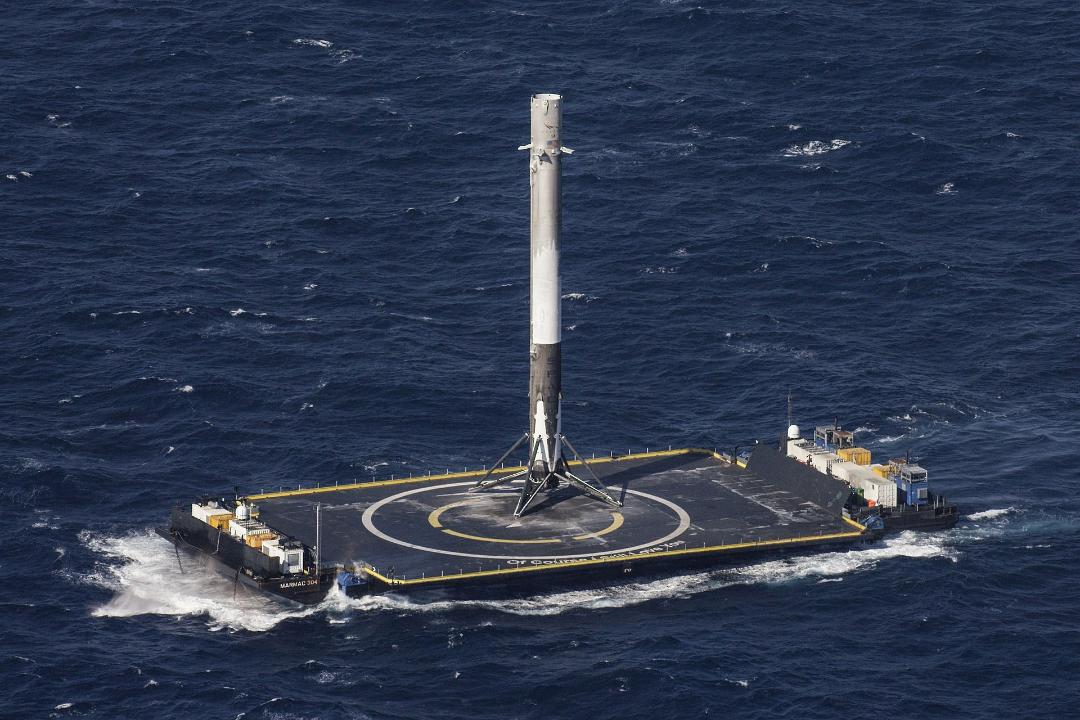
I did mention, didn’t I, that all of SpaceX’s components are
recoverable? One of their Falcon 9 first-stage booster rockets has
now landed safely on a floating platform and been reflown 12 times.
Sigh. Politics.
Meanwhile, here’s the Big Question: Why are we going back to the
moon???
First stage of a SpaceX Falcon 9 after landing on an autonomous drone ship. (SpaceX, donated to public domain)
Michael Kauffman and Justin Garwood are in love with the Klamath Mountains, the rugged and remote mountain range in Northern California that is world-renowned for its biodiversity.
They, together with 32 other co-authors, have published the first definitive natural history guide to the region. Michael and Justin explain to Gang Green why the region is so special on this week’s episode of the EcoNews.
John
was born in Eureka to parents Attilio and Dorothy Freson. He had two sisters, Marie Johnson and Phyllis Patton.
He went to
Marshall Elementary School and graduated from Eureka High. He
was active in the 4H and FFA Programs. He worked on many ranches as
well as his own through the years, beginning in high school, as that
is where his heart lay.
At 19 years old John married his high school
sweetheart, Donna Brown, and was drafted into the Army. John and his
wife spent their time in the service in Alabama, where their firstborn, Sandra Dupret, was born. After his time in the service, he came home
to go to work for Mulkey and Kovacovich and he and his wife had three
more children — Lori Borges, Johni B Atterberry and Mark Freson. He
loved ranching, hunting and country life. Later in his life he met
Rosemary Moore and her daughters Peggy and Christine. He helped raise
the girls to adulthood.
In his last few years he lived in Loleta and was cared for by his children, his wonderful
daughter-in-law Verlenea Freson and son-in-law Norman Dupret.
John
is survived by his sister, Marie Johnson, all of his children,
nieces, nephews and numerous grandchildren and great-grandchildren, whom he adored. John will be missed for his love of telling the
best stories and his love of gab with anyone and everyone he met.
A celebration of life will be held on November 5, 2022, at 1 p.m. at
Bear River Casino, in the ballroom.
###
The obituary above was submitted by John Freson’sloved ones. The Lost Coast Outpost runs obituaries of Humboldt County residents at no charge. See guidelines here. Email news@lostcoastoutpost.com.
Keith
David Ambrosini January
22, 1959 - August 26, 2022
Keith
was born on January 22, 1959 in Eureka to Les and Dorothy (Bartoli)
Ambrosini. Keith was a lifelong resident of Eureka.
Keith
loved deer hunting, duck hunting, fishing and camping. Keith loved
playing sports starting at a early age, he played baseball,
basketball and later took up golf. Keith was a avid fan of the San
Francisco Giants and San Francisco 49ers.
Keith
is proceeded in death by his mother Dorothy Ambrosini, his beloved
wife and best friend Mary Ambrosini, his Grandparents Les and
Florence Ambrosini, Joe and Emily Bartoli, his mother and father
in-law Joe and Eve McClaren, his Uncle and Aunt Charlie and Edith
Bartoli, Uncle and Aunt Jay and Pat Harris.
Keith
is survived by his father Les Ambrosini, his brother Alan Ambrosini,
his nephew and his wife Robert Ambrosini and Heidi Ambrosini, his
great nephews Riley Ambrosini and Trevor Ambrosini, Pam Lowry
(Ambrosini), his step daughter Johana, brother in-law Ried McClaren
and numerous cousins.
Viewing
will be held September 15,2022 from 11 a.m. to 1 p.m. Family and friends
can stop by Sanders funeral home 1835 E Street Eureka to say
goodbye.
Funeral
service will be on September 15, 2022 at 2 p.m. at Sunset Memorial Park — 3975 Broadway, Eureka — in the chapel located in the mausoleum .
Family and friends are encouraged to share personal stories of his
life with everyone.
Flowers
can be sent to
Sanders Funeral Home 1835
E Street Eureka, CA 95501
###
The obituary above was submitted by Keith Ambrosini’sloved ones. The Lost Coast Outpost runs obituaries of Humboldt County residents at no charge. See guidelines here. Email news@lostcoastoutpost.com.









.jpg)
