On April 24, 2026, at approximately 11:45 a.m., officers with the Eureka Police Department responded to a
business in the 3500 block of F Street for a report of a robbery involving a knife.
Upon arrival, officers contacted the reporting party, who stated that a male suspect took several items and,
when confronted, brandished a knife at the victim. The suspect then fled on foot and was last seen running
southbound on F Street toward Grant Elementary School.
Out of an abundance of caution, the School Resource Officer placed the school on lockdown while officers
conducted a safety sweep of the campus. The suspect was not located, and the lockdown was lifted at
approximately 12:15 p.m.
The suspect is described as a male, approximately 30 years old, 5’8” tall, last seen wearing a dark green jacket,
green sweatpants, black shoes and wearing white headphones.
This is an active and ongoing investigation. Anyone with information related to this incident is encouraged to
contact Eureka Police Department at (707) 441-4300.
Your chance to “Stamp Out Hunger” in our community is coming up! It’s easy to participate in the annual Letter Carriers Food Drive. Just look for a blue bag in your mailbox the week leading up to the food drive, pack it with non-perishable items, and leave it by your mailbox on Saturday, May 9. Your letter carrier will do the rest, collecting donations and delivering them to Food for People and their network of countywide food pantries.
Over the last year, Food for People has seen increased numbers of families and seniors seeking food assistance as inflation continues to affect food prices. Donations from the community are crucial to help our neighbors put food on the table.
The most needed items for the food drive include canned fish and meat, nut butters, soups and stews, and canned fruits and vegetables. Please do not donate home-canned items or food in glass containers. If you miss your letter carrier on May 9, you can drop your donation off at Food for People in Eureka at 307 W. 14th St. Monday through Friday from 9 AM - 4 PM, or contact the food pantry in your local community.
Press release from the Humboldt County Sheriff’s Office:
On
April 23, 2026, at approximately 3:47 a.m., the Humboldt County
Sheriff’s Emergency Communications Center received a 911 call and
multiple text messages from a female victim reporting she had been
kidnapped and was hiding inside a gas station bathroom in Blue Lake.
While deputies were responding to the area, dispatchers advised
that the suspect was 46-year-old Timothy Richard Long and that he had
kidnapped the 35-year-old female victim from outside their residence
in McKinleyville and transported her to Blue Lake, where he stopped
for fuel.
Upon arrival, deputies located Long outside the business and
detained him without incident.
When additional deputies arrived on scene, they contacted the
victim who was still hiding inside the bathroom. Based on their
investigation and evidence gathered at the scene, deputies arrested
Long and transported him to the Humboldt County Correctional
Facility, where he was booked on the following charges:
PC 207(a): Kidnapping
PC 273.6(a): Violation of a
Domestic Violence Court Order
PC 1203.2(a): Violation of Probation
Anyone with information regarding this case or related criminal
activity is encouraged to contact the Humboldt County Sheriff’s
Office at (707) 445-7251 or the Sheriff’s Office Crime Tip Line at
(707) 268-2539.
Photo via Wikimedia Commons. By Phliar from Republic of San Francisco - Shelter Cove, CC BY-SA 2.0
The budget of Shelter Cove’s Resort Improvement District No. 1 is in the red.
The entity, on average, has spent about $40,000 a year more than revenue for the past 10 years, according to District data. And it hasn’t had a net-neutral budget since the 2015-16 fiscal year.
The general manager of the District, which is tasked with providing emergency services, utilities and maintaining municipal systems for the remote SoHum community, is pushing for a tax measure to help “right the ship.”
Table courtesy of General Manager Christopher Christianson
The District is consistently budgeting for hundreds of thousands more in revenue than it’s getting each year.
Despite these budget predictions, Christopher Christianson, general manager of the District, said it isn’t quite as bad of a picture as it could be, pointing to what the District actually spent over the last decade compared to the budget.
Christianson said unfilled staff positions and deferred capital expenses are keeping spending down to around revenue.
Still, “we have been dipping into the reserves quite a bit,” he said.
In August, the District’s Board of Directors agreed to change a reserve policy cutting the required amount of operating funding on-hand from 12 months to six.
The District currently has about $2 million in reserves, in the general fund and enterprise fund combined, equaling around six months of operating expenses, according to Christianson.
Income to the District has been steadily on the decline for the past 10 years, according to the District’s data, despite recent rate increases across all utilities. Christianson attributed this primarily to the crash of the cannabis industry.
“We benefited from the cannabis industry, in a way,” he said, pointing to indoor cannabis growers who spent big on electricity and water, two utilities the district delivers.
And even if the years of Shelter Cove’s cannabis boom are largely over, he says the infrastructure remains, and the District has to maintain it.
“We’re deferring a lot of larger projects that we need to do,” said Christianson.
Two looming, high-cost infrastructure projects include the replacement of four water storage tanks and the water treatment plant built in 1965, with costs of $3.3 million and $6.4 million respectively.
“While $60 more per year per taxable parcel will gather an estimated additional $230,000 in revenue, it will still not make up the shortfall that has existed for the past 10 years. Eventually, the deferred maintenance and delayed capital expenditures will catch up to us,” Christianson said in an email.
He said the additional revenue could be used as matching funds for grant applications for the bigger infrastructure projects.
If the measure doesn’t pass, he said the District will have to start looking again at rate increases, something most recently done from 2020 through 2025.
He said rate-paying residents make up just 17% of all Shelter Cove property owners, and is in favor of spreading out the costs to all property owners through this tax measure.
Arlin Reid, board president of the Shelter Cove Property Owners Association (SCPOA), said in an email to the Outpost the organization is in support of the tax measure in light of the deficit.
A SCPOA letter in support of the measure pointed to the good of the community alongside infrastructure needs.
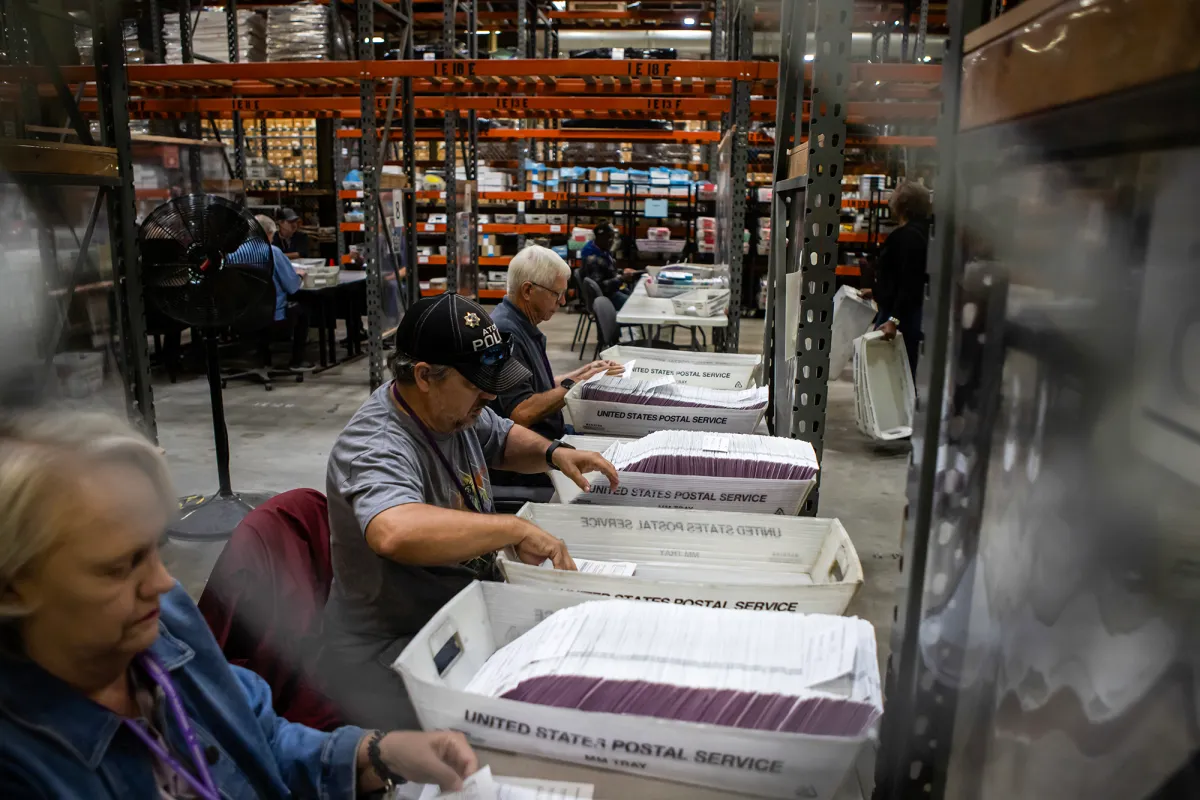
Election workers sort ballots at the Fresno County Elections Warehouse in Fresno on Nov. 5, 2025. Photo by Larry Valenzuela, CalMatters/CatchLight Local
###
This story was originally published by CalMatters. Sign up for their newsletters.
###
Political persecution, threats of violence and the seizure of sensitive documents might sound like a plot line for a heist or thriller movie.
The integrity of the state’s voting systems will be under intense scrutiny this year with control of the U.S. House on the line, as Californians could play a decisive role in which party wins the majority. Yet while timely and decisive results are more crucial than ever, California is famous for its ploddingly slow vote count.
That lengthy wait has increasingly sown distrust in the accuracy of California’s results, especially among Republicans, and particularly in races where a candidate leading on election day falls behind as more ballots are processed in subsequent days.
“Every day matters,” said Kim Alexander, president of the nonpartisan California Voter Foundation. “Election security is about security in reality and also security in perception, and they’re both equally important.”
During a panel Thursday on election integrity, presented by CalMatters and the UC Student and Policy Center, Alexander argued that election administrators are boxing themselves into a “false choice” if they sacrifice timeliness in the name of accuracy. When winners aren’t decided for days, sometimes weeks, the ensuing uncertainty leaves room for doubt to take root, speculation to grow and misinformation to spread.
It took eight days in 2024 for The Associated Press to be able to declare Republicans had won control of the U.S. House, partly because of outstanding votes in California races, Alexander said. Two years earlier, it took nine days. In 2020, it took the AP seven days to determine that Democrats would retain the House, she said. Each time, outcomes in California swing districts played a decisive role.
“We’re creating a window of opportunity for people to make these claims,” Alexander said, referring to largely unfounded claims of systemic voter fraud and election rigging. “We have to acknowledge that.”
Fellow panelists defended California’s meticulousness as crucial to its election integrity. Assemblymember Gail Pellerin, Democratic chair of the Assembly elections committee and former Santa Cruz County registrar of voters, argued that county officials need time to verify voters’ signatures on vote-by-mail envelopes “so people don’t get disenfranchised for penmanship or for failure to sign.”
“There’s nothing in law that says, I need to meet your deadline,” Pellerin said of media outlets and journalists who are eager to call races on election night. “What the law says is that I need to count the votes accurately, securely. I need to check them, and double-check them, and audit them, and then I certify them.”
Matt Barreto, director of the UCLA Voting Rights Center, noted that counties have 30 days post-election to certify their results and submit them to the secretary of state. That process, he said, should be completed as quickly as possible but “not at the expense of the county registrars doing their job effectively to make sure every vote is counted.”
Catharine Baker, head of the UC Center, emphasized — pointedly to Pellerin — that counties need more money to make sure they’re sufficiently staffed and have the equipment they need to count efficiently.
They all agreed that voters can do one thing to speed up the count: turn in their mail ballots early so counties can process them before election day.
Large partisan divide over election integrity
California voters are highly polarized in their views on the status of democracy in their state and country, largely along party lines.
A new survey from the UC Berkeley Institute of Governmental Studies found a third of Democrats said they are “extremely satisfied” or “very satisfied” with the way democracy works in California, while only 4% of Republicans said they felt that way. Conversely, more than two-thirds of Republicans are not satisfied at all, compared to 10% of Democrats.
Those results are practically unchanged from voters’ responses in 2024, despite several major political events, including a presidential election that President Donald Trump won, a new presidential administration and a special election in California in which voters adopted more partisan gerrymandered congressional districts.
“It speaks to the fact that in a lot of ways our democracy is stuck,” said Eric Schickler, a UC Berkeley political science professor and co-director of the institute. “Republicans have one perspective on what’s wrong — they make claims of voter fraud and slow ballot counts,” he said, “and Democrats have another, which is concerns about voter suppression.”
The poll also highlighted the partisan divide over a proposed ballot initiative from Republican Assemblymember Carl DeMaio of San Diego that would require Californians to show photo identification to vote. When asked whether they would support the measure, but without any context about who was for and against it, 56% of survey respondents said they strongly or moderately supported it, while 39% were strongly or moderately opposed.
But those shifted the more information voters were given. When told that DeMaio was the main proponent of preventing fraud and that Democrats argue the measure is part of Trump’s agenda to keep people of color from voting, the support flipped, with only 39% supporting the measure and 52% opposed.
UCSF-Fresno Medical Student Darlene Tran checks the blood pressure of a farmworker in an equipment barn during part of the Rural Mobile Health program visit at a farm outside of Helm on June 16, 2025. Photo by Larry Valenzuela, CalMatters/CatchLight Local
###
This story was originally published by CalMatters. Sign up for their newsletters.
###
Angelica Salas is used to hearing from people who have opinions about her work providing legal aid to immigrants. She knows many people have different views on immigration, including ones that contradict hers.
But she wasn’t prepared for the moment that a stranger showed up at her mother’s house looking for her.
“I was very shocked. My mother said somebody came looking for you,” said Salas, the executive director for the The Coalition for Humane Immigrant Rights. “It’s OK if someone decides to picket me if they don’t agree with what I’m doing. … That’s their First Amendment right. It’s very different to go to your mother’s home.”
Incidents like that one — and the threatening phone calls Salas and her staff regularly receive — led her organization to support a bill that would expand a privacy program that allows certain workers to hide where they live from public databases.
It seemed noncontroversial at first. An expansion of the Safe at Home Program the Legislature approved last year passed with little opposition.
But the new proposal set off a firestorm among some Republican legislators and conservatives who argue that it is unconstitutional and has the potential to silence independent investigations into government wrongdoing.
“Not only are we unwilling to investigate fraud, but our Legislature is quite literally moving in the opposite direction,” Assemblymember Josh Hoover of Folsom said at a GOP press conference about fraud last week.
The proposal passed the Assembly’s public safety committee this week and is moving through the Legislature.
Expanding Safe at Home program
Originally established to help victims of domestic violence, California’s Safe at Home program helps participants keep their residential addresses confidential and out of public records by providing a substitute mailing address through the California secretary of state. People who live in the same residence are also eligible.
Since its creation nearly 30 years ago, eligibility has expanded to include victims of stalking, sexual assault and human trafficking, as well as to people who work in reproductive health care and, during the COVID-19 pandemic, public health care officials. To be eligible, individuals must provide evidence that they have received credible threats of violence.
Last year, California passed a law expanding it to people who work in gender-affirming health care. Though the bill advanced through the Legislature mostly on a party-line vote, it received bipartisan support in the Assembly’s public safety and judiciary committees, and two Republican assemblymembers voted for it on the floor.
The new measure, Assembly Bill 2624, would widen the eligibility for the Safe at Home Program to “immigration support services provider, employee, or volunteer,” such as Salas and her colleagues.
Stopping independent journalists?
Some GOP assemblymembers, particularly Carl DeMaio of San Diego, have railed against the bill, arguing that it violates constitutional protections for the press, and that it limits journalists’ ability to investigate organizations for fraud, waste and abuse.
At a privacy committee hearing earlier this month, DeMaio pointed to a provision of the bill that would ban a person from knowingly posting on the internet “the personal information or image of any designated immigration support services provider.”
The provision goes on to say “with the intent … to cause imminent great bodily harm” and “reasonable fear.”
DeMaio dubbed the bill the “Stop Nick Shirley Act,” after the conservative social media influencer whose 2025 video accused child care centers in Minnesota of widespread fraud. His pieces triggered a surge of federal immigration enforcement activity. In February, Shirley visited several Somali-run day care centers in San Diego where he accused owners of running “ghost facilities” with no children present.
DeMaio argues that the bill would curb Shirley and other “citizen journalists” from investigating taxpayer-funded organizations by intimidating them with costly fines and sanctions.
“This is not about protecting people from violence,” said DeMaio. “This is about threatening and intimidating people who are trying to shine a light on bad behavior. If you have nothing to hide, why fear the transparency?”
During a Fox News segment, Caroline Sunshine, President Donald Trump’s former deputy communications director, urged Gov. Gavin Newsom to denounce the bill, calling it “an authoritarian piece of legislation … designed to silence journalists and cover up the mess that is California.”
Shirley himself posted a 25-minute video confronting Democratic legislators about the proposal, and pointing out that the bill’s author, Democratic Assemblymember Mia Bonta of Oakland, is married to California Attorney General Rob Bonta.
“Instead of going after the fraudsters,” said Shirley in the video, “They’re trying to make it criminal to go after the people committing this fraud.”
Reaction to bill called ‘shocking’
Assemblymember Bonta contends that the bill attempts to prevent the misuse of personal information — especially actions tied to threats or incitement of violence — not to limit lawful speech. But her measure has drawn so much ire from the right that Bonta said she and her staff have received death threats over it.
“I can’t imagine how it must be for immigrant service providers who are doing their job every single day to have to deal with this level of hate,” she said at the public safety hearing.
The proposal has since been amended to exclude mentions of social media, though that language was in the law making gender-affirming health care providers eligible for the confidentiality program.
Aydee Rodriguez, who testified in support of the bill as a fellow for the Solís Policy Institute at the Women’s Foundation of California, said the reaction has been shocking.
“This law has been in existence for 30 years. No one had an issue for 30 years until now, when we wanted to protect immigrant service providers,” Rodriguez said. “That’s the trigger, it’s ‘immigrant,’ and that’s what’s sad for me.”
###
CalMatters reporter Nadia Lathan contributed to this story.
Valley Grocery at 339 Main Street in Ferndale. | Submitted.
###
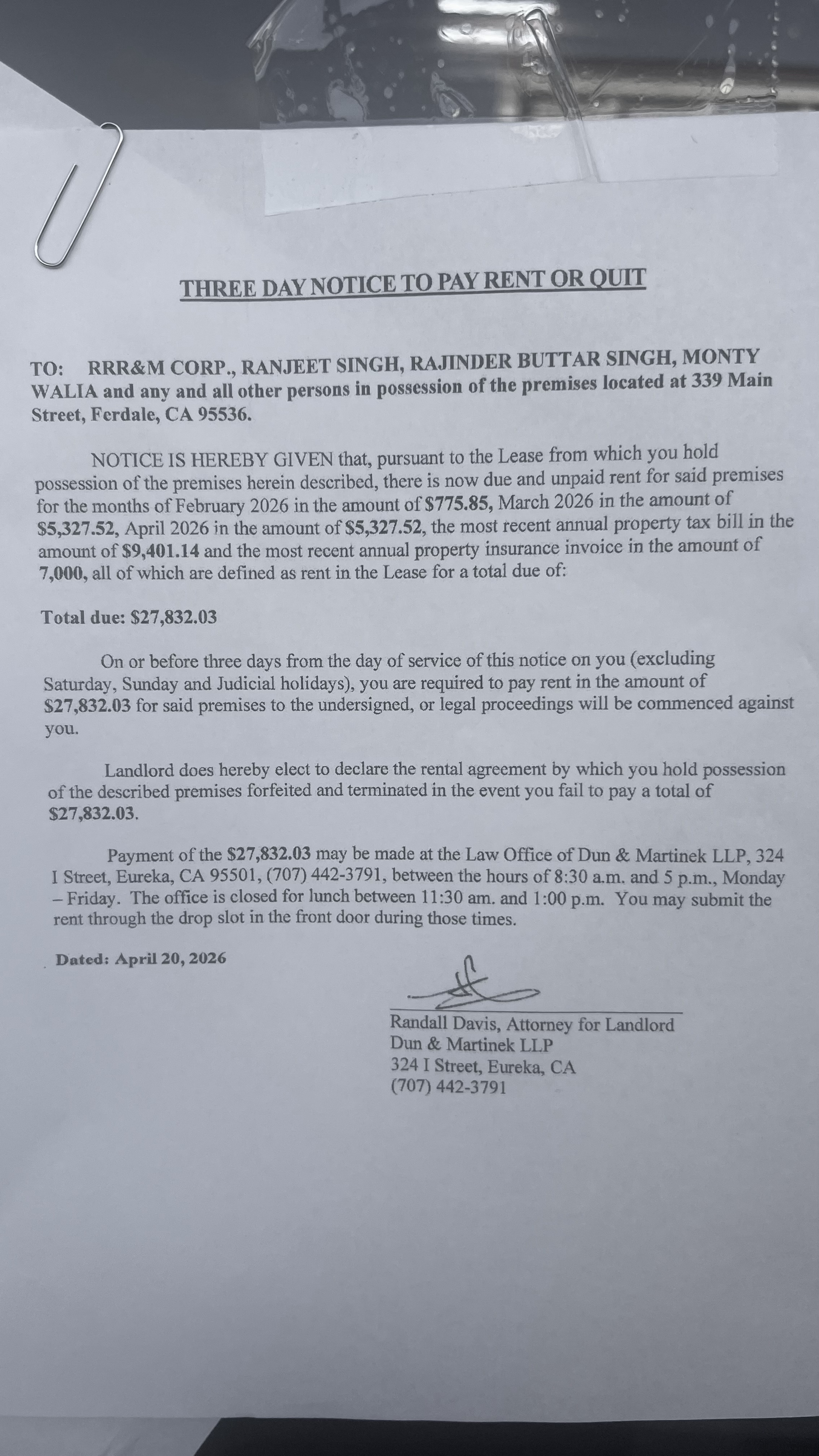
Ferndale’s Valley Grocery closed its doors earlier this week, and a three-day notice posted on the front door threatens legal action if the store’s current operators fail to pay $27,832.03 in past-due rent, property tax and insurance payments by 5 p.m. today.
The legal notice, affixed to the front door with clear packing tape, is signed by Eureka attorney Randall Davis, “Attorney for Landlord.” It’s addressed to Ranjeet Singh, Rajinder Buttar Singh, Monty Walia, RRR&M Corp. “and any and all other persons in possession of the premises located at 339 Main Street, Ferdale, CA 95536.”
The sudden closure of Ferndale’s primary grocery store, should it last, will have major impacts on residents of the Victorian village. Built in 1872, this Main Street building has operated as a grocery store ever since, though it suffered major structural damage in the earthquake of 1906 and again in the magnitude-7.2 quake of 1992. (In 1906, the storefront collapsed onto the street, killing two cows. In 1992 it crumbled again, this time flattening a Chevrolet and a Volvo, whose owner had just stepped inside to buy cigarettes. Check out a photo of the smashed Volvo at the U.C. Berkeley Seismology Lab’s website.)
In addition to your standard supply of food provisions, beverages and snack items, Valley Grocery carried Ferndale souvenirs and operated a popular deli that sold pre-made items such as sandwiches, salads, burgers and Mexican food.
Voicemails left for Ranjeet Singh were not returned by the time this post was published.
According to the Humboldt County Assessor’s Office, the current owner of the building is a corporation called Umar, Inc., which lists its mailing address as a P.O. box in Davis.
The phone number listed online for Valley Grocery has been disconnected.
The three-day notice on the front door, dated April 20, says the tenants owe $11,430.89 in rent from the past three months, plus $9,401.14 for a property tax bill and $7,000 for the annual property insurance invoice. Failure to pay the total amount of nearly $28,000 within three days will result in “legal proceedings,” the notice says.
We tried to reach attorney Randall Davis, who works with the Eureka firm of Dun & Martinek, LLP, but we were informed that he’s out of the office.
A Ferndale resident tells the Outpost that the lights in Valley Grocery have been out since Tuesday, though a generator was running at the back of the store this afternoon.