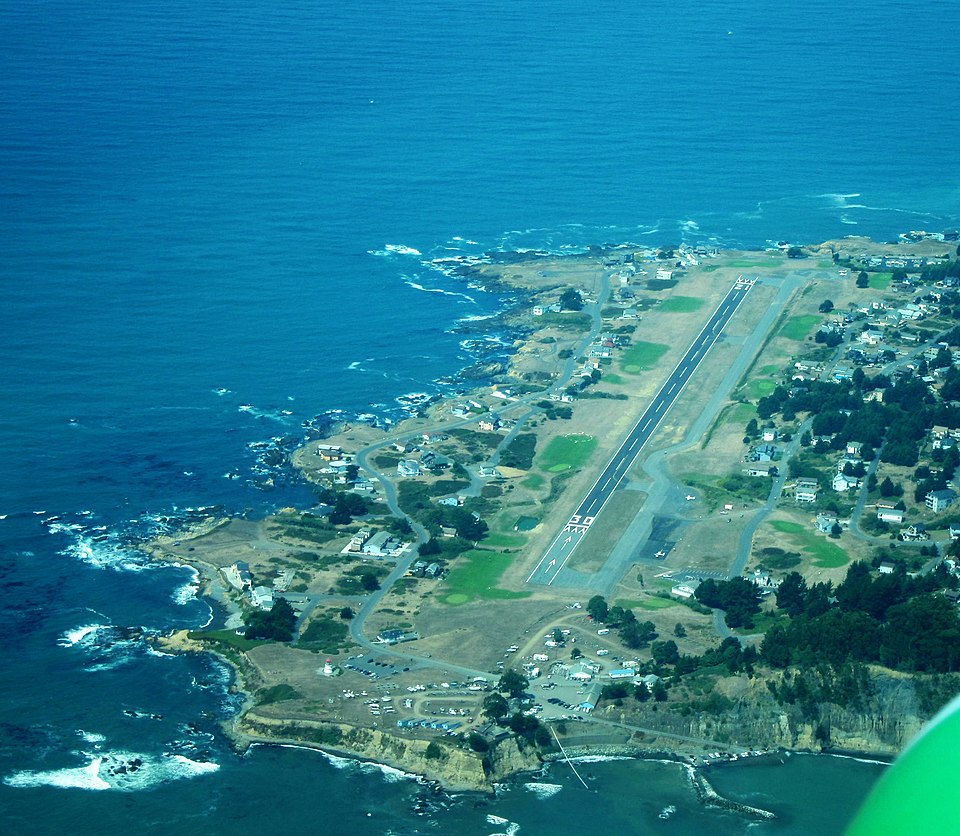
Photo via Wikimedia Commons. By Phliar from Republic of San Francisco - Shelter Cove, CC BY-SA 2.0
The budget of Shelter Cove’s Resort Improvement District No. 1 is in the red.
The entity, on average, has spent about $40,000 a year more than revenue for the past 10 years, according to District data. And it hasn’t had a net-neutral budget since the 2015-16 fiscal year.
The general manager of the District, which is tasked with providing emergency services, utilities and maintaining municipal systems for the remote SoHum community, is pushing for a tax measure to help “right the ship.”

Table courtesy of General Manager Christopher Christianson
The District is consistently budgeting for hundreds of thousands more in revenue than it’s getting each year.
Despite these budget predictions, Christopher Christianson, general manager of the District, said it isn’t quite as bad of a picture as it could be, pointing to what the District actually spent over the last decade compared to the budget.
Christianson said unfilled staff positions and deferred capital expenses are keeping spending down to around revenue.
Still, “we have been dipping into the reserves quite a bit,” he said.
In August, the District’s Board of Directors agreed to change a reserve policy cutting the required amount of operating funding on-hand from 12 months to six.
The District currently has about $2 million in reserves, in the general fund and enterprise fund combined, equaling around six months of operating expenses, according to Christianson.
Income to the District has been steadily on the decline for the past 10 years, according to the District’s data, despite recent rate increases across all utilities. Christianson attributed this primarily to the crash of the cannabis industry.
“We benefited from the cannabis industry, in a way,” he said, pointing to indoor cannabis growers who spent big on electricity and water, two utilities the district delivers.
And even if the years of Shelter Cove’s cannabis boom are largely over, he says the infrastructure remains, and the District has to maintain it.
“We’re deferring a lot of larger projects that we need to do,” said Christianson.
Two looming, high-cost infrastructure projects include the replacement of four water storage tanks and the water treatment plant built in 1965, with costs of $3.3 million and $6.4 million respectively.
This situation has prompted a District-supported tax measure. Voters in Shelter Cove will weigh in on increasing the special utilities, improvement and operations tax by $60, to total $140, this June.
Will this totally fix the budget problems?
“While $60 more per year per taxable parcel will gather an estimated additional $230,000 in revenue, it will still not make up the shortfall that has existed for the past 10 years. Eventually, the deferred maintenance and delayed capital expenditures will catch up to us,” Christianson said in an email.
He said the additional revenue could be used as matching funds for grant applications for the bigger infrastructure projects.
If the measure doesn’t pass, he said the District will have to start looking again at rate increases, something most recently done from 2020 through 2025.
He said rate-paying residents make up just 17% of all Shelter Cove property owners, and is in favor of spreading out the costs to all property owners through this tax measure.
Arlin Reid, board president of the Shelter Cove Property Owners Association (SCPOA), said in an email to the Outpost the organization is in support of the tax measure in light of the deficit.
A SCPOA letter in support of the measure pointed to the good of the community alongside infrastructure needs.

CLICK TO MANAGE