

Two Arrested on Drug and Burglary Charges After Eureka Traffic Stop
LoCO Staff / Wednesday, June 15, 2022 @ 10:07 a.m. / Crime
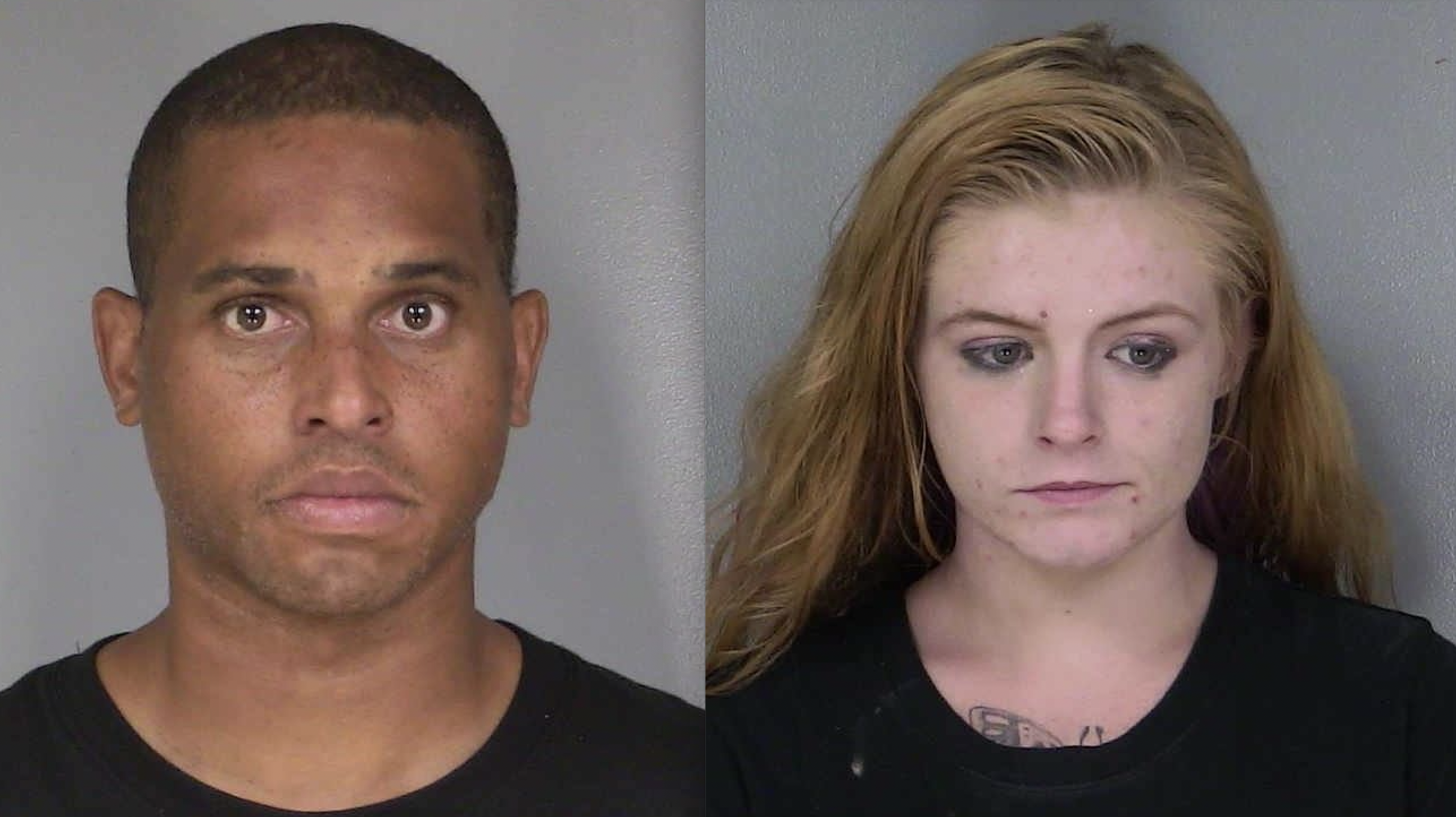
HCSO
Press release from the Humboldt County Sheriff’s Office:
On June 15, 2022, at about 12:08 a.m., a Humboldt County Sheriff’s deputy conducted a traffic stop for a vehicle code violation in the area of 4th and H Streets in Eureka.
Deputies contacted three occupants of the vehicle. The driver, 20-year-old Kaylee Chere Martin, was found to have an outstanding felony warrant for her arrest. Martin was taken into custody without incident. The two passengers were both found to be on probation with search clauses.
During a search of the vehicle, deputies located over 27 grams of methamphetamine and drug paraphernalia belonging to 37-year-old passenger Quentin Laone Bell. Bell was arrested and booked into the Humboldt County Correctional Facility on charges of possession of a controlled substance (HS 11378) and violation of probation (PC 1203.2(a)(2)), in addition to warrant charges of driving with a suspended license (VC 14601.1(a)) and violation of promise to appear (VC 40508(a)).
Martin was booked into the Humboldt County Correctional Facility on warrant charges of burglary (PC 459/461(b)) and grand theft (PC 487(a)).
This case is still under investigation.
Anyone with information about this case or related criminal activity is encouraged to call the Humboldt County Sheriff’s Office at (707) 445-7251 or the Sheriff’s Office Crime Tip line at (707) 268-2539.

BOOKED
Yesterday: 6 felonies, 12 misdemeanors, 0 infractions
JUDGED
Humboldt County Superior Court Calendar: Today
CHP REPORTS
No current incidents
ELSEWHERE
RHBB: HAF+WRCF Opens Fall Grant Round for Artists, Seniors and Holiday Programs
RHBB: State Parks Urges Safety Precautions Ahead of Labor Day Weekend
(UPDATE: NOT A TAURUS) ARSON INVESTIGATION: Sheriff’s Office Seeking Ford Taurus Driver Believed to Have Started Yesterday’s Manila Vegetation Fire
LoCO Staff / Wednesday, June 15, 2022 @ 9:41 a.m. / Crime , Fire
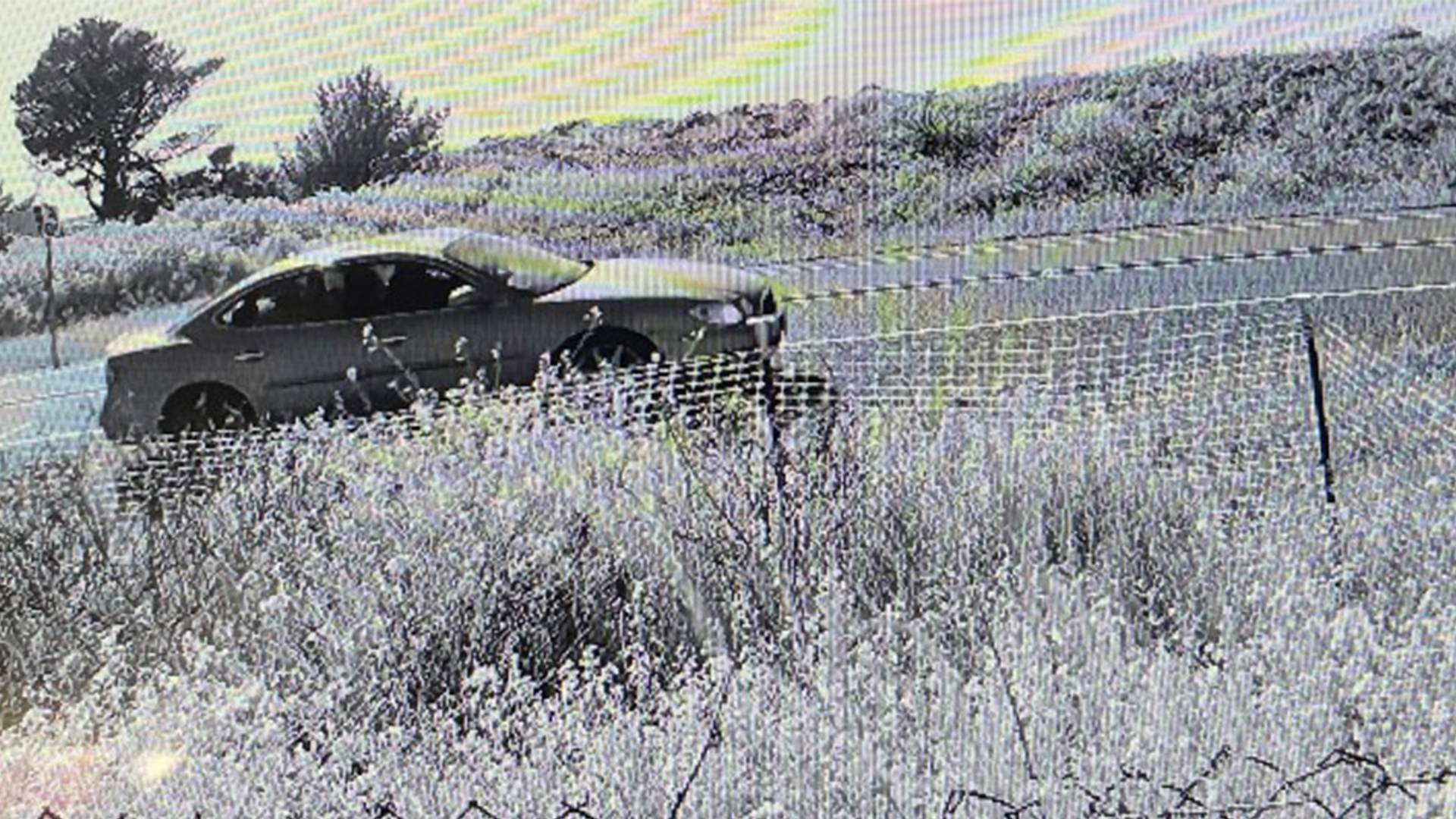
Do you know this Taurus and who might’ve been driving it in Manila yesterday?
[UPDATE: This release originally claimed the suspect vehicle was a Ford Taurus. Local social media users have determined that the car in question is actually a Buick LaCrosse and HCSO has opted to agree with them. This new thinking is reflected below.]
Press release from the Humboldt County Sheriff’s Office:
The Humboldt County Sheriff’s Office is seeking the public’s assistance to identify the suspect of an arson fire Tuesday evening.
On June 14, 2022, at about 5 p.m., Humboldt County Sheriff’s deputies were dispatched to assist fire personnel with an investigation into a possible arson fire in the Manila area.
During their investigation, Sheriff’s deputies were provided with surveillance footage from a residence depicting a light-colored
Ford TaurusBuick LaCrosse pull to the side of Highway 255 near Lupin Drive. The driver of the vehicle is shown throwing an unknown item out of the vehicle, causing a vegetation fire.This investigation comes one day after numerous fires in the Samoa area on June 13. Those fires are still under investigation at this time.
Anyone with information regarding the suspect or this incident is encouraged to call the Humboldt County Sheriff’s Office at (707) 445-7251 or the Sheriff’s Office Crime Tip line at (707) 268-2539.
California Legislators Want to Help You Buy a House With Down Payment, ‘Shared Equity’
Alejandro Lazo / Wednesday, June 15, 2022 @ 7 a.m. / Sacramento
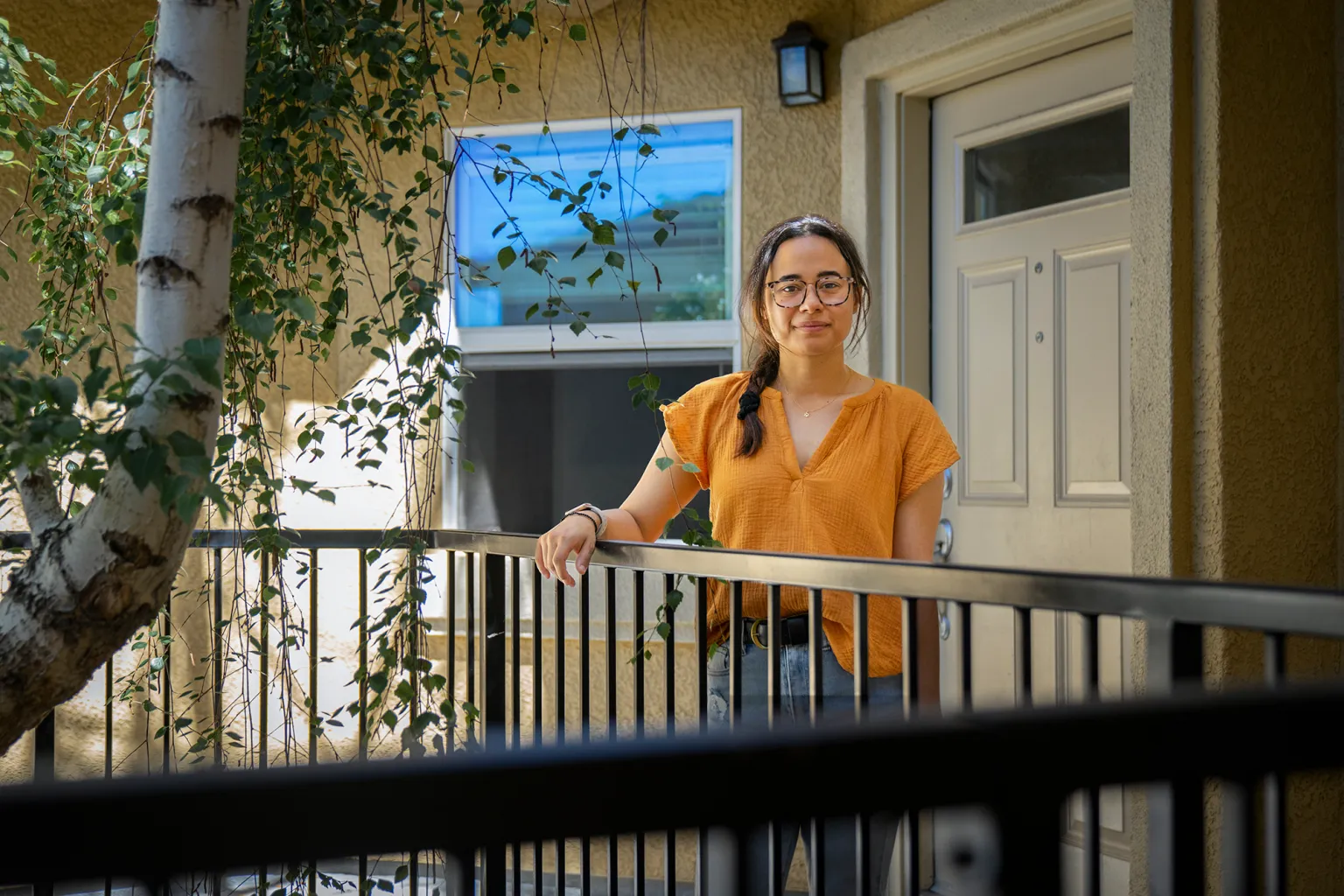
Aralyn Tucker outside of her condo in Natomas on June 11, 2022. Photo by Julie Hotz for CalMatters
First-time buyers often rely on family gifts to afford the down payments on their homes. Now California Legislators want the government to fill the role of generous relative.
Lawmakers are proposing creating a billion-dollar fund in this year’s state budget that would provide California’s first-time buyers either all of the money they need for a down payment, or very close to it, in exchange for partial ownership stakes in those residences.
The proposal, put forward by state Senate President Pro Tem Toni Atkins, comes as skyrocketing property prices broaden the divide between those who own their homes and those who rent in California. In the past year, Golden State homeowners gained $141,000 in home equity, on average, the housing research firm CoreLogic reported last week, more than in any other state.
California’s rate of home ownership, at 56%, is second lowest in the country behind New York, according to the American Community Survey data from the census.
Atkins said the California Dream for All program is aimed at creating opportunities for lower- and middle-income buyers in a rapidly rising market, including those who have faced racial and economic barriers to homeownership.
“The California Dream for All program will give more people the chance to break free from the cycle of renting,” Atkins said last month. “This has the ability to change people’s lives.”
The proposal is the subject of negotiations between the Legislature’s Democratic supermajority and Gov. Gavin Newsom, also a Democrat, on how to spend a projected budget surplus of $97.5 billion. The legislature passed a budget on Monday that includes the proposal, though negotiations with Newsom continue on a final overall spending plan.
A spokesman for the governor declined to comment on the proposal, citing the ongoing negotiations. It was not included in the governor’s original budget nor in his May revised budget.
A multi-billion dollar fund
The housing proposal – which would call for issuing revenue bonds of $1 billion a year for 10 years to create the fund — is the largest in a slew of proposals intended to promote homeownership this year. The proposal also includes $50 million in the budget this year, and $150 million per year after that to pay for the administrative costs of the program and the interest costs of the revenue bonds.
The program envisions helping some 7,700 borrowers a year, according to estimates made by the program’s designers based on home price projections. A start date for the proposed program has not been indicated.
(GRAPHIC: “How the proposed ‘California Dream for All’ program would work“)
If approved, the program would begin issuing interest-free second mortgage loans covering up to 30% of a home’s purchase price, though lawmakers expect many of the loans would cover 17%, asking borrowers to include 3% of their own money or pair the loan with other first-time buyer programs.
The interest-free loans would be paid back into a state fund whenever the home was sold, or if a bigger mortgage was acquired in a cash-out refinancing. For instance, if the fund provided 20% toward the purchase price of the home, the fund would get back its initial investment, as well as a 20% share of any increase in the home’s value.
The program would reinvest those proceeds, giving the fund the ability to make new loans for eligible participants, even if prices have risen significantly.
As long as home prices rise, the plan would create equity for people who otherwise would have remained renters. The program also would generate enough returns for the state to help future homebuyers.
If prices fall, homeowners might still gain some equity and the fund would absorb the losses, program planners said.
Building generational wealth
The program is intended to build as much flexibility as possible. Buyers who have lived in historically low-income neighborhoods can receive priority for some of the funds and can use shared appreciation loans to buy in their current neighborhoods or buy homes elsewhere.
“We need to make sure that the state’s homeownership assistance program serves people in all parts of the state, including in its high cost areas,” said Micah Weinberg, chief executive of the nonprofit group California Forward, which oversaw drafting the proposal.
“We cannot wait until more housing is built for these communities to begin to build the generational wealth that they were locked out of and deeply deserve,” he said during a recent legislative hearing.
The program would be open to buyers making less than 150% of the median income in their area, and it would target first-generation homebuyers as well as those with high student debt loads.
If approved, the program would significantly improve home affordability in California for the people awarded one of the loans, proponents say. If it had existed in 2021, for instance, it would have reduced the annual income needed to buy a median priced home of $786,000 by more than $30,000 to about $90,000, according to Kate Owens, a principal at HR&A Advisors, Inc., one of the economic consulting firms hired to devise the program.
The program is distinct from other down payment assistance programs in that most offer much smaller payments, often around 3% to 5% of the purchase price, in the form of grants or loans.
The proposed state fund allows homeowners to not put down a down payment, eliminating the need to save for that initial investment, which Atkins said is the biggest hurdle for many buyers in today’s market.
These equity sharing arrangements often are referred to as shared appreciation mortgages. The California plan would be the largest attempted experiment with such home loans ever created in the U.S., designers of the program said.
Fewer can afford homes
Over a 40-year period the program could assist some 157,000 families with interest-free loans, said Gene Slater, chairman of CSG Advisors, another consultancy hired to design the program.
Lawmakers said they are trying to do more to support homeownership, especially now that the pandemic has spurred demand for single-family properties as remote workers seek more space, and as communities throughout the state are falling woefully short of homebuilding goals.
“Until California truly prioritizes affordable homeownership, a generation of Californians will be effectively barred from one of the most reliable forms of wealth generation available — owning a home,” said Assemblymember Tim Grayson, a Democrat from Concord, in April.
California’s home price increases mean affordability has plummeted, even more so for Black and Latino families. Only 26% of California households overall earned the minimum annual income needed to buy a median-priced, single-family home last year. Just 17% of Black and Latino households could afford such a property, according to a report by the California Association of Realtors, which supports the creation of the down payment fund.
“Homeownership provides working families with the unparalleled ability to accrue generational wealth and experience financial stability through a fixed mortgage versus rising rents,” said the California Homeownership Coalition, a group that includes the Realtors, the California Building Industry Association and Habitat for Humanity.
“These funding solutions are especially important for communities of color still facing disproportionately low homeownership rates because of decades-long discriminatory housing practices.”
Potential complications
Richard Green, director of the University of Southern California’s Lusk Center for Real Estate, put forward a competing research proposal that was not selected by the state. He supports the goals of the one under consideration but is concerned about how complicated it is.
“There are lots of things in life where the policy idea is great (but) executing it is hard,” he said, adding that while the program would only be a fraction of the state’s massive housing market, it could contribute to rising prices if it got bigger. “If this program scales it would almost certainly have at least some impact.”
Andrew Caplin, a professor at New York University who wrote a book on shared equity programs, said he is eager to see the concept take off, but he has largely promoted the idea for private investors, not governments.
Caplin did not study the California plan, but he said he would be concerned that politicians might feel pressured to not demand repayment and “in the end, it will all be agreed that we can’t really collect the money — like student loans.”
Someone else’s mortgage
Had it been in existence, the program could have helped a homebuyer such as Aralyn Tucker, 29, who moved to Sacramento in 2017 because she was priced out of the housing market of her hometown of San Jose.
Tucker, who has a master’s degree in public policy and administration from Sacramento State University, works in human resources at a private school. She was only able to afford a two-bedroom condominium in Sacramento after her parents contributed most of the down payment as a gift.
Buying a home was important, she said, because her family had moved at least four times before she turned 18, at times into unstable housing situations.
“Creating that generational wealth and creating that security has been really important to my parents,” she said.
Down payment help was critical, because her mortgage payment is only $200 more than rent, she said, but she couldn’t save for the down payment on her own.
“Folks in my generation, we have so many extra expenses that we’re not able to set that cash aside as a down payment,” she said.
“Here I am making enough money to afford $2,200 in rent each month that I paid on time every month, and yet, I wouldn’t qualify for a mortgage because I don’t have the down payment,” she said. “We’re constantly behind and we’re paying into a system that doesn’t give anything back to us regarding equity. I’m paying someone else’s mortgage.”
###
This article is part of the California Divide project, a collaboration among newsrooms examining income inequality and economic survival in California. CalMatters.org is a nonprofit, nonpartisan media venture explaining California policies and politics.
OBITUARY: Robert Walter Cowell, 1962-2022
LoCO Staff / Wednesday, June 15, 2022 @ 6:56 a.m. / Obits

Robert
Walter Cowell
August 27,1963 - March16, 2022
On August 27, 1963 a long-awaited son was born to Ray “Peanuts” and Ann Cowell at Redwood Memorial Hospital in Fortuna. He was welcomed by his four older sisters who immediately vied for the role as to who would take care of and protect him.
To his dismay, we never stopped. Robbie passed over peacefully in his sleep on March 16, 2022 at the age of 58.
Rob was named after his father’s brother who died in a logging accident in his senior year of high school. He was taught early the legacy of his family who were all hardworking men and women who loved and supported their families. He lived by this code his entire life, always there to lend a hand when needed.
He shared our father’s love and respect for guns and looked forward to hunting with his dad, but never got the chance as our father died before they could when Rob was only 12. He continued to care for Dad and Grandpa’s guns although he was never a hunter.
Rob contracted spinal meningitis as a toddler and if not for a penicillin shot given in the doctor’s office and being rushed to the hospital we would have lost him then. As a result he had to learn to walk again and suffered hearing problems his entire life. He hated the hearing aids and rarely wore them except when necessary, learning to read lips so not to be so noticeable. He would say, “I hear what I need to”…
After graduating from Fortuna High he went to drafting school in Arizona at Phoenix Institute of Technology. After graduating there were few jobs available so he joined the Corps of Engineers and worked installing swamp coolers for housing developments. When his corps service ended he returned to Humboldt County and began his career in security, first at PL before joining the Bear River security team. Rob loved his job and rarely took time off. When he got sick in 2019 and was off for two months he worried often that he was leaving them short-handed, and when the doctors finally released him he came home, packed and was ready then next morning to get back to Fortuna and his job.
He loved all the people he met and loved to hear their stories and adventures. He regaled his sister Edie with many during his convalescence. He grew wise by quietly listening and knew something about almost everything and could build or fix almost everything. He was a quiet, gentle man; a loving forgiving man; a strong and helpful man; a wise and patient man.
Our brother was a special gift we did not deserve but through God’s grace and mercy he quietly loved and shared his life with us.
Rob is survived by his sisters Debbie Hudson, Cindy (Victor} Grass, Edie Cowell (Toy Pryor) and Kris Murray. He is also survived by five nieces and nephews and 13 great-nieces and -nephews. Preceding him were his mother and father and brothers-in-law Bill Hudson and Frank Murray Jr.
Please join us for a celebration of life on Saturday, August 20 at 2 p.m. It will be at Bear River Casino in the Ballroom, courtesy of Bear River Casino. We would love for you to join us and share your favorite stories and memories of Rob.
Memorial donations can be made to St. Jude’s Children’s Hospital and the American Diabetes Association.
###
The obituary above was submitted by Rob Cowell’s loved ones. The Lost Coast Outpost runs obituaries of Humboldt County residents at no charge. See guidelines here. Email news@lostcoastoutpost.com.
OBITUARY: Cletis Gier, 1936-2022
LoCO Staff / Wednesday, June 15, 2022 @ 6:56 a.m. / Obits
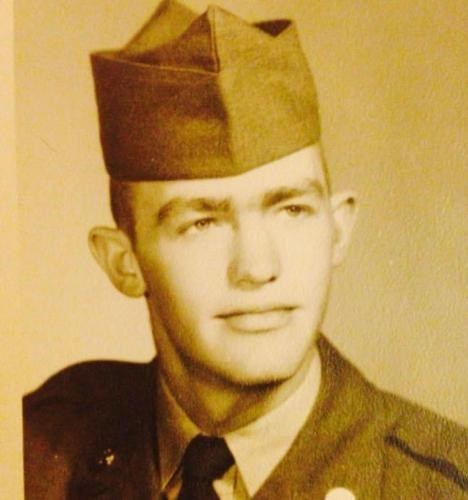
Cletis — or “Clete,” as he was known — was raised and retired in McKinleyville.
Cletis was born on February 5, 1936 to Clyde Allen Gier and Eleanor Laverne Walburn in Willows, Calif. Cletis enlisted in the Army in 1955. He later married the love of his life, Bonnie Lee Lopez, in 1957. They had the first of three children, Joseph, in 1958, Michael in 1959 and Jeffery in 1962. He worked construction most of his life in the Pacific Northwest and retired in California, later moved to Harker Heights, Texas. Cletis enjoyed gardening, working with jewelry, rocks and always loving his puppy, “Twokey” — Two Keys to My Heart!
Cletis Ray Gier was preceded in death by his parents, Clyde and Eleanor Gier; his wife, Bonnie Gier; his son Jeffery Gier; his brother, Dale Gier. He is survived by his sons Joseph Allen Gier and Michael Dale Gier and his grandchildren, Thomas Gier, Natasha Gier, Joshua Gier, Alicia Van Duyn, John Gier, Brandalyn Gier.
In memorial please send no flowers just good thoughts!
A military services will be held on Saturday, June 25 at 11 a.m. at Greenwood Cemetery, Arcata. Reception immediately following service at the Arcata Veterans Memorial Building, 1425 J St., Arcata.
###
The obituary above was submitted by Clete Gier’s loved ones. The Lost Coast Outpost runs obituaries of Humboldt County residents at no charge. See guidelines here. Email news@lostcoastoutpost.com.
A Plane Made an Emergency Landing in the Arcata Bottoms This Afternoon
Hank Sims / Tuesday, June 14, 2022 @ 4:19 p.m. / Emergencies

Photos: Andrew Goff.
An airplane made an emergency landing in the Arcata Bottoms this afternoon, just a little bit before 3:30 p.m.
Everyone was OK, the Sheriff’s Office reports.
The airplane is a four-seater, single-engine Cessna 182R that was flying up from Monterey, according to FlightAware. It’s registered to Vista Aviation out a Pacoima, Calif.
Police and other emergency service personnel are still on scene in the private field off Lanphere Road where the plane came to an abortive yet safe stop.
Sean Campbell of Arcata Fire tells the Outpost‘s Andrew Goff, on scene, that the National Transportation Safety Board will be investigating.
We’ll update when we know more.
###
UPDATE, 5:20 p.m.:
Press release from the County of Humboldt:
This afternoon a private aircraft destined for the California Redwood Coast Humboldt County Airport (ACV) made an emergency landing in a field located in the 4000 block of Lanphere Road, near Sun Valley Farms in the Arcata Bottoms.
The aircraft, which departed from Southern California, was planning to land at the ACV Airport to refuel. Their final destination was reported to be in Washington State. The emergency landing resulted for reasons unknown at this time. Four people were on board the flight, and all walked away from the landing site with no reported injuries.
The Humboldt County Department of Aviation would like to thank the Humboldt County Sheriff’s Office, the Arcata Fire District and all other agencies for their prompt response to the emergency landing site.
The Humboldt County Department of Aviation will continue to participate in the efforts to investigate this incident in partnership with the Humboldt County Sheriff’s Office, Arcata Fire, the Federal Aviation Administration (FAA) Operations Team and any other appropriate parties.

(PHOTOS) Eureka High School BIPOC Student Clubs Unveil Murals Representing Cultural Diversity
Stephanie McGeary / Tuesday, June 14, 2022 @ 1:59 p.m. / Art , Community , Education
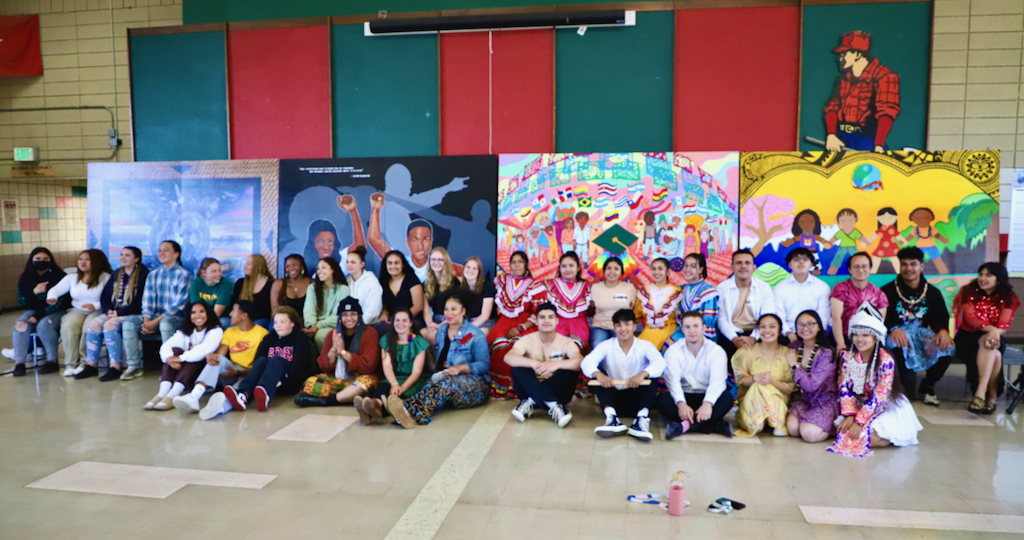
Members of Eureka High’s Native American Club, Black Student Union, LatinX Club and Asian and Pacific Islander Club pose in front of their club’s murals at the school | Photos: Andrew Goff
###
After more than two years of planning and overcoming a few roadblocks, four Eureka High School clubs — the Native American Club, the Black Student Union, the LatinX Club and the Asian and Pacific Islander Club – were finally able to complete four cultural murals, which were unveiled during a ceremony at the school Monday evening.
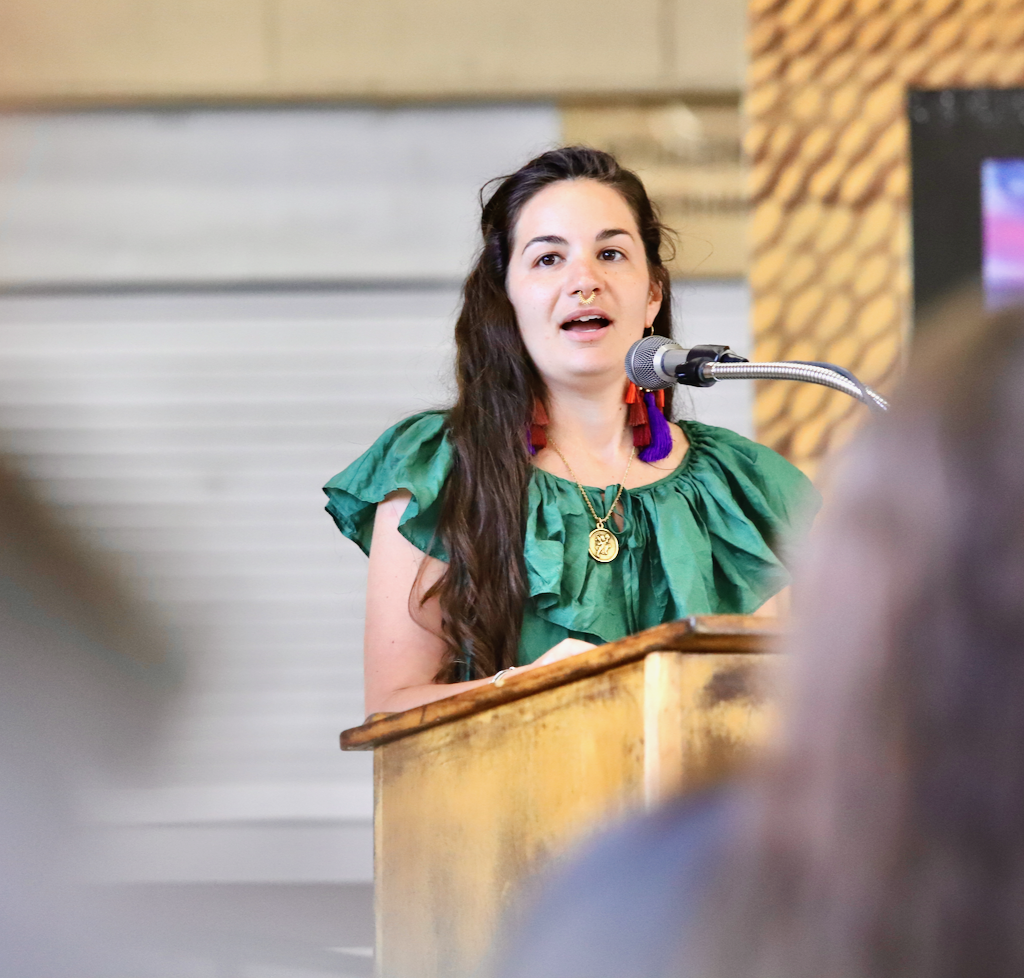
“Each mural you see here today was designed and created by the students who represent each club,” Naomi Doherty, the project facilitator, said to the crowd gathered in the Eureka High School cafeteria. “Art can be a way to share, spark conversation and inspire. But most importantly, art is a way to be seen.”
Doherty provided some background on the project – a DreamMaker project of the Ink People Center of the Arts, called Art Representation Culture (ARC) – and its journey to fruition. After the mural project was delayed by the pandemic, the project was again halted when the Eureka City Schools Board of Education voted to ban school murals altogether. The board’s controversial decision sparked opposition from students and the community, causing the ECS board to overturn the decision, allowing the project to move forward.
The four clubs each designed their murals with guidance and inspiration from local guest speakers and with help from a local artist selected by each club. The project received grant funding from the Humboldt Area Foundation, the Ink People and the Humboldt Women’s International League for Peace and Freedom. Sharonne Blanck, president of the Eureka Chapter of the NAACP also raised money through a GoFundMe to pay each of the artists that painted the murals.

The Native American Club mural by David Mata
Members from the clubs spoke during Monday’s ceremony, explaining the significance of their murals and how each design represents their heritage. In a joint speech, members of the Native American Club explained how their mural, painted by Native artist David Mata, represents the past and present struggles of Native peoples.
“Through this mural, we want everyone to know that we’re still here,” one club member said. “This mural shows who we are, unlike the history books we read today.”
“The ancestors in the background represent our past and our journey into the present,” another student added. “The images in the foreground symbolize obstacles and challenges we’ve overcome over the past few years and over history.”

The Black Student Union mural by Mickey Montgomery
Amaya Watson, president of the Black Students Union, explained that their mural, painted by local artist Mickey Montgomery, depicts silhouettes of Nina Simone, Martin Luther King Jr., Tupac Shakur and Kobe Bryant. “They are all Black figures that fought for Black empowerment, Black rights and paved the way for Black equity and Black excellence,” Watson said.
In the mural’s foreground, Watson added, are Charmaine and Josiah Lawson, who, Watson said, represent the legacy of the Black Student Movement and Black Lives Matter specific to Humboldt County. The image is also an acknowledgment of the David Josiah Lawson Memorial Scholarship, which provides funds to Eureka High students, Watson said.

The LatinX Club mural by Jose Moreno
Members of the LatinX Club said their mural, painted by local painter Jose Moreno, celebrates the diverse backgrounds of LatinX people, honors the hard work of their families, and aims to break stereotypes.
“We are breaking the stereotype that LatinX people aren’t educated and can’t succeed,” club member Ashley Lopez said.
“With this mural, we are encouraged to fight for a better future, to dream big and to celebrate our heritage,” another student added.
Following their speech, members of the LatinX Club performed a traditional Baile Folklorico dance for the crowd.

The AAPI Club mural by Josie Licavoli
The Asian and Pacific Islander (AAPI) Club closed out the ceremony, discussing the significance of their club’s colorful mural, painted by artist Josie Licavoli. The mural features several figures holding hands, representing the different Asian and Pacific Islander cultures coming together, the students said. The surrounding images of different foods, shows their love for sharing their different cultural traditions and dishes.
“Throughout history, our cultures have been colonized,” said Sidney Caampued, vice president of the AAPI Club. “Yet we took what they brought from the clothing wear, to food we eat, even the languages we speak, and made it into something beautiful, something of our own. By acknowledging our hard times, now and in history, we realize our strengths in ourselves and in our community.”
Scroll down for more photos from Monday’s mural unveiling ceremony.
###
PREVIOUSLY:
- After Eureka City Schools Board Votes to End Murals, Community Rallies for BIPOC Student Clubs That Were Planning Murals of Their Own
- Eureka City Schools Board Will Reconsider Recent Ban on Murals; Community Members Urge Board to Examine its Biases
- Eureka City Schools Board Overturns Mural Ban, Making Way for BIPOC Student Art
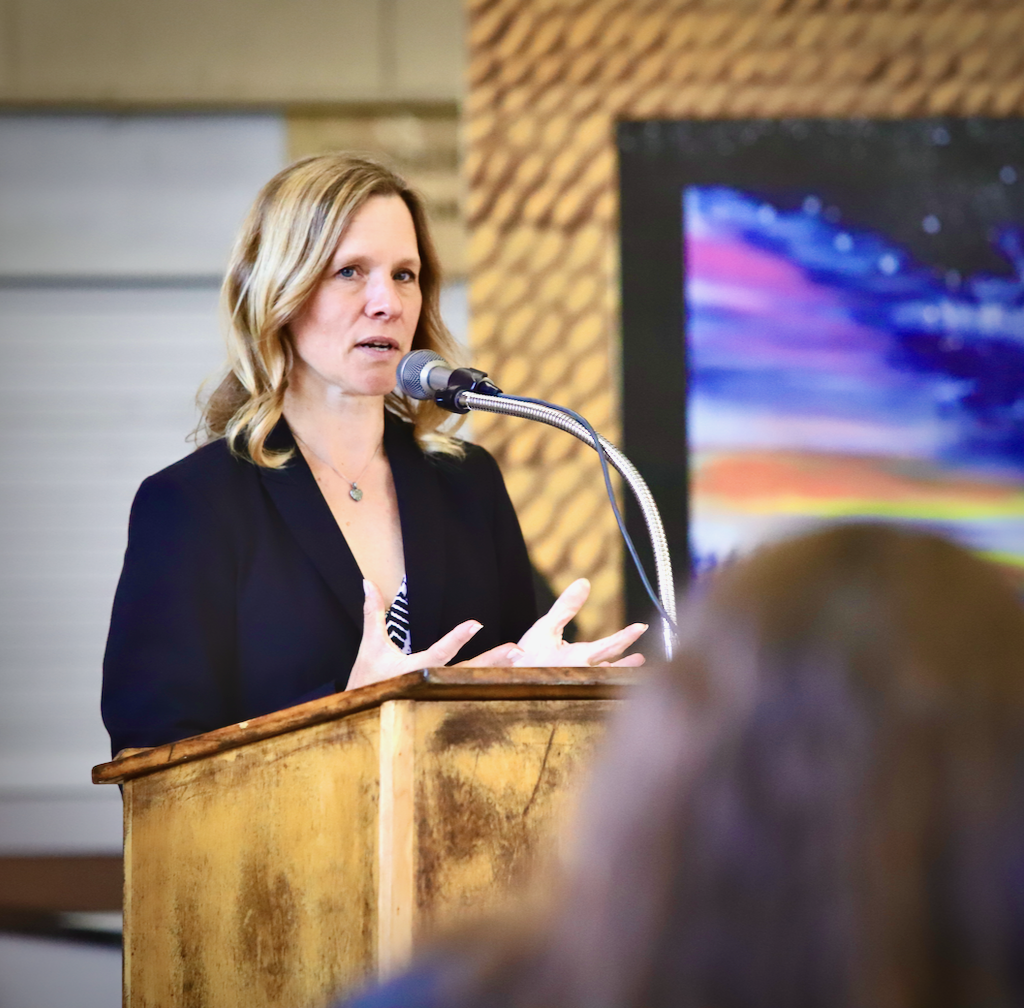
EHS Principal Jennifer Johnson kicked off the event
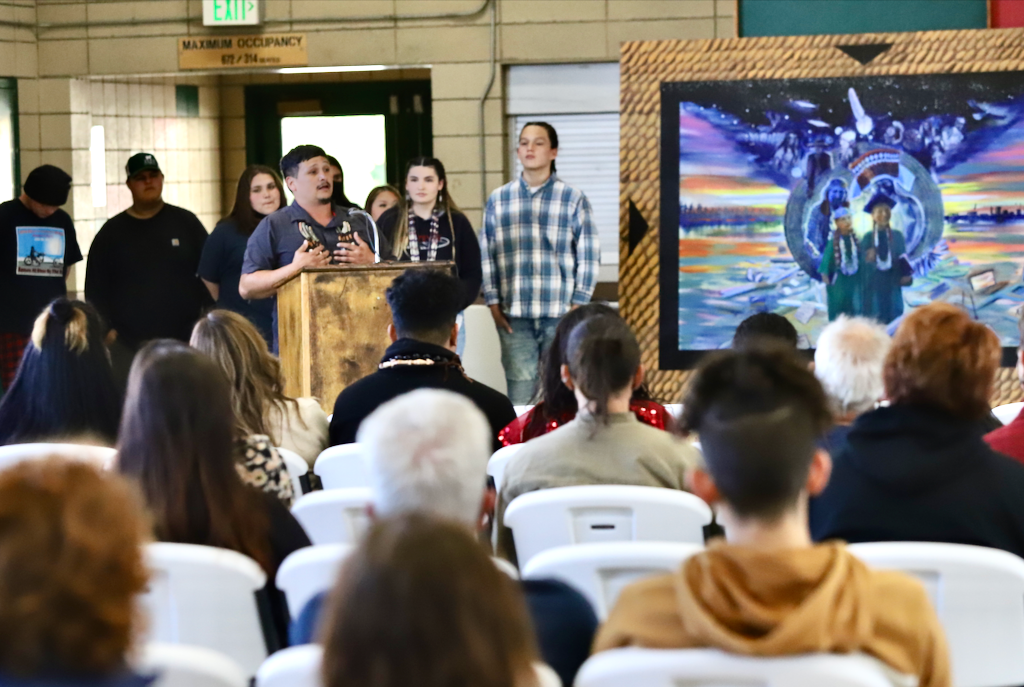
The Native American Club and EHS teacher James Gensaw present their mural

Amaya Watson of the BSU presents her club’s mural

Above and below: Members of the LatinX Club honor their culture with dance

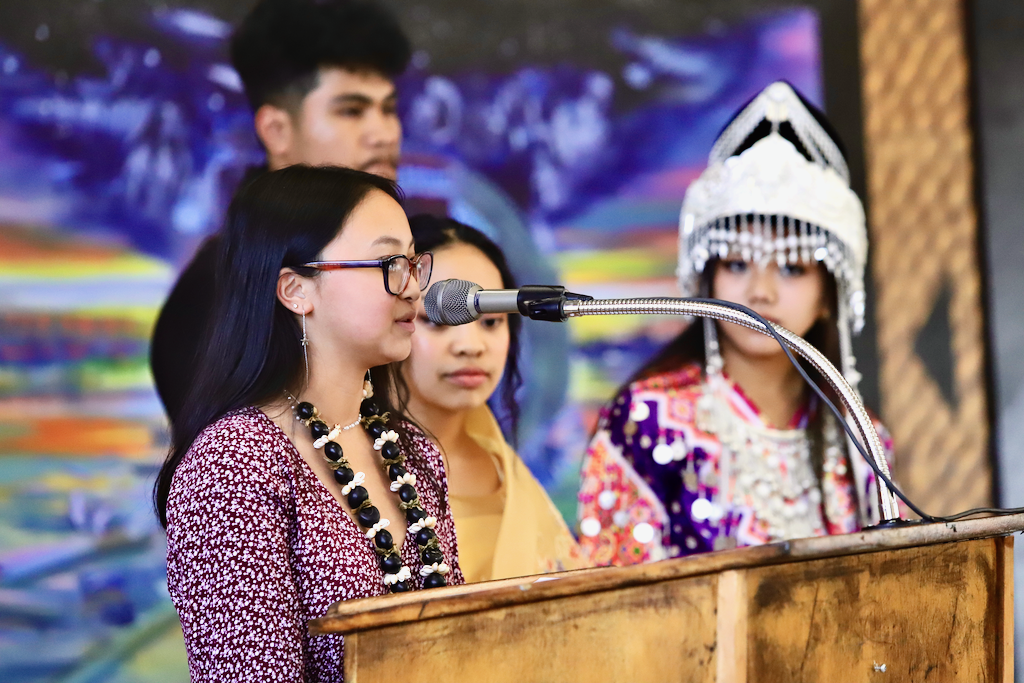
AAPI Club member Jenica Huddleston presents her club’s mural

Amaya Watson and Aundrea Stuckey


