

SHOOTING UPDATE: Female Uninjured During Weekend Standoff on Cousins Street, Eureka Police Say; 31-Year-Old Male Arrested
LoCO Staff / Tuesday, May 31, 2022 @ 12:57 p.m. / Crime
PREVIOUSLY:
###

From the Eureka Police Department:
The suspect from the May 29, 2022 incident on Cousins Street has been identified as 31-year-old Matthew Esparza of Eureka. Esparza was arrested on scene and transported and booked into the Humboldt County Correctional Facility for negligent discharge of a firearm. The female victim was determined to have not been injured during the incident.
A search warrant was served on the residence and detectives located a loaded firearm and a spent shell casing. This remains an active investigation and EPD Detectives are continuing to conduct interviews. Additional charges for Esparza are expected.
Anyone with information regarding this incident is asked to contact Detective Eckert at (707) 441-4060.
BOOKED
Today: 7 felonies, 6 misdemeanors, 0 infractions
JUDGED
Humboldt County Superior Court Calendar: Today
CHP REPORTS
13570 Mm101 N Hum R135.70 (HM office): Trfc Collision-Unkn Inj
Us199 / Middle Fork Gasquet Rd (HM office): Traffic Hazard
2550 Mm162 W Men 25.50 (HM office): Trfc Collision-No Inj
ELSEWHERE
RHBB: ‘Check In With Your People’: Humboldt’s Suicide Rate More Than Twice the State Average
RHBB: HAF+WRCF Opens Fall Grant Round for Artists, Seniors and Holiday Programs
Money Wars: Special Interests Spend Big in California Primary
Ben Christopher / Tuesday, May 31, 2022 @ 7:12 a.m. / Sacramento
If you haven’t noticed, your mail carrier certainly has: Election season has arrived in California and with it, the regular flood of political ads from unions, corporations and other special interest groups hoping to influence your vote.
Though contributions made directly to political candidates are capped by state law, no such limits apply to “independent expenditure” committees — so long as those outside influences are, in fact, independent and don’t coordinate with the campaigns they’re trying to help.
With early voting already underway and just two weeks to go before the June 7 primary, millions of dollars of help is now inundating California, showing up in races up and down the ballot. Perhaps you’ve driven past a curious bobble-headed billboard, had your mailbox stuffed with mailers sponsored by innocuous-sounding neighborhood groups or been puzzled by campaign ads that seem to be promoting the wrong candidate.
That’s all the handwork of what California election watchers refer to simply as “I.E.”
Though independent political spending is still dwarfed in California by old-fashioned direct contributions to candidates, it can play an outsized role in competitive elections, said Ann Ravel, who has served as the top campaign finance watchdog for both the state of California and the federal government. As an unsuccessful Democratic candidate for state Senate in one of 2020’s most fiercely competitive legislative races, she knows from first-hand experience.
“When you see it in person, it’s a lot different than when you see it as a regulator,” said Ravel, whose South Bay race against fellow Democrat Dave Cortese became a $6.2 million proxy battle between organized labor groups, housing interests and tech companies including Uber and Lyft. “I remember thinking, ‘Oh God, now I have to go to all these meetings with all these people and suck up to them?’”
Unlike relatively small individual contributions, six-figure spending by a single interest group in a close race can be difficult for a candidate to ignore, she said. “You have to be able to compete…I think that’s the problem.”
Another common feature of independent expenditure committees, said Claremont McKenna College political science professor Jack Pitney, is that they most often play the role of bad cop, attacking candidates they want to knock off.
“It provides a certain degree of cover to the candidate who benefits,” he said. “They can’t be accused of going negative.”
Even for seasoned politicos and election reporters, the rivers of cash can be complicated to track — and sometimes even convoluted to make sense of. For the fascinated, outraged or perplexed voter, consider this your user’s guide.
Shades of blue
Accounting and financial oversight doesn’t always inflame political passions, but the race to become California’s next controller is shaping up to be among the most competitive statewide races. With five well-financed candidates — four of them Democrats — and no clear front-runner, it’s a remarkably open race. Just in terms of money raised by the campaigns, themselves, it’s the highest-dollar statewide race.
The conventional wisdom is that Lanhee Chen, the lone Republican, will snag one of the two spots for the November ballot. That leaves the four Democrats fighting for the second spot.
Enter JobsPAC, an IE committee sponsored by the California Chamber of Commerce.
“The race for a spot in the general election is a jump ball between the four major Democratic candidates — each start with limited name ID and no statewide bully pulpit for communications,” reads a strategic memo produced by the committee earlier this month.
Its Democrat of choice: state Sen. Steve Glazer of Walnut Creek. The committee’s goal, the memo continued, is to get out the pro-Glazer message “at a scale and frequency usually reserved for top of the ticket statewide and/or high profile congressional races.”
“Just to have an open seat for constitutional office is not too common,” said Marty Wilson, who oversees the Chamber’s IE activity. “We’ve had a longstanding relationship with Steve, so from our perspective for an open seat it was just natural that we would back him.”
Big business throwing its financial weight behind a preferred Democrat is not a new phenomenon in California. Given the lowly state of the state’s Republican Party, which hasn’t fielded a successful statewide candidate in California since 2006, the Chamber, along with much of the state’s business community, has long seen the pragmatism in backing moderate Democrats against more progressive alternatives in both statewide races and in legislative and congressional districts.
As a result, the most competitive races across the state often don’t pit Democrats versus Republicans, but candidates from different ideological factions within the state’s ruling party. It’s often in those races where independent expenditure committees funded by business, labor and other competing interests do electoral battle.
This year, those top targets for IE cash include an East Bay state Senate race, featuring Democrats Lily Mei and Aisha Wahab and a Sacramento state Senate standoff between Democrats Angelique Ashby and Dave Jones. In both races, those candidates are almost certain to grab the top two spots needed to make it to the November ballot. But money is flooding in early anyway as competing interests race to secure a healthy margin on Election Day, sully their opponents’ standing with voters and mount a financial show of force.
Other races attracting big spending this election season include competitive (though likewise thoroughly Democratic) Assembly races in San Diego, Hayward, San Mateo, Inglewood and Palmdale.
And while the biggest race for independent expenditures this year so far is the competitive contest for attorney general, in second place is the thoroughly non-competitive race for superintendent of public instruction. As of Friday, nearly $1.8 million had been spent to support incumbent Tony Thurmond. Virtually all of that came from a single committee funded by teachers and school worker unions.
Why spend so much to boost a relatively safe candidate in such a low-voltage race?
In a statement, Jeff Gozzo, a strategist with the committee, simply said: “Thurmond has shown real leadership for students, parents and educators.”
The ‘pick your opponent’ ploy
If you’ve been listening to the radio lately, you might have heard an ad that sounds as if it backs Democratic Attorney General Rob Bonta, but which dedicated a curious amount of airtime to his most conservative opponent, Republican Eric Early.
Rather than warn voters about Bonta’s better-funded challengers, Republican Nathan Hochman or unaffiliated Anne Marie Schubert, the ad noted that Early is a “true conservative,” a “huge Trump supporter,” “a big Second Amendment defender” and a “leader” in the recall effort last year to oust Gov. Gavin Newsom from office.
The ad was sponsored by the independent expenditure group Communities for Justice Supporting Rob Bonta for Attorney General 2022, which is primarily funded by uber-wealthy Bay Area liberals including Quinn Delaney and Patty Quillin, along with the state’s prison guard union, which endorsed Bonta.
Last week, another Bonta-backing committee reported spending another $250,000 to “oppose” Early.
What gives?
Boosting your own candidate while not-so-subtly raising the profile of your preferred opponent is a tried-and-true tactic in California. In 2018, Newsom pulled the same maneuver in the lead up to the primary by blasting Republican John Cox. That was an effort to herd the fractured GOP base around Cox’s candidacy, ultimately to the detriment of Antonio Villaraigosa, a fellow Democrat and moderate alternative.
“Three-dimensional political chess,” is how San Francisco Chronicle reporter Joe Garofoli characterized the pro-Bonta ad. “This is how you get a Dem/Rep runoff,” tweeted Democratic political analyst Paul Mitchell. The California GOP, which endorsed Hochman, denounced the ad as a “misinformation campaign.”
Dan Newman, a consultant for Communities for Justice, said the messaging on Early is consistent with the committee’s own polling that he is most likely to finish second behind Bonta in June, beating out the much better financed Hochman and Schubert for a spot on the November ballot. Early, who ran for attorney general in 2018 and helped organize the 2021 Newsom recall effort, is “already relatively well known and well-loved in MAGA-land,” said Newman.
But the messaging also reflects the political calculation that Bonta would likely have an easier time against Trump-boosting an ultra-conservative, rather than a relatively moderate Republican or a party-less prosecutor famous for bringing the “Golden State Killer” to justice.
The Bonta campaign, itself, seems to have absorbed that lesson as well. In a recent press release, his campaign touted Republican opponent Hochman’s unclear stance on abortion. As messaging, it performs double-duty: celebrating Bonta’s progressive credentials on the issue for the Democratic Party’s base, while casting doubt on Hochman’s conservative bona fides with GOP voters.
But opponent shopping can be a risky game, said political scientist Pitney. In the 1966 governor’s race, Pat Brown “dumped a lot of opposition on George Christopher,” the moderate Republican mayor of San Francisco, in order to steer the GOP nomination to whom Brown’s camp believed to be the less electable alternative.
That “weaker” candidate, Pitney points out: “This washed up old actor named Ronald Reagan,” who went on to beat Brown by 15 percentage points.
What does the IE want?
When a politician’s campaign spends money, it’s easy to deduce what they’re after: They want to win their election.
Spending by independent expenditure committees — which sometimes cobble together contributions from many sources and may either support or oppose a candidate — can be a little more complicated.
Earlier this month a committee funded by the state’s landlord lobby and the California Association of Realtors, spent roughly $20,000 to support the candidacy of former Assemblymember Kansen Chu, a Democrat who is hoping to once again represent north San Jose. But the group is not solely interested in Chu. It spent about the same amount to boost both Fremont City Councilmember Teresa Keng and former San Jose City Councilmember Lan Diep, two other Democrats in the same race.
What do Keng, Chu and Diep have in common?
They aren’t Assemblymember Alex Lee, a self-described Democratic Socialist who supports rent control and believes the state should be providing housing directly to renters. So far, the committee has also spent more than $126,000 to defeat him.

An independent expenditure committee called Housing Providers for Responsible Solutions is trying to defeat Assemblymember Alex Lee.
That multi-candidate strategy might not be apparent to a South Bay resident who gets one of the committee’s mailers. To find out, a curious voter would have to look up the committee’s name — Housing Providers for Responsible Solutions — on the state’s online campaign finance portal.
While the inclusion of “housing providers” in that committee’s name offers a strong clue about its funding and policy preferences, not all IE groups are so instructively titled.
A notable example: San Diego Families Opposing Georgette Gómez, a significant spender in the race to fill the seat of former Assemblymember Lorena Gonzalez, who stepped down in January to lead the state’s largest labor organization and has endorsed Gómez. Her chief opponent is former City Councilmember David Alvarez. Some of the top funding for the “families” group comes from a list of similarly unhelpfully-named committees: Californians for Jobs and a Strong Economy and Keeping Californians Working.
Reported donations to those committees show that the ultimate source of the cash is a who’s who of some of the largest business interests in the state, including Uber, Amazon, Sempra Energy and Chevron.
And though a committee may carry on spending from one election to the next under the same name, that doesn’t mean its funders — or even its overall political purpose — stays the same. Another recent contributor to the San Diego Families committee is the Coalition for Public Safety Reform, Training and Transparency.
It was initially established by the Los Angeles Police Protective League, the union of LAPD officers, but the league was removed as a sponsor earlier this year. Since then, funding has come from organizations further south: the Deputy Sheriffs’ Association of San Diego County and Sycuan Band of Kumeyaay Nation near El Cajon.
Recycling existing committees for new political purposes and mixing and matching existing coalitions behind new names are both common practice, said Doug Morrow, a Democratic political researcher who tracks independent expenditures.
“The sponsors change, but the committees live on and the consultants get paid,” he said.
A double-edged sword
For a candidate, having a well-financed committee in your corner that can spend unlimited gobs of cash has its perks. But sometimes all that financial help comes at a political cost.
In the race to replace Autumn Burke, the former state Assemblymember who unexpectedly stepped down from her Inglewood seat earlier this year, candidates Robert Pullen-Miles and Tina McKinnor have both been beneficiaries and targets of an inordinate amount of independent expenditures.
The biggest spenders rushing in to assist Pullen-Miles, a former Burke staffer who has her endorsement: oil giants Chevron and Valero through a longstanding committee called Coalition to Restore California’s Middle Class. In an overwhelmingly Democratic district that extends to the beach, that isn’t likely to be a popular association. Pullen-Miles’ opponents are using that to their advantage, characterizing him as the candidate of “big oil.”

Opponents of Robert Pullen-Miles are attacking him over support from an independent expenditure committee funded by oil companies.
McKinnor, a former Burke staffer who left that post on bad terms, and who was also a high-ranking organizer in the state Democratic Party, has the backing of progressive groups and much of organized labor. But she, too, has some industry spenders in her camp that have proven to be a political liability. The biggest spending pro-McKinnor committee, the Alliance for California’s Tomorrow, is funded in part by the tobacco company, Philip Morris. With that connection in hand, the Pullen-Miles campaign threw together a website drawing attention to his opponent’s “dirty dollars.”
As an illustration of just how convoluted these financial interventions can be: When Burke, Pullen-Miles’ backer, was first elected to the Legislature in 2014, the Alliance for California’s Tomorrow spent more than $60,000 to help her.
A similar kind of guilt by financial association has come to dominate the race to fill the state Senate seat in Sacramento to be vacated by termed-out Democrat Richard Pan. There, former Insurance Commissioner Jones has been the subject of a gauntlet of negative ads funded by Future PAC. Most notable among them — a billboard emblazoned with a Jones bobblehead.
Future PAC, which has spent nearly $500,000 so far to hammer Jones, serves as a clearinghouse for a wide variety of industry groups and unions, including hospital associations, pharmaceutical companies, agricultural interests and the umbrella organization for the state’s police officer unions.
But Jones and his supporters have fastened onto one contributor in particular: Californians for Jobs and a Strong Economy, another business-backed IE committee, supported in part by oil and energy companies. “Big Oil wants Angelique Ashby,” says a mailer from California Alliance, an IE funded by California Environmental Voters, Consumer Attorneys of California and Opportunity PAC.
Ashby, a Sacramento City Councilmember, responded in a tweet Monday that she has kept a pledge not to take fossil fuel money in her campaign.
“The IEs have the money and so whoever the IEs are for or against, that’s used to define the candidate,” said Steve Maviglio, a Democratic political consultant who supports Ashby and has volunteered with her campaign. “They’re not helping.”
###
CalMatters.org is a nonprofit, nonpartisan media venture explaining California policies and politics.
OBITUARY: Karen Jeanne Johnson, 1952-2022
LoCO Staff / Tuesday, May 31, 2022 @ 6:56 a.m. / Obits
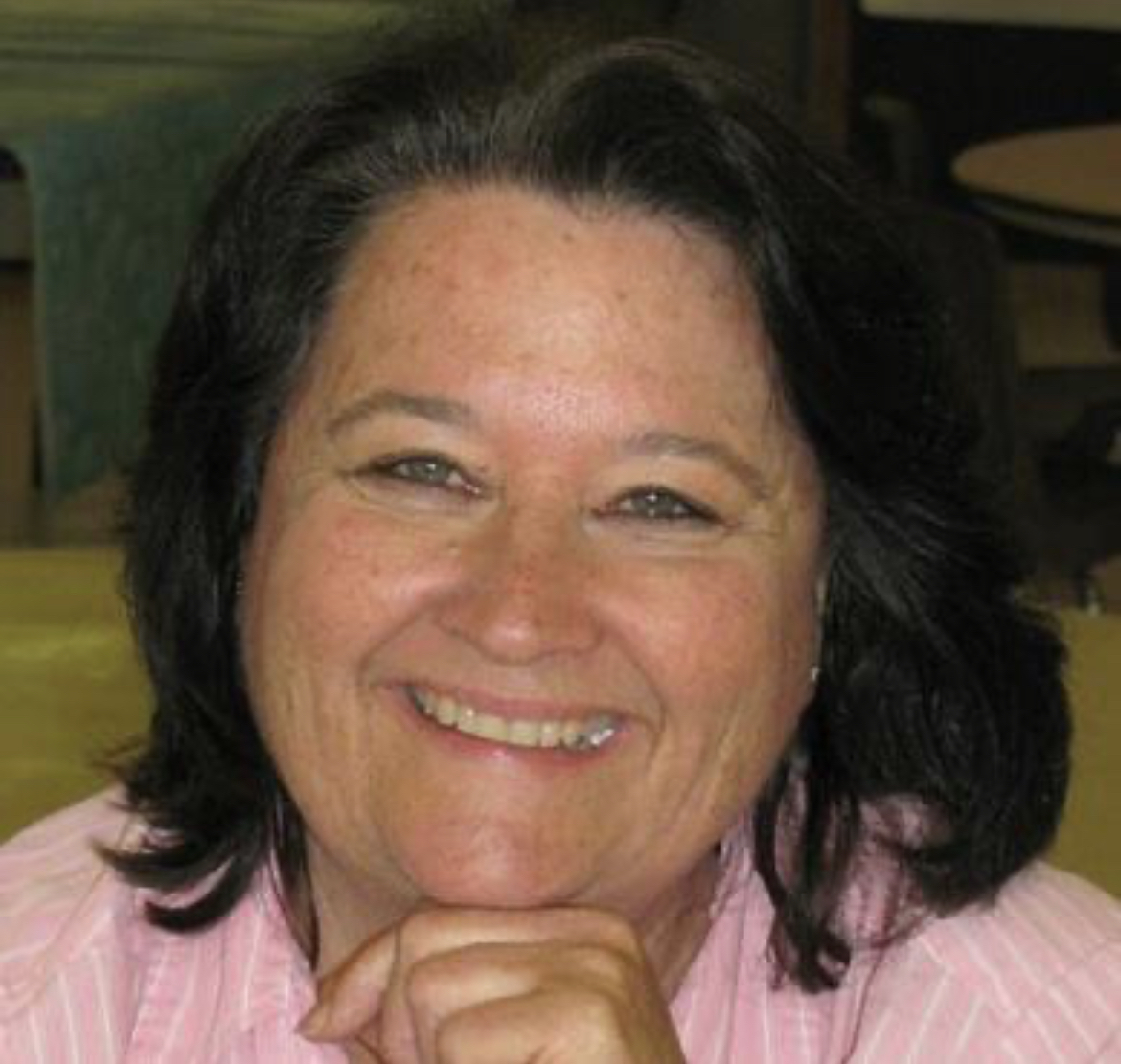
On May 4, 2022,
Karen Jeanne Johnson peacefully passed away, surrounded by her loved
ones, and into the loving arms of our Lord Jesus Christ. May 4th
will forever be Karen’s “Glory Day.”
Karen was born on January 5, 1952 to Jack and Jeannie Chamberlain. She was the oldest of four children and she let her brothers know who was in charge of the Chamberlain siblings. Over the years we would hear countless stories of the summertime fun Mom had with her brothers, friends and visiting cousins from Oregon. Stories that involved mudball fights, boys vs. girls, (the girls would put rocks in their mudballs), riding horses, playing in the creek, and wild cucumber fights were just a few of their fun times.
Karen graduated in 1970 from Fortuna Union High School, and in 1972 married Ralph Edward Johnson. They were to celebrate their 50th wedding anniversary this summer.
Karen fought a hard battle against metastatic breast cancer. She was in remission for four years until the cancer returned with a vengeance. When she went through her first set of chemo treatments, she never missed a day of work. Karen loved her work. She was the director of Great Beginnings Preschool, and taught kindergarten as well. The love she had for her students and the preschool was well known. She loved her kids, and she made sure that her students were not aware of her being sick and going through chemo treatments. Her “littles” came first, and she said they helped her fight and get through chemo and radiation treatments.
Karen began working for New Life Christian School in 1998 and was a pillar in the NLCS community. She wore many “hats” over the years as teacher, principal, board member/president, and fundraising chairperson. The dedication she had for NLCS was unprecedented. That dedication flowed down to her students and the impact she had on so many lives. Great Beginnings Preschool was her creation and her “baby” as she would say, and she worked tireless hours along with her staff to create an amazing preschool/kindergarten program.
Karen was also a rancher and a rancher’s wife. She, Ralph, and their son Jacob raise beef cattle as JKR Ranch and manage the Kinsey Ranch in Southern Humboldt. Karen was a hard worker and loved living on the ranch. She would commute from Benbow to Fortuna to teach during the school year and then work tirelessly on her days off, weekends and during the summer on the ranch. Karen and Ralph always put in a huge garden and in late summer and early fall Karen was canning and freezing the harvest. And cook!! Karen was an amazing cook and took great pride in her cooking. Hospitality was one of her many gifts. She loved having guests at the ranch, sitting on the patio sipping iced tea and admiring her beautiful garden.
Karen was preceded in death by her parents Jack and Jeanne Chamberlain.
She is survived by her husband, Ralph Johnson, her children Kay (Lou) Challoner, Jacob (Tara) Johnson, grandchildren, Melissa (Rusty) Calkins, Sage, Savanah and Sydney Johnson, great grandchildren Julia & Gavin Calkins. Siblings, Brad (Nancy) Chamberlain, Rod (Debbie) Chamberlain & Jay Chamberlain, brother-in-law Robert Johnson (Mary) as well as many nieces, nephews, and cousins.
This obituary could go on for miles to share what an amazing, beautiful, talented, and Godly woman she was. The family will be holding a memorial to honor Karen on Saturday, June 11th at 1 p.m. The memorial will be located at The Journey Church, 95 Belleview, Rio Del. Longtime friend and Pastor, Bob Hapgood, will be helping the family honor Karen and providing the message.
We miss our mom beyond measure. We have wanted to pick up the phone and call her so many times, but we realize we cannot do that right now; but we will see her again someday. Our family is a family of faith, and our mom was such a strong, loving Christian woman. She wanted everyone to have a personal relationship with Christ. If anyone should have questions about how to know Christ, call or visit a local church or check out a church’s website. Since Covid, so many churches have online services.
Our family would like to thank the staff at Providence Oncology. Our mom thought so highly of the nursing staff in the office and infusion center. She was forever grateful for each one of you.
In lieu of flowers, donations may be made to Great Beginnings Preschool c/o New Life Christian School, P.O. Box 404, Fortuna, CA 95540.
###
The obituary above was submitted by Karen Johnson’s loved ones. The Lost Coast Outpost runs obituaries of Humboldt County residents at no charge. See guidelines here. Email news@lostcoastoutpost.com.
(VIDEO) One Person Dead, One Rescued After Hazardous Surf Sweeps Hikers From Black Sands Beach
John Ross Ferrara / Monday, May 30, 2022 @ 4:15 p.m. / Emergencies

Photo and rescue footage provided by the Shelter Cove Volunteer Fire Department.
One person has died and another was hospitalized after large, hazardous waves pulled a pair of hikers out to sea at Black Sands Beach yesterday.
Shelter Cove Volunteer Fire Department Chief Nick Pape told the Outpost that the department’s Ocean Rescue Team responded to the emergency by personal watercraft and boat at 2:10 p.m. The team reportedly reached the distressed hikers approximately 13 minutes later, where they found the victims trapped in 15 to 25-foot waves.
“Our team rescued the first patient, who was treading water, and took that patient to our boat crew,” Pape said. “Then our Jet Ski team went in to recover the unconscious patient and bring them back out of the water.”
The unconscious hiker was later pronounced dead by paramedics. The rescued hiker was determined to be in stable condition, and was flown to an unconfirmed hospital for additional care.
Pape said that one hiker is suspected to have been washed away by a sneaker wave, but was unable to give an official confirmation. The other hiker reportedly also became trapped in the surf after attempting to rescue the first distressed person. It’s unclear which of these hikers survived the incident.
“We assume it was a sneaker wave,” he said. “Black Sands Beach is known for having sneaker waves and a very dangerous shore break.”
Pape was unable to confirm any of the hikers’ personal details, but said that the Humboldt County Sheriff’s Office is leading the investigation and that the agency is expected to release additional details at a later time.
As summer approaches, the Shelter Cove Volunteer Fire Department is warning all beachgoers to keep a safe distance from the shoreline.
“We train for this moment and the team really risked their own safety to bring back both patents,” Pape said. “We’re proud of the crew and sorry for the loss. We’ll continue to keep training and hopefully get the word out that the ocean is very dangerous — especially Black Sands Beach. We see it time and time again. With the summer season, we want to prepare people and educate them on the dangers that these beaches present.”
Eureka Police Actively Investigating Incident on Cousins Street That Allegedly Involved a Gunshot
LoCO Staff / Sunday, May 29, 2022 @ 5 p.m. / Crime

Photos: Bill Prescott.
Eureka Police Department press release:
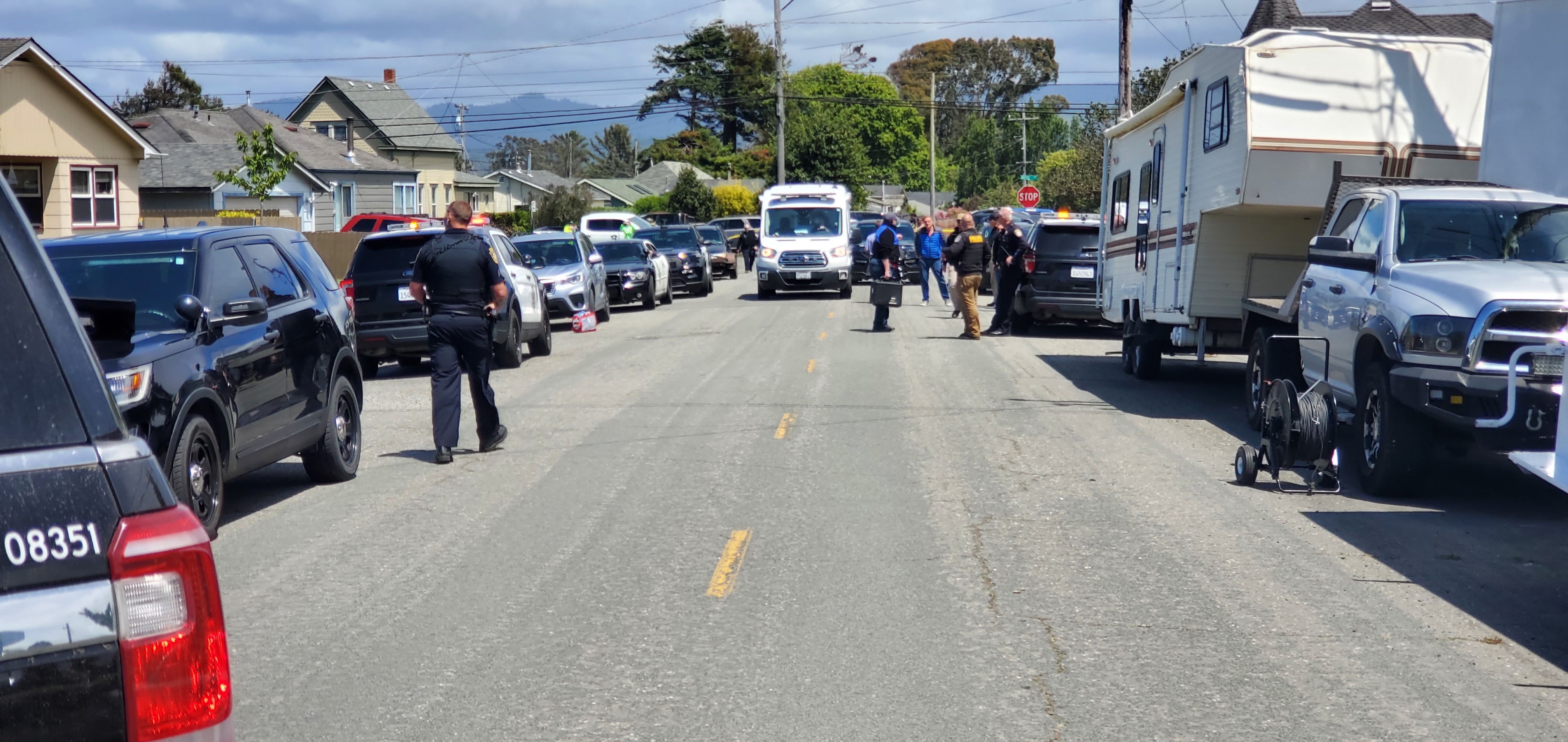
On May 29, 2022, at about 11:32 a.m., the Eureka Police Department responded to a residence on the 1200 block of Cousins Street for the report of a male in possession of a firearm who was refusing to allow a female resident to leave. As officers arrived on scene, they, as well as nearby neighbors, heard a single gunshot from the area near the residence.
Based on the circumstances and the investigation to this point, officers established a perimeter and made a request for assistance from the Humboldt County Sheriff’s Department SWAT and Crisis Negotiation Teams (CNT). Upon their arrival, contact was made at the residence utilizing verbal commands. The occupants of the residence, a male and female, exited the residence. The male was detained and the female was transported by City Ambulance to St. Joseph hospital for a medical evaluation.
At the time of this press release, EPD Detectives are still on scene executing search warrants, conducting interviews, and collecting evidence. Additional information concerning the arrest and subsequent charges will be released at the conclusion of the investigation.
This is an active and on-going investigation. If you have any information in regards to this incident, please contact Det. Eckert at 707-441-4060.
The Eureka Police Department would like to thank the Humboldt County Sheriff’s Department, the members of SWAT and CNT, Humboldt Bay Fire, and City Ambulance for their assistance with this incident.
GROWING OLD UNGRACEFULLY: Who’s Satoshi?
Barry Evans / Sunday, May 29, 2022 @ 7 a.m. / Growing Old Ungracefully
“I’ve been working on a new electronic cash system that’s fully peer-to-peer, with no trusted third party.” (Satoshi Nakamoto, October 2008)
###
Satoshi Nakamoto (he/she/they?) created the first version of Bitcoin in the spring of 2007, which, in retrospect, seems prescient. A year later, the whole global financial system melted down into a recession, thanks to big investment banks (under the jurisdiction of the Federal Reserve) making irresponsible bets on unsecured mortgages. Bitcoin, which operates outside of a central authority (no “Bitcoin Headquarters” exists), suddenly seemed like an idea whose time had come.
Satoshi wrote soon after, “The root problem with conventional currency is all the trust that’s required to make it work. Banks must be trusted to hold our money and transfer it electronically, but they lend it out in waves of credit bubbles with barely a fraction in reserve.” You can read his 9-page “white paper” introducing Bitcoin here.

First page of Satoshi Nakamoto’s “white paper” issued October 31, 2008, describing Bitcoin and the blockchain.
But Bitcoin isn’t really the best (enlightened money!) or the worst (Ponzi scheme!) of Satoshi’s inventions. Whatever you think of Bitcoin (and its hundreds of copycat currencies), what Satoshi will be remembered for in the future is the blockchain, a brilliant way for anyone to communicate, safely and discreetly, with anyone else, without the need for a trusted third party. For instance, a single 324-gigabyte blockchain, perfectly copied on tens of thousands of computers across the globe, carries the timestamped record of every Bitcoin transaction since the first one on January 12, 2009 (at 18:15:05 UT, in case you’re keeping track). Anyone can download it. Read about how the blockchain works here.
So who is/are Satoshi Nakamoto? Not the unfortunate Japanese-American retired physicist Dorian Satoshi Nakamoto, who Newsweek fingered in 2014 as being the Satoshi. It was a case of mistaken identity, and the Bitcoin community rallied, donating $1 million to Dorian for the invasion of his toy-train-collecting privacy.
And probably not any of the other claimants, either. In fact, given that Satoshi owns about one million Bitcoin (worth $30 billion today), which has sat there, unused, “lost,” for over a decade, perhaps he is no longer in the land of the living. The last “for sure” communication from him/her/them was in April 2011, when an email to a developer friend said, “I’ve moved on to other things.” Since then, nada.
My best guess is that Satoshi died in 2011, soon after that email and another saying “I probably won’t be around in the future.” Len Sassaman, an American genius “cypherpunk” who committed suicide in Belgium that July, had been suffering from depression for some time. We may never know for sure, but enough members of the Bitcoin community believe Len was Satoshi that they erected an appropriate memorial to him: a testimonial embedded into Bitcoin’s blockchain.

Gov. Gavin Newsom Tests Positive for COVID-19
LoCO Staff / Saturday, May 28, 2022 @ 4:07 p.m. / Government

Gov. Gavin Newsom speaks during the State of the State in Sacramento on March 8, 2022. Photo by Miguel Gutierrez Jr., CalMatters
###
Press release from the Governor’s Office:
This morning, the Governor tested positive for COVID-19 after exhibiting mild symptoms. The Governor will continue to work remotely. In accordance with local and state health guidelines, Governor Newsom will remain in isolation at least through Thursday, June 2 and until he tests negative. As outlined in California’s SMARTER Plan, which focuses on testing and treatment, the Governor will test prior to leaving isolation. The Governor has also received a prescription for Paxlovid, the antiviral that has been proven effective against COVID-19, and will begin his 5-day regimen immediately. Governor Newsom is vaccinated and has received two booster shots, including as recently as May 18.
Vaccinations and boosters remain the best way to protect yourself from COVID-19. California was the first state in the nation to announce a comprehensive plan to deal with COVID-19 going forward, the SMARTER plan, that focuses on testing and treating patients to avoid serious disease.
By following the guidelines outlined in the SMARTER plan, individuals can help protect themselves and others, and public officials can prepare for surges in COVID-19 transmission, like the one we are currently seeing across the country.


