
THE ECONEWS REPORT: Coal Trains Inch Forward with Surface Transportation Board Decision
The EcoNews Report / Saturday, May 28, 2022 @ 10 a.m. / Environment

A freight train carrying coal. | Photo: CSIRO via Wikimedia Commons, Creative Commons License.
Two weeks ago, the federal Surface Transportation Board made some important decisions about the future of trails in our region. Tune in to hear about the latest developments including what’s in store for the Annie and Mary Trail and what comes next in determining the future for the Great Redwood Trail. Will it be a spectacular 300-mile trail connecting communities from San Francisco to Humboldt Bay, or will rail entities succeed in taking the right-of-way from the public and using it to poison our future?
Learn more at nocoalhumboldt.org
AUDIO:
BOOKED
Today: 7 felonies, 6 misdemeanors, 0 infractions
JUDGED
Humboldt County Superior Court Calendar: Today
CHP REPORTS
0 Us101 N (HM office): Trfc Collision-Unkn Inj
13570 Mm101 N Hum R135.70 (HM office): Trfc Collision-Unkn Inj
Us199 / Middle Fork Gasquet Rd (HM office): Traffic Hazard
2550 Mm162 W Men 25.50 (HM office): Trfc Collision-No Inj
ELSEWHERE
RHBB: ‘Check In With Your People’: Humboldt’s Suicide Rate More Than Twice the State Average
RHBB: HAF+WRCF Opens Fall Grant Round for Artists, Seniors and Holiday Programs
OBITUARY: David Hiram Drake, 1932-2022
LoCO Staff / Saturday, May 28, 2022 @ 6:56 a.m. / Obits
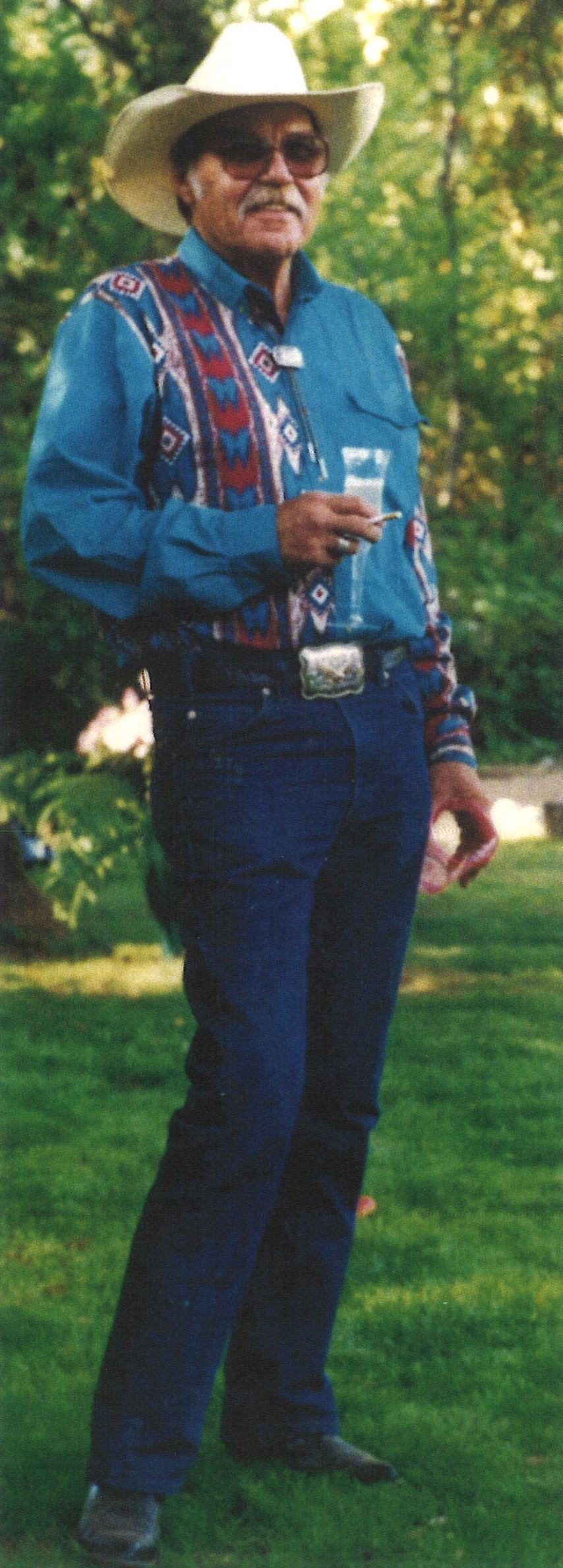
David Hiram Drake was born on March 7, 1932 and crossed over to “The Happy Hunting Grounds” on March
5, 2022. He had a long and wonderful life of almost 90 years. His lifelong best friend, Ranney Beck
(Bronson’s Double) left us on the same day. They were both “Tricksters” in their younger years at Somes
Bar and Orleans. Our Karuk Tribe would call them “Pihneefichs” (coyotes).
Dave served in the Korean Conflict as a military policeman in 1955-56. He was a bartender for many years in Eureka, Willow Creek and Los Angeles. He also worked in the local sawmills. He had an Alaskan sawmill he used for many years milling lumber.
Dave married his first wife, Bonnie Rails, a beautiful Karuk Indian woman, and had one son — David Drake, the Karate Expert. He and his children David, Robert, Michael and Gabrielle (Chickie) were National Karate Champions in 1988 until 1991.
Dave Drake married his second wife, Adrienne “Cuddles” Colegrove, the Hupa Medicine Woman. She also crossed to the other side on April 3, 2016. They lived together on the banks of the beautiful Trinity River, where Dave would sit and watch the salmon run up the river. Dave and Cuddles grew beautiful flowers and had so many family gatherings, weddings, funerals, etc. Dave’s brother-in-law, Dr. Doyle Bradshaw, could not believe he knew the names of all of his beautiful roses. Dave was as expert “Horticulturist”!
Dave was one of eight siblings: Zona Ferris, Betty Bacock, Helen Beck, Ella Benedict, Shirley Bates and Bev Drake-Bradshaw. Dave was about eight years old when his sister, Zona Ferris, told him to get out of the apple tree. He of course, didn’t listen to her. She threw an apple at him and knocked him out of the tree. He fell on the creek below and broke his arm. It wasn’t easy living with seven sisters, especially when they would curl his hair with a curling iron to try and make him look like a girl.
When Dave was a young child he ran from his mother Lonnie Drake and she out ran him as he tried to climb through the fence. He laughed so hard as she drug him back to the house and punished him. He could not believe she caught him. Work day was Saturday at the Drake home in Somes Bar — working, cleaning, etc. — however , Dave would always disappear. He would be found under a tree, reading a book .
Dave spent time camping in the Marble Mountains as a child. His father and mother packed President Hoover and the Stanford University group into the Hoover cabin. He was also very proud of his heritage to President Warren Harding, who had an extremely brilliant legal mind. Dave served on the Karuk Indian Council in his younger years. He dipped for salmon at the Ishi Pishi Falls to help feed the local natives from Ka’timIin (Somes Bar) and Panamniik (Orleans).
Dave was a very spiritual person and very much involved in the local Indian ceremonies. He made Indian drums, which he learned from his father-in-law, Frank Colegrove. Dave was an avid horseman and always had quarter horses. He was the grand marshall of the Hoopa Rodeo in 2007. One of his friends said “When I die and come back as an animal, I want to belong to Dave Drake. He treats his animals better than his friends.” Dave also loved spending his time in Reno, Nevada, Lucky Bear, Hoopa and Blue Lake Casinos.
Dave leaves behind his son David Drake, (Linda Rhodes); his sisters Betty Bacock, Shirley Bates and Bev Drake-Bradshaw; his grandchildren, David, Michael, Robert, and Gabrielle; his great-grandchildren Ashley, Qo:so:s, Xatimniim, Tanis, Carmen, Aryana, Kininden, David Drake the fifth, Witisu Schlueter, Robert Drake Jr., and Aislinn Drake. He also had nieces, nephews and cousins too numerous to mention.
The family of Dave Drake would like to thank his nieces Renee Ferris and Poppy George, and David and Linda for their help at this time of sorrow .
A celebration of life will be held when Covid-19 is over .
Pallbearers are: Joe LeMieux, Porty Blake, Robert Attebery, Tim Bussell, Brian Tripp and Walt Lara.
###
The obituary above was submitted by David Drake’s loved ones. The Lost Coast Outpost runs obituaries of Humboldt County residents at no charge. See guidelines here. Email news@lostcoastoutpost.com.
OBITUARY: Elvin Luis, 1938-2022
LoCO Staff / Saturday, May 28, 2022 @ 6:56 a.m. / Obits
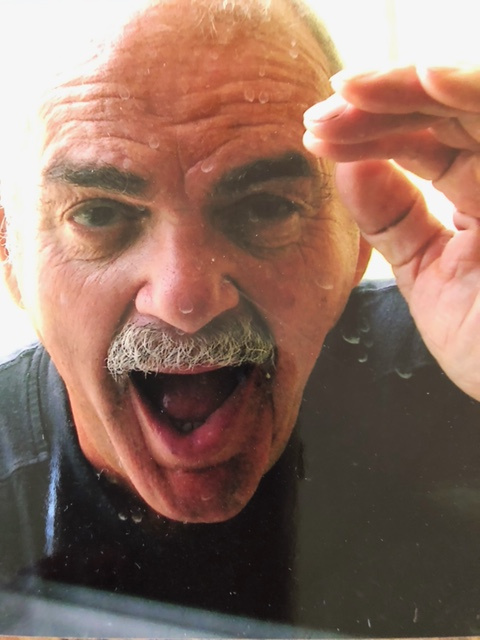
Elvin Luis passed away May 22, 2022, at the age
of 84 years young. Born February 12, 1938, he was the second of three
children at the family dairy farm. He grew up learning his work ethic
from his Portuguese immigrant parents by working on the dairy farm
from a very young age. Driving from the time he was 14, it was a
natural progression that he would eventually become a truck driver.
He drove long-haul trucks for several years before landing his job at
Louisiana Pacific. In 1957 he married Shirley Lampley, and over the
course of their marriage, they had two children, David Sr. and
Richard Luis. The marriage ended, and they remained friends,
co-parenting their children when this was nonexistent.
He met and ultimately married Aileen Bull (Greer) and her four kids, John, Pam, Ernie, and Kurt Bull December 15, 1972. His only biological daughter, Kimberley, was born in April of 1973. In the summer of 1973, he survived a severe truck accident that cost him his right hand and part of his forearm. In true Elvin fashion, he did not allow this to slow him down. Once he recovered, LP made national headlines by modifying the cab of a truck to enable him to continue to drive using a prosthetic hook. He was happily back to work, and when the opportunity presented itself, he was promoted to Transportation Coordinator for the West Coast. He was responsible for moving the wood products to various pulp mills speckled throughout Oregon and California. This often involved many late night/early morning calls, as the trucks would become stuck due to varied road conditions or mechanical failures.
During this time, he and Aileen spent their spare time working on the family property in southern Humboldt. With all seven kids in tow, they had an instant work crew. The large tent was erected on the deck on Memorial weekend and would stay up through Labor Day. The family spent many summer weekends clearing brush, swimming in the creek and the Eel River, cooking over the fire, and hiking through the hills. Once they bought out the property above them, including a little two-bedroom cabin, his vision was endless. He loved working on the property, constantly improving it. Elvin was always a man of action. Never being one to sit idle, Aileen and Elvin opened the You and Me Restaurant in Eureka in 1982. While still working for LP, he and Aileen would start at the restaurant by 5:30 am. He would then head off to work while Aileen would run the restaurant. Once Elvin finished his “day job,” he would return to the restaurant to help with the end-of-the-day clean-up. Most days, they did not return home until well after 7 pm. Elvin still found time to keep his home yard immaculately landscaped, and he often spent weekends working on the property in Southern Humboldt. In 1992, they decided to close the restaurant due to the many changes and business decline in downtown Eureka.
After the unexpected and untimely passing of his second wife, Aileen, he dipped his toes back into the dating world. He reconnected with Penny (Gates) Tipton, whom he dated when they were younger, and married in October 2001. Elvin then added her five kids, Kathy, Julie, Dan, Kevin, and Jeanne, to his clan (making it an even dozen). He retired shortly after they married, allowing them to travel and enjoy their kids, grandkids & great-grandkids. A few of the highlights of their travels included cruises to Alaska and Mexico and all the trips visiting out-of-town family. They hosted many family functions at their house; you never left hungry! Because of their love of music, they volunteered at the local jazz festivals. Wanting to share their love of music with their grandkids, they took them to the Thursday night Concerts by the Bay. The grandkids have wonderful memories of dancing with them in the streets. After Penny’s passing in 2014, he took over the “babysitting” duties for some of the grandkids, who kept him young and on his toes. Even with watching his grandkids, he still had excess energy to burn. What started as just mowing yards for friends turned into a booming business by word of mouth. He and his sons, David and Ernie, and grandsons, Stephen and Christopher, worked the business. We are forever grateful for the legacy of work ethic that he instilled in us.
Elvin’s love language was acts of service and always putting others first. He loved to help people and do little things for them to show how much he cared. From mowing lawns to helping with little handyman-type things, he had a zest for life, a love of community, his mama and her sweet bread, Portuguese beans and linguica, his family, and the outdoors. He was the original tough guy, with much endurance and fortitude. He was an active member of the Eureka Elks Lodge.
In 1992, Elvin made his first blood donation to help his friend, Leon Battaglia. Over the next 30 years, Elvin made 44 whole blood donations for just under 40 gallons of blood. He also became a regular platelet donor, donating 269 times. Over the course of the 30 years, he became endeared and loved by those working at Northern California Community Blood Bank. He regularly shared his enthusiasm for donating blood with his family, often recruiting his grandchildren to donate when they came of age. He loved that he could give back to more than just his family and friends by donating blood. His final act of donation came with his passing, and per his request, “anything of use” could be donated.
Please join us for a celebration of life Saturday, June 4, 2022, at Cutten Community Church, 2020 Campton Rd., Eureka, from 1 to 4 p.m. In lieu of flowers, the family asks that blood donations be made to the Humboldt Community Blood Bank in Elvin’s honor, using code Luis or donating at your local blood bank.
Elvin was preceded in death by his parents, Antone and Marie Luis, his brother, Tony Luis, wives, Aileen Luis and Penny Luis, son, Kurt Bull, and granddaughters, Brooke Luedemann and Sarah Gates. He is survived by his sister, Laverne (Bert) Witt, and by his kids, Kim Luis, David Luis Sr., and family, Richard Luis and family, Pam Luedemann and family, John Bull and family, Ernie Bull, Kathy (Chris) Vogel, and family, Julie (Jim) Uhey, and family, Dan (Melissa) Gates, and family, Kevin (Annette) Gates, and family, and Jeanne (Mike) Scollard, and family. He is also survived by numerous nieces, nephews, cousins, and lifelong friends.
The family would like to thank the staff of Providence St. Joseph Hospital for their outstanding care and compassion for him and us. They continued to tell us daily that Elvin being surrounded by all of his family is a true testament to the man he was. We miss him already.
###
The obituary above was submitted by Elvin Luis’ loved ones. The Lost Coast Outpost runs obituaries of Humboldt County residents at no charge. See guidelines here. Email news@lostcoastoutpost.com.
When Exactly Did Larry Doss Move to Orick? He Has Several Different Answers.
Ryan Burns / Friday, May 27, 2022 @ 4:46 p.m. / Politics

Larry Doss, candidate for Humboldt County Supervisor. | Image via Facebook.
###
The “carpetbagger” tag got hung on local real estate broker Larry Doss even before his campaign for Fifth District Humboldt County Supervisor officially began.
The epithet may not strictly apply to Doss. After all, it can’t be said that he has no ties whatsoever in the Fifth District. It’s true that until recently, and for many years, he lived at a property called the Shiny 4D Ranch at the south end of Eureka. Still, Doss and his wife have owned a ranch property up in Orick since 2004, and that’s now his primary residence.
Doss moved north when he did largely so he could qualify as a challenger to incumbent Fifth District Supervisor Steve Madrone. He told the Outpost as much in September.
But his answers to residency questions on the campaign trail haven’t helped him to shake the “carpetbagger” accusations. In interviews and candidate forums, Doss has given a few different answers when asked how long he’s lived in the Fifth, none of which quite align with records on file with the county.
When the Times-Standard endorsed Madrone back on April 17, the paper noted, “Doss told us he purchased his ranch in 2004 and in 2020, amid the pandemic, he and his family chose to make it his full-time residence.”
The extra context, there — “amid the pandemic” — suggests a clear memory of the moving experience.
Doss gave a similar response at a May 16 candidate forum run by the League of Women Voters and broadcast on KEET TV.
“My primary residence in the Fifth District has been since 2020,” he said. “And I’ve been registered to vote since 2020 in the Fifth District.”
He went on to say that he has lived and “owned our family home” in the Fifth District since 2004. This living-in-two-places-at-once situation must be what he was relying on when responding to a Times-Standard candidate questionnaire, published May 5:
Q: How long have you been living in 5th District?
Doss: Since 2004
Even if one accepts this dual residency, the dates don’t align with Doss’ tenure as the First District representative on the Humboldt Bay, Harbor, Recreation and Conservation District’s Board of Commissioners, a seat he filled until October 2021.
To serve on the Harbor District board, you must live in the district you represent. Doss represented District 1, which includes southern Eureka, Ferndale and much of the Eel River Valley, until the meeting of October 14, 2021, when the board accepted his letter of resignation.
Doss’ Oct. 1, 2021, letter to his fellow commissioners, which you can find in this agenda packet, says, “My residence has changed as of today to Orick, which makes me ineligible to serve out my term. Our family move has been an 18 year plan in the works and I expected it would be year or so out, but I could not pass this opportunity, plus I’m not getting any younger.”
So arguably still “amid the pandemic,” but not 2020.
When I interviewed Doss in September 2021 he acknowledged that his “official residence” was still in Eureka, saying he and his wife regularly go back and forth between there and the Orick property.
Staff at the Humboldt County Elections Office said Doss re-registered at his new Orick address the following month — on or near October 4, 2021. So his claim to have been registered to vote in the Fifth since 2020 doesn’t check out, either.
But he did re-register in plenty of time to qualify for his campaign run. Registrar of Voters Kelly Sanders recently told us via email, “A candidate for county supervisor needs to be registered in the district for 30 days prior to filling out candidacy forms.” Doss submitted his candidacy forms this past February.
Meanwhile, the Humboldt County Assessor’s Office still has the Shiny 4D Ranch address listed as Doss’ primary residence, the one for which he can claim a property tax exemption, though Deputy Assessor Howard LaHaie told us that Doss has submitted a change-of-address form; it just hasn’t been processed yet. (LaHaie wouldn’t say exactly when the form was submitted.)
Madrone has been troubled by the inconsistencies. “This residency matter is important, and it keeps getting more concerning,” he said during the KEET debate.
A voicemail left for Doss seeking clarification on these questions was not immediately returned.
Eureka City Council Aims to Boost the City’s Reserves With Its First Budget Surplus in Years
Isabella Vanderheiden / Friday, May 27, 2022 @ 1:01 p.m. / Local Government
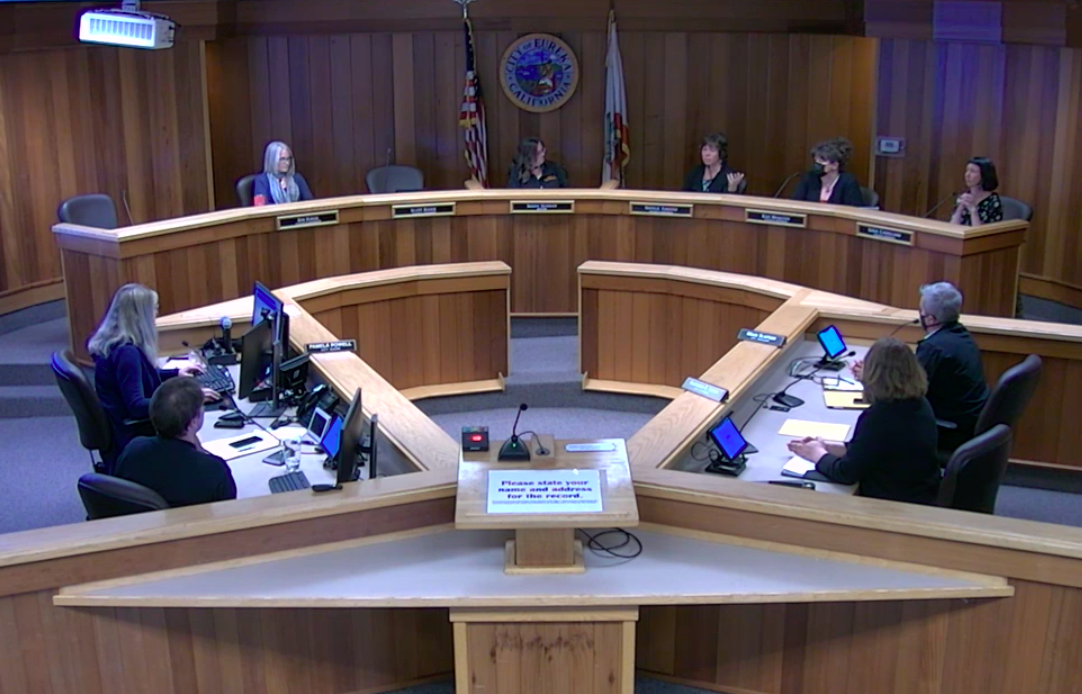
The Eureka City Council convened for a special budget session on Tuesday evening. | Screenshot
###
After two years of significant budget cuts, the City of Eureka is expecting a $1.6 million budget surplus in the upcoming fiscal year. The Eureka City Council convened for a special meeting this week to take a look at the budget proposal for Fiscal Year (FY) 2022-23 and make recommendations as to how the extra cash should be allocated.
“I would point out that [the budget] surplus for Fiscal Year 2022-23 is an estimate,” Lane Millar, the City’s finance director, said during Tuesday’s meeting. “There is no guarantee that this will be what happens at the end of the fiscal year but typically our budgets are pretty close to what we start with, given that there are no pandemics or things of that nature.”
He noted that the $1,598,550 surplus could quickly shrink in certain circumstances. For example, the City will see expense increases later this year due to cost-of-living adjustment (COLA) pay increases. In addition, funds generated from Measure Z “are not guaranteed and could disappear in future years.”
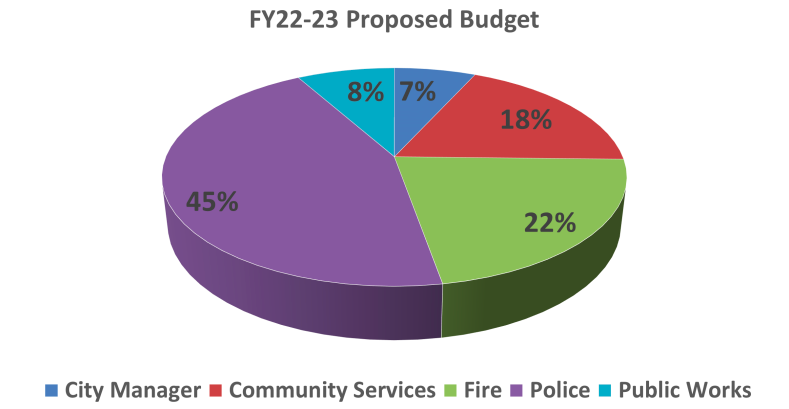
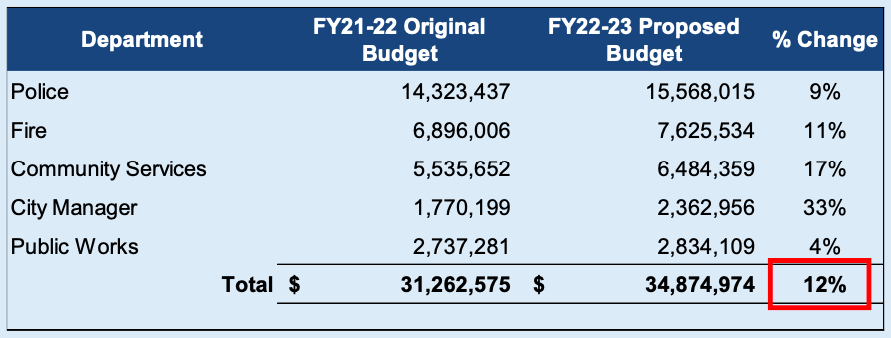
Millar’s presentation focused on expenditures from individual departments within the General Fund, including the Eureka Police Department (EPD), Humboldt Bay Fire (HBF), Community Services, the City Manager’s office and Public Works.
Screenshot
Screenshot
Starting with EPD, Millar noted that the department’s budget is split into two divisions: police and communications/dispatch. Each division is projected to receive a nine percent and a ten percent budget increase, respectively. “Even with those increases, the police department is not seeing a very large increase mainly due to the fact that we’ve seen a lot of turnover,” he said. “When turnover happens you have new people fill positions that usually start at a lower step.”
HBF will likely see an 11% budget increase next year. “The reason why it’s not going up at a higher rate was because we’ve added employees,” Millar continued. “…If you’re the biggest department – like police or fire – and other departments add employees, you’ll actually see the cost allocation line items go down because those costs are being spread out among more people and other departments.
The budget for Community Services – including the Sequoia Park Zoo, park operations, recreation-youth programs and activities, administration, the Adorni Center, harbor operations and recreation-adult programs and activities – has increased “at a higher rate than average” that is being driven primarily by the zoo. Millar largely attributed the 45 percent increase to operational shifts at the zoo following the opening of the Redwood Skywalk.
Public Works has experienced “less growth than the average” and is projected to see a four percent increase next year.
“Public Works has a lot of divisions, but a lot of divisions with smaller budgets overall,” he said. Public Works covers administration, building-code enforcement, the Emergency Operations Center, engineering, stormwater, streets/alley maintenance and traffic/signals. “…We’re seeing people being moved around from one division to the other.”
The City Manager’s divisions – development and Community Access Project for Eureka (CAPE) – are expected to increase by 33 percent. Millar attributed the vast majority of the growth in the department to grant-funded positions.
The main takeaway from the overall budget proposal is that there are no major changes from the current fiscal year and both revenues and expenditures have leveled off, according to Millar. “I think the objective going forward, due to the fact we have a very healthy surplus, is identifying a new reserve objective in order to achieve long-term fiscal sustainability and to avoid cutting services during economic downturns.”
The council discussed the possibility of using a slice of the budget surplus (approximately $75,000) for participatory budgeting and community projects.
“One thing about the participatory budgeting that I love is that it gets people in our community engaged,” said Councilmember Kim Bergel. “It brings forward this pride of ownership and…it really sets a narrative and it sets up an opportunity for people to feel empowered and involved.”
Councilmember Leslie Castellano also expressed her support for participatory budgeting but suggested a more community-initiated approach.
“I know some people gave me feedback, like, if they had a little more [money], they could have done more with a project if they could make their own proposals,” she said. “…I’m glad to see that we have a surplus…and that we’re continuing to stay in a sustainable place.”
Millar said he has focused on building up the City’s reserves to create a bigger cushion to avoid budget cuts in the future. “My long-term goal is to create enough of a cushion where we can withstand even a multi-year downturn and maintain the same level of service.”
Councilmember Natalie Arroyo underscored the importance of “aggressively saving money.”
“I just don’t want to encourage us…to find all these places to spend half a million dollars,” she said. “I would love to see us in a position where we have six months of reserves.”
The council agreed to set a goal to maintain six months of reserves but did not take a vote on the matter.
A video of Tuesday’s budget study session can be found here.
Cal State Raises Issue With Cal Grant Expansion
Mikhail Zinshteyn / Friday, May 27, 2022 @ 8:57 a.m. / Sacramento
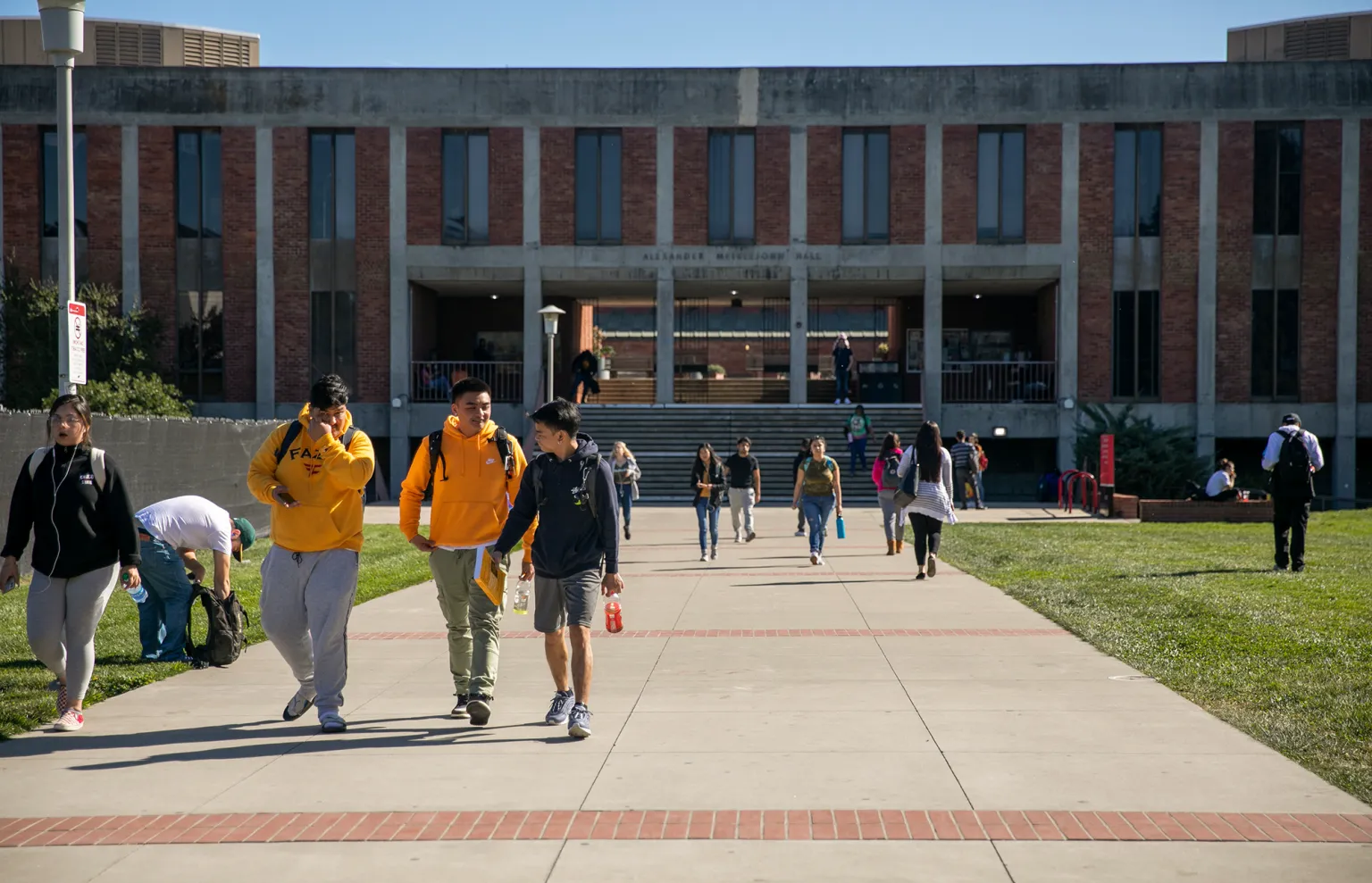
Students walk near Meiklejohn Hall at California State University East Bay on Feb. 25, 2020. Photo by Anne Wernikoff for CalMatters
The campaign to expand free tuition to more low-income California students has been riding a wave of unanimous goodwill, despite its large costs. But the state’s — and nation’s — largest public university system has made public its concern that key trade-offs required for that expansion will be a financial burden for some middle-class students.
Backers of the effort say those concerns are misplaced. How and whether lawmakers choose to respond will affect the fate of tens of thousands of prospective college students in California for years to come.
Officials from the California State University Chancellor’s Office warned the Board of Trustees on Tuesday that while it projects a net increase of nearly 29,000 students overall who’ll receive the free-tuition grant, it would also see a decrease of roughly 39,000 future middle-class students — even as some 68,000 low-income students would be newly eligible for the grant. To be clear, if the Cal Grant expansion occurs as proposed, middle-class students currently receiving the award will continue to do so.
The information wasn’t necessarily new. Supporters of expanding the Cal Grant, the state’s chief financial aid tool that waives tuition or gives cash aid to roughly 500,000 Californians, have been transparent that some students would lose eligibility even as more would gain. But, while it has no formal position on expanding Cal Grant, Cal State’s packaging of the information was an inversion of the dominant narrative so far that Cal Grant expansion is a net win for students.
At issue is Assembly Bill 1746, a bill championed by key lawmakers and a constellation of student advocacy groups. The bill passed the Assembly on Thursday unanimously and is endorsed by the California community college system, whose students would be the major beneficiaries of the bill. If passed and funded, another 150,000 students would get the Cal Grant, a result of the bill doing away with age and time-out-of-high school restrictions for university students and grade requirements for community college students.
But that 150,000 figure is a net gain. Because the bill would lower the income eligibility ceiling, tens of thousands of middle-class students would suddenly be left without the Cal Grant – including the 39,000 Cal State undergraduates. For a family of four, the income ceiling would drop from around $116,000 a year to $73,000, university officials said.
Prominent drivers of the Cal Grant expansion effort argue university systems will have more than enough money from their own financial aid dollars to cover any funding gaps for middle-class students. That’s because by adding more students to the state financial aid program, that frees internal financial aid money for a system like Cal State to cover students who would have previously been eligible for Cal Grants.Sensitivities are high.
Some backers of the Cal Grant expansion viewed this week’s presentation to the Board of Trustees — the governance body of the Cal State system — as unbalanced. The presentation focused too much on who’d lose out under Cal Grant without acknowledging the benefit to lower-income students currently ineligible for the Cal Grant, said Audrey Dow, senior vice president of Campaign for College Opportunity, an advocacy nonprofit in California.Cal Grant expansion within the bill requires more than $300 million annually in state support. It’s a large sum that needs to be negotiated as part of the state budget by June 15 between lawmakers and Gov. Gavin Newsom. Adding to the intrigue, Newsom vetoed a similar expansion of the Cal Grant last year despite unanimous support from the Legislature.
Will Cal State’s concerns with the bill have a negative impact on those budget negotiations? “No,” wrote Assemblymember Jose Medina, a Democrat from Riverside and co-author of the bill. “Our hope is that the (public higher education system) segments will recognize the immense benefit that debt-free college will provide their students and their institutions,” Medina added in a written statement.
Architects of the bill say another financial aid expansion — Middle Class Scholarship 2.0 — will eventually cover that eligibility gap. But that wouldn’t be true until the state commits enough money to fully fund that program, which won’t happen this year. The state this year plans to put a $632 million down payment of the scholarship. Fully funding it — and thereby covering the eligibility gap left by the proposed changes to the Cal Grant — would cost the state an additional $2 billion annually.
“The CSU believes that any modernization of the Cal Grant program should do no harm,” said Eric Bakke, interim assistant vice chancellor for advocacy and state relations at Cal State, during the Trustees meeting Tuesday.Another author of the Cal Grant expansion bill, Assemblymember Kevin McCarty, a Democrat from Sacramento, said in a statement that “Cal Grant reform and expanding the Middle Class Scholarship is the correct pathway to debt-free college in California.” He added that lawmakers will “make both work in tandem, and the very few students who’ll end up not being eligible for the Cal Grant will be supplemented through the Middle Class Scholarship.”
Backers of the Cal Grant expansion say the Cal State system isn’t telling the whole story. The Cal State also operates a $700 million financial aid grant — called the State University Grant — that Cal Grant expansion advocates say could be used to cover the expenses for the middle-class students left out of the bill.“I don’t think that it was a full representation of what the bill can do,” said Isaac Alferos, the outgoing head of the Cal State Student Association, which represents university students and is a key supporter of the Cal Grant expansion bill.Under the Cal Grant expansion plan, Cal State students would receive $83 million more annually than they collectively do now at full implementation, according to data provided by the California Student Aid Commission. That’s even after accounting for the fact that the plan would get rid of a roughly $1,650 non-tuition award to cover portions of living expenses that goes to almost 114,000 Cal Grant recipients at Cal State today.
CalMatters asked the Cal State Chancellor’s Office for a breakdown of how the university’s $700 million grant would fare if the Cal Grant expansion passes, but the system didn’t provide one. Instead it offered a statement from Noelia Gonzalez, the system’s interim director of financial aid. Cal State “does not oppose Assembly Bill 1746,” she wrote, and that “we will certainly revisit our policies” if Cal Grant expansion has an impact on the university grant.
At least one Cal State Trustee homed in on the missing state university grant data. “I would have loved to see more numbers from the presentation that proposes a (State University Grant) plan along with the Cal Grant plan if passed,” said outgoing student Trustee Krystal Raynes in an interview. If there is more pressure on the university grant, the Cal State system could ask the state for more funding, she added.
###
CalMatters.org is a nonprofit, nonpartisan media venture explaining California policies and politics.
Bill Would Allow Lawsuits for Marketing Guns to Kids
Nigel Duara / Friday, May 27, 2022 @ 8:50 a.m. / Sacramento

WEE1 Tactical claims their JR-15 .22 caliber long rifle is 20% smaller than a traditional AR-15. Screenshot via YouTube
The man at the gun show lifted a 2.2 pound rifle and pulled back the stock with an audible “chock,” presenting it to the YouTube segment’s host.
“When we set out to produce a small firearm for children in an AR-looking package, we were pretty sure we needed to have a ‘wow factor’ in the safety area,” Eric Schmid, owner of Wee 1 Tactical, said in a video uploaded in January.
What Utah-based Wee 1 Tactical produced was a smaller model of the AR-15, called the JR-15. Schmid was in Las Vegas in January to promote the smaller weapon, which the company pledges will look and feel “just like Mom and Dad’s gun.”
Schmid demonstrated a safety pin intended to keep the weapon’s trigger locked. He and the host noted that it would likely prevent small children from operating a firearm without their parents present.
“It takes a lot of tension to be able to pull that out,” said host Barret Kendrick.
“Your 12-year-olds are gonna unlock it really quickly,” Schmid replied.
A bill that passed out of the Assembly on Thursday night would make the marketing of firearms to children and those not legally allowed to possess them a civil liability. AB 1594 would allow lawsuits against gun manufacturers based on their marketing, one of the few exemptions to a federal ban on such lawsuits. The bill is now in the hands of the Senate.
Brought by San Francisco Democrat Phil Ting, the bill is an attempt to ensure that gun manufacturers can’t object in state court to lawsuits that target their marketing – an argument Smith & Wesson made in a San Diego court last year.
The proposal is similar to a bill passed last year in New York – one that survived a legal challenge from guns rights advocates in federal court on Wednesday.
“Unfortunately, it seems like not a day goes by before there’s another tragic mass shooting,” Ting said. “We have guns in the hands of the wrong people and we have an industry that takes no responsibility for empowering killers in our community.”
The bill alleges that some gun manufacturers market and sell “increasingly dangerous new products,” from ghost guns to bump stocks, which give them an unfair business advantage over “more responsible competitors.” If passed, the bill would allow the Department of Justice, county attorneys, city attorneys and the public to sue over those practices.
Among the practices singled out in the bill are:
- Manufacturers that produce guns with features “most suitable for assaultive purposes” rather than hunting or self-defense.
- Guns designed, sold or marketed in a way that “foreseeably promotes” their conversion into an illegal weapon, such as turning a semi-automatic weapon into a fully automatic weapon.
- Guns designed, sold or marketed to children or people who are legally prohibited from possessing firearms.
The bill is part of a larger wave of more than a dozen gun control laws proposed by California Democrats ahead of today’s deadline to move bills from their house of origin.
On Wednesday, one day after a man killed at least 21 people with an AR-15 in a shooting at a Texas elementary school, Gov. Gavin Newsom singled out some gun marketing tactics at a press conference rallying support for AB 1594 and other gun control measures.
“You’ve got folks out there manufacturing and marketing an AR-15 for babies. For babies,” Newsom said. “And their logo is a pacifier with the baby AR-15. These are extremists. They need to be called out.”
Newsom seemed to be talking about the JR-15 and Wee 1 Tactical’s logo, which is two skulls with a target in one eye and a pacifier in each mouth. One skull has a mohawk and the other has pigtails.
Lawsuits against gun manufacturers are prohibited by the Protection of Lawful Commerce in Arms Act, a 2005 law that the NRA said at the time was “the most significant piece of pro-gun legislation in twenty years.”

A portion of a WEE1 Tactical press release.
President Joe Biden has said repealing the law is among his administration’s top priorities, though his Justice Department continues to defend the legislation in court.
The federal law allowed for six exceptions in which lawsuits are allowable against gun manufacturers. One of them is for manufacturers who violate state or federal laws governing the marketing or sales of guns.
The marketing exception to the law allowed parents of children killed in the 2012 Sandy Hook Elementary School massacre to successfully sue Remington Arms last year. A state lawsuit in San Diego after a 2019 shooting was allowed to proceed last year on the same basis.
The survivors of the shooting at a San Diego area synagogue argued that Smith & Wesson used marketing “that attracted impulsive young men with military complexes who were particularly likely to be attracted to the unique ability of AR-15 style weapons.”
Smith & Wesson responded that the federal law shielded them from such lawsuits, but a San Diego County Superior Court judge disagreed, citing the marketing exception.
Michael Schwartz, executive director of San Diego County Gun Owners, said the bill and others brought forward by Democrats this session are a threat to gun ownership rights throughout California.
“If fully realized and implemented, it’s an enormous threat to gun rights,” Schwartz said. “There’s no way to stop anyone from using a product illegally. But you wouldn’t sue Ford for someone drinking and driving.”
When it comes to the JR-15, singled out by Newsom, Schwartz said marketing is still directed to the people who can purchase the guns, the parents. And, he said, previous laws around regulating the marketing of age-limited products like tobacco don’t apply to guns.
“I don’t know what the perceived fear is, but I’m not afraid that kids are gonna get addicted to an AR-15,” Schwartz said. “It’s the most popular long gun in the United States because it functions in all kinds of situations.”
###
CalMatters.org is a nonprofit, nonpartisan media venture explaining California policies and politics.


